Recognition: 2 theorem links
· Lean TheoremOptimal non-linear mechanisms for laminar-turbulent transition of a shock-induced separated shear layer
Pith reviewed 2026-05-12 04:21 UTC · model grok-4.3
The pith
Forcing the oblique first Mack mode alone triggers the turbulent cascade in a shock-induced separated shear layer.
A machine-rendered reading of the paper's core claim, the machinery that carries it, and where it could break.
Core claim
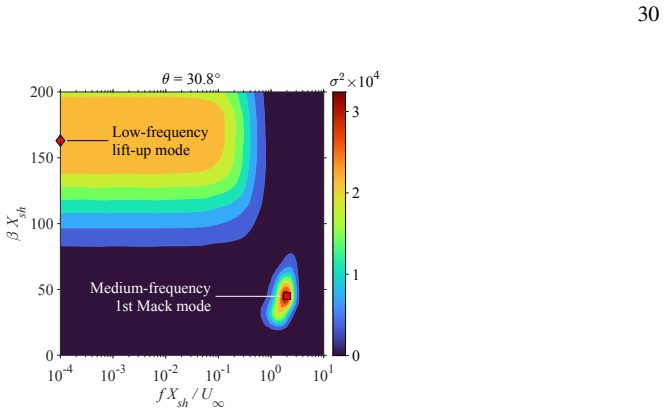
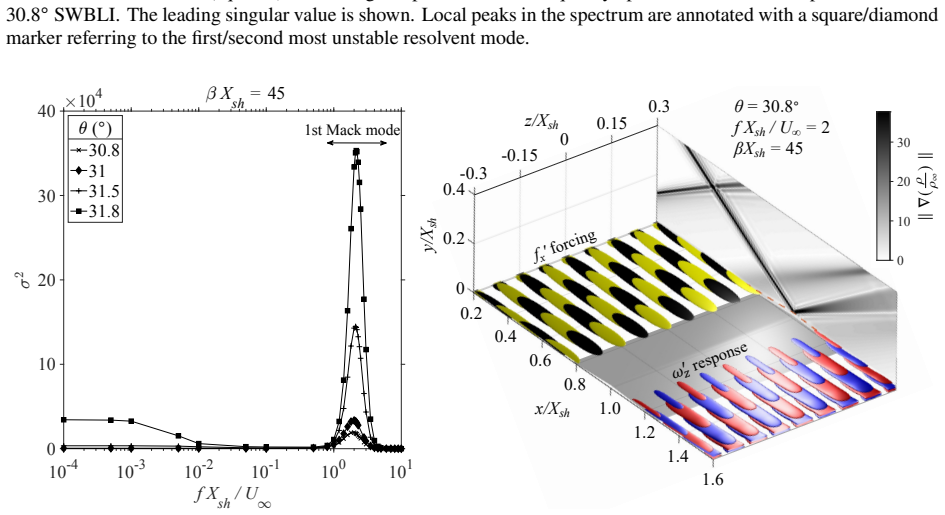
In the globally stable yet convectively unstable Mach 2.15 oblique SWBLI, nonlinear input-output optimisation identifies a four-stage transition pathway: optimal forcing of oblique first Mack mode waves at moderate frequencies leads to nonlinear self-interaction of counter-propagating Mack waves that generates streamwise Gortler-like vortices in the reattachment region; these vortices then lift up streamwise velocity streaks; finally, subharmonic sinuous secondary instability causes streak breakdown. The optimal forcing structures are quasi-invariant across amplitudes from infinitesimal to transitional, demonstrating that excitation of the oblique first Mack mode alone suffices to trigger a
What carries the argument
Nonlinear input-output optimisation framework in the space-time spectral Navier-Stokes formulation that resolves mean-flow distortion and triadic energy transfers with a finite number of harmonics.
Load-bearing premise
The nonlinear frequency-domain approach with a finite number of harmonics is sufficient to capture mean-flow distortion and all relevant triadic energy transfers without requiring additional unresolved modes.
What would settle it
A full direct numerical simulation started from the identified optimal forcing at transitional amplitude that produces neither the four-stage sequence nor the quasi-invariant forcing structures would falsify the central claim.
Figures








read the original abstract
Laminar-turbulent transition in shock wave-boundary-layer interactions (SWBLI) remains a major challenge for hypersonic vehicle design, with implications for drag, heat transfer, and structural loads. Linear optimal perturbation analyses can identify candidate instabilities, but the full route to breakdown in SWBLI requires nonlinear optimisation. Here, we characterise the optimal transition pathway in a globally stable yet convectively unstable Mach 2.15 oblique SWBLI using a nonlinear input-output optimisation framework based on the space-time spectral Navier-Stokes formulation of Poulain et al. (Comput. Fluids, 2024). The nonlinear frequency-domain approach captures mean-flow distortion, resolves triadic energy transfers, and extracts intrinsic nonlinear stresses that activate additional instability mechanisms. We identify a four-stage pathway: (1) optimal forcing of oblique first Mack mode waves at moderate frequencies; (2) nonlinear self-interaction of counter-propagating Mack waves, generating streamwise Gortler-like vortices in the reattachment region where streamline curvature peaks; (3) lift-up of streamwise velocity streaks by these vortices; and (4) subharmonic sinuous secondary instability leading to streak breakdown. Optimisation across forcing amplitudes from infinitesimal to transitional levels yields quasi-invariant optimal forcing structures, showing that exciting the oblique first Mack mode alone can trigger the turbulent cascade. Parametric studies over frequency-wavenumber space and forcing configurations confirm this preferential pathway. By resolving nonlinear energy transfers with a finite number of harmonics, this work provides a tractable framework for transition prediction and control strategy development in high-speed separated flows, bridging linear stability theory and fully turbulent simulation.
Editorial analysis
A structured set of objections, weighed in public.
Referee Report
Summary. The manuscript develops a nonlinear input-output optimization framework based on the space-time spectral Navier-Stokes formulation to identify the optimal forcing for laminar-turbulent transition in a Mach 2.15 oblique shock-wave/boundary-layer interaction. It reports a four-stage pathway consisting of oblique first Mack mode excitation, nonlinear self-interaction generating Gortler-like vortices near reattachment, lift-up of streamwise streaks, and subharmonic sinuous secondary instability leading to breakdown. The central result is that optimal forcing structures remain quasi-invariant across amplitudes from the linear to transitional regime, implying that excitation of the oblique first Mack mode alone suffices to trigger the full cascade.
Significance. If the reported invariance and pathway hold under validation, the work supplies a computationally tractable nonlinear optimization tool that bridges linear stability theory and DNS for high-speed separated flows. This could inform transition prediction and control strategies in hypersonic vehicle design, where SWBLI effects on drag and heating are critical. The extraction of intrinsic nonlinear stresses via finite-harmonic resolution is a methodological strength.
major comments (2)
- [Numerical formulation and results sections] The claim that optimal forcings are quasi-invariant from infinitesimal to transitional amplitudes (abstract) and that the oblique first Mack mode alone triggers the cascade rests on the finite-harmonic truncation fully capturing mean-flow distortion and all triadic transfers. No convergence study with respect to the number of retained harmonics is presented, which is load-bearing because unresolved higher-order interactions at transitional amplitudes could alter the generated Gortler-like vortices, streak breakdown, and thus the extracted invariance.
- [Results and discussion] No quantitative validation data, error bars, or direct comparison against DNS or experiments are supplied to support the four-stage pathway or the reported optimal structures (abstract). This is critical for the central claim, as the nonlinear optimization outputs must be shown to reproduce known transition features in the same SWBLI configuration before the quasi-invariance can be accepted as physical rather than numerical.
minor comments (2)
- [Abstract] The abstract and introduction would benefit from explicit statements of the retained harmonic count and the frequency-wavenumber range explored in the parametric studies.
- [Method] Notation for the nonlinear stresses and the definition of the optimization objective could be clarified with a dedicated equation block to aid reproducibility.
Simulated Author's Rebuttal
We are grateful to the referee for their detailed and constructive feedback on our manuscript. Their comments have helped us identify areas for improvement. We address each major comment below, indicating the revisions we plan to make.
read point-by-point responses
-
Referee: [Numerical formulation and results sections] The claim that optimal forcings are quasi-invariant from infinitesimal to transitional amplitudes (abstract) and that the oblique first Mack mode alone triggers the cascade rests on the finite-harmonic truncation fully capturing mean-flow distortion and all triadic transfers. No convergence study with respect to the number of retained harmonics is presented, which is load-bearing because unresolved higher-order interactions at transitional amplitudes could alter the generated Gortler-like vortices, streak breakdown, and thus the extracted invariance.
Authors: We thank the referee for this important observation. The finite-harmonic approach is designed to capture the essential nonlinear interactions up to the point where higher harmonics contribute negligibly to the energy budget, as monitored through spectral decay in our simulations. However, we agree that an explicit convergence study is necessary to rigorously support the quasi-invariance of the optimal forcings. In the revised manuscript, we will add a dedicated subsection or appendix presenting results with varying numbers of retained harmonics (e.g., increasing from the current resolution to higher), showing that the optimal forcing structures, the generated Gortler-like vortices, and the subsequent stages remain largely unchanged. This will confirm that the truncation does not affect the central conclusions. revision: yes
-
Referee: [Results and discussion] No quantitative validation data, error bars, or direct comparison against DNS or experiments are supplied to support the four-stage pathway or the reported optimal structures (abstract). This is critical for the central claim, as the nonlinear optimization outputs must be shown to reproduce known transition features in the same SWBLI configuration before the quasi-invariance can be accepted as physical rather than numerical.
Authors: The referee raises a valid point regarding validation. Our study introduces a new nonlinear optimization framework and applies it to reveal the transition pathway, with the structures identified being consistent with previously reported mechanisms in SWBLI literature, such as the role of oblique Mack modes and streak instabilities. However, we did not include direct quantitative comparisons or error bars from DNS/experiments in this work, as the focus was on the methodological development and the identification of the optimal pathway. We will revise the discussion section to provide more explicit qualitative comparisons to existing DNS and experimental data on oblique SWBLI transition at similar Mach numbers, citing specific features like the location of Gortler vortices and streak breakdown. A full quantitative validation would require dedicated DNS runs matching our exact configuration, which we note as a valuable direction for future work but beyond the present scope. We believe the current results still provide valuable insight as a computationally efficient alternative to full DNS for exploring transition routes. revision: partial
Circularity Check
No circularity: optimization outputs are independent of inputs
full rationale
The derivation applies the standard Navier-Stokes equations within a space-time spectral formulation (cited to Poulain et al. 2024, non-overlapping authors) to perform nonlinear input-output optimization. The reported quasi-invariant optimal forcings, four-stage pathway, and Mack-mode sufficiency are computed results from varying forcing amplitudes, not definitions or fits that presuppose the outcomes. No self-definitional loops, fitted inputs renamed as predictions, or load-bearing self-citations appear in the chain; the framework remains externally grounded in the governing equations and produces falsifiable structures.
Axiom & Free-Parameter Ledger
axioms (2)
- domain assumption The space-time spectral Navier-Stokes formulation of Poulain et al. (2024) accurately represents the compressible flow dynamics for the chosen truncation.
- domain assumption The oblique SWBLI at Mach 2.15 is globally stable yet convectively unstable.
Lean theorems connected to this paper
-
IndisputableMonolith/Cost/FunctionalEquation.leanwashburn_uniqueness_aczel unclearnonlinear frequency-domain approach captures mean-flow distortion, resolves triadic energy transfers, and extracts intrinsic nonlinear stresses
-
IndisputableMonolith/Foundation/RealityFromDistinction.leanreality_from_one_distinction unclearfour-stage pathway: optimal forcing of oblique first Mack mode waves... nonlinear self-interaction... Görtler-like vortices... streak breakdown
Reference graph
Works this paper leans on
-
[1]
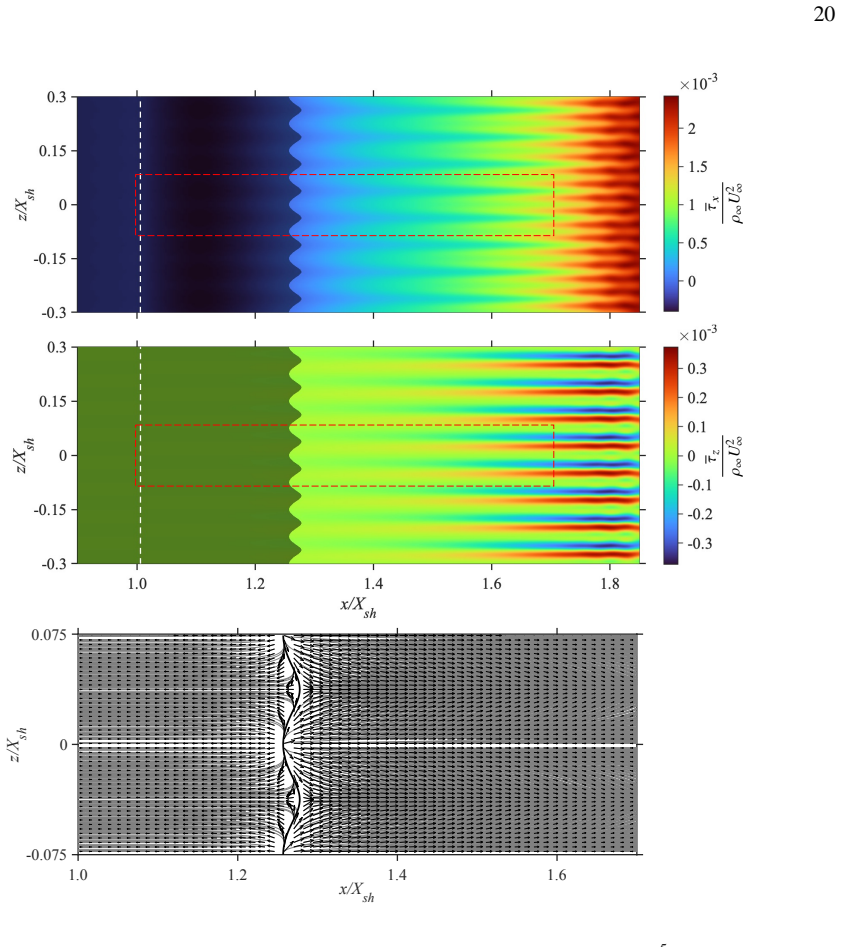
The𝑢= 0isosurfacerepresentingthe3Dstructureofthebubbleshowsthatspanwisecorrugationsappear on the rear side of the separation zone, downstream of the mean bubble apex, matching the location where the streamwise vortices are originally seeded by the the quadratic non-linearity. In contrast, the front side is essentially 2D with no visible spanwise modulatio...
-
[2]
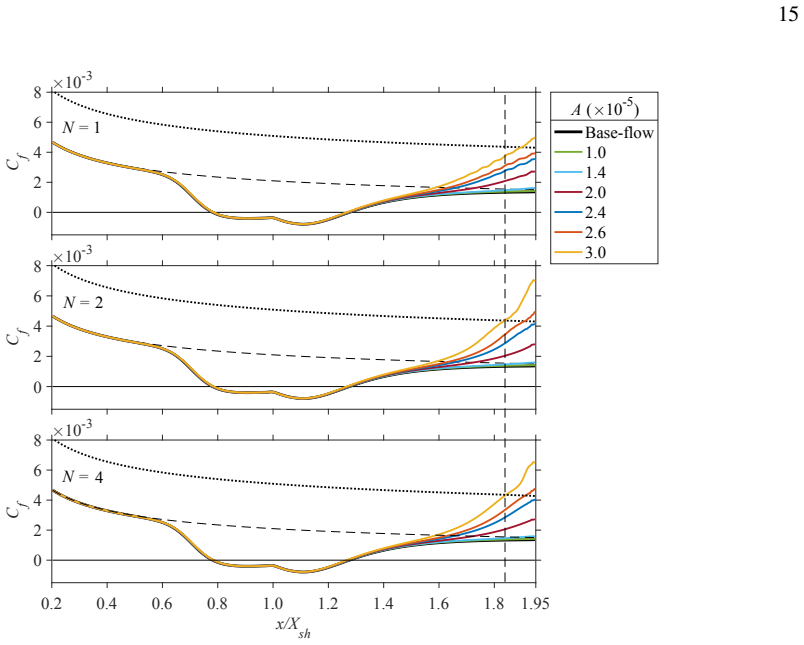
Oblique wave-like disturbances optimally forcing the shear layer upstream of separation lead to the amplification of the first Mack mode through the receptivity process at the selective frequency range 𝑓 𝑋𝑠ℎ∕𝑈∞ ∼ 10 0, a process well described by linear resolvent at small disturbance amplitude. 25 TurbulentLaminar Cf -10246810⨉10-3 0 0.2 0.4-0.3-0.150.150...
-
[3]
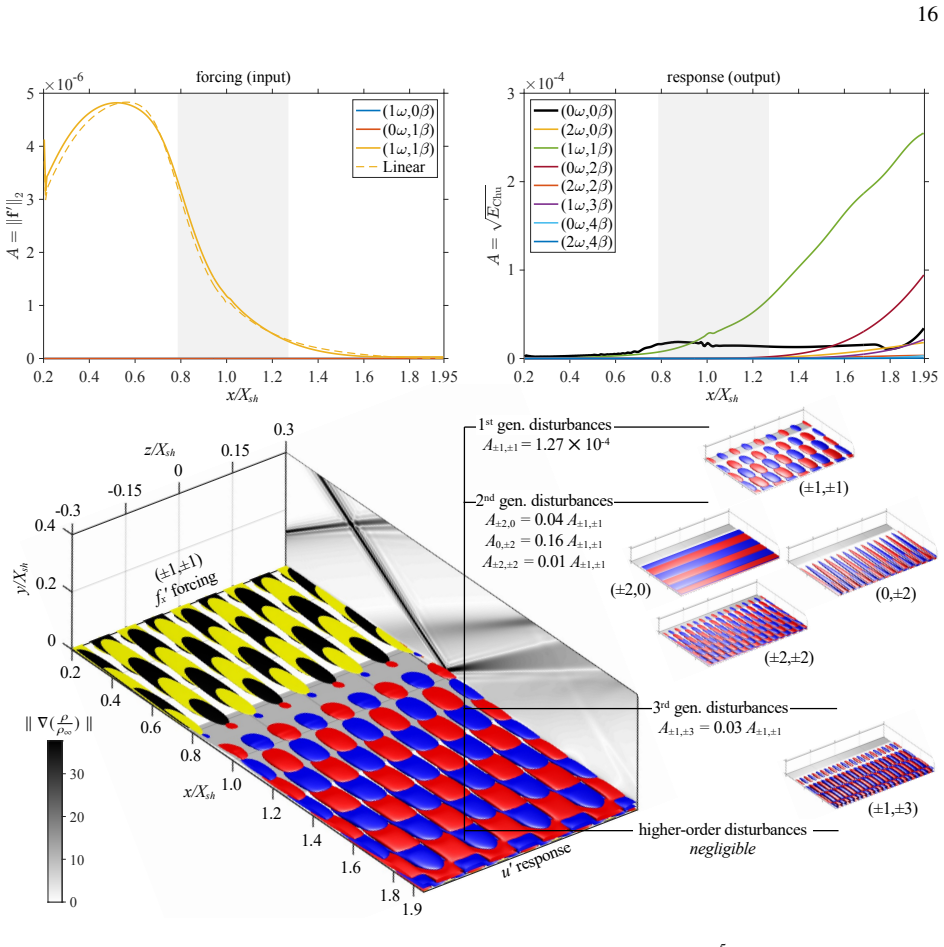
At finite amplitude, the non-linear (quadratic) self-interaction of (1,1) Mack waves seeds (0,2) streamwiseGörtler-likevorticesinthereattachmentregionwherethestreamlinecurvatureissufficient to support unstable Görtler modes
-
[4]
Velocity (0,2) streaks are generated by streamwise vortices due to the imparted upwash/downwash effect
-
[5]
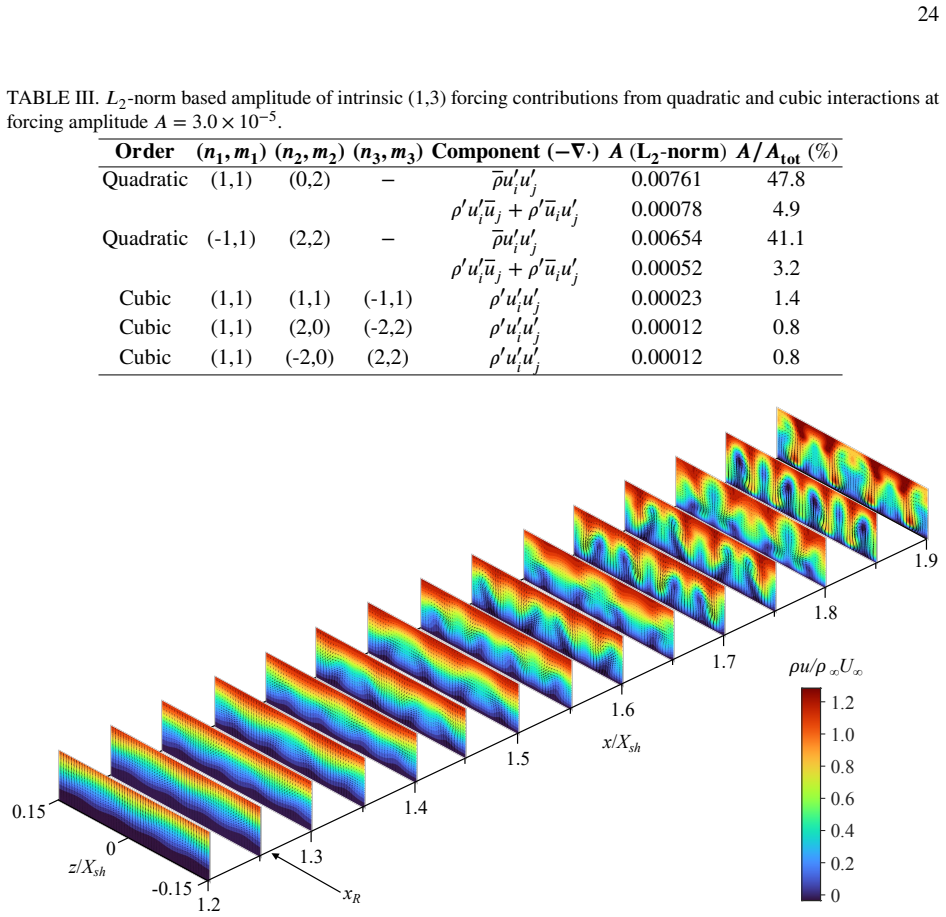
Asecondaryinstabilityofthestreaksofsub-harmonicsinuoustypedrivenbythe(1,3)modeinduces spanwise meandering motions on the low-speed streaks –a process that is predominantly seeded by quadratic interactions between first and second generation modes
-
[6]
The mean skin friction rises sharply towards the typical turbulent values
In the late transitional stages prior to breakdown, coherentΛ-vortices appear and later disintegrate to small-scale structures, an event that is typically observed in canonical transitional boundary layer flows. The mean skin friction rises sharply towards the typical turbulent values. Thepresentresearchdemonstratedthatitissufficienttoexciteobliquewavesvi...
-
[7]
Global eigenvalue problem We introduce the Fourier ansatz for the linear perturbations, 𝐪′(𝑥, 𝑦, 𝑧, 𝑡) = ̂𝐪(𝑥, 𝑦) exp (i𝛽𝑧−𝜆𝑡 ) +c.c.,(B4) where𝛽is the real spanwise wavenumber and𝜆=𝜎+i𝜔is the complex eigenvalue associated with the spatial eigenmode ̂𝐪(𝑥, 𝑦). Injecting eq. (B4) into eq. (B3), we derive the global eigenvalue problem, −𝜆 ̂𝐪=𝐉 ̂𝐪,(B5) whose ...
-
[8]
Flows of this kind are called amplifier flows [105]
Resolvent analysis Even in globally stable fluid systems such as boundary layers, disturbances can grow in time due to the non-normality of the linearized N-S operator, in particular, stemming from the shear in the flow. Flows of this kind are called amplifier flows [105]. In such cases, all the eigenvalues of the Jacobian operator decay intime,howeverthe...
-
[9]
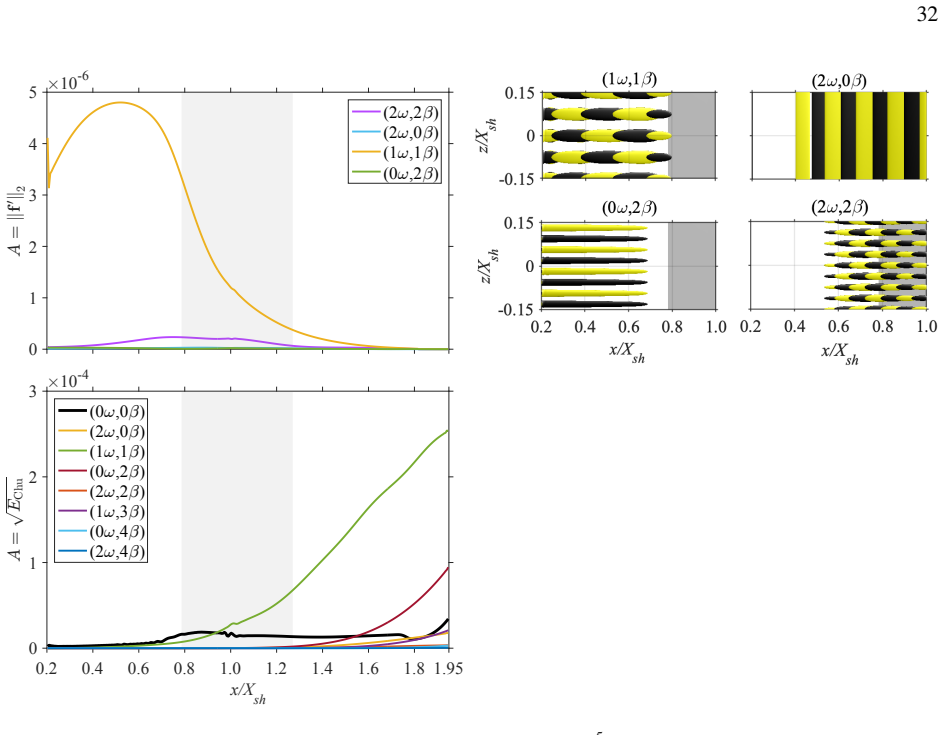
Low-frequency (𝑆𝑡𝐿sep ∼ 10 −4-10−2): bubble breathing mode and streaks, 32 0 1 2 3 4 5A=kf0k2 #10-6 (2!,2-) (2!,0-) (1!,1-) (0!,2-) 0.20.40.60.81.01.21.41.61.81.95 x/Xsh 0 1 2 3A=pEChu #10-4 (0!,0-) (2!,0-) (1!,1-) (0!,2-) (2!,2-) (1!,3-) (0!,4-) (2!,4-) FIG.17. Optimalforcing/responsesolutionatlowamplitude𝐴= 0.5×10 −5computedfromthe𝑁= 2, 𝑀= 4system with ...
-
[10]
Medium-frequency (𝑆𝑡𝐿sep ∼ 10 −1-100): shear layer modes (Mack, Kelvin-Helmholtz instabilities), and
-
[11]
Appendix C: Parametric studies
High-frequency (𝑆𝑡𝐿sep ∼ 10 1): free-stream turbulent fluctuations (only in turbulent SWBLIs). Appendix C: Parametric studies
-
[12]
Super-harmonic forcing We explore the super-harmonic forcing configuration to see if the route to turbulence of the𝜃= 30.8◦ SWBLI is affected. The set-up is the same as in §IV, but we also extend the optimization to the forcing harmonics(±2𝜔,0𝛽),(±2𝜔,±1𝛽),(±1𝜔,±2𝛽),(0𝜔,±2𝛽)and(±2𝜔,±2𝛽). Infigure17weplotthesolutionatlowamplitude𝐴= 0.5 × 10 −5 andobservetha...
-
[13]
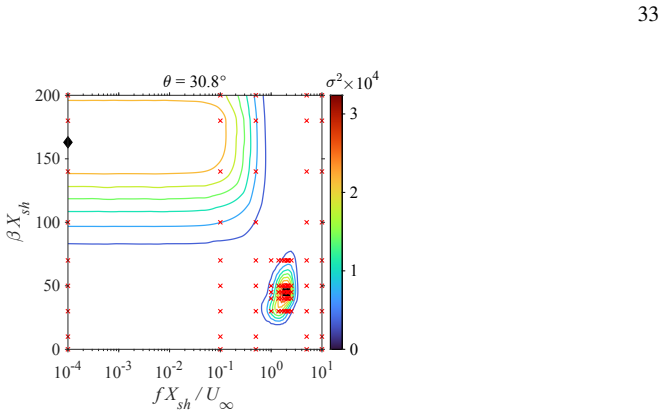
Frequency-spanwise wavenumber scan The analysis performed in §IV assumes that forcing the flow at the most unstable frequency-spanwise wavenumber of the linear 1st Mack mode yields maximum increase in the drag. Because the non-linear behavior of the fluid system is initially governed by a substantially linear primary instability mechanism up to the reatta...
-
[14]
H. Babinsky and J. K. Harvey,Shock Wave-Boundary-Layer Interactions, Cambridge Aerospace Series (Cambridge University Press, 2011)
work page 2011
-
[15]
A. J. Smits and J.-P. Dussauge,Turbulent Shear Layers in Supersonic Flow(Springer New York, NY, 2006)
work page 2006
-
[16]
N. T. Clemens and V. Narayanaswamy, Low-frequency unsteadiness of shock wave/turbulent boundary layer interactions, Annual Review of Fluid Mechanics46, 469 (2014)
work page 2014
-
[17]
S. Piponniau, J.-P. Dussauge, J.-F. Debieve, and P. Dupont, A simple model for low-frequency unsteadiness in shock-induced separation, Journal of Fluid Mechanics629, 87 (2009)
work page 2009
-
[18]
S. Pirozzoli, M. Bernardini, and F. Grasso, Direct numerical simulation of transonic shock/boundary layer interaction under conditions of incipient separation, Journal of Fluid Mechanics657, 361–393 (2010)
work page 2010
-
[19]
E. Touber and N. D. Sandham, Low-order stochastic modelling of low-frequency motions in reflected shock- wave/boundary-layer interactions, Journal of Fluid Mechanics671, 417 (2011)
work page 2011
-
[20]
N. Gomez-Vega, M. Gramola, and P. J. K. Bruce, Oblique shock control with steady flexible panels, AIAA Journal58, 2109 (2020). 38
work page 2020
-
[21]
N. D. Sandham, E. Schülein, A. Wagner, S. Willems, and J. Steelant, Transitional shock-wave/boundary-layer interactions in hypersonic flow, Journal of Fluid Mechanics752, 349–382 (2014)
work page 2014
-
[22]
F. Y. Zuo, A. Memmolo, G. P. Huang, and S. Pirozzoli, Direct numerical simulation of conical shock wave–turbulent boundary layer interaction, Journal of Fluid Mechanics877, 167–195 (2019)
work page 2019
-
[23]
S.Cao,J.Hao,I.Klioutchnikov,C.Y.Wen,H.Olivier,andK.A.Heufer,Transitiontoturbulenceinhypersonic flow over a compression ramp due to intrinsic instability, Journal of Fluid Mechanics941, A8 (2022)
work page 2022
-
[24]
J.-C. Robinet, Bifurcations in shock-wave/laminar-boundary-layer interaction: global instability approach, Journal of Fluid Mechanics579, 85 (2007)
work page 2007
-
[25]
A. Sansica, N. D. Sandham, and Z. Hu, Instability and low-frequency unsteadiness in a shock-induced laminar separation bubble, Journal of Fluid Mechanics798, 5–26 (2016)
work page 2016
-
[26]
B. Bugeat, J.-C. Robinet, J.-C. Chassaing, and P. Sagaut, Low-frequency resolvent analysis of the laminar oblique shock wave/boundary layer interaction, Journal of Fluid Mechanics942, A43 (2022)
work page 2022
-
[27]
A. Dwivedi, G. S. Sidharth, J. W. Nichols, G. V. Candler, and M. R. Jovanović, Reattachment streaks in hypersoniccompressionrampflow: aninput–outputanalysis,JournalofFluidMechanics880,113–135(2019)
work page 2019
-
[28]
J.Fang,A.A.Zheltovodov,Y.Yao,C.Moulinec,andD.R.Emerson,Ontheturbulenceamplificationinshock- wave/turbulent boundary layer interaction, Journal of Fluid Mechanics897, A32 (2020)
work page 2020
-
[29]
M.Lugrin,S.Beneddine,C.Leclercq,E.Garnier,andR.Bur,Transitionscenarioinhypersonicaxisymmetrical compression ramp flow, Journal of Fluid Mechanics907, A6 (2021)
work page 2021
-
[30]
S.Cao,J.Hao,I.Klioutchnikov,H.Olivier,andC.Y.Wen,Unsteadyeffectsinahypersoniccompressionramp flow with laminar separation, Journal of Fluid Mechanics912, A3 (2021)
work page 2021
-
[31]
S.S.Sawant,V.Theofilis,andD.A.Levin,Onthesynchronisationofthree-dimensionalshocklayerandlaminar separation bubble instabilities in hypersonic flow over a double wedge, Journal of Fluid Mechanics941, A7 (2022)
work page 2022
-
[32]
A.Dwivedi, G.Sidharth,andM.R.Jovanović,Obliquetransitioninhypersonicdouble-wedgeflow,Journalof Fluid Mechanics948, A37 (2022)
work page 2022
-
[33]
J. Hao, On the low-frequency unsteadiness in shock wave–turbulent boundary layer interactions, Journal of Fluid Mechanics971, A28 (2023)
work page 2023
-
[34]
Z. Song and J. Hao, Instabilities in shock-wave–boundary-layer interactions at mach 6, Journal of Fluid Mechanics1019, A28 (2025)
work page 2025
-
[35]
F.Guiho,F.Alizard,andJ.-C.Robinet,Instabilitiesinobliqueshockwave/laminarboundary-layerinteractions, Journal of Fluid Mechanics789, 1–35 (2016)
work page 2016
-
[36]
S. GS, A. Dwivedi, G. V. Candler, and J. W. Nichols, Onset of three-dimensionality in supersonic flow over a slender double wedge, Physical Review Fluids3, 093901 (2018)
work page 2018
-
[37]
Z.SongandJ.Hao,Globalinstabilityoftheinteractionbetweenanobliqueshockandalaminarboundarylayer, Physics of Fluids35, 084121 (2023)
work page 2023
-
[38]
D. V. Gaitonde, Progress in shock wave/boundary layer interactions, Progress in Aerospace Sciences72, 80 (2015)
work page 2015
-
[39]
P. K. Rabey, S. P. Jammy, P. J. K. Bruce, and N. D. Sandham, Two-dimensional unsteadiness map of oblique shock wave/boundary layer interaction with sidewalls, Journal of Fluid Mechanics871, R4 (2019)
work page 2019
-
[40]
J. A. S. Threadgill and P. J. K. Bruce, Unsteady flow features across different shock/boundary-layer interaction configurations, AIAA Journal58, 3063 (2020)
work page 2020
-
[41]
N.Hildebrand,A.Dwivedi,J.W.Nichols,M.R.Jovanović,andG.V.Candler,Simulationandstabilityanalysis of oblique shock-wave/boundary-layer interactions at mach 5.92, Physical Review Fluids3(2018)
work page 2018
-
[42]
D. Khotyanovsky, A. Kudryavtsev, and A. Shershnev, Numerical study of the interaction of the supersonic flat-plate boundary layer with an oblique incident shock, AIP Conference Proceedings2125, 030032 (2019)
work page 2019
-
[43]
A. Dwivedi, N. Hildebrand, J. W. Nichols, G. V. Candler, and M. R. Jovanović, Transient growth analysis of oblique shock-wave/boundary-layer interactions at mach 5.92, Physical Review Fluids5, 063904 (2020)
work page 2020
- [44]
-
[45]
F.Li,M.Choudhari,andP.Paredes,SecondaryinstabilityofGörtlervorticesinhypersonicboundarylayerover an axisymmetric configuration, Theoretical and Computational Fluid Dynamics36, 205–235 (2022)
work page 2022
-
[46]
J. Kuehl and P. Paredes, Görtler modified mack-modes on a hypersonic flared cone, in54th AIAA Aerospace Sciences Meeting(2016)
work page 2016
-
[47]
A. Dwivedi, C. J. Broslawski, G. V. Candler, and R. D. Bowersox, Three-dimensionality in shock/boundary layer interactions: a numerical and experimental investigation, inAIAA AVIATION 2020 FORUM(American 39 Institute of Aeronautics and Astronautics, 2020)
work page 2020
-
[48]
M.Mauriello, P.K.Sharma, L.Larchevêque,andN.Sandham,Roleofnonlinearitiesinducedbydeterministic forcing in the low-frequency dynamics of transitional shock wave/boundary layer interaction, Journal of Fluid Mechanics1016, A6 (2025)
work page 2025
-
[49]
M. R. Jovanović and B. Bamieh, Componentwise energy amplification in channel flows, Journal of Fluid Mechanics534, 145 (2005)
work page 2005
-
[50]
D. Sipp and O. Marquet, Characterization of noise amplifiers with global singular modes: the case of the leading-edge flat-plate boundary layer, Theoretical and Computational Fluid Dynamics27, 617 (2013)
work page 2013
-
[51]
Y. Tokura and H. Maekwa, Spatial dns of an isothermal flat plate supersonic turbulent boundary layer with/out impinging shock wave, Journal of Fluid Science and Technology6, 30 (2011)
work page 2011
-
[52]
F.Tong,Z.Tang,C.Yu,X.Zhu,andX.Li,Numericalanalysisofshockwaveandsupersonicturbulentboundary interaction between adiabatic and cold walls, Journal of Turbulence18, 569 (2017)
work page 2017
-
[53]
J. Duan, X. Li, X. Li, and H. Liu, Direct numerical simulation of a supersonic turbulent boundary layer over a compression–decompression corner, Physics of Fluids33, 065111 (2021)
work page 2021
-
[54]
X. Li, D. Fu, Y. Ma, and X. Liang, Direct numerical simulation of shock/turbulent boundary layer interaction in a supersonic compression ramp, Science China Physics, Mechanics & Astronomy53, 1651–1658 (2010)
work page 2010
-
[55]
J. M. Floryan and W. S. Saric, Stability of Görtler vortices in boundary layers, AIAA Journal20, 316 (1982)
work page 1982
-
[56]
P. Hall and M. Malik, The growth of Görtler vortices in compressible boundary layers, Journal of Engineering Mathematics23, 239–251 (1989)
work page 1989
-
[57]
J. M. Floryan, On the Görtler instability of boundary layers, Progress in Aerospace Sciences28, 235 (1991)
work page 1991
-
[58]
L.-U. Schrader, L. Brandt, and T. A. Zaki, Receptivity, instability and breakdown of Görtler flow, Journal of Fluid Mechanics682, 362–396 (2011)
work page 2011
-
[59]
A. Roghelia, H. Olivier, I. Egorov, and P. Chuvakhov, Experimental investigation of Görtler vortices in hypersonic ramp flows, Experiments in Fluids58, 139 (2017)
work page 2017
-
[60]
J.Ren,SecondaryInstabilitiesofGörtlerVorticesinHigh-SpeedBoundaryLayers(SpringerSingapore,2018)
work page 2018
- [61]
-
[62]
G. M. D. Currao, R. Choudhury, S. L. Gai, A. J. Neely, and D. R. Buttsworth, Hypersonic transitional shock- wave–boundary-layer interaction on a flat plate, AIAA Journal58, 814 (2020)
work page 2020
-
[63]
H. Görtler, Instabilität laminarer grenzschichten an konkaven wänden gegenüber gewissen dreidimensionalen störungen, Zamm-zeitschrift Fur Angewandte Mathematik Und Mechanik21, 250 (1941)
work page 1941
-
[64]
W. S. Saric, Görtler vortices, Annual Review of Fluid Mechanics26, 379 (1994)
work page 1994
-
[65]
M. Mauriello, L. Larchevêque, and P. Dupont, Non-linearities in the low-frequency dynamics of transitional shock wave / boundary layer interactions, in56th 3AF International Conference on Applied Aerodynamics (Toulouse, France, 2022)
work page 2022
-
[66]
I. Ben Hassan Saïdi, S. Wang, G. Fournier, C. Tenaud, and J.-C. Robinet, Modal analysis of the triadic interactionsinthedynamicsofatransitionalshockwaveboundarylayerinteraction,JournalofFluidMechanics 1009, A43 (2025)
work page 2025
-
[67]
B.S.VenkatachariandC.L.Chang,Investigationoftransitionalshock-wave/boundarylayerinteractionsusing directnumericalsimulations,inAIAAScitech2019Forum(AmericanInstituteofAeronauticsandAstronautics, 2019)
work page 2019
- [68]
-
[69]
C. Caillaud, A. Scholten, J. Kuehl, P. Paredes, M. Lugrin, S. Esquieu, F. Li, M. M. Choudhari, E. K. Benitez, M.P.Borg,Z.A.McDaniel,andJ.S.Jewell,Separationandtransitiononacone-cylinder-flare: Computational investigations, AIAA Journal63, 2615 (2025)
work page 2025
- [70]
-
[71]
R.H.M.Giepman,F.F.J.Schrijer,andB.W.vanOudheusden,Aparametricstudyoflaminarandtransitional oblique shock wave reflections, Journal of Fluid Mechanics844, 187–215 (2018)
work page 2018
-
[72]
Y. Jiao, Z. Ma, L. Xue, C. Wang, J. Chen, and K. Cheng, Experimental study on the heat flux of transitional shock wave–boundary layer interaction at mach 6, Acta Astronautica219, 353 (2024)
work page 2024
-
[73]
S. Cherubini, P. De Palma, J.-C. Robinet, and A. Bottaro, The minimal seed of turbulent transition in the boundary layer, Journal of Fluid Mechanics689, 221–253 (2011)
work page 2011
-
[74]
C. C. T. Pringle, A. P. Willis, and R. R. Kerswell, Minimal seeds for shear flow turbulence: using nonlinear 40 transient growth to touch the edge of chaos, Journal of Fluid Mechanics702, 415–443 (2012)
work page 2012
- [75]
-
[76]
F. Savarino, D. Sipp, and G. Rigas, Optimal transitional mechanisms of incompressible separated shear layers subject to external disturbances, Journal of Fluid Mechanics1016, A43 (2025)
work page 2025
-
[77]
A. Poulain, C. Content, A. Schioppa, P. Nibourel, G. Rigas, and D. Sipp, Adjoint-based optimisation of time- and span-periodic flow fields with space-time spectral method: Application to non-linear instabilities in compressible boundary layer flows, Computers & Fluids282, 106386 (2024)
work page 2024
-
[78]
W. Sutherland, Lii. the viscosity of gases and molecular force, The London, Edinburgh, and Dublin Philosophical Magazine and Journal of Science36, 507 (1893)
-
[79]
J.Sierra-Ausin,V.Citro,F.Giannetti,andD.Fabre,Efficientcomputationoftime-periodiccompressibleflows with spectral techniques, Computer Methods in Applied Mechanics and Engineering393, 114736 (2022)
work page 2022
-
[80]
A. Gopinath and A. Jameson, Time spectral method for periodic unsteady computations over two-and three- dimensional bodies, in43rd AIAA aerospace sciences meeting and exhibit(2005) p. 1220
work page 2005
discussion (0)
Sign in with ORCID, Apple, or X to comment. Anyone can read and Pith papers without signing in.