Recognition: 2 theorem links
· Lean TheoremA minimization theorem for the Koide ratio and its Standard Model calibration
Pith reviewed 2026-05-12 03:07 UTC · model grok-4.3
The pith
Any positive mass set with Koide ratio Q0 reaches a unique minimum of Q0/(1+Q0) when extended by one optimally chosen mass.
A machine-rendered reading of the paper's core claim, the machinery that carries it, and where it could break.
Core claim
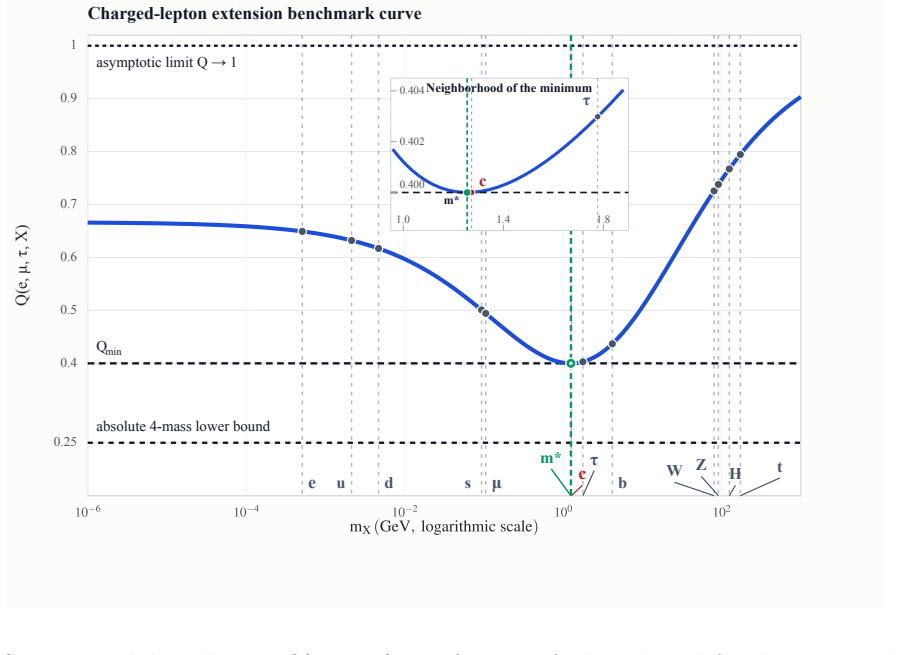
For any positive mass set with Koide ratio Q0, the one-particle extension Q(m1,…,mN,x) has a unique global minimum Qmin=Q0/(1+Q0) at m*=[(∑mi)/(∑√mi)]2. For the measured charged leptons this yields m*ℓ=1.25534(16) GeV and Q4,min exp=0.3999978(43); in the ideal Koide limit QℓK=2/3 the minimum is exactly 2/5. In effective-participant language Neff≡1/Q the optimal one-particle extension increases Neff by one. The one-particle Neff profile is exactly Lorentzian in a dimensionless share-mismatch coordinate u.
What carries the argument
The one-particle extension Q(m1,…,mN,x) of the Koide ratio Q=(∑√mi)2/∑mi, which reaches its unique global minimum when the added mass equals [(sum of original masses) divided by (sum of their square roots)] squared.
Load-bearing premise
The Koide ratio is defined in the standard way using sums of masses and sums of square roots of masses, all masses are positive real numbers, and the extension is formed by adding exactly one new mass x.
What would settle it
A direct computation showing that the extended Koide ratio does not attain its claimed minimum value at m* or that the minimum is not unique when all masses remain positive.
Figures

read the original abstract
The charged-lepton Koide relation remains a striking empirical regularity in Standard-Model flavor data. We prove that for any positive mass set with Koide ratio $Q_0$, the one-particle extension $Q(m_1,\ldots,m_N,x)$ has a unique global minimum $Q_\text{min}=Q_0/(1+Q_0)$ at $m^*=\bigl[(\sum_i m_i)/(\sum_i \sqrt{m_i})\bigr]^2$. This exact kinematic result defines a unique extension benchmark. For the measured charged leptons it gives $m_*^\ell = 1.255\,34(16)\,\text{GeV}$ and $Q_{4,\min}^{\mathrm{exp}} = 0.399\,997\,8(43)$; in the ideal Koide limit $Q_\ell^{\mathrm{K}}=2/3$, the corresponding minimum is exactly $2/5$. In the effective-participant language $N_{\mathrm{eff}}\equiv 1/Q$, the optimal one-particle extension increases $N_{\mathrm{eff}}$ by one, while the equal-$k$ multiplet extension increases it by $k$. The one-particle $N_{\mathrm{eff}}$ profile is exactly Lorentzian in a dimensionless share-mismatch coordinate $u$, which we interpret kinematically rather than dynamically. Using charged-lepton pole masses with the PDG~2024 own-scale $\overline{\text{MS}}$ charm mass gives $Q(e,\mu,\tau,c)=0.400\,002\,5(64)$, i.e. $11.7\,\text{ppm}$ above the measured-input benchmark and $6.2\,\text{ppm}$ above $2/5$. This intentionally mixed-definition comparison is treated only as a phenomenological coincidence. To calibrate it within a stated benchmark class, we perform an exhaustive common-scale scan over non-neutrino Standard Model 2-body and 3-body seeds with one added mass. The charged-lepton-plus-charm continuation ranks $33/12{,}720$ in the raw trial set, $24/2{,}640$ after collapsing repeated scale realizations, and $6/756$ within the fermion-only collapsed subset. We present the charm case as an empirically calibrated example of the theorem, not as a dynamical flavor model.
Editorial analysis
A structured set of objections, weighed in public.
Referee Report
Summary. The paper proves a minimization theorem for the Koide ratio: for any set of positive masses with ratio Q0, the one-particle extension Q(m1,…,mN,x) has a unique global minimum Qmin=Q0/(1+Q0) at m*=[(∑mi)/(∑√mi)]². It applies this to the charged leptons (yielding m*ℓ≈1.25534(16) GeV and Q4,min^exp≈0.3999978(43)), notes proximity to the charm mass in a mixed-definition comparison, and supports the calibration via an exhaustive scan over non-neutrino SM 2-body/3-body seeds with one added mass, where the lepton+charm case ranks 33/12720 (raw), 24/2640 (collapsed), and 6/756 (fermion-only).
Significance. If the theorem holds, it supplies an exact, parameter-free kinematic property of the Koide ratio under one-particle extension, serving as a benchmark rather than a dynamical model. The SM application is explicitly labeled phenomenological coincidence, with the scan providing empirical context; strengths include the direct calculus derivation, clear N_eff≡1/Q interpretation, and Lorentzian profile in the share-mismatch coordinate.
major comments (1)
- [SM calibration section] § on SM calibration and exhaustive scan: the selection criteria for the 12,720-trial set of 'non-neutrino Standard Model 2-body and 3-body seeds', the definition of common-scale realizations, and the exact collapsing procedure to 2,640 and 756 subsets are only summarized. This renders the reported rankings (33/12,720 → 24/2,640 → 6/756) non-reproducible and weakens the claim that the charged-lepton-plus-charm continuation constitutes a calibrated example.
minor comments (3)
- [Abstract] Abstract: the numerical inputs for m*ℓ and Q4,min^exp cite PDG 2024 pole masses and own-scale MSbar charm mass, but the precise error propagation (yielding the (16) and (43) uncertainties) should be stated explicitly.
- [Theorem statement] The one-particle extension Q(m1,…,mN,x) and the effective-participant language N_eff≡1/Q are introduced without an early equation reference; adding a numbered definition early would improve readability.
- [N_eff profile paragraph] The Lorentzian form of the N_eff profile in the dimensionless share-mismatch coordinate u is stated but the explicit functional form of u is not highlighted in the text or figure caption.
Simulated Author's Rebuttal
We thank the referee for the positive overall assessment and for the constructive comment on the SM calibration section. We agree that additional detail is needed to ensure full reproducibility of the scan and rankings, and we will incorporate this in the revised manuscript.
read point-by-point responses
-
Referee: [SM calibration section] § on SM calibration and exhaustive scan: the selection criteria for the 12,720-trial set of 'non-neutrino Standard Model 2-body and 3-body seeds', the definition of common-scale realizations, and the exact collapsing procedure to 2,640 and 756 subsets are only summarized. This renders the reported rankings (33/12,720 → 24/2,640 → 6/756) non-reproducible and weakens the claim that the charged-lepton-plus-charm continuation constitutes a calibrated example.
Authors: We agree that the manuscript currently summarizes rather than fully specifies the scan procedure, which limits independent verification of the trial counts and rankings. In the revised version we will expand the relevant section (and, if needed, add a short appendix) to provide: (i) the explicit list of non-neutrino SM 2-body and 3-body seeds together with the precise selection rules that generate the raw set of 12,720 trials; (ii) the operational definition of a “common-scale realization,” including how reference masses are chosen and how the added mass is normalized; and (iii) the exact collapsing algorithm, including the duplicate-detection criterion and the resulting reduction steps to 2,640 and 756 entries. With these additions the reported rankings (33/12,720, 24/2,640, 6/756) will be directly reproducible. We retain the phenomenological framing of the calibration and do not claim it constitutes a dynamical model. revision: yes
Circularity Check
No significant circularity: theorem is direct calculus from definition
full rationale
The paper's central minimization theorem follows immediately from the standard definition of the Koide ratio Q = (sum sqrt(m_i))^2 / sum m_i by elementary calculus on the one-particle extension Q(x). The critical point and global minimum Q_min = Q0/(1+Q0) are obtained without fitted parameters, self-citations, or prior results. The Standard Model calibration is explicitly presented as a phenomenological coincidence rather than a derived prediction, with no load-bearing steps that reduce to the inputs by construction.
Axiom & Free-Parameter Ledger
axioms (2)
- domain assumption The Koide ratio for a set of masses is defined as Q = (sum sqrt(m_i))^2 / sum m_i
- domain assumption All masses are positive real numbers
Lean theorems connected to this paper
-
IndisputableMonolith/Cost/FunctionalEquation.leanwashburn_uniqueness_aczel echoes?
echoesECHOES: this paper passage has the same mathematical shape or conceptual pattern as the Recognition theorem, but is not a direct formal dependency.
Theorem 1. ... Q_N+1 has a unique global minimum at r* = R2/R1 ... The minimum value is Q_min = Q0/(1+Q0).
-
IndisputableMonolith/Foundation/BranchSelection.leanbranch_selection echoes?
echoesECHOES: this paper passage has the same mathematical shape or conceptual pattern as the Recognition theorem, but is not a direct formal dependency.
N_eff ≡ 1/Q ... N_eff,max = N_eff,0 + 1 ... exact Lorentzian coordinate u ... Q(u) = Q_min(1+u^2)
What do these tags mean?
- matches
- The paper's claim is directly supported by a theorem in the formal canon.
- supports
- The theorem supports part of the paper's argument, but the paper may add assumptions or extra steps.
- extends
- The paper goes beyond the formal theorem; the theorem is a base layer rather than the whole result.
- uses
- The paper appears to rely on the theorem as machinery.
- contradicts
- The paper's claim conflicts with a theorem or certificate in the canon.
- unclear
- Pith found a possible connection, but the passage is too broad, indirect, or ambiguous to say the theorem truly supports the claim.
Reference graph
Works this paper leans on
-
[1]
Koide, Fermion-boson two-body model of quarks and leptons and Cabibbo mixing, Lett
Y. Koide, Fermion-boson two-body model of quarks and leptons and Cabibbo mixing, Lett. Nuovo Cim.34, 201 (1982)
work page 1982
-
[2]
Koide, New view of quark-lepton mass hierarchy, Phys
Y. Koide, New view of quark-lepton mass hierarchy, Phys. Rev. D28, 252 (1983)
work page 1983
-
[3]
Navaset al.(Particle Data Group), Review of particle physics, Phys
S. Navaset al.(Particle Data Group), Review of particle physics, Phys. Rev. D110, 030001 (2024)
work page 2024
-
[4]
Foot, A note on Koide’s lepton mass relation, Mod
R. Foot, A note on Koide’s lepton mass relation, Mod. Phys. Lett. A9, 169 (1994), arXiv:hep- ph/9402242
-
[5]
Sumino, Family gauge symmetry and Koide’s mass formula, Phys
Y. Sumino, Family gauge symmetry and Koide’s mass formula, Phys. Lett. B671, 477 (2009), arXiv:0812.2090
-
[6]
Sumino, Family gauge symmetry as an origin of Koide’s mass formula and charged lepton spectrum, J
Y. Sumino, Family gauge symmetry as an origin of Koide’s mass formula and charged lepton spectrum, J. High Energy Phys.2009(05), 075, arXiv:0812.2103
-
[7]
N. Li and B.-Q. Ma, Estimate of neutrino masses from Koide’s relation, Phys. Lett. B609, 309 (2005), arXiv:hep-ph/0505028
-
[8]
N. Li and B.-Q. Ma, Energy scale independence of Koide’s relation for quark and lepton masses, Phys. Rev. D73, 013009 (2006), arXiv:hep-ph/0601031
-
[9]
Z.-z. Xing and H. Zhang, On the Koide-like relations for the running masses of charged leptons, neutrinos and quarks, Phys. Lett. B635, 107 (2006), arXiv:hep-ph/0602134
-
[10]
W. Rodejohann and H. Zhang, Extended empirical fermion mass relation, Phys. Lett. B698, 152 (2011), arXiv:1101.5525
-
[11]
A. Kartavtsev, A remark on the Koide relation for quarks, arXiv e-print (2011), unpublished preprint, arXiv:1111.0480
- [12]
-
[13]
A. Rivero and A. Gsponer, The strange formula of Dr. Koide, arXiv e-print (2005), unpub- lished preprint, arXiv:hep-ph/0505220
work page internal anchor Pith review arXiv 2005
- [14]
-
[15]
Department of Justice and Federal Trade Commission,Horizontal Merger Guidelines, Tech
U.S. Department of Justice and Federal Trade Commission,Horizontal Merger Guidelines, Tech. Rep. (U.S. Department of Justice and Federal Trade Commission, 2010)
work page 2010
- [16]
-
[17]
Koide, Charged lepton mass sum rule from U(3) family higgs potential model, Mod
Y. Koide, Charged lepton mass sum rule from U(3) family higgs potential model, Mod. Phys. Lett. A5, 2319 (1990)
work page 1990
-
[18]
Koide, Seesaw mass matrix model of quarks and leptons with flavor-triplet higgs scalars, Eur
Y. Koide, Seesaw mass matrix model of quarks and leptons with flavor-triplet higgs scalars, Eur. Phys. J. C48, 223 (2006)
work page 2006
-
[19]
Koide, Charged lepton mass relations in a supersymmetric yukawaon model, Phys
Y. Koide, Charged lepton mass relations in a supersymmetric yukawaon model, Phys. Rev. D 79, 033009 (2009), arXiv:0811.3475 [hep-ph]. 31
discussion (0)
Sign in with ORCID, Apple, or X to comment. Anyone can read and Pith papers without signing in.