Recognition: no theorem link
Giant Rashba Splitting and Enhanced Nonlinear Berry-Phase Responses in Sliding-Tunable vdW MXene Heterostructures
Pith reviewed 2026-05-12 03:26 UTC · model grok-4.3
The pith
Sliding and stacking in MXene heterostructures with CrBr3 mechanically tune exchange-SOC interplay to induce a quantum anomalous Hall phase.
A machine-rendered reading of the paper's core claim, the machinery that carries it, and where it could break.
Core claim
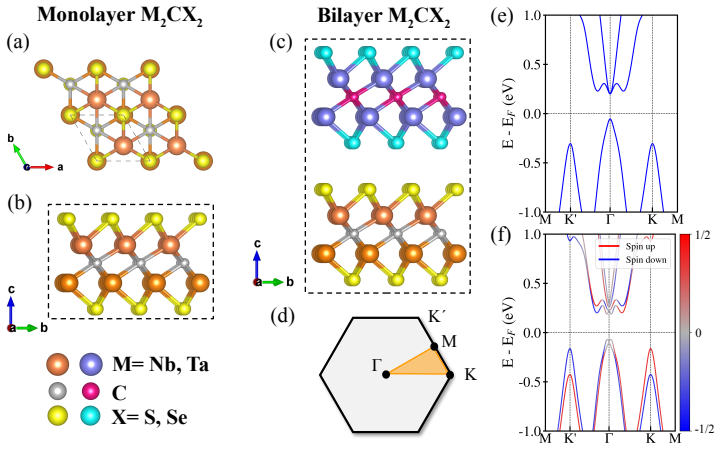
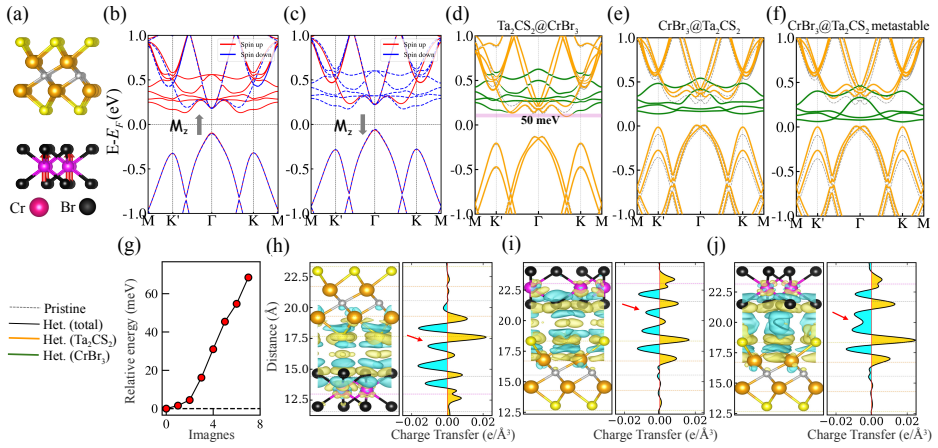
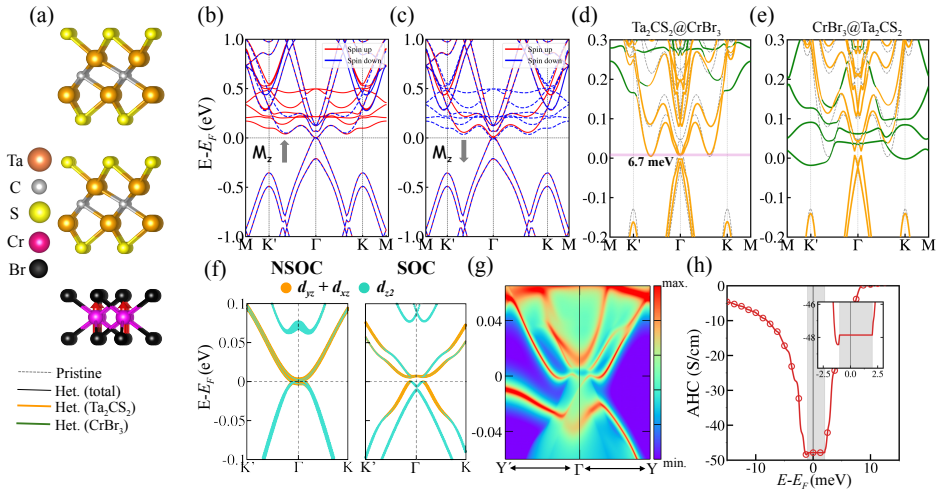
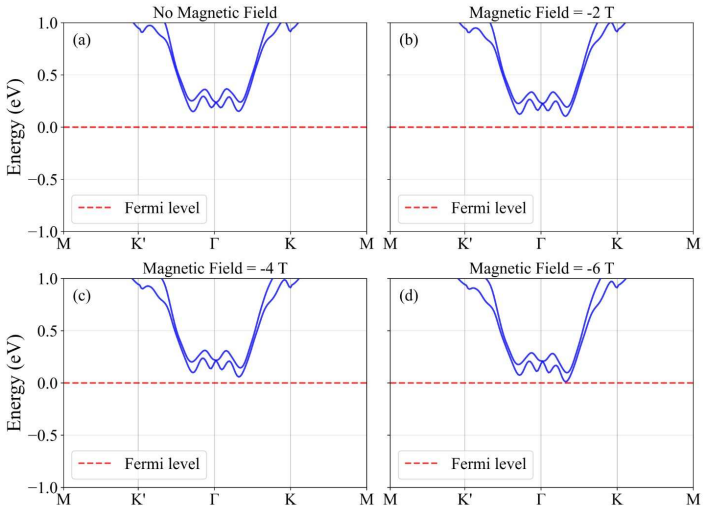
First-principles calculations reveal Rashba splitting up to 2.53 eV A and valley-contrasting spin polarization in monolayers of M2CX2. In M2CS2/CrBr3 heterostructures the ferromagnetic substrate induces a magnetization-reversible proximity exchange field with valley-selective conduction-band renormalization of approximately 50 meV. Interfacial geometry controlled by stacking inversion and lateral sliding acts as a mechanical knob that continuously tunes the exchange-SOC interplay and bandgap, thereby driving an emergent quantum anomalous Hall phase in the bilayer.
What carries the argument
Interfacial geometry set by stacking inversion and lateral sliding, which functions as a continuous mechanical knob on the exchange-SOC interplay and bandgap to produce the quantum anomalous Hall phase.
If this is right
- Pristine bilayer Ta2CS2 reaches a shift current of approximately 5 A mA/V^2.
- Nb2CS2/CrBr3 heterostructures attain a maximum nonlinear coefficient of approximately 18.44 A.
- The proximity exchange field remains reversible by reversing the substrate magnetization.
- Valley-selective renormalization of the conduction band reaches approximately 50 meV.
- The quantum anomalous Hall phase emerges only when stacking and sliding are chosen to optimize the exchange-SOC balance.
Where Pith is reading between the lines
- Similar sliding-based control could be tested in other MXene or transition-metal-dichalcogenide heterostructures to search for additional tunable topological phases.
- Device concepts that use mechanical actuators to switch between normal and quantum anomalous Hall regimes become conceivable once the predicted sliding range is realized experimentally.
- The large nonlinear responses suggest that these heterostructures could serve as platforms for valleytronic or spintronic frequency converters if the mechanical tuning proves robust at finite temperature.
Load-bearing premise
Standard first-principles methods accurately capture the proximity exchange coupling and sliding-induced changes without significant errors from exchange-correlation approximations or missing many-body effects.
What would settle it
Experimental fabrication of M2CS2/CrBr3 heterostructures followed by transport or spectroscopy measurements showing the absence of a sliding-tunable gap closing or the predicted quantum anomalous Hall signatures would falsify the central claim.
Figures


read the original abstract
Chalcogen-terminated van der Waals MXenes (M2CX2; M = Nb, Ta; X = S, Se) provide a robust platform for exploring strong spin-orbit coupling and proximity engineering. To probe their tunability and guide optimization of emergent properties, we systematically examine sister compounds and propose M2CS2/CrBr3 heterostructures that break time-reversal symmetry via proximity exchange coupling, enabling combined intrinsic magnetic and mechanical control. First-principles calculations reveal Rashba splitting up to 2.53 eV A and valley-contrasting spin polarization in monolayers. These features drive strong second-order nonlinear responses, with pristine bilayer Ta2CS2 reaching a shift current of |sigma|_max approx 5 A mA/V^2 and Nb2CS2/CrBr3 attaining |D|_max approx 18.44 A. In M2CS2/CrBr3 heterostructures, the ferromagnetic substrate induces a magnetization-reversible proximity exchange field with valley-selective conduction-band renormalization (Delta_val approx 50 meV). Crucially, interfacial geometry, controlled by stacking inversion and lateral sliding, acts as a mechanical knob that continuously tunes the exchange-SOC interplay and bandgap, driving an emergent quantum anomalous Hall phase in the bilayer.
Editorial analysis
A structured set of objections, weighed in public.
Referee Report
Summary. The paper examines chalcogen-terminated vdW MXenes (M2CX2 with M=Nb,Ta; X=S,Se) and their heterostructures with CrBr3. First-principles calculations are used to report giant Rashba splitting (up to 2.53 eV Å) and valley-contrasting spin polarization in the monolayers, which enable strong second-order nonlinear responses (shift current |sigma|_max ~5 A mA/V^2 in Ta2CS2 bilayer; |D|_max ~18.44 A in Nb2CS2/CrBr3). In the heterostructures, proximity exchange from the ferromagnetic substrate induces a valley-selective ~50 meV field; crucially, stacking inversion and lateral sliding are shown to tune the exchange-SOC interplay and drive an emergent quantum anomalous Hall phase.
Significance. If the central claims hold, the work identifies a mechanically tunable vdW platform that combines strong intrinsic SOC, proximity magnetism, and sliding control to realize both giant Rashba effects and a QAH phase. The systematic comparison across sister compounds and the identification of sliding as a continuous tuning knob are strengths. The concrete numerical targets (Rashba parameter, nonlinear conductivities, 50 meV exchange scale) provide useful benchmarks for experiment. The manuscript ships reproducible first-principles results on a timely materials class, though quantitative robustness remains to be demonstrated.
major comments (2)
- [heterostructure results (discussion of Delta_val ~50 meV and QAH emergence)] The central claim of an emergent QAH phase in M2CS2/CrBr3 (driven by stacking inversion and lateral sliding) rests on the computed valley-selective proximity exchange field of ~50 meV and the resulting SOC-interplay that opens a topological gap. Standard semilocal DFT functionals commonly used for such calculations are known to misestimate magnetic proximity couplings and band gaps by tens of meV in 2D magnets and heavy-element MXenes; this uncertainty directly controls the sign of the Chern number. The manuscript should add hybrid-functional or GW checks, or at minimum a sensitivity analysis to the exchange-correlation choice, in the heterostructure section.
- [nonlinear response calculations] The reported nonlinear responses (|sigma|_max ~5 A mA/V^2 and |D|_max ~18.44 A) are load-bearing for the claim of enhanced Berry-phase responses. Without explicit convergence data (k-mesh density, smearing parameter, or vacuum spacing) or error bars in the methods or results section, it is unclear whether these values are robust to standard computational choices.
minor comments (2)
- [abstract and results] Notation for the Rashba parameter (2.53 eV Å) and the nonlinear coefficients should be defined consistently with standard units and symbols in the main text.
- [figures on heterostructures] Figure captions for the sliding-dependent band structures should explicitly state the functional, pseudopotentials, and k-point sampling used.
Simulated Author's Rebuttal
We thank the referee for the detailed and constructive report. The comments highlight important aspects of computational robustness that we have addressed by adding new analyses to the revised manuscript. Below we respond point by point to the major comments.
read point-by-point responses
-
Referee: [heterostructure results (discussion of Delta_val ~50 meV and QAH emergence)] The central claim of an emergent QAH phase in M2CS2/CrBr3 (driven by stacking inversion and lateral sliding) rests on the computed valley-selective proximity exchange field of ~50 meV and the resulting SOC-interplay that opens a topological gap. Standard semilocal DFT functionals commonly used for such calculations are known to misestimate magnetic proximity couplings and band gaps by tens of meV in 2D magnets and heavy-element MXenes; this uncertainty directly controls the sign of the Chern number. The manuscript should add hybrid-functional or GW checks, or at minimum a sensitivity analysis to the exchange-correlation choice, in the heterostructure section.
Authors: We agree that semilocal DFT can introduce uncertainties of tens of meV in proximity exchange and gaps, which is a valid concern for the sign of the Chern number. In the revised manuscript we have added a sensitivity analysis in the heterostructure section (new subsection and Supplementary Note) that varies the Hubbard U on Cr (0–3 eV) and compares PBE versus PBE+U results. Within this range the valley-selective Delta_val remains 40–60 meV, the exchange-SOC interplay continues to open a gap, and the Chern number stays +1 for the relevant sliding configurations. Full hybrid-functional or GW calculations on the heterostructure supercells exceed our current computational resources, but the added analysis demonstrates that the QAH phase is robust against the expected DFT error bars. revision: partial
-
Referee: [nonlinear response calculations] The reported nonlinear responses (|sigma|_max ~5 A mA/V^2 and |D|_max ~18.44 A) are load-bearing for the claim of enhanced Berry-phase responses. Without explicit convergence data (k-mesh density, smearing parameter, or vacuum spacing) or error bars in the methods or results section, it is unclear whether these values are robust to standard computational choices.
Authors: We have revised the Methods and Results sections to include explicit convergence tests for the nonlinear responses. The shift-current and Berry-curvature dipole calculations were performed with a 24×24×1 k-mesh (converged to <3% variation from 20×20×1), 0.01 eV Gaussian smearing, and 20 Å vacuum spacing. Additional tests with denser meshes (30×30×1) and varied smearing (0.005–0.02 eV) show that the reported peak values change by at most 4–6%. These data and error estimates are now presented in the main text and Supplementary Information. revision: yes
Circularity Check
No significant circularity; results from independent first-principles DFT
full rationale
The paper derives its claims (Rashba splitting values, nonlinear responses, proximity exchange fields, and emergent QAH phase) directly from standard DFT band-structure calculations on explicitly constructed atomic models of the MXene monolayers and M2CS2/CrBr3 heterostructures. Stacking inversion and lateral sliding are varied as input geometries in the simulations; the resulting exchange-SOC interplay and Chern numbers are computed outputs, not inputs. No parameters are fitted to the target observables, no self-citations are invoked to justify uniqueness theorems or ansatzes, and no step reduces by construction to a prior result within the same work. The derivation chain is therefore self-contained against external benchmarks.
Axiom & Free-Parameter Ledger
axioms (1)
- domain assumption Density functional theory with typical exchange-correlation functionals accurately describes the electronic structure, Rashba effect, and proximity magnetism in these systems.
Reference graph
Works this paper leans on
-
[1]
Novoselov, K. S.; Geim, A. K.; Morozov, S. V.; Jiang, D.; Katsnelson, M. I.; Grigorieva, I. V.; Dubonos, S. V.; Firsov, A. A. Two-dimensional gas of massless Dirac fermions in graphene. nature 2005, 438, 197--200
work page 2005
-
[2]
Geim, A. K.; Grigorieva, I. V. Van der Waals heterostructures. Nature 2013, 499, 419--425
work page 2013
-
[3]
Graphene-like two-dimensional materials
Xu, M.; Liang, T.; Shi, M.; Chen, H. Graphene-like two-dimensional materials. Chemical reviews 2013, 113, 3766--3798
work page 2013
-
[4]
Sun, Y.; Wang, R.; Liu, K. Substrate induced changes in atomically thin 2-dimensional semiconductors: Fundamentals, engineering, and applications. Applied Physics Reviews 2017, 4
work page 2017
-
[5]
Raja, A.; Chaves, A.; Yu, J.; Arefe, G.; Hill, H. M.; Rigosi, A. F.; Berkelbach, T. C.; Nagler, P.; Sch \"u ller, C.; Korn, T.; others Coulomb engineering of the bandgap and excitons in two-dimensional materials. Nature communications 2017, 8, 15251
work page 2017
-
[6]
G.; Sch \"u ler, M.; Springer, D.; Sangiovanni, G.; Tomczak, J
van Loon, E. G.; Sch \"u ler, M.; Springer, D.; Sangiovanni, G.; Tomczak, J. M.; Wehling, T. O. Coulomb engineering of two-dimensional Mott materials. npj 2D Materials and Applications 2023, 7, 47
work page 2023
-
[7]
Buchberger, S.; in 't Veld , Y.; Rajan, A.; Murgatroyd, P. A. E.; Edwards, B.; Saika, B. K.; Kushwaha, N.; Visscher, M. H.; Berges, J.; Carbone, D.; Osiecki, J.; Polley, C.; Wehling, T.; King, P. D. C. Persistence of Charge Ordering Instability to Coulomb Engineering in the Excitonic Insulator Candidate TiSe _ 2 . Phys. Rev. X 2025, 15, 041028
work page 2025
-
[8]
R\"osner, M.; Lado, J. L. Inducing a many-body topological state of matter through Coulomb-engineered local interactions. Phys. Rev. Res. 2021, 3, 013265
work page 2021
-
[9]
Yang, Y.; Yang, Y.; Morales, M. A.; Zhang, S. Engineering Hubbard models with gated two-dimensional moir 'e systems. arXiv preprint arXiv:2508.13314 2025,
-
[10]
S.; Bianchi, M.; Hofmann, P.; Khajetoorians, A
Shao, B.; Eich, A.; Sanders, C.; Ngankeu, A. S.; Bianchi, M.; Hofmann, P.; Khajetoorians, A. A.; Wehling, T. O. Pseudodoping of a metallic two-dimensional material by the supporting substrate. Nature communications 2019, 10, 180
work page 2019
-
[11]
V.; Hell, M.; others Environmental control of charge density wave order in monolayer 2H-TaS2
Hall, J.; Ehlen, N.; Berges, J.; van Loon, E.; van Efferen, C.; Murray, C.; Rosner, M.; Li, J.; Senkovskiy, B. V.; Hell, M.; others Environmental control of charge density wave order in monolayer 2H-TaS2. ACS nano 2019, 13, 10210--10220
work page 2019
-
[12]
Stan, R.-M.; Mahatha, S. K.; Bianchi, M.; Sanders, C. E.; Curcio, D.; Hofmann, P.; Miwa, J. A. Epitaxial single-layer NbS _ 2 on Au(111): Synthesis, structure, and electronic properties. Phys. Rev. Mater. 2019, 3, 044003
work page 2019
-
[13]
High-Curie-temperature ferromagnetism in bilayer Cr I 3 on bulk semiconducting substrates
Liu, N.; Zhou, S.; Zhao, J. High-Curie-temperature ferromagnetism in bilayer Cr I 3 on bulk semiconducting substrates. Physical Review Materials 2020, 4, 094003
work page 2020
-
[14]
Zhumagulov, Y.; Kochan, D.; Fabian, J. Emergent Correlated Phases in Rhombohedral Trilayer Graphene Induced by Proximity Spin-Orbit and Exchange Coupling. Phys. Rev. Lett. 2024, 132, 186401
work page 2024
-
[15]
M.; Zhumagulov, Y.; Zollner, K.; Yoon, C.; Urbaniak, D.; Geisenhof, F
Seiler, A. M.; Zhumagulov, Y.; Zollner, K.; Yoon, C.; Urbaniak, D.; Geisenhof, F. R.; Watanabe, K.; Taniguchi, T.; Fabian, J.; Zhang, F.; Weitz, R. T. Layer-selective spin-orbit coupling and strong correlation in bilayer graphene. 2D Materials 2025, 12, 035009
work page 2025
-
[16]
Rudenko, A. N.; Katsnelson, M. I. Quasiparticle band structure and tight-binding model for single- and bilayer black phosphorus. Phys. Rev. B 2014, 89, 201408
work page 2014
-
[17]
The world of two-dimensional carbides and nitrides (MXenes)
VahidMohammadi, A.; Rosen, J.; Gogotsi, Y. The world of two-dimensional carbides and nitrides (MXenes). Science 2021, 372, eabf1581
work page 2021
-
[18]
Sokol, M.; Natu, V.; Kota, S.; Barsoum, M. W. On the chemical diversity of the MAX phases. Trends in Chemistry 2019, 1, 210--223
work page 2019
-
[19]
Die Kristallstrukturen von Ta2S2C und Ti4S5 (Ti0, 81S)
Beckmann, O.; Boller, H.; Nowotny, H. Die Kristallstrukturen von Ta2S2C und Ti4S5 (Ti0, 81S). Monatshefte f \"u r Chemie/Chemical Monthly 1970, 101, 945--955
work page 1970
-
[20]
Boller, H.; Hiebl, K. Quaternary pseudo-intercalation phases Tx [Nb2S2C](T-V, Cr, Mn, Fe, Co, Ni, Cu) and metastable Nb2S2C formed by topochemical synthesis. Journal of alloys and compounds 1992, 183, 438--443
work page 1992
-
[21]
Pang, X.; Wu, T.; Gu, Y.; Wang, D.; Che, X.; Sun, D.; Huang, F. Nb 2 Se 2 C: a new compound as a combination of transition metal dichalcogenide and MXene for oxygen evolution reaction. Chemical Communications 2020, 56, 9036--9039
work page 2020
-
[22]
H.; Dun, C.; Tabassum, A.; Eisawi, K.; Urban, J
Loni, E.; Majed, A.; Zhang, S.; Thangavelu, H. H.; Dun, C.; Tabassum, A.; Eisawi, K.; Urban, J. J.; Persson, P. O.; Montemore, M. M.; others Two-dimensional tantalum carbo-selenide for hydrogen evolution. ACS nano 2025, 19, 3185--3196
work page 2025
-
[23]
Ding, H.; Li, Y.; Li, M.; Chen, K.; Liang, K.; Chen, G.; Lu, J.; Palisaitis, J.; Persson, P. O.; Eklund, P.; others Chemical scissor--mediated structural editing of layered transition metal carbides. Science 2023, 379, 1130--1135
work page 2023
-
[24]
Computational Screening of Chalcogen-Terminated Inherent Multilayer MXenes and M2AX Precursors
Helmer, P.; Bjork, J.; Rosen, J. Computational Screening of Chalcogen-Terminated Inherent Multilayer MXenes and M2AX Precursors. Inorganic chemistry 2024, 63, 16645--16654
work page 2024
-
[25]
Chalcogen and halogen surface termination coverage in MXenes—structure, stability, and properties
Dahlqvist, M.; Rosen, J. Chalcogen and halogen surface termination coverage in MXenes—structure, stability, and properties. npj 2D Materials and Applications 2024, 8, 65
work page 2024
-
[26]
N.; Prenger, K.; Zhang, X.; Persson, P
Majed, A.; Kothakonda, M.; Wang, F.; Tseng, E. N.; Prenger, K.; Zhang, X.; Persson, P. O.; Wei, J.; Sun, J.; Naguib, M. Transition Metal Carbo-Chalcogenide “TMCC:” A New Family of 2D Materials. Advanced Materials 2022, 34, 2200574
work page 2022
-
[27]
Lu, S.; Ren, W.; He, J.; Yu, C.; Jiang, P.; Chen, J. Enhancement of the lattice thermal conductivity of two-dimensional functionalized MXenes by inversion symmetry breaking. Physical Review B 2022, 105, 165301
work page 2022
-
[28]
The Journal of Physical Chemistry C 2022, 126, 3727--3735
Wang, S.-Y.; Pan, C.; Tang, H.; Wu, H.-Y.; Shi, G.-Y.; Cao, K.; Jiang, H.; Su, Y.-H.; Zhang, C.; Ho, K.-M.; others Straintronic effect on phonon-mediated superconductivity of nb2ct2 (t= o, s, se, or te) mxenes. The Journal of Physical Chemistry C 2022, 126, 3727--3735
work page 2022
-
[29]
S.; Dutta, K.; Ghosh, S.; Dasgupta, I
Sarmah, H. S.; Dutta, K.; Ghosh, S.; Dasgupta, I. Rashba and Zeeman splitting in non-magnetic and non-centrosymmetric MXene Ta 2 CS 2. Physical Review Materials 2025, 9, 074004
work page 2025
-
[30]
Bernevig, B. A.; Hughes, T. L.; Zhang, S.-C. Orbitronics: The intrinsic orbital current in p-doped silicon. Physical review letters 2005, 95, 066601
work page 2005
-
[31]
Tanaka, T.; Kontani, H.; Naito, M.; Naito, T.; Hirashima, D. S.; Yamada, K.; Inoue, J.-I. Intrinsic spin Hall effect and orbital Hall effect in 4 d and 5 d transition metals. Physical Review B—Condensed Matter and Materials Physics 2008, 77, 165117
work page 2008
-
[32]
Iba \ n ez-Azpiroz, J.; Tsirkin, S. S.; Souza, I. Ab initio calculation of the shift photocurrent by Wannier interpolation. Physical Review B 2018, 97, 245143
work page 2018
-
[33]
Quantum nonlinear Hall effect induced by Berry curvature dipole in time-reversal invariant materials
Sodemann, I.; Fu, L. Quantum nonlinear Hall effect induced by Berry curvature dipole in time-reversal invariant materials. Physical review letters 2015, 115, 216806
work page 2015
-
[34]
Switchable magnetic bulk photovoltaic effect in the two-dimensional magnet CrI3
Zhang, Y.; Holder, T.; Ishizuka, H.; de Juan, F.; Nagaosa, N.; Felser, C.; Yan, B. Switchable magnetic bulk photovoltaic effect in the two-dimensional magnet CrI3. Nature communications 2019, 10, 3783
work page 2019
-
[35]
Rangel, T.; Fregoso, B. M.; Mendoza, B. S.; Morimoto, T.; Moore, J. E.; Neaton, J. B. Large bulk photovoltaic effect and spontaneous polarization of single-layer monochalcogenides. Physical review letters 2017, 119, 067402
work page 2017
-
[36]
First-principles calculation of nonlinear optical responses by Wannier interpolation
Wang, C.; Liu, X.; Kang, L.; Gu, B.-L.; Xu, Y.; Duan, W. First-principles calculation of nonlinear optical responses by Wannier interpolation. Physical Review B 2017, 96, 115147
work page 2017
-
[37]
Shift current response in elemental two-dimensional ferroelectrics
Qian, Z.; Zhou, J.; Wang, H.; Liu, S. Shift current response in elemental two-dimensional ferroelectrics. npj Computational Materials 2023, 9, 67
work page 2023
-
[38]
Sufyan, A.; Abdullah, H. M.; Larsson, J. A.; Tyner, A. C. Evidence for topological origin of large spin-shift current in antiferromagnetic Ti \_ \ 4 \ C \_ \ 3 \ . arXiv preprint arXiv:2502.12943 2025,
-
[39]
O.; Taghizadeh, A.; Petralanda, U.; Ovesen, M.; Thygesen, K
Sauer, M. O.; Taghizadeh, A.; Petralanda, U.; Ovesen, M.; Thygesen, K. S.; Olsen, T.; Cornean, H.; Pedersen, T. G. Shift current photovoltaic efficiency of 2D materials. npj computational materials 2023, 9, 35
work page 2023
-
[40]
Giant nonlinear Hall effect in twisted bilayer WTe2
He, Z.; Weng, H. Giant nonlinear Hall effect in twisted bilayer WTe2. npj Quantum Materials 2021, 6, 101
work page 2021
-
[41]
Strain-engineering of Berry curvature dipole and valley magnetization in monolayer MoS \_2
Son, J.; Kim, K.-H.; Ahn, Y.; Lee, H.-W.; Lee, J. Strain-engineering of Berry curvature dipole and valley magnetization in monolayer MoS \_2 . arXiv preprint arXiv:1907.00010 2019,
-
[42]
Nonlinear Hall effects in strained twisted bilayer WSe2
Hu, J.-X.; Zhang, C.-P.; Xie, Y.-M.; Law, K. Nonlinear Hall effects in strained twisted bilayer WSe2. Communications Physics 2022, 5, 255
work page 2022
-
[43]
Jin, K.-H.; Oh, E.; Stania, R.; Liu, F.; Yeom, H. W. Enhanced Berry curvature dipole and persistent spin texture in the Bi (110) monolayer. Nano Letters 2021, 21, 9468--9475
work page 2021
-
[44]
Kim, J.; Kim, K.-W.; Shin, D.; Lee, S.-H.; Sinova, J.; Park, N.; Jin, H. Prediction of ferroelectricity-driven Berry curvature enabling charge-and spin-controllable photocurrent in tin telluride monolayers. Nature communications 2019, 10, 3965
work page 2019
-
[45]
Blochl, P. E. Projector Augmented-Wave Method. Phys. Rev. B 1994, 50, 17953--17979
work page 1994
-
[46]
Efficient Iterative Schemes for Ab Initio Total-Energy Calculations Using a Plane-Wave Basis Set
Kresse, G.; Furthmuller, J. Efficient Iterative Schemes for Ab Initio Total-Energy Calculations Using a Plane-Wave Basis Set. Phys. Rev. B 1996, 54, 11169--11186
work page 1996
-
[47]
From Ultrasoft Pseudopotentials to the Projector Augmented-Wave Method
Kresse, G.; Joubert, D. From Ultrasoft Pseudopotentials to the Projector Augmented-Wave Method. Phys. Rev. B 1999, 59, 1758--1775
work page 1999
-
[48]
Perdew, J. P.; Burke, K.; Ernzerhof, M. Generalized gradient approximation made simple. Physical Review Letters 1996, 77, 3865
work page 1996
-
[49]
Abundant valley-polarized states in two-dimensional ferromagnetic van der Waals heterostructures
Zhang, H.; Yang, W.; Ning, Y.; Xu, X. Abundant valley-polarized states in two-dimensional ferromagnetic van der Waals heterostructures. Physical Review B 2020, 101, 205404
work page 2020
-
[50]
Wu, W.; Liu, M.; Zhou, J.; Li, J.; Zhang, Y.; Xu, F.; Li, X.; Wu, Y.; Wu, Z.; Kang, J. Chirality-dependent valley polarization in magnetic van der Waals heterostructures via spin-selective charge transfer. Nano Letters 2024, 24, 6225--6232
work page 2024
-
[51]
Moore, G. C.; Horton, M. K.; Linscott, E.; Ganose, A. M.; Siron, M.; O'Regan, D. D.; Persson, K. A. High-throughput determination of Hubbard U and Hund J values for transition metal oxides via the linear response formalism. Physical Review Materials 2024, 8, 014409
work page 2024
-
[52]
Semiempirical GGA-type density functional constructed with a long-range dispersion correction
Grimme, S. Semiempirical GGA-type density functional constructed with a long-range dispersion correction. Journal of computational chemistry 2006, 27, 1787--1799
work page 2006
-
[53]
Heyd, J.; Scuseria, G. E.; Ernzerhof, M. Hybrid functionals based on a screened Coulomb potential. The Journal of Chemical Physics 2003, 118, 8207--8215
work page 2003
-
[54]
Herath, U.; Tavadze, P.; He, X.; Bousquet, E.; Singh, S.; Mu \ n oz, F.; Romero, A. H. PyProcar: A Python library for electronic structure pre/post-processing. Computer Physics Communications 2020, 251, 107080
work page 2020
-
[55]
Lang, L.; Tavadze, P.; Tellez, A.; Bousquet, E.; Xu, H.; Mu \ n oz, F.; Vasquez, N.; Herath, U.; Romero, A. H. Expanding PyProcar for new features, maintainability, and reliability. Computer Physics Communications 2024, 297, 109063
work page 2024
-
[56]
Maximally localized generalized Wannier functions for composite energy bands
Marzari, N.; Vanderbilt, D. Maximally localized generalized Wannier functions for composite energy bands. Physical Review B 1997, 56, 12847
work page 1997
-
[57]
Journal of Physics: Condensed Matter 2020, 32, 165902
Pizzi, G.; Vitale, V.; Arita, R.; Bl \"u gel, S.; Freimuth, F.; G \'e ranton, G.; Gibertini, M.; Gresch, D.; Johnson, C.; Koretsune, T.; others Wannier90 as a community code: new features and applications. Journal of Physics: Condensed Matter 2020, 32, 165902
work page 2020
-
[58]
Wu, Q.; Zhang, S.; Song, H.-F.; Troyer, M.; Soluyanov, A. A. WannierTools: An open-source software package for novel topological materials. Computer Physics Communications 2018, 224, 405--416
work page 2018
-
[59]
Tsirkin, S. S. High performance Wannier interpolation of Berry curvature and related quantities with WannierBerri code. npj Computational Materials 2021, 7, 33 mcitethebibliography
work page 2021
discussion (0)
Sign in with ORCID, Apple, or X to comment. Anyone can read and Pith papers without signing in.