pith. machine review for the scientific record. sign in

arxiv: 2605.09694 · v1 · submitted 2026-05-10 · ✦ hep-ex

Recognition: no theorem link

Measurement of branching fractions of D^+_sto K⁰_SK⁰_S π^+π⁰ and D^+_sto K⁰_S K^+π⁰π⁰

BESIII Collaboration: M. Ablikim , M. N. Achasov , P. Adlarson , X. C. Ai , R. Aliberti , A. Amoroso , Q. An , Y. Bai
show 676 more authors
O. Bakina Y. Ban H.-R. Bao V. Batozskaya K. Begzsuren N. Berger M. Berlowski M. B. Bertani D. Bettoni F. Bianchi E. Bianco A. Bortone I. Boyko R. A. Briere A. Brueggemann H. Cai M. H. Cai X. Cai A. Calcaterra G. F. Cao N. Cao S. A. Cetin X. Y. Chai J. F. Chang T. T. Chang G. R. Che Y. Z. Che C. H. Chen Chao Chen G. Chen H. S. Chen H. Y. Chen M. L. Chen S. J. Chen S. M. Chen T. Chen X. R. Chen X. T. Chen X. Y. Chen Y. B. Chen Y. Q. Chen Z. K. Chen J. C. Cheng L. N. Cheng S. K. Choi X. Chu G. Cibinetto F. Cossio J. Cottee-Meldrum H. L. Dai J. P. Dai X. C. Dai A. Dbeyssi R. E. de Boer D. Dedovich C. Q. Deng Z. Y. Deng A. Denig I. Denisenko M. Destefanis F. De~Mori X. X. Ding Y. Ding Y. X. Ding J. Dong L. Y. Dong M. Y. Dong X. Dong M. C. Du S. X. Du X. L. Du Y. Y. Duan Z. H. Duan P. Egorov G. F. Fan J. J. Fan Y. H. Fan J. Fang S. S. Fang W. X. Fang Y. Q. Fang L. Fava F. Feldbauer G. Felici C. Q. Feng J. H. Feng L. Feng Q. X. Feng Y. T. Feng M. Fritsch C. D. Fu J. L. Fu Y. W. Fu H. Gao Y. Gao Y. N. Gao Y. Y. Gao Z. Gao S. Garbolino I. Garzia L. Ge P. T. Ge Z. W. Ge C. Geng E. M. Gersabeck A. Gilman K. Goetzen J. D. Gong L. Gong W. X. Gong W. Gradl S. Gramigna M. Greco M. D. Gu M. H. Gu C. Y. Guan A. Q. Guo J. N. Guo L. B. Guo M. J. Guo R. P. Guo X. Guo Y. P. Guo A. Guskov J. Gutierrez T. T. Han F. Hanisch K. D. Hao X. Q. Hao F. A. Harris C. Z. He K. L. He F. H. Heinsius C. H. Heinz Y. K. Heng C. Herold P. C. Hong G. Y. Hou X. T. Hou Y. R. Hou Z. L. Hou H. M. Hu J. F. Hu Q. P. Hu S. L. Hu T. Hu Y. Hu Z. M. Hu G. S. Huang K. X. Huang L. Q. Huang P. Huang X. T. Huang Y. P. Huang Y. S. Huang T. Hussain N. H\"usken N. in der Wiesche J. Jackson Q. Ji Q. P. Ji W. Ji X. B. Ji X. L. Ji X. Q. Jia Z. K. Jia D. Jiang H. B. Jiang P. C. Jiang S. J. Jiang X. S. Jiang Y. Jiang J. B. Jiao J. K. Jiao Z. Jiao S. Jin Y. Jin M. Q. Jing X. M. Jing T. Johansson S. Kabana N. Kalantar-Nayestanaki X. L. Kang X. S. Kang M. Kavatsyuk B. C. Ke V. Khachatryan A. Khoukaz O. B. Kolcu B. Kopf M. Kuessner X. Kui N. Kumar A. Kupsc W. K\"uhn Q. Lan W. N. Lan T. T. Lei M. Lellmann T. Lenz C. Li C. H. Li C. K. Li D. M. Li F. Li G. Li H. B. Li H. J. Li H. L. Li H. N. Li Hui Li J. R. Li J. S. Li J. W. Li K. Li K. L. Li L. J. Li Lei Li M. H. Li M. R. Li P. L. Li P. R. Li Q. M. Li Q. X. Li R. Li S. X. Li Shanshan Li T. Li T. Y. Li W. D. Li W. G. Li X. Li X. H. Li X. K. Li X. L. Li X. Y. Li X. Z. Li Y. Li Y. G. Li Y. P. Li Z. H. Li Z. J. Li Z. X. Li Z. Y. Li C. Liang H. Liang Y. F. Liang Y. T. Liang G. R. Liao L. B. Liao M. H. Liao Y. P. Liao J. Libby A. Limphirat D. X. Lin L. Q. Lin T. Lin B. J. Liu B. X. Liu C. X. Liu F. Liu F. H. Liu Feng Liu G. M. Liu H. Liu H. B. Liu H. H. Liu H. M. Liu Huihui Liu J. B. Liu J. J. Liu K. Liu K. Y. Liu Ke Liu L. Liu L. C. Liu Lu Liu M. H. Liu P. L. Liu Q. Liu S. B. Liu W. M. Liu W. T. Liu X. Liu X. K. Liu X. L. Liu X. Y. Liu Y. Liu Y. B. Liu Z. A. Liu Z. D. Liu Z. Q. Liu Z. Y. Liu X. C. Lou H. J. Lu J. G. Lu X. L. Lu Y. Lu Y. H. Lu Y. P. Lu Z. H. Lu C. L. Luo J. R. Luo J. S. Luo M. X. Luo T. Luo X. L. Luo Z. Y. Lv X. R. Lyu Y. F. Lyu Y. H. Lyu F. C. Ma H. L. Ma Heng Ma J. L. Ma L. L. Ma L. R. Ma Q. M. Ma R. Q. Ma R. Y. Ma T. Ma X. T. Ma X. Y. Ma Y. M. Ma F. E. Maas I. Mackay M. Maggiora S. Malde Q. A. Malik H. X. Mao Y. J. Mao Z. P. Mao S. Marcello A. Marshall F. M. Melendi Y. H. Meng Z. X. Meng G. Mezzadri H. Miao T. J. Min R. E. Mitchell X. H. Mo B. Moses N. Yu. Muchnoi J. Muskalla Y. Nefedov F. Nerling Z. Ning S. Nisar Q. L. Niu W. D. Niu Y. Niu C. Normand S. L. Olsen Q. Ouyang S. Pacetti X. Pan Y. Pan A. Pathak Y. P. Pei M. Pelizaeus H. P. Peng X. J. Peng Y. Y. Peng K. Peters K. Petridis J. L. Ping R. G. Ping S. Plura V. Prasad F. Z. Qi H. R. Qi M. Qi S. Qian W. B. Qian C. F. Qiao J. H. Qiao J. J. Qin J. L. Qin L. Q. Qin L. Y. Qin P. B. Qin X. P. Qin X. S. Qin Z. H. Qin J. F. Qiu Z. H. Qu J. Rademacker C. F. Redmer A. Rivetti M. Rolo G. Rong S. S. Rong F. Rosini Ch. Rosner M. Q. Ruan N. Salone A. Sarantsev Y. Schelhaas K. Schoenning M. Scodeggio W. Shan X. Y. Shan Z. J. Shang J. F. Shangguan L. G. Shao M. Shao C. P. Shen H. F. Shen W. H. Shen X. Y. Shen B. A. Shi H. Shi J. L. Shi J. Y. Shi S. Y. Shi X. Shi H. L. Song J. J. Song M. H. Song T. Z. Song W. M. Song Y. X. Song Zirong Song S. Sosio S. Spataro S Stansilaus F. Stieler S. S Su G. B. Sun G. X. Sun H. Sun H. K. Sun J. F. Sun K. Sun L. Sun R. Sun S. S. Sun T. Sun W. Y. Sun Y. C. Sun Y. H. Sun Y. J. Sun Y. Z. Sun Z. Q. Sun Z. T. Sun C. J. Tang G. Y. Tang J. Tang J. J. Tang L. F. Tang Y. A. Tang L. Y. Tao M. Tat J. X. Teng J. Y. Tian W. H. Tian Y. Tian Z. F. Tian I. Uman B. Wang Bo Wang C. Wang Cong Wang D. Y. Wang H. J. Wang J. Wang J. J. Wang J. P. Wang K. Wang L. L. Wang L. W. Wang M. Wang N. Y. Wang S. Wang T. Wang T. J. Wang W. Wang W. P. Wang X. Wang X. F. Wang X. L. Wang X. N. Wang Xin Wang Y. Wang Y. D. Wang Y. F. Wang Y. H. Wang Y. J. Wang Y. L. Wang Y. N. Wang Yaqian Wang Yi Wang Yuan Wang Z. Wang Z. L. Wang Z. Q. Wang Z. Y. Wang Ziyi Wang D. Wei D. H. Wei H. R. Wei F. Weidner S. P. Wen U. Wiedner G. Wilkinson M. Wolke J. F. Wu L. H. Wu L. J. Wu Lianjie Wu S. G. Wu S. M. Wu X. Wu Y. J. Wu Z. Wu L. Xia B. H. Xiang D. Xiao G. Y. Xiao H. Xiao Y. L. Xiao Z. J. Xiao C. Xie K. J. Xie Y. Xie Y. G. Xie Y. H. Xie Z. P. Xie T. Y. Xing C. F. Xu C. J. Xu G. F. Xu H. Y. Xu M. Xu Q. J. Xu Q. N. Xu T. D. Xu X. P. Xu Y. Xu Y. C. Xu Z. S. Xu F. Yan L. Yan W. B. Yan W. C. Yan W. H. Yan W. P. Yan X. Q. Yan H. J. Yang H. L. Yang H. X. Yang J. H. Yang R. J. Yang Y. Yang Y. H. Yang Y. Q. Yang Y. Z. Yang Z. P. Yao M. Ye M. H. Ye Z. J. Ye Junhao Yin Z. Y. You B. X. Yu C. X. Yu G. Yu J. S. Yu L. W. Yu T. Yu X. D. Yu Y. C. Yu C. Z. Yuan H. Yuan J. Yuan L. Yuan M. K. Yuan S. H. Yuan Y. Yuan C. X. Yue Ying Yue A. A. Zafar F. R. Zeng S. H. Zeng X. Zeng Y. J. Zeng Y. C. Zhai Y. H. Zhan Zhang B. L. Zhang B. X. Zhang D. H. Zhang G. Y. Zhang H. Zhang H. C. Zhang H. H. Zhang H. Q. Zhang H. R. Zhang H. Y. Zhang J. Zhang J. J. Zhang J. L. Zhang J. Q. Zhang J. S. Zhang J. W. Zhang J. X. Zhang J. Y. Zhang J. Z. Zhang Jianyu Zhang L. M. Zhang Lei Zhang N. Zhang P. Zhang Q. Zhang Q. Y. Zhang R. Y. Zhang S. H. Zhang Shulei Zhang X. M. Zhang X. Y. Zhang Y. Zhang Y. T. Zhang Y. H. Zhang Y. P. Zhang Z. D. Zhang Z. H. Zhang Z. L. Zhang Z. X. Zhang Z. Y. Zhang Z. Z. Zhang Zh. Zh. Zhang G. Zhao J. Y. Zhao J. Z. Zhao L. Zhao M. G. Zhao S. J. Zhao Y. B. Zhao Y. L. Zhao Y. X. Zhao Z. G. Zhao A. Zhemchugov B. Zheng B. M. Zheng J. P. Zheng W. J. Zheng X. R. Zheng Y. H. Zheng B. Zhong C. Zhong H. Zhou J. Q. Zhou S. Zhou X. Zhou X. K. Zhou X. R. Zhou X. Y. Zhou Y. X. Zhou Y. Z. Zhou A. N. Zhu J. Zhu K. Zhu K. J. Zhu K. S. Zhu L. Zhu L. X. Zhu S. H. Zhu T. J. Zhu W. D. Zhu W. J. Zhu W. Z. Zhu Y. C. Zhu Z. A. Zhu X. Y. Zhuang J. H. Zou J. Zu
Authors on Pith no claims yet

Pith reviewed 2026-05-12 04:16 UTC · model grok-4.3

classification ✦ hep-ex
keywords D_s^+branching fractionhadronic decayK0Spi0charm mesonfour-body decaydecay observation
0
0 comments X

The pith

D_s^+ decays observed with branching fractions 4.08 and 3.32 x 10^{-3}

A machine-rendered reading of the paper's core claim, the machinery that carries it, and where it could break.

The paper establishes the first observations of two specific four-body hadronic decays of the D_s^+ meson by examining electron-positron collision events. Signal candidates are reconstructed from combinations of neutral kaons and pions, and their yields are extracted via mass fits before normalizing to a reference decay to obtain branching fractions. A sympathetic reader would care because these rates fill gaps in the known decay pattern of the charmed strange meson and supply concrete inputs for testing models of the strong force at the charm mass scale. The data sample corresponds to 7.33 fb^{-1} collected at center-of-mass energies between 4.128 and 4.226 GeV.

Core claim

The hadronic decays D_s^+ to K^0_S K^0_S pi^+ pi^0 and D_s^+ to K^0_S K^+ pi^0 pi^0 are observed, with branching fractions determined to be (4.08 plus or minus 0.46 statistical plus or minus 0.45 systematic) times 10^{-3} and (3.32 plus or minus 0.64 statistical plus or minus 0.31 systematic) times 10^{-3} respectively.

What carries the argument

Reconstruction of final-state particles including K0S from pi^+ pi^- pairs and pi0 from photon pairs, followed by invariant-mass fits to extract signal yields and efficiency corrections from simulation.

If this is right

  • These modes now contribute known fractions to the total decay width of the D_s^+ meson.
  • The measured rates can be added to global averages of D_s^+ branching fractions used by other experiments.
  • The results serve as benchmarks for Monte Carlo generators modeling multi-body charm decays.
  • The same reconstruction methods can be applied to search for analogous decays in other charmed mesons.

Where Pith is reading between the lines

These are editorial extensions of the paper, not claims the author makes directly.

  • The ratio of the two branching fractions could test expectations from isospin symmetry or Cabibbo-favored versus suppressed amplitudes.
  • Combining these measurements with the D_s^+ lifetime would tighten the uncertainty on the total decay width.
  • Dalitz-plot or amplitude analyses of the same final states could reveal resonant substructure not addressed here.

Load-bearing premise

Monte Carlo simulations accurately reproduce detector efficiencies, background shapes, and signal extraction without significant bias from fit models or data selection criteria.

What would settle it

Finding no significant excess above background in the D_s^+ candidate mass distribution for either reconstructed final state would invalidate the claimed observations and branching fractions.

Figures
Figures reproduced from arXiv: 2605.09694 by A. Amoroso, A. A. Zafar, A. Bortone, A. Brueggemann, A. Calcaterra, A. Dbeyssi, A. Denig, A. Gilman, A. Guskov, A. Khoukaz, A. Kupsc, A. Limphirat, A. Marshall, A. N. Zhu, A. Pathak, A. Q. Guo, A. Rivetti, A. Sarantsev, A. Zhemchugov, B. A. Shi, B. C. Ke, BESIII Collaboration: M. Ablikim, B. H. Xiang, B. J. Liu, B. Kopf, B. L. Zhang, B. Moses, B. M. Zheng, Bo Wang, B. Wang, B. X. Liu, B. X. Yu, B. X. Zhang, B. Zheng, B. Zhong, C. D. Fu, C. F. Qiao, C. F. Redmer, C. F. Xu, C. Geng, Chao Chen, C. H. Chen, C. Herold, C. H. Heinz, C. H. Li, Ch. Rosner, C. J. Tang, C. J. Xu, C. K. Li, C. Li, C. Liang, C. L. Luo, C. Normand, Cong Wang, C. P. Shen, C. Q. Deng, C. Q. Feng, C. Wang, C. Xie, C. X. Liu, C. X. Yu, C. X. Yue, C. Y. Guan, C. Z. He, C. Zhong, C. Z. Yuan, D. Bettoni, D. Dedovich, D. H. Wei, D. H. Zhang, D. Jiang, D. M. Li, D. Wei, D. Xiao, D. X. Lin, D. Y. Wang, E. Bianco, E. M. Gersabeck, F. A. Harris, F. Bianchi, F. C. Ma, F. Cossio, F. De~Mori, F. E. Maas, Feng Liu, F. Feldbauer, F. Hanisch, F. H. Heinsius, F. H. Liu, F. Li, F. Liu, F. M. Melendi, F. Nerling, F. Rosini, F. R. Zeng, F. Stieler, F. Weidner, F. Yan, F. Z. Qi, G. B. Sun, G. Chen, G. Cibinetto, G. F. Cao, G. Felici, G. F. Fan, G. F. Xu, G. Li, G. Mezzadri, G. M. Liu, G. R. Che, G. R. Liao, G. Rong, G. S. Huang, G. Wilkinson, G. X. Sun, G. Y. Hou, G. Y. Tang, G. Yu, G. Y. Xiao, G. Y. Zhang, G. Zhao, H. B. Jiang, H. B. Li, H. B. Liu, H. Cai, H. C. Zhang, Heng Ma, H. F. Shen, H. Gao, H. H. Liu, H. H. Zhang, H. J. Li, H. J. Lu, H. J. Wang, H. J. Yang, H. K. Sun, H. L. Dai, H. Liang, H. Liu, H. L. Li, H. L. Ma, H. L. Song, H. L. Yang, H. M. Hu, H. Miao, H. M. Liu, H. N. Li, H. P. Peng, H. Q. Zhang, H.-R. Bao, H. R. Qi, H. R. Wei, H. R. Zhang, H. S. Chen, H. Shi, H. Sun, Huihui Liu, Hui Li, H. Xiao, H. X. Mao, H. X. Yang, H. Y. Chen, H. Yuan, H. Y. Xu, H. Y. Zhang, H. Zhang, H. Zhou, I. Boyko, I. Denisenko, I. Garzia, I. Mackay, I. Uman, J. B. Jiao, J. B. Liu, J. C. Cheng, J. Cottee-Meldrum, J. D. Gong, J. Dong, J. Fang, J. F. Chang, J. F. Hu, J. F. Qiu, J. F. Shangguan, J. F. Sun, J. F. Wu, J. G. Lu, J. Gutierrez, J. H. Feng, J. H. Qiao, J. H. Yang, J. H. Zou, Jianyu Zhang, J. Jackson, J. J. Fan, J. J. Liu, J. J. Qin, J. J. Song, J. J. Tang, J. J. Wang, J. J. Zhang, J. K. Jiao, J. L. Fu, J. Libby, J. L. Ma, J. L. Ping, J. L. Qin, J. L. Shi, J. L. Zhang, J. Muskalla, J. N. Guo, J. P. Dai, J. P. Wang, J. P. Zheng, J. Q. Zhang, J. Q. Zhou, J. Rademacker, J. R. Li, J. R. Luo, J. S. Li, J. S. Luo, J. S. Yu, J. S. Zhang, J. Tang, Junhao Yin, J. Wang, J. W. Li, J. W. Zhang, J. X. Teng, J. X. Zhang, J. Y. Shi, J. Y. Tian, J. Yuan, J. Y. Zhang, J. Y. Zhao, J. Zhang, J. Zhu, J. Zu, J. Z. Zhang, J. Z. Zhao, K. Begzsuren, K. D. Hao, Ke Liu, K. Goetzen, K. J. Xie, K. J. Zhu, K. L. He, K. Li, K. Liu, K. L. Li, K. Peters, K. Petridis, K. Schoenning, K. Sun, K. S. Zhu, K. Wang, K. X. Huang, K. Y. Liu, K. Zhu, L. B. Guo, L. B. Liao, L. C. Liu, Lei Li, Lei Zhang, L. Fava, L. Feng, L. F. Tang, L. Ge, L. Gong, L. G. Shao, L. H. Wu, Lianjie Wu, L. J. Li, L. J. Wu, L. Liu, L. L. Ma, L. L. Wang, L. M. Zhang, L. N. Cheng, L. Q. Huang, L. Q. Lin, L. Q. Qin, L. R. Ma, L. Sun, Lu Liu, L. W. Wang, L. W. Yu, L. Xia, L. X. Zhu, L. Yan, L. Y. Dong, L. Y. Qin, L. Y. Tao, L. Yuan, L. Zhao, L. Zhu, M. B. Bertani, M. Berlowski, M. C. Du, M. Destefanis, M. D. Gu, M. Fritsch, M. Greco, M. G. Zhao, M. H. Cai, M. H. Gu, M. H. Li, M. H. Liao, M. H. Liu, M. H. Song, M. H. Ye, M. J. Guo, M. Kavatsyuk, M. Kuessner, M. K. Yuan, M. L. Chen, M. Lellmann, M. Maggiora, M. N. Achasov, M. Pelizaeus, M. Qi, M. Q. Jing, M. Q. Ruan, M. R. Li, M. Rolo, M. Scodeggio, M. Shao, M. Tat, M. Wang, M. Wolke, M. X. Luo, M. Xu, M. Y. Dong, M. Ye, N. Berger, N. Cao, N. H\"usken, N. in der Wiesche, N. Kalantar-Nayestanaki, N. Kumar, N. Salone, N. Yu. Muchnoi, N. Y. Wang, N. Zhang, O. Bakina, O. B. Kolcu, P. Adlarson, P. B. Qin, P. C. Hong, P. C. Jiang, P. Egorov, P. Huang, P. L. Li, P. L. Liu, P. R. Li, P. T. Ge, P. Zhang, Q. A. Malik, Q. An, Q. Ji, Q. J. Xu, Q. Lan, Q. Liu, Q. L. Niu, Q. M. Li, Q. M. Ma, Q. N. Xu, Q. Ouyang, Q. P. Hu, Q. P. Ji, Q. X. Feng, Q. X. Li, Q. Y. Zhang, Q. Zhang, R. A. Briere, R. Aliberti, R. E. de Boer, R. E. Mitchell, R. G. Ping, R. J. Yang, R. Li, R. P. Guo, R. Q. Ma, R. Sun, R. Y. Ma, R. Y. Zhang, S. A. Cetin, S. B. Liu, S. Garbolino, S. Gramigna, S. G. Wu, Shanshan Li, Shulei Zhang, S. H. Yuan, S. H. Zeng, S. H. Zhang, S. H. Zhu, S. J. Chen, S. Jin, S. J. Jiang, S. J. Zhao, S. Kabana, S. K. Choi, S. L. Hu, S. L. Olsen, S. Malde, S. Marcello, S. M. Chen, S. M. Wu, S. Nisar, S. Pacetti, S. Plura, S. P. Wen, S. Qian, S. S. Fang, S. Sosio, S. Spataro, S. S. Rong, S. S Su, S. S. Sun, S Stansilaus, S. Wang, S. X. Du, S. X. Li, S. Y. Shi, S. Zhou, T. Chen, T. D. Xu, T. Hu, T. Hussain, T. J. Min, T. Johansson, T. J. Wang, T. J. Zhu, T. Lenz, T. Li, T. Lin, T. Luo, T. Ma, T. Sun, T. T. Chang, T. T. Han, T. T. Lei, T. Wang, T. Y. Li, T. Yu, T. Y. Xing, T. Z. Song, U. Wiedner, V. Batozskaya, V. Khachatryan, V. Prasad, W. B. Qian, W. B. Yan, W. C. Yan, W. D. Li, W. D. Niu, W. D. Zhu, W. G. Li, W. Gradl, W. H. Shen, W. H. Tian, W. H. Yan, W. Ji, W. J. Zheng, W. J. Zhu, W. K\"uhn, W. M. Liu, W. M. Song, W. N. Lan, W. P. Wang, W. P. Yan, W. Shan, W. T. Liu, W. Wang, W. X. Fang, W. X. Gong, W. Y. Sun, W. Z. Zhu, X. B. Ji, X. Cai, X. C. Ai, X. C. Dai, X. Chu, X. C. Lou, X. Dong, X. D. Yu, X. F. Wang, X. Guo, X. H. Li, X. H. Mo, Xin Wang, X. J. Peng, X. K. Li, X. K. Liu, X. Kui, X. K. Zhou, X. L. Du, X. Li, X. Liu, X. L. Ji, X. L. Kang, X. L. Li, X. L. Liu, X. L. Lu, X. L. Luo, X. L. Wang, X. M. Jing, X. M. Zhang, X. N. Wang, X. Pan, X. P. Qin, X. P. Xu, X. Q. Hao, X. Q. Jia, X. Q. Yan, X. R. Chen, X. R. Lyu, X. R. Zheng, X. R. Zhou, X. Shi, X. S. Jiang, X. S. Kang, X. S. Qin, X. T. Chen, X. T. Hou, X. T. Huang, X. T. Ma, X. Wang, X. Wu, X. X. Ding, X. Y. Chai, X. Y. Chen, X. Y. Li, X. Y. Liu, X. Y. Ma, X. Y. Shan, X. Y. Shen, X. Y. Zhang, X. Y. Zhou, X. Y. Zhuang, X. Zeng, X. Zhou, X. Z. Li, Yaqian Wang, Y. A. Tang, Y. Bai, Y. Ban, Y. B. Chen, Y. B. Liu, Y. B. Zhao, Y. C. Sun, Y. C. Xu, Y. C. Yu, Y. C. Zhai, Y. C. Zhu, Y. Ding, Y. D. Wang, Y. F. Liang, Y. F. Lyu, Y. F. Wang, Y. Gao, Y. G. Li, Y. G. Xie, Y. H. Fan, Y. H. Lu, Y. H. Lyu, Y. H. Meng, Y. H. Sun, Y. Hu, Y. H. Wang, Y. H. Xie, Y. H. Yang, Y. H. Zhan, Y. H. Zhang, Y. H. Zheng, Ying Yue, Yi Wang, Y. Jiang, Y. Jin, Y. J. Mao, Y. J. Sun, Y. J. Wang, Y. J. Wu, Y. J. Zeng, Y. K. Heng, Y. Li, Y. Liu, Y. Lu, Y. L. Wang, Y. L. Xiao, Y. L. Zhao, Y. M. Ma, Y. Nefedov, Y. N. Gao, Y. Niu, Y. N. Wang, Y. Pan, Y. P. Guo, Y. P. Huang, Y. P. Li, Y. P. Liao, Y. P. Lu, Y. P. Pei, Y. P. Zhang, Y. Q. Chen, Y. Q. Fang, Y. Q. Yang, Y. R. Hou, Y. Schelhaas, Y. S. Huang, Y. T. Feng, Y. Tian, Y. T. Liang, Y. T. Zhang, Yuan Wang, Y. Wang, Y. W. Fu, Y. X. Ding, Y. Xie, Y. X. Song, Y. Xu, Y. X. Zhao, Y. X. Zhou, Y. Yang, Y. Y. Duan, Y. Y. Gao, Y. Y. Peng, Y. Yuan, Y. Z. Che, Y. Zhang, Y. Z. Sun, Y. Z. Yang, Y. Z. Zhou, Z. A. Liu, Z. A. Zhu, Z. D. Liu, Z. D. Zhang, Z. F. Tian, Z. Gao, Z. G. Zhao, Zhang, Z. H. Duan, Z. H. Li, Z. H. Lu, Z. H. Qin, Z. H. Qu, Z. H. Zhang, Zh. Zh. Zhang, Zirong Song, Ziyi Wang, Z. Jiao, Z. J. Li, Z. J. Shang, Z. J. Xiao, Z. J. Ye, Z. K. Chen, Z. K. Jia, Z. L. Hou, Z. L. Wang, Z. L. Zhang, Z. M. Hu, Z. Ning, Z. P. Mao, Z. P. Xie, Z. P. Yao, Z. Q. Liu, Z. Q. Sun, Z. Q. Wang, Z. S. Xu, Z. T. Sun, Z. Wang, Z. W. Ge, Z. Wu, Z. X. Li, Z. X. Meng, Z. X. Zhang, Z. Y. Deng, Z. Y. Li, Z. Y. Liu, Z. Y. Lv, Z. Y. Wang, Z. Y. You, Z. Y. Zhang, Z. Z. Zhang.

Figure 1
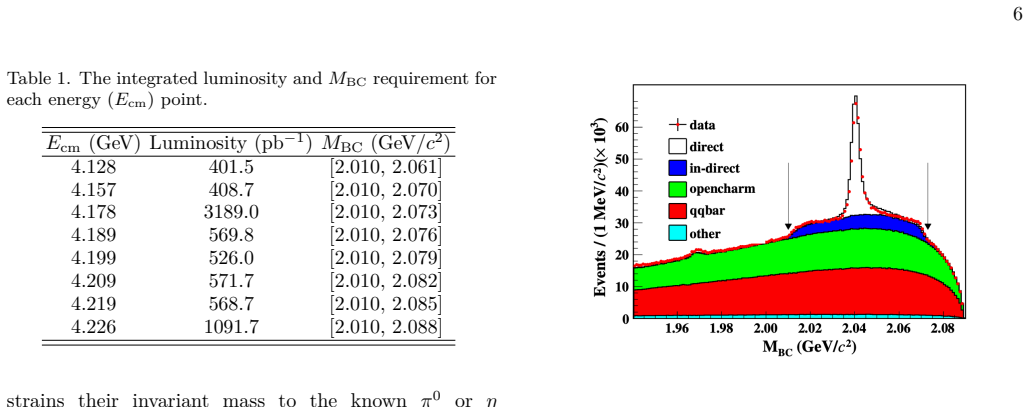
Figure 1. Figure 1: Distributions of MBC of the ST D − s candidates in data and inclusive MC samples at 4.178 GeV. The candidates between the two black arrows are retained for further analysis. The colored histograms represent various e +e − annihilation processes. These histograms are estimated with inclusive MC samples mentioned in Sec. II. The white (direct) histogram corresponds to events where the ST D − s candidate is p… view at source ↗
Figure 2
Figure 2. Figure 2: Fits to the Mtag distributions of the accepted ST D − s candidates for different tag modes. The points with error bars are data summed over all energy points, the blue solid curves are the best fit results, and the red dashed curves are the fitted background shapes. For the D − s → K0 SK− tag mode, the green curve is the D− → K0 S π− peaking background. The pair of light blue arrows denotes the Mtag signal… view at source ↗
Figure 3
Figure 3. Figure 3: Fits to the Msig distributions of the accepted DT candidates. The points with error bars are data. The blue solid curves are the fit results. The yellow and red dashed curves are the fitted signals and combinatorial background, respectively. The green dashed curve represents the background bump caused by D + s → ρ +ϕ [PITH_FULL_IMAGE:figures/full_fig_p008_3.png] view at source ↗
Figure 4
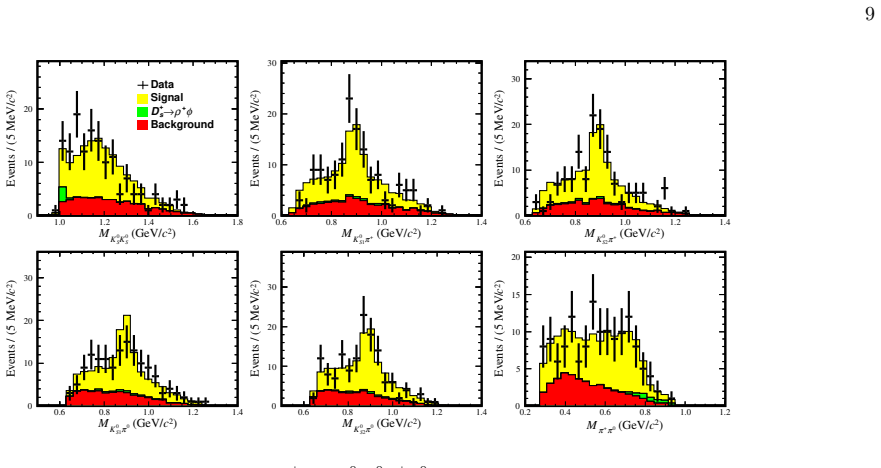
Figure 4. Figure 4: Comparisons of MKK, MKπ, and Mππ for D + s → K0 SK0 Sπ +π 0 . The points with error bars are data, the yellow filled histograms are signal, the green histogram represents the peaking background from D + s → ρ +ϕ, and the red filled histograms are simulated backgrounds from the inclusive MC sample. Events have been further required to satisfy 1.943 < Msig < 1.983 GeV/c 2 . 0.2 0.4 0.6 0.8 1.0 ) 2 0 (GeV/c π… view at source ↗
Figure 5
Figure 5. Figure 5: Comparisons of MKK, MKπ, and Mππ for D + s → K0 SK+π 0π 0 . The points with error bars are data, the yellow filled histograms are signal, and the red filled histograms are simulated backgrounds from the inclusive MC sample. Events have been further required to satisfy 1.943 < Msig < 1.983 GeV/c 2 . the quoted branching fractions of D∗− s → γ(π 0 )D+ s be ±1σ affects the DT efficiencies by 0.2%, which is as… view at source ↗
read the original abstract

By analyzing $e^+e^-$ collision data corresponding to an integrated luminosity of 7.33~fb$^{-1}$ collected with the BESIII detector at center-of-mass energies ranging from 4.128 to 4.226~GeV, we report the observations of the hadronic decays $D^+_s\to K^0_SK^0_S\pi^+\pi^0$ and $D^+_s\to K^0_S K^+\pi^0\pi^0$. Their decay branching fractions are determined to be ${\mathcal B}(D^+_s\to K^0_SK^0_S \pi^+\pi^0)=(4.08\pm0.46_{\rm stat}\pm0.45_{\rm syst})\times 10^{-3}$ and ${\mathcal B}(D^+_s\to K^0_S K^+\pi^0\pi^0)=(3.32\pm0.64_{\rm stat}\pm0.31_{\rm syst})\times 10^{-3}$, where the first uncertainties are statistical and the second are systematic.

Editorial analysis

A structured set of objections, weighed in public.

Desk editor's note, referee report, simulated authors' rebuttal, and a circularity audit. Tearing a paper down is the easy half of reading it; the pith above is the substance, this is the friction.

Referee Report

1 major / 2 minor

Summary. The paper reports the first observations of the decays D_s^+ → K_S^0 K_S^0 π^+ π^0 and D_s^+ → K_S^0 K^+ π^0 π^0 in 7.33 fb^{-1} of e^+e^- collision data collected by BESIII at √s = 4.128–4.226 GeV. Branching fractions are extracted via standard single- or double-tag techniques with MC-derived efficiencies, yielding B(D_s^+ → K_S^0 K_S^0 π^+ π^0) = (4.08 ± 0.46_stat ± 0.45_syst) × 10^{-3} and B(D_s^+ → K_S^0 K^+ π^0 π^0) = (3.32 ± 0.64_stat ± 0.31_syst) × 10^{-3}.

Significance. These absolute branching-fraction measurements add new experimental input on multi-body hadronic D_s decays, which can constrain models of charm decay dynamics and improve predictions for related processes. The direct use of collision data with quoted statistical and systematic uncertainties, without reliance on parameter-free derivations or self-referential fits, is a methodological strength.

major comments (1)
  1. The central results depend on Monte Carlo modeling of detector efficiencies and background shapes for these four-body final states. A dedicated section or appendix should quantify the agreement between data and MC in control samples (e.g., sideband or tag-side distributions) to demonstrate that any residual mismatch does not bias the extracted signal yields at the level of the quoted uncertainties.
minor comments (2)
  1. The abstract states the observations but does not quote the statistical significance or raw event yields; adding these numbers would help readers assess the strength of the claims immediately.
  2. Clarify in the text whether the analysis employs a single-tag or double-tag method and how the normalization mode is chosen, as this choice directly affects the absolute branching-fraction scale.

Simulated Author's Rebuttal

1 responses · 0 unresolved

We thank the referee for the positive evaluation of our manuscript and for the constructive comment on the validation of Monte Carlo modeling. We address the point below and have revised the paper accordingly.

read point-by-point responses
  1. Referee: The central results depend on Monte Carlo modeling of detector efficiencies and background shapes for these four-body final states. A dedicated section or appendix should quantify the agreement between data and MC in control samples (e.g., sideband or tag-side distributions) to demonstrate that any residual mismatch does not bias the extracted signal yields at the level of the quoted uncertainties.

    Authors: We agree that explicit validation of the Monte Carlo description is important for four-body final states. In the revised manuscript we have added a new Appendix A that presents direct data-MC comparisons for the relevant kinematic variables (invariant masses of K_S^0 pairs, pion momenta, and missing-mass distributions) in both the signal region and the sideband regions, as well as for the single-tag D_s^- candidates. The comparisons demonstrate agreement within the available statistics; any small residual differences are already incorporated into the systematic uncertainties quoted in the paper. This addition confirms that modeling uncertainties do not bias the extracted yields beyond the reported errors. revision: yes

Circularity Check

0 steps flagged

No significant circularity

full rationale

This is a direct experimental measurement of two hadronic branching fractions from e+e- collision data at BESIII. The reported values are obtained by counting signal yields in data, dividing by reconstruction efficiencies derived from Monte Carlo, and normalizing to the known D_s^+ production cross section and integrated luminosity. No derivation chain reduces a claimed prediction to a fitted parameter by construction, no self-citation supplies a load-bearing uniqueness theorem, and no ansatz is smuggled in. The analysis follows standard single- or double-tag procedures with quoted statistical and systematic uncertainties; the central results remain independent of the paper's own inputs once external benchmarks (luminosity, cross sections, detector response) are accepted.

Axiom & Free-Parameter Ledger

0 free parameters · 0 axioms · 0 invented entities

The central claim is an experimental measurement relying on standard particle physics techniques, detector calibration, and Monte Carlo modeling of efficiencies and backgrounds; no specific free parameters, axioms, or invented entities are detailed in the abstract.

pith-pipeline@v0.9.0 · 9258 in / 1151 out tokens · 60041 ms · 2026-05-12T04:16:41.722408+00:00 · methodology

discussion (0)

Sign in with ORCID, Apple, or X to comment. Anyone can read and Pith papers without signing in.

Reference graph

Works this paper leans on

25 extracted references · 25 canonical work pages

  1. [1]

    P. U. E. Onyisi et al. (CLEO Collaboration), Phys. Rev. D 88, 032009 (2013)

  2. [2]

    Ablikim et al

    M. Ablikim et al. (BESIII Collaboration), JHEP 06, 181 (2021)

  3. [3]

    Y. K. Hsiao and C. Q. Geng, Phys. Lett. B 770, 348 (2017)

  4. [4]

    Z. Rui, Y. Li and H. n. Li, JHEP 05, 082 (2021)

  5. [5]

    Y. K. Hsiao, Phys. Lett. B 845, 138158 (2023)

  6. [6]

    Ablikim et al

    M. Ablikim et al . (BESIII Collaboration), Phys. Rev. D 104, 032011 (2021)

  7. [7]

    Ablikim et al

    M. Ablikim et al . (BESIII Collaboration), Phys. Rev. D 103, 092006 (2021)

  8. [8]

    Navas et al

    S. Navas et al. (Particle Data Group), Phys. Rev. D 110, 030001 (2024)

  9. [9]

    Ablikim et al

    M. Ablikim et al. (BESIII Collaboration), Nucl. Instrum. Meth. A 614, 345 (2010)

  10. [10]

    C. H. Yu et al. , Proceedings of IPAC2016, Busan, Korea, 2016

  11. [11]

    Li et al

    X. Li et al. , Radiat. Detect. Technol. Methods 1, 13 (2017); Y. X. Guo et al. , Radiat. Detect. Technol. Methods 1, 15 (2017) ; P. Cao et al., Nucl. Instrum. Meth. A 953, 163053 (2020)

  12. [12]

    Ablikim et al

    M. Ablikim et al. (BESIII Collaboration), Chin. Phys. C 39, 093001 (2015) ; Chin. Phys. C 46, 113002 (2022) . These articles described the integrated luminosity measurement for data taken at √s = 4.189, 4.199, 4.209, 4.219, and 4.226 GeV. The integrated luminosity values for the other data samples have been obtained by a similar procedure

  13. [13]

    Agostinelli et al

    S. Agostinelli et al. (GEANT4 Collaboration), Nucl. Instrum. Meth. A 506, 250 (2003)

  14. [14]

    Jadach, B

    S. Jadach, B. F. L. Ward and Z. Was, Phys. Rev. D 63, 113009 (2001) ; Comput. Phys. Commun. 130, 260 (2000)

  15. [15]

    D. J. Lange, Nucl. Instrum. Meth. A 462, 152 (2001) ; R. G. Ping, Chin. Phys. C 32, 599 (2008)

  16. [16]

    J. C. Chen, G. S. Huang, X. R. Qi, D. H. Zhang and Y. S. Zhu, Phys. Rev. D 62, 034003 (2000) ; R. L. Yang, R. G. Ping and H. Chen, Chin. Phys. Lett. 31, 061301 (2014)

  17. [17]

    Barberio, B

    E. Barberio, B. van Eijk and Z. Was, Comput. Phys. Commun. 66, 115 (1991)

  18. [18]

    R. M. Baltrusaitis et al. (MARKIII collaboration), Phys. Rev. Lett. 56, 2140 (1986). J. Adler et al. (MARKIII collaboration), Phys. Rev. Lett. 60, 89 (1988)

  19. [19]

    B. C. Ke, J. Koponen, H. B. Li and Y. Zheng, Ann. Rev. Nucl. Part. Sci. 73, 285 (2023)

  20. [20]

    Ablikim et al

    M. Ablikim et al. (BESIII Collaboration), Phys. Rev. D 108, 112001 (2023)

  21. [21]

    Ablikim et al

    M. Ablikim et al . (BESIII Collaboration), Phys. Rev. D 83, 112005 (2011)

  22. [23]

    Ablikim et al

    M. Ablikim et al. (BESIII Collaboration), Phys. Rev. D 104, 032001 (2021)

  23. [24]

    Ablikim et al

    M. Ablikim et al. (BESIII Collaboration), Phys. Rev. D 92, 112008 (2015)

  24. [25]

    Ablikim et al

    M. Ablikim et al. (BESIII Collaboration), Phys. Rev. D 108, 092003 (2023)

  25. [26]

    Ablikim et al

    M. Ablikim et al. (BESIII Collaboration), Phys. Rev. D 109, 032011 (2024)