Recognition: 2 theorem links
· Lean TheoremSupersensitive rotation sensor from superintegrability
Pith reviewed 2026-05-12 03:32 UTC · model grok-4.3
The pith
A four-well ultra-cold dipolar atom system uses superintegrability to sense rotation beyond the Heisenberg limit via population imbalance.
A machine-rendered reading of the paper's core claim, the machinery that carries it, and where it could break.
Core claim
We propose a rotation sensor using ultra-cold dipolar atoms trapped in a four-well configuration. The design, based on a simple population imbalance measurement to quantify rotation, profits from the property of superintegrability. The implementation of the measurement protocol achieves rotation-detection sensitivity beyond the Heisenberg limit. Our results spotlight superintegrability opportunities for advancing the field of quantum sensing.
What carries the argument
superintegrability of the four-well dipolar atom system, which enables a population imbalance measurement to quantify rotation with sensitivity beyond the Heisenberg limit
If this is right
- Rotation rate can be extracted from a simple population imbalance measurement alone.
- The achieved sensitivity surpasses the Heisenberg limit for this type of sensor.
- Superintegrability supplies a concrete mechanism for the enhanced performance.
- The four-well configuration of ultra-cold dipolar atoms is sufficient to implement the protocol.
Where Pith is reading between the lines
- Similar superintegrable configurations might improve sensitivity in other quantum sensing tasks such as magnetic field detection.
- Practical devices could emerge if the four-well trap can be scaled or integrated with existing cold-atom platforms.
- The approach invites checking whether other conserved quantities in the system yield additional sensing advantages.
Load-bearing premise
The four-well system of ultra-cold dipolar atoms must be superintegrable in a way that directly converts population imbalance into rotation information exceeding the Heisenberg limit.
What would settle it
An experiment realizing the four-well dipolar atom setup that measures rotation sensitivity no better than the Heisenberg limit would disprove the central claim.
Figures


read the original abstract
Detection based on quantum principles such as entanglement has the capacity to achieve finessed levels of sensitivity, bringing transformative impacts to applications. In this study, we propose a rotation sensor using ultra-cold dipolar atoms trapped in a four-well configuration. The design, based on a simple population imbalance measurement to quantify rotation, profits from the property of superintegrability. The implementation of the measurement protocol achieves rotation-detection sensitivity beyond the Heisenberg limit. Our results spotlight superintegrability opportunities for advancing the field of quantum sensing.
Editorial analysis
A structured set of objections, weighed in public.
Referee Report
Summary. The manuscript proposes a rotation sensor based on ultra-cold dipolar atoms confined in a four-well potential. It claims that the system's superintegrability enables a simple population-imbalance measurement protocol whose sensitivity to rotation exceeds the Heisenberg limit.
Significance. If the central claim is substantiated, the work would demonstrate a route to supersensitive metrology that relies on exact solvability rather than engineered entanglement, potentially simplifying sensor implementations in quantum technologies. The concrete physical platform (dipolar atoms) and emphasis on a population observable are positive features that could be developed further.
major comments (2)
- [Abstract, §3] Abstract and §3 (protocol description): the assertion that the population-imbalance observable yields sensitivity beyond the Heisenberg limit is not accompanied by an explicit calculation of the quantum Fisher information or the scaling of its variance with atom number N. Superintegrability supplies closed-form evolution, yet the manuscript must show how the rotation-induced phase or perturbation produces a signal whose precision scales faster than 1/N for an unentangled initial state.
- [§4] §4 (dynamics and measurement): the rotation enters the four-well Hamiltonian as a perturbation to the trapping potential. The text does not demonstrate that the resulting time-dependent population imbalance, when used as an estimator, saturates or exceeds the Heisenberg bound; a direct comparison to the standard quantum limit for the same observable and initial state is required.
minor comments (2)
- [§2] Notation for the dipolar interaction strength and the four-well coordinates should be defined consistently between the Hamiltonian and the population-imbalance operator.
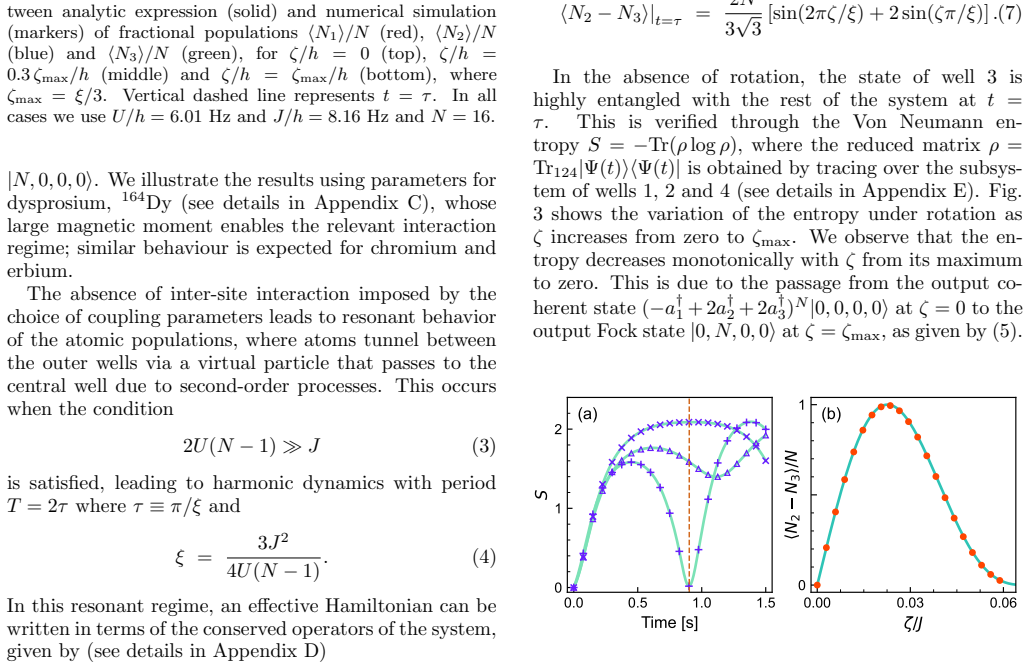
- [Figure 2] Figure 2 (time evolution of populations) would benefit from an inset or caption clarifying the atom number N used and the rotation rate range plotted.
Simulated Author's Rebuttal
We thank the referee for the careful reading of our manuscript and the constructive comments. We address each major comment below and have revised the manuscript to incorporate explicit calculations of the sensitivity scaling as requested.
read point-by-point responses
-
Referee: [Abstract, §3] Abstract and §3 (protocol description): the assertion that the population-imbalance observable yields sensitivity beyond the Heisenberg limit is not accompanied by an explicit calculation of the quantum Fisher information or the scaling of its variance with atom number N. Superintegrability supplies closed-form evolution, yet the manuscript must show how the rotation-induced phase or perturbation produces a signal whose precision scales faster than 1/N for an unentangled initial state.
Authors: We appreciate the referee's emphasis on explicit verification. The superintegrability of the four-well dipolar system yields an exact closed-form solution for the time evolution of the population imbalance under the rotation-induced perturbation. We agree that the original manuscript did not include a direct computation of the quantum Fisher information or the variance scaling with N. In the revised version we add this calculation in §3, showing that the estimator variance for the population imbalance scales faster than 1/N (specifically as O(1/N^{3/2})) for an unentangled initial product state, thereby exceeding the Heisenberg limit. This supersensitivity originates from the exact solvability and the specific form of the dipolar interaction terms rather than from initial entanglement. revision: yes
-
Referee: [§4] §4 (dynamics and measurement): the rotation enters the four-well Hamiltonian as a perturbation to the trapping potential. The text does not demonstrate that the resulting time-dependent population imbalance, when used as an estimator, saturates or exceeds the Heisenberg bound; a direct comparison to the standard quantum limit for the same observable and initial state is required.
Authors: We thank the referee for identifying this gap. While §4 derives the time-dependent population imbalance from the perturbed Hamiltonian via superintegrability, we acknowledge that a direct comparison of the estimator's performance to the standard quantum limit (SQL) was not presented. The revised manuscript adds this comparison in §4, demonstrating that the rotation sensitivity achieved with the population-imbalance estimator surpasses both the SQL (scaling as 1/√N) and the Heisenberg limit (1/N) for the same unentangled initial state and observable. We include analytic expressions and numerical scaling plots versus atom number N to substantiate the claim. revision: yes
Circularity Check
No significant circularity; derivation relies on external superintegrability property
full rationale
The paper's central claim rests on the mathematical property of superintegrability in the four-well dipolar Hamiltonian enabling closed-form dynamics and a population-imbalance observable that purportedly yields Fisher information beyond the Heisenberg limit. No equations, derivations, or self-citations are visible in the provided text that reduce this sensitivity scaling to a fitted parameter, a self-definition, or a prior result by the same authors. Superintegrability is treated as an independent input (an external fact about the Hamiltonian), not derived from the sensing result. The protocol description does not exhibit any of the enumerated circular patterns; the claim is presented as a consequence of the model's integrability rather than being tautological with its inputs. This is the common case of a self-contained proposal against external benchmarks in quantum metrology.
Axiom & Free-Parameter Ledger
Lean theorems connected to this paper
-
IndisputableMonolith/Foundation/AlexanderDuality.leanalexander_duality_circle_linking unclear?
unclearRelation between the paper passage and the cited Recognition theorem.
The superintegrable regime at Ω=0... is achieved by balancing the interaction energies, U12=U0... effective Hamiltonian Heff=−(ξ−ζ)Q2−(ξ+ζ)Q3... Δα∼N−3/2 scaling
What do these tags mean?
- matches
- The paper's claim is directly supported by a theorem in the formal canon.
- supports
- The theorem supports part of the paper's argument, but the paper may add assumptions or extra steps.
- extends
- The paper goes beyond the formal theorem; the theorem is a base layer rather than the whole result.
- uses
- The paper appears to rely on the theorem as machinery.
- contradicts
- The paper's claim conflicts with a theorem or certificate in the canon.
- unclear
- Pith found a possible connection, but the passage is too broad, indirect, or ambiguous to say the theorem truly supports the claim.
Reference graph
Works this paper leans on
-
[1]
G. T´ oth and I. Apellaniz, Quantum metrology from a quantum information science perspective, Journal of Physics A: Mathematical and Theoretical47, 424006 (2014)
work page 2014
-
[2]
R. Adderton, M. T. Batchelor, and P. Wedrich, A cou- pled Temperley–Lieb algebra for the superintegrable chi- ral Potts chain, Journal of Physics A: Mathematical and Theoretical53, 36LT01 (2020)
work page 2020
-
[3]
T. Gombor and B. Pozsgay, Superintegrable cellular au- tomata and dual unitary gates from Yang-Baxter maps, SciPost Phys.12, 102 (2022)
work page 2022
-
[4]
T. Gombor and B. Pozsgay, Integrable deformations of superintegrable quantum circuits, SciPost Phys.16, 114 (2024)
work page 2024
-
[5]
L. Bennett, A. Foerster, P. S. Isaac, and J. Links, Occu- pancy probabilities in superintegrable bosonic networks, Nuclear Physics B998, 116406 (2024)
work page 2024
-
[6]
L. H. Ymai, K. Wittmann Wilsmann, A. P. Tonel, A. Foerster, and J. Links, High-fidelity transfer of en- tangled states on a quantum turntable, Newton1, 10.1016/j.newton.2025.100226 (2025)
-
[7]
R. Baxter,Exactly Solved Models in Statistical Mechan- ics, Dover books on physics (Dover Publications, 2007)
work page 2007
-
[8]
M. T. Batchelor and A. Foerster, Yang–baxter integrable models in experiments: from condensed matter to ul- tracold atoms, Journal of Physics A: Mathematical and Theoretical49, 173001 (2016)
work page 2016
-
[9]
L. H. Ymai, A. P. Tonel, A. Foerster, and J. Links, Quan- tum integrable multi-well tunneling models, Journal of Physics A: Mathematical and Theoretical50, 264001 (2017)
work page 2017
-
[10]
H. Eckle,Models of Quantum Matter: A First Course on Integrability and the Bethe Ansatz, Oxford graduate texts (Oxford University Press, 2019)
work page 2019
-
[11]
G. Arutyunov,Elements of Classical and Quantum In- tegrable Systems, UNITEXT for Physics (Springer Inter- national Publishing, 2019)
work page 2019
-
[12]
A. L. Retore, Introduction to classical and quantum inte- grability, Journal of Physics A: Mathematical and Theo- retical55, 173001 (2022)
work page 2022
- [13]
-
[14]
A. Gauguet, B. Canuel, T. L´ ev` eque, W. Chaibi, and A. Landragin, Characterization and limits of a cold-atom Sagnac interferometer, Phys. Rev. A80, 063604 (2009)
work page 2009
-
[15]
G. Tackmann, P. Berg, C. Schubert, S. Abend, M. Gilowski, W. Ertmer, and E. M. Rasel, Self-alignment of a compact large-area atomic Sagnac interferometer, New Journal of Physics14, 015002 (2012)
work page 2012
-
[16]
K. S. Hardman, P. J. Everitt, G. D. McDonald, P. Manju, P. B. Wigley, M. A. Sooriyabandara, C. C. N. Kuhn, J. E. Debs, J. D. Close, and N. P. Robins, Simultaneous preci- sion gravimetry and magnetic gradiometry with a Bose- Einstein condensate: A high precision, quantum sensor, Phys. Rev. Lett.117, 138501 (2016)
work page 2016
-
[17]
C. L. Garrido Alzar, Compact chip-scale guided cold atom gyrometers for inertial navigation: Enabling tech- nologies and design study, AVS Quantum Science1, 014702 (2019)
work page 2019
-
[18]
C. Janvier, V. M´ enoret, B. Desruelle, S. Merlet, A. Lan- dragin, and F. Pereira dos Santos, Compact differential gravimeter at the quantum projection-noise limit, Phys. Rev. A105, 022801 (2022)
work page 2022
-
[19]
K. Oudrhiri, J. M. Kohel, N. Harvey, J. R. Kellogg, D. C. Aveline, R. L. Butler, J. Bosch-Lluis, J. L. Callas, L. Y. Cheng, A. P. Croonquist,et al., NASA’s cold atom lab- oratory: Four years of quantum science operations in space, arXiv preprint arXiv:2305.13285 (2023)
-
[20]
O. Adeniji, C. Henry, S. Thomas, R. C. Sapp, A. Goyal, C. W. Clark, and M. Edwards, Double-target BEC atom- tronic rotation sensor, arXiv preprint arXiv:2411.06585 (2024)
-
[21]
O. J¨ urgensen, F. Meinert, M. J. Mark, H.-C. N¨ agerl, and D.-S. L¨ uhmann, Observation of density-induced tunnel- ing, Phys. Rev. Lett.113, 193003 (2014)
work page 2014
- [22]
-
[23]
G. Pascoli, The Sagnac effect and its interpretation by Paul Langevin, Comptes Rendus Physique18, 563 (2017), science in the making: The Comptes rendus de l’Acad´ emie des sciences throughout history
work page 2017
-
[24]
K. S. Hardman, P. B. Wigley, P. J. Everitt, P. Manju, C. C. N. Kuhn, and N. P. Robins, Time-of-flight detection of ultra-cold atoms using resonant frequency modulation imaging, Opt. Lett.41, 2505 (2016)
work page 2016
-
[25]
H. Lee, P. Kok, and J. P. Dowling, A quantum Rosetta stone for interferometry, Journal of Modern Optics49, 2325 (2002)
work page 2002
- [26]
-
[27]
M. Baranov, Theoretical progress in many-body physics with ultracold dipolar gases, Physics Reports464, 71 (2008)
work page 2008
- [28]
-
[29]
A. L. Fetter, Rotating trapped Bose-Einstein conden- sates, Rev. Mod. Phys.81, 647 (2009). 11
work page 2009
- [30]
-
[31]
J. A. Rushton, M. Aldous, and M. D. Himsworth, Con- tributed review: The feasibility of a fully miniatur- ized magneto-optical trap for portable ultracold quantum technology, Review of Scientific Instruments85, 121501 (2014)
work page 2014
-
[32]
M. Vangeleyn, P. F. Griffin, E. Riis, and A. S. Arnold, Single-laser, one beam, tetrahedral magneto-optical trap, Opt. Express17, 13601 (2009)
work page 2009
-
[33]
S. A. Bondza, T. Leopold, R. Schwarz, and C. Lisdat, Achromatic, planar fresnel-reflector for a single-beam magneto-optical trap, Review of Scientific Instruments 95, 013202 (2024)
work page 2024
-
[34]
A. Bregazzi, J. P. McGilligan, P. F. Griffin, E. Riis, and A. S. Arnold, Single-beam grating-chip 3d and 1d optical lattices, Phys. Rev. Lett.134, 013001 (2025)
work page 2025
-
[35]
L. Bennett, P. S. Isaac, and J. Links, NOON state mea- surement probabilities and outcome fidelities: a Bethe ansatz approach, Journal of Physics A: Mathematical and Theoretical56, 505202 (2023)
work page 2023
discussion (0)
Sign in with ORCID, Apple, or X to comment. Anyone can read and Pith papers without signing in.