Recognition: 1 theorem link
All-Optical Universal Control of Hyperfine Qudits in Trapped Neutral Atoms
Pith reviewed 2026-05-12 02:56 UTC · model grok-4.3
The pith
Magic polarization angles enable all-optical universal control of hyperfine qudits in trapped neutral atoms.
A machine-rendered reading of the paper's core claim, the machinery that carries it, and where it could break.
Core claim
For the fermionic isotope 173Yb, the strong hyperfine interaction in the 3P1 manifold enables fast and selective Raman transitions between nuclear-spin states in the 1S0 ground-state manifold using a single linearly polarized laser. For each neighboring transition in the qudit manifold, a magic polarization angle enables coherent, state-selective control while suppressing off-resonant excitations sufficiently to support operation frequencies exceeding 100 kHz. Combined with phase-shift operations, this provides universal control of the full single-qudit space, and compatible two-qudit gates based on the Rydberg blockade mechanism complete a universal gate set.
What carries the argument
Magic polarization angles for a single linearly polarized laser that drive state-selective Raman transitions in the hyperfine manifold while suppressing off-resonant couplings.
If this is right
- Universal single-qudit control becomes possible using only optical fields and simple phase shifts.
- Rydberg blockade supplies compatible two-qudit entangling gates without conflicting with the single-qudit protocol.
- State-selective readout schemes can be integrated with the all-optical control.
- The 173Yb platform supports high-fidelity qudit operations at speeds exceeding 100 kHz.
Where Pith is reading between the lines
- Fewer lasers and simpler optics could lower the technical barriers to scaling neutral-atom quantum processors that use higher-dimensional qudits.
- The approach may generalize to other atoms with comparable hyperfine structure in their metastable states.
- Successful implementation would allow direct tests of whether qudit circuits deliver measurable resource savings over qubit equivalents in the same hardware.
Load-bearing premise
That magic polarization angles exist for each neighboring transition such that coherent state-selective control is achieved while off-resonant excitations are suppressed sufficiently to support operation frequencies exceeding 100 kHz.
What would settle it
A measurement or calculation at the proposed magic angles showing that the ratio of desired to off-resonant Rabi frequencies is too low to support gates above 100 kHz with acceptable fidelity would disprove the scheme.
Figures




read the original abstract
Quantum systems with more than two levels $-$ so-called qudits $-$ offer increased computational density and reduced circuit complexity compared to qubit-based architectures, but achieving universal and scalable control remains challenging. We propose an all-optical scheme for universal qudit control in trapped neutral atoms in moderate to high magnetic fields, focusing on the fermionic isotope $^{173}$Yb ($I=5/2$). The strong hyperfine interaction in the $^3P_1$ manifold enables fast and selective Raman transitions between nuclear-spin states in the $^1S_0$ ground-state manifold using a single linearly polarized laser. For each neighboring transition in the qudit manifold, we identify a magic polarization angle that enables coherent, state-selective control while suppressing off-resonant excitations, with operation frequencies exceeding 100~kHz. Combined with phase-shift operations, this provides universal control of the full single-qudit space. We further discuss compatible two-qudit gates based on the Rydberg blockade mechanism, completing a universal gate set, and analyze state-selective readout schemes compatible with the proposed protocol. Our results identify $^{173}$Yb as a promising platform for high-fidelity, all-optical qudit-based quantum information processing.
Editorial analysis
A structured set of objections, weighed in public.
Referee Report
Summary. The paper proposes an all-optical scheme for universal single-qudit control of the I=5/2 hyperfine manifold in 173Yb atoms using a single linearly polarized laser to drive state-selective Raman transitions via the 3P1 manifold. For each neighboring ΔmF=±1 transition, the authors identify a 'magic' polarization angle that is claimed to enable coherent driving at >100 kHz while suppressing off-resonant excitations to other hyperfine states. These operations, combined with phase-shift gates, are asserted to provide universal single-qudit control; compatible Rydberg-blockade two-qudit gates and state-selective readout are also discussed.
Significance. If the claimed magic angles can be shown to simultaneously deliver the required Rabi rates and leakage suppression, the scheme would constitute a notable simplification for neutral-atom qudit architectures, replacing multi-laser or microwave control with a single optical field and potentially enabling higher gate speeds and reduced hardware complexity.
major comments (3)
- [Sections describing the magic-angle identification and single-qudit control] The central claim that magic polarization angles exist for all six neighboring transitions rests on an unshown perturbative treatment of AC Stark shifts and Raman couplings. No explicit effective-Hamiltonian derivation, numerical diagonalization of the driven hyperfine manifold, or plots of Ω_res(θ) and leakage rates versus polarization angle are provided to confirm that a single θ per transition can null off-resonant couplings by an order of magnitude while keeping Ω_res > 2π×100 kHz at moderate-to-high B fields.
- [The paragraph on universal single-qudit space] The universal-control assertion requires that the identified angles work simultaneously for the full ladder without higher-order Zeeman mixing or polarization imperfections invalidating the nulls. The manuscript supplies neither a quantitative error budget nor a fidelity estimate under realistic laser linewidth, intensity noise, or magnetic-field inhomogeneity.
- [The section on two-qudit gates] For the two-qudit gates, the Rydberg-blockade mechanism is stated to be compatible, but no calculation of blockade strength relative to the single-qudit Rabi frequency, no estimate of leakage into non-blockaded states, and no gate-fidelity projection are given.
minor comments (1)
- [Abstract and Sec. on magic angles] The abstract and main text refer to 'magic polarization angles' without tabulating the numerical values or the atomic-physics inputs (e.g., hyperfine constants, Landé g-factors) used to locate them.
Simulated Author's Rebuttal
We thank the referee for their careful reading of the manuscript and for the constructive comments, which have helped us improve the clarity and completeness of our work. We address each major comment below and have revised the manuscript to incorporate the requested details, derivations, and analyses.
read point-by-point responses
-
Referee: [Sections describing the magic-angle identification and single-qudit control] The central claim that magic polarization angles exist for all six neighboring transitions rests on an unshown perturbative treatment of AC Stark shifts and Raman couplings. No explicit effective-Hamiltonian derivation, numerical diagonalization of the driven hyperfine manifold, or plots of Ω_res(θ) and leakage rates versus polarization angle are provided to confirm that a single θ per transition can null off-resonant couplings by an order of magnitude while keeping Ω_res > 2π×100 kHz at moderate-to-high B fields.
Authors: We acknowledge that the main text presents the identified magic angles and resulting Rabi rates without including the supporting derivations or numerical validations. The angles were obtained from a perturbative treatment of the AC Stark shifts and effective Raman couplings within the hyperfine manifold of 173Yb. In the revised manuscript we will add an appendix that contains (i) the explicit effective-Hamiltonian derivation, (ii) results of numerical diagonalization of the driven system, and (iii) plots of Ω_res(θ) and leakage rates versus polarization angle for each neighboring transition at representative magnetic fields. These additions will explicitly demonstrate that, for each Δm_F = ±1 transition, a single θ exists that suppresses off-resonant excitations by more than an order of magnitude while maintaining Ω_res > 2π × 100 kHz. revision: yes
-
Referee: [The paragraph on universal single-qudit space] The universal-control assertion requires that the identified angles work simultaneously for the full ladder without higher-order Zeeman mixing or polarization imperfections invalidating the nulls. The manuscript supplies neither a quantitative error budget nor a fidelity estimate under realistic laser linewidth, intensity noise, or magnetic-field inhomogeneity.
Authors: We agree that a quantitative error budget is required to substantiate the claim of universal single-qudit control. In the revised manuscript we will add a dedicated subsection that provides an error budget incorporating higher-order Zeeman mixing, finite polarization purity, laser linewidth, intensity noise, and magnetic-field inhomogeneity. Using realistic experimental parameters for 173Yb, we will report estimated gate infidelities for the full set of single-qudit operations. revision: yes
-
Referee: [The section on two-qudit gates] For the two-qudit gates, the Rydberg-blockade mechanism is stated to be compatible, but no calculation of blockade strength relative to the single-qudit Rabi frequency, no estimate of leakage into non-blockaded states, and no gate-fidelity projection are given.
Authors: The manuscript’s discussion of two-qudit gates is limited to a statement of compatibility with Rydberg blockade. We will expand this section in the revision to include (i) estimates of the blockade interaction strength relative to the single-qudit Raman Rabi frequencies, (ii) an analysis of leakage channels into non-blockaded states, and (iii) projected two-qudit gate fidelities based on typical Rydberg lifetimes and interaction strengths in 173Yb. revision: yes
Circularity Check
No circularity: magic polarization angles and universal control derived from independent atomic physics calculations
full rationale
The paper's central claim of universal single-qudit control rests on identifying magic polarization angles for Raman transitions in the I=5/2 manifold of 173Yb. These angles are obtained from perturbative calculations of AC Stark shifts and effective Rabi frequencies using the known hyperfine structure, Zeeman mixing, and laser polarization, which are external atomic-physics inputs independent of the control protocol. No parameter is fitted to the scheme's own performance metrics and then re-labeled as a prediction; the >100 kHz operation frequency is a consequence of the calculated suppression of off-resonant couplings rather than a self-referential fit. Two-qudit gates via Rydberg blockade and readout schemes are discussed separately without reducing to the single-qudit angles. The derivation chain is therefore self-contained against external benchmarks and contains no self-definitional, fitted-input, or self-citation load-bearing steps.
Axiom & Free-Parameter Ledger
axioms (2)
- standard math Standard quantum mechanics of light-atom interactions and hyperfine structure in moderate-to-high magnetic fields.
- domain assumption Strong hyperfine interaction in the 3P1 manifold of 173Yb enables fast Raman coupling.
Reference graph
Works this paper leans on
-
[1]
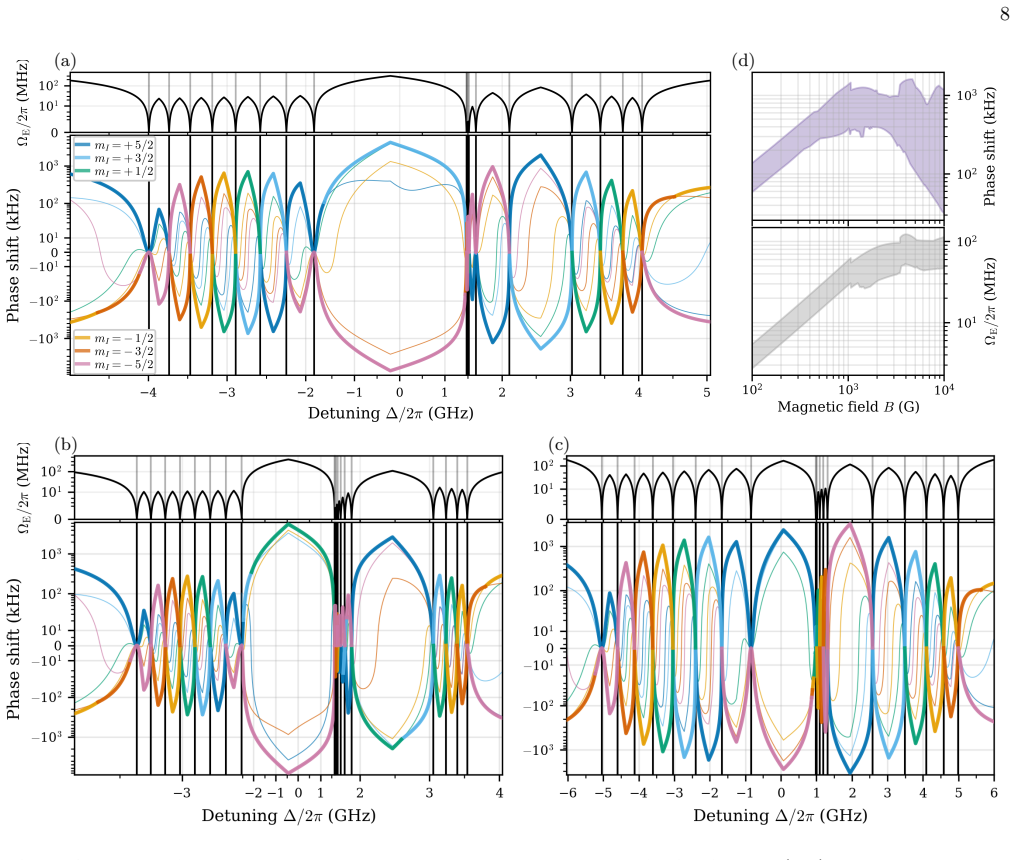
Magic angle From the effective Hamiltonian in Eq. (14) we obtain the diagonal energies Eeff(mI) =E G mI − Ω2 E 4 sz mI cos2 θ+s x mI sin2 θ , which defines the effective energy difference between neighboring states δEeff,mI =E eff(mI +1)−E eff(mI). Using Eq. (14), this energy difference can be written explicitly as δEeff,mI =δE G mI − Ω2 E 4 h δsz mI cos2...
-
[2]
First, the excited-state population must remain small
Feasibility conditions In addition to the resonance condition, two further con- straints must be satisfied to obtain high-fidelity transi- tions. First, the excited-state population must remain small. From the adiabatic-elimination approximation in Eq. (10) one obtains the crude bound pE :=∥ψ E ∥2 ≈ ⟨ψ G|W H −2 E W † |ψG⟩ ≤ Ω2 E 4δ2 min ,(21) whereδ min d...
-
[3]
bright” state from the remaining “dark
Phase diagram of nearest neighbor transitions The resulting phase diagram is shown in Fig. 2(a) and (b). Panel (a) presents a scan over magnetic fieldBand detuning ˜∆, where we introduce the shifted detuning ˜∆ = ∆− 1 2I+1 2I+1X ν=1 Eν,(25) which centers the excited state levels of them J =−1 manifold around zero and improves the visibility of the relevan...
-
[4]
Combining these expressions yields |ℏΩE|=D q 2I ε0c .(A1) Using this formula, electronic Rabi frequencies of ΩE/2π= 10,20,40 MHz correspond to intensities of I= 0.02,0.08,0.3 W/cm 2, respectively. For a Gaus- sian beam with waistw 0, the peak intensity isI= 2P πw2 0 , wherePdenotes the optical power. Hence, these intensi- ties map to optical powers of a f...
-
[5]
Adiabatic elimination in theH=G ⊕ E decomposition Beyond the crude condition∂ t |ψE ⟩ ≈0, we can derive the effective Hamiltonian rigorously. Following Ref. [44], we integrate the evolution equation of the excited state in Eq. (9) to obtain |ψE(t)⟩=e −iHE t |ψE(0)⟩ −i Z t 0 e−iHE(t−τ) W † |ψG(τ)⟩dτ . Inserting this expression into Eq. (8) yields anexact i...
-
[6]
SinceH G is diagonal in| 1S0, mI ⟩, it suffices to analyze the second-order termW H −1 E W †
Five-diagonal effective Hamiltonian We show that⟨m|H eff |m′⟩= 0 for|m−m ′|>2. SinceH G is diagonal in| 1S0, mI ⟩, it suffices to analyze the second-order termW H −1 E W †. First, the dipole oper- ators act only on electronic degrees of freedom and there- fore preserve the nuclear projection. Hence any change m′ →mmust occur within the excited-manifold re...
-
[7]
The effective Hamiltonian in Eq
Available control Hamiltonians Let{|j⟩} d j=1 denote the ordered nuclear-spin basis. The effective Hamiltonian in Eq. (14) can be written as Heff =D+ d−1X j=1 ajX(1) j + d−2X j=1 bjX(2) j ,(C1) with diagonalD, nearest-neighbor couplings X(1) j :=|j⟩⟨j+1|+|j+1⟩⟨j|,(C2) and, in general, next-nearest-neighbor terms X(2) j :=|j⟩⟨j+2|+|j+2⟩⟨j|.(C3) For suitabl...
-
[8]
Isolation of individual neighboring couplings We define the antisymmetric operators Y (1) j :=−i (|j⟩⟨j+1| − |j+1⟩⟨j|), Y (2) j :=−i (|j⟩⟨j+2| − |j+2⟩⟨j|). (C6) A direct calculation gives, fork= 1,2, [Hϕ, X(k) j ] = i(λj −λj+k)Y (k) j ,(C7) and therefore [Hϕ,[H ϕ, X(k) j ]] = (λj −λj+k)2X(k) j .(C8) Thus, the double commutator withH ϕ acts diagonally on t...
-
[9]
Generation ofsu(d) FromX (1) j andY (1) j one obtains the diagonal difference Zj :=|j⟩⟨j| − |j+1⟩⟨j+1|(C14) through the commutator [X (1) j , Y (1) j ] = 2iZ j. Hence, for each neighboring pair, the generatorsX (1) j , Y (1) j , Z j span the full localsu(2) algebra. Since generators exist for all neighboring pairs, the sys- tem forms a connected chain. St...
-
[10]
Y. Wang, Z. Hu, B. C. Sanders, and S. Kais, Qudits and high-dimensional quantum computing, Frontiers in PhysicsVolume 8 - 2020, 10.3389/fphy.2020.589504 (2020)
- [11]
-
[12]
Z. Jia, W. Huie, L. Li, W. K. C. Sun, X. Hu, Aakash, H. Kogan, A. Karve, J. Y. Lee, and J. P. Covey, An architecture for two-qubit encoding in neutral ytterbium- 171 atoms, npj Quantum Information10, 106 (2024)
work page 2024
-
[13]
D. Gonz´ alez-Cuadra, T. V. Zache, J. Carrasco, B. Kraus, and P. Zoller, Hardware efficient quantum simulation of non-abelian gauge theories with qudits on rydberg plat- forms, Phys. Rev. Lett.129, 160501 (2022)
work page 2022
-
[14]
T. V. Zache, D. Gonz´ alez-Cuadra, and P. Zoller, Fermion-qudit quantum processors for simulating lattice gauge theories with matter, Quantum7, 1140 (2023)
work page 2023
-
[15]
M. Ringbauer, M. Meth, L. Postler, R. Stricker, R. Blatt, P. Schindler, and T. Monz, A universal qudit quantum processor with trapped ions, Nat. Phys. , 1053 (2022)
work page 2022
-
[16]
M. Meth, J. Zhang, J. F. Haase, C. Edmunds, L. Postler, A. J. Jena, A. Steiner, L. Dellantonio, R. Blatt, P. Zoller, T. Monz, P. Schindler, C. Muschik, and M. Ringbauer, Simulating two-dimensional lattice gauge theories on a qudit quantum computer, Nature Physics21, 570 (2025)
work page 2025
-
[17]
E. T. Campbell, Enhanced fault-tolerant quantum com- puting ind-level systems, Phys. Rev. Lett.113, 230501 (2014)
work page 2014
-
[18]
S. Omanakuttan, A. Mitra, M. J. Martin, and I. H. Deutsch, Quantum optimal control of ten-level nuclear spin qudits in 87Sr, Phys. Rev. A104, L060401 (2021)
work page 2021
-
[19]
S. Omanakuttan, A. Mitra, E. J. Meier, M. J. Martin, and I. H. Deutsch, Qudit entanglers using quantum op- timal control, PRX Quantum4, 040333 (2023)
work page 2023
-
[20]
J. K. Krondorfer, M. Diez, and A. W. Hauser, Single- qudit control in 87Sr via optical nuclear electric reso- nance, Phys. Rev. A112, 062614 (2025)
work page 2025
-
[21]
G. K. Brennen, D. P. O’Leary, and S. S. Bullock, Criteria for exact qudit universality, Phys. Rev. A71, 052318 (2005)
work page 2005
- [22]
-
[23]
Y. Chi, J. Huang, Z. Zhang, J. Mao, Z. Zhou, X. Chen, C. Zhai, J. Bao, T. Dai, H. Yuan,et al., A programmable qudit-based quantum processor, Nat. Commun.13, 1166 (2022)
work page 2022
-
[24]
M. J. Peterer, S. J. Bader, X. Jin, F. Yan, A. Kamal, T. J. Gudmundsen, P. J. Leek, T. P. Orlando, W. D. Oliver, and S. Gustavsson, Coherence and decay of higher energy levels of a superconducting transmon qubit, Phys. Rev. Lett.114, 010501 (2015)
work page 2015
-
[25]
E. Svetitsky, H. Suchowski, R. Resh, Y. Shalibo, N. Katz, Y. Rofe, H. Bluhm, D. Mahalu, and A. Frydman, Hid- den two-qubit dynamics of a four-level josephson circuit, Nature Communications5, 5617 (2014)
work page 2014
-
[26]
J. Randall, S. Weidt, E. D. Standing, K. Lake, S. C. Web- ster, D. F. Murgia, T. Navickas, K. Roth, and W. K. Hensinger, Efficient preparation and detection of mi- crowave dressed-state qubits and qutrits with trapped ions, Phys. Rev. A91, 012322 (2015)
work page 2015
-
[27]
M. M. Boyd, T. Zelevinsky, A. D. Ludlow, S. Blatt, T. Zanon-Willette, S. M. Foreman, and J. Ye, Nuclear spin effects in optical lattice clocks, Phys. Rev. A76, 022510 (2007)
work page 2007
-
[28]
Saffman, Quantum computing with atomic qubits and rydberg interactions: progress and challenges, J
M. Saffman, Quantum computing with atomic qubits and rydberg interactions: progress and challenges, J. Phys. B: At. Mol. Opt. Phys.49, 202001 (2016)
work page 2016
-
[29]
L. Henriet, L. Beguin, A. Signoles, T. Lahaye, A. Browaeys, G.-O. Reymond, and C. Jurczak, Quantum computing with neutral atoms, Quantum4, 327 (2020). 16
work page 2020
-
[30]
J. W. Lis, A. Senoo, W. F. McGrew, F. R¨ onchen, A. Jenkins, and A. M. Kaufman, Midcircuit operations using the omg architecture in neutral atom arrays, Phys. Rev. X13, 041035 (2023)
work page 2023
-
[31]
N. Chen, L. Li, W. Huie, M. Zhao, I. Vetter, C. H. Greene, and J. P. Covey, Analyzing the rydberg-based optical-metastable-ground architecture for 171Yb nuclear spins, Phys. Rev. A105, 052438 (2022)
work page 2022
-
[32]
S. Ma, A. P. Burgers, G. Liu, J. Wilson, B. Zhang, and J. D. Thompson, Universal gate operations on nuclear spin qubits in an optical tweezer array of 171Yb atoms, Phys. Rev. X12, 021028 (2022)
work page 2022
-
[33]
A. Jenkins, J. W. Lis, A. Senoo, W. F. McGrew, and A. M. Kaufman, Ytterbium nuclear-spin qubits in an op- tical tweezer array, Phys. Rev. X12, 021027 (2022)
work page 2022
- [34]
-
[35]
S. Ma, G. Liu, P. Peng, B. Zhang, S. Jandura, J. Claes, A. P. Burgers, G. Pupillo, S. Puri, and J. D. Thompson, High-fidelity gates and mid-circuit erasure conversion in an atomic qubit, Nature622, 279 (2023)
work page 2023
-
[36]
M. A. Norcia, W. B. Cairncross, K. Barnes, P. Battaglino, A. Brown, M. O. Brown, K. Cassella, C.-A. Chen, R. Coxe, D. Crow, J. Epstein, C. Griger, A. M. W. Jones, H. Kim, J. M. Kindem, J. King, S. S. Kondov, K. Kotru, J. Lauigan, M. Li, M. Lu, E. Megidish, J. Marjanovic, M. McDonald, T. Mittiga, J. A. Muniz, S. Narayanaswami, C. Nishiguchi, R. Noter- mans...
work page 2023
-
[37]
W. Huie, L. Li, N. Chen, X. Hu, Z. Jia, W. K. C. Sun, and J. P. Covey, Repetitive readout and real-time control of nuclear spin qubits in 171Yb atoms, PRX Quantum4, 030337 (2023)
work page 2023
-
[38]
K. Barnes, P. Battaglino, B. J. Bloom, K. Cassella, R. Coxe, N. Crisosto, J. P. King, S. S. Kondov, K. Kotru, S. C. Larsen, J. Lauigan, B. J. Lester, M. McDonald, E. Megidish, S. Narayanaswami, C. Nishiguchi, R. Noter- mans, L. S. Peng, A. Ryou, T.-Y. Wu, and M. Yarwood, Assembly and coherent control of a register of nuclear spin qubits, Nat. Commun.13, 2...
work page 2022
-
[39]
J. K. Krondorfer and A. W. Hauser, Nuclear electric res- onance for spatially resolved spin control via pulsed opti- cal excitation in the UV-visible spectrum, Phys. Rev. A 108, 053110 (2023)
work page 2023
-
[40]
J. K. Krondorfer, M. Diez, and A. W. Hauser, Optical nuclear electric resonance in LiNa: selective addressing of nuclear spins through pulsed lasers, Phys. Scr.99, 075307 (2024)
work page 2024
-
[41]
J. K. Krondorfer, S. Pucher, M. Diez, S. Blatt, and A. W. Hauser, Optical nuclear electric resonance as single qubit gate for trapped neutral atoms, Journal of Physics B: Atomic, Molecular and Optical Physics58, 235001 (2025)
work page 2025
-
[42]
S. Taie, R. Yamazaki, S. Sugawa, and Y. Takahashi, An su(6) mott insulator of an atomic fermi gas realized by large-spin pomeranchuk cooling, Nature Physics8, 825 (2012)
work page 2012
- [43]
-
[44]
M. A. Cazalilla, A. F. Ho, and M. Ueda, Ultracold gases of ytterbium: ferromagnetism and mott states in an su(6) fermi system, New Journal of Physics11, 103033 (2009)
work page 2009
-
[45]
D. Xiao, J. Li, W. C. Campbell, T. Dellaert, P. McMillin, A. Ransford, C. Roman, and A. Derevianko, Hyperfine structure of 173Yb+: Toward resolving the 173Yb nuclear- octupole-moment puzzle, Phys. Rev. A102, 022810 (2020)
work page 2020
-
[46]
O. Abdel Karim, A. Muzi Falconi, R. Panza, W. Liu, and F. Scazza, Single-atom imaging of 173yb in optical tweez- ers loaded by a five-beam magneto-optical trap, Quan- tum Science and Technology10, 045019 (2025)
work page 2025
-
[47]
C. W. Hoyt, Z. W. Barber, C. W. Oates, T. M. Fortier, S. A. Diddams, and L. Hollberg, Observation and ab- solute frequency measurements of the 1s0−3p0 optical clock transition in neutral ytterbium, Phys. Rev. Lett. 95, 083003 (2005)
work page 2005
-
[48]
O. Abdel Karim, A. Muzi Falconi, R. Panza, W. Liu, and F. Scazza, Single-atom imaging of 173ybin optical tweez- ers loaded by a five-beam magneto-optical trap, Quan- tum Science and Technology10, 045019 (2025)
work page 2025
-
[49]
J.-L. Brylinski and R. Brylinski, Universal quantum gates, inMathematics of Quantum Computation, edited by R. Brylinski and G. Chen (Chapman & Hall/CRC, Boca Raton, FL, 2002) pp. 101–116
work page 2002
-
[50]
T. Kuwamoto, K. Honda, Y. Takahashi, and T. Yabuzaki, Magneto-optical trapping of yb atoms using an intercombination transition, Phys. Rev. A60, R745 (1999)
work page 1999
-
[51]
N. Stone, Table of nuclear magnetic dipole and electric quadrupole moments, Atomic Data and Nuclear Data Ta- bles90, 75 (2005)
work page 2005
-
[52]
P. E. Atkinson, J. S. Schelfhout, and J. J. Mc- Ferran, Hyperfine constants and line separations for the 1s0-3p1 intercombination line in neutral ytterbium with sub-doppler resolution, Physical Review A100, 10.1103/physreva.100.042505 (2019)
-
[53]
V. Paulisch, H. Rui, H. K. Ng, and B.-G. Englert, Beyond adiabatic elimination: A hierarchy of approximations for multi-photon processes, The European Physical Journal Plus129, 12 (2014)
work page 2014
- [54]
- [55]
- [56]
-
[57]
F. Robicheaux, D. Booth, and M. Saffman, Theory of long-range interactions for rydberg states attached to hyperfine-split cores, Physical Review A97, 022508 (2018). 17
work page 2018
- [58]
- [59]
-
[60]
S. Jandura and G. Pupillo, Time-optimal two-and three- qubit gates for rydberg atoms, Quantum6, 712 (2022)
work page 2022
-
[61]
H. Letellier, ´A. Mitchell Galv˜ ao de Melo, A. Dorne, and R. Kaiser, Loading of a large yb mot on the 1s0→1p1 transition, Review of Scientific Instruments94, 123203 (2023)
work page 2023
-
[62]
W. R. S. Garton, F. S. Tomkins, and H. M. Crosswhite, Magnetic effects in ba i and sr i absorption spectra, Pro- ceedings of the Royal Society of London. Series A, Math- ematical and Physical Sciences373, 189 (1980)
work page 1980
-
[63]
J. Neukammer, H. Rinneberg, and U. Majewski, Diamag- netic shift and singlet–triplet mixing of yb rydberg states with large radial extent, Phys. Rev. A30, 1142 (1984)
work page 1984
-
[64]
T. Pohl, H. R. Sadeghpour, and P. Schmelcher, Cold and ultracold rydberg atoms in strong magnetic fields, Physics Reports484, 181 (2009)
work page 2009
-
[65]
Robicheaux, Angular dependence of the interaction between two rydberg atoms, Phys
F. Robicheaux, Angular dependence of the interaction between two rydberg atoms, Phys. Rev. A97, 022508 (2018)
work page 2018
-
[66]
I. Reichenbach and I. H. Deutsch, Sideband cooling while preserving coherences in the nuclear spin state in group- ii-like atoms, Phys. Rev. Lett.99, 123001 (2007)
work page 2007
-
[67]
Shi, Coherence-preserving cooling of nuclear-spin qubits in a weak magnetic field, Phys
X.-F. Shi, Coherence-preserving cooling of nuclear-spin qubits in a weak magnetic field, Phys. Rev. A107, 023102 (2023)
work page 2023
-
[68]
S. J. Glaser, U. Boscain, T. Calarco, C. P. Koch, W. K¨ ockenberger, R. Kosloff, I. Kuprov, B. Luy, S. Schirmer, T. Schulte-Herbr¨ uggen, D. Sugny, and F. K. Wilhelm, Training Schr¨ odinger’s cat: quantum opti- mal control, The European Physical Journal D69, 279 (2015)
work page 2015
-
[69]
C. P. Koch, U. Boscain, T. Calarco, G. Dirr, S. Fil- ipp, S. J. Glaser, R. Kosloff, S. Montangero, T. Schulte- Herbr¨ uggen, D. Sugny, and F. K. Wilhelm, Quantum op- timal control in quantum technologies. strategic report on current status, visions and goals for research in Eu- rope, EPJ Quantum Technology9, 19 (2022)
work page 2022
-
[70]
S. G. Porsev, Y. G. Rakhlina, and M. G. Kozlov, Electric- dipole amplitudes, lifetimes, and polarizabilities of the low-lying levels of atomic ytterbium, Phys. Rev. A60, 2781 (1999)
work page 1999
-
[71]
A. Banerjee, U. D. Rapol, D. Das, A. Krishna, and V. Natarajan, Precise measurements of uv atomic lines: Hyperfine structure and isotope shifts in the 398.8 nm line of yb, Europhysics Letters63, 340 (2003)
work page 2003
discussion (0)
Sign in with ORCID, Apple, or X to comment. Anyone can read and Pith papers without signing in.