Recognition: 2 theorem links
· Lean TheoremPredictive capabilities of the integrated modeling TRANSP code for tokamak plasmas
Pith reviewed 2026-05-12 03:14 UTC · model grok-4.3
The pith
The TRANSP code's PT_SOLVER module and T3D/GX integration deliver a robust numerical framework for time-dependent predictive transport simulations of tokamak plasmas.
A machine-rendered reading of the paper's core claim, the machinery that carries it, and where it could break.
Core claim
The predictive TRANSP framework has a robust numerical implementation for time-dependent predictive transport simulations. PT_SOLVER advances the coupled transport equations using an implicit Newton method that includes source coupling, moving-geometry terms, and nonlinear stabilization based on modified Peclet numbers to handle stiffness from gradient-dependent diffusivities. The TRANSP Interface to the modular T3D/GX workflow enables coupling to high-fidelity gyrokinetic models for turbulent transport. Verification through analytical and manufactured solution benchmarks plus code-to-code comparisons confirms convergence and accuracy, providing a basis for hybrid reduced and high-fidelity预测
What carries the argument
PT_SOLVER, a modular multi-region parallel solver that uses an implicit Newton method with nonlinear stabilization based on modified Peclet numbers to advance coupled transport equations while handling source terms and stiffness.
If this is right
- The solver handles source terms for heating, current drive, alpha-particle effects, and collisional energy exchange.
- Nonlinear stabilization via modified Peclet numbers controls discretization in regions of steep gradients.
- Convergence is assessed using both residual norms and profile-change measures.
- The T3D/GX interface supports coupled simulations with high-fidelity gyrokinetic transport models.
- The framework enables future hybrid workflows that combine reduced models with high-fidelity predictions.
Where Pith is reading between the lines
- This numerical approach could reduce the computational cost of exploring operating scenarios for devices like ITER while maintaining accuracy.
- The modular design may allow straightforward addition of new physics such as impurity transport or edge effects.
- Validated predictive runs might improve the reliability of extrapolations from current experiments to future fusion facilities.
- Such tools could eventually support near-real-time profile predictions for plasma control and optimization.
Load-bearing premise
The chosen verification benchmarks and code-to-code comparisons with TGLF/NEO are sufficient to demonstrate robustness across the full range of conditions in real tokamak experiments.
What would settle it
A significant mismatch between TRANSP-predicted profiles and measured data from a well-characterized tokamak discharge where input conditions and uncertainties are precisely known.
Figures


read the original abstract
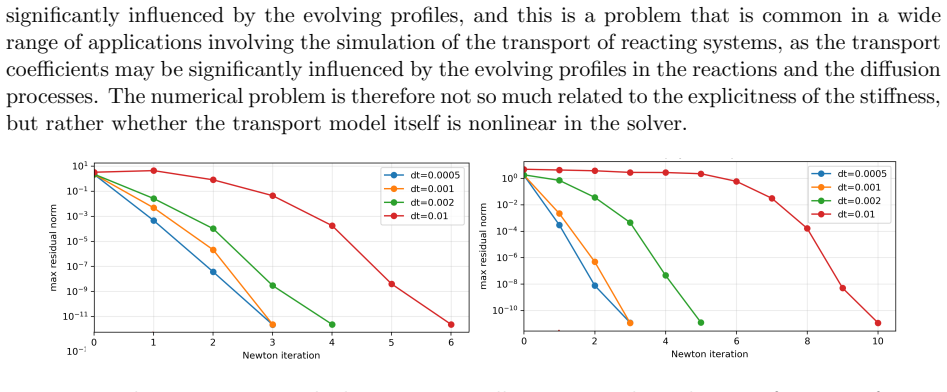
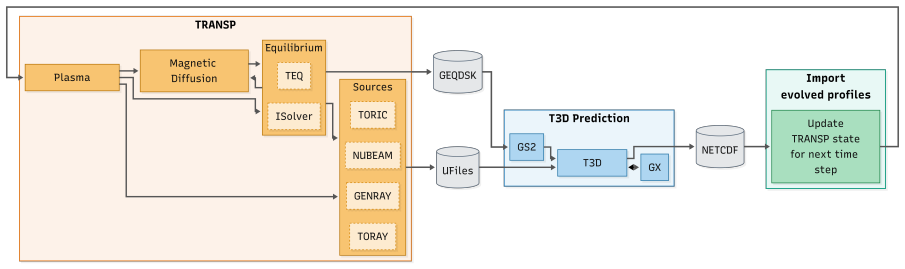
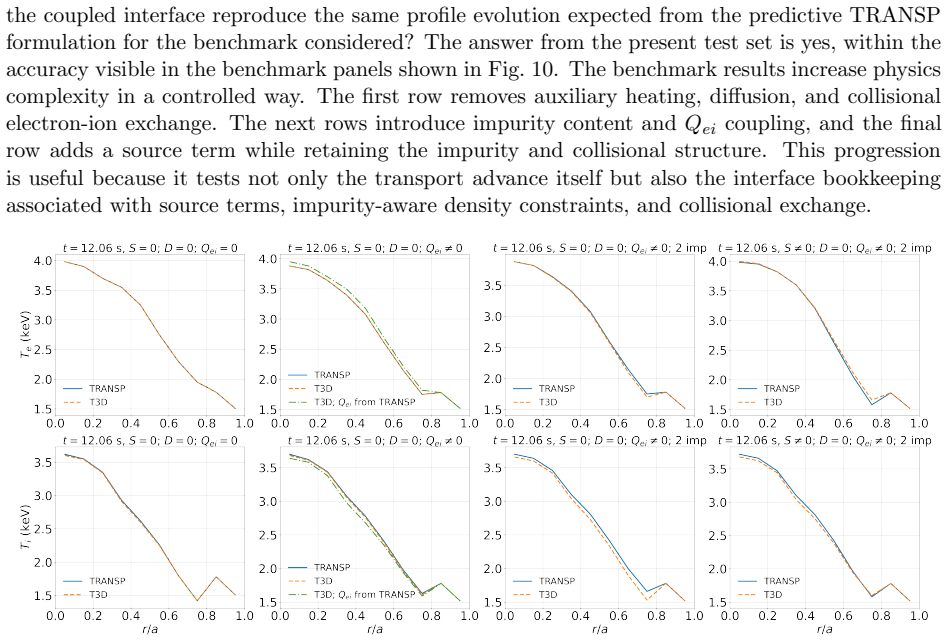
This paper expands on the TRANSP description given in Computer Physics Communications 312 (2025) 109611 by describing recent progress in TRANSP's predictive functionality and emphasizing the development of the PT_SOLVER module and integration of the high-fidelity T3D/GX framework for plasma profile prediction using a high-fidelity gyrokinetic model for turbulent transport. PT_SOLVER is a modular, multi-region, parallel solver for coupled transport equations of particle density, electron and ion energy, and toroidal angular momentum that uses an implicit Newton method to advance the solution of these equations. The numerical formulation includes source coupling, moving-geometry terms, and nonlinear stabilization based on modified Peclet numbers, thereby enabling the PT_SOLVER to handle the stiffness associated with gradient-dependent transport models. Stabilization occurs via a nonlinear function controlling discretization in zones of steep gradients or rapidly changing transport coefficients. Source terms that account for heating, current drive, alpha-particle effects, and collisional energy exchange are handled thoroughly, and both residual norms and profile-change measures are used to assess convergence. Verification is carried out using analytical benchmark solutions, manufactured solution benchmarks, convergence studies of stiff gradient-dependent diffusivities, and code-to-code comparisons of TGYRO using the TGLF/NEO models for anomalous and neoclassical transport. This paper also describes the TRANSP Interface to the modular T3D/GX workflow and presents verification examples related to the interface for coupled prediction simulations. The results in this paper confirm that the predictive TRANSP framework has a robust numerical implementation for time-dependent predictive transport simulations, and it provides a basis for future hybrid reduced and high-fidelity workflows.
Editorial analysis
A structured set of objections, weighed in public.
Referee Report
Summary. The paper expands on the TRANSP code's predictive capabilities for tokamak plasmas by detailing the PT_SOLVER module, a modular parallel solver that uses an implicit Newton method to advance coupled transport equations for particle density, electron/ion energy, and toroidal angular momentum. It incorporates source coupling, moving-geometry terms, and nonlinear Peclet-number stabilization to handle stiffness from gradient-dependent transport models. Verification includes analytical benchmarks, manufactured solutions, stiff diffusivity convergence studies, and code-to-code comparisons with TGYRO using TGLF/NEO for anomalous and neoclassical transport. The work also describes the TRANSP interface to the T3D/GX high-fidelity gyrokinetic workflow and presents associated verification examples.
Significance. If the reported verification results hold, the paper establishes a robust numerical foundation for time-dependent predictive transport simulations in TRANSP. The use of multiple independent verification methods (analytical solutions, manufactured solutions, dedicated stiff-diffusivity tests, and external code comparisons) is a clear strength that supports reliability for stiff, coupled systems and provides a credible basis for hybrid reduced-order and high-fidelity modeling workflows in fusion plasma research.
minor comments (1)
- The description of convergence assessment (residual norms versus profile-change measures) in the PT_SOLVER section would benefit from a brief quantitative example showing how the two criteria are balanced in a stiff test case.
Simulated Author's Rebuttal
We thank the referee for the positive review, accurate summary of the PT_SOLVER and T3D/GX contributions, and recommendation to accept the manuscript. There are no major comments requiring a point-by-point response.
Circularity Check
No significant circularity in verification chain
full rationale
The paper's central claim is that the PT_SOLVER implicit Newton scheme provides robust numerical implementation for stiff time-dependent transport equations, confirmed via external verification. This rests on analytical benchmark solutions, manufactured solution tests, dedicated convergence studies for gradient-dependent diffusivities, and independent code-to-code comparisons against TGLF/NEO and TGYRO. The single reference to a prior TRANSP description (CPC 2025) supplies only background context and does not carry any uniqueness theorem, ansatz, or fitted parameter that the present results reduce to by construction. No self-definitional loops, renamed empirical patterns, or load-bearing self-citations appear in the derivation or verification steps.
Axiom & Free-Parameter Ledger
axioms (2)
- standard math Implicit Newton methods with nonlinear stabilization via modified Peclet numbers are stable for stiff gradient-dependent transport equations.
- domain assumption TGLF and NEO models provide adequate representations of anomalous and neoclassical transport for verification purposes.
Lean theorems connected to this paper
-
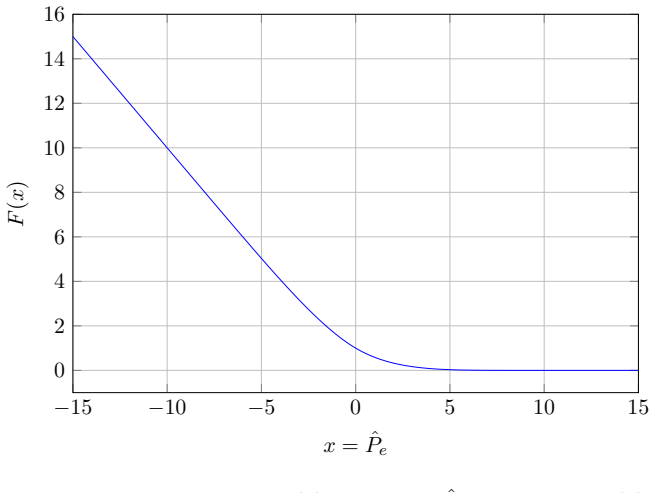
IndisputableMonolith/Cost/FunctionalEquation.leanwashburn_uniqueness_aczel unclearPT_SOLVER uses an implicit time-advance combined with a Newton-based iterative method... nonlinear stabilization based on modified Péclet numbers... F(x) = ... piecewise function of Pê
-
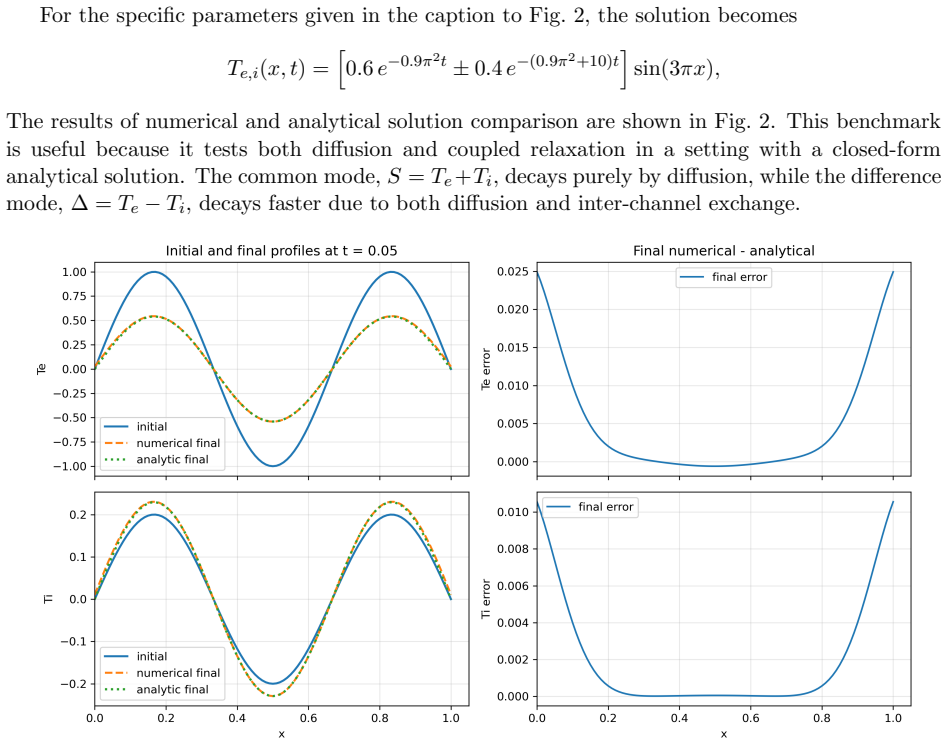
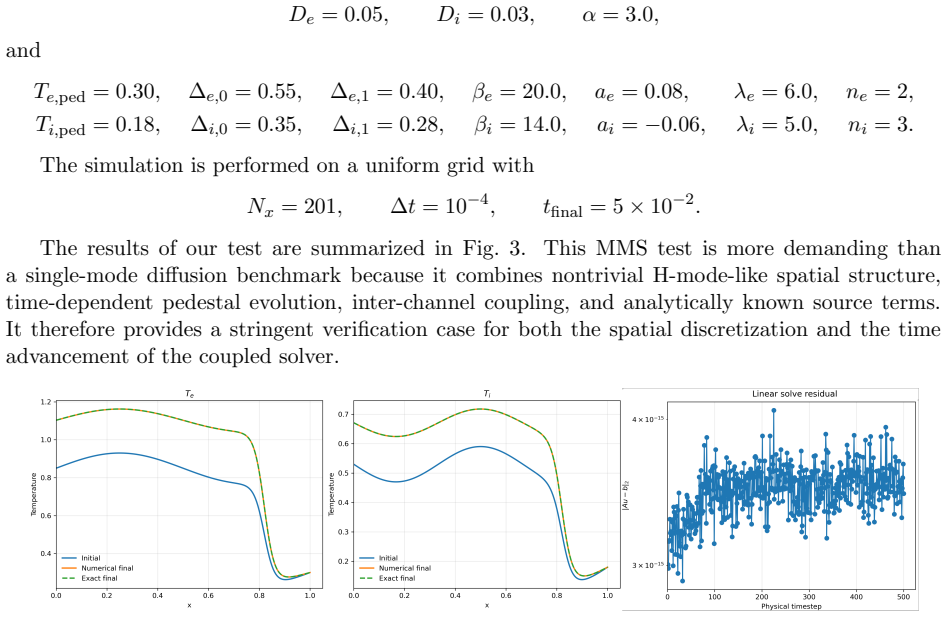
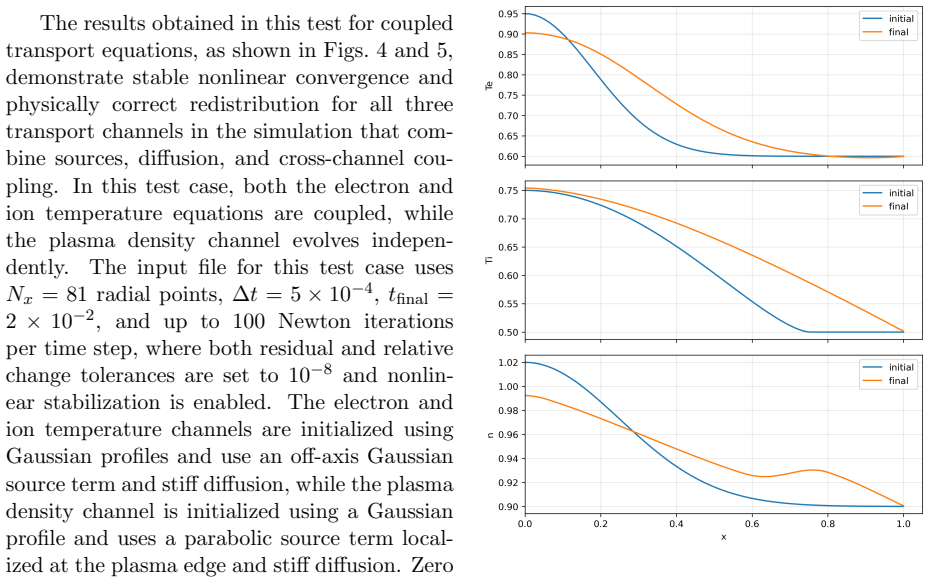
IndisputableMonolith/Foundation/RealityFromDistinction.leanreality_from_one_distinction unclearVerification... analytical benchmark solutions, manufactured solution benchmarks, convergence studies of stiff gradient-dependent diffusivities, and code-to-code comparisons with TGYRO using TGLF/NEO
Reference graph
Works this paper leans on
-
[1]
An Empirical Approach to Tokamak Transport
R.J. Hawryluk. “An Empirical Approach to Tokamak Transport”. In:Physics of Plasmas Close to Thermonuclear Conditions, ed. by B. Coppi, et al.Vol. 1 (1980), pp. 19–46
work page 1980
-
[2]
June 2018.doi:10.11578/dc.20180627.4.url:https: //www.osti.gov/biblio/code-12542
Joshua Breslau et al.TRANSP. June 2018.doi:10.11578/dc.20180627.4.url:https: //www.osti.gov/biblio/code-12542
-
[3]
TRANSP integrated modeling code for interpretive and predictive analysis of tokamak plasmas
A.Y. Pankin et al. “TRANSP integrated modeling code for interpretive and predictive analysis of tokamak plasmas”. In:Computer Physics Communications312 (2025), p. 109611.issn: 0010-4655.doi:https://doi.org/10.1016/j.cpc.2025.109611.url:https://www. sciencedirect.com/science/article/pii/S0010465525001134
work page doi:10.1016/j.cpc.2025.109611.url:https://www 2025
-
[4]
Alpha heating in ITER L-mode and H-mode plasmas
R.V. Budny. “Alpha heating in ITER L-mode and H-mode plasmas”. In:Nuclear Fusion52.1 (Nov. 2011), p. 013001.doi:10.1088/0029-5515/52/1/013001.url:https://doi.org/ 10.1088/0029-5515/52/1/013001
work page doi:10.1088/0029-5515/52/1/013001.url:https://doi.org/ 2011
-
[5]
Validation of D–T fusion power prediction capability against 2021 JET D–T experiments
Hyun-Tae Kim et al. “Validation of D–T fusion power prediction capability against 2021 JET D–T experiments”. In:Nuclear Fusion63.11 (Oct. 2023), p. 112004.doi:10.1088/1741- 4326/ace26d.url:https://doi.org/10.1088/1741-4326/ace26d
-
[6]
Core fusion power gain and alpha heating in JET, TFTR, and ITER
R. V. Budny and J. G. Cordey. “Core fusion power gain and alpha heating in JET, TFTR, and ITER”. In:Nuclear Fusion56 (2016), p. 056002
work page 2016
-
[7]
Alpha heating, isotopic mass, and fast ion effects in deuterium–tritium experiments
R. V. Budny and JET Contributors. “Alpha heating, isotopic mass, and fast ion effects in deuterium–tritium experiments”. In:Nuclear Fusion58 (2018), p. 096011. 1https://creativecommons.org/licenses/by/4.0/ 30
work page 2018
-
[8]
J. Abbate et al. “Large-database cross-verification and validation of tokamak transport models using baselines for comparison”. In:Physics of Plasmas31.4 (2024), p. 042506.doi:10.1063/ 5.0190908
work page 2024
-
[9]
G. Avdeeva et al. “Energy transport analysis of NSTX plasmas with the TGLF turbulent and NEO neoclassical transport models”. In:Nuclear Fusion63.12 (Oct. 2023), p. 126020. doi:10.1088/1741-4326/acfc56.url:https://doi.org/10.1088/1741-4326/acfc56
work page doi:10.1088/1741-4326/acfc56.url:https://doi.org/10.1088/1741-4326/acfc56 2023
-
[10]
J. B. Lestz et al. “Assessing time-dependent temperature profile predictions using reduced transport models for high performing NSTX plasmas”. In:Plasma Physics and Controlled Fusion67.10 (2025), p. 105029.doi:10.1088/1361-6587/ae0c35
-
[11]
Sensitivities of time-dependent temperature profile predictions for NSTX with the Multi-Mode Model
J. B. Lestz et al. “Sensitivities of time-dependent temperature profile predictions for NSTX with the Multi-Mode Model”. In:Plasma Physics and Controlled Fusion67.10 (2025), p. 105030. doi:10.1088/1361-6587/ae0c34
-
[12]
TRANSP-TGLF core predictive modeling of the JET DT baseline sce- nario
F. Auriemma et al. “TRANSP-TGLF core predictive modeling of the JET DT baseline sce- nario”. In:Nuclear Fusion66.5 (Apr. 2026), p. 056043.doi:10.1088/1741-4326/ae5de2. url:https://doi.org/10.1088/1741-4326/ae5de2
-
[13]
G. Pereverzev and P. Yushmanov.ASTRA automated system for TRansport analysis in a tokamak. Tech. rep. IPP 5/98. Max-Planck-Institut f¨ ur Plasmaphysik, 2002
work page 2002
-
[14]
G. Cenacchi and A. Taroni.JETTO: A Free Boundary Plasma Transport Code (Basic Ver- sion). Tech. rep. JET-IR(88)03. JET / ENEA, 1988
work page 1988
-
[15]
JINTRAC: A system of codes for integrated simulation of Tokamak scenarios
M. Romanelli et al. “JINTRAC: A system of codes for integrated simulation of Tokamak scenarios”. In:Plasma and Fusion Research9 (2014), p. 3403023.doi:10 . 1585 / pfr . 9 . 3403023
work page 2014
-
[16]
An efficient transport solver for tokamak plasmas
J. M. Park et al. “An efficient transport solver for tokamak plasmas”. In:Computer Physics Communications214 (2017), pp. 1–5.doi:10.1016/j.cpc.2016.12.018
-
[17]
Integrated modeling of highβ N steady state scenario on DIII-D
J. M. Park et al. “Integrated modeling of highβ N steady state scenario on DIII-D”. In: Physics of Plasmas25 (2018), p. 012506
work page 2018
-
[18]
O. Meneghini et al. “FUSE (Fusion Synthesis Engine): A Next Generation Framework for Integrated Design of Fusion Pilot Plants”. In:arXiv preprint arXiv:2409.05894(2024).doi: 10.48550/arXiv.2409.05894. arXiv:2409.05894 [physics.plasm-ph]
-
[19]
TORAX: A Fast and Differentiable Tokamak Transport Simulator in JAX
Jonathan Citrin et al. “TORAX: A Fast and Differentiable Tokamak Transport Simulator in JAX”. In:arXiv preprint arXiv:2406.06718(2024).doi:10.48550/arXiv.2406.06718. arXiv:2406.06718 [physics.plasm-ph]
-
[20]
On 1D diffusion problems with a gradient-dependent diffusion coefficient
S.C. Jardin et al. “On 1D diffusion problems with a gradient-dependent diffusion coefficient”. In:Journal of Computational Physics227.20 (2008), pp. 8769–8775.issn: 0021-9991.doi: https://doi.org/10.1016/j.jcp.2008.06.032.url:https://www.sciencedirect.com/ science/article/pii/S0021999108003616
work page doi:10.1016/j.jcp.2008.06.032.url:https://www.sciencedirect.com/ 2008
-
[21]
Stellarator profile predictions using Trinity3D and GX
Tony Qian et al. “Stellarator profile predictions using Trinity3D and GX”. In:APS Division of Plasma Physics Meeting Abstracts. Vol. 2022. APS Meeting Abstracts. Jan. 2022, BO03.006
work page 2022
-
[22]
TRINITY: A unified treatment of turbulence, transport, and heating in magnetized plasmas
Michael Barnes. “TRINITY: A unified treatment of turbulence, transport, and heating in magnetized plasmas”. eprint arXiv:0901.2868. Ph.D. thesis. University of Maryland, 2008. arXiv:0901.2868 [physics.plasm-ph]
-
[23]
Laguerre-Hermite pseudo-spectral velocity formulation of gyrokinetics
N. R. Mandell, W. Dorland, and M. Landreman. “Laguerre-Hermite pseudo-spectral velocity formulation of gyrokinetics”. In:Journal of Plasma Physics84.1 (2018), p. 905840108.doi: 10.1017/S0022377818000041. 31
-
[24]
GX: a GPU-native gyrokinetic turbulence code for tokamak and stel- larator design
N. R. Mandell et al. “GX: a GPU-native gyrokinetic turbulence code for tokamak and stel- larator design”. In:Journal of Plasma Physics90.4 (2024), p. 905900402.doi:10 . 1017 / S0022377824000631
work page 2024
-
[25]
Dynamic modeling of transport and positional control of tokamaks
S. C. Jardin, N. Pomphrey, and J. DeLucia. “Dynamic modeling of transport and positional control of tokamaks”. In:Journal of Computational Physics66.2 (1986), pp. 481–507.doi: 10.1016/0021-9991(86)90077-X
-
[26]
Stephen Jardin.Computational Methods in Plasma Physics. Boca Raton: CRC Press, 2010. isbn: 9780429075537.doi:10.1201/EBK1439810958.url:https://www.taylorfrancis. com/books/mono/10.1201/EBK1439810958/computational- methods- plasma- physics- stephen-jardin
work page doi:10.1201/ebk1439810958.url:https://www.taylorfrancis 2010
-
[27]
Stable numeric scheme for diffusion equation with a stiff transport
G.V. Pereverzev and G. Corrigan. “Stable numeric scheme for diffusion equation with a stiff transport”. In:Computer Physics Communications179.8 (2008), pp. 579–585.issn: 0010- 4655.doi:10 . 1016 / j . cpc . 2008 . 05 . 006.url:https : / / www . sciencedirect . com / science/article/pii/S001046550800218X
work page 2008
-
[28]
High-order implicit solver in con- servative formulation for tokamak plasma transport equations
Andrei Ludvig-Osipov, Dmytro Yadykin, and P¨ ar Strand. “High-order implicit solver in con- servative formulation for tokamak plasma transport equations”. In:Computer Physics Com- munications311 (2025), p. 109570.doi:10.1016/j.cpc.2025.109570
-
[29]
Federico Felici et al. “Real-time-capable prediction of temperature and density profiles in a tokamak using RAPTOR and a first-principle-based transport model”. In:Nuclear Fusion 58.9 (2018), p. 096006.doi:10.1088/1741-4326/aac8f0
-
[30]
Simon Van Mulders et al. “Rapid optimization of stationary tokamak plasmas in RAPTOR: demonstration for the ITER hybrid scenario with neural network surrogate transport model QLKNN”. In:Nuclear Fusion61.8 (2021), p. 086019.doi:10.1088/1741-4326/ac0d12
-
[31]
Tokamak profile prediction using direct gyrokinetic and neoclassical simula- tion
J. Candy et al. “Tokamak profile prediction using direct gyrokinetic and neoclassical simula- tion”. In:Physics of Plasmas16.6 (2009), p. 060704.doi:10.1063/1.3167820
-
[32]
Direct multiscale coupling of a transport code to gyrokinetic turbulence codes
M. Barnes et al. “Direct multiscale coupling of a transport code to gyrokinetic turbulence codes”. In:Physics of Plasmas17.5 (2010), p. 056109.doi:10.1063/1.3323082
-
[33]
A gyro-Landau-fluid transport model
R. E. Waltz et al. “A gyro-Landau-fluid transport model”. In:Physics of Plasmas4.7 (1997), pp. 2482–2496.doi:10.1063/1.872228.url:https://doi.org/10.1063/1.872228
work page doi:10.1063/1.872228.url:https://doi.org/10.1063/1.872228 1997
-
[34]
Burning Plasma Confinement Projections and Renormalization of the GLF23 Drift-Wave Transport Model
Jonathan E. Kinsey, Gary M. Staebler, and Ronald E. Waltz. “Burning Plasma Confinement Projections and Renormalization of the GLF23 Drift-Wave Transport Model”. In:Fusion Science and Technology44.4 (2003), pp. 763–775.doi:10.13182/FST03-A414.url:https: //doi.org/10.13182/FST03-A414
-
[35]
The first transport code simulations using the trapped gyro-Landau-fluid model
J. E. Kinsey, G. M. Staebler, and R. E. Waltz. “The first transport code simulations using the trapped gyro-Landau-fluid model”. In:Physics of Plasmas15.5 (2008), p. 055908.doi: 10.1063/1.2889008
-
[37]
Physics basis of Multi-Mode anomalous transport module
T. Rafiq et al. “Physics basis of Multi-Mode anomalous transport module”. In:Physics of Plasmas20.3 (2013), p. 032506.doi:10.1063/1.4794288
-
[38]
Microtearing modes in tokamak discharges
T. Rafiq et al. “Microtearing modes in tokamak discharges”. In:Physics of Plasmas23.6 (2016), p. 062507.doi:10.1063/1.4953609. 32
-
[39]
The critical temperature gradient model of plasma transport: Applications to JET and future tokamaks
P-H. Rebut, P.P. Lallia, and M.L. Watkins. “The critical temperature gradient model of plasma transport: Applications to JET and future tokamaks”. In:Plasma Physics and Con- trolled Nuclear Fusion Research (Proc. 12th IAEA Conf., Nice, France). Vol. 2. IAEA, 1989, p. 191
work page 1989
-
[40]
TSC simulation of Ohmic discharges in TFTR
S.C. Jardin, M.G. Bell, and N. Pomphrey. “TSC simulation of Ohmic discharges in TFTR”. In:Nuclear Fusion33.3 (Mar. 1993), p. 371.doi:10 . 1088 / 0029 - 5515 / 33 / 3 / I01.url: https://dx.doi.org/10.1088/0029-5515/33/3/I01
-
[41]
Transport simulation on L-mode and improved confinement associated with current profile modification
A Fukuyama et al. “Transport simulation on L-mode and improved confinement associated with current profile modification”. In:Plasma Physics and Controlled Fusion37.6 (June 1995), p. 611.doi:10.1088/0741-3335/37/6/002.url:https://dx.doi.org/10.1088/ 0741-3335/37/6/002
work page doi:10.1088/0741-3335/37/6/002.url:https://dx.doi.org/10.1088/ 1995
-
[42]
Intermittentβcollapse after NBCD turn-off in JT-60U fully non-inductive reversed shear discharges
N Takei et al. “Intermittentβcollapse after NBCD turn-off in JT-60U fully non-inductive reversed shear discharges”. In:Plasma Physics and Controlled Fusion49.3 (Feb. 2007), p. 335. doi:10 . 1088 / 0741 - 3335 / 49 / 3 / 011.url:https : / / dx . doi . org / 10 . 1088 / 0741 - 3335/49/3/011
work page 2007
-
[43]
Paleoclassical electron heat transport
J.D. Callen. “Paleoclassical electron heat transport”. In:Nuclear Fusion45.9 (Aug. 2005), p. 1120.doi:10.1088/0029-5515/45/9/012.url:https://dx.doi.org/10.1088/0029- 5515/45/9/012
work page doi:10.1088/0029-5515/45/9/012.url:https://dx.doi.org/10.1088/0029- 2005
-
[44]
C. S. Chang and F. L. Hinton. “Effect of impurity particles on the finite-aspect ratio neoclas- sical ion thermal conductivity in a tokamak”. In:The Physics of Fluids29.10 (Oct. 1986), pp. 3314–3316.issn: 0031-9171.doi:10.1063/1.865847. eprint:https://pubs.aip.org/ aip / pfl / article - pdf / 29 / 10 / 3314 / 12413384 / 3314 \ _1 \ _online . pdf.url:https...
-
[45]
E A Belli and J Candy. “Kinetic calculation of neoclassical transport including self-consistent electron and impurity dynamics”. In:Plasma Physics and Controlled Fusion50.9 (July 2008), p. 095010.doi:10.1088/0741-3335/50/9/095010.url:https://dx.doi.org/10.1088/ 0741-3335/50/9/095010
work page doi:10.1088/0741-3335/50/9/095010.url:https://dx.doi.org/10.1088/ 2008
-
[46]
Full linearized Fokker–Planck collisions in neoclassical transport simulations
E A Belli and J Candy. “Full linearized Fokker–Planck collisions in neoclassical transport simulations”. In:Plasma Physics and Controlled Fusion54.1 (Dec. 2011), p. 015015.doi: 10.1088/0741-3335/54/1/015015.url:https://dx.doi.org/10.1088/0741-3335/54/1/ 015015
work page doi:10.1088/0741-3335/54/1/015015.url:https://dx.doi.org/10.1088/0741-3335/54/1/ 2011
-
[47]
W. A. Houlberg et al. “Bootstrap current and neoclassical transport in tokamaks of arbitrary collisionality and aspect ratio”. In:Physics of Plasmas4.9 (Sept. 1997), pp. 3230–3242.issn: 1070-664X.doi:10.1063/1.872465. eprint:https://pubs.aip.org/aip/pop/article- pdf/4/9/3230/19108363/3230\_1\_online.pdf.url:https://doi.org/10.1063/1. 872465
-
[48]
H.G. Dudding et al. “A new quasilinear saturation rule for tokamak turbulence with appli- cation to the isotope scaling of transport”. In:Nuclear Fusion62.9 (July 2022), p. 096005. doi:10.1088/1741-4326/ac7a4d.url:https://doi.org/10.1088/1741-4326/ac7a4d
work page doi:10.1088/1741-4326/ac7a4d.url:https://doi.org/10.1088/1741-4326/ac7a4d 2022
-
[49]
Database generation for validation of TGLF and retraining of neural network accelerated TGLF-NN
Tom F. Neiser et al. “Database generation for validation of TGLF and retraining of neural network accelerated TGLF-NN”. In:APS Division of Plasma Physics Meeting Abstracts. Abstract GP11.00010. 2022, GP11.00010
work page 2022
-
[50]
Multi-fidelity neural network representation of gyrokinetic turbu- lence
Tom F. Neiser et al. “Multi-fidelity neural network representation of gyrokinetic turbu- lence”. In:APS Division of Plasma Physics Meeting Abstracts. Abstract PP11.00039. 2023, PP11.00039. 33
work page 2023
-
[51]
Gyro-Landau fluid equations for trapped and passing particles
G. M. Staebler, J. E. Kinsey, and R. E. Waltz. “Gyro-Landau fluid equations for trapped and passing particles”. In:Physics of Plasmas12.10 (2005), p. 102508.doi:10.1063/1.2044587
-
[52]
A theory-based transport model with com- prehensive physics
G. M. Staebler, J. E. Kinsey, and R. E. Waltz. “A theory-based transport model with com- prehensive physics”. In:Physics of Plasmas14.5 (2007), p. 055909.doi:10.1063/1.2436852
-
[53]
Emily Ann Belli and Jeff Candy. “Kinetic calculation of neoclassical transport including self- consistent electron and impurity dynamics”. In:Plasma Physics and Controlled Fusion50 (2008), p. 095010
work page 2008
-
[54]
Large Database Validation of TGLF on DIII-D and MAST-U Plasmas
T.F. Neiser. “Large Database Validation of TGLF on DIII-D and MAST-U Plasmas”. In:US- EU Transport Task Force. Asheville, NC, Apr. 2024.url:https://conferences.union. wisc.edu/ttf/conference-agenda/
work page 2024
-
[55]
M. Giacomin et al. “A quasi-linear model of electromagnetic turbulent transport and its application to flux-driven transport predictions for STEP”. In:Journal of Plasma Physics 91.1 (2025), E16.doi:10.1017/S0022377824001107
-
[56]
Princeton Plasma Physics Laboratory.Guide to Running TRANSP/T3D/GX Coupled Sim- ulations. TRANSP documentation page. 2026.url:https://transp.pppl.gov/modules/ t3d.html. 34
work page 2026
discussion (0)
Sign in with ORCID, Apple, or X to comment. Anyone can read and Pith papers without signing in.