Recognition: 2 theorem links
· Lean TheoremHawking Radiation and Greybody Factors of Test Scalar and Electromagnetic Fields on Asymptotically Flat Pure Lovelock Black Holes
Pith reviewed 2026-05-12 02:17 UTC · model grok-4.3
The pith
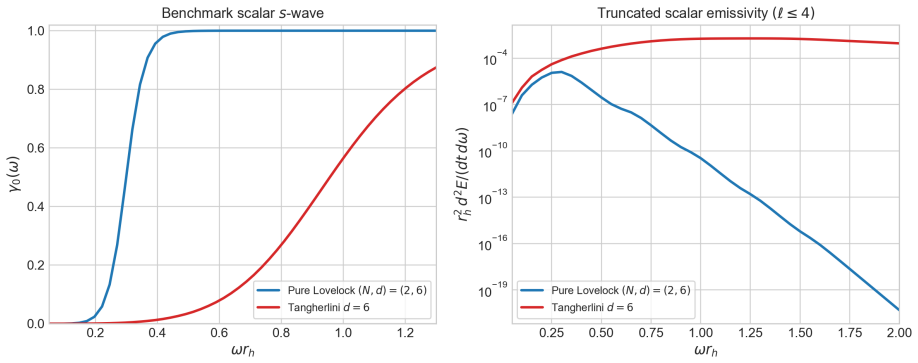
Pure Lovelock black holes radiate far less Hawking radiation than Schwarzschild-Tangherlini black holes of the same horizon radius because their lower temperature outweighs higher wave transmission.
A machine-rendered reading of the paper's core claim, the machinery that carries it, and where it could break.
Core claim
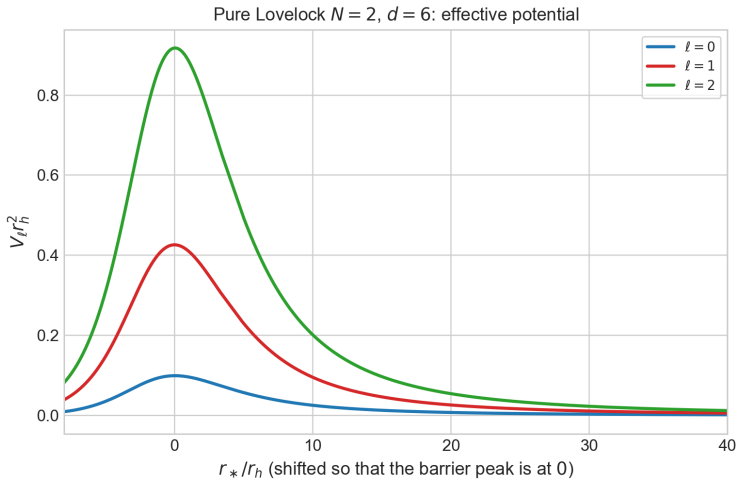
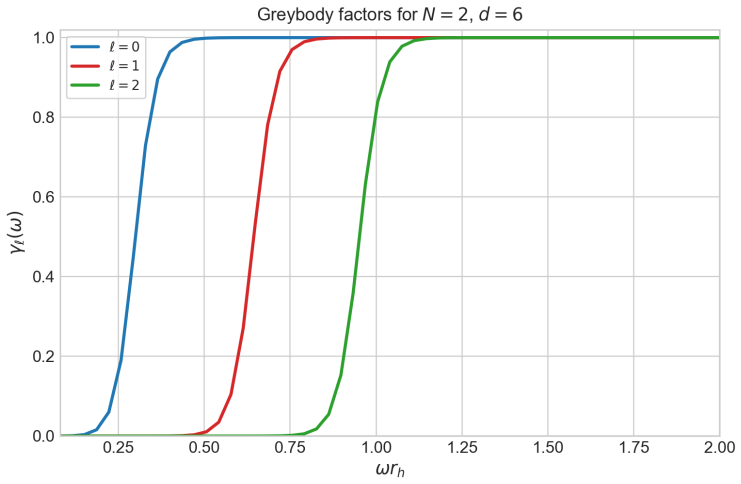
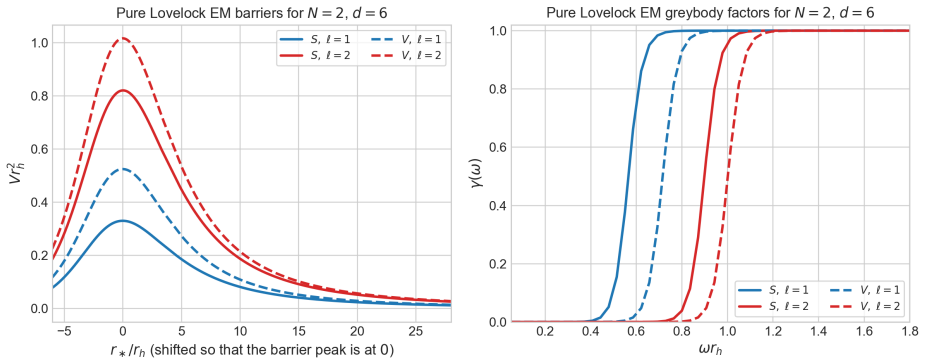
We compute scalar and higher-dimensional electromagnetic greybody factors and Hawking spectra on the critical branch d=2N+2, compare them with Schwarzschild-Tangherlini black holes at the same horizon radius r_h, and show that the smaller Hawking temperature overwhelms the enhanced transmission. In the benchmark d=6 case, the integrated scalar and electromagnetic powers are reduced by about 10^{-3} and 10^{-5}, respectively. We also find a clean higher-curvature signature: as the Lovelock order N grows, Hawking radiation becomes increasingly dominated by the scalar-type electromagnetic sector.
What carries the argument
Greybody factors obtained by solving the radial wave equations for massless scalar and electromagnetic test fields on the pure Lovelock metric and folding the transmission probabilities into the Planck spectrum.
If this is right
- In six dimensions the total scalar Hawking power is suppressed by a factor of roughly 10^{-3} relative to the Einstein case at fixed horizon radius.
- The electromagnetic Hawking power is suppressed by a factor of roughly 10^{-5}.
- Increasing the Lovelock order N shifts the electromagnetic Hawking radiation toward dominance by the scalar-type polarization.
- Pure Lovelock black holes remain geometrically more transparent to test fields than their Einstein counterparts yet radiate far less overall.
Where Pith is reading between the lines
- The temperature-driven suppression may lengthen the evaporation timescale for higher-dimensional black holes once higher-curvature terms are present.
- The growing scalar-type dominance could serve as a potential observational signature distinguishing Lovelock gravity from Einstein gravity if extra dimensions are realized.
- Similar temperature-versus-transmission competition could be checked in other higher-curvature theories by extending the same greybody integration methods.
Load-bearing premise
The test-field approximation on the fixed pure Lovelock background metric gives accurate greybody factors without important back-reaction or numerical-integration artifacts.
What would settle it
A direct numerical integration of the wave equations on the pure Lovelock metric that produces transmission probabilities low enough to make the total radiated power comparable to or larger than the Schwarzschild-Tangherlini case at the same horizon radius.
Figures




read the original abstract
Pure Lovelock black holes are geometrically more transparent than their Einstein counterparts, but they radiate far less. We compute scalar and higher-dimensional electromagnetic greybody factors and Hawking spectra on the critical branch $d=2N+2$, compare them with Schwarzschild--Tangherlini black holes at the same horizon radius $r_h$, and show that the smaller Hawking temperature overwhelms the enhanced transmission. In the benchmark $d=6$ case, the integrated scalar and electromagnetic powers are reduced by about $10^{-3}$ and $10^{-5}$, respectively. We also find a clean higher-curvature signature: as the Lovelock order $N$ grows, Hawking radiation becomes increasingly dominated by the scalar-type electromagnetic sector.
Editorial analysis
A structured set of objections, weighed in public.
Referee Report
Summary. The paper computes greybody factors and Hawking spectra for test scalar and higher-dimensional electromagnetic fields on asymptotically flat pure Lovelock black holes in the critical branch d=2N+2. It compares the results to Schwarzschild-Tangherlini black holes at fixed horizon radius r_h, concluding that the lower Hawking temperature dominates over any transmission enhancement from the more transparent geometry, yielding integrated power reductions of order 10^{-3} (scalar) and 10^{-5} (EM) for the d=6 benchmark. It further identifies a higher-curvature signature in which the scalar-type electromagnetic sector increasingly dominates the radiation as the Lovelock order N grows.
Significance. If the numerical results are robust, the work establishes a concrete, falsifiable distinction between pure Lovelock and Einstein gravity in the Hawking radiation channel. The quantitative suppression factors and the N-dependent mode dominance provide a clean higher-curvature signature that could be relevant for understanding evaporation in higher-dimensional modified gravity. The direct comparison at fixed r_h isolates the effect of the Lovelock curvature terms without confounding changes in horizon size.
major comments (2)
- [§5] §5 (d=6 benchmark results): The central quantitative claims—that scalar and electromagnetic radiated powers are reduced by factors ∼10^{-3} and ∼10^{-5} relative to the Schwarzschild-Tangherlini case—rest on the numerical solution of the radial wave equations followed by integration against the Hawking spectrum. The manuscript must supply convergence tests for the ODE solver, the frequency cutoff and tail integration procedure, and explicit error estimates on the integrated powers; without these, it is impossible to confirm that temperature suppression truly overwhelms the enhanced transmission.
- [§6] §6 (N-dependence): The claim that Hawking radiation becomes increasingly dominated by the scalar-type electromagnetic sector as N increases is load-bearing for the higher-curvature signature. The paper should present explicit ratios or separate spectra for at least three values of N (e.g., N=2,3,4) together with the corresponding greybody factors to demonstrate the trend quantitatively rather than qualitatively.
minor comments (2)
- [Abstract] The abstract states the reductions as “about 10^{-3}” and “10^{-5}”; reporting the precise numerical values (or at least the number of significant figures) would improve reproducibility.
- [§3] Notation for the higher-dimensional electromagnetic field decomposition into scalar-type and vector-type sectors should be defined once in §3 or §4 and used consistently thereafter.
Simulated Author's Rebuttal
We thank the referee for the careful reading of our manuscript and the positive evaluation of its significance. The comments highlight important aspects of the numerical robustness and the quantitative presentation of the N-dependence. We address each major comment below and will revise the manuscript accordingly.
read point-by-point responses
-
Referee: [§5] §5 (d=6 benchmark results): The central quantitative claims—that scalar and electromagnetic radiated powers are reduced by factors ∼10^{-3} and ∼10^{-5} relative to the Schwarzschild-Tangherlini case—rest on the numerical solution of the radial wave equations followed by integration against the Hawking spectrum. The manuscript must supply convergence tests for the ODE solver, the frequency cutoff and tail integration procedure, and explicit error estimates on the integrated powers; without these, it is impossible to confirm that temperature suppression truly overwhelms the enhanced transmission.
Authors: We agree that convergence tests and error estimates are necessary to substantiate the numerical results. In the revised manuscript we will add a new subsection in §5 (and supporting material in the appendices) that reports: (i) convergence of the radial ODE solutions under variations of integration step size and asymptotic boundary conditions, (ii) stability of the integrated powers with respect to the frequency cutoff and the tail-integration cutoff, and (iii) explicit error bars on the reported suppression factors (10^{-3} for scalars and 10^{-5} for electromagnetism). These additions will confirm that the temperature suppression dominates the transmission enhancement within the quoted precision. revision: yes
-
Referee: [§6] §6 (N-dependence): The claim that Hawking radiation becomes increasingly dominated by the scalar-type electromagnetic sector as N increases is load-bearing for the higher-curvature signature. The paper should present explicit ratios or separate spectra for at least three values of N (e.g., N=2,3,4) together with the corresponding greybody factors to demonstrate the trend quantitatively rather than qualitatively.
Authors: We accept that a quantitative demonstration for several values of N strengthens the higher-curvature signature. In the revision we will extend the analysis to N=2, 3 and 4. For each N we will present: separate Hawking spectra for the scalar and electromagnetic sectors, the associated greybody factors, and explicit ratios of the scalar-type to vector-type electromagnetic contributions. These results will be collected in an updated §6 together with a new figure and a summary table that makes the N-dependent dominance trend fully quantitative. revision: yes
Circularity Check
No circularity: direct numerical evaluation of greybody factors on fixed metric
full rationale
The paper computes greybody factors by solving the radial wave equations for test scalar and electromagnetic fields on the given pure Lovelock metric (critical branch d=2N+2), then integrates the transmission probabilities |T(ω)|^2 against the Hawking spectrum to obtain the radiated power. These steps are standard first-principles calculations in curved-spacetime QFT with no fitted parameters, no self-definitional relations, and no load-bearing self-citations that reduce the results to the inputs by construction. The comparison to Schwarzschild-Tangherlini at fixed r_h and the reported reductions (∼10^{-3} scalar, ∼10^{-5} EM for d=6) follow directly from the numerical integration without circular reduction.
Axiom & Free-Parameter Ledger
axioms (2)
- domain assumption The background is the asymptotically flat pure Lovelock black hole on the critical branch d=2N+2.
- domain assumption Scalar and electromagnetic test fields propagate linearly on this fixed background.
Lean theorems connected to this paper
-
IndisputableMonolith/Cost/FunctionalEquation.leanwashburn_uniqueness_aczel unclearWe compute scalar and higher-dimensional electromagnetic greybody factors... by direct numerical integration of the master equations in the tortoise coordinate... γ_ℓ(ω)=|T_ℓ(ω)|²
-
IndisputableMonolith/Foundation/AlexanderDuality.leanalexander_duality_circle_linking unclearf(r)=1-(r_h/r)^{1/N} on the critical branch d=2N+2
Reference graph
Works this paper leans on
-
[1]
Particle creation by black holes,
S. W. Hawking, “Particle creation by black holes,”Communications in Mathematical Physics 43, 199–220 (1975)
work page 1975
-
[2]
Particle emission rates from a black hole: Massless particles from an uncharged, nonrotating hole,
D. N. Page, “Particle emission rates from a black hole: Massless particles from an uncharged, nonrotating hole,”Physical Review D13, 198–206 (1976)
work page 1976
-
[3]
Absorption cross section of small black holes,
W. G. Unruh, “Absorption cross section of small black holes,”Physical Review D14, 3251– 3259 (1976)
work page 1976
-
[4]
Universality of low energy absorption cross sections for black holes,
S. R. Das, G. W. Gibbons and S. D. Mathur, “Universality of low energy absorption cross sections for black holes,”Physical Review Letters78, 417–419 (1997)
work page 1997
-
[5]
The Einstein tensor and its generalizations,
D. Lovelock, “The Einstein tensor and its generalizations,”Journal of Mathematical Physics 12, 498–501 (1971)
work page 1971
-
[6]
Black holes in pure Lovelock gravities,
R.-G. Cai and N. Ohta, “Black holes in pure Lovelock gravities,”Physical Review D74, 064001 (2006)
work page 2006
-
[7]
The Lovelock gravity in the critical spacetime dimension,
N. Dadhich, S. G. Ghosh and S. Jhingan, “The Lovelock gravity in the critical spacetime dimension,”Physics Letters B711, 196–198 (2012)
work page 2012
-
[8]
Bound orbits and gravitational theory,
N. Dadhich, S. G. Ghosh and S. Jhingan, “Bound orbits and gravitational theory,”Physical Review D88, 124040 (2013)
work page 2013
-
[9]
On the static Lovelock black holes,
N. Dadhich, J. M. Pons and K. Prabhu, “On the static Lovelock black holes,”General Relativity and Gravitation45, 1131–1144 (2013)
work page 2013
-
[10]
Pure Lovelock black holes in dimensions d= 3N+ 1 are stable,
R. Gannouji, Y. Rodr´ ıguez Baez and N. Dadhich, “Pure Lovelock black holes in dimensions d= 3N+ 1 are stable,”Physical Review D100, 084011 (2019)
work page 2019
-
[11]
H. Kodama and A. Ishibashi, “Master equations for perturbations of generalized static black holes with charge in higher dimensions,”Progress of Theoretical Physics111, 29–73 (2004)
work page 2004
-
[12]
Hawking radiation from a (4 +n)-dimensional black hole: Exact results for the Schwarzschild phase,
C. M. Harris and P. Kanti, “Hawking radiation from a (4 +n)-dimensional black hole: Exact results for the Schwarzschild phase,”Journal of High Energy Physics10, 014 (2003)
work page 2003
-
[13]
E. Jung and D. K. Park, “Bulk versus brane emissivities of photon fields: For the case of higher-dimensional Schwarzschild phase,”Journal of High Energy Physics05, 055 (2007)
work page 2007
-
[14]
Absorption of massless scalar wave by high-dimensional Lovelock black hole,
J. Chen, H. Liao and Y. Wang, “Absorption of massless scalar wave by high-dimensional Lovelock black hole,”Physics Letters B704, 227–233 (2011)
work page 2011
-
[15]
Greybody factors for a spherically symmetric Einstein–Gauss– Bonnet–de Sitter black hole,
M. Zhang, J. Li and H. Chen, “Greybody factors for a spherically symmetric Einstein–Gauss– Bonnet–de Sitter black hole,”The European Physical Journal C78, 870 (2018)
work page 2018
-
[16]
Hawking radiation for scalar fields by Einstein–Gauss–Bonnet–de Sitter black holes,
P.-C. Li and C.-Y. Zhang, “Hawking radiation for scalar fields by Einstein–Gauss–Bonnet–de Sitter black holes,”Physical Review D99, 024030 (2019)
work page 2019
-
[17]
S. Iyer and C. M. Will, “Black-hole normal modes: A WKB approach. I. Foundations and application of a higher-order WKB analysis of potential-barrier scattering,”Physical Review D35, 3621–3631 (1987). 18
work page 1987
-
[18]
An efficient higher-order WKB code for quasinormal modes and greybody factors,
R. A. Konoplya, J. Matyjasek and A. Zhidenko, “An efficient higher-order WKB code for quasinormal modes and greybody factors,”International Journal of Gravitation and Theoret- ical Physics2(1), 5 (2026)
work page 2026
-
[19]
R.A. Konoplya, “Quasinormal modes in higher-derivative gravity: Testing the black hole parametrization and sensitivity of overtones,”Physical Review D107, 064039 (2023)
work page 2023
-
[20]
Dymnikova black hole from an infinite tower of higher-curvature corrections,
R.A. Konoplya, A. Zhidenko, “Dymnikova black hole from an infinite tower of higher-curvature corrections,”Physics Letters B856, 138945 (2024)
work page 2024
-
[21]
R.A. Konoplya, A.F. Zinhailo, “Hawking radiation of non-Schwarzschild black holes in higher- derivative gravity: a crucial role of grey-body factors,”Physical Review D99, 104060 (2019)
work page 2019
-
[22]
K. Kokkotas, R.A. Konoplya, A. Zhidenko, “Non-Schwarzschild black-hole metric in four di- mensional higher-derivative gravity: analytical approximation,”Physical Review D96, 064007 (2017)
work page 2017
-
[23]
Roman A. Konoplya, Thomas Pappas, Alexander Zhidenko, “Einstein-scalar–Gauss-Bonnet black holes: Analytical approximation for the metric and applications to calculations of shad- ows,”Physical Review D101, 044054 (2020)
work page 2020
-
[24]
Scalar field evolution in Gauss-Bonnet black holes,
E. Abdalla, R.A. Konoplya, C. Molina, “Scalar field evolution in Gauss-Bonnet black holes,” Physical Review D72, 084006 (2005)
work page 2005
-
[25]
Quasinormal modes and a new instability of Einstein–Gauss–Bonnet black holes in the de Sitter world,
M.A. Cuyubamba, R.A. Konoplya, A. Zhidenko, “Quasinormal modes and a new instability of Einstein–Gauss–Bonnet black holes in the de Sitter world,”Physical Review D93, 104053 (2016)
work page 2016
-
[26]
Eikonal instability of Gauss-Bonnet–(anti-)–de Sitter black holes,
R.A. Konoplya, A. Zhidenko, “Eikonal instability of Gauss-Bonnet–(anti-)–de Sitter black holes,”Physical Review D95, 104005 (2017)
work page 2017
-
[27]
R.A. Konoplya, A. Zhidenko, “Quasinormal modes of Gauss–Bonnet–AdS black holes: towards holographic description of finite coupling,”Journal of High Energy Physics09, 139 (2017)
work page 2017
-
[28]
No stable wormholes in Einstein-dilaton- Gauss-Bonnet theory,
M.A. Cuyubamba, R.A. Konoplya, A. Zhidenko, “No stable wormholes in Einstein-dilaton- Gauss-Bonnet theory,”Physical Review D98, 044040 (2018)
work page 2018
-
[29]
Analytical approximation for the Einstein- dilaton-Gauss-Bonnet black hole metric,
K.D. Kokkotas, R.A. Konoplya, A. Zhidenko, “Analytical approximation for the Einstein- dilaton-Gauss-Bonnet black hole metric,”Physical Review D96, 064004 (2017)
work page 2017
-
[30]
Long life of Gauss-Bonnet corrected black holes,
R.A. Konoplya, A. Zhidenko, “Long life of Gauss-Bonnet corrected black holes,”Physical Review D82, 084003 (2010)
work page 2010
-
[31]
The portrait of eikonal instability in Lovelock theories,
R.A. Konoplya, A. Zhidenko, “The portrait of eikonal instability in Lovelock theories,”Journal of Cosmology and Astroparticle Physics05, 050 (2017)
work page 2017
-
[32]
BTZ black holes with higher curvature corrections in the 3D Einstein–Lovelock gravity,
R.A. Konoplya, A. Zhidenko, “BTZ black holes with higher curvature corrections in the 3D Einstein–Lovelock gravity,”Physical Review D102, 064004 (2020)
work page 2020
-
[33]
4D Einstein–Lovelock black holes: Hierarchy of orders in cur- vature,
R.A. Konoplya, A. Zhidenko, “4D Einstein–Lovelock black holes: Hierarchy of orders in cur- vature,”Physics Letters B807, 135607 (2020). 19
work page 2020
-
[34]
Filipe Moura and Ricardo Schiappa, “Higher-derivative corrected black holes: Perturbative stability and absorption cross-section in heterotic string theory,”Classical and Quantum Grav- ity24, 361–386 (2007)
work page 2007
-
[35]
Quasinormal Modes of Lovelock Black Holes,
C. B. Prasobh and V. C. Kuriakose, “Quasinormal Modes of Lovelock Black Holes,”The European Physical Journal C74, 3136 (2014)
work page 2014
-
[36]
Saˇ so Grozdanov and Andrei O. Starinets, “Second-order transport, quasinormal modes and zero-viscosity limit in the Gauss-Bonnet holographic fluid,”Journal of High Energy Physics 03, 166 (2017)
work page 2017
-
[37]
P. A. Gonzalez, Yerko Vasquez and Ruth Noemi Villalobos, “Perturbative and nonperturbative fermionic quasinormal modes of Einstein-Gauss–Bonnet–AdS black holes,”Physical Review D 98, 064030 (2018)
work page 2018
-
[38]
M. S. Churilova and Z. Stuchlik, “Quasinormal modes of black holes in 5D Gauss–Bonnet gravity combined with non-linear electrodynamics,”Annals of Physics418, 168181 (2020)
work page 2020
-
[39]
Probing Einstein-dilaton Gauss-Bonnet Gravity with the inspiral and ringdown of gravitational waves,
Zack Carson and Kent Yagi, “Probing Einstein-dilaton Gauss-Bonnet Gravity with the inspiral and ringdown of gravitational waves,”Physical Review D101, 104030 (2020)
work page 2020
-
[40]
Quasinormal modes and strong cosmic censorship in the regularised 4D Einstein–Gauss–Bonnet gravity,
Akash K. Mishra, “Quasinormal modes and strong cosmic censorship in the regularised 4D Einstein–Gauss–Bonnet gravity,”General Relativity and Gravitation52, 106 (2020)
work page 2020
-
[41]
Ringing of rotating black holes in higher-derivative gravity,
Pablo A. Cano, Kwinten Fransen and Thomas Hertog, “Ringing of rotating black holes in higher-derivative gravity,”Physical Review D102, 044047 (2020)
work page 2020
-
[42]
Jerzy Matyjasek, “Quasinormal modes of dirty black holes in the effective theory of gravity with a third order curvature term,”Physical Review D102, 124046 (2020)
work page 2020
-
[43]
Quasinormal modes of slowly-rotating black holes in dynamical Chern-Simons gravity,
Pratik Wagle, Nicolas Yunes and Hector O. Silva, “Quasinormal modes of slowly-rotating black holes in dynamical Chern-Simons gravity,”Physical Review D105, 124003 (2022)
work page 2022
-
[44]
Black-hole ringdown as a probe of higher-curvature gravity theories,
Hector O. Silva, Abhirup Ghosh and Alessandra Buonanno, “Black-hole ringdown as a probe of higher-curvature gravity theories,”Physical Review D107, 044030 (2023)
work page 2023
-
[45]
Lorenzo Pierini and Leonardo Gualtieri, “Quasinormal modes of rotating black holes in Einstein-dilaton Gauss-Bonnet gravity: The second order in rotation,”Physical Review D 106, 104009 (2022)
work page 2022
-
[46]
Li-Ming Cao, Liang-Bi Wu, Yaqi Zhao and Yu-Sen Zhou, “Quasinormal modes of tensor per- turbation in Kaluza-Klein black hole for Einstein–Gauss–Bonnet gravity,” arXiv:2307.06801 (2023)
-
[47]
Sayan K. Chakrabarti and Kumar S. Gupta, “Asymptotic Quasinormal Modes of d- Dimensional Schwarzschild Black Hole with Gauss-Bonnet Correction,”International Journal of Modern Physics A21, 3565–3574 (2006)
work page 2006
-
[48]
Sayan K. Chakrabarti, “Quasinormal modes of tensor and vector type perturbation of Gauss– Bonnet black hole using third order WKB approach,”General Relativity and Gravitation39, 567–582 (2007). 20
work page 2007
-
[49]
The Mystery of the asymptotic quasinormal modes of Gauss-Bonnet black holes,
Ramin G. Daghigh, Gabor Kunstatter and Jonathan Ziprick, “The Mystery of the asymptotic quasinormal modes of Gauss-Bonnet black holes,”Classical and Quantum Gravity24, 1981– 1992 (2007)
work page 1981
-
[50]
Asymptotic quasinormal modes in Einstein–Gauss–Bonnet gravity,
J. Sadeghi, A. Banijamali, M. R. Setare and H. Vaez, “Asymptotic quasinormal modes in Einstein–Gauss–Bonnet gravity,”International Journal of Modern Physics A26, 2783–2794 (2011)
work page 2011
-
[51]
Quasinormal modes of Gauss- Bonnet black holes at large D,
Bin Chen, Zhong-Ying Fan, Pengcheng Li and Weicheng Ye, “Quasinormal modes of Gauss- Bonnet black holes at large D,”Journal of High Energy Physics01, 085 (2016)
work page 2016
-
[52]
Quasinormal modes of black holes in Lovelock gravity,
Daiske Yoshida and Jiro Soda, “Quasinormal modes of black holes in Lovelock gravity,”Phys- ical Review D93, 044024 (2016)
work page 2016
-
[53]
Quasinormal modes of a black hole with a cloud of strings in Einstein–Gauss–Bonnet gravity,
J. P. Morais Gra¸ ca, Godonou I. Salako and Valdir B. Bezerra, “Quasinormal modes of a black hole with a cloud of strings in Einstein–Gauss–Bonnet gravity,”International Journal of Modern Physics D26, 1750113 (2017)
work page 2017
-
[54]
Quasinor- mal modes of rapidly rotating Einstein-Gauss–Bonnet–dilaton black holes,
Jose Luis Bl´ azquez-Salcedo, Fech Scen Khoo, Burkhard Kleihaus and Jutta Kunz, “Quasinor- mal modes of rapidly rotating Einstein-Gauss–Bonnet–dilaton black holes,”Physical Review D111, L021505 (2025)
work page 2025
-
[55]
Radial perturbations of scalar-Gauss-Bonnet black holes beyond spontaneous scalarization,
Jose Luis Bl´ azquez-Salcedo, Daniela D. Doneva, Jutta Kunz and Stoytcho S. Yazadjiev, “Radial perturbations of scalar-Gauss-Bonnet black holes beyond spontaneous scalarization,” Physical Review D105, 124005 (2022)
work page 2022
-
[56]
Axial perturbations of hairy Gauss-Bonnet black holes with a massive self-interacting scalar field,
Kalin V. Staykov, Jose Luis Bl´ azquez-Salcedo, Daniela D. Doneva, Jutta Kunz, Petya Nedkova and Stoytcho S. Yazadjiev, “Axial perturbations of hairy Gauss-Bonnet black holes with a massive self-interacting scalar field,”Physical Review D105, 044040 (2022)
work page 2022
-
[57]
Polar quasinormal modes of the scalarized Einstein–Gauss–Bonnet black holes,
Jose Luis Bl´ azquez-Salcedo, Daniela D. Doneva, Sarah Kahlen, Jutta Kunz, Petya Nedkova and Stoytcho S. Yazadjiev, “Polar quasinormal modes of the scalarized Einstein–Gauss–Bonnet black holes,”Physical Review D102, 024086 (2020)
work page 2020
-
[58]
Axial perturbations of the scalarized Einstein–Gauss–Bonnet black holes,
Jose Luis Bl´ azquez-Salcedo, Daniela D. Doneva, Sarah Kahlen, Jutta Kunz, Petya Nedkova and Stoytcho S. Yazadjiev, “Axial perturbations of the scalarized Einstein–Gauss–Bonnet black holes,”Physical Review D101, 104006 (2020)
work page 2020
-
[59]
Grey-body factors for scalar and Dirac fields in the Euler–Heisenberg electrody- namics,
Z. Malik, “Grey-body factors for scalar and Dirac fields in the Euler–Heisenberg electrody- namics,”International Journal of Gravitation and Theoretical Physics1(1), 6 (2025)
work page 2025
-
[60]
B. C. L¨ utf¨ uo˘ glu, “Black Holes in Proca–Gauss–Bonnet Gravity with Primary Hair: Particle Motion, Shadows, and Grey-Body Factors,”International Journal of Gravitation and Theo- retical Physics1(1), 4 (2025)
work page 2025
-
[61]
Gravitational quasinormal modes and grey-body factors of Bonanno–Reuter regular black holes,
S. V. Bolokhov and M. Skvortsova, “Gravitational quasinormal modes and grey-body factors of Bonanno–Reuter regular black holes,”International Journal of Gravitation and Theoretical Physics1(1), 3 (2025)
work page 2025
-
[62]
Scattering of a scalar field in the four-dimensional quasi-topological gravity,
A. Dubinsky, “Scattering of a scalar field in the four-dimensional quasi-topological gravity,” International Journal of Gravitation and Theoretical Physics2(1), 6 (2026). 21
work page 2026
-
[63]
Greybody factors for black holes in dRGT massive gravity with electric and magnetic charges,
P. Boonserm, S. Phalungsongsathit, K. Sansuk and P. Wongjun, “Greybody factors for black holes in dRGT massive gravity with electric and magnetic charges,”The European Physical Journal C83, 249 (2023)
work page 2023
-
[64]
Proper-time approach in asymptotic safety via black hole quasinormal modes and grey-body factors,
B. C. L¨ utf¨ uo˘ glu, E. U. Saka, A. Shermatov, J. Rayimbaev, I. Ibragimov and S. Muminov, “Proper-time approach in asymptotic safety via black hole quasinormal modes and grey-body factors,”The European Physical Journal C85, 1190 (2025)
work page 2025
-
[65]
Holographic conductivity of zero temperature superconduc- tors,
R.A. Konoplya and A. Zhidenko, “Holographic conductivity of zero temperature superconduc- tors,”Physics Letters B686, 199–206 (2010)
work page 2010
-
[66]
B. C. L¨ utf¨ uo˘ glu, “Long-lived quasinormal modes and gray-body factors of black holes and wormholes in dark matter inspired Weyl gravity,”The European Physical Journal C85, 486 (2025)
work page 2025
-
[67]
B. C. L¨ utf¨ uo˘ glu, “Non-minimal Einstein–Yang–Mills black holes: fundamental quasinormal mode and grey-body factors versus outburst of overtones,”The European Physical Journal C 85, 630 (2025)
work page 2025
-
[68]
Gravita- tional spectra and wave propagation in regular black holes supported by a Dehnen Halo,
B. C. L¨ utf¨ uo˘ glu, A. Shermatov, J. Rayimbaev, M. Matyoqubov and O. Sirajiddin, “Gravita- tional spectra and wave propagation in regular black holes supported by a Dehnen Halo,”The European Physical Journal C85, 1484 (2025)
work page 2025
-
[69]
B. C. L¨ utf¨ uo˘ glu, “Quasinormal modes and gray-body factors for gravitational perturbations in asymptotically safe gravity,”The European Physical Journal C86, 39 (2026)
work page 2026
-
[70]
S. V. Bolokhov and M. Skvortsova, “Correspondence between quasinormal modes and grey- body factors of spherically symmetric traversable wormholes,”Journal of Cosmology and As- troparticle Physics04, 025 (2025)
work page 2025
-
[71]
S. V. Bolokhov, “Quasinormal Modes and Grey-Body Factors of Scalar, Electromag- netic and Dirac Fields Around Einasto-Supported Regular Black Holes,”arXiv preprint arXiv:2603.22310 [gr-qc] (2026)
-
[72]
Gravitational quasinormal modes of the Hayward space- time,
S. V. Bolokhov and M. Skvortsova, “Gravitational quasinormal modes of the Hayward space- time,”The European Physical Journal C86, 374 (2026)
work page 2026
-
[73]
M. Skvortsova, “Quantum corrected black holes: testing the correspondence between grey- body factors and quasinormal modes,”The European Physical Journal C85, 854 (2025)
work page 2025
-
[74]
A. Dubinsky, “Gray-body factors for gravitational and electromagnetic perturbations around Gibbons–Maeda–Garfinkle–Horowitz–Strominger black holes,”Modern Physics Letters A40, 2550111 (2025)
work page 2025
-
[75]
A. Dubinsky and A. F. Zinhailo, “Analytic expressions for grey-body factors of the general parametrized spherically symmetric black holes,”EPL149, 69004 (2025)
work page 2025
-
[76]
Long-lived modes and grey-body factors of massive fields in quantum-corrected (Hayward) black holes,
A. Dubinsky, “Long-lived modes and grey-body factors of massive fields in quantum-corrected (Hayward) black holes,”International Journal of Theoretical Physics65, 45 (2026)
work page 2026
-
[77]
Correspondence between grey-body factors and quasinormal modes,
R. A. Konoplya and A. Zhidenko, “Correspondence between grey-body factors and quasinormal modes,”Journal of Cosmology and Astroparticle Physics09, 068 (2024). 22
work page 2024
-
[78]
Correspondence between grey-body factors and quasinormal frequencies for rotating black holes,
R. A. Konoplya and A. Zhidenko, “Correspondence between grey-body factors and quasinormal frequencies for rotating black holes,”Physics Letters B861, 139288 (2025)
work page 2025
-
[79]
Malik, (2024), arXiv:2412.13385 [gr-qc]
Z. Malik, “Quasinormal modes and grey-body factors of Morris–Thorne wormholes,”arXiv preprintarXiv:2412.13385 [gr-qc] (2024)
-
[80]
Malik, arXiv e-prints (2025), arXiv:2511.12335 [gr- qc]
Z. Malik, “Long-lived quasinormal modes and grey-body factors of supermassive black holes with a dark matter halo,”arXiv preprintarXiv:2511.12335 [gr-qc] (2025)
discussion (0)
Sign in with ORCID, Apple, or X to comment. Anyone can read and Pith papers without signing in.