Recognition: 2 theorem links
· Lean TheoremGravielectric and gravimagnetic fluxes in nutty black holes
Pith reviewed 2026-05-12 02:46 UTC · model grok-4.3
The pith
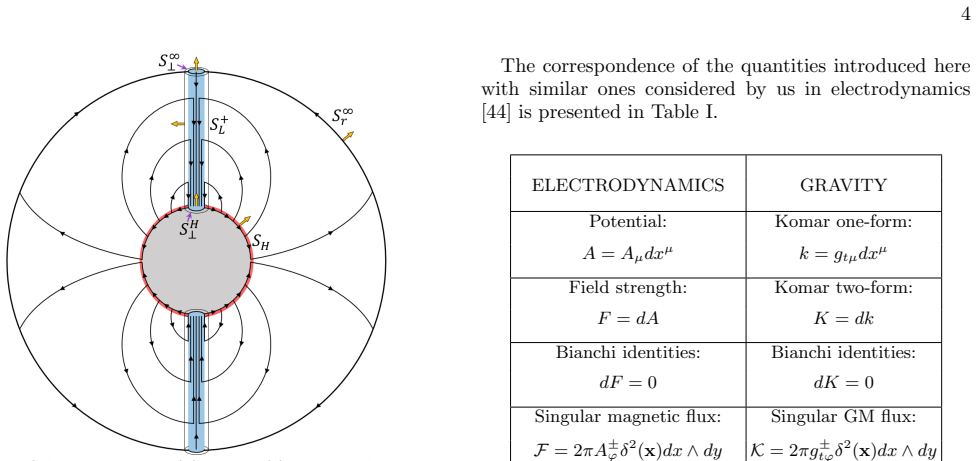
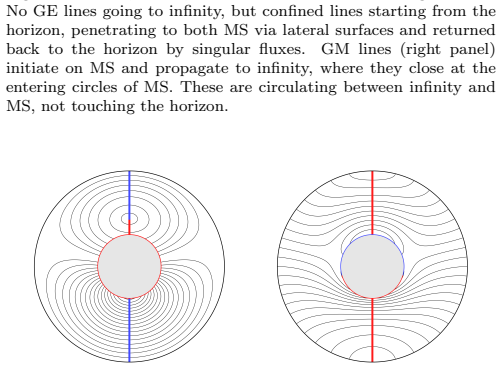
Misner strings carry singular gravielectric and gravimagnetic fluxes that connect horizons to infinity while remaining laterally transparent.
A machine-rendered reading of the paper's core claim, the machinery that carries it, and where it could break.
Core claim
By introducing gravielectric and gravimagnetic fields via the Komar two-form and its dual, the analysis reveals that Misner strings carry singular GE and GM fluxes linking the horizon to infinity. The strings are laterally transparent, permitting field lines to enter and exit the bulk region. In the Taub-NUT vacuum, this transparency means Komar mass integrals around the strings capture only the incoming positive flux from the horizon, which then returns via the string, forming a closed loop without sources. Consequently, Misner strings are massless empty tubes rather than rods of negative mass. Analogously, gravimagnetic lines can link regions of opposite charge on the horizon, accounting,
What carries the argument
The Komar two-form and its dual, which define the gravielectric and gravimagnetic fields whose singular fluxes are tracked through Misner strings as local lines of force.
If this is right
- Standard Komar mass integrals around Misner strings must be interpreted as capturing only the incoming flux component.
- Misner strings function as massless empty tubes that close field-line circuits back to the horizon.
- Gravimagnetic field lines joining oppositely charged horizon patches produce the dipole moment observed in the Kerr metric.
- The same local-force-line description extends the Komar-Tomimatsu mass formulas to stationary solutions containing Misner strings.
Where Pith is reading between the lines
- Similar flux tracking could be applied to other stationary metrics that contain Misner strings or NUT parameters to re-examine their energy distributions.
- The transparent-string picture may offer a consistent way to assign local energy densities in spacetimes where global integrals give counter-intuitive signs.
- Explicit numerical evaluation of the lateral flux component in Taub-NUT coordinates would provide a direct test of the closed-circuit claim.
Load-bearing premise
That the Komar two-form and its dual can be read as defining local lines of force whose fluxes through Misner strings are physically meaningful, with the strings being laterally transparent without introducing extra sources or violating conservation laws.
What would settle it
Explicit integration of the gravielectric Komar two-form over a surface that encloses a Misner string yet remains open to lateral influx, checking whether the net flux is zero when both incoming and outgoing contributions are included.
Figures


read the original abstract
We introduce the gravielectric (GE) and gravimagnetic (GM) fields in stationary spacetime using the Komar two-form and its dual. This opens the way to extend the Komar-Tomimatsu derivation of mass formulas to a more detailed picture in terms of the local lines of force. We show that Misner strings (MS) carry singular GE and GM fluxes connecting the horizon and the asymptotic zone. Moreover, MS are laterally transparent, so field lines can flow in and out of the bulk. This explains why the usual Komar mass integrals around the Misner strings in the Taub-NUT vacuum solution are negative: the pattern of field lines shows that they flow onto the string from the horizon, so it is necessary to calculate the incoming (positive) but not the outgoing Komar fluxes. This incoming flux is then turned back to the horizon through the Misner strings, realizing the closed circuit without sources. So Misner strings are massless empty tubes, but not rigid rods of negative mass. Similarly, GM field lines can connect positively and negatively charged regions of the horizon, generating, for example, the gravimagnetic dipole moment of the Kerr metric.
Editorial analysis
A structured set of objections, weighed in public.
Referee Report
Summary. The paper introduces gravielectric (GE) and gravimagnetic (GM) fields in stationary spacetimes by identifying them with the Komar two-form K = *dξ (ξ the timelike Killing vector) and its dual. It claims that Misner strings in nutty black holes, such as the Taub-NUT vacuum solution, carry singular GE and GM fluxes that connect the horizon to asymptotic infinity. The strings are argued to be laterally transparent, permitting field lines to cross into the bulk while forming closed circuits with no net sources. This is invoked to reinterpret the negative values of standard Komar surface integrals around the strings as arising from incoming (positive) fluxes from the horizon that are not balanced by outgoing contributions, thereby portraying the strings as massless empty tubes rather than rigid rods of negative mass. The same framework is used to explain GM field lines linking oppositely charged regions on the horizon, for instance accounting for the gravimagnetic dipole moment of the Kerr metric.
Significance. If the distributional properties and transparency interpretation can be placed on a firm footing, the work supplies a useful geometric refinement of the Komar-Tomimatsu mass formulas by recasting them in terms of explicit lines of force. It offers a parameter-free, purely geometric account of the sign of Misner-string contributions in Taub-NUT without invoking additional matter or ad-hoc adjustments, and it extends the same picture to rotating solutions such as Kerr. These strengths lie in the conceptual unification rather than in new quantitative predictions.
major comments (2)
- [§3 (Taub-NUT analysis)] The central claim that Misner strings are laterally transparent empty tubes with no hidden sources rests on the assertion that d*dξ = 0 holds distributionally across the string locus. The manuscript states that the vacuum Einstein equations are satisfied away from the strings but does not supply the explicit distributional calculation (e.g., integration across a small tube enclosing the string or evaluation of the jump in the dual two-form) that would confirm the absence of a delta-function source term. Without this step the transparency-without-sources interpretation remains an assumption rather than a derived result.
- [§4] §4, paragraph following the definition of the GM two-form: the statement that GM field lines connect positively and negatively charged horizon regions to produce the Kerr dipole moment is presented without an explicit surface integral or flux computation that isolates the contribution of the string versus the horizon. The sign and magnitude of the resulting dipole therefore cannot yet be checked against the known Kerr value obtained from the standard Komar procedure.
minor comments (2)
- [§2] The definitions of the GE and GM fields are introduced via the Komar two-form and its dual, but the precise normalization (including factors of 4π or 8π) is not stated explicitly in the opening paragraphs; this should be fixed for reproducibility.
- [Figure 1] Figure 1 (schematic of field lines threading the Misner string) would benefit from an accompanying caption that labels the orientation of the integration surfaces used for the Komar integrals.
Simulated Author's Rebuttal
We thank the referee for the careful reading and constructive suggestions. The comments highlight areas where additional explicit calculations will strengthen the presentation. We have revised the manuscript to incorporate these improvements while preserving the core geometric interpretation.
read point-by-point responses
-
Referee: [§3 (Taub-NUT analysis)] The central claim that Misner strings are laterally transparent empty tubes with no hidden sources rests on the assertion that d*dξ = 0 holds distributionally across the string locus. The manuscript states that the vacuum Einstein equations are satisfied away from the strings but does not supply the explicit distributional calculation (e.g., integration across a small tube enclosing the string or evaluation of the jump in the dual two-form) that would confirm the absence of a delta-function source term. Without this step the transparency-without-sources interpretation remains an assumption rather than a derived result.
Authors: We agree that an explicit distributional verification strengthens the argument. In the revised §3 we now include the calculation: we integrate d*dξ over a small cylindrical volume enclosing the Misner string, evaluate the jump in the dual two-form across the lateral surface, and show that the lateral flux vanishes identically while the end-cap contributions cancel in a manner consistent with vacuum equations holding distributionally. This confirms the absence of a delta-function source, establishing that the strings are laterally transparent empty tubes with no hidden sources. revision: yes
-
Referee: [§4] §4, paragraph following the definition of the GM two-form: the statement that GM field lines connect positively and negatively charged horizon regions to produce the Kerr dipole moment is presented without an explicit surface integral or flux computation that isolates the contribution of the string versus the horizon. The sign and magnitude of the resulting dipole therefore cannot yet be checked against the known Kerr value obtained from the standard Komar procedure.
Authors: We appreciate the request for an explicit check. In the revised §4 we have added the surface-integral computation: we construct a closed surface consisting of the positively and negatively charged horizon patches joined by a tube around the string, evaluate the flux of the GM two-form, and isolate the string contribution. The resulting gravimagnetic dipole moment reproduces the known Kerr value obtained from the standard Komar procedure, both in sign and magnitude, confirming that the string provides the connecting flux between oppositely charged regions. revision: yes
Circularity Check
No significant circularity: interpretive extension of Komar formalism to Misner-string fluxes remains self-contained
full rationale
The paper defines gravielectric and gravimagnetic fields directly from the Komar two-form K = *dξ and its dual, then computes their fluxes through Misner strings in the Taub-NUT and Kerr metrics. The negative Komar integrals are reinterpreted via the claimed lateral transparency of the strings, allowing field lines to cross without sources. This is a geometric reinterpretation of existing vacuum solutions and standard Komar integrals; no parameter is fitted to a subset of data and then called a prediction, no self-citation supplies a load-bearing uniqueness theorem, and no ansatz is smuggled in. The derivation chain rests on the Einstein equations away from the strings and the explicit coordinate expressions for the Killing vector, both external to the paper's own claims. The distributional closure question raised by the skeptic is a matter of rigor in the extension, not a reduction of the target result to its own inputs by construction.
Axiom & Free-Parameter Ledger
axioms (1)
- domain assumption The Komar two-form and its dual define conserved quantities and can be interpreted as local gravielectric and gravimagnetic fields in stationary spacetimes.
invented entities (1)
-
Gravielectric and gravimagnetic fields
no independent evidence
Lean theorems connected to this paper
-
IndisputableMonolith/Foundation/AlexanderDuality.leanalexander_duality_circle_linking unclear?
unclearRelation between the paper passage and the cited Recognition theorem.
We introduce the gravielectric (GE) and gravimagnetic (GM) fields in stationary spacetime using the Komar two-form and its dual... Misner strings (MS) carry singular GE and GM fluxes... MS are laterally transparent
-
IndisputableMonolith/Cost/FunctionalEquation.leanwashburn_uniqueness_aczel unclear?
unclearRelation between the paper passage and the cited Recognition theorem.
d ⋆ K = 0, dK = 0... analogous to the sourceless Maxwell equations
What do these tags mean?
- matches
- The paper's claim is directly supported by a theorem in the formal canon.
- supports
- The theorem supports part of the paper's argument, but the paper may add assumptions or extra steps.
- extends
- The paper goes beyond the formal theorem; the theorem is a base layer rather than the whole result.
- uses
- The paper appears to rely on the theorem as machinery.
- contradicts
- The paper's claim conflicts with a theorem or certificate in the canon.
- unclear
- Pith found a possible connection, but the passage is too broad, indirect, or ambiguous to say the theorem truly supports the claim.
Reference graph
Works this paper leans on
-
[1]
is presented in Table I. ELECTRODYNAMICS GRAVITY Potential: Komar one-form: 𝐴=𝐴 𝜇𝑑𝑥𝜇 𝑘=𝑔 𝑡𝜇𝑑𝑥𝜇 Field strength: Komar two-form: 𝐹=𝑑𝐴 𝐾=𝑑𝑘 Bianchi identities: Bianchi identities: 𝑑𝐹= 0 𝑑𝐾= 0 Singular magnetic flux: Singular GM flux: ℱ= 2𝜋𝐴 ± 𝜙 𝛿2(x)𝑑𝑥∧𝑑𝑦 𝒦= 2𝜋𝑔 ± 𝑡𝜙𝛿2(x)𝑑𝑥∧𝑑𝑦 Table I: Similar quantities in electrodynamics and gravity. V. KINKS AND FICTITIOU...
-
[2]
C. W. Misner and J. A. Wheeler, “Classical physics as geometry: Gravitation, electromagnetism, unquantized charge, and mass as properties of curved empty space,” Annals Phys.2, 525-603 (1957)
work page 1957
-
[3]
Duality Transformations of Abelian and Nonabelian Gauge Fields,
S. Deser and C. Teitelboim, “Duality Transformations of Abelian and Nonabelian Gauge Fields,” Phys. Rev. D 13, 1592-1597 (1976)
work page 1976
-
[4]
Monopoles for gravitation and for higher spin fields,
C. W. Bunster, S. Cnockaert, M. Henneaux and R. Por- tugues, “Monopoles for gravitation and for higher spin fields,” Phys. Rev. D73, 105014 (2006). [arXiv:hep- th/0601222 [hep-th]]
-
[5]
Linearized gravitation theory in macro- scopic media,
P. Szekeres, “Linearized gravitation theory in macro- scopic media,” Annals Phys.64, 599-630 (1971)
work page 1971
-
[6]
R. Maartens and B. A. Bassett, “Gravitoelectromag- netism,” Class. Quant. Grav.15, 705 (1998) [arXiv:gr- qc/9704059 [gr-qc]]
-
[7]
S duality for linearized gravity,
J. A. Nieto, “S duality for linearized gravity,” Phys. Lett. A262, 274-281 (1999) [arXiv:hep-th/9910049 [hep-th]]
-
[8]
Gravitoelectromagnetism: A Brief re- view,
B. Mashhoon, “Gravitoelectromagnetism: A Brief re- view,” [arXiv:gr-qc/0311030 [gr-qc]]
-
[9]
Duality in linearized gravity,
M. Henneaux and C. Teitelboim, “Duality in linearized gravity,” Phys. Rev. D71, 024018 (2005) [arXiv:gr- qc/0408101 [gr-qc]]
-
[10]
Manifest spin 2 dual- ity with electric and magnetic sources,
G. Barnich and C. Troessaert, “Manifest spin 2 dual- ity with electric and magnetic sources,” JHEP01, 030 (2009) [arXiv:0812.0552 [hep-th]]
-
[11]
On a La- grangian formulation of gravitoelectromagnetism,
J. Ramos, M. Montigny and F. C. Khanna, “On a La- grangian formulation of gravitoelectromagnetism,” Gen. Rel. Grav.42, 2403-2420 (2010)
work page 2010
-
[12]
Gravita- tional Electric-Magnetic Duality, Gauge Invariance and Twisted Self-Duality,
C. Bunster, M. Henneaux and S. Hortner, “Gravita- tional Electric-Magnetic Duality, Gauge Invariance and Twisted Self-Duality,” J. Phys. A46, 214016 (2013) [er- ratum: J. Phys. A46, 269501 (2013)] [arXiv:1207.1840 [hep-th]]
-
[13]
Nonlocality and gravitoelectro- magnetic duality,
J. Boos and I. Kol´ aˇ r, “Nonlocality and gravitoelectro- magnetic duality,” Phys. Rev. D104, no.2, 024018 (2021) [arXiv:2103.10555 [gr-qc]]
-
[14]
No U(1) ‘electric-magnetic’ duality in Ein- stein gravity,
R. Monteiro, “No U(1) ‘electric-magnetic’ duality in Ein- stein gravity,” JHEP04, 093 (2024) [arXiv:2312.02351 [hep-th]]
-
[15]
Gravitational S-duality realized on NUT- Schwarzschild and NUT-de Sitter metrics,
U. Ellwanger, “Gravitational S-duality realized on NUT- Schwarzschild and NUT-de Sitter metrics,” [arXiv:hep- th/0201163 [hep-th]]
-
[16]
Free spin 2 duality invariance cannot be extended to GR,
S. Deser and D. Seminara, “Free spin 2 duality invariance cannot be extended to GR,” Phys. Rev. D71, 081502 (2005) [arXiv:hep-th/0503030 [hep-th]]
-
[17]
Duality in Einstein’s Gravity,
U. Kol, “Duality in Einstein’s Gravity,” [arXiv:2205.05752 [hep-th]]
-
[18]
Supersymme- try and Gravitational Duality,
R. Argurio, F. Dehouck and L. Houart, “Supersymme- try and Gravitational Duality,” Phys. Rev. D79, 125001 (2009) [arXiv:0810.4999 [hep-th]]
-
[19]
Gravitational duality and rotating solutions,
R. Argurio and F. Dehouck, “Gravitational duality and rotating solutions,” Phys. Rev. D81, 064010 (2010) [arXiv:0909.0542 [hep-th]]
-
[20]
The NUT in the N=2 Superalgebra,
G. Moutsopoulos, “The NUT in the N=2 Superalgebra,” Class. Quant. Grav.27, 035008 (2010) [arXiv:0908.0121 [hep-th]]
-
[21]
Gravitational duality in General Relativity and Supergravity theories,
F. Dehouck, “Gravitational duality in General Relativity and Supergravity theories,” Nucl. Phys. B Proc. Suppl. 216, 223-224 (2011) [arXiv:1101.4020 [hep-th]]
-
[22]
Duality in Gauge Theory, Gravity and String Theory,
U. Kol and S. T. Yau, “Duality in Gauge Theory, Gravity and String Theory,” [arXiv:2311.07934 [hep-th]]
-
[23]
Strongly coupled gravity and duality,
C. M. Hull, “Strongly coupled gravity and duality,” Nucl. Phys. B583, 237-259 (2000) [arXiv:hep-th/0004195 [hep- th]]
-
[24]
Duality in gravity and higher spin gauge fields,
C. M. Hull, “Duality in gravity and higher spin gauge fields,” JHEP09, 027 (2001) [arXiv:hep-th/0107149 [hep-th]]
-
[25]
Magnetic charges for the graviton,
C. M. Hull, “Magnetic charges for the graviton,” JHEP 05, 257 (2024) [arXiv:2310.18441 [hep-th]]
-
[26]
Empty space generalization of the Schwarzschild metric,
E. Newman, L. Tamburino and T. Unti, “Empty space generalization of the Schwarzschild metric,” J. Math. Phys.4, 915 (1963)
work page 1963
-
[27]
The Flatter regions of Newman, Unti and Tamburino’s generalized Schwarzschild space,
C. W. Misner, “The Flatter regions of Newman, Unti and Tamburino’s generalized Schwarzschild space,” J. Math. Phys.4, 924-938 (1963)
work page 1963
-
[28]
Taub- NUT (Newman, Unti, Tamburino) Metric and Incompat- ible Extensions,
J. G. Miller, M. D. Kruskal and B. B. Godfrey, “Taub- NUT (Newman, Unti, Tamburino) Metric and Incompat- ible Extensions,” Phys. Rev. D4, 2945-2948 (1971)
work page 1971
-
[29]
Physical interpretation of N.U.T
Sackfield A. Physical interpretation of N.U.T. metric. Mathematical Proceedings of the Cambridge Philosoph- ical Society. 1971;70(1):89-94
work page 1971
-
[30]
The nut solution as a gravitational dyon,
J. S. Dowker, “The nut solution as a gravitational dyon,” Gen. Rel. Grav.5, no.5, 603-613 (1974)
work page 1974
-
[31]
Some Magnetic and Electric Monopole One-Body Solutions of the Maxwell-Einstein Equations,
P. Mcguire and R. Ruffini, “Some Magnetic and Electric Monopole One-Body Solutions of the Maxwell-Einstein Equations,” Phys. Rev. D12, 3019-3025 (1975)
work page 1975
-
[32]
Dual mass in general relativ- ity,
S.Ramaswamy and A.Sen, “Dual mass in general relativ- ity,” J. Math. Phys. 22, 2612 (1981)
work page 1981
-
[33]
M. T. Mueller and M. J. Perry, “CONSTRAINTS ON MAGNETIC MASS,” Class. Quant. Grav.3, 65 (1986)
work page 1986
-
[34]
Gravitomagnetism in the Kerr-Newman-Taub- NUT space-time,
D. Bini, C. Cherubini, R. T. Jantzen and B. Mash- hoon, “Gravitomagnetism in the Kerr-Newman-Taub- NUT space-time,” Class. Quant. Grav.20, 457-468 (2003) [arXiv:gr-qc/0301055 [gr-qc]]
-
[35]
A new interpretation of the NUT metric in general relativity,
W. B. Bonnor, “A new interpretation of the NUT metric in general relativity,” Math. Proc. Cambridge Phil. Soc. 66, no.1, 145-151 (1969)
work page 1969
-
[36]
Rehabili- tating space-times with NUTs,
G. Cl´ ement, D. Gal’tsov and M. Guenouche, “Rehabili- tating space-times with NUTs,” Phys. Lett. B750, 591- 594 (2015) [arXiv:1508.07622 [hep-th]]
-
[37]
Motion of charged particles in a NUTty Einstein-Maxwell spacetime and causality violation,
G. Cl´ ement and M. Guenouche, “Motion of charged particles in a NUTty Einstein-Maxwell spacetime and causality violation,” Gen. Rel. Grav.50, no.6, 60 (2018) [arXiv:1606.08457 [gr-qc]]
-
[38]
On the Smarr formula for rotating dyonic black holes,
G. Cl´ ement and D. Gal’tsov, “On the Smarr formula for rotating dyonic black holes,” Phys. Lett. B773, 290-294 (2017) [arXiv:1707.01332 [gr-qc]]
-
[39]
On the Smarr formulas for electrovac spacetimes with line singularities,
G. Cl´ ement and D. Gal’tsov, “On the Smarr formulas for electrovac spacetimes with line singularities,” Phys. Lett. B802, 135270 (2020) [arXiv:1908.10617 [gr-qc]]
-
[40]
Thermo- dynamics of Lorentzian Taub-NUT spacetimes,
R. A. Hennigar, D. Kubizˇ n´ ak and R. B. Mann, “Thermo- dynamics of Lorentzian Taub-NUT spacetimes,” Phys. Rev. D100, no.6, 064055 (2019) [arXiv:1903.08668 [hep- th]]
-
[41]
Thermodynamical hairs of the four-dimensional Taub-Newman-Unti-Tamburino space- times,
S. Q. Wu and D. Wu, “Thermodynamical hairs of the four-dimensional Taub-Newman-Unti-Tamburino space- times,” Phys. Rev. D100, no.10, 101501 (2019) [arXiv:1909.07776 [hep-th]]
-
[42]
General Smarr relation and first law of a NUT dyonic black hole,
Z. Chen and J. Jiang, “General Smarr relation and first law of a NUT dyonic black hole,” Phys. Rev. D100, 10 no.10, 104016 (2019) [arXiv:1910.10107 [hep-th]]
-
[43]
Lorentzian Taub-NUT space- times: Misner string charges and the first law,
A. Awad and S. Eissa, “Lorentzian Taub-NUT space- times: Misner string charges and the first law,” Phys. Rev. D105, no.12, 124034 (2022) [arXiv:2206.09124 [hep-th]]
-
[44]
Physical interpretation of NUT solution,
V. S. Manko and E. Ruiz, “Physical interpretation of NUT solution,” Class. Quant. Grav.22, 3555-3560 (2005) [arXiv:gr-qc/0505001 [gr-qc]]
-
[45]
Charged nutty black holes are hairy
D. Gal’tsov and R. Karsanov, “Charged nutty black holes are hairy,” Phys. Lett. B876, 140431 (2026) [arXiv:2602.01111 [gr-qc]]
work page internal anchor Pith review Pith/arXiv arXiv 2026
-
[46]
Stationary and axisymmetric solutions of higher-dimensional general relativity,
T. Harmark, “Stationary and axisymmetric solutions of higher-dimensional general relativity,” Phys. Rev. D70 (2004) 124002
work page 2004
-
[47]
Gravitational multi-NUT solitons, Komar masses and charges,
G. Bossard, H. Nicolai and K. S. Stelle, “Gravitational multi-NUT solitons, Komar masses and charges,” Gen. Rel. Grav.41, 1367-1379 (2009) [arXiv:0809.5218 [hep- th]]
-
[48]
Dual Komar Mass, Torsion and Riemann- Cartan Manifolds,
U. Kol, “Dual Komar Mass, Torsion and Riemann- Cartan Manifolds,” [arXiv:2010.07887 [hep-th]]
-
[49]
Lines of Force of a Point Charge near a Schwarzschild Black Hole,
R. S. Hanni and R. Ruffini, “Lines of Force of a Point Charge near a Schwarzschild Black Hole,” Phys. Rev. D 8, 3259-3265 (1973)
work page 1973
-
[50]
A combined Kerr- NUT solution of the Einstein field equations
M. Demianski and E.T. Newman, “A combined Kerr- NUT solution of the Einstein field equations”, Bull. Acad. Pol. Sc. textbf14, 653 (1966)
work page 1966
-
[51]
D. Christodoulou and R. Ruffini, inBlack Holes, edited by B. DeWitt and C. DeWitt(Cordon and Breach, New York, 1973)
work page 1973
-
[52]
Metric of Two Spin- ning Charged Sources Endowed with the Newman-Unti- Tamburino Parameter,
P. Mcguire and R. Ruffini, “Metric of Two Spin- ning Charged Sources Endowed with the Newman-Unti- Tamburino Parameter,” Phys. Rev. D12, 3026-3029 (1975)
work page 1975
-
[53]
Gravitational field and electric force lines of a new 2-soliton solution,
M. Pizzi, “Gravitational field and electric force lines of a new 2-soliton solution,” Int. J. Mod. Phys. D16, 1087- 1108 (2007)
work page 2007
-
[54]
Electric force lines of the double Reissner-Nordstrom exact solution,
A. Paolino and M. Pizzi, “Electric force lines of the double Reissner-Nordstrom exact solution,” Int. J. Mod. Phys. D17, 1159-1177 (2008)
work page 2008
-
[55]
Multipole moments of compact objects with NUT charge: Theoretical and observational implications,
S. Mukherjee and S. Chakraborty, “Multipole moments of compact objects with NUT charge: Theoretical and observational implications,” Phys. Rev. D102, 124058 (2020) [arXiv:2008.06891 [gr-qc]]
discussion (0)
Sign in with ORCID, Apple, or X to comment. Anyone can read and Pith papers without signing in.