Recognition: 2 theorem links
· Lean TheoremJoint distributions of eigenvectors of symmetric random tensors
Pith reviewed 2026-05-12 01:55 UTC · model grok-4.3
The pith
Joint distributions of eigenvectors of symmetric random tensors reduce to a universal function of tensor geometry in the large-dimension limit.
A machine-rendered reading of the paper's core claim, the machinery that carries it, and where it could break.
Core claim
We compute the joint distributions of arbitrary numbers of eigenvectors of real and complex symmetric random tensors by the quantum field theoretical methods which were previously used to compute the mean distributions. We obtain the random matrix representations and the large-dimension asymptotics of the joint distributions. The latter can be expressed by a common function of tensor geometries, extending the universality found for the mean distributions to the joint distributions.
What carries the argument
The common function of tensor geometries that encodes the large-dimension asymptotics of the joint eigenvector distributions.
If this is right
- Joint distributions for any finite number of eigenvectors admit explicit random-matrix representations.
- Large-dimension asymptotics of these joints are universal across entry distributions and depend only on tensor geometry.
- The same QFT techniques that worked for single eigenvectors now control the full joint case.
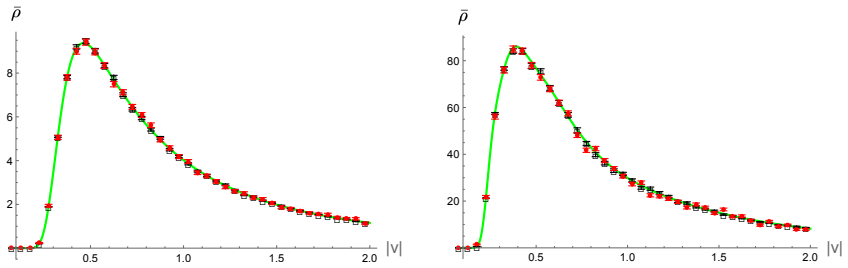
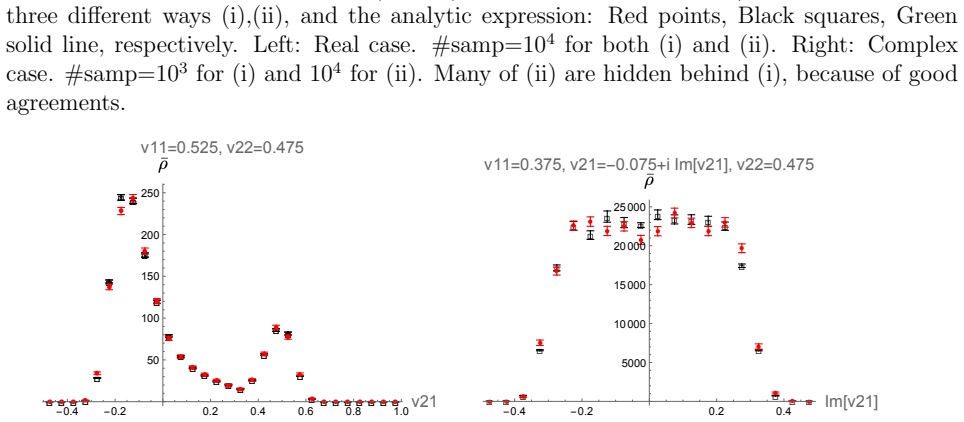
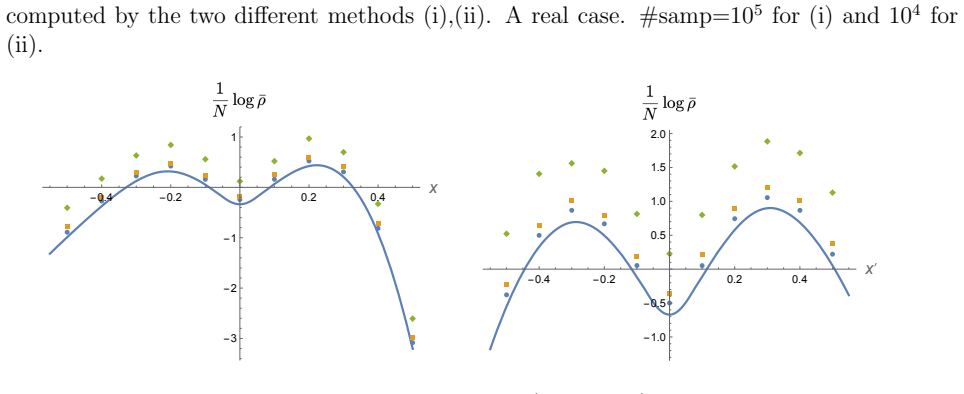
- Numerical Monte Carlo simulations provide direct cross-checks of the analytic expressions.
Where Pith is reading between the lines
- The geometric universality may extend to other observables such as eigenvalue-eigenvector correlations or higher-order statistics.
- Similar large-dimension reductions could appear in tensor models used in quantum gravity or disordered systems.
- The random-matrix representations open the possibility of applying standard random-matrix techniques to compute moments or tail probabilities of the joints.
Load-bearing premise
The random tensor entries are drawn from distributions that permit the application of the previously developed QFT methods, and the large-dimension limit is taken without additional corrections that would depend on the specific entry distribution.
What would settle it
Monte Carlo sampling of eigenvector joint histograms for a fixed tensor dimension and entry distribution that systematically deviates from the predicted common geometric function would falsify the large-dimension asymptotic claim.
Figures

read the original abstract
We compute the joint distributions of arbitrary numbers of eigenvectors of real and complex symmetric random tensors by the quantum field theoretical methods which were previously used to compute the mean distributions. We obtain the random matrix representations and the large-dimension asymptotics of the joint distributions. The latter can be expressed by a common function of tensor geometries, extending the universality found for the mean distributions to the joint distributions. Several crosschecks of our results are carried out by Monte Carlo computations.
Editorial analysis
A structured set of objections, weighed in public.
Referee Report
Summary. The manuscript computes the joint distributions of arbitrary numbers of eigenvectors for real and complex symmetric random tensors using quantum field theory methods previously developed for mean distributions. It derives random-matrix representations of these joints and their large-dimension asymptotics, which are shown to depend on a common function of the tensor geometry, thereby extending the universality previously established for marginal distributions. The results are cross-checked via Monte Carlo simulations for several cases.
Significance. If the derivations hold, the work provides a systematic extension of the QFT framework to joint eigenvector statistics in random tensors. The universality result for joints, expressed solely in terms of geometry, strengthens the case that eigenvector properties in high-dimensional tensor models are largely distribution-independent beyond the first few moments. Explicit random-matrix representations and numerical validations add concrete value for applications in tensor models, quantum gravity, and high-dimensional statistics.
minor comments (3)
- §3, after Eq. (3.12): the transition from the single-eigenvector generating functional to the joint case is sketched but the precise insertion of the additional delta-function constraints for multiple eigenvectors is not written out; adding one intermediate line would clarify the construction.
- Figure 2 caption: the Monte Carlo histograms are compared to the asymptotic formula, but the finite-N correction term used in the fit is not stated; including the explicit form of the 1/N correction would make the cross-check fully reproducible.
- §5.2, paragraph following Eq. (5.7): the statement that the joint distribution 'reduces to the product of marginals when eigenvectors are orthogonal' is correct but would benefit from a one-sentence reminder of the orthogonality measure induced by the tensor geometry.
Simulated Author's Rebuttal
We thank the referee for their positive summary of our manuscript and for recommending minor revision. The referee's description accurately reflects the scope and results of the work. No specific major comments or questions were raised in the report.
Circularity Check
Minor self-citation to prior QFT methods; central derivations and validations remain independent
full rationale
The paper extends QFT methods previously applied to mean eigenvector distributions, as noted in the abstract: 'by the quantum field theoretical methods which were previously used to compute the mean distributions.' It derives new random-matrix representations and large-dimension asymptotics expressed via a common function of tensor geometries, with explicit Monte Carlo cross-checks for several cases. No load-bearing reduction of the joint-distribution results to fitted parameters, self-definitional loops, or unverified self-citations is present; the extension and numerical validations supply independent content. This qualifies as a minor self-citation (score 2) without forcing the central claims by construction.
Axiom & Free-Parameter Ledger
axioms (1)
- domain assumption Random tensor entries follow distributions that allow the previously developed QFT methods to be applied without modification.
Lean theorems connected to this paper
-
IndisputableMonolith/Cost/FunctionalEquation.leanwashburn_uniqueness_aczel unclear?
unclearRelation between the paper passage and the cited Recognition theorem.
We obtain the random matrix representations and the large-dimension asymptotics of the joint distributions. The latter can be expressed by a common function of tensor geometries, extending the universality found for the mean distributions to the joint distributions.
-
IndisputableMonolith/Foundation/RealityFromDistinction.leanreality_from_one_distinction unclear?
unclearRelation between the paper passage and the cited Recognition theorem.
We use the quantum field theoretical methods which were successfully applied to compute the mean distributions of the eigenvalues/vectors of various types of random tensors
What do these tags mean?
- matches
- The paper's claim is directly supported by a theorem in the formal canon.
- supports
- The theorem supports part of the paper's argument, but the paper may add assumptions or extra steps.
- extends
- The paper goes beyond the formal theorem; the theorem is a base layer rather than the whole result.
- uses
- The paper appears to rely on the theorem as machinery.
- contradicts
- The paper's claim conflicts with a theorem or certificate in the canon.
- unclear
- Pith found a possible connection, but the passage is too broad, indirect, or ambiguous to say the theorem truly supports the claim.
Reference graph
Works this paper leans on
-
[1]
On the Distribution of the Roots of Certain Symmetric Matrices,
E. P. Wigner, “On the Distribution of the Roots of Certain Symmetric Matrices,” Annals of Mathematics67(2), 325-327 (1958) doi:10.2307/1970008 39
-
[2]
E. Brezin, C. Itzykson, G. Parisi and J. B. Zuber, “Planar Diagrams,” Commun. Math. Phys.59, 35 (1978) doi:10.1007/BF01614153
-
[3]
Eynard,Counting surfaces : CRM Aisenstadt chair lectures, Prog
B. Eynard,Counting surfaces : CRM Aisenstadt chair lectures, Prog. Math. Phys.70, Birkh¨ auser, 2016 doi:10.1007/978-3-7643-8797-6
-
[4]
Gurau,Random tensors, Oxford University Press, 2016
R. Gurau,Random tensors, Oxford University Press, 2016
work page 2016
-
[5]
doi:10.1093/oso/9780192845290.001.0001 , isbn = 9780192845290, abstract =
A. Tanasa,Combinatorial Physics: Combinatorics, Quantum Field Theory, and Quantum Gravity Models, Oxford University Press, 2021 doi:10.1093/oso/9780192895493.001.0001
-
[6]
Three-dimensional simplicial quantum gravity and generalized matrix models,
J. Ambjorn, B. Durhuus and T. Jonsson, “Three-dimensional simplicial quantum gravity and generalized matrix models,” Mod. Phys. Lett. A6, 1133-1146 (1991) doi:10.1142/S0217732391001184
-
[7]
Tensor model for gravity and orientability of manifold,
N. Sasakura, “Tensor model for gravity and orientability of manifold,” Mod. Phys. Lett. A6, 2613-2624 (1991) doi:10.1142/S0217732391003055
-
[8]
Simplicial quantum gravity in more than two-dimensions,
N. Godfrey and M. Gross, “Simplicial quantum gravity in more than two-dimensions,” Phys. Rev. D43, R1749(R) (1991) doi:10.1103/PhysRevD.43.R1749
-
[9]
Eigenvalues of a real supersymmetric tensor,
L. Qi, “Eigenvalues of a real supersymmetric tensor,” Journal of Symbolic Computation 40, 1302-1324 (2005)
work page 2005
-
[10]
Singular Values and Eigenvalues of Tensors: A Variational Approach,
L.H. Lim, “Singular Values and Eigenvalues of Tensors: A Variational Approach,” in Proceedings of the IEEE International Workshop on Computational Advances in Multi- Sensor Adaptive Processing (CAMSAP ’05), Vol. 1 (2005), pp. 129–132
work page 2005
-
[11]
The number of eigenvalues of a tensor,
D. Cartwright and B. Sturmfels, “The number of eigenvalues of a tensor,” Linear algebra and its applications438, 942-952 (2013)
work page 2013
-
[12]
A. Crisanti and H.-J. Sommers, “The spherical p-spin interaction spin glass model: the statics”, Z. Phys.B 87, 341 (1992) doi:10.1007/BF01309287
-
[13]
Spin-glass theory for pedestrians
T. Castellani and A. Cavagna, “Spin-glass theory for pedestrians”, J. Stat. Mech.: Theo. Exp.2005, P05012 doi:10.1088/1742-5468/2005/05/P05012 [arXiv:cond- mat/0505032]
-
[14]
Random Matrices and Complexity of Spin Glasses
A. Auffinger, G.B. Arous, and J. ˇCern´ y, “Random Matrices and Complexity of Spin Glasses”, Comm. Pure Appl. Math.,66, 165-201 (2013) doi.org/10.1002/cpa.21422 [arXiv:1003.1129 [math.PR]]
-
[15]
A. Shimony, “Degree of entanglement,” Annals of the New York Academy of Sciences, 755(1), 675–679 (1995) doi:10.1111/j.1749-6632.1995.tb39008.x
-
[16]
H. Barnum and N. Linden, “Monotones and invariants for multi-particle quantum states,” Journal of Physics A: Mathematical and General,34(35), 6787 (2001) doi:10.1088/0305- 4470/34/35/305 40
-
[17]
L. Qi, H. Chen, Y, Chen,Tensor Eigenvalues and Their Applications, Springer, Singapore, 2018
work page 2018
-
[18]
Resonant Hamiltonian systems and weakly nonlinear dynamics in AdS spacetimes,
O. Evnin, “Resonant Hamiltonian systems and weakly nonlinear dynamics in AdS spacetimes,” Class. Quant. Grav.38, no.20, 203001 (2021) doi:10.1088/1361-6382/ac1b46 [arXiv:2104.09797 [gr-qc]]
-
[19]
The Tensor Track VII: From Quantum Gravity to Artificial Intelligence,
M. Ouerfelli, V. Rivasseau and M. Tamaazousti, “The Tensor Track VII: From Quantum Gravity to Artificial Intelligence,” [arXiv:2205.10326 [hep-th]]
-
[20]
A supersymmetric SYK model with a curious low energy behavior,
A. Biggs, J. Maldacena and V. Narovlansky, “A supersymmetric SYK model with a curious low energy behavior,” [arXiv:2309.08818 [hep-th]]
-
[21]
Multi-dimensional chaos I: Classical and quantum mechanics,
M. Bianchi, M. Firrotta, J. Sonnenschein and D. Weissman, “Multi-dimensional chaos I: Classical and quantum mechanics,” [arXiv:2510.03007 [hep-th]]
-
[22]
Most Tensor Problems Are NP-Hard,
C.J. Hillar and L.-H. Lim, “Most Tensor Problems Are NP-Hard,” Journal of the ACM, 60, (6), 1 - 39, (2013) doi:10.1145/251232 [arXiv:0911.1393 [cs.CC]]
-
[23]
Topology trivialization transition in random non-gradient autonomous ODEs on a sphere,
Y.V. Fyodorov, “Topology trivialization transition in random non-gradient autonomous ODEs on a sphere,” J. Stat. Mech., 124003 (2016) doi:10.1088/1742-5468/aa511a [arXiv:1610.04831 [math-ph]]
-
[24]
The complexity of spherical p-spin models—A second moment approach,
E. Subag, “The complexity of spherical p-spin models—A second moment approach,” Ann. Probab.45(5), 3385 - 3450 (2017) doi:10.1214/16-AOP1139
-
[25]
The expected number of eigenvalues of a real gaussian tensor,
P. Breiding, “The expected number of eigenvalues of a real gaussian tensor,” SIAM Jour- nal on Applied Algebra and Geometry1, 254-271 (2017) doi:10.1137/16M1089769
-
[26]
How many eigenvalues of a random symmetric tensor are real?,
P. Breiding, “How many eigenvalues of a random symmetric tensor are real?,” Transac- tions of the American Mathematical Society372, 7857-7887 (2019) doi:10.1090/tran/7910
-
[27]
Melonic dominance and the largest eigenvalue of a large random tensor,
O. Evnin, “Melonic dominance and the largest eigenvalue of a large random tensor,” Lett. Math. Phys.111, 66 (2021) doi:10.1007/s11005-021-01407-z [arXiv:2003.11220 [math-ph]]
-
[28]
On the generalization of the Wigner semicircle law to real symmetric tensors,
R. Gurau, “On the generalization of the Wigner semicircle law to real symmetric tensors,” [arXiv:2004.02660 [math-ph]]
-
[29]
J. Kent-Dobias and J. Kurchan, “Complex complex landscapes,” Phys. Rev. Res.3, no.2, 023064 (2021) [arXiv:2012.06299 [cond-mat.stat-mech]]
-
[30]
Analytic continuation over complex landscapes,
J. Kent-Dobias and J. Kurchan, “Analytic continuation over complex landscapes,” J. Phys. A: Math. Theor.55, 434006 (2022) [arXiv:2204.06072 [cond-mat.stat-mech]]
-
[31]
Structure of metastable states in spin glasses by means of a three replica potential,
A. Cavagna, I. Giardina, and G. Parisi, “Structure of metastable states in spin glasses by means of a three replica potential,” Journal of Physics A: Mathematical and General,30 (13), 4449-4466 (1997). 41
work page 1997
-
[32]
A. Pacco, A. Rosso, and V. Ros, “Triplets of local minima in a high-dimensional random landscape: correlations, clustering, and memoryless activated jumps,” J. Stat. Mech.2025, 033302 (2025)
work page 2025
-
[33]
Signed Eigenvalue/vector Distribution of Complex Order-Three Random Tensor,
N. Sasakura, “Signed Eigenvalue/vector Distribution of Complex Order-Three Random Tensor,” PTEP2024, no.5, 053A04 (2024) doi:10.1093/ptep/ptae062 [arXiv:2404.03385 [hep-th]]
-
[34]
Injective norm of real and complex random tensors I: From spin glasses to geometric entanglement,
S. Dartois and B. McKenna, “Injective norm of real and complex random tensors I: From spin glasses to geometric entanglement,” [arXiv:2404.03627 [math.PR]]
-
[35]
Three Cases of Complex Eigenvalue/Vector Distribu- tions of Symmetric Order-Three Random Tensors,
S. Majumder and N. Sasakura, “Three Cases of Complex Eigenvalue/Vector Distribu- tions of Symmetric Order-Three Random Tensors,” PTEP2024, no.9, 093A01 (2024) doi:10.1093/ptep/ptae136 [arXiv:2408.01030 [hep-th]]
-
[36]
Real eigenvalue/vector distribu- tions of random real antisymmetric tensors,
N. Delporte, G. La Scala, N. Sasakura and R. Toriumi, “Real eigenvalue/vector distribu- tions of random real antisymmetric tensors,” to be published in JHEP [arXiv:2510.20398 [hep-th]]
-
[37]
On the injective norm of random fermionic states and skew- symmetric tensors,
S. Dartois and P. Radpay, “On the injective norm of random fermionic states and skew- symmetric tensors,” [arXiv:2510.25474 [math.PR]]
-
[38]
Estimating the entanglement of random multipartite quantum states,
K. P. Fitter, C. Lancien and I. Nechita, “Estimating the entanglement of random multipartite quantum states,” Quantum9, 1870 (2025) doi:10.22331/q-2025-10-01-1870 [arXiv:2209.11754 [quant-ph]]
-
[39]
Signed distributions of real tensor eigenvectors of Gaussian tensor model via a four-fermi theory,
N. Sasakura, “Signed distributions of real tensor eigenvectors of Gaussian tensor model via a four-fermi theory,” Phys. Lett. B836, 137618 (2023) doi:10.1016/j.physletb.2022.137618 [arXiv:2208.08837 [hep-th]]
-
[40]
Real tensor eigenvalue/vector distributions of the Gaussian tensor model via a four-fermi theory,
N. Sasakura, “Real tensor eigenvalue/vector distributions of the Gaussian tensor model via a four-fermi theory,” PTEP2023, no.1, 013A02 (2023) doi:10.1093/ptep/ptac169 [arXiv:2209.07032 [hep-th]]
-
[41]
N. Sasakura, “Exact analytic expressions of real tensor eigenvalue distributions of Gaussian tensor model for small N,” J. Math. Phys.64, no.6, 063501 (2023) doi:10.1063/5.0133874 [arXiv:2210.15129 [hep-th]]
-
[42]
Real eigenvector distributions of random tensors with backgrounds and random deviations,
N. Sasakura, “Real eigenvector distributions of random tensors with backgrounds and random deviations,” PTEP2023, no.12, 123A01 (2023) doi:10.1093/ptep/ptad138 [arXiv:2310.14589 [hep-th]]
-
[43]
The edge of random tensor eigenvalues with deviation,
N. Delporte and N. Sasakura, “The edge of random tensor eigenvalues with deviation,” JHEP01, 071 (2025) doi:10.1007/JHEP01(2025)071 [arXiv:2405.07731 [hep-th]]
-
[44]
L. Pastur and M. Shcherbina, “Universality of the local eigenvalue statistics for a class of unitary invariant random matrix ensembles,” Journal of Statistical Physics86, 109 (1997). 42
work page 1997
-
[45]
Efetov,Supersymmetry in disorder and chaos, Cambridge University Press , 1997
K. Efetov,Supersymmetry in disorder and chaos, Cambridge University Press , 1997
work page 1997
-
[46]
An introduction to large deviations with applications in physics,
I. N. Burenev, D. W. H. Cloete, V. Kharbanda, H. Touchette, “An introduction to large deviations with applications in physics,” SciPost Phys. Lect. Notes 104 (2025) doi: 10.21468/SciPostPhysLectNotes.104 [arXiv:2503.16015 [cond-mat.stat-mech]]
-
[47]
T. Nagao, and M. Wadati, ”Correlation Functions of Random Matrix EnsemblesRe- lated to Classical Orthogonal Polynomials,” Phys. Soc. Jpn.60, 3298 (1991) doi: 10.1143/JPSJ.60.3298 43
discussion (0)
Sign in with ORCID, Apple, or X to comment. Anyone can read and Pith papers without signing in.