Recognition: 2 theorem links
· Lean TheoremNumerical estimation of the capture ability of Neptunian mean motion resonances
Pith reviewed 2026-05-12 04:43 UTC · model grok-4.3
The pith
Numerical simulations produce an empirical formula for the eccentricity threshold required to capture objects into Neptunian mean motion resonances during migration.
A machine-rendered reading of the paper's core claim, the machinery that carries it, and where it could break.
Core claim
For a specific p:q mean motion resonance, small bodies can be captured only when their eccentricities surpass a certain threshold, which increases with faster migration rates, greater distances of MMRs, and higher resonance orders. As long as a particle's eccentricity is suitable, its capture efficiency shows little dependence on the migration rate; instead, it mainly depends on the p value and heliocentric distance, decaying exponentially as either parameter increases. From the simulation results the authors derive simple empirical expressions to calculate the eccentricity threshold and the capture efficiency.
What carries the argument
Numerical N-body simulations of test particles undergoing Neptune's outward migration, used to measure capture probabilities into various exterior p:q resonances and fit empirical formulas to the resulting thresholds and efficiencies.
If this is right
- Capture into distant or high-order resonances requires higher eccentricities, limiting the trapped population at large distances.
- The empirical formulas enable rapid calculation of capture rates for different migration speeds without repeating full simulations.
- Observed resonant trans-Neptunian object populations can be used to back-calculate the speed and distance of Neptune's migration.
- The efficiency decay with p and distance provides a quantitative way to predict resonance populations from the primordial disk.
Where Pith is reading between the lines
- These thresholds could be checked against detailed 3D simulations that include inclination and other planets to see if the planar approximation holds.
- Applying the formulas to different migration histories might help distinguish between smooth migration and migration with jumps.
- The exponential dependence suggests that very distant resonances capture almost no objects, which could explain gaps in the observed distribution.
Load-bearing premise
A planar model without three-dimensional effects or additional perturbations is sufficient to capture the essential dynamics of resonance capture during migration.
What would settle it
Running a simulation with eccentricities below the predicted threshold and finding significant capture into the resonance, or measuring capture rates that do not decay exponentially with increasing p or distance.
Figures


read the original abstract
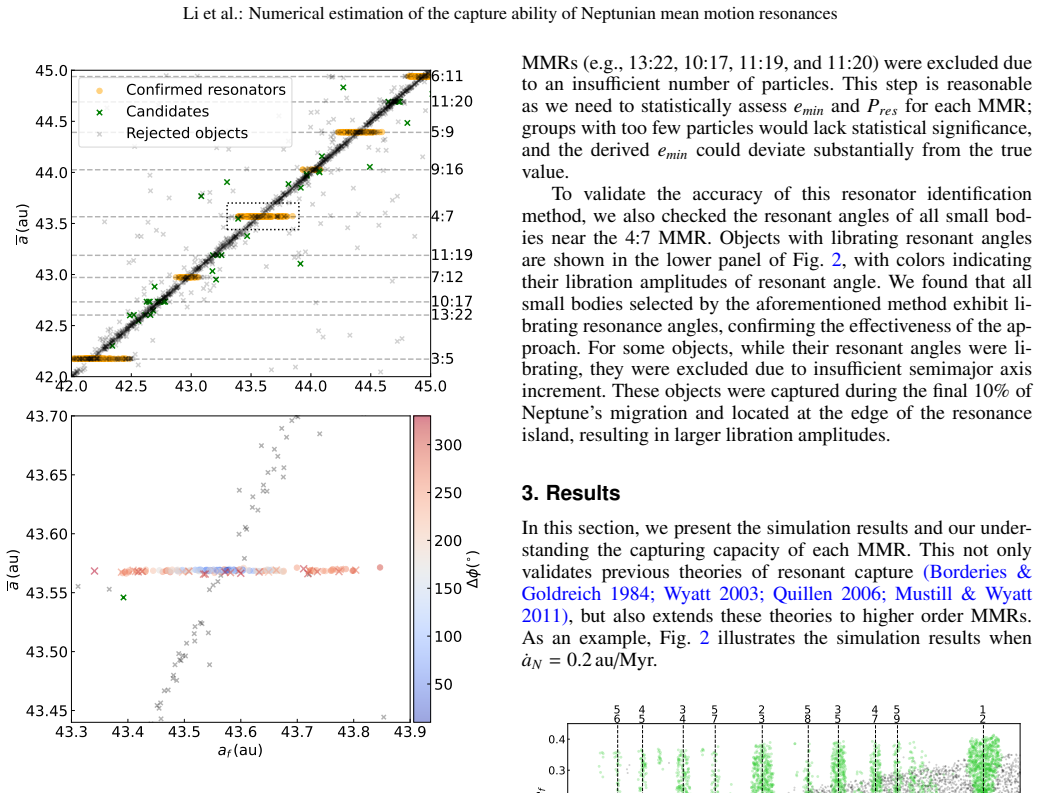
Resonant populations of trans-Neptunian objects serve as crucial dynamical archives for unraveling the early migratory history of the Solar System. A quantitative assessment of the capture efficiency into various mean motion resonances (MMRs) during migration is essential for understanding the origins of these populations, constraining migration parameters, and reconstructing of the primordial planetesimal disk. Using numerical simulations, this study systematically investigates the capture capability of exterior MMRs during Neptune's outward migration in a planar model. For a specific p:q MMR, the small bodies can be captured only when their eccentricities surpass a certain threshold, which increases with faster migration rates, greater distances of MMRs, and higher resonance orders. On the other hand, as long as a particle's eccentricity is suitable, its capture efficiency shows little dependence on the migration rate; instead, it mainly depends on the p value and heliocentric distance, decaying exponentially as either parameter increases. Based on our simulation results, we derive for the first time a simple empirical expression to calculate eccentricity threshold and the capture efficiency. This research provides a systematic quantitative framework for understanding capture into Neptunian MMRs during migration. Future integrations of more comprehensive observational data will facilitate a more precise reconstruction of the Solar System's early dynamical evolution.
Editorial analysis
A structured set of objections, weighed in public.
Referee Report
Summary. The paper reports N-body simulations of test-particle capture into exterior p:q mean-motion resonances with Neptune during its outward migration, performed exclusively in a planar (2D) model. It identifies an eccentricity threshold for capture that rises with faster migration, larger heliocentric distance, and higher resonance order, while capture efficiency (once above threshold) depends primarily on resonance order p and distance and decays exponentially with both. From these runs the authors fit simple empirical expressions for the threshold eccentricity and capture probability, presenting them as a quantitative framework for interpreting resonant TNO populations.
Significance. If the planar results generalize, the empirical formulas would supply a practical, low-cost way to estimate capture fractions for a range of migration histories and resonance orders, directly useful for reconstructing the primordial planetesimal disk and testing migration scenarios against observed resonant populations. The numerical origin of the expressions and their explicit dependence on migration rate, distance, and order constitute a concrete, falsifiable advance over purely analytic treatments.
major comments (3)
- [Abstract, §2] Abstract and §2 (model description): the entire set of empirical expressions is derived from planar integrations; the manuscript contains no tests or discussion of how modest inclinations (i ~ 5–20°) or additional perturbations alter resonance widths and capture probabilities, yet the abstract presents the formulas as a general framework for TNO capture. This assumption is load-bearing for the claimed quantitative utility.
- [Abstract, §3] Abstract and §3 (simulation setup): no information is given on particle number, integrator, time-step, migration implementation (e.g., forced vs. self-consistent), or convergence checks. Without these details the robustness of the fitted eccentricity threshold and exponential decay law cannot be evaluated, undermining the central claim that the expressions are ready for use in migration reconstructions.
- [§4] §4 (empirical fits): the capture-efficiency formula is stated to depend only on p and distance once eccentricity exceeds threshold, but the text does not report the range of migration rates over which this independence was verified or the goodness-of-fit metrics (e.g., residuals or cross-validation). If the independence holds only for a narrow parameter window, the expressions lose predictive value outside that window.
minor comments (2)
- [Introduction] The abstract claims the expressions are derived “for the first time”; a brief literature comparison in the introduction would clarify the novelty relative to earlier analytic or numerical capture studies.
- [§4] Notation for resonance order (p:q) and the exact functional form of the empirical expressions should be defined explicitly in a dedicated subsection or table to aid reproducibility.
Simulated Author's Rebuttal
We thank the referee for their constructive and detailed comments, which have helped us identify areas for improvement in clarity and completeness. We address each major comment point by point below. Where appropriate, we have revised the manuscript to incorporate additional details, caveats, and supporting information without altering the core numerical results or empirical expressions.
read point-by-point responses
-
Referee: [Abstract, §2] Abstract and §2 (model description): the entire set of empirical expressions is derived from planar integrations; the manuscript contains no tests or discussion of how modest inclinations (i ~ 5–20°) or additional perturbations alter resonance widths and capture probabilities, yet the abstract presents the formulas as a general framework for TNO capture. This assumption is load-bearing for the claimed quantitative utility.
Authors: We agree that the work is restricted to a planar (2D) model, as stated in the title, abstract, and §2. The empirical expressions are derived and validated exclusively under this assumption and are not claimed to be inclination-independent. To address the concern, we will revise the abstract to explicitly emphasize the planar nature of the study and add a dedicated paragraph in the discussion section noting the limitations for inclined orbits and the potential impact of perturbations. We will also state that the formulas provide a baseline for low-inclination cases and that 3D extensions are left for future work. This improves transparency without changing the presented results. revision: partial
-
Referee: [Abstract, §3] Abstract and §3 (simulation setup): no information is given on particle number, integrator, time-step, migration implementation (e.g., forced vs. self-consistent), or convergence checks. Without these details the robustness of the fitted eccentricity threshold and exponential decay law cannot be evaluated, undermining the central claim that the expressions are ready for use in migration reconstructions.
Authors: We apologize for this omission in the original submission. In the revised manuscript we will expand §3 with a new subsection providing all requested technical details: 10,000 test particles per resonance, the REBOUND N-body integrator with the WHFast symplectic scheme, a fixed time-step of 0.1 yr, forced outward migration implemented via a constant da/dt term, and convergence tests performed by doubling particle number and halving the time-step. These additions will allow readers to assess the robustness of the fitted thresholds and efficiencies. revision: yes
-
Referee: [§4] §4 (empirical fits): the capture-efficiency formula is stated to depend only on p and distance once eccentricity exceeds threshold, but the text does not report the range of migration rates over which this independence was verified or the goodness-of-fit metrics (e.g., residuals or cross-validation). If the independence holds only for a narrow parameter window, the expressions lose predictive value outside that window.
Authors: The claimed independence of capture efficiency on migration rate (above the eccentricity threshold) was verified across migration rates from 0.2 to 8 AU Myr⁻¹, which spans the range of interest for Neptune migration models. In the revised §4 we will explicitly state this verified range and include quantitative goodness-of-fit measures (R² > 0.92 for all fits, together with residual plots versus migration rate and resonance order) to demonstrate that the exponential dependence on p and distance holds robustly within the explored parameter space. revision: yes
Circularity Check
Empirical fits to independent N-body data; no reduction to inputs by construction
full rationale
The paper runs planar N-body simulations of Neptune's migration and resonance capture, then explicitly fits simple empirical expressions for eccentricity threshold and capture efficiency to those simulation outputs. This is a standard data-driven workflow with no self-referential loop: the simulations are independent numerical integrations, the expressions are transparently derived from them, and no first-principles claim or uniqueness theorem is invoked. No self-citations, ansatzes, or renamings of known results appear in the provided text. The planar-model limitation is an assumption about applicability, not a circularity in the derivation chain.
Axiom & Free-Parameter Ledger
Lean theorems connected to this paper
-
IndisputableMonolith/Foundation/AlexanderDuality.leanalexander_duality_circle_linking unclear?
unclearRelation between the paper passage and the cited Recognition theorem.
Using numerical simulations, this study systematically investigates the capture capability of exterior MMRs during Neptune’s outward migration in a planar model... we derive for the first time a simple empirical expression to calculate e_min and the capture efficiency.
-
IndisputableMonolith/Foundation/RealityFromDistinction.leanreality_from_one_distinction unclear?
unclearRelation between the paper passage and the cited Recognition theorem.
we employed a planar restricted three-body model consisting of the Sun, Neptune, and massless small bodies.
What do these tags mean?
- matches
- The paper's claim is directly supported by a theorem in the formal canon.
- supports
- The theorem supports part of the paper's argument, but the paper may add assumptions or extra steps.
- extends
- The paper goes beyond the formal theorem; the theorem is a base layer rather than the whole result.
- uses
- The paper appears to rely on the theorem as machinery.
- contradicts
- The paper's claim conflicts with a theorem or certificate in the canon.
- unclear
- Pith found a possible connection, but the passage is too broad, indirect, or ambiguous to say the theorem truly supports the claim.
Reference graph
Works this paper leans on
-
[1]
Adams, E. R., Gulbis, A. A. S., Elliot, J. L., et al. 2014, AJ, 148, 55
work page 2014
- [2]
-
[3]
1994, Celestial Mechanics and Dynamical Astronomy, 60, 225
Beauge, C. 1994, Celestial Mechanics and Dynamical Astronomy, 60, 225
work page 1994
-
[4]
Beck, R. A. 1981, Irish Astronomical Journal, 15, 87
work page 1981
- [5]
-
[6]
Chen, Y .-T., Gladman, B., V olk, K., et al. 2019, AJ, 158, 214 ADS
work page 2019
-
[7]
Chiang, E. I. & Jordan, A. B. 2002, AJ, 124, 3430
work page 2002
-
[8]
Crompvoets, B. L., Lawler, S. M., V olk, K., et al. 2022, psj, 3, 113 ADS
work page 2022
-
[9]
Frangakis, C. N. 1973, apss, 22, 421
work page 1973
- [10]
-
[11]
Gladman, B., Lawler, S. M., Petit, J.-M., et al. 2012, AJ, 144, 23 ADS
work page 2012
- [12]
- [13]
-
[14]
Kaib, N. A. & Sheppard, S. S. 2016, AJ, 152, 133
work page 2016
-
[15]
Kotoulas, T. & V oyatzis, G. 2004, Celestial Mechanics and Dynamical Astron- omy, 88, 343 ADS
work page 2004
-
[16]
Kotoulas, T. A. 2005, aap, 429, 1107
work page 2005
-
[17]
Lan, L. & Malhotra, R. 2019, Celestial Mechanics and Dynamical Astronomy, 131, 39 ADS
work page 2019
- [18]
-
[19]
F., Morbidelli, A., Van Laerhoven, C., Gomes, R., & Tsiganis, K
Levison, H. F., Morbidelli, A., Van Laerhoven, C., Gomes, R., & Tsiganis, K. 2008, Icarus, 196, 258
work page 2008
- [20]
- [21]
- [22]
- [23]
-
[24]
Lykawka, P. S. & Mukai, T. 2007, Icarus, 192, 238
work page 2007
- [25]
- [26]
- [27]
-
[28]
Melita, M. D. & Brunini, A. 2000, Icarus, 147, 205 ADS
work page 2000
-
[29]
Message, P. J. 1958, AJ, 63, 443
work page 1958
-
[30]
2002, Modern celestial mechanics : aspects of solar system dy- namics
Morbidelli, A. 2002, Modern celestial mechanics : aspects of solar system dy- namics
work page 2002
-
[31]
Morbidelli, A. & Nesvorný, D. 2020, in The Trans-Neptunian Solar System, ed. D. Prialnik, M. A. Barucci, & L. Young, 25–59
work page 2020
-
[32]
Morbidelli, A., Thomas, F., & Moons, M. 1995, icarus, 118, 322
work page 1995
-
[33]
Murray, C. D. & Dermott, S. F. 1999, Solar System Dynamics
work page 1999
-
[34]
Murray-Clay, R. A. & Chiang, E. I. 2005, apj, 619, 623
work page 2005
-
[35]
Mustill, A. J. & Wyatt, M. C. 2011, MNRAS, 413, 554 ADS
work page 2011
- [36]
-
[37]
Namouni, F. & Morais, M. H. M. 2017, MNRAS, 467, 2673 Nesvorný, D. 2015, AJ, 150, 68 Nesvorný, D. 2018, ARA&A, 56, 137 ADS Nesvorný, D. & Morbidelli, A. 2012, AJ, 144, 117 Nesvorný, D. & V okrouhlický, D. 2016, ApJ, 825, 94
work page 2017
-
[38]
Peale, S. J. 1976, ARA&A, 14, 215
work page 1976
-
[39]
Pike, R. E., Kavelaars, J. J., Petit, J. M., et al. 2015, AJ, 149, 202
work page 2015
-
[40]
Plummer, H. C. 1916, mnras, 76, 390
work page 1916
-
[41]
Quillen, A. C. 2006, MNRAS, 365, 1367
work page 2006
- [42]
- [43]
-
[44]
Saillenfest, M., Fouchard, M., Tommei, G., & Valsecchi, G. B. 2016, Celestial Mechanics and Dynamical Astronomy, 126, 369
work page 2016
-
[45]
Tiscareno, M. S. & Malhotra, R. 2009, aj, 138, 827
work page 2009
-
[46]
Tsiganis, K., Gomes, R., Morbidelli, A., & Levison, H. F. 2005, Nature, 435, 459 V olk, K., Murray-Clay, R., Gladman, B., et al. 2016, AJ, 152, 23 ADS V olk, K., Murray-Clay, R. A., Gladman, B. J., et al. 2018, AJ, 155, 260 V oyatzis, G., Kotoulas, T., & Hadjidemetriou, J. D. 2005, Celestial Mechanics and Dynamical Astronomy, 91, 191
work page 2005
- [47]
-
[48]
Wyatt, M. C. 2003, ApJ, 598, 1321 ADS
work page 2003
-
[49]
Yoder, C. F. 1979, Celestial Mechanics, 19, 3
work page 1979
-
[50]
Yu, T. Y . M., Murray-Clay, R., & V olk, K. 2018, AJ, 156, 33 ADS Article number, page 12 of 12
work page 2018
discussion (0)
Sign in with ORCID, Apple, or X to comment. Anyone can read and Pith papers without signing in.