Recognition: no theorem link
RAYTHEIA: A high-performance ray-tracing algorithm for three-dimensional direction-dependent equations in astronomical simulations
Pith reviewed 2026-05-12 04:46 UTC · model grok-4.3
The pith
The RAYTHEIA algorithm enables accurate three-dimensional modeling of photodissociation region chemistry at resolutions of 512 cubed grid cells.
A machine-rendered reading of the paper's core claim, the machinery that carries it, and where it could break.
Core claim
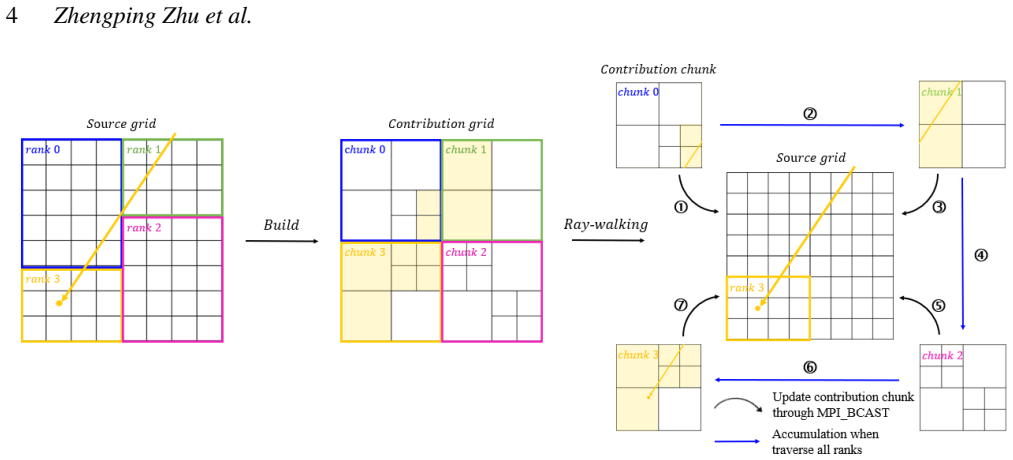
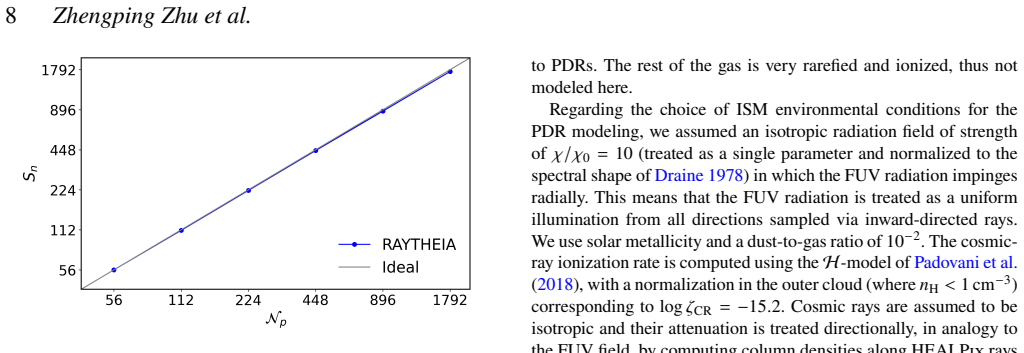
RAYTHEIA employs a dual-grid framework with the native simulation mesh as source and an AMR Cartesian grid for contribution accumulation. It integrates a leaf-only linear-octree to cut memory use, digital differential analyzer traversal for path finding, Morton code indexing for fast lookups, and the slab method for path length computation. A hybrid MPI and OpenMP parallel framework with chunk communication delivers near-ideal linear speed-up. Integrated with the 3D-PDR code, the method solves PDR chemistry in a turbulent cloud at 512^3 resolution, showing accuracy and convergence at low angular resolutions, and produces synthetic maps of diagnostic lines.
What carries the argument
Dual-grid framework with leaf-only linear-octree, DDA traversal, Morton indexing, and slab method for ray-walking and accumulation in parallel.
If this is right
- Three-dimensional PDR chemistry can be modeled in turbulent star-forming clouds at 512^3 grid cells.
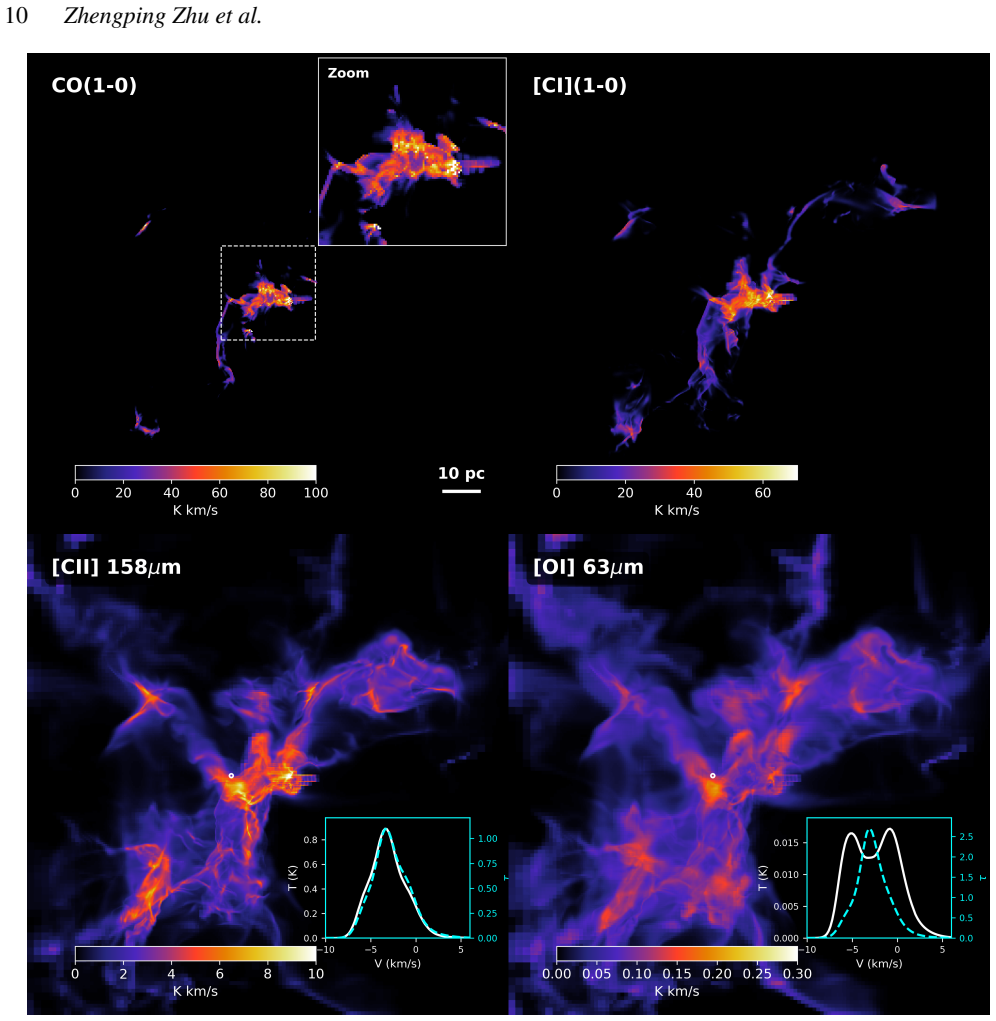
- High-resolution synthetic emission maps can capture effects like self-absorption in [O I] lines.
- The amount of [C I]-bright but CO-dark molecular gas can be measured directly.
- CO-to-H2 conversion factors can be derived in agreement with observations.
- Direction-dependent equations can be solved accurately even at low angular resolutions.
Where Pith is reading between the lines
- Similar ray-tracing approaches might speed up simulations in other areas of radiative transfer beyond PDRs.
- Extending the method to higher dimensions or different grid types could broaden its use in astrophysical modeling.
- Performance on even larger grids or with more processors could be tested to confirm the linear scaling.
- Comparison with other ray-tracing methods on the same problem would quantify the gains in speed and accuracy.
Load-bearing premise
The data structures and traversal methods do not introduce significant errors into the chemistry calculations through truncation or interpolation.
What would settle it
Compare the output chemistry abundances or line intensities from RAYTHEIA against a reference solution computed with a slower but exact ray-tracing method on a smaller grid, checking for deviations larger than a few percent at low angular resolutions.
Figures




read the original abstract
We present RAYTHEIA, a high-performance reverse ray-tracing algorithm designed to efficiently solve three-dimensional direction-dependent equations in astronomical simulations. The algorithm uses a dual-grid framework in which the native simulation mesh -- serving as the source grid for ray emission -- and an adaptive mesh refinement (AMR) Cartesian contribution grid are constructed for efficient ray-walking and contribution accumulation. The core of the algorithm integrates a leaf-only linear-octree data structure to reduce memory overhead, the digital differential analyzer (DDA) traversal method to efficiently determine the ray-walking path, Morton Code indexing to fast leaf cell lookup during traversal, and the slab method to analytically compute the path length. Furthermore, RAYTHEIA employs a hybrid (MPI/OpenMP) distributed parallel framework with a chunk-to-chunk communication strategy, achieving exceptional, near-ideal linear speed-up ratio and delivering high-end performance. We integrate RAYTHEIA with the 3D-PDR code to solve the complex chemistry and radiation transfer in photodissociation regions (PDRs). This allowed the modelling of three-dimensional PDR chemistry in a turbulent, star-forming cloud at an unprecedented resolution of $512^3$ grid cells. The algorithm demonstrates accuracy and convergence even at low angular resolutions. We further showcase the capabilities of RAYTHEIA by producing high-resolution synthetic emission maps of key diagnostic lines of a star-forming region capturing physical effects such as [O I] $63\mu$m self-absorption, measuring the [C I]-bright but CO-dark molecular gas, and deriving a CO-to-H$_2$ conversion factor in agreement with observations.
Editorial analysis
A structured set of objections, weighed in public.
Referee Report
Summary. The paper presents RAYTHEIA, a reverse ray-tracing algorithm for solving three-dimensional direction-dependent equations in astronomical simulations. It employs a dual-grid framework (native mesh plus AMR Cartesian contribution grid), leaf-only linear-octree, DDA traversal, Morton indexing, and slab method for path lengths, combined with hybrid MPI/OpenMP parallelism using chunk-to-chunk communication. The algorithm is integrated with the 3D-PDR code to model PDR chemistry and radiation transfer in a turbulent star-forming cloud at 512^3 resolution, producing synthetic emission maps that include effects such as [O I] 63 µm self-absorption and CO-dark gas, while claiming near-ideal linear speedup and accuracy/convergence even at low angular resolutions.
Significance. If the accuracy and error-control claims hold, RAYTHEIA would represent a meaningful technical advance by enabling high-resolution 3D PDR simulations that were previously computationally prohibitive, with direct implications for interpreting observations of star-forming regions through physically consistent synthetic maps.
major comments (2)
- [Abstract / Results] Abstract and results section: the central claim that the algorithm 'demonstrates accuracy and convergence even at low angular resolutions' and produces 'physically plausible maps' is not supported by any quantitative error norms, L2 residuals, convergence plots versus angular resolution, or direct comparisons against analytic solutions or reference integrators on the same grids. Without these, the assertion that truncation or interpolation errors from the dual-grid accumulation and native-mesh mapping remain negligible for the chemistry solution cannot be evaluated.
- [Algorithm description / Dual-grid framework] Section describing the dual-grid framework and slab accumulation: the paper does not quantify how geometric mismatches or interpolation at AMR refinement boundaries affect the direction-dependent radiation field before it is fed into the 3D-PDR chemistry solver. A sensitivity test showing stability of key observables (e.g., [O I] 63 µm optical depth or CO-dark gas fraction) under variations in the mapping procedure is required to substantiate that the 512^3 results are numerically robust rather than artifacts of the discretization.
minor comments (2)
- [Abstract] The abstract states 'exceptional, near-ideal linear speed-up ratio' but does not report the actual scaling exponents, core counts, or strong/weak scaling plots; these should be added with explicit numbers for reproducibility.
- [Methods] Notation for the slab-method path-length calculation and Morton-code indexing should be defined explicitly with equations in the methods section to allow independent implementation.
Simulated Author's Rebuttal
We thank the referee for their thorough and constructive review of our manuscript on the RAYTHEIA algorithm. The comments identify areas where additional quantitative validation would strengthen the presentation of accuracy and robustness claims. We address each major comment below and have prepared revisions to incorporate the requested analyses and tests.
read point-by-point responses
-
Referee: [Abstract / Results] Abstract and results section: the central claim that the algorithm 'demonstrates accuracy and convergence even at low angular resolutions' and produces 'physically plausible maps' is not supported by any quantitative error norms, L2 residuals, convergence plots versus angular resolution, or direct comparisons against analytic solutions or reference integrators on the same grids. Without these, the assertion that truncation or interpolation errors from the dual-grid accumulation and native-mesh mapping remain negligible for the chemistry solution cannot be evaluated.
Authors: We agree that the current manuscript would be strengthened by explicit quantitative support for the accuracy and convergence statements. In the revised version, we will add a dedicated validation subsection (including new figures) that reports L2 error norms for radiation field and chemistry quantities, convergence plots versus angular resolution (down to the low-resolution regime cited), and direct comparisons against analytic solutions for simplified geometries as well as reference integrator runs on identical grids. These additions will allow readers to evaluate the magnitude of dual-grid truncation and mapping errors relative to the chemistry solution. revision: yes
-
Referee: [Algorithm description / Dual-grid framework] Section describing the dual-grid framework and slab accumulation: the paper does not quantify how geometric mismatches or interpolation at AMR refinement boundaries affect the direction-dependent radiation field before it is fed into the 3D-PDR chemistry solver. A sensitivity test showing stability of key observables (e.g., [O I] 63 µm optical depth or CO-dark gas fraction) under variations in the mapping procedure is required to substantiate that the 512^3 results are numerically robust rather than artifacts of the discretization.
Authors: We acknowledge that the manuscript lacks a quantitative assessment of interpolation and geometric mismatch effects at AMR boundaries. In the revision we will include a new sensitivity study that systematically varies the mapping and interpolation procedures at refinement interfaces. The study will report the resulting changes in the direction-dependent radiation field and in downstream observables such as [O I] 63 µm optical depth and CO-dark gas fraction, thereby demonstrating numerical stability of the 512^3 results. revision: yes
Circularity Check
No circularity in algorithmic description or claims
full rationale
The paper presents RAYTHEIA as a new reverse ray-tracing algorithm using dual-grid, leaf-only linear-octree, DDA traversal, Morton indexing, slab method, and hybrid parallelism. No equations, predictions, or uniqueness theorems are derived; performance and accuracy claims rest on reported implementation benchmarks and convergence tests at 512^3 resolution. No self-citations, fitted parameters renamed as predictions, or self-definitional reductions appear in the derivation chain. The contribution is a computational method whose correctness is externally verifiable via code and benchmarks, making the analysis self-contained with no load-bearing circular steps.
Axiom & Free-Parameter Ledger
axioms (2)
- domain assumption The slab method analytically computes exact path lengths through Cartesian cells without approximation error for the chosen grid.
- domain assumption The linear-octree and Morton indexing preserve all necessary leaf-cell information without loss during traversal.
Reference graph
Works this paper leans on
-
[1]
SILCC-Zoom: the dynamic and chemical evolution of molecular clouds. , keywords =. doi:10.1093/mnras/stx2343 , archivePrefix =. 1704.06487 , primaryClass =
-
[2]
An alternative accurate tracer of molecular clouds: the `XCi-factor'. , keywords =. doi:10.1093/mnrasl/slu013 , archivePrefix =. 1401.5072 , primaryClass =
-
[3]
Photoelectric heating of interstellar gas. , keywords =. doi:10.1086/190513 , adsurl =
-
[4]
Cosmic-ray ionisation in circumstellar discs. , keywords =. doi:10.1051/0004-6361/201732202 , archivePrefix =. 1803.09348 , primaryClass =
-
[5]
The Photodissociation and Chemistry of Interstellar CO. , keywords =. doi:10.1086/166877 , adsurl =
-
[6]
GMC Collisions as Triggers of Star Formation. V. Observational Signatures. , keywords =. doi:10.3847/1538-4357/aa94c5 , archivePrefix =. 1706.07006 , primaryClass =
-
[7]
Photodissociation region diagnostics across galactic environments. , keywords =. doi:10.1093/mnras/stab121 , archivePrefix =. 2012.06773 , primaryClass =
-
[8]
A Portrait of Cold Gas in Galaxies at 60 pc Resolution and a Simple Method to Test Hypotheses That Link Small-scale ISM Structure to Galaxy-scale Processes. , keywords =. doi:10.3847/0004-637X/831/1/16 , archivePrefix =. 1606.07077 , primaryClass =
-
[9]
An Unbiased CO Survey toward the Northern Region of the Small Magellanic Cloud with the Atacama Compact Array. I. Overview: CO Cloud Distributions. , keywords =. doi:10.3847/1538-4357/ac1ff4 , archivePrefix =. 2108.09018 , primaryClass =
-
[10]
The CO-dark molecular gas in the cold H I arc. , keywords =. doi:10.1051/0004-6361/202450067 , archivePrefix =. 2405.02055 , primaryClass =
-
[11]
The CO-to-H _ 2 Conversion Factor. , keywords =. doi:10.1146/annurev-astro-082812-140944 , archivePrefix =. 1301.3498 , primaryClass =
work page internal anchor Pith review Pith/arXiv arXiv doi:10.1146/annurev-astro-082812-140944
-
[12]
Astrochemistry of Cosmic Phenomena , year = 1992, editor =
Diffuse, Translucent & High-Latitude Clouds: Theoretical Considerations(rp). Astrochemistry of Cosmic Phenomena , year = 1992, editor =
work page 1992
-
[13]
Metallicity dependence of the CO-to-H _ 2 and the [CI]-to-H _ 2 conversion factors in galaxies. , keywords =. doi:10.1051/0004-6361/202554067 , archivePrefix =. 2503.12073 , primaryClass =
-
[14]
H _ 2 Formation on Grain Surfaces. , keywords =. doi:10.1086/381775 , adsurl =
-
[15]
2004, MNRAS, 348, 1019, doi: 10.1111/j.1365-2966.2004.07422.x
CI lines as tracers of molecular gas, and their prospects at high redshifts. , keywords =. doi:10.1111/j.1365-2966.2004.07762.x , archivePrefix =. astro-ph/0403092 , primaryClass =
-
[16]
Lampray: Multi-group long characteristics ray tracing for adaptive mesh radiation hydrodynamics. arXiv e-prints , keywords =. doi:10.48550/arXiv.1809.05541 , archivePrefix =. 1809.05541 , primaryClass =
-
[17]
Smoothed particle hydrodynamics simulations of expanding H II regions. I. Numerical method and applications. , keywords =. doi:10.1051/0004-6361/200811522 , archivePrefix =. 0902.2374 , primaryClass =
-
[18]
Modeling UV Radiation Feedback from Massive Stars. I. Implementation of Adaptive Ray-tracing Method and Tests. , keywords =. doi:10.3847/1538-4357/aa9b80 , archivePrefix =. 1711.06277 , primaryClass =
-
[19]
Dynamically Driven Evolution of Molecular Gas in the Barred Spiral Galaxy M83 Traced by CO J = 2─1/1─0 Line Ratio Variations. , keywords =. doi:10.3847/1538-4357/add1dc , adsurl =
-
[20]
ALMA FACTS. III. High-resolution CO(2─1)/CO(1─0) Maps of Twelve Nearby Galaxies. , keywords =. doi:10.3847/1538-4357/ae4d39 , archivePrefix =. 2507.13498 , primaryClass =
-
[21]
The penetration of Far-UV radiation into molecular clouds. , keywords =. doi:10.1051/0004-6361:20066119 , archivePrefix =. astro-ph/0702033 , primaryClass =
-
[22]
Full SED fitting with the KOSMA- PDR code. I. Dust modelling. , keywords =. doi:10.1051/0004-6361/201118190 , archivePrefix =. 1211.3546 , primaryClass =
-
[23]
A Model for Atomic and Molecular Interstellar Gas: The Meudon PDR Code. , keywords =. doi:10.1086/503252 , archivePrefix =. astro-ph/0602150 , primaryClass =
-
[24]
The penetration of diffuse ultraviolet radiation into interstellar clouds. , keywords =. doi:10.1086/157778 , adsurl =
-
[25]
, year = 1984, month = feb, volume =
Photodissociation of OH in Interstellar Clouds. , year = 1984, month = feb, volume =. doi:10.1086/161729 , adsurl =
-
[26]
Wide-field CO isotopologue emission and the CO-to-H _ 2 factor across the nearby spiral galaxy M101. , keywords =. doi:10.1051/0004-6361/202245718 , archivePrefix =. 2302.03044 , primaryClass =
-
[27]
New constraints on the ^ 12 CO(2-1)/(1-0) line ratio across nearby disc galaxies. , keywords =. doi:10.1093/mnras/stab859 , archivePrefix =. 2103.10442 , primaryClass =
-
[28]
The Physical Drivers and Observational Tracers of CO-to-H _ 2 Conversion Factor Variations in Nearby Barred Galaxy Centers. , keywords =. doi:10.3847/1538-4357/accb86 , archivePrefix =. 2304.04732 , primaryClass =
-
[29]
Variation in the CO J = 2─1/1─0 line ratio
Molecular clouds at the edge of the Galaxy: I. Variation in the CO J = 2─1/1─0 line ratio. , keywords =. doi:10.1051/0004-6361/202453007 , archivePrefix =. 2504.13732 , primaryClass =
-
[30]
CO(1-0) line imaging of massive star-forming disc galaxies at z=1.5-2.2. , keywords =. doi:10.1093/mnras/stu838 , archivePrefix =. 1404.7393 , primaryClass =
-
[31]
CO line ratios in molecular clouds: the impact of environment. , keywords =. doi:10.1093/mnras/stx3263 , archivePrefix =. 1711.01221 , primaryClass =
-
[32]
TORUS-3DPDR: a self-consistent code treating three-dimensional photoionization and photodissociation regions. , keywords =. doi:10.1093/mnras/stv2156 , archivePrefix =. 1509.05038 , primaryClass =
-
[33]
Journal of Computational Physics , keywords =
Hybrid Adaptive Ray-Moment Method (HARM ^ 2 ): A highly parallel method for radiation hydrodynamics on adaptive grids. Journal of Computational Physics , keywords =. doi:10.1016/j.jcp.2016.10.048 , adsurl =
-
[34]
Frontiers in Astronomy and Space Sciences , keywords =
Radiation transport methods in star formation simulations. Frontiers in Astronomy and Space Sciences , keywords =. doi:10.3389/fspas.2024.1346812 , archivePrefix =. 2403.05410 , primaryClass =
-
[35]
<monospace>Fervent</monospace>: chemistry-coupled, ionizing and non-ionizing radiative feedback in hydrodynamical simulations. , keywords =. doi:10.1093/mnras/stv1906 , archivePrefix =. 1503.08987 , primaryClass =
-
[36]
Tree-based solvers for adaptive mesh refinement code FLASH - II: radiation transport module TreeRay. , keywords =. doi:10.1093/mnras/stab1482 , archivePrefix =. 2105.09644 , primaryClass =
-
[37]
2011, MNRAS, 415, 2101, doi: 10.1111/j.1365-2966.2011.18820.x
ENZO+MORAY: radiation hydrodynamics adaptive mesh refinement simulations with adaptive ray tracing. , keywords =. doi:10.1111/j.1365-2966.2011.18646.x , archivePrefix =. 1012.2865 , primaryClass =
-
[38]
TREVR: A general N log ^ 2 N radiative transfer algorithm. , keywords =. doi:10.1093/mnras/stz525 , archivePrefix =. 1902.08083 , primaryClass =
-
[39]
Emission of CO, C I, and C II in W3 Main. , keywords =. doi:10.1051/0004-6361:20047085 , archivePrefix =. astro-ph/0406141 , primaryClass =
-
[40]
[CII] 158 m emission and metallicity in photon dominated regions. , keywords =. doi:10.1051/0004-6361:20053845 , archivePrefix =. astro-ph/0601682 , primaryClass =
-
[41]
A photon dominated region code comparison study. , keywords =. doi:10.1051/0004-6361:20065918 , archivePrefix =. astro-ph/0702231 , primaryClass =
-
[42]
, year = 1970, month = jan, volume =
Spectral line formation in Wolf-Rayet envelopes. , year = 1970, month = jan, volume =. doi:10.1093/mnras/149.2.111 , adsurl =
-
[43]
doi:10.4159/harvard.9780674864658 , adsurl =
Moving Envelopes of Stars. doi:10.4159/harvard.9780674864658 , adsurl =
-
[44]
The UMIST database for astrochemistry 2012. , keywords =. doi:10.1051/0004-6361/201220465 , archivePrefix =. 1212.6362 , primaryClass =
-
[45]
Collisional Excitation of the [C II] Fine Structure Transition in Interstellar Clouds. , keywords =. doi:10.1088/0067-0049/203/1/13 , archivePrefix =. 1209.4536 , primaryClass =
-
[46]
How to Calculate Molecular Column Density. , keywords =. doi:10.1086/680323 , archivePrefix =. 1501.01703 , primaryClass =
-
[47]
Is atomic carbon a good tracer of molecular gas in metal-poor galaxies?. , keywords =. doi:10.1093/mnras/stv2863 , archivePrefix =. 1509.01939 , primaryClass =
-
[48]
Radiation-magnetohydrodynamics with MPI-AMRVAC using flux-limited diffusion. , keywords =. doi:10.1051/0004-6361/202452208 , archivePrefix =. 2503.02764 , primaryClass =
-
[49]
Radiation-magnetohydrodynamics simulations of cosmic ray feedback in disc galaxies. , keywords =. doi:10.1093/mnras/stac1196 , archivePrefix =. 2202.01245 , primaryClass =
-
[50]
AREPO-IDORT: Implicit Discrete Ordinates Radiation Transport for Radiation Magnetohydrodynamics on an Unstructured Moving Mesh. arXiv e-prints , keywords =. doi:10.48550/arXiv.2503.16627 , archivePrefix =. 2503.16627 , primaryClass =
-
[51]
Monte Carlo radiative transfer with explicit absorption to simulate absorption, scattering, and stimulated emission. , keywords =. doi:10.1051/0004-6361/202244521 , archivePrefix =. 2208.06137 , primaryClass =
-
[52]
Anatomy of the massive star-forming region S106. The [O I] 63 m line observed with GREAT/SOFIA as a versatile diagnostic tool for the evolution of massive stars. , keywords =. doi:10.1051/0004-6361/201732508 , archivePrefix =. 1806.00991 , primaryClass =
-
[53]
The [O I] fine structure line profiles in Mon R2 and M17 SW: The puzzling nature of cold foreground material identified by [ ^ 12 C II] self-absorption. , keywords =. doi:10.1051/0004-6361/202450530 , archivePrefix =. 2404.17538 , primaryClass =
-
[54]
Opening the Treasure Chest in Carina. , keywords =. doi:10.1051/0004-6361/201935482 , archivePrefix =. 1905.03161 , primaryClass =
-
[55]
Bright-rimmed clouds in IC 1396: I. Dynamics. , keywords =. doi:10.1051/0004-6361/202449397 , archivePrefix =. 2408.12432 , primaryClass =
-
[56]
Modeling Collisional Excitation of [O I] Fine Structure Line Emission from PDRs. I. Homogeneous Clouds. , keywords =. doi:10.3847/1538-4357/ab535e , adsurl =
-
[57]
Interstellar Cloud Conditions Based on 63 m [O I] Emission and Absorption in W3. , keywords =. doi:10.3847/1538-4357/abfb69 , adsurl =
-
[58]
Outflows from young objects observed with the ISO-LWS. I. Fine structure lines [O I] 63 m, [O I] 145 m and [C II] 157 m. , keywords =. doi:10.1051/0004-6361:20053925 , archivePrefix =. astro-ph/0509836 , primaryClass =
-
[59]
Molecule formation and infrared emission in fast interstellar shocks. I. Physical processes. , keywords =. doi:10.1086/190631 , adsurl =
-
[60]
Carbon monoxide in collapsing interstellar clouds. , keywords =. doi:10.1086/153665 , adsurl =
-
[61]
The impact of cosmic-ray attenuation on the carbon cycle emission in molecular clouds. , keywords =. doi:10.1051/0004-6361/202142411 , archivePrefix =. 2110.06958 , primaryClass =
-
[62]
C ^ + detection of warm dark gas in diffuse clouds. , keywords =. doi:10.1051/0004-6361/201015088 , archivePrefix =. 1007.3048 , primaryClass =
-
[63]
A Herschel [C ii] Galactic plane survey. II. CO-dark H _ 2 in clouds. , keywords =. doi:10.1051/0004-6361/201322406 , archivePrefix =. 1312.3320 , primaryClass =
-
[64]
A Herschel [C ii] Galactic plane survey. I. The global distribution of ISM gas components. , keywords =. doi:10.1051/0004-6361/201321188 , archivePrefix =. 1304.7770 , primaryClass =
-
[65]
Carbon in different phases ([CII], [CI], and CO) in infrared dark clouds: Cloud formation signatures and carbon gas fractions. , keywords =. doi:10.1051/0004-6361/201424757 , archivePrefix =. 1410.0156 , primaryClass =
-
[66]
C., Cormier, D., Hony, S., et al
Tracing the total molecular gas in galaxies: [CII] and the CO-dark gas. , keywords =. doi:10.1051/0004-6361/202038860 , archivePrefix =. 2009.00649 , primaryClass =
-
[67]
First detection of the [CII] 158 m line in the intermediate-velocity cloud Draco. , keywords =. doi:10.1051/0004-6361/202348349 , archivePrefix =. 2404.15739 , primaryClass =
-
[68]
Tight correlation of star formation with [CI] and CO lines across cosmic time. , keywords =. doi:10.1051/0004-6361/202451269 , archivePrefix =. 2508.09951 , primaryClass =
-
[69]
Molecular Gas Mass Measurements of an Active, Starburst Galaxy at z 2.6 Using ALMA Observations of the [C I], CO, and Dust Emission. , keywords =. doi:10.3847/1538-4357/ad9021 , archivePrefix =. 2411.04290 , primaryClass =
-
[70]
Ionized Carbon in Galaxies: The [C II] 158 m Line as a Total Molecular Gas Mass Tracer Revisited. , keywords =. doi:10.3847/1538-4357/ad8c3e , archivePrefix =. 2410.20684 , primaryClass =
-
[71]
Photodissociation and X-Ray-Dominated Regions. , keywords =. doi:10.1146/annurev-astro-052920-010254 , archivePrefix =. 2202.05867 , primaryClass =
-
[72]
Reviews of Modern Physics , keywords =
Photodissociation regions in the interstellar medium of galaxies. Reviews of Modern Physics , keywords =. doi:10.1103/RevModPhys.71.173 , adsurl =
-
[73]
Photodissociation regions. I. Basic model. , keywords =. doi:10.1086/163111 , adsurl =
-
[74]
Chemistry in Dense Photon-dominated Regions. , keywords =. doi:10.1086/192198 , adsurl =
- [75]
-
[76]
An important paper , journal=
-
[77]
Another Unreal Paper , journal=
-
[78]
A Last Unreal Paper , journal=
-
[79]
Foundations of radiation hydrodynamics
-
[80]
Monthly Notices of the Royal Astronomical Society , volume=
TREVR: A general N log2 N radiative transfer algorithm , author=. Monthly Notices of the Royal Astronomical Society , volume=. 2019 , publisher=
work page 2019
discussion (0)
Sign in with ORCID, Apple, or X to comment. Anyone can read and Pith papers without signing in.