Recognition: no theorem link
Revisiting the Independence Assumption in LEO Satellite-to-Ground Optical Links: A State-Coupled Joint Fading Model
Pith reviewed 2026-05-12 04:27 UTC · model grok-4.3
The pith
A state-coupled fading model shows that assuming independence between scintillation and angular loss biases outage predictions in LEO satellite optical links.
A machine-rendered reading of the paper's core claim, the machinery that carries it, and where it could break.
Core claim
The paper develops a state-coupled joint fading model in which a discrete slow atmospheric state, defined by separate FA and BL scaling factors, jointly characterizes scintillation and angular loss under state-conditioned independence, enabling closed-form outage probability analysis that reveals elevation-dependent biases in the independent baseline.
What carries the argument
The discrete slow atmospheric state parameterized by FA and BL scaling factors, which couples scintillation and angular loss through state-conditioned independence.
Load-bearing premise
The coupling between scintillation and angular loss is adequately represented by a discrete slow atmospheric state with separate scaling factors for free atmosphere and boundary layer, allowing state-conditioned independence to replace unconditional independence.
What would settle it
Compare outage probability predictions from the state-coupled model and the independent model against measured data from LEO optical links under controlled non-nominal turbulence conditions at varying elevations.
Figures

read the original abstract
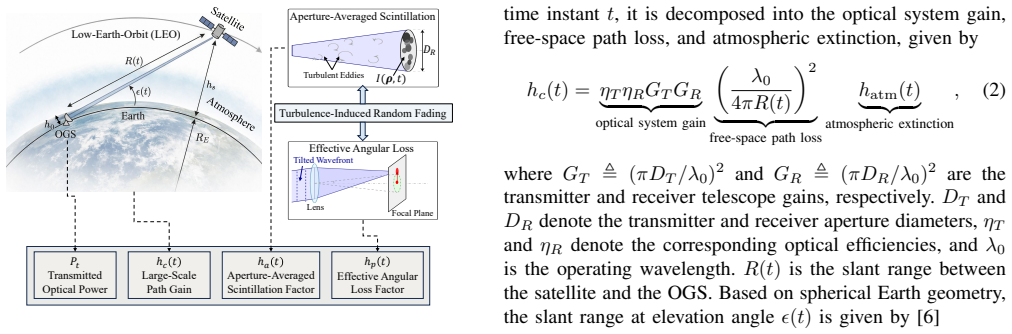
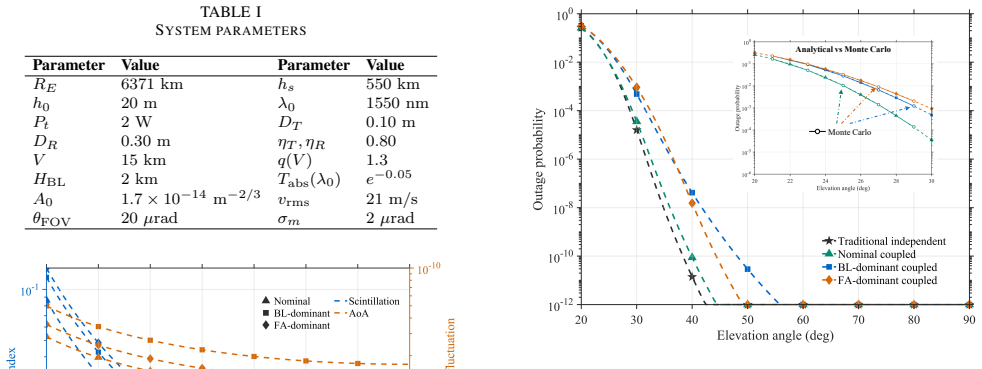
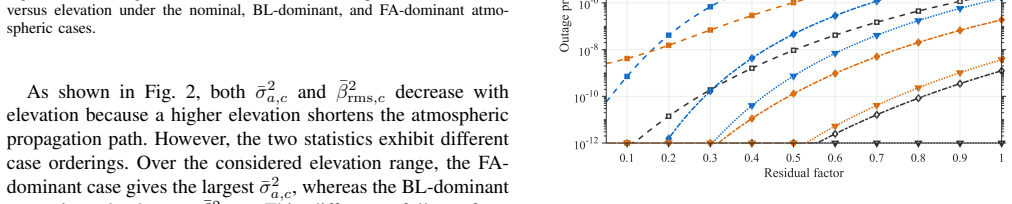
Performance analysis of low Earth orbit (LEO) satellite-to-ground optical links relies on composite fading models that typically evaluate scintillation and angular loss under the assumption of statistical independence. While ensuring analytical tractability, this assumption decouples fading mechanisms driven by the same atmospheric turbulence and fails to capture the distinct effects of free atmosphere (FA) and boundary layer (BL) perturbations. To model this coupling while preserving tractability, this paper develops a state-coupled joint fading model. In the proposed framework, aperture-averaged scintillation and effective angular loss are jointly characterized by a discrete slow atmospheric state, parameterized by separate FA and BL scaling factors. By replacing unconditional independence with state-conditioned independence, the model enables a closed-form derivation of the outage probability, preserving the computational simplicity of the independent baseline. Numerical results show that the independent baseline can misestimate outage under non-nominal layered turbulence states. This outage prediction bias varies with elevation because the relative roles of scintillation and angular loss change with the link geometry, resulting in different residual angular correction requirements for a given outage target.
Editorial analysis
A structured set of objections, weighed in public.
Referee Report
Summary. The paper claims that the standard assumption of statistical independence between aperture-averaged scintillation and effective angular loss in LEO satellite-to-ground optical links produces outage misestimation. It introduces a state-coupled joint fading model in which a discrete slow atmospheric state, parameterized by separate free-atmosphere (FA) and boundary-layer (BL) scaling factors, captures the coupling induced by layered turbulence. Replacing unconditional independence with state-conditioned independence yields a closed-form outage probability expression whose computational cost matches the independent baseline. Numerical results are presented to show that the independent model under- or over-estimates outage under non-nominal turbulence states and that the magnitude of this bias varies with elevation angle because the relative contributions of scintillation and angular loss change with link geometry.
Significance. If the discrete-state parameterization can be shown to faithfully reproduce the joint statistics of scintillation and angular loss without introducing artifacts, the work would improve outage predictions for LEO optical links and highlight elevation-dependent design margins. The retention of a closed-form expression is a practical strength that preserves analytical tractability while relaxing the independence assumption.
major comments (2)
- [Section III] Section III (State-Coupled Joint Fading Model): the discrete slow atmospheric state is defined by separate FA and BL scaling factors whose origin (derived from the continuous Cn²(z) profile, assumed, or fitted) is not specified. Because the central claim of elevation-dependent outage bias rests on these factors, any post-hoc selection would make the reported misestimation circular with the parameterization itself.
- [Section V] Section V (Numerical Results): the elevation-dependent bias is demonstrated only for a small set of non-nominal discrete states; no sensitivity study is provided on the number of states, the spacing of the FA/BL factors, or a comparison against a continuous joint distribution derived from the underlying turbulence profile. This leaves open whether the observed bias is a general physical feature or an artifact of the chosen discretization.
minor comments (2)
- [Abstract] Abstract: the phrase 'closed-form derivation' is used without indicating the key mathematical steps (e.g., which integral is evaluated in closed form under state-conditioned independence).
- [Throughout] Notation: the symbols FA and BL are introduced without an explicit sentence defining them as scaling factors applied to the respective turbulence layers; a one-sentence definition on first use would improve clarity.
Simulated Author's Rebuttal
We thank the referee for the thorough review and valuable comments on our manuscript. We address the major comments point by point below, proposing revisions to enhance clarity and robustness.
read point-by-point responses
-
Referee: [Section III] Section III (State-Coupled Joint Fading Model): the discrete slow atmospheric state is defined by separate FA and BL scaling factors whose origin (derived from the continuous Cn²(z) profile, assumed, or fitted) is not specified. Because the central claim of elevation-dependent outage bias rests on these factors, any post-hoc selection would make the reported misestimation circular with the parameterization itself.
Authors: The FA and BL scaling factors are motivated by standard atmospheric turbulence models, specifically the Hufnagel-Valley Cn² profile for the free atmosphere and empirical boundary-layer models. We will revise Section III to explicitly derive the discrete states from these profiles, including the selection criteria based on typical variations observed in literature (e.g., Cn² values ranging from 10^{-17} to 10^{-13} m^{-2/3}). This ensures the parameterization is physically grounded and not post-hoc, thereby addressing the concern of circularity. revision: yes
-
Referee: [Section V] Section V (Numerical Results): the elevation-dependent bias is demonstrated only for a small set of non-nominal discrete states; no sensitivity study is provided on the number of states, the spacing of the FA/BL factors, or a comparison against a continuous joint distribution derived from the underlying turbulence profile. This leaves open whether the observed bias is a general physical feature or an artifact of the chosen discretization.
Authors: We agree that additional validation is needed. In the revised manuscript, we will expand Section V with a sensitivity analysis varying the number of discrete states from 4 to 9 and the spacing of scaling factors. Furthermore, we will include a comparison of the discrete model's outage predictions against a numerical integration or Monte Carlo simulation over the continuous Cn²(z) profile to demonstrate that the bias persists and is not discretization-dependent. This will confirm the general nature of the elevation-dependent misestimation. revision: yes
Circularity Check
No circularity: parameterization is explicit modeling choice with independent numerical comparison
full rationale
The paper introduces a discrete slow atmospheric state model parameterized by separate FA and BL scaling factors, then replaces unconditional independence with state-conditioned independence to obtain a closed-form outage expression. This is a deliberate modeling assumption stated upfront in the abstract, not a reduction of the target result to its own inputs. The central numerical claim (independent baseline misestimates outage, with elevation-dependent bias) is obtained by comparing the new model's predictions against the standard independent case; the bias is an output of that comparison rather than a quantity defined by the scaling factors themselves. No self-citations, fitted-input renamings, or uniqueness theorems are invoked in the provided text to justify the core steps. The derivation remains self-contained against external benchmarks because the closed-form follows directly from the stated conditional-independence assumption applied to the joint state model, without the outage expressions collapsing back to the parameter definitions by construction.
Axiom & Free-Parameter Ledger
free parameters (1)
- FA and BL scaling factors
axioms (1)
- domain assumption State-conditioned independence between aperture-averaged scintillation and effective angular loss
invented entities (1)
-
discrete slow atmospheric state
no independent evidence
Reference graph
Works this paper leans on
-
[1]
LEO Satellite Access Network (LEO-SAN) Toward 6G: Challenges and Approaches,
Z. Xiao, J. Yang, T. Mao, C. Xu, R. Zhang, Z. Han, and X.-G. Xia, “LEO Satellite Access Network (LEO-SAN) Toward 6G: Challenges and Approaches,”IEEE Wireless Communications, vol. 31, no. 2, pp. 89–96, 2024
work page 2024
-
[2]
Latest Developments in the Field of Optical Communications for Small Satellites and Beyond,
D. R. Kolev, A. Carrasco-Casado, P. V . Trinh, K. Shiratama, F. Ishola, H. Kotake, J. Nakazono, Y . Saito, H. Kunimori, T. Kubooka, H. Tsuji, and M. Toyoshima, “Latest Developments in the Field of Optical Communications for Small Satellites and Beyond,”Journal of Lightwave Technology, vol. 41, no. 12, pp. 3750–3757, 2023
work page 2023
-
[3]
C.-W. Chow, “Recent Advances and Future Perspectives in Optical Wire- less Communication, Free Space Optical Communication and Sensing for 6G,”Journal of Lightwave Technology, vol. 42, no. 11, pp. 3972– 3980, 2024
work page 2024
-
[4]
Optical Communication in Space: Challenges and Mitigation Techniques,
H. Kaushal and G. Kaddoum, “Optical Communication in Space: Challenges and Mitigation Techniques,”IEEE Communications Surveys & Tutorials, vol. 19, no. 1, pp. 57–96, 2017
work page 2017
-
[5]
A. Zahr, G. Colavolpe, T. Foggi, B. Matuz, and A. Vannucci, “An Information-Theoretic Comparison Between Coherent and IM/DD Transmissions for Free Space Optical Communications,”IEEE Journal on Selected Areas in Communications, vol. 42, no. 5, pp. 1304–1315, 2024
work page 2024
-
[6]
E2E Physical Layer and Link Analysis for High-Throughput Satellite Optical Communication,
V . Spirito, E. Ciaramella, and G. Cossu, “E2E Physical Layer and Link Analysis for High-Throughput Satellite Optical Communication,”IEEE Journal on Selected Areas in Communications, vol. 43, no. 5, pp. 1660– 1675, 2025
work page 2025
-
[7]
W. Moon and H. Kim, “Minimum Link Distance of Terrestrial Testbeds Required to Simulate the Satellite-to-Ground FSO Communication Links,”IEEE Photonics Journal, vol. 17, no. 5, pp. 1–11, 2025
work page 2025
-
[8]
W. Helsdingen, R. Den Breeje, and R. Saathof, “Modeling the physical layer of air-to-space optical communication networks using the modified multi-scale method,”Journal of Optical Communications and Network- ing, vol. 17, no. 3, pp. 178–187, 2025
work page 2025
-
[9]
M. P. Ninos, V . Spirito, G. Cossu, and E. Ciaramella, “Outage Per- formance of Uplink Pre-Amplified FSO Links Over Turbulence, Beam Wander, and Pointing Errors,”IEEE Communications Letters, vol. 27, no. 12, pp. 3275–3279, 2023
work page 2023
-
[10]
Outage Capacity Optimization for Free-Space Optical Links With Pointing Errors,
A. A. Farid and S. Hranilovic, “Outage Capacity Optimization for Free-Space Optical Links With Pointing Errors,”Journal of Lightwave Technology, vol. 25, no. 7, pp. 1702–1710, 2007
work page 2007
-
[11]
B. P. Dix-Matthews, S. F. Karpathakis, and S. W. Schediwy, “Atmo- spheric turbulence characterization with simultaneous measurement of phase, angle of arrival, and intensity in a retroreflected optical link,” Optics Letters, vol. 48, no. 21, pp. 5519–5522, 2023
work page 2023
-
[12]
Weichel,Laser beam propagation in the atmosphere
H. Weichel,Laser beam propagation in the atmosphere. SPIE Press, 1990, vol. 3
work page 1990
-
[13]
I. I. Kim, B. McArthur, and E. J. Korevaar, “Comparison of laser beam propagation at 785 nm and 1550 nm in fog and haze for optical wireless communications,” inOptical wireless communications III, vol. 4214. Spie, 2001, pp. 26–37
work page 2001
-
[14]
Laser beam propagation through random media,
L. C. Andrews and R. L. Phillips, “Laser beam propagation through random media,”Laser Beam Propagation Through Random Media: Second Edition, 2005
work page 2005
discussion (0)
Sign in with ORCID, Apple, or X to comment. Anyone can read and Pith papers without signing in.