Recognition: 2 theorem links
· Lean TheoremEfficient Airy Beam Training for Quasi-LoS Terahertz Near-Field Communications
Pith reviewed 2026-05-12 04:14 UTC · model grok-4.3
The pith
Polar codebook designs cut Airy beam training overhead by over half for THz near-field links
A machine-rendered reading of the paper's core claim, the machinery that carries it, and where it could break.
Core claim
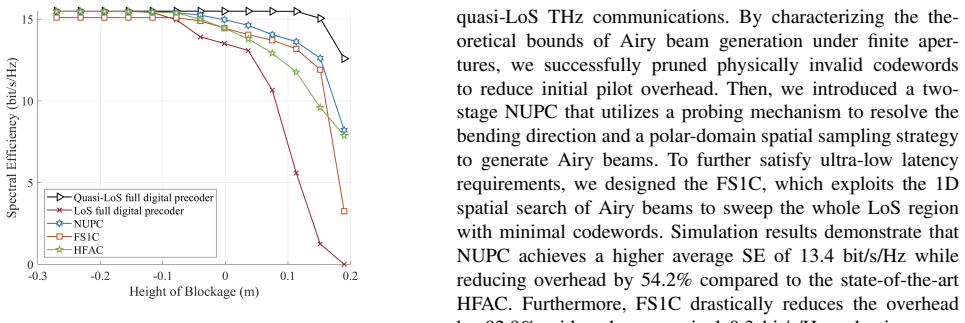
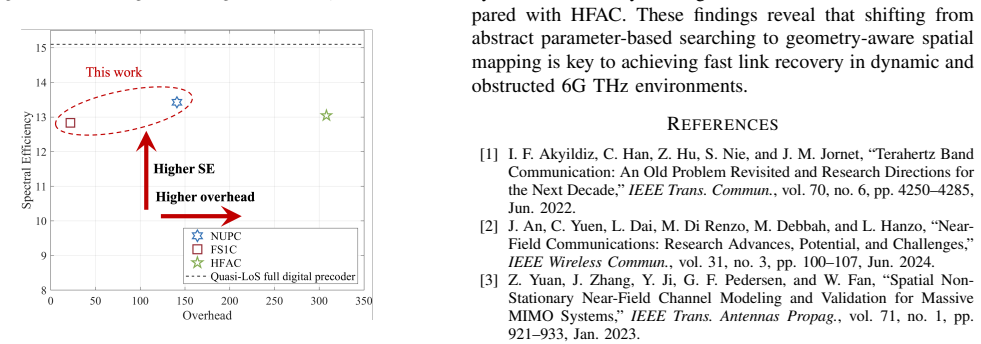
By establishing theoretical bounds of Airy beam generation under finite apertures to prune physically invalid codewords, a two-stage Non-Uniform Polar Codebook (NUPC) is presented that uses a probing mechanism to resolve bending direction and a polar-domain spatial sampling strategy; simulations show NUPC raises average spectral efficiency by 13.4 bit/s/Hz and lowers training overhead by 54.2 percent versus the hierarchical focusing-Airy codebook, while the Fast-Scanning 1D Codebook (FS1C) reduces overhead by 92.9 percent with only a 0.3 bit/s/Hz spectral efficiency drop.
What carries the argument
The two-stage Non-Uniform Polar Codebook (NUPC) that resolves Airy beam bending direction via probing and generates valid beams through polar-domain sampling after pruning invalid codewords with finite-aperture bounds.
If this is right
- NUPC raises average spectral efficiency by 13.4 bit/s/Hz over the hierarchical focusing-Airy codebook.
- Training overhead falls 54.2 percent with NUPC while preserving performance.
- FS1C reduces overhead by 92.9 percent with only a 0.3 bit/s/Hz spectral efficiency reduction.
- Both designs address the need for low training overhead in large-aperture THz systems with quasi-LoS conditions.
Where Pith is reading between the lines
- The bounding and pruning step could extend to training other curved or self-accelerating beams in near-field settings.
- Lower overhead might allow more frequent retraining as users or obstacles move in practical deployments.
- The polar sampling strategy suggests similar efficiency gains are possible in other large-array beam management problems beyond Airy beams.
Load-bearing premise
The simulation channel models and finite-aperture Airy beam generation bounds accurately capture real quasi-LoS propagation and hardware constraints.
What would settle it
A hardware testbed experiment that measures actual training overhead and spectral efficiency in a terahertz setup with partial obstructions using the proposed codebooks versus the prior hierarchical method.
Figures

read the original abstract
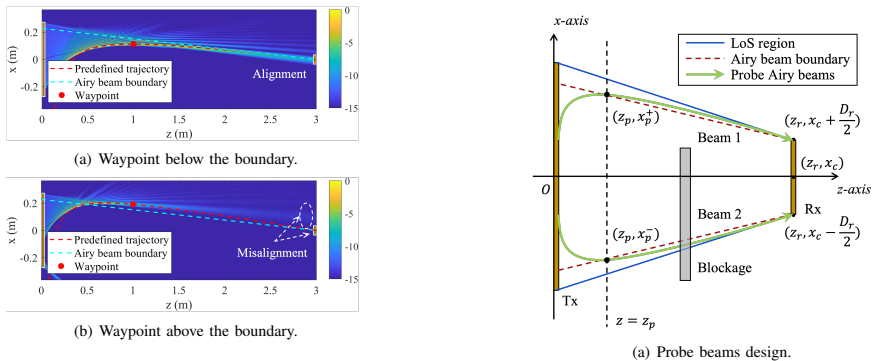
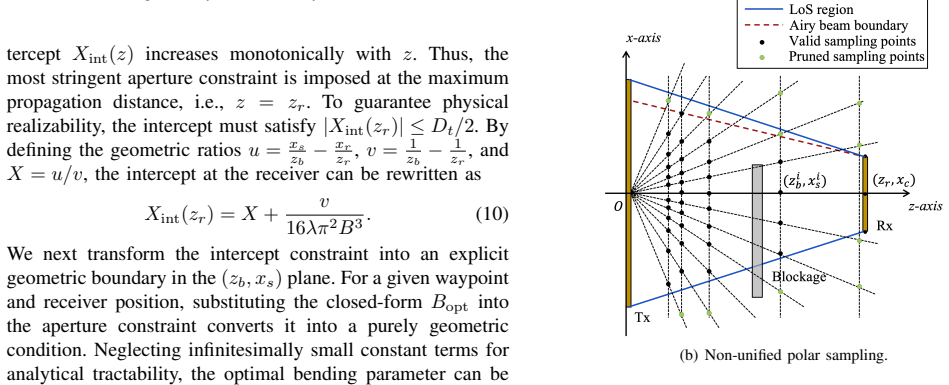
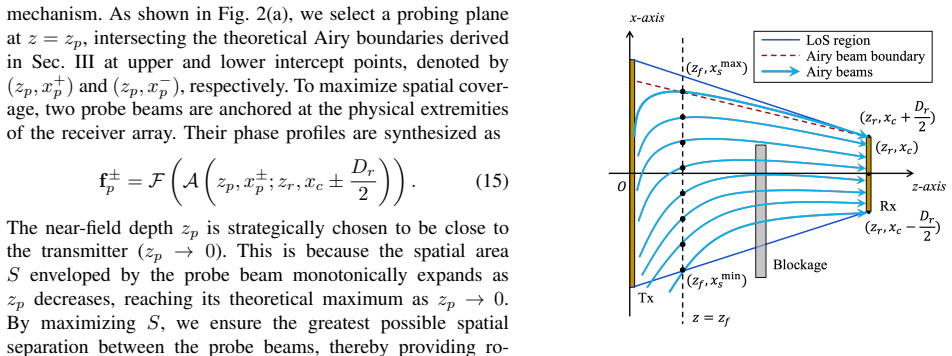
With the enlargement of antenna apertures in 6G Terahertz (THz) communications, the Rayleigh distance expands significantly, rendering near-field propagation a dominant scenario in THz links. Beyond conventional Line-of-Sight (LoS) and Non-Line-of-Sight (NLoS) conditions, quasi-LoS scenarios with partial obstructions have emerged as a critical challenge. Airy beams offer a promising solution to circumvent obstacles due to their unique curving trajectory. However, existing Airy beam training methods typically rely on parameter-based sampling or exhaustive search, leading to significant pilot overhead and low training efficiency. In this paper, an efficient Airy beam training framework is proposed to address this research gap. First, the theoretical bounds of Airy beam generation under finite apertures to prune physically invalid codewords are derived. Based on this, a two-stage Non-Uniform Polar Codebook (NUPC) design is presented, utilizing a probing mechanism to resolve the bending direction and a polar-domain spatial sampling strategy to generate Airy beams. To address ultra-low latency requirements, a Fast-Scanning 1D Codebook (FS1C) is further developed that sweeps the entire LoS region with minimal codewords. Simulation results demonstrate that NUPC achieves a higher average spectral efficiency (SE) by 13.4 bit/s/Hz while reducing training overhead by 54.2% compared to the state-of-the-art hierarchical focusing-Airy codebook (HFAC). Furthermore, FS1C reduces overhead by 92.9% with only a marginal 0.3 bit/s/Hz reduction compared with HFAC.
Editorial analysis
A structured set of objections, weighed in public.
Referee Report
Summary. The manuscript proposes an efficient Airy beam training framework for quasi-LoS THz near-field communications with large apertures. It first derives theoretical bounds on Airy beam generation under finite apertures to prune invalid codewords. Building on this, it introduces a two-stage Non-Uniform Polar Codebook (NUPC) that uses a probing mechanism to determine bending direction followed by polar-domain spatial sampling, plus a Fast-Scanning 1D Codebook (FS1C) that sweeps the LoS region with minimal codewords. Monte-Carlo simulations report that NUPC improves average spectral efficiency by 13.4 bit/s/Hz while cutting training overhead by 54.2% relative to the hierarchical focusing-Airy codebook (HFAC), and that FS1C reduces overhead by 92.9% at the cost of only 0.3 bit/s/Hz SE loss.
Significance. If the underlying channel and beam models prove accurate, the reported overhead reductions with preserved or improved SE would be practically relevant for low-latency THz links operating in the near-field regime with partial obstructions. The finite-aperture bounds constitute a reusable theoretical contribution that could inform other curved-beam designs.
major comments (2)
- [Simulation Results] Simulation Results section: The headline claims (13.4 bit/s/Hz SE gain and 54.2% overhead reduction for NUPC; 92.9% overhead reduction for FS1C) are obtained exclusively from Monte-Carlo runs that invoke the derived finite-aperture Airy bounds and the two-stage polar sampling procedure. No hardware measurements, no comparison against measured THz traces with real partial blockages, and no sensitivity sweeps over obstacle permittivity, geometry, or surface roughness are reported; consequently the numerical margins remain conditional on the fidelity of the synthetic quasi-LoS model.
- [Section III] Section III (Proposed Codebook Designs), Eq. (finite-aperture bound): The pruning of physically invalid codewords rests on the derived bounds, yet the manuscript does not quantify how sensitive the final SE and overhead figures are to small violations of those bounds (e.g., aperture truncation errors or phase quantization).
minor comments (2)
- [Section III] Notation for the two-stage probing mechanism and polar sampling radii is introduced without an accompanying table that maps symbols to physical quantities; this slows reading of the algorithmic description.
- [Figures] Figure captions for the beam-pattern plots do not state the carrier frequency, aperture size, or obstacle parameters used, making direct reproduction of the curves difficult.
Simulated Author's Rebuttal
We thank the referee for the constructive and detailed comments. We address each major comment below and indicate the revisions we will make to strengthen the manuscript.
read point-by-point responses
-
Referee: [Simulation Results] Simulation Results section: The headline claims (13.4 bit/s/Hz SE gain and 54.2% overhead reduction for NUPC; 92.9% overhead reduction for FS1C) are obtained exclusively from Monte-Carlo runs that invoke the derived finite-aperture Airy bounds and the two-stage polar sampling procedure. No hardware measurements, no comparison against measured THz traces with real partial blockages, and no sensitivity sweeps over obstacle permittivity, geometry, or surface roughness are reported; consequently the numerical margins remain conditional on the fidelity of the synthetic quasi-LoS model.
Authors: We acknowledge that the reported performance gains are derived from Monte-Carlo simulations based on the theoretical models developed in the paper. In THz near-field beam training research, simulation-driven evaluation using established quasi-LoS channel models with partial obstructions is the prevailing methodology, given the practical challenges of realizing large-aperture hardware testbeds for Airy beams. The underlying propagation model follows standard THz literature. To directly address the concern about sensitivity, we will add new simulation results in the revised manuscript that include sweeps over obstacle permittivity, geometry, and surface roughness, thereby demonstrating the robustness of the SE and overhead improvements under model variations. revision: partial
-
Referee: [Section III] Section III (Proposed Codebook Designs), Eq. (finite-aperture bound): The pruning of physically invalid codewords rests on the derived bounds, yet the manuscript does not quantify how sensitive the final SE and overhead figures are to small violations of those bounds (e.g., aperture truncation errors or phase quantization).
Authors: We agree that explicitly quantifying the sensitivity of the final metrics to small violations of the finite-aperture bounds would improve the rigor of the pruning strategy. In the revised manuscript, we will incorporate additional analysis and figures that introduce controlled perturbations, including small aperture truncation errors and phase quantization, and report their effects on spectral efficiency and training overhead. revision: yes
- Hardware measurements and direct comparisons against measured THz traces with real partial blockages, as these require specialized experimental facilities beyond the scope of the current theoretical and simulation-based study.
Circularity Check
No significant circularity in the derivation chain
full rationale
The paper derives theoretical bounds on finite-aperture Airy beam generation to prune invalid codewords, then constructs NUPC (two-stage polar sampling with probing) and FS1C designs from those bounds, and reports simulation performance metrics. These steps do not reduce by construction to fitted parameters, self-definitions, or load-bearing self-citations; the SE gains and overhead reductions are obtained from Monte-Carlo evaluation of the new codebooks against HFAC, using independent channel models. The chain is self-contained with no tautological reductions visible.
Axiom & Free-Parameter Ledger
Reference graph
Works this paper leans on
-
[1]
Terahertz Band Communication: An Old Problem Revisited and Research Directions for the Next Decade,
I. F. Akyildiz, C. Han, Z. Hu, S. Nie, and J. M. Jornet, “Terahertz Band Communication: An Old Problem Revisited and Research Directions for the Next Decade,”IEEE Trans. Commun., vol. 70, no. 6, pp. 4250–4285, Jun. 2022
work page 2022
-
[2]
Near- Field Communications: Research Advances, Potential, and Challenges,
J. An, C. Yuen, L. Dai, M. Di Renzo, M. Debbah, and L. Hanzo, “Near- Field Communications: Research Advances, Potential, and Challenges,” IEEE Wireless Commun., vol. 31, no. 3, pp. 100–107, Jun. 2024
work page 2024
-
[3]
Spatial Non- Stationary Near-Field Channel Modeling and Validation for Massive MIMO Systems,
Z. Yuan, J. Zhang, Y . Ji, G. F. Pedersen, and W. Fan, “Spatial Non- Stationary Near-Field Channel Modeling and Validation for Massive MIMO Systems,”IEEE Trans. Antennas Propag., vol. 71, no. 1, pp. 921–933, Jan. 2023
work page 2023
-
[4]
Terahertz Wireless Data Center: Gaussian Beam or Airy Beam?
W. Zhao, S. Abadal, G. Song, J. Jiang, and C. Han, “Terahertz Wireless Data Center: Gaussian Beam or Airy Beam?”IEEE Trans. Wireless Commun., vol. 25, pp. 7922–7938, 2026
work page 2026
-
[5]
Limited Feedback Hybrid Precoding for Multi-User Millimeter Wave Systems,
A. Alkhateeb, G. Leus, and R. W. Heath, “Limited Feedback Hybrid Precoding for Multi-User Millimeter Wave Systems,”IEEE Trans. Wireless Commun., vol. 14, no. 11, pp. 6481–6494, Nov. 2015
work page 2015
-
[6]
Multiple Access for Near-Field Communications: SDMA or LDMA?
Z. Wu and L. Dai, “Multiple Access for Near-Field Communications: SDMA or LDMA?”IEEE J. Sel. Areas Commun., vol. 41, no. 6, pp. 1918–1935, Jun. 2023
work page 1918
-
[7]
K. Zhan, W. Zhang, R. Jiao, L. Dou, and B. Liu, “Propagations of Airy Beams with Quadratic Phase Modulation, and Their Interaction in Paraxial Optical Systems,”Opt. Commun., vol. 474, p. 126156, Nov. 2020
work page 2020
-
[8]
Curving THz Wireless Data Links Around Obstacles,
H. Guerboukha, B. Zhao, Z. Fang, E. Knightly, and D. M. Mittleman, “Curving THz Wireless Data Links Around Obstacles,”Commun. Eng., vol. 3, no. 1, p. 58, 2024
work page 2024
-
[9]
Curving Around Obstacles via NN-Enabled Wavefront Shaping in Sub-THz Wireless Networks,
H. Chen, A. Kludze, and Y . Ghasempour, “Curving Around Obstacles via NN-Enabled Wavefront Shaping in Sub-THz Wireless Networks,” in Proc. of IEEE Globecom, Dec. 2024
work page 2024
-
[10]
Breaking near-field communication barriers: Focused, curved, or Airy beamforming?
S. Zhang, B. Di, and L. Song, “Breaking Near-Field Communication Barriers: Focused, Curved, or Airy Beamforming?”arXiv:2604.01704, Apr. 2026
-
[11]
W. Zhao, C. Han, and E. Bj ¨ornson, “Airy Beam Engineering in Near- field Communications: A Tractable Closed-Form Analysis in the Tera- hertz Band,”arXiv:2603.13866., Mar. 2026
-
[12]
Learning- Based Blockage-Resilient Beam Training in Near-Field Terahertz Com- munications,
C. Weng, Y . Guo, B. Zhao, Y . Wang, W. Chen, and Z. Li, “Learning- Based Blockage-Resilient Beam Training in Near-Field Terahertz Com- munications,”arXiv:2510.25433., Oct. 2025
-
[13]
Airy Beams and Accelerating Waves: An Overview of Recent Advances,
N. K. Efremidis, Z. Chen, M. Segev, and D. N. Christodoulides, “Airy Beams and Accelerating Waves: An Overview of Recent Advances,” Optica, vol. 6, no. 5, pp. 686–701, May 2019
work page 2019
-
[14]
H. Chen, A. Kludze and Y . Ghasempour, “A Physics-informed Airy Beam Learning Framework for Blockage Avoidance in Sub-terahertz Wireless Networks.”Nat. Commun., vol. 16, no. 7387, Aug. 2025
work page 2025
discussion (0)
Sign in with ORCID, Apple, or X to comment. Anyone can read and Pith papers without signing in.