Recognition: 1 theorem link
· Lean TheoremMagnetohydrodynamic equilibrium and neutronics study on MAST-U using Jenga framework
Pith reviewed 2026-05-12 04:28 UTC · model grok-4.3
The pith
Jenga unifies tokamak systems, equilibrium, and neutronics modeling by sharing data structures across fidelities, as shown by reproducing MAST-U equilibria from EFIT++ inputs.
A machine-rendered reading of the paper's core claim, the machinery that carries it, and where it could break.
Core claim
Jenga is developed as a unified design and modeling framework for tokamaks, seamlessly coupling systems-level studies to high-fidelity models based on first principles. In this work, static Grad-Shafranov (GS) equilibrium for an entire pulse and the neutronics study of the MAST-U tokamak are carried out in Jenga. Coil currents and plasma profiles from the EFIT++ reconstruction of MAST-U shots are used to reproduce the plasma poloidal flux and shape targets at different time slices, with results in good agreement with FreeGSNKE and Fiesta codes. Neutronics analysis is performed for a hypothetical 50-50 mixture of deuterium-tritium (DT) fuel using the same data structure, with a distributed 14
What carries the argument
The Jenga framework, which maintains consistent data structures for plasma geometry, tokamak design parameters, and profiles to enable coupled 0D systems studies, 2D Grad-Shafranov equilibrium solving, and 3D neutron transport.
If this is right
- Jenga reproduces full-pulse equilibria from existing reconstructions while matching results from independent codes.
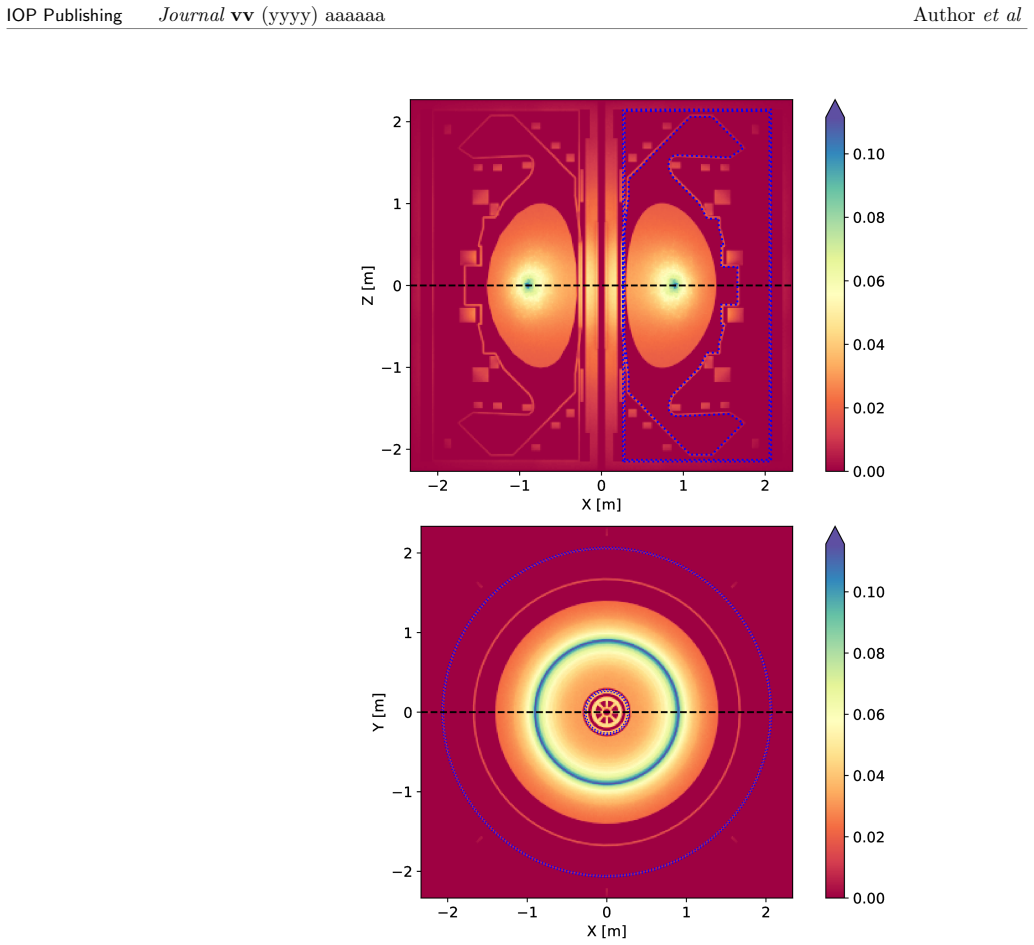
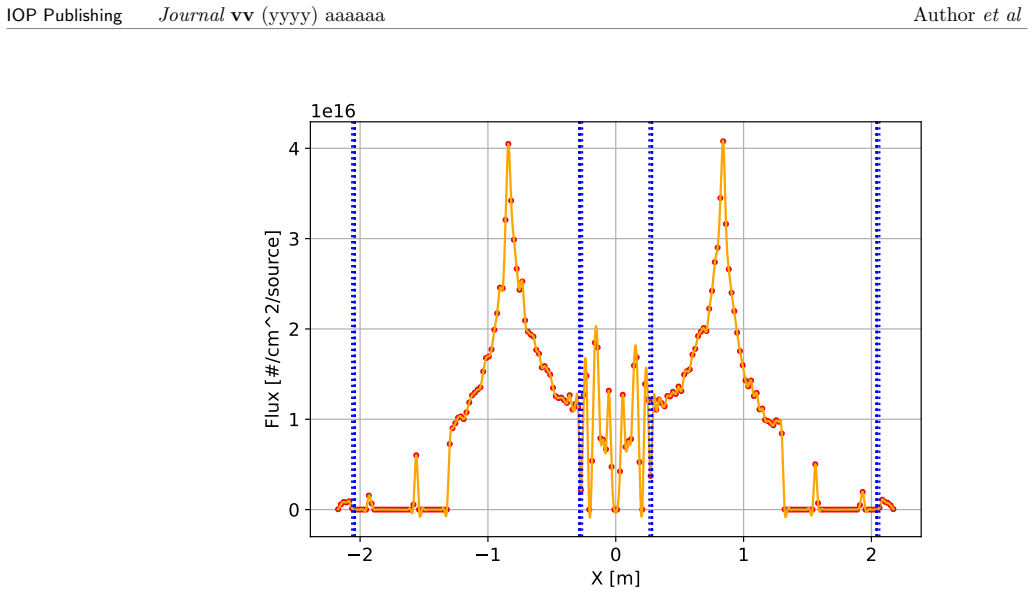
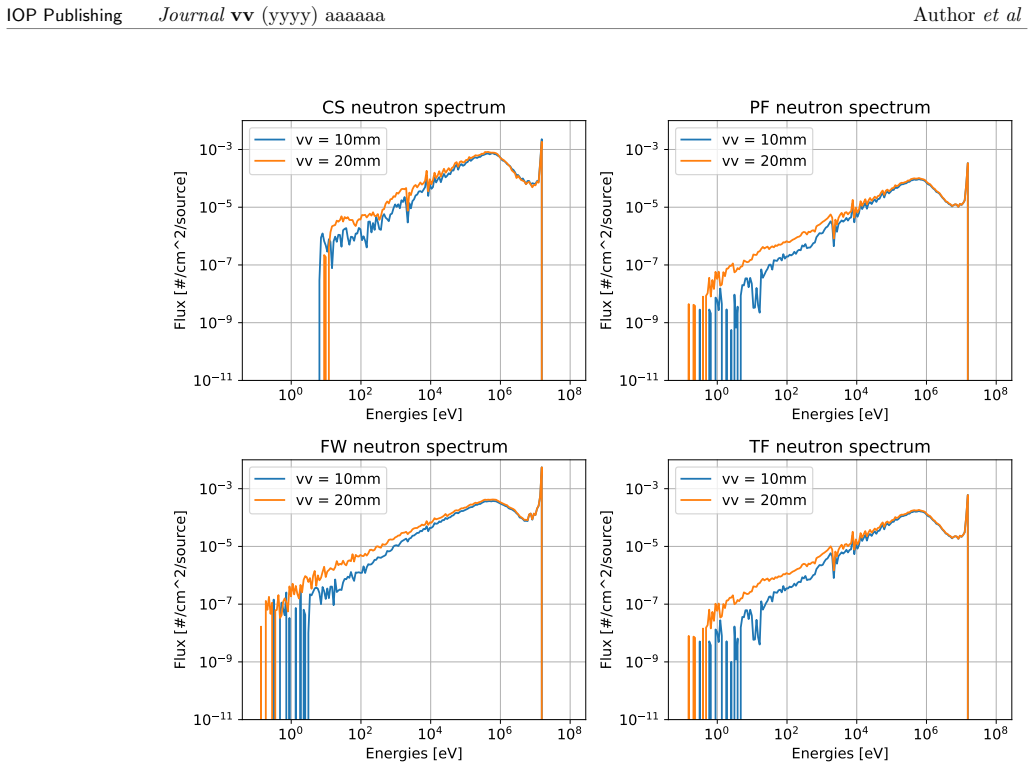
- Neutronics calculations use identical inputs as the equilibrium step, allowing direct comparison of flux on coils versus the limiter.
- Neutron sources are placed inside the last closed flux surface with strength set by local density and temperature for each scenario.
- The framework supports combined 0D, 2D, and 3D numerics from one set of plasma geometry and profile data.
Where Pith is reading between the lines
- Design teams could iterate tokamak configurations faster by feeding equilibrium outputs straight into neutronics without manual data conversion.
- The same structure might be tested on other spherical tokamaks or with time-evolving profiles to check scalability.
- Discrepancies in neutron spectra could motivate adding explicit transport modules while keeping the shared data backbone.
Load-bearing premise
EFIT++ reconstructions supply coil currents and plasma profiles accurate enough for Jenga to match as targets, and neutron sources inside the last closed flux surface can be modeled solely from local ion density and temperature.
What would settle it
Jenga run on the same EFIT++ inputs produces poloidal flux or plasma shape that deviates beyond numerical tolerances from the reconstruction at multiple time slices, or neutron flux spectra that differ markedly from independent Monte Carlo runs once scattering and transport beyond the local source assumption are added.
Figures




read the original abstract
Tokamak design is inherently challenging due to several cross-competing effects which require a careful and calibrated treatment to obtain an optimal operational envelope. Incorporating physics across varied fidelities is crucial in this exercise. Jenga is developed as a unified design and modeling framework for tokamaks, seamlessly coupling systems-level studies to high-fidelity models based on first principles. In this work, static Grad-Shafranov (GS) equilibrium for an entire pulse and the neutronics study of the Mega Ampere Spherical Tokamak Upgrade (MAST-U) tokamak are carried out in Jenga. Coil currents and plasma profiles from the EFIT++ reconstruction of MAST-U shots are used to reproduce the plasma poloidal flux and shape targets at different time slices. The results from Jenga are also in good agreement with FreeGSNKE and Fiesta codes. Neutronics analysis is performed for a hypothetical 50-50 mixture of deuterium-tritium (DT) fuel, using the same data structure as the systems and equilibrium studies. A distributed neutron source is initialized within the last closed flux surface (LCFS) of the plasma, with their strength being functions of the density and temperature of the ions. The distribution of the neutron flux across the energy spectrum is computed for the active coils and the first wall (limiter) independently over multiple scenarios. We demonstrate the capabilities of Jenga with a comprehensive analysis that takes inputs about the plasma geometry, tokamak design and plasma profiles and performs 0D, 2D and 3D numerics for the systems study, equilibrium and neutron transport respectively.
Editorial analysis
A structured set of objections, weighed in public.
Referee Report
Summary. The manuscript introduces Jenga as a unified tokamak design and modeling framework that couples systems-level studies to high-fidelity Grad-Shafranov (GS) equilibrium and neutron transport calculations based on first principles. It demonstrates the framework on MAST-U by using EFIT++ coil currents and plasma profiles to reproduce static GS equilibria across an entire pulse at multiple time slices, reports agreement with FreeGSNKE and Fiesta, and performs neutronics for a hypothetical 50-50 DT plasma by initializing a distributed neutron source inside the LCFS whose strength depends on local ion density and temperature, then computing energy spectra of the neutron flux on active coils and the first wall (limiter) using the same data structures throughout.
Significance. A working unified framework with consistent data structures across 0D systems, 2D equilibrium, and 3D neutronics would be valuable for integrated tokamak studies, particularly if it enables seamless multi-fidelity workflows without data translation overhead. The present demonstration, however, consists of equilibrium reproduction from external reconstructions plus standard neutronics with a conventional birth-rate source; it does not yet deliver new physical predictions, experimental validation, or quantitative benchmarks that would establish broader utility.
major comments (3)
- [Abstract and equilibrium results] Abstract and equilibrium results section: the statement of 'good agreement' with FreeGSNKE and Fiesta is not accompanied by any quantitative error metrics (e.g., RMS flux error, boundary shape deviation, or poloidal-field residuals), mesh resolution details, or convergence criteria for the GS solver; without these, the central claim that Jenga reproduces the targets cannot be assessed.
- [Neutronics section] Neutronics section: the distributed source is stated to have strength 'functions of the density and temperature of the ions,' but the explicit functional form, normalization procedure, and any validation against known neutronics benchmarks or measurements are absent; this assumption is load-bearing for the reported flux spectra.
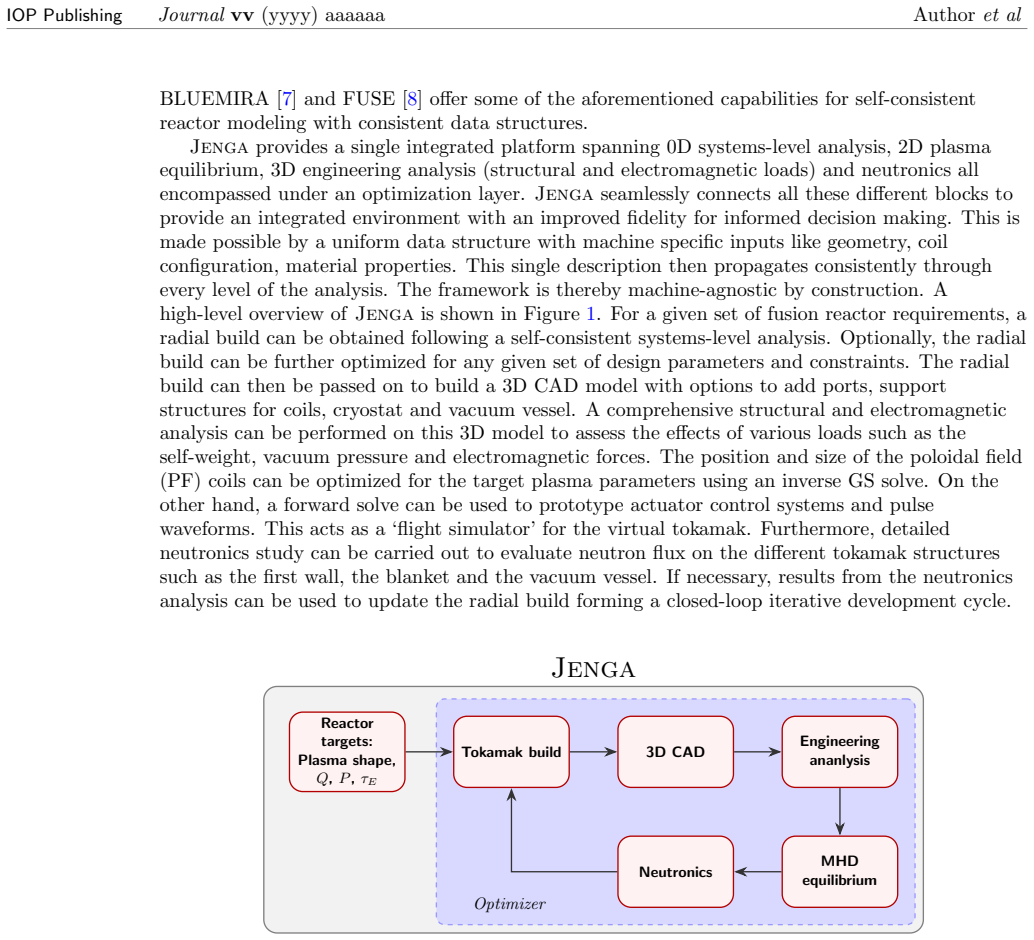
- [Framework description] Framework description: while the manuscript emphasizes use of the same data structures, no concrete example or diagram illustrates how the systems-level, GS-equilibrium, and neutron-transport modules exchange information or maintain consistency beyond simple data passing; this weakens the 'seamlessly coupling' claim.
minor comments (2)
- [Abstract] Several acronyms (LCFS, DT, EFIT++) appear without initial definition on first use.
- [Methods] The manuscript would benefit from a brief methods subsection detailing the numerical scheme (finite-element order, boundary conditions) employed for the GS solve and the transport code or Monte-Carlo settings used for neutronics.
Simulated Author's Rebuttal
We thank the referee for the constructive review and valuable suggestions for improving the clarity and rigor of our manuscript. We have revised the paper to incorporate quantitative metrics for the equilibrium comparisons, explicit details on the neutron source, and an illustrative diagram of the framework coupling. Our point-by-point responses follow.
read point-by-point responses
-
Referee: Abstract and equilibrium results section: the statement of 'good agreement' with FreeGSNKE and Fiesta is not accompanied by any quantitative error metrics (e.g., RMS flux error, boundary shape deviation, or poloidal-field residuals), mesh resolution details, or convergence criteria for the GS solver; without these, the central claim that Jenga reproduces the targets cannot be assessed.
Authors: We agree that quantitative metrics strengthen the assessment of agreement. In the revised manuscript we have added RMS errors on the poloidal flux, deviations in the plasma boundary shape, and residuals in the poloidal magnetic field. We also specify the mesh resolution employed in the Grad-Shafranov solver and the convergence tolerance on the residual norm. These additions allow direct evaluation of how closely Jenga reproduces the EFIT++ targets and the results from FreeGSNKE and Fiesta. revision: yes
-
Referee: Neutronics section: the distributed source is stated to have strength 'functions of the density and temperature of the ions,' but the explicit functional form, normalization procedure, and any validation against known neutronics benchmarks or measurements are absent; this assumption is load-bearing for the reported flux spectra.
Authors: We accept that the explicit form and normalization are required for reproducibility. The revised manuscript now states the source strength explicitly as a function of local ion density and temperature (via the DT reactivity) and describes the normalization to the assumed total fusion power. While the work uses hypothetical DT scenarios and therefore does not include direct experimental validation, the formulation follows standard neutronics practice; we have added a brief note on this point. revision: yes
-
Referee: Framework description: while the manuscript emphasizes use of the same data structures, no concrete example or diagram illustrates how the systems-level, GS-equilibrium, and neutron-transport modules exchange information or maintain consistency beyond simple data passing; this weakens the 'seamlessly coupling' claim.
Authors: We agree that a visual and textual illustration would better support the coupling claim. The revised manuscript includes a new figure showing the data-flow diagram between the systems-level, equilibrium, and neutronics modules, together with a concrete example of how the LCFS geometry and plasma profiles are passed directly to initialize the neutron source and geometry without intermediate file translations. revision: yes
Circularity Check
No significant circularity; equilibria and neutronics use independent EFIT++ inputs with external validation
full rationale
The derivation chain begins with external EFIT++ coil currents and plasma profiles as targets for reproducing GS equilibria at multiple time slices, followed by direct comparison to independent codes FreeGSNKE and Fiesta. Neutronics initializes a conventional distributed source whose strength is a function of local ion density and temperature inside the LCFS, then computes flux spectra on coils and wall. No equation reduces a reported output to a quantity defined by the authors' own fitted parameters or prior self-citation; all load-bearing steps remain self-contained against external benchmarks and standard methods.
Axiom & Free-Parameter Ledger
free parameters (1)
- coil currents and plasma profiles
axioms (2)
- domain assumption Static Grad-Shafranov equilibrium accurately describes the plasma at each time slice
- domain assumption Neutron source strength inside the LCFS is determined solely by local ion density and temperature for a 50-50 DT mix
Reference graph
Works this paper leans on
-
[1]
M. Kovari et al. ““PROCESS”: A systems code for fusion power plants—Part 1: Physics”. In: Fusion Engineering and Design89.12 (2014), pp. 3054–3069.issn: 0920-3796.doi: https://doi.org/10.1016/j.fusengdes.2014.09.018.url: https://www.sciencedirect.com/science/article/pii/S0920379614005961
-
[2]
M. Kovari et al. ““PROCESS”: A systems code for fusion power plants – Part 2: Engineering”. In:Fusion Engineering and Design104 (2016), pp. 9–20.issn: 0920-3796.doi: https://doi.org/10.1016/j.fusengdes.2016.01.007.url: https://www.sciencedirect.com/science/article/pii/S0920379616300072
-
[3]
DEMO reactor design using the new modular system code SYCOMORE
C´ edric Reux et al. “DEMO reactor design using the new modular system code SYCOMORE”. In:Nuclear Fusion55.7 (2015), p. 073011
work page 2015
-
[4]
Optimization of a mega-ampere spherical tokamak for beta-limit and confinement studies
S.C. McCool et al. “Optimization of a mega-ampere spherical tokamak for beta-limit and confinement studies”. In: (1994).url:https://inis.iaea.org/records/3qt3n-ydv48
work page 1994
-
[5]
AB Mineev et al. “Engineering-physical model (GLOBSYS) for the next step of the Globus-M spherical tokamak program: Verification of some subsystems on achieved and predictable data from installations NSTX, NSTX-U, MAST, MAST-U, and ST40”. In: Physics of Atomic Nuclei85.7 (2022), pp. 1205–1213
work page 2022
-
[6]
JINTRAC: A System of Codes for Integrated Simulation of Tokamak Scenarios
Michele ROMANELLI et al. “JINTRAC: A System of Codes for Integrated Simulation of Tokamak Scenarios”. In:Plasma and Fusion Research9 (2014), pp. 3403023–3403023.doi: 10.1585/pfr.9.3403023
-
[7]
BLUEPRINT: a novel approach to fusion reactor design
M Coleman and S McIntosh. “BLUEPRINT: a novel approach to fusion reactor design”. In: Fusion Engineering and Design139 (2019), pp. 26–38
work page 2019
-
[8]
O Meneghini et al. “FUSE (Fusion Synthesis Engine): A next generation framework for integrated design of fusion pilot plants”. In:arXiv preprint arXiv:2409.05894(2024)
-
[9]
L.L. Lao et al. “Reconstruction of current profile parameters and plasma shapes in tokamaks”. In:Nuclear Fusion25.11 (1985), p. 1611.doi:10.1088/0029-5515/25/11/007. url:https://doi.org/10.1088/0029-5515/25/11/007
-
[10]
MHD Equilibrium Reconstruction in the DIII-D Tokamak
L. L. Lao et al. “MHD Equilibrium Reconstruction in the DIII-D Tokamak”. In:Fusion Science and Technology48.2 (2005), pp. 968–977.doi:10.13182/FST48-968. eprint: https://doi.org/10.13182/FST48-968.url:https://doi.org/10.13182/FST48-968. 19 IOP PublishingJournalvv(yyyy) aaaaaa Authoret al
-
[11]
K Pentland et al. “Validation of the static forward Grad–Shafranov equilibrium solvers in FreeGSNKE and Fiesta using EFIT++ reconstructions from MAST-U”. In:Physica Scripta 100.2 (2025), p. 025608
work page 2025
-
[12]
High performance plasma vertical position control system for upgraded MAST
G. Cunningham. “High performance plasma vertical position control system for upgraded MAST”. In:Fusion Engineering and Design88.12 (2013), pp. 3238–3247.issn: 0920-3796. doi:https://doi.org/10.1016/j.fusengdes.2013.10.001.url: https://www.sciencedirect.com/science/article/pii/S0920379613006753
-
[13]
FreeGSNKE: A Python-based dynamic free-boundary toroidal plasma equilibrium solver
N. C. Amorisco et al. “FreeGSNKE: A Python-based dynamic free-boundary toroidal plasma equilibrium solver”. In:Physics of Plasmas31.4 (Apr. 2024), p. 042517.issn: 1070-664X. doi:10.1063/5.0188467. eprint:https://pubs.aip.org/aip/pop/article- pdf/doi/10.1063/5.0188467/19912488/042517_1_5.0188467.pdf.url: https://doi.org/10.1063/5.0188467
-
[14]
C. Hansen et al. “TokaMaker: An open-source time-dependent Grad-Shafranov tool for the design and modeling of axisymmetric fusion devices”. In:Computer Physics Communications 298 (2024), p. 109111.issn: 0010-4655.doi: https://doi.org/10.1016/j.cpc.2024.109111.url: https://www.sciencedirect.com/science/article/pii/S0010465524000341
-
[15]
OpenMC: A state-of-the-art Monte Carlo code for research and development
Paul K. Romano et al. “OpenMC: A state-of-the-art Monte Carlo code for research and development”. In:Annals of Nuclear Energy82 (2015). Joint International Conference on Supercomputing in Nuclear Applications and Monte Carlo 2013, SNA + MC 2013. Pluri- and Trans-disciplinarity, Towards New Modeling and Numerical Simulation Paradigms, pp. 90–97. issn: 0306...
-
[16]
Stephen Jardin.Computational Methods in Plasma Physics. 1st. USA: CRC Press, Inc., 2010. isbn: 1439810214
work page 2010
-
[17]
Francesco Carpanese. “Development of free-boundary equilibrium and transport solvers for simulation and real-time interpretation of tokamak experiments”. PhD thesis. EPFL, 2021
work page 2021
-
[18]
Search for Gamma-Rays from the Deuteron-Deuteron Reaction
Arthur J. Ruhlig. “Search for Gamma-Rays from the Deuteron-Deuteron Reaction”. In:Phys. Rev.54 (4 1938), pp. 308–308.doi:10.1103/PhysRev.54.308.url: https://link.aps.org/doi/10.1103/PhysRev.54.308
-
[19]
Joel A Kulesza et al.MCNP®code version 6.3. 1 theory & user manual. Tech. rep. Los Alamos National Laboratory (LANL), Los Alamos, NM (United States), 2024
work page 2024
-
[20]
Tripoli-4®, CEA, EDF and AREVA reference Monte Carlo code
Emeric Brun et al. “Tripoli-4®, CEA, EDF and AREVA reference Monte Carlo code”. In: SNA+ MC 2013-Joint International Conference on Supercomputing in Nuclear Applications+ Monte Carlo. EDP Sciences. 2014, p. 06023
work page 2013
-
[21]
The Serpent Monte Carlo code: Status, development and applications in 2013
Jaakko Lepp¨ anen et al. “The Serpent Monte Carlo code: Status, development and applications in 2013”. In:Annals of Nuclear Energy82 (2015). Joint International Conference on Supercomputing in Nuclear Applications and Monte Carlo 2013, SNA + MC 2013. Pluri- and Trans-disciplinarity, Towards New Modeling and Numerical Simulation Paradigms, pp. 142–150.issn...
-
[22]
AU et al.CadQuery/cadquery: CadQuery 2.4.0. Version 2.4.0. Jan. 2024.doi: 10.5281/zenodo.10513848.url:https://doi.org/10.5281/zenodo.10513848
work page doi:10.5281/zenodo.10513848.url:https://doi.org/10.5281/zenodo.10513848 2024
-
[23]
Acceleration techniques for the direct use of CAD-based geometry in fusion neutronics analysis
Paul P.H. Wilson et al. “Acceleration techniques for the direct use of CAD-based geometry in fusion neutronics analysis”. In:Fusion Engineering and Design85.10 (2010). Proceedings of the Ninth International Symposium on Fusion Nuclear Technology, pp. 1759–1765.issn: 0920-3796.doi:https://doi.org/10.1016/j.fusengdes.2010.05.030.url: https://www.sciencedire...
-
[24]
FENDL: A library for fusion research and applications
G. Schnabel et al. “FENDL: A library for fusion research and applications”. In:Nuclear Data Sheets193 (2024). Special Issue on Nuclear Reaction Data, pp. 1–78.issn: 0090-3752.doi: https://doi.org/10.1016/j.nds.2024.01.001.url: https://www.sciencedirect.com/science/article/pii/S0090375224000012
-
[25]
Mark B Chadwick et al. “ENDF/B-VII. 1 nuclear data for science and technology: cross sections, covariances, fission product yields and decay data”. In:Nuclear data sheets112.12 (2011), pp. 2887–2996.doi:https://doi.org/10.1016/j.nds.2006.11.001. 20 IOP PublishingJournalvv(yyyy) aaaaaa Authoret al
-
[26]
The joint evaluated fission and fusion nuclear data library, JEFF-3.3
Arjan JM Plompen et al. “The joint evaluated fission and fusion nuclear data library, JEFF-3.3”. In:The European Physical Journal A56.7 (2020), p. 181.doi: https://doi.org/10.1140/epja/s10050-020-00141-9
-
[27]
Reali, Luca et al. “Stress, strain, neutron transport and radiation effects in a full fusion tokamak device: A virtual MAST-U study”. In:EPJ Web Conf.302 (2024), p. 06002.doi: 10.1051/epjconf/202430206002.url:https://doi.org/10.1051/epjconf/202430206002
work page doi:10.1051/epjconf/202430206002.url:https://doi.org/10.1051/epjconf/202430206002 2024
-
[28]
I. Br´ esard et al. “A three dimensional calculation of neutron streaming through ITER tokamak pumping ducts with the Monte Carlo code TRIPOLI-2”. In:Fusion Engineering and Design18 (1991), pp. 377–385.issn: 0920-3796.doi: https://doi.org/10.1016/0920-3796(91)90154-I.url: https://www.sciencedirect.com/science/article/pii/092037969190154I
-
[29]
Tokamak D-T neutron source models for different plasma physics confinement modes
Clement Fausser et al. “Tokamak D-T neutron source models for different plasma physics confinement modes”. In:Fusion Engineering and Design87.5 (2012). Tenth International Symposium on Fusion Nuclear Technology (ISFNT-10), pp. 787–792.issn: 0920-3796.doi: https://doi.org/10.1016/j.fusengdes.2012.02.025.url: https://www.sciencedirect.com/science/article/pi...
-
[30]
Neutron measurement techniques for tokamak plasmas
O N Jarvis. “Neutron measurement techniques for tokamak plasmas”. In:Plasma Physics and Controlled Fusion36.2 (1994), p. 209.doi:10.1088/0741-3335/36/2/002.url: https://doi.org/10.1088/0741-3335/36/2/002
-
[31]
Analysis on nuclear heating in the superconducting coils of HT-7U tokamak fusion device
Yican Wu et al. “Analysis on nuclear heating in the superconducting coils of HT-7U tokamak fusion device”. In:Fusion Engineering and Design66-68 (2003). 22nd Symposium on Fusion Technology, pp. 1013–1017.issn: 0920-3796.doi: https://doi.org/10.1016/S0920-3796(03)00247-3.url: https://www.sciencedirect.com/science/article/pii/S0920379603002473
-
[32]
Relativistic calculation of fusion product spectra for thermonuclear plasmas
L. Ballabio, J. K¨ allne, and G. Gorini. “Relativistic calculation of fusion product spectra for thermonuclear plasmas”. In:Nuclear Fusion38.11 (1998), p. 1723.doi: 10.1088/0029-5515/38/11/310.url:https://doi.org/10.1088/0029-5515/38/11/310
work page doi:10.1088/0029-5515/38/11/310.url:https://doi.org/10.1088/0029-5515/38/11/310 1998
-
[33]
Effect of Fusion Neutron Source Numerical Models on Neutron Wall Loading in a D-D Tokamak Device
Chen Yi-xue and Wu Yi-can. “Effect of Fusion Neutron Source Numerical Models on Neutron Wall Loading in a D-D Tokamak Device”. In:Plasma Science and Technology5.2 (2003), p. 1749.doi:10.1088/1009-0630/5/2/011.url: https://doi.org/10.1088/1009-0630/5/2/011
-
[34]
Measurement of neutron flux from a tokamak plasma device
G.L. Morgan and A.C. England. “Measurement of neutron flux from a tokamak plasma device”. In:Nuclear Instruments and Methods129.1 (1975), pp. 1–9.issn: 0029-554X.doi: https://doi.org/10.1016/0029-554X(75)90103-2.url: https://www.sciencedirect.com/science/article/pii/0029554X75901032. 21
discussion (0)
Sign in with ORCID, Apple, or X to comment. Anyone can read and Pith papers without signing in.