Recognition: 1 theorem link
· Lean TheoremUtility-Aware Progressive Inference over UDP Packet Blocks for Emergency Communications
Pith reviewed 2026-05-12 04:02 UTC · model grok-4.3
The pith
Estimating packet utility allows early stopping in UDP-based emergency inference, saving packets and delay while retaining most accuracy.
A machine-rendered reading of the paper's core claim, the machinery that carries it, and where it could break.
Core claim
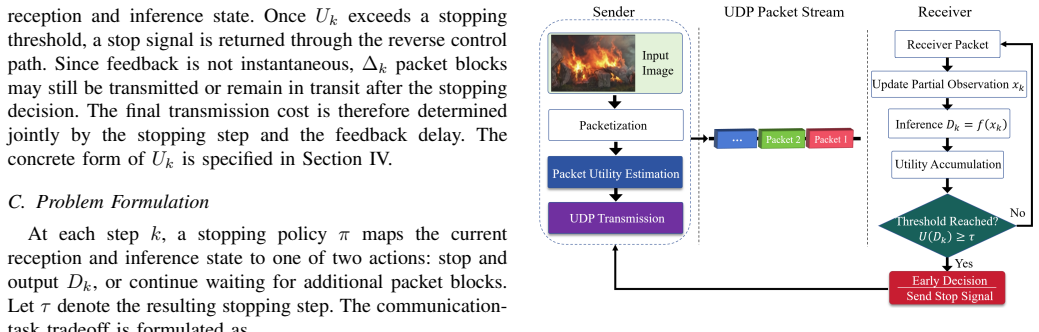
The proposed method has the sender estimate packet-level decision utility as lightweight control metadata, while the receiver progressively updates partial observations, accumulates the utility of received packets, and triggers an early stop once the normalized utility exceeds a prescribed threshold, leading to efficient hazard recognition over UDP links.
What carries the argument
Packet-level decision utility accumulated at the receiver to decide when sufficient evidence for early stopping has been received.
If this is right
- Reduces average packet budget by 34.2% at the main operating point.
- Reduces decision delay by 1209.17 ms.
- Retains 91.5% of the full-reception match rate.
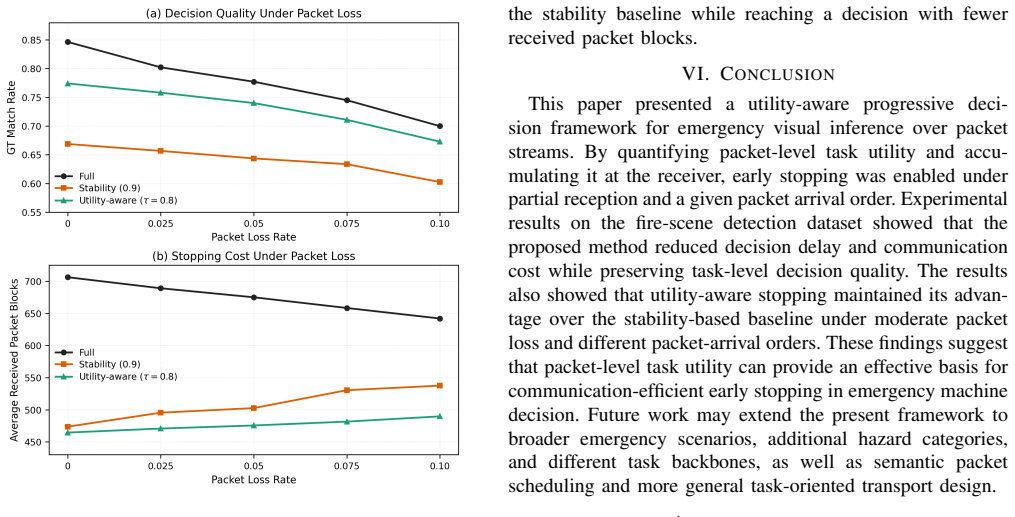
- Maintains advantage over stability-based baseline under moderate packet loss and varying arrival orders.
Where Pith is reading between the lines
- This method might apply to other real-time visual inference tasks in constrained networks.
- Robustness to packet loss suggests potential for integration with error correction schemes.
- Adaptive utility thresholds could further optimize performance in dynamic environments.
Load-bearing premise
The sender can reliably estimate packet-level decision utility as lightweight control metadata and accumulated partial observations support reliable early decisions without significant accuracy loss.
What would settle it
A replication experiment on the fire-scene dataset where utility-based early stopping either requires nearly full packets or drops the match rate well below 91.5%.
Figures

read the original abstract
Emergency communications increasingly rely on remote visual inference for timely hazard detection under stringent bandwidth and latency constraints. However, conventional UDP-based visual delivery typically performs inference only after the full payload has been received, even though partially received packet blocks may already contain sufficient task-relevant evidence for reliable decision making. This paper proposes a utility-aware progressive inference framework for emergency communications, which operates directly on UDP packet blocks and determines when sufficient task value has been accumulated for early hazard recognition. Specifically, the sender estimates packet-level decision utility as lightweight control metadata, while the receiver progressively updates partial observations, accumulates the utility of received packets, and triggers an early stop once the normalized utility exceeds a prescribed threshold. Experiments on a fire-scene detection dataset show that, at the main operating point, the proposed method reduces the average packet budget by 34.2% and the decision delay by 1209.17 ms while retaining 91.5% of the full-reception match rate. The method also maintains its advantage over the stability-based baseline under moderate packet loss and different packet-arrival orders. These results demonstrate that packet-level utility provides an effective basis for communication-efficient and delay-aware hazard recognition over UDP-based emergency links.
Editorial analysis
A structured set of objections, weighed in public.
Referee Report
Summary. The manuscript proposes a utility-aware progressive inference framework for emergency communications over UDP packet blocks. The sender estimates packet-level decision utility as lightweight control metadata; the receiver progressively updates partial observations, accumulates received utility, and triggers early stopping for hazard recognition (e.g., fire-scene detection) once normalized utility exceeds a prescribed threshold. Experiments on a fire-scene dataset report that the method reduces average packet budget by 34.2% and decision delay by 1209.17 ms while retaining 91.5% of the full-reception match rate, with maintained advantage over a stability-based baseline under moderate packet loss and reordering.
Significance. If the utility estimation reliably predicts task contribution, the framework could improve bandwidth efficiency and latency in constrained emergency links for remote visual inference. The reported gains over full reception and the stability baseline suggest practical value for delay-sensitive applications, provided the core predictor is validated.
major comments (3)
- [Methods (assumed §3)] The manuscript provides no detailed description or validation of the sender-side packet-level decision utility estimation procedure (how it is computed from the model, whether it accounts for inter-packet dependencies, or its predictive accuracy for final inference). This is load-bearing for the central claim that accumulated partial observations support reliable early decisions without significant accuracy loss.
- [Experiments (§4)] §4 (Experiments): The quantitative claims (34.2% packet reduction, 1209.17 ms delay reduction at 91.5% retained match rate) are reported without error bars, number of trials, data-split details, dataset size/diversity description, or statistical significance tests. The fire-scene dataset and UDP packet-block simulation are insufficiently specified to assess generalizability.
- [Experiments (§4)] The stability-based baseline comparison lacks implementation details (e.g., how stability is measured, resource parity with the proposed utility method) and does not include ablation over different normalized utility thresholds to show robustness of the reported operating point.
minor comments (2)
- Clarify the exact numerical value of the normalized utility threshold used for the main operating point and provide pseudocode for the receiver-side accumulation and early-stop logic.
- Add labels, legends, and axis units to all figures; ensure table captions fully describe experimental conditions.
Simulated Author's Rebuttal
We thank the referee for the detailed and constructive comments. We have carefully considered each point and provide our responses below, along with planned revisions to address the concerns.
read point-by-point responses
-
Referee: [Methods (assumed §3)] The manuscript provides no detailed description or validation of the sender-side packet-level decision utility estimation procedure (how it is computed from the model, whether it accounts for inter-packet dependencies, or its predictive accuracy for final inference). This is load-bearing for the central claim that accumulated partial observations support reliable early decisions without significant accuracy loss.
Authors: We acknowledge the referee's point that the sender-side utility estimation procedure requires more detailed exposition and validation. We will revise Section 3 to include a comprehensive description of how the utility is computed from the model outputs, its handling of packet dependencies, and empirical validation of its predictive power for the final inference accuracy. This will include additional figures and analysis to support the reliability of early decisions. revision: yes
-
Referee: [Experiments (§4)] §4 (Experiments): The quantitative claims (34.2% packet reduction, 1209.17 ms delay reduction at 91.5% retained match rate) are reported without error bars, number of trials, data-split details, dataset size/diversity description, or statistical significance tests. The fire-scene dataset and UDP packet-block simulation are insufficiently specified to assess generalizability.
Authors: The referee correctly identifies gaps in the experimental reporting. In the revised version, we will include error bars, specify the number of trials, data-split details, dataset size and diversity description, perform statistical significance tests, and provide full specifications for the fire-scene dataset and the UDP packet-block simulation to allow assessment of generalizability. revision: yes
-
Referee: [Experiments (§4)] The stability-based baseline comparison lacks implementation details (e.g., how stability is measured, resource parity with the proposed utility method) and does not include ablation over different normalized utility thresholds to show robustness of the reported operating point.
Authors: We agree that more implementation details are needed for the stability-based baseline, including how stability is measured and confirmation of resource parity. We will also add an ablation study over different normalized utility thresholds to show the robustness of the reported operating point. revision: yes
Circularity Check
No circularity: empirical gains measured against external baseline, not forced by definition or self-citation
full rationale
The paper's central claim rests on an experimental comparison: a utility estimation procedure at the sender, accumulation at the receiver, and early stopping at a prescribed normalized threshold. Performance (34.2% packet reduction, 1209 ms delay reduction at 91.5% retained accuracy) is obtained by running the method on a fire-scene dataset and contrasting it with a stability-based baseline under packet loss and reordering. No equation or step equates the reported savings to the utility estimator by construction; the threshold is an external hyper-parameter, not fitted to force the outcome. No self-citation chain supplies a uniqueness theorem or ansatz that the present work merely renames. The derivation is therefore self-contained against the stated experimental controls.
Axiom & Free-Parameter Ledger
free parameters (1)
- normalized utility threshold
axioms (1)
- domain assumption Partial UDP packet blocks contain sufficient task-relevant evidence for reliable early hazard decisions
Lean theorems connected to this paper
-
IndisputableMonolith/Cost/FunctionalEquation.leanwashburn_uniqueness_aczel unclearsender estimates packet-level decision utility as lightweight control metadata... receiver... accumulates the utility of received packets, and triggers an early stop once the normalized utility exceeds a prescribed threshold
Reference graph
Works this paper leans on
-
[1]
Task-oriented communications for NextG: End-to-end deep learning and AI security aspects,
Y . E. Sagduyu, S. Ulukus, and A. Yener, “Task-oriented communications for NextG: End-to-end deep learning and AI security aspects,”IEEE Wireless Communications, vol. 30, no. 3, pp. 52–60, 2023
work page 2023
-
[2]
Engineering semantic communication: A survey,
D. Wheeler and B. Natarajan, “Engineering semantic communication: A survey,”IEEE Access, vol. 11, pp. 13 965–13 995, 2023
work page 2023
-
[3]
A survey on semantic communications: Technologies, solutions, applications and challenges,
Y . Liu, X. Wang, Z. Ning, M. Zhou, L. Guo, and B. Jedari, “A survey on semantic communications: Technologies, solutions, applications and challenges,”Digital Communications and Networks, vol. 10, no. 3, pp. 528–545, 2024
work page 2024
-
[4]
Semantics-empowered communications: A tutorial-cum-survey,
Z. Lu, R. Li, K. Lu, X. Chen, E. Hossain, Z. Zhao, and H. Zhang, “Semantics-empowered communications: A tutorial-cum-survey,”IEEE Communications Surveys & Tutorials, vol. 26, no. 1, pp. 41–79, 2024
work page 2024
-
[5]
Bridging theory and practice: A review of task-oriented communication for embodied agent societies,
S. Zhang, X. Zheng, Y . Zhang, S. Li, and T. Jiang, “Bridging theory and practice: A review of task-oriented communication for embodied agent societies,”IEEE Transactions on Network Science and Engineering, vol. 12, no. 6, pp. 4480–4497, 2025
work page 2025
-
[6]
Task-oriented communication for edge video analytics,
J. Shao, X. Zhang, and J. Zhang, “Task-oriented communication for edge video analytics,”IEEE Transactions on Wireless Communications, vol. 23, no. 5, pp. 4141–4154, 2024
work page 2024
-
[7]
Progressive transmission of high-dimensional data features for inference at the network edge,
Q. Lan, Q. Zeng, P. Popovski, D. G ¨und¨uz, and K. Huang, “Progressive transmission of high-dimensional data features for inference at the network edge,” inProc. IEEE 23rd Int. Workshop Signal Processing Advances in Wireless Communications (SPAWC), 2022, pp. 1–5
work page 2022
-
[8]
Digital semantic device-edge co-inference with task-oriented ARQ,
X. Li, S. Bi, S. Wang, X. Li, and Y .-J. A. Zhang, “Digital semantic device-edge co-inference with task-oriented ARQ,”IEEE Transactions on Vehicular Technology, vol. 73, no. 9, pp. 13 986–13 990, 2024
work page 2024
-
[9]
Knowledge graph driven UA V cognitive semantic communication systems for efficient object detection,
X. Song, L. Yuan, Z. Qu, F. Zhou, Q. Wu, T. Q. S. Quek, and R. Q. Hu, “Knowledge graph driven UA V cognitive semantic communication systems for efficient object detection,” inProc. IEEE Int. Conf. Com- munications (ICC), 2024, pp. 1685–1690
work page 2024
-
[10]
Semantic communication empowered collaborative perception in con- strained networks,
Y . Liu, Q. Huang, R. Li, Z. Zhao, S. Zhao, Y . Liu, Y . Zhu, and H. Zhang, “Semantic communication empowered collaborative perception in con- strained networks,”IEEE Wireless Communications Letters, vol. 14, no. 3, pp. 701–705, 2025
work page 2025
-
[11]
You only look once: Unified, real-time object detection,
J. Redmon, S. Divvala, R. Girshick, and A. Farhadi, “You only look once: Unified, real-time object detection,” inProc. IEEE Conf. Com- puter Vision and Pattern Recognition (CVPR), 2016, pp. 779–788
work page 2016
-
[12]
YOLOX: Exceeding YOLO Series in 2021
Z. Ge, S. Liu, F. Wang, Z. Li, and J. Sun, “YOLOX: Exceeding YOLO series in 2021,”CoRR, vol. abs/2107.08430, 2021
work page internal anchor Pith review arXiv 2021
discussion (0)
Sign in with ORCID, Apple, or X to comment. Anyone can read and Pith papers without signing in.