Recognition: 2 theorem links
· Lean TheoremRegular hairy black holes by gravitational decoupling: Bardeen and Minkowski-core seeds
Pith reviewed 2026-05-12 03:46 UTC · model grok-4.3
The pith
Gravitational decoupling with a fixed exponential profile generates two families of regular hairy black holes from Bardeen-type and hollow Minkowski-core seeds.
A machine-rendered reading of the paper's core claim, the machinery that carries it, and where it could break.
Core claim
We construct two families of regular hairy black holes within gravitational decoupling using a fixed exponential deformation profile for an effective tensor-vacuum sector. The first family is generated from a Bardeen-type seed and produces a de Sitter-like core. The second family is generated from a hollow seed with an asymptotically Minkowski core so that the central density vanishes and no de Sitter core is produced. For each branch we determine the critical deformation strengths separating horizonless, extremal, and two-horizon geometries in the static case, and we obtain the corresponding Kerr-like rotating extension by promoting the mass parameter to the deformed mass function.
What carries the argument
The fixed exponential deformation profile for the effective tensor-vacuum sector in the gravitational decoupling framework, applied to seed metrics to produce hairy solutions while preserving regularity.
If this is right
- For appropriate ranges of the deformation parameter, the solutions exhibit two horizons, an extremal single horizon, or no horizons at all.
- Rotating black hole solutions are obtained by promoting the constant mass to the position-dependent deformed mass function in the Kerr metric.
- The weak energy condition is satisfied in the exterior region for the representative parameter values considered.
- The second family has vanishing central density and lacks the de Sitter core present in the first family.
Where Pith is reading between the lines
- The same deformation profile could be tested on other known seed solutions to generate additional regular hairy black hole families with different core properties.
- These constructions might help explore how modified gravity or effective matter distributions can resolve black hole singularities in a controlled way.
- Further analysis of stability or thermodynamic properties could reveal differences between the de Sitter-core and Minkowski-core families.
Load-bearing premise
That a fixed exponential deformation profile can be introduced into the gravitational decoupling framework while keeping the seed metrics regular and satisfying the Einstein field equations without extra constraints.
What would settle it
Direct substitution of the deformed metric into the Einstein equations to check if the effective stress-energy tensor matches the one implied by the exponential profile, or numerical verification that the central density is zero for the hollow seed family.
Figures


read the original abstract
We construct two families of regular hairy black holes within gravitational decoupling using a fixed exponential deformation profile for an effective tensor-vacuum sector. The first family is generated from a Bardeen-type seed and produces a de Sitter-like core. The second family is generated from a hollow seed with an asymptotically Minkowski core so that the central density vanishes and no de Sitter core is produced. For each branch we determine the critical deformation strengths separating horizonless, extremal, and two-horizon geometries in the static case, and we obtain the corresponding Kerr-like rotating extension by promoting the mass parameter to the deformed mass function. Representative parameter choices are used to illustrate the horizon structure and to verify the weak energy condition in the exterior region.
Editorial analysis
A structured set of objections, weighed in public.
Referee Report
Summary. The paper claims to construct two families of regular hairy black holes within the gravitational decoupling framework using a fixed exponential deformation profile for an effective tensor-vacuum sector. One family is generated from a Bardeen-type seed and yields a de Sitter-like core; the second uses a hollow seed with an asymptotically Minkowski core in which the central density vanishes. Critical values of the deformation strength separating horizonless, extremal, and two-horizon geometries are determined for the static metrics. Kerr-like rotating extensions are obtained by promoting the constant mass parameter to the deformed mass function. The weak energy condition is verified for representative parameter choices in the exterior region.
Significance. If the constructions hold, especially the consistency of the rotating extensions, the work supplies explicit, tunable families of regular black holes with controlled core behavior (de Sitter versus Minkowski) inside the gravitational-decoupling approach. The determination of critical deformation strengths for distinct horizon structures and the WEC checks provide concrete parameter ranges that can be used in phenomenological studies of singularity resolution and energy conditions.
major comments (1)
- [Rotating extensions (section describing the Kerr-like metrics)] The rotating extensions are constructed by substituting the deformed mass function for the constant mass parameter inside the Kerr line element. This substitution generates additional curvature components (angular and cross terms) whose matching to the same effective tensor-vacuum source defined by the static decoupling is not demonstrated. No explicit verification that the resulting metrics satisfy the decoupled Einstein equations is provided, which is required to support the claim that these are rotating hairy black holes within the gravitational-decoupling framework.
minor comments (2)
- [Abstract and construction section] The precise functional form of the fixed exponential deformation profile and the explicit deformed mass function should be stated in the abstract and again at the beginning of the construction section to improve immediate readability.
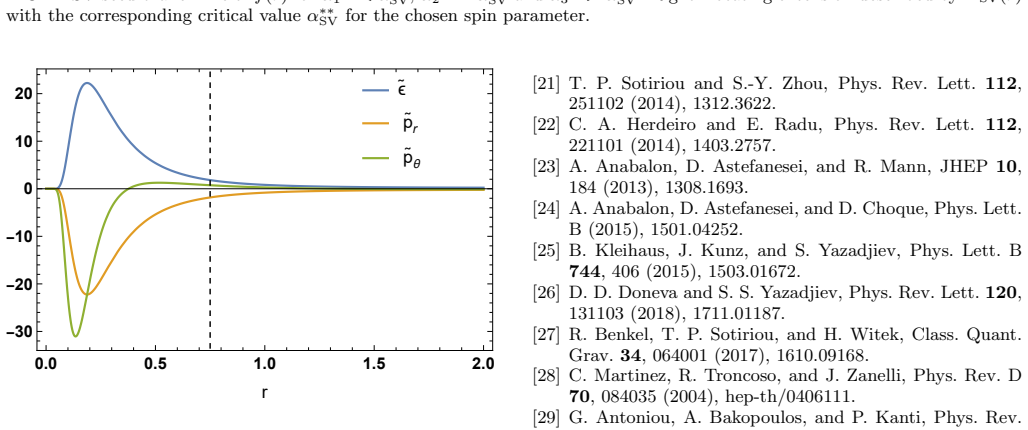
- [Horizon-structure and WEC sections] Figure captions or tables listing the critical deformation strengths would benefit from explicit numerical values of the representative parameters used for the horizon-structure plots and WEC verification.
Simulated Author's Rebuttal
We thank the referee for the careful reading of our manuscript and the constructive feedback. We address the single major comment below.
read point-by-point responses
-
Referee: The rotating extensions are constructed by substituting the deformed mass function for the constant mass parameter inside the Kerr line element. This substitution generates additional curvature components (angular and cross terms) whose matching to the same effective tensor-vacuum source defined by the static decoupling is not demonstrated. No explicit verification that the resulting metrics satisfy the decoupled Einstein equations is provided, which is required to support the claim that these are rotating hairy black holes within the gravitational-decoupling framework.
Authors: We acknowledge that the manuscript presents the Kerr-like extensions via the standard promotion of the mass parameter to the deformed mass function m(r), following the procedure commonly employed in the gravitational-decoupling literature for generating rotating solutions from static seeds. This construction defines the effective tensor-vacuum sector to source the resulting geometry by design. However, we agree that an explicit computation of the additional curvature components and their consistency with the same effective source would strengthen the presentation. In the revised version we will add a short appendix or subsection providing this verification for the rotating metrics, or, if the calculation proves lengthy, a clarifying remark on the scope of the claim. revision: partial
Circularity Check
Rotating Kerr-like extensions defined by mass promotion without verification that they solve the decoupled equations
specific steps
-
self definitional
[Abstract and rotating extensions discussion]
"we obtain the corresponding Kerr-like rotating extension by promoting the mass parameter to the deformed mass function"
The rotating metric is introduced by direct substitution of the r-dependent deformed mass function into the Kerr line element. No subsequent check is performed to confirm that the curvature components of this metric match an effective tensor-vacuum source that is consistent with the gravitational decoupling ansatz used for the static case. The properties (horizons, WEC) are then computed on this assumed metric, making the status of the rotating solutions definitional rather than derived from the field equations.
full rationale
The static families are constructed by choosing a fixed exponential deformation profile and inserting it into the gravitational decoupling framework; this defines an effective source whose Einstein tensor matches the deformed metric by construction, which is the standard way the method works and does not introduce circularity. However, the rotating extensions are obtained simply by promoting the mass parameter inside the Kerr metric. The paper presents these as solutions and computes their horizon structure and energy conditions, but provides no demonstration that the resulting metric satisfies the Einstein equations with a source consistent with the original decoupling. This step reduces the central claim for the rotating family to a definitional assumption rather than a derived result.
Axiom & Free-Parameter Ledger
free parameters (1)
- deformation strength parameter
axioms (1)
- domain assumption Gravitational decoupling separates the Einstein equations into a seed sector plus an effective tensor-vacuum sector that can be solved independently
Lean theorems connected to this paper
-
IndisputableMonolith/Cost/FunctionalEquation.leanwashburn_uniqueness_aczel unclearWe construct two families of regular hairy black holes within gravitational decoupling using a fixed exponential deformation profile for an effective tensor-vacuum sector... m_hair(r) follows from a single radial integral... κE(r) = α r² ℓ⁴ e^{-r/ℓ}
-
IndisputableMonolith/Foundation/AlexanderDuality.leanalexander_duality_circle_linking unclearKerr-like rotating extension by promoting the mass parameter to the deformed mass function... Δ(r) = r² - 2r m̃(r) + a²
Reference graph
Works this paper leans on
- [1]
-
[2]
S. W. Hawking and G. F. R. Ellis,The Large Scale Struc- ture of Space-Time, Cambridge Monographs on Math- ematical Physics (Cambridge University Press, 2011), ISBN 978-0-521-20016-5, 978-0-521-09906-6, 978-0-511- 82630-6, 978-0-521-09906-6
work page 2011
-
[3]
R. M. Wald, inBlack Holes, Gravitational Radiation and the Universe, edited by B. R. Iyer and B. Bhawal (Springer, Dordrecht, 1999), vol. 100 ofFundamental Theories of Physics, pp. 69–86, gr-qc/9710068
work page internal anchor Pith review arXiv 1999
-
[4]
Van de Moortel, Comptes Rendus
M. Van de Moortel, Comptes Rendus. M´ ecanique353, 415 (2025), 2501.13180
-
[5]
A. Burinskii, E. Elizalde, S. R. Hildebrandt, and G. Magli, Phys. Rev. D65, 064039 (2002), gr- qc/0109085
- [6]
-
[7]
A. Smailagic and E. Spallucci, Phys. Lett. B688, 82 (2010), 1003.3918
-
[8]
C. Bambi and L. Modesto, Phys. Lett. B721, 329 (2013), 1302.6075
work page Pith review arXiv 2013
- [9]
-
[10]
I. Dymnikova and E. Galaktionov, Class. Quant. Grav. 6 α<α * α=α * α>α * 0 5 10 15 20 -0.4 -0.2 0.0 0.2 0.4 0.6 0.8 1.0 r e-λ( r) α<α ** α=α ** α>α ** 0 2 4 6 8 10 12 14 -3 -2 -1 0 1 2 3 r Δ(r) FIG. 4: SV-seed branch. Left:f(r) forα SV 1 < α ∗ SV,α SV 2 =α ∗ SV andα SV 3 > α ∗ SV. Right: rotating extension described by ∆ SV(r) with the corresponding criti...
work page 2016
- [11]
-
[12]
Regular Black Hole in General Relativity Coupled to Nonlinear Electrodynamics
E. Ayon-Beato and A. Garcia, Phys. Rev. Lett.80, 5056 (1998), gr-qc/9911046
work page Pith review arXiv 1998
- [13]
-
[14]
Regular black holes with a nonlinear electrodynamics source
L. Balart and E. C. Vagenas, Phys. Rev. D90, 124045 (2014), 1408.0306
work page Pith review arXiv 2014
-
[15]
Rotating Regular Black Hole Solution
B. Toshmatov, B. Ahmedov, A. Abdujabbarov, and Z. Stuchlik, Phys. Rev. D89, 104017 (2014), 1404.6443
work page Pith review arXiv 2014
-
[16]
Construction of Regular Black Holes in General Relativity
Z.-Y. Fan and X. Wang, Phys. Rev. D94, 124027 (2016), 1610.02636
work page Pith review arXiv 2016
-
[17]
A. Allahyari, M. Khodadi, S. Vagnozzi, and D. F. Mota, JCAP2002, 003 (2020), 1912.08231
-
[18]
P. Martin-Moruno and M. Visser, Fundam. Theor. Phys. 189, 193 (2017), 1702.05915
-
[19]
T. P. Sotiriou and V. Faraoni, Phys. Rev. Lett.108, 081103 (2012), 1109.6324
work page Pith review arXiv 2012
-
[20]
Dressing a black hole with a time-dependent Galileon
E. Babichev and C. Charmousis, JHEP08, 106 (2014), 1312.3204
work page Pith review arXiv 2014
-
[21]
T. P. Sotiriou and S.-Y. Zhou, Phys. Rev. Lett.112, 251102 (2014), 1312.3622
work page Pith review arXiv 2014
-
[22]
C. A. Herdeiro and E. Radu, Phys. Rev. Lett.112, 221101 (2014), 1403.2757
work page Pith review arXiv 2014
-
[23]
A. Anabalon, D. Astefanesei, and R. Mann, JHEP10, 184 (2013), 1308.1693
-
[24]
A. Anabalon, D. Astefanesei, and D. Choque, Phys. Lett. B (2015), 1501.04252
-
[25]
B. Kleihaus, J. Kunz, and S. Yazadjiev, Phys. Lett. B 744, 406 (2015), 1503.01672
-
[26]
D. D. Doneva and S. S. Yazadjiev, Phys. Rev. Lett.120, 131103 (2018), 1711.01187
work page Pith review arXiv 2018
- [27]
-
[28]
C. Martinez, R. Troncoso, and J. Zanelli, Phys. Rev. D 70, 084035 (2004), hep-th/0406111
-
[29]
Evasion of No-Hair Theorems and Novel Black-Hole Solutions in Gauss-Bonnet Theories
G. Antoniou, A. Bakopoulos, and P. Kanti, Phys. Rev. Lett.120, 131102 (2018), 1711.03390
work page Pith review arXiv 2018
-
[30]
G. Antoniou, A. Bakopoulos, and P. Kanti, Phys. Rev. D97, 084037 (2018), 1711.07431
- [31]
- [32]
- [33]
- [34]
-
[35]
R. da Rocha and A. A. Tomaz, Eur. Phys. J. C80, 857 (2020), 2005.02980
- [36]
- [37]
- [38]
- [39]
- [40]
-
[41]
S. Mahapatra and I. Banerjee, Phys. Dark Univ.39, 101172 (2023), 2208.05796
-
[42]
Y. Heydarzade, M. Misyura, and V. Vertogradov, Phys. Rev. D108, 044073 (2023), 2307.04556
-
[43]
Ovalle,Black holes without Cauchy horizons and integrable singularities,Phys
J. Ovalle, Phys. Rev. D107, 104005 (2023), 2305.00030
-
[44]
E. Contreras, J. Ovalle, and R. Casadio, Phys. Rev. D 7 103, 044020 (2021), 2101.08569
- [45]
- [46]
- [47]
-
[48]
Interior Dynamics of Regular Schwarzschild Black Holes
J. Ovalle (2025), 2509.00816
work page internal anchor Pith review Pith/arXiv arXiv 2025
discussion (1)
Sign in with ORCID, Apple, or X to comment. Anyone can read and Pith papers without signing in.