Recognition: 3 theorem links
· Lean TheoremAntisymmetric linear transverse magnetization and ferroaxial moments induced by geometry-driven electric field gradients
Pith reviewed 2026-05-12 04:13 UTC · model grok-4.3
The pith
Geometry in finite mesoscopic systems creates electric field gradients that induce antisymmetric linear transverse magnetization.
A machine-rendered reading of the paper's core claim, the machinery that carries it, and where it could break.
Core claim
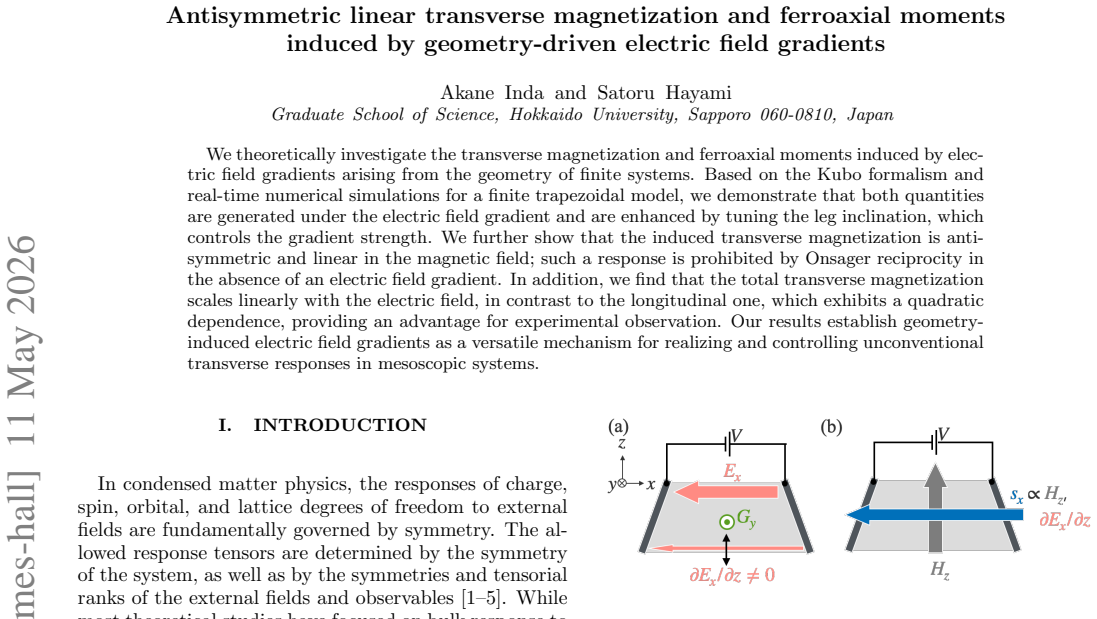
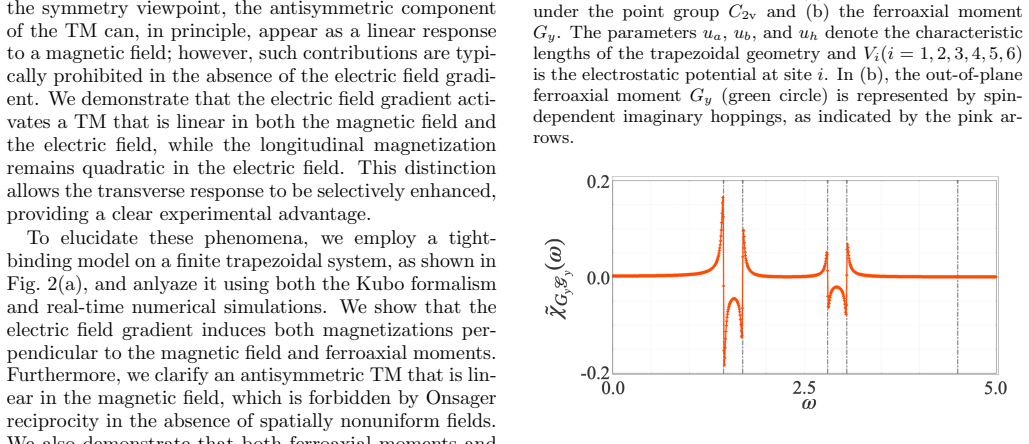
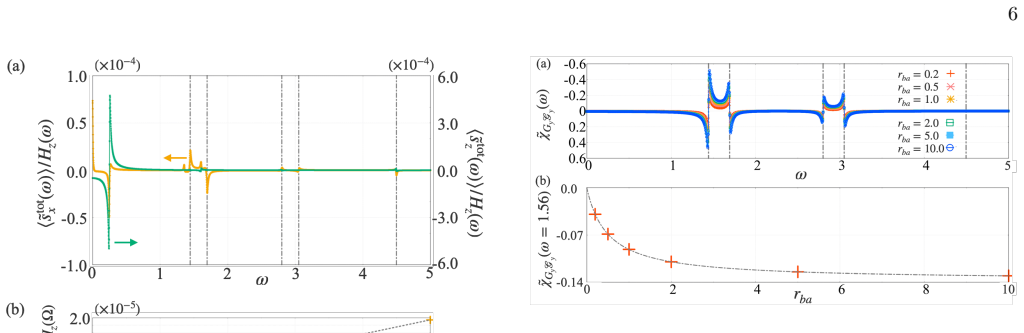
Using the Kubo formalism and real-time simulations on a finite trapezoidal model, geometry-driven electric field gradients generate both transverse magnetization and ferroaxial moments. The transverse magnetization is antisymmetric and linear in the magnetic field, a response normally prohibited by Onsager reciprocity in the absence of a gradient. The total transverse magnetization scales linearly with the electric field while the longitudinal magnetization scales quadratically, and both quantities are enhanced by increasing the leg inclination that controls gradient strength.
What carries the argument
The geometry-driven electric field gradient in a finite trapezoidal model whose strength is tuned by leg inclination, which breaks the symmetry that otherwise forbids the linear antisymmetric response.
If this is right
- The transverse magnetization is antisymmetric and linear in the magnetic field.
- The total transverse magnetization scales linearly with electric field strength while the longitudinal magnetization scales quadratically.
- Both the magnetization and ferroaxial moments increase when the leg inclination is tuned to strengthen the electric field gradient.
- Geometry-induced gradients provide a mechanism for unconventional transverse responses in mesoscopic systems.
Where Pith is reading between the lines
- Similar linear antisymmetric responses may appear in other non-uniform geometries such as triangular or irregular shapes if they produce comparable field gradients.
- The linear scaling with electric field could make transverse signals easier to detect experimentally than quadratic longitudinal ones in suitably engineered nanostructures.
- This approach might be combined with other symmetry-breaking features to further control ferroaxial moments without additional external fields.
Load-bearing premise
The finite trapezoidal model and its leg-inclination tuning accurately represent the essential physics of geometry-driven electric field gradients in real mesoscopic systems without dominant higher-order effects or boundary artifacts.
What would settle it
An experiment on a mesoscopic trapezoidal sample that measures the transverse magnetization versus magnetic field strength and finds a clear linear antisymmetric dependence that vanishes when the geometry is made symmetric.
Figures





read the original abstract
We theoretically investigate the transverse magnetization and ferroaxial moments induced by electric field gradients arising from the geometry of finite systems. Based on the Kubo formalism and real-time numerical simulations for a finite trapezoidal model, we demonstrate that both quantities are generated under the electric field gradient and are enhanced by tuning the leg inclination, which controls the gradient strength. We further show that the induced transverse magnetization is antisymmetric and linear in the magnetic field; such a response is prohibited by Onsager reciprocity in the absence of an electric field gradient. In addition, we find that the total transverse magnetization scales linearly with the electric field, in contrast to the longitudinal one, which exhibits a quadratic dependence, providing an advantage for experimental observation. Our results establish geometry-induced electric field gradients as a versatile mechanism for realizing and controlling unconventional transverse responses in mesoscopic systems.
Editorial analysis
A structured set of objections, weighed in public.
Referee Report
Summary. The paper claims that geometry-induced electric field gradients in finite mesoscopic systems generate transverse magnetization and ferroaxial moments. Using the Kubo formalism and real-time simulations on a finite trapezoidal tight-binding model, it shows these quantities are enhanced by increasing leg inclination (which strengthens the gradient). The transverse magnetization is antisymmetric and linear in the applied magnetic field (prohibited by Onsager reciprocity without the gradient), and the total transverse magnetization scales linearly with electric field strength while the longitudinal component scales quadratically.
Significance. If the central numerical results hold and the mechanism is isolated, the work identifies a geometry-based route to unconventional magnetoelectric responses in mesoscopic systems, offering a way to realize antisymmetric linear-in-B transverse magnetization without violating reciprocity. The linear-in-E scaling of the transverse response versus quadratic longitudinal scaling is a concrete experimental advantage. The combination of analytic Kubo expressions with real-time dynamics provides falsifiable predictions for finite-size systems.
major comments (2)
- [Model description and numerical results sections] The central claim that the observed antisymmetric linear-in-B transverse magnetization and linear-in-E scaling arise specifically from the geometry-driven E-field gradient (rather than from simultaneous changes in aspect ratio, edge termination, or multipole moments) rests on the trapezoidal model with leg-inclination tuning. The manuscript should include explicit controls, such as fixed-aspect-ratio comparisons or continuum-limit checks, to demonstrate that inclination primarily modulates the gradient without introducing dominant confounding symmetry-breaking effects.
- [Kubo formalism section] The Kubo-formalism derivation of the transverse response (prohibited by Onsager in the absence of gradient) is load-bearing for the novelty claim. The manuscript should explicitly state the symmetry assumptions and show that the linear term vanishes identically when the E-gradient is set to zero while keeping all other geometric parameters fixed.
minor comments (3)
- Clarify the definition of ferroaxial moments and how they are computed from the simulations; the abstract mentions them but the connection to the magnetization data is not immediately transparent.
- Add error bars or convergence checks for the real-time simulations with respect to system size and time-step parameters.
- The statement that the transverse response is 'prohibited by Onsager reciprocity in the absence of an electric field gradient' would benefit from a brief reminder of the relevant Onsager relation and how the gradient modifies it.
Simulated Author's Rebuttal
We thank the referee for their careful reading and constructive comments on our manuscript. We have revised the paper to address the concerns about isolating the geometry-driven electric field gradient and explicitly demonstrating the vanishing of the linear response in the Kubo formalism. Point-by-point responses follow.
read point-by-point responses
-
Referee: [Model description and numerical results sections] The central claim that the observed antisymmetric linear-in-B transverse magnetization and linear-in-E scaling arise specifically from the geometry-driven E-field gradient (rather than from simultaneous changes in aspect ratio, edge termination, or multipole moments) rests on the trapezoidal model with leg-inclination tuning. The manuscript should include explicit controls, such as fixed-aspect-ratio comparisons or continuum-limit checks, to demonstrate that inclination primarily modulates the gradient without introducing dominant confounding symmetry-breaking effects.
Authors: We agree that additional controls are needed to isolate the gradient effect. In the revised manuscript we have added fixed-aspect-ratio calculations (by compensating base-width changes while varying leg inclination) in an expanded Section III and new Figure 3. These confirm that the antisymmetric linear-in-B transverse magnetization and linear-in-E scaling persist and track the gradient strength. We have also included a brief continuum-limit discussion in the supplementary material explaining why discrete finite-size effects do not dominate the gradient-induced response. revision: yes
-
Referee: [Kubo formalism section] The Kubo-formalism derivation of the transverse response (prohibited by Onsager in the absence of gradient) is load-bearing for the novelty claim. The manuscript should explicitly state the symmetry assumptions and show that the linear term vanishes identically when the E-gradient is set to zero while keeping all other geometric parameters fixed.
Authors: We thank the referee for highlighting this key point. In the revised Section II we now explicitly state the symmetry assumptions (time-reversal symmetry together with inversion symmetry in the zero-gradient limit, which enforce Onsager reciprocity). We analytically set the E-gradient parameter to zero while holding all other geometric parameters fixed and show that the relevant Kubo correlator for the antisymmetric transverse magnetization vanishes identically. This is corroborated by a new numerical panel in Figure 2 demonstrating the zero-gradient limit. revision: yes
Circularity Check
No circularity; results follow from Kubo formalism and independent numerical simulations on trapezoidal model.
full rationale
The paper derives its claims about antisymmetric linear transverse magnetization and ferroaxial moments using the standard Kubo formalism combined with real-time numerical simulations on a finite trapezoidal tight-binding model, where leg inclination tunes the geometry-induced electric field gradient. These calculations directly produce the reported linear-in-B antisymmetry (contrasting Onsager reciprocity without gradient) and the contrasting linear vs. quadratic E-scaling for transverse vs. longitudinal magnetization. No steps reduce by construction to fitted inputs, self-definitions, or self-citation chains; the model parameters are physical choices, not tautological. The derivation remains self-contained against external benchmarks such as reciprocity relations and does not rely on renaming known results or smuggling ansatze via citations.
Axiom & Free-Parameter Ledger
axioms (2)
- standard math Kubo formalism applies to calculate responses to electric field gradients in finite systems
- domain assumption Onsager reciprocity prohibits antisymmetric linear transverse magnetization in the absence of electric field gradient
Lean theorems connected to this paper
-
IndisputableMonolith/Cost/FunctionalEquation.leanwashburn_uniqueness_aczel unclear?
unclearRelation between the paper passage and the cited Recognition theorem.
We employ a tight-binding model on a finite trapezoidal system... Kubo formalism... real-time numerical simulations... Peierls substitution... von Neumann equation
-
IndisputableMonolith/Foundation/AlphaCoordinateFixation.leanalpha_pin_under_high_calibration unclear?
unclearRelation between the paper passage and the cited Recognition theorem.
scaling behavior consistent with α rba/(β rba +1)... leg inclination... electric field gradient
-
IndisputableMonolith/Foundation/AbsoluteFloorClosure.leanabsolute_floor_iff_bare_distinguishability unclear?
unclearRelation between the paper passage and the cited Recognition theorem.
antisymmetric linear transverse magnetization... prohibited by Onsager reciprocity in the absence of an electric field gradient
What do these tags mean?
- matches
- The paper's claim is directly supported by a theorem in the formal canon.
- supports
- The theorem supports part of the paper's argument, but the paper may add assumptions or extra steps.
- extends
- The paper goes beyond the formal theorem; the theorem is a base layer rather than the whole result.
- uses
- The paper appears to rely on the theorem as machinery.
- contradicts
- The paper's claim conflicts with a theorem or certificate in the canon.
- unclear
- Pith found a possible connection, but the passage is too broad, indirect, or ambiguous to say the theorem truly supports the claim.
Reference graph
Works this paper leans on
-
[1]
Birss,Symmetry and magnetism, Selected topics in solid state physics (North-Holland Pub
R. Birss,Symmetry and magnetism, Selected topics in solid state physics (North-Holland Pub. Co., 1964)
work page 1964
-
[2]
D. B. Litvin,Magnetic Group Tables(International Union of Crystallography, 2013)
work page 2013
-
[3]
S. V. Gallego, J. Etxebarria, L. Elcoro, E. S. Tasci, and J. M. Perez-Mato, Acta Cryst.A75, 438 (2019)
work page 2019
-
[4]
M. Yatsushiro, H. Kusunose, and S. Hayami, Phys. Rev. B104, 054412 (2021). 9
work page 2021
-
[5]
J. Etxebarria, J. M. Perez-Mato, E. S. Tasci, and L. El- coro, Acta Cryst.81, 317 (2025)
work page 2025
-
[6]
L. D. Landau, J. S. Bell, M. Kearsley, L. Pitaevskii, E. Lifshitz, and J. Sykes,Electrodynamics of continuous media, Vol. 8 (elsevier, 2013)
work page 2013
- [7]
-
[8]
T. Yamanaka, Y. Ihara, and S. Hayami, Journal of the Physical Society of Japan94, 083705 (2025)
work page 2025
- [9]
- [10]
- [11]
- [12]
- [13]
- [14]
- [15]
- [16]
- [17]
-
[18]
A. Roy, M. H. D. Guimar˜ aes, and J. S lawi´ nska, Phys. Rev. Materials6, 045004 (2022)
work page 2022
- [19]
- [20]
-
[21]
K. Du, D. Jo, X. Xu, F.-T. Huang, M.-H. Lee, M.-W. Chu, K. Wang, X. Guo, L. Zhao, D. Vanderbilt,et al., Nat. Phys.22, 61 (2026)
work page 2026
- [22]
- [23]
- [24]
-
[25]
R. D. Johnson, S. Nair, L. C. Chapon, A. Bombardi, C. Vecchini, D. Prabhakaran, A. T. Boothroyd, and P. G. Radaelli, Phys. Rev. Lett.107, 137205 (2011)
work page 2011
-
[26]
R. D. Johnson, L. C. Chapon, D. D. Khalyavin, P. Manuel, P. G. Radaelli, and C. Martin, Phys. Rev. Lett.108, 067201 (2012)
work page 2012
- [27]
-
[28]
T. Hasegawa, W. Yoshida, K. Nakamura, N. Ogita, and K. Matsuhira, J. Phys. Soc. Jpn.89, 054602 (2020)
work page 2020
- [29]
- [30]
- [31]
-
[32]
S. Yamagishi, T. Hayashida, R. Misawa, K. Kimura, M. Hagihala, T. Murata, S. Hirose, and T. Kimura, Chem. Mater.35, 747 (2023)
work page 2023
- [33]
- [34]
- [35]
- [36]
- [37]
-
[38]
X. Luo, D. Obeysekera, C. Won, S. H. Sung, N. Schnitzer, R. Hovden, S.-W. Cheong, J. Yang, K. Sun, and L. Zhao, Phys. Rev. Lett.127, 126401 (2021)
work page 2021
-
[39]
G. Liu, T. Qiu, K. He, Y. Liu, D. Lin, Z. Ma, Z. Huang, W. Tang, J. Xu, K. Watanabe,et al., Nat. Nanotechnol. 18, 854 (2023)
work page 2023
-
[40]
S. Prosandeev, I. Ponomareva, I. Kornev, I. Naumov, and L. Bellaiche, Phys. Rev. Lett.96, 237601 (2006)
work page 2006
-
[41]
I. I. Naumov and H. Fu, Phys. Rev. Lett.101, 197601 (2008)
work page 2008
- [42]
- [43]
- [44]
- [45]
- [46]
-
[47]
A. Ono, S. Okumura, S. Imai, and Y. Akagi, Phys. Rev. B110, 125111 (2024)
work page 2024
-
[48]
K. Hattori, H. Watanabe, J. Iguchi, T. Nomoto, and R. Arita, Phys. Rev. B110, 014425 (2024)
work page 2024
- [49]
- [50]
- [51]
- [52]
- [53]
- [54]
-
[55]
K. Hattori, H. Watanabe, and R. Arita, Phys. Rev. Lett. 136, 046603 (2026)
work page 2026
- [56]
discussion (0)
Sign in with ORCID, Apple, or X to comment. Anyone can read and Pith papers without signing in.