Recognition: no theorem link
Collective resonance light scattering from thermally relaxing systems in cavities
Pith reviewed 2026-05-12 04:04 UTC · model grok-4.3
The pith
Molecules in optical cavities produce split upper and lower polariton peaks in fluorescence scattering under strong coupling.
A machine-rendered reading of the paper's core claim, the machinery that carries it, and where it could break.
Core claim
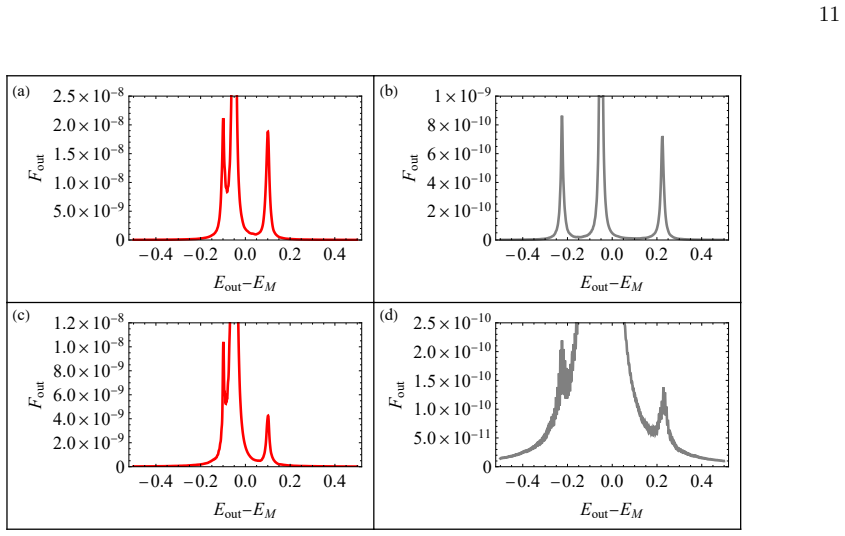
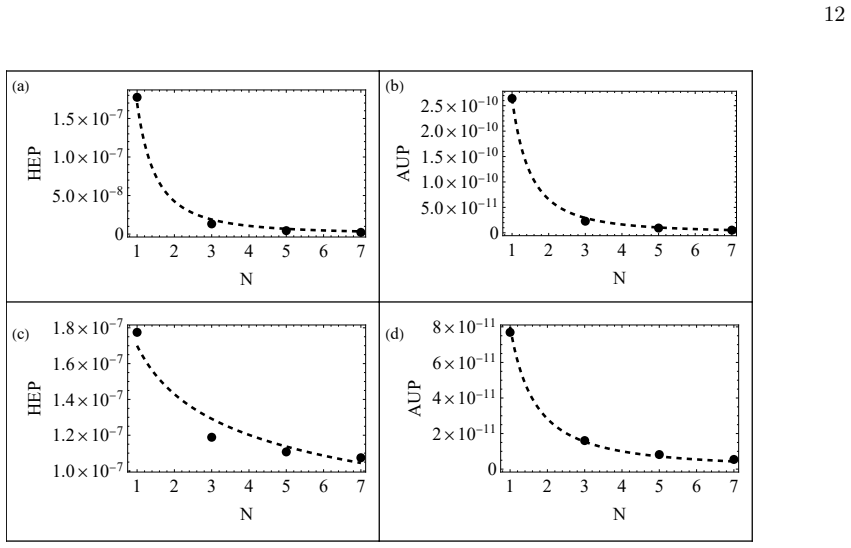
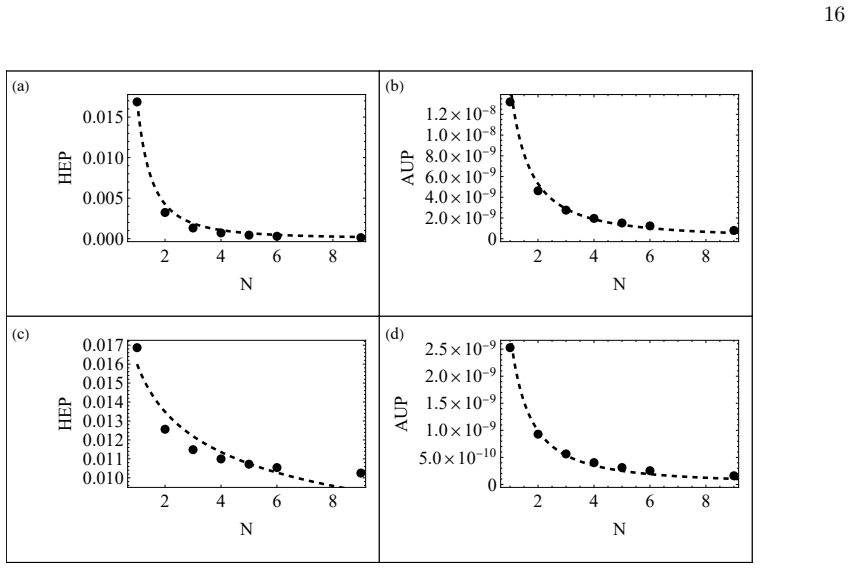
Steady-state solutions of the Schrödinger equation or Liouville-space master equation that include local thermal relaxation produce resonance light scattering spectra exhibiting an elastic peak at the incident-photon energy and an inelastic fluorescence peak near the molecular excitation energy. When the molecules are placed inside an optical cavity, the fluorescence peak splits into upper- and lower-polaritonic peaks in the strong-coupling regime. With cavity-molecule coupling kept fixed, the elastic Rayleigh peak intensity and the integrated polaritonic or fluorescence spectral weight display distinct collective trends as the number of molecules is varied.
What carries the argument
Steady-state solutions of the Schrödinger equation or Liouville master equation that incorporate local thermal relaxation to generate the resonance light scattering spectra.
If this is right
- The elastic Rayleigh peak intensity follows a specific collective scaling with molecule number at fixed coupling.
- The integrated spectral weight of the polaritonic peaks exhibits a distinct collective trend separate from the elastic component.
- The splitting of the fluorescence into upper and lower polariton peaks occurs only in the strong-coupling regime inside the cavity.
- The Schrödinger and Liouville approaches produce qualitatively similar spectra while highlighting different features of thermally induced dephasing.
Where Pith is reading between the lines
- These scaling relations could be tested by varying ensemble size in cavity experiments to isolate collective cavity effects from single-molecule scattering.
- The assumption of purely local relaxation suggests that weak intermolecular interactions might leave the polariton splitting largely intact provided collective decoherence remains absent.
- Time-dependent extensions of the same master-equation framework might reveal how thermal relaxation influences the transient formation of polariton branches.
Load-bearing premise
The molecules remain strictly noninteracting and thermal relaxation together with dephasing are treated as purely local processes without additional collective decoherence channels.
What would settle it
Measuring the scattering spectrum inside a cavity while varying the number of molecules at fixed coupling strength and checking whether the inelastic feature splits into upper and lower polariton peaks whose integrated intensities follow the predicted collective scalings.
Figures



read the original abstract
We study steady-state resonance light scattering from ensembles of noninteracting molecules, both in free space and inside optical cavities, while accounting for local thermal relaxation. The scattering spectra are obtained from steady-state solutions of either the Schr\"{o}dinger equation or a Liouville-space master equation. In the absence of a cavity, the spectra exhibit an elastic peak at the incident-photon energy and an inelastic fluorescence peak near the molecular excitation energy. Inside a cavity, the fluorescence peak splits into upper- and lower-polaritonic peaks in the strong-coupling regime. We analyze how the elastic and inelastic spectral features scale with the number of molecules under fixed cavity-molecule coupling and identify distinct collective trends in the Rayleigh peak intensity and in the integrated polaritonic or fluorescence spectral weight. The two theoretical approaches yield qualitatively consistent results while highlighting different aspects of thermally induced relaxation and dephasing.
Editorial analysis
A structured set of objections, weighed in public.
Referee Report
Summary. The manuscript studies steady-state resonance light scattering from ensembles of noninteracting molecules in free space and inside optical cavities, incorporating local thermal relaxation and dephasing. Spectra are computed from steady-state solutions of either the Schrödinger equation or a Liouville master equation. In cavities, the inelastic fluorescence peak splits into upper and lower polaritonic peaks under strong coupling. The work examines how elastic (Rayleigh) and inelastic spectral features scale with molecule number N at fixed single-molecule cavity coupling strength, reporting distinct collective trends in Rayleigh-peak intensity and integrated polaritonic/fluorescence weight. The two formalisms produce qualitatively consistent results.
Significance. If the reported N-scaling trends prove robust, the work would clarify how local thermal processes modify collective light-matter interactions in cavities, with potential relevance to polariton chemistry and cavity QED experiments. The dual-formalism cross-check is a positive feature that strengthens internal consistency.
major comments (2)
- [Liouville master-equation formulation and scaling analysis] The central scaling claims (distinct collective trends in Rayleigh intensity and integrated inelastic weight with N at fixed per-molecule g) rest on the assumption of strictly local relaxation/dephasing in the Liouville master equation. The manuscript does not test or bound the effects of possible collective decoherence channels mediated by the shared cavity mode; such channels would alter steady-state populations and coherences and could change the reported N-dependence.
- [Results and discussion of scaling] The abstract states that the two approaches yield qualitatively consistent results, yet no quantitative comparison to known limits (N=1 case, zero-temperature limit, or weak-coupling analytic expressions) is provided to anchor the scaling trends. This leaves the support for the collective trends moderate.
minor comments (2)
- [Abstract] Clarify in the abstract and introduction that 'fixed cavity-molecule coupling' refers to fixed single-molecule g (collective vacuum Rabi frequency scaling as sqrt(N)).
- [Theory and notation] Ensure uniform notation for the single-molecule coupling strength g across all equations and figures.
Simulated Author's Rebuttal
We thank the referee for the careful reading of our manuscript and the constructive comments. We address each major point below and indicate the revisions we will make.
read point-by-point responses
-
Referee: The central scaling claims (distinct collective trends in Rayleigh intensity and integrated inelastic weight with N at fixed per-molecule g) rest on the assumption of strictly local relaxation/dephasing in the Liouville master equation. The manuscript does not test or bound the effects of possible collective decoherence channels mediated by the shared cavity mode; such channels would alter steady-state populations and coherences and could change the reported N-dependence.
Authors: We acknowledge that our Liouville master-equation model employs strictly local relaxation and dephasing operators, consistent with the assumption of independent molecular baths. Collective decoherence channels mediated by the shared cavity mode are not included and could indeed modify the steady-state populations and the resulting N-scaling. The Schrödinger-equation approach offers an independent cross-check that does not rely on the same master-equation assumptions. In the revised manuscript we will add an explicit discussion of this modeling choice, its limitations, and the conditions under which collective decoherence effects might become relevant. revision: partial
-
Referee: The abstract states that the two approaches yield qualitatively consistent results, yet no quantitative comparison to known limits (N=1 case, zero-temperature limit, or weak-coupling analytic expressions) is provided to anchor the scaling trends. This leaves the support for the collective trends moderate.
Authors: We agree that quantitative benchmarks against known limits would strengthen the support for the reported trends. In the revised manuscript we will include direct comparisons for the N=1 case, the zero-temperature limit, and the weak-coupling regime against available analytic expressions. These comparisons will be added to the results section to better anchor the collective scaling behavior and to quantify the consistency between the two formalisms. revision: yes
Circularity Check
No significant circularity in derivation chain
full rationale
The paper obtains scattering spectra directly from steady-state solutions of the Schrödinger equation or local Liouville master equation applied to strictly noninteracting molecules. Scaling of elastic/inelastic features with molecule number N (under fixed per-molecule coupling) is then extracted as a post-computation observation from those spectra. No self-definitional steps, fitted inputs renamed as predictions, load-bearing self-citations, or ansatzes smuggled via citation appear in the abstract or described methodology. The central results remain independent of the inputs and are falsifiable against external master-equation benchmarks.
Axiom & Free-Parameter Ledger
axioms (3)
- domain assumption Molecules are noninteracting
- domain assumption Thermal relaxation is local and captured by the master equation
- standard math Steady-state solutions of Schrödinger or Liouville master equation yield the scattering spectra
Reference graph
Works this paper leans on
-
[1]
D.L. Pavia, G.M. Lampman, G.S. Kriz, and J.A. Vyvyan. Introduction to Spectroscopy. Cengage Learning, 2014
work page 2014
- [2]
-
[3]
Characterization of electronic transitions in complex molecules
Michael Kasha. Characterization of electronic transitions in complex molecules. Discussions of the Faraday Society, 9:14, 1950
work page 1950
-
[4]
Modes and mode volumes of leaky optical cavities and plasmonic nanoresonators
Philip Trøst Kristensen and Stephen Hughes. Modes and mode volumes of leaky optical cavities and plasmonic nanoresonators. ACS Photonics, 1(1):2–10, December 2013
work page 2013
-
[5]
Rohit Chikkaraddy, Bart de Nijs, Felix Benz, Steven J. Barrow, Oren A. Scherman, Edina Rosta, Angela Demetriadou, Peter Fox, Ortwin Hess, and Jeremy J. Baumberg. Single-molecule strong coupling at room temperature in plasmonic nanocavities. Nature, 535(7610):127–130, June 2016. 22
work page 2016
-
[6]
Johannes Feist and Francisco J. Garcia-Vidal. Extraordinary exciton conductance induced by strong coupling. Phys. Rev. Lett., 114:196402, May 2015
work page 2015
-
[7]
Hutchison, Eloise Devaux, Cyriaque Genet, and Thomas W
Xiaolan Zhong, Thibault Chervy, Shaojun Wang, Jino George, Anoop Thomas, James A. Hutchison, Eloise Devaux, Cyriaque Genet, and Thomas W. Ebbesen. Non-radiative energy transfer mediated by hybrid light-matter states. Angewandte Chemie International Edition, 55(21):6202–6206, April 2016
work page 2016
-
[8]
Xiaolan Zhong, Thibault Chervy, Lei Zhang, Anoop Thomas, Jino George, Cyriaque Genet, James A. Hutchison, and Thomas W. Ebbesen. Energy transfer between spatially separated entangled molecules. Angewandte Chemie International Edition, 56(31):9034–9038, June 2017
work page 2017
-
[9]
Long-range transport of organic exciton-polaritons revealed by ultrafast microscopy
Georgi Gary Rozenman, Katherine Akulov, Adina Golombek, and Tal Schwartz. Long-range transport of organic exciton-polaritons revealed by ultrafast microscopy. ACS Photonics, 5(1):105–110, December 2017
work page 2017
-
[10]
Ribeiro, Matthew Du, Liying Chen, Zimo Yang, Jiaxi Wang, Joel Yuen-Zhou, and Wei Xiong
Bo Xiang, Raphael F. Ribeiro, Matthew Du, Liying Chen, Zimo Yang, Jiaxi Wang, Joel Yuen-Zhou, and Wei Xiong. Intermolecular vibrational energy transfer enabled by microcavity strong light–matter coupling. Science, 368(6491):665–667, May 2020
work page 2020
-
[11]
Kyriacos Georgiou, Rahul Jayaprakash, Andreas Othonos, and David G. Lidzey. Ultralong-range polariton-assisted energy transfer in organic microcavities. Angewandte Chemie International Edition, 60(30):16661–16667, June 2021
work page 2021
-
[12]
Cavity-enhanced transport of excitons
Johannes Schachenmayer, Claudiu Genes, Edoardo Tignone, and Guido Pupillo. Cavity-enhanced transport of excitons. Phys. Rev. Lett., 114:196403, May 2015
work page 2015
-
[13]
Modification of excitation and charge transfer in cavity quantum-electrodynamical chemistry
Christian Sch¨ afer, Michael Ruggenthaler, Heiko Appel, and Angel Rubio. Modification of excitation and charge transfer in cavity quantum-electrodynamical chemistry. Proceedings of the National Academy of Sciences, 116(11):4883–4892, February 2019
work page 2019
-
[14]
Cavity-assisted ultrafast long-range periodic energy transfer between plasmonic nanoantennas
Martin Aeschlimann, Tobias Brixner, Mirko Cinchetti, Benjamin Frisch, Bert Hecht, Matthias Hensen, Bernhard Huber, Christian Kramer, Enno Krauss, Thomas H Loeber, Walter Pfeiffer, Martin Piecuch, and Philip Thielen. Cavity-assisted ultrafast long-range periodic energy transfer between plasmonic nanoantennas. Light: Science & Applications, 6(11):e17111–e17...
work page 2017
-
[15]
Mart´ ınez-Mart´ ınez, Raphael F
Matthew Du, Luis A. Mart´ ınez-Mart´ ınez, Raphael F. Ribeiro, Zixuan Hu, Vinod M. Menon, and Joel Yuen-Zhou. Theory for polariton-assisted remote energy transfer. Chemical Science, 9(32):6659–6669, 23 2018
work page 2018
-
[16]
Martijn de Sterke, Stefan Enoch, Redha Abdeddaim, and J´ erˆ ome Wenger
Kaizad Rustomji, Marc Dubois, Boris Kuhlmey, C. Martijn de Sterke, Stefan Enoch, Redha Abdeddaim, and J´ erˆ ome Wenger. Direct imaging of the energy-transfer enhancement between two dipoles in a photonic cavity. Phys. Rev. X, 9:011041, Mar 2019
work page 2019
-
[17]
E. Orgiu, J. George, J. A. Hutchison, E. Devaux, J. F. Dayen, B. Doudin, F. Stellacci, C. Genet, J. Schachenmayer, C. Genes, G. Pupillo, P. Samor` ı, and T. W. Ebbesen. Conductivity in organic semiconductors hybridized with the vacuum field. Nature Materials, 14(11):1123–1129, September 2015
work page 2015
-
[18]
Grede, Demetra Tsokkou, Natalie Banerji, and Noel C
Nina Krainova, Alex J. Grede, Demetra Tsokkou, Natalie Banerji, and Noel C. Giebink. Polaron photoconductivity in the weak and strong light-matter coupling regime. Phys. Rev. Lett., 124:177401, Apr 2020
work page 2020
-
[19]
M. Halbhuber, J. Mornhinweg, V. Zeller, C. Ciuti, D. Bougeard, R. Huber, and C. Lange. Non- adiabatic stripping of a cavity field from electrons in the deep-strong coupling regime.Nature Photonics, 14(11):675–679, August 2020
work page 2020
-
[20]
Cavity-enhanced transport of charge
David Hagenm¨ uller, Johannes Schachenmayer, Stefan Sch¨ utz, Claudiu Genes, and Guido Pupillo. Cavity-enhanced transport of charge. Phys. Rev. Lett., 119:223601, Nov 2017
work page 2017
-
[21]
Cavity-assisted mesoscopic transport of fermions: Coherent and dissipative dynamics
David Hagenm¨ uller, Stefan Sch¨ utz, Johannes Schachenmayer, Claudiu Genes, and Guido Pupillo. Cavity-assisted mesoscopic transport of fermions: Coherent and dissipative dynamics. Physical Review B, 97(20), May 2018
work page 2018
-
[22]
Direct observation of ultrafast plasmonic hot electron transfer in the strong coupling regime
Hangyong Shan, Ying Yu, Xingli Wang, Yang Luo, Shuai Zu, Bowen Du, Tianyang Han, Bowen Li, Yu Li, Jiarui Wu, Feng Lin, Kebin Shi, Beng Kang Tay, Zheng Liu, Xing Zhu, and Zheyu Fang. Direct observation of ultrafast plasmonic hot electron transfer in the strong coupling regime. Light: Science & Applications, 8(1), January 2019
work page 2019
-
[23]
Yantao Pang, Anoop Thomas, Kalaivanan Nagarajan, Robrecht M. A. Vergauwe, Kripa Joseph, Bianca Patrahau, Kuidong Wang, Cyriaque Genet, and Thomas W. Ebbesen. On the role of symmetry in vi- brational strong coupling: The case of charge-transfer complexation. Angewandte Chemie International Edition, 59(26):10436–10440, April 2020. 24
work page 2020
-
[24]
Arkajit Mandal, Todd D. Krauss, and Pengfei Huo. Polariton-mediated electron transfer via cavity quantum electrodynamics. The Journal of Physical Chemistry B, 124(29):6321–6340, June 2020
work page 2020
- [25]
-
[26]
Phonon heat transport in cavity-mediated optomechanical nanoresonators
Cheng Yang, Xinrui Wei, Jiteng Sheng, and Haibin Wu. Phonon heat transport in cavity-mediated optomechanical nanoresonators. Nature Communications, 11(1), September 2020
work page 2020
-
[27]
Cavity-correlated electron-nuclear dynamics from first principles
Johannes Flick and Prineha Narang. Cavity-correlated electron-nuclear dynamics from first principles. Phys. Rev. Lett., 121:113002, Sep 2018
work page 2018
-
[28]
Johannes Flick, Michael Ruggenthaler, Heiko Appel, and Angel Rubio. Atoms and molecules in cavities, from weak to strong coupling in quantum-electrodynamics (qed) chemistry.Proceedings of the National Academy of Sciences, 114(12):3026–3034, March 2017
work page 2017
-
[29]
Christian Sch¨ afer, Michael Ruggenthaler, and Angel Rubio. Ab initio nonrelativistic quantum electro- dynamics: Bridging quantum chemistry and quantum optics from weak to strong coupling. Phys. Rev. A, 98:043801, Oct 2018
work page 2018
-
[30]
Welakuh, Michael Ruggenthaler, Heiko Appel, and Angel Rubio
Johannes Flick, Davis M. Welakuh, Michael Ruggenthaler, Heiko Appel, and Angel Rubio. Light–matter response in nonrelativistic quantum electrodynamics. ACS Photonics, 6(11):2757–2778, October 2019
work page 2019
-
[31]
Haugland, Enrico Ronca, Eirik F
Tor S. Haugland, Enrico Ronca, Eirik F. Kjønstad, Angel Rubio, and Henrik Koch. Coupled cluster theory for molecular polaritons: Changing ground and excited states. Phys. Rev. X, 10:041043, Dec 2020
work page 2020
-
[32]
Haugland, Christian Sch¨ afer, Enrico Ronca, Angel Rubio, and Henrik Koch
Tor S. Haugland, Christian Sch¨ afer, Enrico Ronca, Angel Rubio, and Henrik Koch. Intermolecular interactions in optical cavities: An ab initio qed study. The Journal of Chemical Physics, 154(9), March 2021
work page 2021
-
[33]
Jussi Toppari, and Gerrit Groenhof
Hoi Ling Luk, Johannes Feist, J. Jussi Toppari, and Gerrit Groenhof. Multiscale molecular dynamics simulations of polaritonic chemistry. Journal of Chemical Theory and Computation, 13(9):4324–4335, August 2017
work page 2017
-
[34]
Hoffmann, Lionel Lacombe, Angel Rubio, and Neepa T
Norah M. Hoffmann, Lionel Lacombe, Angel Rubio, and Neepa T. Maitra. Effect of many modes on self-polarization and photochemical suppression in cavities. The Journal of Chemical Physics, 153(10), September 2020. 25
work page 2020
-
[35]
Christian Sch¨ afer, Johannes Flick, Enrico Ronca, Prineha Narang, and Angel Rubio. Shining light on the microscopic resonant mechanism responsible for cavity-mediated chemical reactivity. Nature Communications, 13(1), December 2022
work page 2022
-
[36]
Hutchison, Tal Schwartz, Cyriaque Genet, Elo¨ ıse Devaux, and Thomas W
James A. Hutchison, Tal Schwartz, Cyriaque Genet, Elo¨ ıse Devaux, and Thomas W. Ebbesen. Mod- ifying chemical landscapes by coupling to vacuum fields. Angewandte Chemie International Edition, 51(7):1592–1596, January 2012
work page 2012
-
[37]
Garcia-Vidal, and Johannes Feist
Javier Galego, Francisco J. Garcia-Vidal, and Johannes Feist. Suppressing photochemical reactions with quantized light fields. Nature Communications, 7(1), December 2016
work page 2016
-
[38]
Battulga Munkhbat, Martin Wers¨ all, Denis G. Baranov, Tomasz J. Antosiewicz, and Timur Shegai. Suppression of photo-oxidation of organic chromophores by strong coupling to plasmonic nanoantennas. Science Advances, 4(7), July 2018
work page 2018
-
[39]
Investigating new reactivities enabled by polariton photochemistry
Arkajit Mandal and Pengfei Huo. Investigating new reactivities enabled by polariton photochemistry. The Journal of Physical Chemistry Letters, 10(18):5519–5529, September 2019
work page 2019
-
[40]
Felipe Herrera and Frank C. Spano. Cavity-controlled chemistry in molecular ensembles. Phys. Rev. Lett., 116:238301, Jun 2016
work page 2016
-
[41]
R. H. Dicke. Coherence in spontaneous radiation processes. Phys. Rev., 93:99–110, Jan 1954
work page 1954
-
[42]
Tao E. Li, Bingyu Cui, Joseph E. Subotnik, and Abraham Nitzan. Molecular polaritonics: Chemical dynamics under strong light–matter coupling. Annual Review of Physical Chemistry, 73(1):43–71, April 2022
work page 2022
-
[43]
Tuning the plexcitonic optical chirality using discrete structurally chiral plasmonic nanoparticles
Qingqing Cheng, Jian Yang, Lichao Sun, Chuang Liu, Guizeng Yang, Yunlong Tao, Xuehao Sun, Binbin Zhang, Hongxing Xu, and Qingfeng Zhang. Tuning the plexcitonic optical chirality using discrete structurally chiral plasmonic nanoparticles. Nano Letters, 23(23):11376–11384, December 2023
work page 2023
-
[44]
Entanglement boost for extractable work from ensembles of quantum batteries
Robert Alicki and Mark Fannes. Entanglement boost for extractable work from ensembles of quantum batteries. Phys. Rev. E, 87:042123, Apr 2013
work page 2013
-
[45]
High- power collective charging of a solid-state quantum battery
Dario Ferraro, Michele Campisi, Gian Marcello Andolina, Vittorio Pellegrini, and Marco Polini. High- power collective charging of a solid-state quantum battery. Phys. Rev. Lett., 120:117702, Mar 2018
work page 2018
-
[46]
Adam D. Dunkelberger, Blake S. Simpkins, Igor Vurgaftman, and Jeffrey C. Owrutsky. Vibration- cavity polariton chemistry and dynamics. Annual Review of Physical Chemistry, 73(1):429–451, April 26 2022
work page 2022
-
[47]
Wenxiang Ying, M. Elious Mondal, Eric R. Koessler, Sebastian Montillo Vega, and Pengfei Huo. Collective effects in polariton chemistry and photophysics. Annual Review of Physical Chemistry, January 2026
work page 2026
-
[48]
In fact, the state|in⟩formally belongs to the group of radiative continua, but it (and the state|out⟩ denoted later) has a special status because it represents the incident (outgoing) states of the process under discussion. An alternative interpretation of|in⟩and|j⟩is that they refer to the initial state of unexcited molecules dressed by the incident fiel...
-
[49]
George B. Rybicki and William H. Press. Class of fast methods for processing irregularly sampled or otherwise inhomogeneous one-dimensional data. Physical Review Letters, 74(7):1060–1063, February 1995
work page 1995
- [50]
-
[51]
Hsing-Ta Chen, Zeyu Zhou, Maxim Sukharev, Joseph E. Subotnik, and Abraham Nitzan. Interplay between disorder and collective coherent response: Superradiance and spectral motional narrowing in the time domain. Physical Review A, 106(5), November 2022
work page 2022
-
[52]
A. Nitzan. Chemical Dynamics in Condensed Phases. Oxford Graduate Texts. OUP Oxford, 2024
work page 2024
-
[53]
We also make the wide band approximation by assuming that the edge of the continuum is far from the energetic region of interest, through which the density of states is constant
-
[54]
Diagonal elementsρ k,k do not receive the relaxation rateγbecause the dephasing is associated with transitions in molecular energy spacing, whileρ k,k refers to the same molecular state
-
[55]
The elastic peak is dominant in the overall shape of the lineshape, it may cause distortion to the closer wing or even suppress the inelastic peak when the number of molecules is large (see Fig. S1(b) in SI)
discussion (0)
Sign in with ORCID, Apple, or X to comment. Anyone can read and Pith papers without signing in.