Recognition: no theorem link
Higgs-Portal Spin-1 Dark Matter with Parity-Violating Interaction for a Galactic Halo Gamma Ray Excess
Pith reviewed 2026-05-12 03:28 UTC · model grok-4.3
The pith
A dark photon dark matter model with parity-violating Higgs portal interactions uses a 400 MeV scalar mediator to explain a galactic gamma-ray excess via Sommerfeld-enhanced annihilation.
A machine-rendered reading of the paper's core claim, the machinery that carries it, and where it could break.
Core claim
Augmenting the parity-violating dark photon dark matter scenario with a CP-even scalar mediator of mass approximately 400 MeV, which couples directly to the dark photon mass operator, induces a long-range attractive force between dark matter particles. This force produces Sommerfeld enhancement of the present-day annihilation cross section in the galactic halo, allowing a 420 GeV dark matter particle annihilating to W+W- to account for the reported gamma-ray excess under a Navarro-Frenk-White rho-squared profile, while leaving the higher-velocity freeze-out dynamics and relic abundance unchanged.
What carries the argument
The CP-even scalar mediator coupled to the dark photon mass operator, which generates a velocity-dependent long-range attractive potential responsible for Sommerfeld enhancement of the annihilation rate at low velocities.
If this is right
- The model predicts gamma-ray signals primarily from W boson decays that future indirect detection experiments can target.
- Annihilation rates remain consistent with relic density requirements because Sommerfeld enhancement applies only at low velocities in the halo.
- Direct detection signals stay suppressed by the p-wave nature of the interaction and the parity-violating operator.
- The framework accommodates the reported excess while satisfying constraints from dwarf spheroidal galaxies due to saturation of the enhancement.
Where Pith is reading between the lines
- Similar light scalar mediators could be added to other velocity-suppressed dark matter models to reconcile thermal relic density with halo signals without new freeze-out physics.
- The specific scalar mass near 400 MeV may imply additional low-energy effects if the mediator has any visible-sector couplings beyond the dark photon.
- Precision cosmic-ray data in positron or antiproton channels could provide independent tests of the W+W- annihilation mode assumed here.
Load-bearing premise
The observed galactic gamma-ray excess is produced by dark matter annihilation with a Navarro-Frenk-White density profile squared, and the added scalar mediator of mass near 400 MeV introduces no new experimental constraints or changes to freeze-out.
What would settle it
A high-precision measurement of the galactic center gamma-ray spectrum that shows no excess matching the shape and normalization expected from 420 GeV dark matter annihilating to W+W- pairs, or an observation of an unsuppressed annihilation rate in dwarf galaxies that violates the predicted p-wave behavior after Sommerfeld saturation.
Figures


read the original abstract
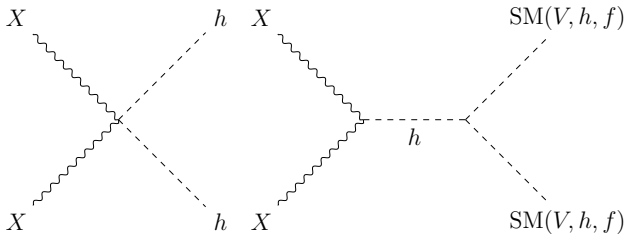
We study a dark photon dark matter scenario associated with a gauged $U(1)_X$ symmetry, stabilized by a dark parity that forbids kinetic mixing with the Standard Model. The leading interactions between the dark photon dark matter and the Standard Model arise from dimension-six Higgs-portal operators. In previous work, we found that for the parity-violating operator, the dark matter annihilation process is $p$-wave suppressed, naturally evading stringent direct-detection constraints while reproducing the observed relic abundance through thermal freeze-out. For a cutoff scale of 1 TeV, a dark matter mass of around 400 GeV is favored to realize the observed relic abundance. This scenario predicts cosmic-ray signals, in particular in the $W^{+}W^{-}$ channel, which can be targeted by indirect-detection experiments. Recently, a halo-like gamma-ray excess has been reported by Totani. Assuming a Navarro--Frenk--White $-\rho^2$ morphology for the dark matter distribution, a dark matter mass of 420 GeV is favored for the $W^{+}W^{-}$ final state. Motivated by this excess, we consider the present dark photon dark matter framework augmented by a CP-even scalar mediator with a mass of around 400 MeV, which couples to the dark photon mass operator in order to enhance the present-day annihilation rate in the Galactic halo without affecting the freeze-out dynamics. The exchange of this scalar induces a long-range attractive force, leading to Sommerfeld enhancement of the annihilation rate. The enhancement is saturating in dwarf spheroidal galaxies and the annihilation rate is dropping as $p$-wave remaining consistent with constraints from dwarf galaxies and cosmology.
Editorial analysis
A structured set of objections, weighed in public.
Referee Report
Summary. The paper studies a spin-1 dark photon DM candidate from a gauged U(1)_X with dark parity stabilization. Leading interactions arise from parity-violating dimension-6 Higgs-portal operators, yielding p-wave suppressed annihilation that evades direct detection while allowing thermal freeze-out to match the relic density for m_DM ≈ 400 GeV and cutoff scale 1 TeV. Motivated by the Totani galactic halo gamma-ray excess (assuming NFW ρ² morphology and W⁺W⁻ final state), the authors augment the model with a CP-even scalar mediator of mass ~400 MeV coupled to the dark photon mass operator. This induces a long-range attractive force producing Sommerfeld enhancement of the halo annihilation rate at low velocities while leaving freeze-out dynamics and the p-wave nature unchanged, remaining consistent with dwarf spheroidal and cosmological bounds.
Significance. If the velocity separation between halo and freeze-out regimes can be rigorously established, the construction supplies a concrete mechanism for reconciling thermal relic production with enhanced present-day indirect signals via a light mediator, without introducing new early-universe constraints. It extends the authors' prior parity-violating portal work and yields falsifiable predictions in the W⁺W⁻ cosmic-ray channel. The parameter choices (m_DM, cutoff, mediator mass) are fitted to data rather than predicted, which is common in such phenomenological studies but limits a priori predictivity.
major comments (2)
- [Abstract] Abstract: The central claim that the ~400 MeV scalar mediator 'enhance[s] the present-day annihilation rate in the Galactic halo without affecting the freeze-out dynamics' is load-bearing for the relic-density calculation yet unsupported by explicit results. For a mediator this light, the coupling strength required to produce sufficient Sommerfeld boost for the Totani excess (NFW profile, m_DM ~420 GeV) will generally yield a non-negligible enhancement factor at freeze-out velocities (v ~ 0.1c). No velocity-dependent cross-section computation, Sommerfeld factor S(v) plot, or coupling bound ensuring S(v_freeze-out) ≈ 1 is provided, leaving the consistency of the quoted relic abundance uncertain.
- [Abstract] The reported DM mass window (400 GeV for relic density, 420 GeV for the gamma excess) and the mediator mass (~400 MeV) are each chosen to reproduce observations. The manuscript must demonstrate that a single set of parameters simultaneously satisfies both the thermal relic calculation (including any residual Sommerfeld correction) and the halo flux normalization, rather than treating them as independent fits.
minor comments (2)
- Ensure the Totani gamma-ray excess reference is fully cited with arXiv or journal details in the main text and bibliography.
- Clarify the precise form of the dimension-6 parity-violating operator and the scalar coupling to the dark photon mass term (e.g., via an explicit Lagrangian term) to aid reproducibility.
Simulated Author's Rebuttal
We are grateful to the referee for the thorough review and valuable suggestions. We have carefully considered the major comments and will revise the manuscript to address them by providing the requested explicit calculations and consistent parameter choices.
read point-by-point responses
-
Referee: [Abstract] Abstract: The central claim that the ~400 MeV scalar mediator 'enhance[s] the present-day annihilation rate in the Galactic halo without affecting the freeze-out dynamics' is load-bearing for the relic-density calculation yet unsupported by explicit results. For a mediator this light, the coupling strength required to produce sufficient Sommerfeld boost for the Totani excess (NFW profile, m_DM ~420 GeV) will generally yield a non-negligible enhancement factor at freeze-out velocities (v ~ 0.1c). No velocity-dependent cross-section computation, Sommerfeld factor S(v) plot, or coupling bound ensuring S(v_freeze-out) ≈ 1 is provided, leaving the consistency of the quoted relic abundance uncertain.
Authors: We acknowledge the referee's concern regarding the lack of explicit verification for the Sommerfeld enhancement at freeze-out. Although the manuscript asserts that the light mediator does not affect freeze-out dynamics, we agree that this requires explicit demonstration. In the revised manuscript, we will include a plot showing the Sommerfeld factor S(v) as a function of velocity for the relevant coupling. We will demonstrate that the coupling can be chosen such that S(v) ≈ 1 for v ≈ 0.1c (freeze-out), while providing the required enhancement at halo velocities v ≈ 10^{-3} c. This will confirm the consistency of the relic density calculation. revision: yes
-
Referee: [Abstract] The reported DM mass window (400 GeV for relic density, 420 GeV for the gamma excess) and the mediator mass (~400 MeV) are each chosen to reproduce observations. The manuscript must demonstrate that a single set of parameters simultaneously satisfies both the thermal relic calculation (including any residual Sommerfeld correction) and the halo flux normalization, rather than treating them as independent fits.
Authors: We thank the referee for this observation. The slight difference in the quoted dark matter masses arises from separate fits to the relic density and the gamma-ray excess data. In the revised version, we will adopt a single dark matter mass value (e.g., 410 GeV) and adjust the mediator coupling to simultaneously reproduce the observed relic abundance (with Sommerfeld correction at freeze-out) and the gamma-ray flux normalization for the Totani excess. This will be presented with updated calculations in the main text. revision: yes
Circularity Check
No significant circularity in derivation chain
full rationale
The paper selects the dark matter mass (~400 GeV) and cutoff (1 TeV) to reproduce the observed relic abundance via the dimension-6 parity-violating operator, then introduces a ~400 MeV scalar mediator whose coupling is chosen to produce velocity-dependent Sommerfeld enhancement that matches the reported gamma-ray excess at halo velocities while remaining p-wave suppressed at freeze-out. This is standard parameter adjustment for model-building to explain an observed signal; the text does not rename a fitted quantity as an independent first-principles prediction, nor does any equation reduce to its input by construction. The reference to prior work on the base model is not load-bearing for the new mediator augmentation, and no self-citation chain or ansatz smuggling is exhibited. The derivation remains self-contained against external inputs such as relic density measurements and the Totani excess morphology.
Axiom & Free-Parameter Ledger
free parameters (3)
- cutoff scale =
1 TeV
- dark matter mass =
400-420 GeV
- scalar mediator mass =
400 MeV
axioms (3)
- domain assumption Gauged U(1)_X symmetry with dark parity that forbids kinetic mixing and stabilizes the dark photon
- domain assumption Dimension-six Higgs-portal operators as the dominant interactions between dark and visible sectors
- domain assumption Navarro-Frenk-White density profile with -ρ² morphology for interpreting the gamma-ray excess
invented entities (2)
-
Dark photon (spin-1 gauge boson of U(1)_X)
no independent evidence
-
CP-even scalar mediator
no independent evidence
Reference graph
Works this paper leans on
-
[1]
B. Holdom, Phys. Lett. B166, 196-198 (1986) doi:10.1016/0370-2693(86)91377-8
-
[2]
M. Fabbrichesi, E. Gabrielli and G. Lanfranchi, doi:10.1007/978-3-030-62519-1 [arXiv:2005.01515 [hep-ph]]
-
[3]
A. Caputo, A. J. Millar, C. A. J. O’Hare and E. Vitagliano, Phys. Rev. D104, no.9, 095029 (2021) doi:10.1103/PhysRevD.104.095029 [arXiv:2105.04565 [hep-ph]]
-
[4]
Yamashita, JHEP10, 205 (2024) doi:10.1007/JHEP10(2024)205 [arXiv:2407.01002 [hep-ph]]
K. Yamashita, JHEP10, 205 (2024) doi:10.1007/JHEP10(2024)205 [arXiv:2407.01002 [hep-ph]]
-
[5]
Totani, JCAP11, 080 (2025) doi:10.1088/1475-7516/2025/11/080 [arXiv:2507.07209 [astro-ph.HE]]
T. Totani, JCAP11, 080 (2025) doi:10.1088/1475-7516/2025/11/080 [arXiv:2507.07209 [astro-ph.HE]]
- [6]
- [7]
-
[8]
Electroweak Doublet Dark Matter for a Galactic Halo Gamma-Ray Excess
Y. Nomura and T. Totani, [arXiv:2604.05016 [hep-ph]]
work page internal anchor Pith review Pith/arXiv arXiv
- [9]
-
[10]
Sommerfeld, Annalen Phys.403, no.3, 257-330 (1931) doi:10.1002/andp.19314030302
A. Sommerfeld, Annalen Phys.403, no.3, 257-330 (1931) doi:10.1002/andp.19314030302
-
[11]
J. Hisano, S. Matsumoto and M. M. Nojiri, Phys. Rev. Lett.92, 031303 (2004) doi:10.1103/PhysRevLett.92.031303 [arXiv:hep-ph/0307216 [hep-ph]]. 10
-
[12]
J. Hisano, S. Matsumoto and M. M. Nojiri, Phys. Rev. D67, 075014 (2003) doi:10.1103/PhysRevD.67.075014 [arXiv:hep-ph/0212022 [hep-ph]]
-
[13]
N. Padmanabhan and D. P. Finkbeiner, Phys. Rev. D72, 023508 (2005) doi:10.1103/PhysRevD.72.023508 [arXiv:astro-ph/0503486 [astro-ph]]
-
[14]
T. R. Slatyer, Phys. Rev. D93, no.2, 023527 (2016) doi:10.1103/PhysRevD.93.023527 [arXiv:1506.03811 [hep-ph]]
-
[15]
Planck 2018 results. VI. Cosmological parameters
N. Aghanimet al.[Planck], Astron. Astrophys.641, A6 (2020) [erratum: Astron. As- trophys.652, C4 (2021)] doi:10.1051/0004-6361/201833910 [arXiv:1807.06209 [astro- ph.CO]]
work page internal anchor Pith review Pith/arXiv arXiv doi:10.1051/0004-6361/201833910 2020
-
[16]
A. De Felice, T. Ogura, S. Tsujikawa and K. Yamashita, [arXiv:2512.17231 [hep-ph]]
-
[17]
N. Arkani-Hamed, D. P. Finkbeiner, T. R. Slatyer and N. Weiner, Phys. Rev. D79, 015014 (2009) doi:10.1103/PhysRevD.79.015014 [arXiv:0810.0713 [hep-ph]]
-
[18]
S. Cassel, J. Phys. G37, 105009 (2010) doi:10.1088/0954-3899/37/10/105009 [arXiv:0903.5307 [hep-ph]]
-
[19]
D. Baumann, Cambridge University Press, 2022, ISBN 978-1-108-93709-2, 978-1-108- 83807-8 doi:10.1017/9781108937092
-
[20]
J. Ellis, Comput. Phys. Commun.210, 103-123 (2017) doi:10.1016/j.cpc.2016.08.019 [arXiv:1601.05437 [hep-ph]]. 11
discussion (0)
Sign in with ORCID, Apple, or X to comment. Anyone can read and Pith papers without signing in.