Recognition: 1 theorem link
· Lean TheoremValley-contrasting Spin Textures in Janus Metal Phosphochalcogenides
Pith reviewed 2026-05-12 02:55 UTC · model grok-4.3
The pith
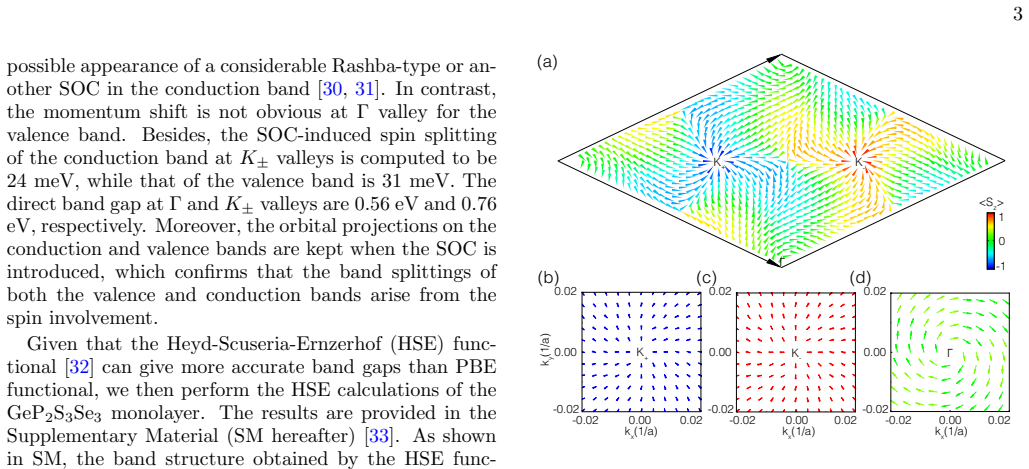
Janus MP₂S₃Se₃ monolayers host Ising spin textures at K valleys and a Weyl-Rashba mix at the Γ valley due to symmetry breaking.
A machine-rendered reading of the paper's core claim, the machinery that carries it, and where it could break.
Core claim
Via first-principles calculations, Janus MP₂S₃Se₃ monolayers exhibit distinct spin textures at different valleys. Ising-type spin textures are located at K± valleys, while the symmetry breaking from the Janus structure brings about a coexistence of Weyl-type and Rashba-type spin textures at Γ valley. In addition to valley-contrasting spin textures, valley dependence also occurs in Berry-curvature-driven anomalous Hall currents and optical selectivity. Energy differences between Γ and K±, as well as band gaps, are highly tunable by applied strain.
What carries the argument
The Janus-induced breaking of inversion symmetry, which generates valley-specific momentum-resolved spin textures (Ising at K± and mixed Weyl-Rashba at Γ).
If this is right
- Anomalous Hall currents driven by Berry curvature vary with valley.
- Optical transitions show valley-dependent circular selectivity.
- Applied strain shifts the energy separation between Γ and K± valleys and alters the band gaps.
- The spin-valley coupling opens routes to devices that address both degrees of freedom in one material.
Where Pith is reading between the lines
- Similar multi-texture behavior may appear in other Janus transition-metal dichalcogenides or phosphochalcogenides once symmetry is broken.
- Electrical gating or heterostructure stacking could provide external knobs to select or switch between the observed spin textures.
- Strain engineering demonstrated here suggests a route to mechanically tunable valley filters in flexible 2D devices.
- The coexistence of three spin-texture families in one Brillouin zone may enable new spin-filtering or spin-to-charge conversion schemes not possible in conventional valley materials.
Load-bearing premise
First-principles calculations correctly capture the momentum-resolved spin textures, their valley contrasts, and strain responses without major errors from the exchange-correlation functional or omitted many-body corrections.
What would settle it
Spin- and angle-resolved photoemission spectroscopy that fails to resolve Ising-type out-of-plane spin polarization at the K valleys or mixed in-plane and out-of-plane components at Γ would falsify the predicted textures.
Figures



read the original abstract
Momentum-resolved spin textures and potential valley-contrasting physical properties in the momentum space are two intriguing characteristics of noncentrosymmetric materials, and they have broad applications in spintronics and valleytronics. The realization of diverse spin textures within a single material, along with their further coupling to the valley degree of freedom, is highly desirable. Via first-principles calculations, we investigate electronic properties of Janus MP$_2$S$_3$Se$_3$ monolayers, which exhibits distinct spin textures at different valleys. While Ising-type spin textures are located at $K_\pm$ valleys, the symmetry breaking from the Janus structure brings about a coexistence of Weyl-type and Rashba-type spin textures at $\Gamma$ valley. In addition to valley-contrasting spin textures, valley dependence also occurs in Berry-curvature-driven anomalous Hall currents and optical selectivity. Besides, energy differences between $\Gamma$ and $K_\pm$, as well as band gaps, are highly tunable by applied strain. These findings present an intriguing coupling between diverse spin textures and multiple valleys, and pave the way for designing advanced electronic devices that leverage spin and valley degrees of freedom.
Editorial analysis
A structured set of objections, weighed in public.
Referee Report
Summary. The manuscript reports first-principles calculations on Janus MP₂S₃Se₃ monolayers, claiming distinct valley-contrasting spin textures: Ising-type at the K± valleys and a coexistence of Weyl-type and Rashba-type textures at the Γ valley arising from Janus-induced symmetry breaking. It further asserts valley dependence in Berry-curvature-driven anomalous Hall currents and optical selectivity, plus strain tunability of Γ–K energy differences and band gaps. These features are positioned as enabling spin-valleytronic device concepts.
Significance. If the computed spin textures and their valley contrast prove robust, the work would establish a single 2D platform hosting multiple distinct spin-texture types coupled to valleys, extending beyond conventional Ising or Rashba systems. The strain tunability and predicted valley-selective transport/optical responses would strengthen the case for practical spin-valley coupling in phosphochalcogenide monolayers. The first-principles approach to predicting these momentum-resolved features is a clear strength when properly validated.
major comments (3)
- [Methods] Methods/Computational Details: The manuscript states that results are obtained from first-principles calculations but supplies no information on the exchange-correlation functional, spin-orbit coupling implementation, k-point mesh density, plane-wave cutoff, or convergence tests. Because the central claims rest on the precise classification of momentum-resolved spin textures ⟨σ⟩(k) (Ising at K± versus coexisting Weyl+Rashba at Γ), the absence of these details is load-bearing; spin textures are known to shift with semilocal versus hybrid functionals and with k-sampling.
- [Results] Results on spin textures (likely §3 or Fig. 2–4): The assignment of Weyl-type and Rashba-type components at Γ is presented without quantitative benchmarks (e.g., comparison to analytic models or to well-studied Janus monolayers such as MoSSe) or tests under functional variation. This directly affects the claim that the Janus structure produces a stable coexistence of these textures rather than an artifact of the chosen DFT setup.
- [Results] Berry curvature and anomalous Hall section (likely §4): Valley-dependent anomalous Hall currents are asserted on the basis of the same unvalidated band structures. Without reported convergence of the Berry curvature integral with respect to k-mesh or functional, the quantitative valley contrast in transport cannot be considered established.
minor comments (2)
- [Abstract] Notation for the two K valleys is written as K± in the abstract but should be standardized (K+ / K−) throughout the text and figures for clarity.
- [Figures] Figure captions for spin-texture plots should explicitly state the energy window or band index used for the momentum-resolved ⟨σ⟩(k) maps.
Simulated Author's Rebuttal
We thank the referee for the careful reading and constructive comments on our manuscript. We agree that additional computational details and validation are needed to support the claims on spin textures and transport properties. We address each major comment below and will revise the manuscript accordingly.
read point-by-point responses
-
Referee: [Methods] The manuscript states that results are obtained from first-principles calculations but supplies no information on the exchange-correlation functional, spin-orbit coupling implementation, k-point mesh density, plane-wave cutoff, or convergence tests. Because the central claims rest on the precise classification of momentum-resolved spin textures ⟨σ⟩(k) (Ising at K± versus coexisting Weyl+Rashba at Γ), the absence of these details is load-bearing; spin textures are known to shift with semilocal versus hybrid functionals and with k-sampling.
Authors: We agree that these details are essential for reproducibility and to validate the spin-texture classifications. In the revised manuscript we will add a dedicated Computational Methods section that specifies the exchange-correlation functional, the treatment of spin-orbit coupling, the k-point mesh, plane-wave cutoff, and convergence criteria employed in our calculations. We will also include explicit tests demonstrating that the Ising, Weyl, and Rashba spin textures remain qualitatively unchanged under moderate variations in k-sampling and other parameters. revision: yes
-
Referee: [Results] The assignment of Weyl-type and Rashba-type components at Γ is presented without quantitative benchmarks (e.g., comparison to analytic models or to well-studied Janus monolayers such as MoSSe) or tests under functional variation. This directly affects the claim that the Janus structure produces a stable coexistence of these textures rather than an artifact of the chosen DFT setup.
Authors: We acknowledge the value of quantitative benchmarks. The revised manuscript will incorporate a decomposition of the Γ-point spin texture into its Weyl-like (linear dispersion) and Rashba-like (helical) components, with explicit fitting parameters. We will also add a direct comparison to the spin textures reported for the benchmark Janus monolayer MoSSe and will perform additional calculations with a hybrid functional to confirm that the coexistence of textures is robust and not an artifact of the semilocal functional. revision: yes
-
Referee: [Results] Valley-dependent anomalous Hall currents are asserted on the basis of the same unvalidated band structures. Without reported convergence of the Berry curvature integral with respect to k-mesh or functional, the quantitative valley contrast in transport cannot be considered established.
Authors: We agree that convergence must be demonstrated. In the revision we will present the anomalous Hall conductivity and its valley contrast as a function of k-mesh density, showing that the reported valley dependence stabilizes with denser sampling. We will also note the functional dependence and any additional checks performed to establish the robustness of the valley-selective transport features. revision: yes
Circularity Check
No circularity: results are direct outputs of standard first-principles DFT
full rationale
The paper derives its central claims (Ising spin textures at K± valleys, coexisting Weyl+Rashba textures at Γ, valley-dependent Berry curvature and optical selectivity, strain tunability) exclusively via first-principles calculations on the Janus MP₂S₃Se₃ monolayers. These are external numerical evaluations of the Kohn-Sham Hamiltonian, spin expectation values ⟨σ⟩(k), Berry curvature, and optical matrix elements; none of the reported quantities are obtained by fitting to the target observables, by self-definition, or by renaming a prior result. No load-bearing step reduces to a self-citation chain, an ansatz smuggled via citation, or a uniqueness theorem imported from the authors' own prior work. The derivation chain is therefore self-contained against external benchmarks and receives the default non-circularity finding.
Axiom & Free-Parameter Ledger
free parameters (1)
- applied strain
axioms (1)
- domain assumption Standard DFT approximations (exchange-correlation functional and pseudopotentials) are sufficient to capture spin textures and Berry curvature in these monolayers.
Reference graph
Works this paper leans on
-
[1]
A. Manchon, H. C. Koo, J. Nitta, S. M. Frolov, and R. A. Duine, Nat. Mater.14, 871 (2015)
work page 2015
-
[2]
J. Chen, K. Wu, W. Hu, and J. Yang, J. Phys. Chem. Lett.12, 12256 (2021)
work page 2021
-
[3]
F. T. Vasko, JETP Letters30, 541 (1979)
work page 1979
-
[4]
Y. A. Bychkov and E. I. Rashba, JETP Letters39, 78 (1984)
work page 1984
- [5]
-
[6]
Z. Y. Zhu, Y. C. Cheng, and U. Schwingenschl¨ ogl, Phys. Rev. B84, 153402 (2011)
work page 2011
-
[7]
D. Xiao, G.-B. Liu, W. Feng, X. Xu, and W. Yao, Phys. Rev. Lett.108, 196802 (2012)
work page 2012
-
[8]
M. Hirayama, R. Okugawa, S. Ishibashi, S. Murakami, and T. Miyake, Phys. Rev. Lett.114, 206401 (2015)
work page 2015
-
[9]
M. Sakano, M. Hirayama, T. Takahashi, S. Akebi, M. Nakayama, K. Kuroda, K. Taguchi, T. Yoshikawa, K. Miyamoto, T. Okuda, K. Ono, H. Kumigashira, T. Ideue, Y. Iwasa, N. Mitsuishi, K. Ishizaka, S. Shin, T. Miyake, S. Murakami, T. Sasagawa, and T. Kondo, Phys. Rev. Lett.124, 136404 (2020)
work page 2020
-
[10]
G. Gatti, D. Gos´ albez-Mart´ ınez, S. S. Tsirkin, M. Fan- ciulli, M. Puppin, S. Polishchuk, S. Moser, L. Testa, E. Martino, S. Roth, P. Bugnon, L. Moreschini, A. Bost- wick, C. Jozwiak, E. Rotenberg, G. Di Santo, L. Petaccia, I. Vobornik, J. Fujii, J. Wong, D. Jariwala, H. A. Atwa- ter, H. M. Rønnow, M. Chergui, O. V. Yazyev, M. Grioni, and A. Crepaldi, ...
work page 2020
- [11]
- [12]
-
[13]
F. Mahfouzi, N. Nagaosa, and B. K. Nikoli´ c, Phys. Rev. Lett.109, 166602 (2012)
work page 2012
-
[14]
S. C. de la Barrera, M. R. Sinko, D. P. Gopalan, N. Sivadas, K. L. Seyler, K. Watanabe, T. Taniguchi, D. Xiao, J. Yan, D. G. Mandrus,et al., Nat. Commun. 9, 1868 (2018)
work page 2018
-
[15]
C. Wang, B. Lian, X. Guo, J. Mao, Z. Zhang, D. Zhang, B.-L. Gu, Y. Xu, and W. Duan, Phys. Rev. Lett.123, 126402 (2019)
work page 2019
- [16]
-
[17]
J. A. Krieger, S. Stolz, I. Robredo, K. Manna, E. C. Mc- Farlane, M. Date, B. Pal, J. Yang, E. B. Guedes, J. H. Dil, C. M. Polley, M. Leandersson, C. Shekhar, H. Bor- rmann, Q. Yang, M. Lin, V. N. Strocov, M. Caputo, M. D. Watson, T. K. Kim, C. Cacho, F. Mazzola, J. Fu- jii, I. Vobornik, S. S. P. Parkin, B. Bradlyn, C. Felser, M. G. Vergniory, and N. B. M...
work page 2024
-
[18]
G. Gatti, D. Gos´ albez-Mart´ ınez, S. S. Tsirkin, M. Fan- 6 ciulli, M. Puppin, S. Polishchuk, S. Moser, L. Testa, E. Martino, S. Roth, P. Bugnon, L. Moreschini, A. Bost- wick, C. Jozwiak, E. Rotenberg, G. Di Santo, L. Petaccia, I. Vobornik, J. Fujii, J. Wong, D. Jariwala, H. A. Atwa- ter, H. M. Rønnow, M. Chergui, O. V. Yazyev, M. Grioni, and A. Crepaldi...
work page 2020
- [19]
-
[20]
B. Feng, Y.-H. Chan, Y. Feng, R.-Y. Liu, M.-Y. Chou, K. Kuroda, K. Yaji, A. Harasawa, P. Moras, A. Barinov, et al., Phys. Rev. B94, 195134 (2016)
work page 2016
-
[21]
A. C. Riis-Jensen, M. Pandey, and K. S. Thygesen, J. Phys. Chem. C122, 24520 (2018)
work page 2018
- [22]
-
[23]
J. Chen, K. Wu, H. Ma, W. Hu, and J. Yang, RSC Adv. 10, 6388 (2020)
work page 2020
-
[24]
M. M. Petri´ c, M. Kremser, M. Barbone, Y. Qin, Y. Sayyad, Y. Shen, S. Tongay, J. J. Finley, A. R. Botello- M´ endez, and K. M¨ uller, Phys. Rev. B103, 035414 (2021)
work page 2021
-
[25]
P.-F. Liu, F. Zheng, J. Li, J.-G. Si, L. Wei, J. Zhang, and B.-T. Wang, Phys. Rev. B105, 245420 (2022)
work page 2022
-
[26]
J. Magn. Magn. Mater.563, 169897 (2022)
work page 2022
-
[27]
T. Hu, F. Jia, G. Zhao, J. Wu, A. Stroppa, and W. Ren, Phys. Rev. B97, 235404 (2018)
work page 2018
- [28]
-
[29]
J. P. Perdew, K. Burke, and M. Ernzerhof, Phys. Rev. Lett.77, 3865 (1996)
work page 1996
-
[30]
L. G. D. da Silveira, P. Barone, and S. Picozzi, Phys. Rev. B93, 245159 (2016)
work page 2016
-
[31]
B. D. Bhat, J. Phys.: Condens. Matter35, 435301 (2023)
work page 2023
-
[32]
J. Heyd, G. E. Scuseria, and M. Ernzerhof, J. Chem. Phys.118, 8207 (2003)
work page 2003
-
[33]
See Supplemental Material for calculation details, the ratio of two types of spin textures at Γ valley, band struc- tures of the GeP 2S3Se3 monolayer using the HSE func- tional, and spin textures of other bands
-
[34]
T. Cao, G. Wang, W. Han, H. Ye, C. Zhu, J. Shi, Q. Niu, P. Tan, E. Wang, B. Liu, and J. Feng, Nat. Commun.3, 887 (2012)
work page 2012
discussion (0)
Sign in with ORCID, Apple, or X to comment. Anyone can read and Pith papers without signing in.