Recognition: no theorem link
Families of planar lattices with arbitrarily high T_{rm c} for the ferromagnetic Ising model
Pith reviewed 2026-05-12 03:24 UTC · model grok-4.3
The pith
Certain families of planar lattices achieve arbitrarily high critical temperatures for the ferromagnetic Ising model.
A machine-rendered reading of the paper's core claim, the machinery that carries it, and where it could break.
Core claim
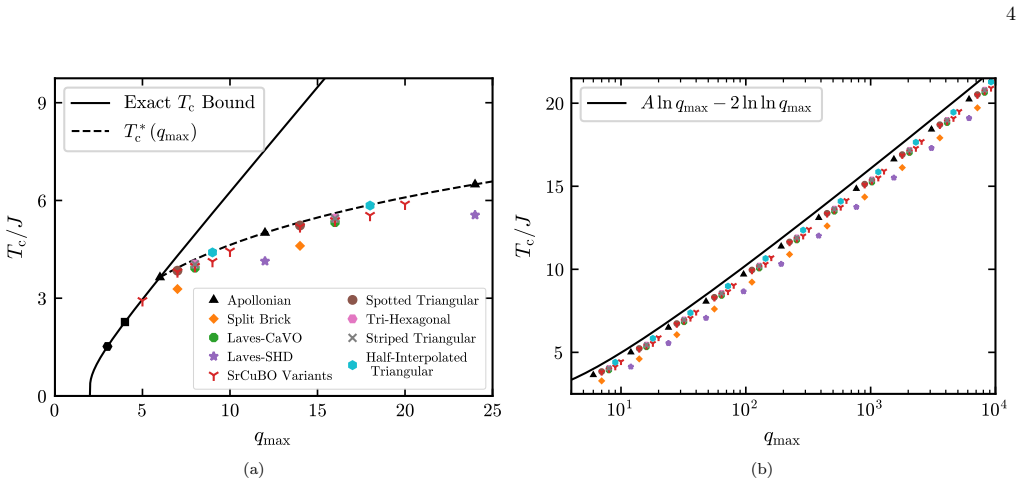
We construct families of periodic tessellations of the plane with arbitrarily high critical temperature, Tc, for the classical ferromagnetic Ising model. Motivated by exact bounds that tie large Tc to large maximal coordination number qmax, we create the lattices through iterative triangulation and obtain explicit expressions for their Tc. Tc scales asymptotically as Tc/J ~ (2/ln 2) ln qmax. We conjecture that the function Tc*(qmax) is optimal for all periodic tessellations of the plane, and show that the family of Apollonian lattices saturates this bound.
What carries the argument
Iterative triangulation of the triangular lattice to generate Apollonian lattices with arbitrarily large maximal coordination number qmax, from which explicit Tc values are derived.
If this is right
- The critical temperature can be increased without limit by constructing lattices with sufficiently high qmax.
- A universal scaling law Tc/J ∼ (2 / ln 2) ln qmax holds for the constructed families.
- Apollonian lattices achieve the conjectured maximal Tc for any given qmax among all periodic planar lattices.
- Explicit formulas for Tc in these lattices provide concrete examples for studying high-temperature ferromagnetism in two dimensions.
Where Pith is reading between the lines
- Realizing these high-qmax lattices in physical systems such as topoelectric circuits could allow Ising models to remain ordered at higher temperatures than on standard lattices.
- The logarithmic scaling may extend to other two-dimensional spin models or to questions of optimality in non-periodic planar graphs.
- Lattice designs that maximize Tc for given qmax could improve thermal robustness in Ising-based optimization hardware.
Load-bearing premise
The exact bounds that require large maximal coordination number qmax to achieve large Tc apply to these iteratively triangulated periodic lattices.
What would settle it
An independent numerical computation of the critical temperature for one of the constructed lattices with large but finite qmax that deviates from the derived explicit expression or exceeds the conjectured Tc*(qmax).
Figures




read the original abstract
We construct families of periodic tessellations of the plane with arbitrarily high critical temperature, $T_{\rm c}$, for the classical ferromagnetic Ising model. Our approach is motivated by recently found exact bounds, which imply that large values of $T_{\rm c}$ require large values of the maximal coordination number of the lattice, $q_{\rm max}$. We create such lattices through iterative triangulation and derive explicit expressions for their $T_{\rm c}$. Furthermore, we show that $T_{\rm c}$ for these families scales asymptotically as $T_{\rm c}/J\sim A \ln q_{\rm max}$ with a universal prefactor $A=2/\ln 2$. We introduce a function $T_{\rm c}^*(q_{\rm max})$ that we conjecture to be optimal for all periodic tessellations of the plane. We show that the family of so-called Apollonian lattices, which are derived from the Triangular lattice through iterative triangulation, saturates this bound. The lattices discussed in this work are relevant for theoretical questions of optimality in network systems and may be realized experimentally in Coherent Ising Machines or topoelectric circuits in the future.
Editorial analysis
A structured set of objections, weighed in public.
Referee Report
Summary. The paper constructs families of periodic planar lattices via iterative triangulation, starting from lattices such as the triangular lattice, yielding arbitrarily large maximal coordination number q_max. Explicit expressions for the ferromagnetic Ising critical temperature Tc are derived for these families, from which the asymptotic scaling Tc/J ∼ (2/ln 2) ln q_max is obtained. A function Tc^*(q_max) is defined and conjectured to be the optimal (supremum) Tc achievable by any periodic planar tessellation at fixed q_max; the Apollonian subfamily is shown to saturate this conjectured bound.
Significance. If the explicit Tc expressions and scaling derivation are correct, the work supplies concrete, constructible examples of planar periodic lattices with unbounded Tc, directly illustrating the link between high q_max and high Tc implied by recent bounds. The universal prefactor and conjectured optimality function provide a quantitative benchmark for lattice design, with relevance to network optimization questions and possible experimental platforms such as coherent Ising machines or topoelectric circuits.
major comments (1)
- The section introducing Tc^*(q_max): the optimality conjecture for all periodic tessellations rests on saturation by the Apollonian family and the absence of counterexamples within the constructed families, but no general upper-bound proof or exhaustive comparison to other known lattices is supplied; this makes the saturation claim conditional rather than definitive, though the existence of arbitrarily high-Tc families is independent of the conjecture.
minor comments (2)
- The abstract and main text refer to 'explicit expressions' for Tc; the manuscript should clarify whether these are closed-form solutions or recursive relations that must be solved numerically for each member of the family.
- The asymptotic analysis yielding the prefactor 2/ln 2 should include a brief statement of the large-q_max approximation steps and any error terms to allow independent verification of the scaling.
Simulated Author's Rebuttal
We thank the referee for their positive assessment and constructive comment. We address the point below and will revise the manuscript accordingly to clarify the conjectural status of the optimality claim.
read point-by-point responses
-
Referee: The section introducing Tc^*(q_max): the optimality conjecture for all periodic tessellations rests on saturation by the Apollonian family and the absence of counterexamples within the constructed families, but no general upper-bound proof or exhaustive comparison to other known lattices is supplied; this makes the saturation claim conditional rather than definitive, though the existence of arbitrarily high-Tc families is independent of the conjecture.
Authors: We agree with the referee that the optimality of Tc^*(q_max) is presented as a conjecture rather than a proven result. It is supported by the observation that the Apollonian subfamily saturates the proposed bound while other constructed families do not exceed it, but we supply neither a general upper-bound proof for arbitrary periodic planar tessellations nor an exhaustive comparison against all known lattices. Such a proof remains an open question. As the referee notes, the core results—the explicit constructions of families with arbitrarily high Tc and the asymptotic scaling Tc/J ∼ (2/ln 2) ln q_max—are independent of this conjecture. In the revised version we will rephrase the relevant section to state more explicitly that Tc^*(q_max) is conjectured to be optimal, and we will add a clarifying sentence underscoring the independence of the main findings from the conjecture. revision: yes
Circularity Check
No significant circularity: explicit lattice constructions and derived scaling are independent of the labeled conjecture.
full rationale
The paper constructs families of periodic planar lattices via iterative triangulation starting from known lattices such as the triangular lattice, then derives explicit (closed-form or recursive) expressions for the Ising critical temperature Tc on these lattices. The asymptotic scaling Tc/J ∼ (2/ln 2) ln q_max is obtained by direct analysis of those expressions as q_max grows, without parameter fitting or redefinition of inputs as outputs. The function Tc*(q_max) is introduced explicitly as a conjecture for the supremum over all periodic tessellations and is not used to derive the scaling or the existence of high-Tc families; the Apollonian saturation is shown within the constructed family. No self-definitional loop, fitted-input prediction, or load-bearing self-citation chain appears in the central derivation chain. The result is therefore self-contained against external benchmarks.
Axiom & Free-Parameter Ledger
axioms (1)
- domain assumption Recently found exact bounds imply that large Tc requires large q_max
Reference graph
Works this paper leans on
-
[1]
The Laves-Star lattice in Fig. 1 is constructed from the Triangular lattice through iterative triangulation, and we indeed confirm for the Laves-Star lattice that T ′ c J = 1 artanh g(tc) = 5.007.(7) The next member in the family, obtained from the Laves-Star lattice through iterative triangulation, is the Compass-Rose lattice from Fig. 1, for which we co...
work page 2048
-
[2]
Rapidly convergent expression We first show that t∗ c(q) = lim n→∞ hn " 1 gn(tΛc ) + 2 ln 2 ln q 6 −2 ln 1 + 1 nln 2 ln q 6 #−1! ,(F2) which converges much faster innthan the expression in Eq. (93) and thus allows for efficient numerical compu- tation ofT ∗ c . First, we outline a proof of the equivalence of Eqs. (F2) and (93), and then show why the repre...
-
[3]
By expanding aboutq= 15, we obtain an ex- pression that gives good accuracy for 6≤q≤24
T aylor Polynomial approximation We now present numerical values for the first six co- efficients of the Taylor series expansion ofT ∗ c (q) about q= 15. By expanding aboutq= 15, we obtain an ex- pression that gives good accuracy for 6≤q≤24. We write T ∗ c (q) J = ∞X k=0 ak(q−15) k.(F24) 4 5 6 7 T ∗ c /J Exact Taylor (to order 4) Taylor (to order 6) 10 15...
-
[4]
B. M. McCoy and J.-M. Maillard, The importance of the Ising model, Prog. Theor. Phys.127, 791 (2012)
work page 2012
-
[5]
M. E. Fisher, Simple Ising models still thrive!: A review of some recent progress, Phys. A: Stat. Mech. and its Appl.106, 28 (1981)
work page 1981
-
[6]
K¨ ulske, The Ising model: Highlights and perspectives, Math
C. K¨ ulske, The Ising model: Highlights and perspectives, Math. Phys. Anal. Geom.28, 20 (2025)
work page 2025
-
[7]
Ising, Beitrag zur Theorie des Ferromagnetismus, Z
E. Ising, Beitrag zur Theorie des Ferromagnetismus, Z. Phys.31, 253 (1925)
work page 1925
-
[8]
M. Noguer i Alonso and C. You, The mathematics of the Ising model and neural networks, SSRN Electron. J. 10.2139/ssrn.5078967 (2025), sSRN Working Paper No. 5078967
-
[9]
J. Majewski, H. Li, and J. Ott, The Ising model in physics and statistical genetics, Am. J. Hum. Genet.69, 853 (2001)
work page 2001
-
[10]
M. Weber and J. Buceta, The cellular Ising model: A framework for phase transitions in multicellular environ- ments, J. R. Soc. Interface13, 20151092 (2016)
work page 2016
-
[11]
A. E. Noble, J. Machta, and A. Hastings, Emergent long- range synchronization of oscillating ecological popula- tions without external forcing described by Ising univer- 22 sality, Nat. Commun.6, 6664 (2015)
work page 2015
-
[12]
J. J. Hopfield, Neural networks and physical systems with emergent collective computational abilities, Proc. Natl. Acad. Sci. U.S.A.79, 2554 (1982)
work page 1982
-
[13]
S. E. Fahlman, G. E. Hinton, and T. J. Sejnowski, Mas- sively parallel architectures for AI: NETL, Thistle, and Boltzmann machines, in Proc. Natl. Conf. Artif. Intell (AAAI) (1983) pp. 109–113
work page 1983
-
[14]
D. H. Ackley, G. E. Hinton, and T. J. Sejnowski, A learn- ing algorithm for Boltzmann machines, Cogn. Sci.9, 147 (1985)
work page 1985
-
[15]
H. Sun, R. K. Panda, R. Verdel, A. Rodriguez, M. Dal- monte, and G. Bianconi, Network science: Ising states of matter, Phys. Rev. E109, 054305 (2024)
work page 2024
-
[16]
Privman, Finite-size scaling: New results, Physica A 177, 241 (1991)
V. Privman, Finite-size scaling: New results, Physica A 177, 241 (1991)
work page 1991
-
[17]
O. Vasilyev, A. Macio lek, and S. Dietrich, Criticality senses topology, Europhys. Lett.128, 20002 (2019)
work page 2019
-
[18]
O. A. Vasilyev, A. Macio lek, and S. Dietrich, Sensitivity of the thermodynamics of two-dimensional systems to- wards the topological classes of their surfaces, Physica A 624, 128960 (2023)
work page 2023
-
[19]
S. Utsunomiya, K. Takata, and Y. Yamamoto, Mapping of Ising models onto injection-locked laser systems, Opt. Express19, 18091 (2011)
work page 2011
- [20]
-
[21]
Z. Wang, A. Marandi, K. Wen, R. L. Byer, and Y. Ya- mamoto, Coherent Ising machine based on degenerate optical parametric oscillators, Phys. Rev. A88, 063853 (2013)
work page 2013
-
[22]
A. Marandi, Z. Wang, K. Takata, R. L. Byer, and Y. Ya- mamoto, Network of time-multiplexed optical parametric oscillators as a coherent Ising machine, Nat. Photon.8, 937 (2014)
work page 2014
-
[23]
Y. Yamamoto, K. Aihara, i. Leleu, K.-i. Kawarabayashi, S. Kako, M. Fejer, K. Inoue, and H. Takesue, Coherent Ising machines–optical neural networks operating at the quantum limit, npj Quantum Inf3, 49 (2017)
work page 2017
-
[24]
Y. Yamamoto, T. Leleu, S. Ganguli, and H. Mabuchi, Co- herent Ising machines—Quantum optics and neural net- work Perspectives, Appl. Phys. Lett.117, 160501 (2020)
work page 2020
-
[25]
Y. Fang, J. Huang, and Z. Ruan, Experimental obser- vation of phase transitions in spatial photonic Ising ma- chine, Phys. Rev. Lett.127, 043902 (2021)
work page 2021
-
[26]
H. Takesue, Y. Yamada, K. Inaba, T. Ikuta, Y. Yonezu, T. Inagaki, T. Honjo, T. Kazama, K. Enbutsu, T. Umeki, and R. Kasahara, Observing a phase transition in a coherent Ising machine, Phys. Rev. Appl.19, L031001 (2023)
work page 2023
- [27]
-
[28]
M. E. Fisher and D. S. Gaunt, Ising model and self- avoiding walks on hypercubical lattices and “high- density” expansions, Phys. Rev.133, A224 (1964)
work page 1964
-
[29]
Galebach, n-uniform tilings, accessed: 2026-2-20
B. Galebach, n-uniform tilings, accessed: 2026-2-20
work page 2026
-
[30]
J. E. Soto S´ anchez, A. Medeiros e S´ a, and L. H. de Figueiredo, Acquiring periodic tilings of regular poly- gons from images, Vis. Comput.35, 899 (2019)
work page 2019
-
[31]
J. E. Soto S´ anchez, T. Weyrich, A. Medeiros e S´ a, and L. H. de Figueiredo, An integer representation for peri- odic tilings of the plane by regular polygons, Comput. Graph.95, 69 (2021)
work page 2021
-
[32]
J. E. Soto S´ anchez, T. Weyrich, A. Medeiros e S´ a, and L. H. de Figueiredo, On periodic tilings with regular poly- gons, accessed: 2026-2-21
work page 2026
-
[33]
V. Gomez-Jauregui, H. Hogg, C. Manchado, and C. Otero, GomJau–Hogg’s notation for automatic gen- eration ofk-uniform tessellations with ANTWERP v3.0, Symmetry13, 2376 (2021)
work page 2021
-
[34]
B. Gr¨ unbaum and G. C. Shephard,Tilings and Patterns, Dover Books on Mathematics (Dover Publications, Mine- ola, NY, 2016)
work page 2016
-
[35]
M. A. G. Portillo and M. G. E. da Luz, Correlation trends between the Ising critical temperature and the corre- sponding spanning tree constant, J. Stat. Mech.2025, 043202 (2025)
work page 2025
- [36]
-
[37]
I. Syozi, Ising model and the transformation method: Ex- act solutions and critical phenomena, inPhase Transi- tions and Critical Phenomena, Vol. 1, edited by C. Domb and M. S. Green (Academic Press, London, 1972)
work page 1972
-
[38]
Codello, Exact Curie temperature for the Ising model on Archimedean and Laves lattices, J
A. Codello, Exact Curie temperature for the Ising model on Archimedean and Laves lattices, J. Phys. A: Math. Theor.43, 385002 (2010)
work page 2010
-
[39]
N. Chai, S. Chaudhuri, C. Choi, Z. Komargodski, E. Ra- binovici, and M. Smolkin, Symmetry breaking at all tem- peratures, Phys. Rev. Lett.125, 131603 (2020)
work page 2020
-
[40]
B. Hawashin, J. Rong, and M. M. Scherer, Ultraviolet- complete local field theory of persistent symmetry break- ing in 2 + 1 dimensions, Phys. Rev. Lett.134, 041602 (2025)
work page 2025
-
[41]
Y. Han, X. Huang, Z. Komargodski, A. Lucas, and F. K. Popov, Entropic order, Nat. Commun.17, 87 (2026)
work page 2026
- [42]
-
[43]
J. S. Andrade, H. J. Herrmann, R. F. S. Andrade, and L. R. da Silva, Apollonian networks: Simultaneously scale-free, small world, Euclidean, space filling, and with matching graphs, Phys. Rev. Lett.94, 018702 (2005)
work page 2005
- [44]
-
[45]
H. Au-Yang and J. H. H. Perk, Onsager’s star-triangle equation: Master key to integrability, inIntegrable Sys- tems in Quantum Field Theory and Statistical Mechan- ics, edited by M. Jimbo, T. Miwa, and A. Tsuchiya (Aca- demic Press, San Diego, 1989) pp. 57–94
work page 1989
-
[46]
R. J. Baxter and I. G. Enting, 399th solution of the Ising model, J. Phys. A: Math. Gen.11, 2463 (1978)
work page 1978
-
[47]
C. C. Wu, Ising models on hyperbolic graphs, J. Stat. Phys.85, 251 (1996)
work page 1996
-
[48]
C. C. Wu, Ising models on hyperbolic graphs II, J. Stat. Phys.100, 893 (2000)
work page 2000
- [49]
-
[50]
T. Iharagi, A. Gendiar, H. Ueda, and T. Nishino, Phase transition of the Ising model on a hyperbolic lattice, J. Phys. Soc. Jpn.79, 104001 (2010)
work page 2010
-
[51]
J. Maciejko and S. Rayan, Hyperbolic band theory, Sci. Adv.7(2021). 23
work page 2021
-
[52]
I. Boettcher, A. V. Gorshkov, A. J. Koll´ ar, J. Maciejko, S. Rayan, and R. Thomale, Crystallography of hyperbolic lattices, Phys. Rev. B105, 125118 (2022)
work page 2022
-
[53]
X. Wang, Z. Nussinov, and G. Ortiz, Emergence of a boundary-sensitive phase in hyperbolic Ising models, Phys. Rev. B112, 214102 (2025)
work page 2025
-
[54]
D. J. J. Farnell, O. G¨ otze, J. Schulenburg, R. Zinke, R. F. Bishop, and P. H. Y. Li, Interplay between lattice topol- ogy, frustration, and spin quantum number in quantum antiferromagnets on Archimedean lattices, Phys. Rev. B 98, 224402 (2018)
work page 2018
-
[55]
van der Waerden, Die lange Reichweite der regelm¨ aßigen Atomanordnung in Mischkristallen, Z
B. van der Waerden, Die lange Reichweite der regelm¨ aßigen Atomanordnung in Mischkristallen, Z. Physik118, 473 (1941)
work page 1941
-
[56]
Cimasoni, The critical Ising model via Kac–Ward ma- trices, Commun
D. Cimasoni, The critical Ising model via Kac–Ward ma- trices, Commun. Math. Phys.316, 99 (2012)
work page 2012
- [57]
-
[58]
R. P. Feynman,Statistical Mechanics: A Set of Lectures, Frontiers in Physics (W. A. Benjamin, 1972)
work page 1972
-
[59]
Kardar,Statistical Physics of Fields(Cambridge Uni- versity Press, Cambridge, UK, 2007)
M. Kardar,Statistical Physics of Fields(Cambridge Uni- versity Press, Cambridge, UK, 2007)
work page 2007
- [60]
-
[61]
D. N. Joseph and I. Boettcher, Walking on Archimedean lattices: Insights from Bloch band theory, Phys. Rev. E 112, 044118 (2025)
work page 2025
-
[62]
F. Laves, Ebenenteilung und Koordinationszahl, Zeitschrift f¨ ur Kristallographie – Crystalline Materials 78, 208 (1931)
work page 1931
-
[63]
B. Sriram Shastry and B. Sutherland, Exact ground state of a quantum mechanical antiferromagnet, Physica B+C 108, 1069 (1981)
work page 1981
-
[64]
O. Stolz,Vorlesungen ¨ uber allgemeine Arithmetik: Nach den Neueren Ansichten(Teubners, Leipzig, 1885) pp. 173–175
-
[65]
Ces` aro, Sur la convergence des s´ eries, Nouvelles an- nales de math´ e’matiques7, 49 (1888)
E. Ces` aro, Sur la convergence des s´ eries, Nouvelles an- nales de math´ e’matiques7, 49 (1888)
-
[66]
Mure¸ san,A Concrete Approach to Classical Analysis (Springer, 2008) pp
M. Mure¸ san,A Concrete Approach to Classical Analysis (Springer, 2008) pp. 84–87
work page 2008
-
[67]
V. V. Albert, L. I. Glazman, and L. Jiang, Topological properties of linear circuit lattices, Phys. Rev. Lett.114, 173902 (2015)
work page 2015
-
[68]
J. Ningyuan, C. Owens, A. Sommer, D. Schuster, and J. Simon, Time- and site-resolved dynamics in a topolog- ical circuit, Phys. Rev. X5, 021031 (2015)
work page 2015
-
[69]
C. H. Lee, S. Imhof, C. Berger, F. Bayer, J. Brehm, L. W. Molenkamp, T. Kiessling, and R. Thomale, Topolectrical circuits, Commun Phys1, 1 (2018)
work page 2018
- [70]
-
[71]
P. M. Lenggenhager, A. Stegmaier, L. K. Upreti, T. Hof- mann, T. Helbig, A. Vollhardt, M. Greiter, C. H. Lee, S. Imhof, H. Brand, T. Kiesling, I. Boettcher, T. Ne- upert, R. Thomale, and T. Bzdusek, Simulating hyper- bolic space on a circuit board, Nat. Commun.13, 4373 (2022)
work page 2022
- [72]
-
[73]
A. Chen, H. Brand, T. Helbig, T. Hofmann, S. Imhof, A. Fritzsche, T. Kießling, A. Stegmaier, L. K. Upreti, T. Neupert, , T. Bzdusek, M. Greiter, R. Thomale, and I. Boettcher, Hyperbolic matter in electrical circuits with tunable complex phases, Nat. Commun.14, 622 (2023)
work page 2023
-
[74]
H. Hohmann, T. Hofmann, T. Helbig, S. Imhof, H. Brand, L. K. Upreti, A. Stegmaier, A. Fritzsche, T. M¨ uller, U. Schwingenschl¨ ogl, C. H. Lee, M. Greiter, L. W. Molenkamp, T. Kießling, and R. Thomale, Obser- vation of cnoidal wave localization in nonlinear topolec- tric circuits, Phys. Rev. Res.5, L012041 (2023)
work page 2023
-
[75]
S. Dey, A. Chen, P. Basteiro, A. Fritzsche, M. Greiter, M. Kaminski, P. M. Lenggenhager, R. Meyer, R. Sor- bello, A. Stegmaier, R. Thomale, J. Erdmenger, and I. Boettcher, Simulating holographic conformal field the- ories on hyperbolic lattices, Phys. Rev. Lett.133, 061603 (2024)
work page 2024
-
[76]
Kitaev, Anyons in an exactly solved model and be- yond, Annals of Physics321, 2 (2006)
A. Kitaev, Anyons in an exactly solved model and be- yond, Annals of Physics321, 2 (2006)
work page 2006
- [77]
- [78]
-
[79]
P. d’Ornellas and J. Knolle, Kitaev–Heisenberg model on the star lattice: From chiral Majorana fermions to chiral triplons, Phys. Rev. B109, 094421 (2024)
work page 2024
-
[80]
K. Appel and W. Haken,Contemporary Mathematics, edited by J. Koch, Vol. 98 (American Mathematical So- ciety, Providence, Rhode Island, 1989)
work page 1989
discussion (0)
Sign in with ORCID, Apple, or X to comment. Anyone can read and Pith papers without signing in.