Recognition: 1 theorem link
· Lean TheoremNeural-ISAM: A hybrid in-situ machine learning approach for complex manifold-based combustion models in LES of turbulent flames
Pith reviewed 2026-05-12 02:55 UTC · model grok-4.3
The pith
Neural-ISAM replaces sections of an ISAT binary tree with on-the-fly neural networks to reduce memory for manifold combustion models.
A machine-rendered reading of the paper's core claim, the machinery that carries it, and where it could break.
Core claim
Neural-ISAM couples neural networks to manifold databases on-the-fly by periodically searching the ISAT binary tree to identify candidate regions for pruning, training neural networks on those regions, and replacing the corresponding tree portions with the trained networks, thereby lowering the memory requirements of the database while preserving accuracy in LES of two turbulent flames.
What carries the argument
The ISAT binary tree that stores encountered manifold solutions, which is periodically searched to select regions that are replaced by neural networks trained on the data in those regions.
If this is right
- Database memory footprint shrinks as more regions of the ISAT tree are replaced by compact neural networks.
- Accuracy stays within acceptable bounds for the thermochemical states actually visited during the simulations.
- The hybrid database supports manifold models whose complexity would otherwise make pure tabulation memory-prohibitive.
- Computational cost of periodic training is offset by faster queries and lower storage in the resulting structure.
Where Pith is reading between the lines
- Longer or larger simulations could become practical without memory limits scaling directly with manifold dimension.
- The same pruning-and-replace pattern could be applied to other in-situ tabulation tasks outside combustion.
- Periodic retraining during a run might allow the networks to track slow drifts in the encountered state distribution.
Load-bearing premise
Neural networks trained on selected regions of the ISAT tree can stand in for the original tabulated data with negligible loss of accuracy over the full set of states that appear in the LES of the target flames.
What would settle it
A direct comparison of flame statistics and thermochemical fields between a pure ISAM reference run and a Neural-ISAM run that shows large or growing discrepancies.
Figures



read the original abstract
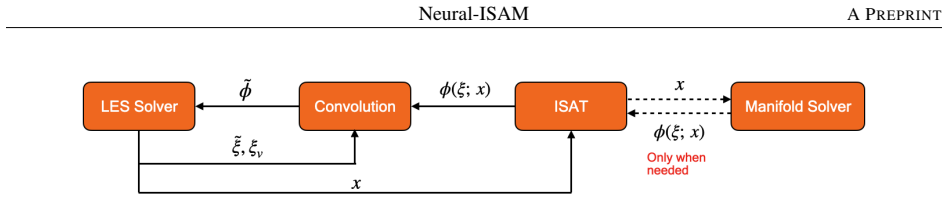
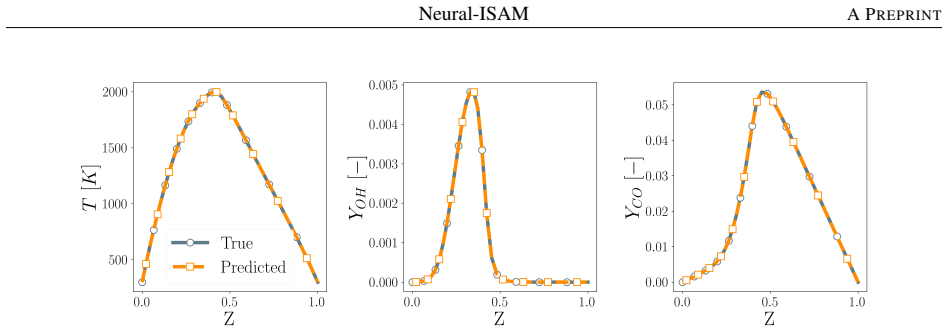
Manifold-based combustion models decrease the cost of turbulent combustion simulations by projecting the thermochemical state onto a lower-dimensional manifold, allowing the thermochemical state to be computed separately from the flow solver. The solutions to the manifold equations have traditionally been precomputed and pretabulated, but this results in large memory requirements and significant precomputation cost even for simple models. One approach to alleviate the memory requirements is to use In-Situ Adaptive Manifolds (ISAM), which only stores solutions that are encountered during a simulation in a database built with In-Situ Adaptive Tabulation (ISAT). Even with ISAM, as the manifold complexity increases, the memory requirements can still grow too large. Another approach to reduce memory of these databases are machine learning methods, for they represent functions in a highly memory-compact manner. However, current implementations of these methods require the pregeneration of training datasets with little knowledge of the states present in a simulation. This work develops the Neural In-Situ Adaptive Manifolds (Neural-ISAM) method, which is designed to address the drawbacks of both adaptive tabulation and machine learning methods, and leverage their benefits by coupling neural networks to manifold databases on-the-fly. ISAM databases are built via ISAT, which stores the manifold solutions in a binary tree, and Neural-ISAM periodically searches this tree to identify regions that can be pruned. Neural networks are trained on the candidate regions, and these portions of the binary tree are then replaced by the trained neural network, reducing the memory requirements of the database. Neural-ISAM memory usage, computational performance, and accuracy is evaluated in LES of two turbulent flames with increasing manifold model complexity: Sandia Flame D and the Sandia Sooting flame.
Editorial analysis
A structured set of objections, weighed in public.
Referee Report
Summary. The manuscript introduces Neural-ISAM, a hybrid in-situ method that extends ISAM (built on ISAT binary trees) by periodically searching the tree for prunable regions, training neural networks on the stored manifold solutions in those regions, and replacing the corresponding tree substructures with the trained networks. This is intended to reduce memory footprint while preserving accuracy for manifold-based combustion models. The approach is demonstrated in LES of Sandia Flame D and the Sandia sooting flame, with claims that memory, performance, and accuracy are evaluated for models of increasing complexity.
Significance. If the accuracy and robustness claims are substantiated, the work provides a practical route to scaling manifold models to higher dimensions and more nonlinear thermochemistry without the memory explosion of full tabulation or the offline data-generation burden of pure ML surrogates. The on-the-fly, simulation-adapted training is a clear strength that aligns the surrogate directly with encountered states.
major comments (3)
- [Abstract] Abstract: The abstract states that memory usage, computational performance, and accuracy 'is evaluated' on the two flames, yet supplies no quantitative metrics (e.g., memory reduction factors, L2 or max-norm errors relative to baseline ISAT, wall-time comparisons, or number of pruned leaves). Without these numbers or baseline tables, the central claim that Neural-ISAM simultaneously reduces memory 'with negligible loss of accuracy' cannot be assessed.
- [Method] Method (pruning and replacement procedure): Neural networks are trained exclusively on the discrete states already stored in selected ISAT leaves. No a-priori error bound or extrapolation control is provided to guarantee that the NN remains within the original ISAT tolerance for queries that land near region boundaries or in previously unseen combinations of manifold coordinates. This is especially load-bearing for the sooting-flame case, where manifold dimension and nonlinearity are higher.
- [Results] Results (Sandia sooting flame): The empirical post-pruning accuracy checks do not include controlled out-of-distribution tests (e.g., perturbed inlet conditions or extended simulation times that populate new regions adjacent to pruned subtrees). Without such tests, the claim that replacement 'maintains accuracy across the full range of states' remains unverified for the more challenging manifold.
minor comments (1)
- [Introduction] Clarify early in the introduction the precise relationship between ISAM, ISAT, and the new Neural-ISAM pruning step so that readers can distinguish the novel contribution from prior adaptive-tabulation literature.
Simulated Author's Rebuttal
We thank the referee for the constructive and detailed review of our manuscript. We address each major comment below and indicate the revisions we will make to strengthen the presentation of our results and methods.
read point-by-point responses
-
Referee: [Abstract] Abstract: The abstract states that memory usage, computational performance, and accuracy 'is evaluated' on the two flames, yet supplies no quantitative metrics (e.g., memory reduction factors, L2 or max-norm errors relative to baseline ISAT, wall-time comparisons, or number of pruned leaves). Without these numbers or baseline tables, the central claim that Neural-ISAM simultaneously reduces memory 'with negligible loss of accuracy' cannot be assessed.
Authors: We agree that the abstract would be improved by including summary quantitative metrics. Although the detailed evaluations and metrics appear in the Results section, we will revise the abstract to explicitly report key figures such as memory reduction factors, representative error norms relative to baseline ISAT, and performance comparisons for both flames. This will allow readers to assess the central claims immediately. revision: yes
-
Referee: [Method] Method (pruning and replacement procedure): Neural networks are trained exclusively on the discrete states already stored in selected ISAT leaves. No a-priori error bound or extrapolation control is provided to guarantee that the NN remains within the original ISAT tolerance for queries that land near region boundaries or in previously unseen combinations of manifold coordinates. This is especially load-bearing for the sooting-flame case, where manifold dimension and nonlinearity are higher.
Authors: This is a valid observation on the current reliance on empirical rather than theoretical guarantees. The method performs post-training validation by comparing NN outputs to the original ISAT solutions on the stored leaf data and uses the binary tree structure to limit extrapolation. We will add a new subsection to the Methods section that discusses the error control approach in more detail, reports quantitative error statistics (including boundary queries) for the sooting flame, and clarifies the fallback behavior to the original tree when needed. revision: partial
-
Referee: [Results] Results (Sandia sooting flame): The empirical post-pruning accuracy checks do not include controlled out-of-distribution tests (e.g., perturbed inlet conditions or extended simulation times that populate new regions adjacent to pruned subtrees). Without such tests, the claim that replacement 'maintains accuracy across the full range of states' remains unverified for the more challenging manifold.
Authors: We acknowledge that the accuracy verification in the current manuscript is performed on states encountered during the standard LES runs rather than dedicated controlled OOD experiments. The turbulent Sandia sooting flame simulations already populate a wide range of manifold states, but we agree that additional tests would strengthen the robustness claim. In the revised manuscript we will add results from extended simulation times and/or perturbed inlet conditions, with corresponding accuracy metrics for states near pruned subtrees. revision: yes
Circularity Check
No circularity: algorithmic extension with independent empirical validation
full rationale
The paper describes Neural-ISAM as a hybrid algorithm that couples existing ISAT/ISAM binary-tree tabulation with periodic on-the-fly neural-network training to prune subtrees. The central claim is that this replacement reduces memory while preserving accuracy, and this is evaluated through LES simulations of Sandia Flame D and the Sandia sooting flame. No derivation reduces a result to its own inputs by construction, no parameter is fitted on a subset and then called a prediction of a closely related quantity, and no load-bearing premise rests solely on self-citation. The method's performance claims are supported by direct numerical experiments rather than a closed mathematical loop. The absence of an a-priori error bound is a methodological limitation but does not constitute circularity.
Axiom & Free-Parameter Ledger
axioms (2)
- domain assumption Manifold projection remains valid for the thermochemical states encountered in the target turbulent flames
- ad hoc to paper Local regions of the manifold can be approximated by neural networks with acceptable error for the simulation
Lean theorems connected to this paper
-
IndisputableMonolith/Cost/FunctionalEquationwashburn_uniqueness_aczel unclearNeural networks are trained on the candidate regions, and these portions of the binary tree are then replaced by the trained neural network, reducing the memory requirements of the database.
Reference graph
Works this paper leans on
-
[1]
Toward accommodating realistic fuel chemistry in large-scale computations
Tianfeng Lu and Chung K Law. Toward accommodating realistic fuel chemistry in large-scale computations. Progress in Energy and Combustion Science, 35(2):192–215, 2009
work page 2009
-
[2]
Norbert Peters. Laminar diffusion flamelet models in non-premixed turbulent combustion.Progress in energy and combustion science, 10(3):319–339, 1984
work page 1984
-
[3]
Flamelet-generated manifolds: development and application to premixed laminar flames
Jeroen Adrianus Van Oijen. Flamelet-generated manifolds: development and application to premixed laminar flames. 2002
work page 2002
-
[4]
Stephen B Pope. Small scales, many species and the manifold challenges of turbulent combustion.Proceedings of the Combustion Institute, 34(1):1–31, 2013
work page 2013
-
[5]
Michael E Mueller. Physically-derived reduced-order manifold-based modeling for multi-modal turbulent combustion.Combustion and Flame, 214:287–305, 2020
work page 2020
-
[6]
Les model for sooting turbulent nonpremixed flames.Combustion and Flame, 159(6):2166–2180, 2012
Michael E Mueller and Heinz Pitsch. Les model for sooting turbulent nonpremixed flames.Combustion and Flame, 159(6):2166–2180, 2012
work page 2012
-
[7]
Reducing the memory footprint in large eddy simulations of reactive flows
Steffen Weise and Christian Hasse. Reducing the memory footprint in large eddy simulations of reactive flows. Parallel Computing, 49:50–65, 2015
work page 2015
-
[8]
Matthias Ihme, Christoph Schmitt, and Heinz Pitsch. Optimal artificial neural networks and tabulation methods for chemistry representation in les of a bluff-body swirl-stabilized flame.Proceedings of the Combustion Institute, 32(1):1527–1535, 2009
work page 2009
-
[9]
Maximilian Hansinger, Yipeng Ge, and Michael Pfitzner. Deep residual networks for flamelet/progress variable tabulation with application to a piloted flame with inhomogeneous inlet.Combustion Science and Technology, 194(8):1587–1613, 2022
work page 2022
-
[10]
Jiarui Zhang, Honglan Huang, Zhixun Xia, Likun Ma, Yifan Duan, Yanghe Feng, and Jincai Huang. Artificial neural networks for chemistry representation in numerical simulation of the flamelet-based models for turbulent combustion.IEEE Access, 8:80020–80029, 2020
work page 2020
-
[11]
Yan Zhang, Shijie Xu, Shenghui Zhong, Xue-Song Bai, Hu Wang, and Mingfa Yao. Large eddy simulation of spray combustion using flamelet generated manifolds combined with artificial neural networks.Energy and AI, 2:100021, 2020
work page 2020
-
[12]
Kaimeng Li, Pourya Rahnama, Ricardo Novella, and Bart Somers. Combining flamelet-generated manifold and machine learning models in simulation of a non-premixed diffusion flame.Energy and AI, 14:100266, 2023
work page 2023
-
[13]
Amol Salunkhe, Dwyer Deighan, Paul E DesJardin, and Varun Chandola. Physics informed machine learning for chemistry tabulation.Journal of Computational Science, 69:102001, 2023
work page 2023
-
[14]
MD Emami and A Eshghinejad Fard. Laminar flamelet modeling of a turbulent ch4/h2/n2 jet diffusion flame using artificial neural networks.Applied Mathematical Modelling, 36(5):2082–2093, 2012
work page 2082
-
[15]
Matthias Ihme, Alison L Marsden, and Heinz Pitsch. Generation of optimal artificial neural networks using a pattern search algorithm: Application to approximation of chemical systems.Neural Computation, 20(2):573–601, 2008
work page 2008
-
[16]
Chemtab: A physics guided chemistry modeling framework
Amol Salunkhe, Dwyer Deighan, Paul E DesJardin, and Varun Chandola. Chemtab: A physics guided chemistry modeling framework. InInternational Conference on Computational Science, pages 75–88. Springer, 2022
work page 2022
-
[17]
Cristian E Lacey, Alex G Novoselov, and Michael E Mueller. In-situ adaptive manifolds: Enabling computationally efficient simulations of complex turbulent reacting flows.Proceedings of the Combustion Institute, 38(2):2673– 2680, 2021
work page 2021
-
[18]
Alex G Novoselov, Cristian E Lacey, Bruce A Perry, and Michael E Mueller. Large eddy simulation of a turbulent lifted flame using multi-modal manifold-based models: Feasibility and interpretability.Proceedings of the Combustion Institute, 38(2):2581–2588, 2021
work page 2021
-
[19]
Matthew X Yao, Israel J Bonilla, S Trevor Fush, and Michael E Mueller. In-situ adaptive manifolds for soot evolution in non-adiabatic turbulent reacting flows.Proceedings of the Combustion Institute, 41:105824, 2025
work page 2025
-
[20]
Computationally efficient implementation of combustion chemistry using in situ adaptive tabulation
Stephen B Pope. Computationally efficient implementation of combustion chemistry using in situ adaptive tabulation. 1997
work page 1997
-
[21]
Liuyan Lu and Stephen B Pope. An improved algorithm for in situ adaptive tabulation.Journal of Computational Physics, 228(2):361–386, 2009
work page 2009
-
[22]
Effects of turbulence on species mass fractions in methane/air jet flames
Robert S Barlow and Jonathan H Frank. Effects of turbulence on species mass fractions in methane/air jet flames. InSymposium (international) on combustion, volume 27, pages 1087–1095. Elsevier, 1998. 13 Neural-ISAMA PREPRINT
work page 1998
-
[23]
Jiayao Zhang, Christopher R Shaddix, and Robert W Schefer. Design of “model-friendly” turbulent non-premixed jet burners for c2+ hydrocarbon fuels.Review of Scientific Instruments, 82(7), 2011
work page 2011
-
[24]
Bruce A Perry and Michael E Mueller. Effect of multiscalar subfilter pdf models in les of turbulent flames with inhomogeneous inlets.Proceedings of the Combustion Institute, 37(2):2287–2295, 2019
work page 2019
-
[25]
Tom O’Malley, Elie Bursztein, James Long, François Chollet, Haifeng Jin, Luca Invernizzi, et al. Kerastuner. https://github.com/keras-team/keras-tuner, 2019
work page 2019
-
[26]
Norbert Peters. Local quenching due to flame stretch and non-premixed turbulent combustion.Combustion Science and Technology, 30(1-6):1–17, 1983
work page 1983
-
[27]
Olivier Desjardins, Guillaume Blanquart, Guillaume Balarac, and Heinz Pitsch. High order conservative finite difference scheme for variable density low mach number turbulent flows.Journal of Computational Physics, 227(15):7125–7159, 2008
work page 2008
-
[28]
Jonathan F MacArt and Michael E Mueller. Semi-implicit iterative methods for low mach number turbulent reacting flows: Operator splitting versus approximate factorization.Journal of Computational Physics, 326:569– 595, 2016
work page 2016
-
[29]
PDRs.https://ctrfl.princeton.edu/software/
Michael E Mueller. PDRs.https://ctrfl.princeton.edu/software/
-
[30]
GRI-3.0.http://www.me.berkeley.edu/gri_mech/
Gregory P Smith, David M Golden, Michael Frenklach, Nigel W Moriarty, Boris Eiteneer, Mikhail Goldenberg, C Thomas Bowman, Ronald K Hanson, Soonho Song, William C Gardiner Jr., Vitali V Lissianski, and Zhiwei Qin. GRI-3.0.http://www.me.berkeley.edu/gri_mech/
-
[31]
A Cody Nunno and Michael E Mueller. Manifold assumptions in modeling radiation heat losses in turbulent nonpremixed combustion.Proceedings of the Combustion Institute, 37(2):2223–2230, 2019
work page 2019
-
[32]
Fabrizio Bisetti, Guillaume Blanquart, Michael E Mueller, and Heinz Pitsch. On the formation and early evolution of soot in turbulent nonpremixed flames.Combustion and Flame, 159(1):317–335, 2021
work page 2021
-
[33]
John B Burbidge, Lonnie Magee, and A Leslie Robb. Alternative transformations to handle extreme values of the dependent variable.Journal of the American statistical Association, 83(401):123–127, 1988. 14
work page 1988
discussion (0)
Sign in with ORCID, Apple, or X to comment. Anyone can read and Pith papers without signing in.