Recognition: 2 theorem links
· Lean TheoremA Generative AI-Enhanced Digital Twin Framework for Proactive Interference Management in Hybrid Near/Far-Field Wireless Systems
Pith reviewed 2026-05-12 03:49 UTC · model grok-4.3
The pith
Integrating generative AI with digital twins allows proactive interference management by anticipating blockages in hybrid near- and far-field wireless systems.
A machine-rendered reading of the paper's core claim, the machinery that carries it, and where it could break.
Core claim
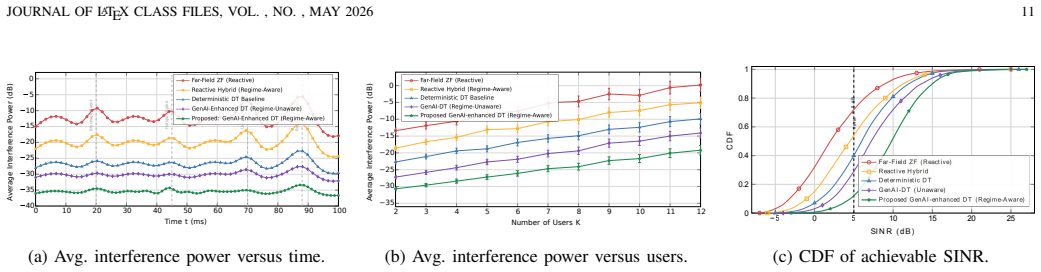
The framework constructs a high-resolution site-specific virtual replica of the indoor deployment environment and integrates a generative AI module to anticipate and proactively suppress blockages rather than reacting after disruption occurs, achieving significant improvements in interference suppression, signal-to-interference-plus-noise ratio, and outage probability in XL-MIMO networks that operate across hybrid near-field and far-field regimes.
What carries the argument
The GenAI-enhanced digital twin framework, which builds a site-specific 3D virtual replica to locate blockage causes and uses generative models to forecast and suppress them in advance.
If this is right
- The framework reduces interference more effectively than conventional reactive schemes.
- It delivers higher signal-to-interference-plus-noise ratio than purely deterministic digital-twin approaches.
- Outage probability decreases in simulations using Sionna ray-tracing datasets.
- Interference management shifts from post-disruption reaction to preemptive anticipation in dynamic indoor wireless systems.
Where Pith is reading between the lines
- If the virtual replica holds in live deployments, the same structure could extend to outdoor or vehicular scenarios with comparable propagation dynamics.
- Training the generative component on varied ray-tracing traces might enable handling of blockage patterns not seen during initial modeling.
- Pairing the twin with continuous sensor inputs could keep the 3D replica updated and raise prediction accuracy over time.
Load-bearing premise
The high-resolution site-specific virtual replica accurately represents real-world 3D propagation and dynamic blockages, and the generative AI module can reliably anticipate and suppress those blockages in advance.
What would settle it
Physical measurements in the same indoor setting that show no improvement in SINR or outage probability from the proactive suppression compared with reactive schemes would disprove the central claim.
Figures

read the original abstract
The applications of Digital Twins (DT) and Generative AI (GenAI) have demonstrated their capabilities in modeling and learning-based wireless communications. However, their joint potential for proactive wireless system design remains largely underexplored, particularly in extremely large-scale multiple-input multiple-output (XL-MIMO) networks, characterized by hybrid near-field (NF) and far-field (FF) propagation regimes. In this work, we propose an integrated GenAI-enhanced DT framework for proactive interference management in dynamic indoor scenarios. The DT constructs a high-resolution, site-specific virtual replica of the deployment environment, understanding where and why blockage occurs within a realistic 3D representation of the indoor space. Integration of the GenAI module further assists the framework in anticipating and proactively suppressing blockage, rather than reacting after the disruption occurs. Extensive simulation results based on Sionna ray-tracing datasets demonstrate that the proposed framework achieves significant improvements in interference suppression, signal-to-interference-plus-noise ratio (SINR), and outage probability compared to conventional reactive schemes and purely deterministic DT-based approaches.
Editorial analysis
A structured set of objections, weighed in public.
Referee Report
Summary. The manuscript proposes an integrated Generative AI-enhanced Digital Twin (DT) framework for proactive interference management in XL-MIMO systems operating in hybrid near-field/far-field regimes within dynamic indoor environments. The DT constructs a high-resolution, site-specific 3D virtual replica to model blockage locations and causes, while the GenAI module anticipates dynamic blockages to enable proactive suppression rather than reactive mitigation. The central empirical claim is that extensive simulations on Sionna ray-tracing datasets yield significant gains in interference suppression, SINR, and outage probability relative to conventional reactive schemes and purely deterministic DT baselines.
Significance. If the DT fidelity and GenAI prediction accuracy hold beyond the simulated setting, the work could advance proactive design paradigms for interference management in spatially dynamic wireless systems by leveraging site-specific modeling and generative prediction. The explicit use of Sionna ray-tracing datasets for reproducibility is a positive element. However, the significance is constrained by the absence of any real-world channel measurements or hardware validation, leaving the translation from deterministic ray-tracing to practical performance untested.
major comments (3)
- [Simulation Results] Simulation Results section: the reported performance gains in SINR and outage probability are presented without error bars, confidence intervals, or details on the number of Monte Carlo runs, making it impossible to assess statistical significance or variability of the claimed improvements over baselines.
- [Framework Description and Simulation Results] The central claim that the GenAI module enables proactive blockage suppression (and thus superior SINR/outage) rests on the unverified assumption that the Sionna-generated DT replica accurately captures real-world 3D propagation, material parameters, and mobility statistics; no section provides cross-validation against measured indoor channels or hardware-in-the-loop tests.
- [GenAI Module] No specifics are given on the GenAI architecture, training dataset split, loss function, or hyperparameter choices, which are load-bearing for reproducing the proactive prediction performance and for evaluating whether the gains are due to the proposed integration or to favorable simulation tuning.
minor comments (2)
- [System Model] Notation for near-field/far-field boundary and hybrid propagation model should be defined explicitly with a reference equation or diagram in the system model section.
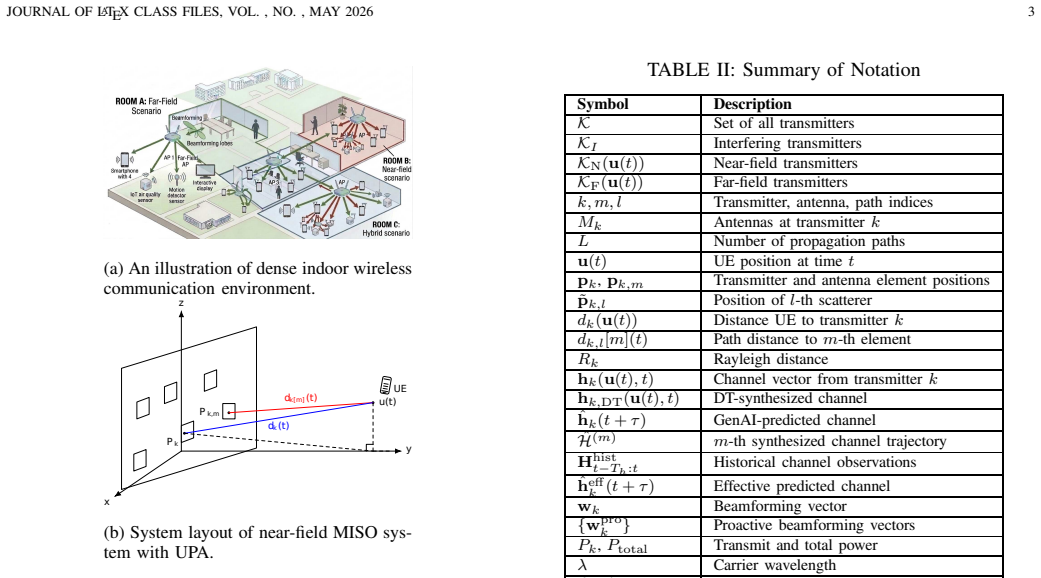
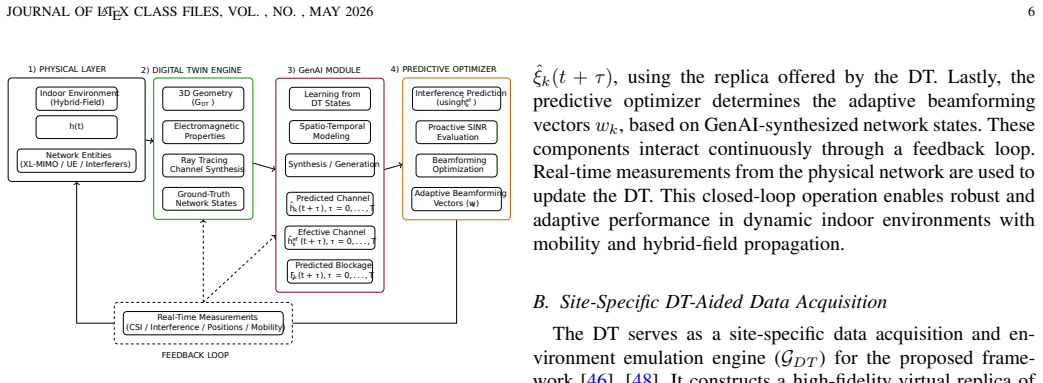
- [Figures] Figure captions for the DT replica and GenAI workflow diagrams lack sufficient detail on what each component represents (e.g., input/output interfaces).
Simulated Author's Rebuttal
We thank the referee for the constructive and detailed comments on our manuscript. We have addressed each point below and believe the revisions will enhance the paper's rigor and reproducibility.
read point-by-point responses
-
Referee: [Simulation Results] Simulation Results section: the reported performance gains in SINR and outage probability are presented without error bars, confidence intervals, or details on the number of Monte Carlo runs, making it impossible to assess statistical significance or variability of the claimed improvements over baselines.
Authors: We agree that statistical details are essential for assessing the reliability of the results. In the revised manuscript, we will update the Simulation Results section to include error bars representing one standard deviation across runs. We will also explicitly state that all reported metrics are averaged over 1000 independent Monte Carlo realizations, allowing readers to evaluate variability and the significance of the observed gains over the baselines. revision: yes
-
Referee: [Framework Description and Simulation Results] The central claim that the GenAI module enables proactive blockage suppression (and thus superior SINR/outage) rests on the unverified assumption that the Sionna-generated DT replica accurately captures real-world 3D propagation, material parameters, and mobility statistics; no section provides cross-validation against measured indoor channels or hardware-in-the-loop tests.
Authors: We acknowledge that our evaluation relies on Sionna ray-tracing simulations rather than real-world measurements. Sionna is a standard, open-source tool whose ray-tracing accuracy for indoor environments has been validated in multiple prior studies (which we will cite). In the revision, we will add an explicit discussion of model assumptions, limitations of the deterministic ray-tracing approach, and the absence of hardware validation. However, performing new channel measurements or hardware-in-the-loop experiments is outside the scope of the current simulation-focused contribution. revision: partial
-
Referee: [GenAI Module] No specifics are given on the GenAI architecture, training dataset split, loss function, or hyperparameter choices, which are load-bearing for reproducing the proactive prediction performance and for evaluating whether the gains are due to the proposed integration or to favorable simulation tuning.
Authors: We thank the referee for highlighting this omission. The revised manuscript will include a new subsection fully specifying the GenAI module: it employs a conditional generative adversarial network with a U-Net generator and PatchGAN discriminator; the dataset is partitioned 70/15/15 for training/validation/testing; the loss combines adversarial loss with an L1 reconstruction term; and key hyperparameters are learning rate 2e-4, batch size 64, and 150 epochs with early stopping. These additions will support reproducibility and clarify the source of the performance improvements. revision: yes
- The lack of real-world channel measurements or hardware-in-the-loop validation, which cannot be addressed by revision alone as it would require new experimental data collection beyond the simulation-based scope of this work.
Circularity Check
No circularity: framework evaluated on external Sionna ray-tracing datasets with no self-referential reductions.
full rationale
The manuscript proposes an integrated DT+GenAI framework for proactive interference management and reports all quantitative results from simulations on independent Sionna ray-tracing datasets. No equations, predictions, or performance claims reduce by construction to fitted parameters, self-citations, or ansatzes imported from the authors' prior work. The derivation chain remains self-contained against the external simulation benchmark.
Axiom & Free-Parameter Ledger
Reference graph
Works this paper leans on
-
[1]
A. Shafie, N. Y ang, C. Han, J. M. Jornet, M. Juntti, and T. K ˜A¼rner, “Terahertz Communications for 6G and Beyond Wireless Netwo rks: Challenges, Key Advancements, and Opportunities,” IEEE Netw. , vol. 37, no. 3, pp. 162–169, May 2023
work page 2023
-
[2]
J. M. Jornet and I. F. Akyildiz, “Channel Modeling and Cap acity Analysis for Electromagnetic Wireless Nanonetworks in the Terahertz Band,” IEEE Trans. Wireless Commun. , vol. 10, no. 10, pp. 3211–3221, Oct. 2011
work page 2011
-
[3]
X. Ma, A. A. Nasir, and D. B. Da Costa, “Hybrid Near/Far-Fi eld Communications of RIS-Aided Cell-Free Massive MIMO With Visibility Region Detection,” IEEE Open J. Commun. Soc. , vol. 6, pp. 1710–1726, 2025
work page 2025
-
[4]
M. Parvini, B. Banerjee, M. Qurratulain Khan, A. Nimr, an d G. Fettweis, “Interference Characterization and Mitigation in Near-Fi eld XL-MIMO: A Case for Linear and Circular Array Geometries,” IEEE Wireless Commun. Lett. , vol. 15, pp. 111–115, 2026
work page 2026
-
[5]
Stochastic Geometry based Interference Analysis of Multiuser mmWave Networks with RIS,
J. Kokkoniemi and M. Juntti, “Stochastic Geometry based Interference Analysis of Multiuser mmWave Networks with RIS,” in 2021 IEEE 32nd Int. Symp. Pers., Indoor Mobile Radio Commun. (PIMRC) , Sep. 2021, pp. 567–572, iSSN: 2166-9589
work page 2021
-
[6]
Zero-forci ng methods for downlink spatial multiplexing in multiuser MIMO channe ls,
Q. Spencer, A. Swindlehurst, and M. Haardt, “Zero-forci ng methods for downlink spatial multiplexing in multiuser MIMO channe ls,” IEEE Trans. Signal Process. , vol. 52, no. 2, pp. 461–471, Feb. 2004
work page 2004
-
[7]
Near-Field Beamforming f or Large Intelligent Surfaces,
S. Hu, M. C. Ilter, and H. Wang, “Near-Field Beamforming f or Large Intelligent Surfaces,” in 2022 IEEE 33rd Int. Symp. Pers., Indoor Mobile Radio Commun. (PIMRC) , Sep. 2022, pp. 1367–1373, iSSN: 2166-9589
work page 2022
-
[8]
Wireless Netw ork Digital Twin for 6G: Generative AI as a Key Enabler,
Z. Tao, W. Xu, Y . Huang, X. Wang, and X. Y ou, “Wireless Netw ork Digital Twin for 6G: Generative AI as a Key Enabler,” IEEE Wireless Commun., vol. 31, no. 4, pp. 24–31, Aug. 2024
work page 2024
-
[9]
A Digital Twin Networ k Approach for 6G Wireless Network Autonomy,
J. Deng, L. Y ue, H. Y ang, and G. Liu, “A Digital Twin Networ k Approach for 6G Wireless Network Autonomy,” in 2023 IEEE Int. Conf. Commun. W orkshops (ICC W orkshops), May 2023, pp. 415–420, iSSN: 2694-2941
work page 2023
-
[10]
Digit al Twin Networks for Sustainable In-network Computing in Future 6G Networks ,
M. Becattini, G. Fontani, L. Paroli, and A. Iera, “Digit al Twin Networks for Sustainable In-network Computing in Future 6G Networks ,” in 2024 IEEE 35th Int. Symp. Pers., Indoor Mobile Radio Commun. (PIM RC), Sep. 2024, pp. 1–6, iSSN: 2166-9589
work page 2024
-
[11]
Enhancing Open RAN Digital Twin Thr ough Power Consumption Measurement,
A. Al-Tahmeesschi, Y . Chu, J. Shackleton, S. Chetty, M. Rahmani, D. Grace, and H. Ahmadi, “Enhancing Open RAN Digital Twin Thr ough Power Consumption Measurement,” in 2025 IEEE 36th Int. Symp. Pers., Indoor Mobile Radio Commun. (PIMRC) , Sep. 2025, pp. 1–6, iSSN: 2166-9589
work page 2025
-
[12]
G uest Editorial: Digital Twins and Pervasive Intelligence Syner gy in 6G and Beyond,
H. Peng, K. Suto, P . Wang, K. Zhang, and C. Puligheddu, “G uest Editorial: Digital Twins and Pervasive Intelligence Syner gy in 6G and Beyond,” IEEE Wireless Commun., vol. 32, no. 3, pp. 88–89, Jun. 2025
work page 2025
-
[13]
I. J. Goodfellow, J. Pouget-Abadie, M. Mirza, B. Xu, D. W arde-Farley, S. Ozair, A. Courville, and Y . Bengio, “Generative Adversar ial Nets,” in Advances in Neural Information Processing Systems , vol. 27. Curran Associates, Inc., 2014
work page 2014
-
[14]
Auto-Encoding V ariationa l Bayes,
D. P . Kingma and M. Welling, “Auto-Encoding V ariationa l Bayes,” Dec. 2013
work page 2013
-
[15]
Denoising diffusion prob abilistic models,
J. Ho, A. Jain, and P . Abbeel, “Denoising diffusion prob abilistic models,” in Proc. 34th Int. Conf. Neural Information Processing System s, ser. NIPS ’20. Red Hook, NY , USA: Curran Associates Inc., Dec. 202 0, pp. 6840–6851
-
[16]
A. V aswani, N. Shazeer, N. Parmar, J. Uszkoreit, L. Jone s, A. N. Gomez, ˚A. u. Kaiser, and I. Polosukhin, “Attention is All you Need,” in Advances in Neural Information Processing Systems , vol. 30. Curran Associates, Inc., 2017
work page 2017
-
[17]
Generative AI in mobile networks: a survey,
A. Karapantelakis, P . Alizadeh, A. Alabassi, K. Dey, an d A. Nikou, “Generative AI in mobile networks: a survey,” Ann. Telecommun. , vol. 79, no. 1, pp. 15–33, Feb. 2024
work page 2024
-
[18]
Applications of Generative AI (GAI) for Mobile and Wireless Networking: A Survey,
T.-H. Vu, S. Kumar Jagatheesaperumal, M.-D. Nguyen, N. V an Huynh, S. Kim, and Q.-V . Pham, “Applications of Generative AI (GAI) for Mobile and Wireless Networking: A Survey,” IEEE Internet Things J. , vol. 12, no. 2, pp. 1266–1290, Jan. 2025
work page 2025
-
[19]
F. Khoramnejad and E. Hossain, “Generative AI for the Op timization of Next-Generation Wireless Networks: Basics, State-of-the -Art, and Open Challenges,” IEEE Commun. Surveys Tuts. , vol. 27, no. 6, pp. 3483– 3525, Dec. 2025
work page 2025
-
[20]
GenTwin: Gen- erative AI-Powered Digital Twinning for Adaptive Manageme nt in IoT Networks,
K. Duran, H. Shin, T. Q. Duong, and B. Canberk, “GenTwin: Gen- erative AI-Powered Digital Twinning for Adaptive Manageme nt in IoT Networks,” IEEE Trans. Cogn. Commun. Netw., vol. 11, no. 2, pp. 1053– 1063, Apr. 2025
work page 2025
-
[21]
Generative AI-Driv en Digital Twin for Mobile Networks,
H. Chai, H. Wang, T. Li, and Z. Wang, “Generative AI-Driv en Digital Twin for Mobile Networks,” IEEE Netw., vol. 38, no. 5, pp. 84–92, Sep. 2024
work page 2024
-
[22]
A Survey on GenAI-Driven Digital Twins: Toward Int elligent 6G Networks and Metaverse Systems,
F. Naeem, M. Ali, G. Kaddoum, Y . Faheem, Y . Zhang, M. Debb ah, and C. Y uen, “A Survey on GenAI-Driven Digital Twins: Toward Int elligent 6G Networks and Metaverse Systems,” IEEE Open J. Commun. Soc. , vol. 6, pp. 10 365–10 402, 2025
work page 2025
-
[23]
Generative AI Empowered Network Digital T wins: Architecture, Technologies, and Applications,
T. Li, Q. Long, H. Chai, S. Zhang, F. Jiang, H. Liu, W. Huan g, D. Jin, and Y . Li, “Generative AI Empowered Network Digital T wins: Architecture, Technologies, and Applications,” ACM Comput. Surv. , vol. 57, no. 6, pp. 157:1–157:43, Feb. 2025
work page 2025
-
[24]
Generative AI- Empowered Digital Twin: A Comprehensive Survey With Taxono my,
D. Chiaro, P . Qi, A. Pescap ˜A¨, and F. Piccialli, “Generative AI- Empowered Digital Twin: A Comprehensive Survey With Taxono my,” IEEE Trans. Ind. Inform. , vol. 21, no. 6, pp. 4287–4295, Jun. 2025
work page 2025
-
[25]
Gen-TWIN: Generative-AI-Enabled Digital Twin for Open Radio Access Networks,
O. T. Basaran, D. Villa, P . Johari, M. Polese, C. Fiandri no, F. Dressler, and T. Melodia, “Gen-TWIN: Generative-AI-Enabled Digital Twin for Open Radio Access Networks,” in IEEE INFOCOM 2025 - IEEE Conf. Comput. Commun. W orkshops (INFOCOM WKSHPS) , May 2025, pp. 1–7, iSSN: 2833-0587
work page 2025
-
[26]
Generative AI-Driven Digital Twin in the Manufacturing Internet of Thi ngs: A Comprehensive Survey,
X. Fu, M. Qin, P . Pace, C. Savaglio, W. Li, and G. Fortino, “Generative AI-Driven Digital Twin in the Manufacturing Internet of Thi ngs: A Comprehensive Survey,” IEEE Internet Things J. , vol. 13, no. 6, pp. 10 522–10 546, Mar. 2026
work page 2026
-
[27]
Gener- ative AI-enabled Digital Twins for 6G-enhanced Smart Citie s,
K. Duran, L. V . Cakir, M. Ozdem, K. Gursu, and B. Canberk, “Gener- ative AI-enabled Digital Twins for 6G-enhanced Smart Citie s,” in 2024 IEEE Globecom W orkshops (GC Wkshps) , Dec. 2024, pp. 1–6, iSSN: 2166-0077
work page 2024
-
[28]
G enerative Digital Twins: A Novel Approach in the IoT Edge-Cloud Contin uum,
C. Savaglio, V . Barbuto, F. Mangione, and G. Fortino, “G enerative Digital Twins: A Novel Approach in the IoT Edge-Cloud Contin uum,” IEEE Internet Things Mag. , vol. 8, no. 1, pp. 42–48, Jan. 2025
work page 2025
-
[29]
Network GDT: GenAI Based Dig ital Twin for Automated Network Performance Evaluation,
S. Singh, S. Kumar, P . M. Hong, A. Jain, M. R. Kanagarathi nam, K. M. Sivalingam, and H. K. Narsani, “Network GDT: GenAI Based Dig ital Twin for Automated Network Performance Evaluation,” in IEEE Int. Conf. Commun. (ICC) , Jun. 2025, pp. 2150–2155, iSSN: 1938-1883
work page 2025
-
[30]
When Digital Twin Meets Generative AI: Intelligent Closed-Loop Network Management,
X. Huang, H. Y ang, C. Zhou, M. He, X. Shen, and W. Zhuang, “ When Digital Twin Meets Generative AI: Intelligent Closed-Loop Network Management,” IEEE Netw., vol. 39, no. 5, pp. 272–279, Sep. 2025
work page 2025
-
[31]
Z. Jin, L. Y ou, H. Zhou, Y . Wang, X. Liu, X. Gong, X. Gao, D. W. K. Ng, and X.-G. Xia, “GDM4MMIMO: Generative Diffusion Models for JOURNAL OF LATEX CLASS FILES, VOL. , NO. , MA Y 2026 13 Massive MIMO Communications,” IEEE Commun. Mag. , vol. 64, no. 4, pp. 50–56, Apr. 2026
work page 2026
-
[32]
A Digital Twin Ass isted Frame- work for Interference Nulling in Millimeter Wave MIMO Syste ms,
Y . Zhang, T. Osman, and A. Alkhateeb, “A Digital Twin Ass isted Frame- work for Interference Nulling in Millimeter Wave MIMO Syste ms,” in 2023 IEEE Int. Conf. Commun. W orkshops (ICC W orkshops), May 2023, pp. 248–253, iSSN: 2694-2941
work page 2023
-
[33]
Exploring Gen erative AI for Mitigating Digital Twin Deviation in Secure V ehicula r Edge Computing,
X. Li, W. Wang, P . Liu, T. Zhou, and H. Xia, “Exploring Gen erative AI for Mitigating Digital Twin Deviation in Secure V ehicula r Edge Computing,” IEEE Open J. Commun. Soc. , vol. 7, pp. 3046–3059, 2026
work page 2026
-
[34]
Wireless 6G Connectivity for Massive Number o f Devices and Critical Services,
A. E. Kal ˜A¸r, G. Durisi, S. Coleri, S. Parkvall, W. Y u, A. Mueller, and P . Popovski, “Wireless 6G Connectivity for Massive Number o f Devices and Critical Services,” Proc. IEEE , vol. 113, no. 9, pp. 826–848, Sep. 2025
work page 2025
-
[35]
Near-Field Focusing and Beam Shaping Through Cooperative RIS for Communications and Sensing,
˜A. F. V aquero, ˜A. Pend ˜A¡s-Recondo, S. M. Feito, and M. Arrebola, “Near-Field Focusing and Beam Shaping Through Cooperative RIS for Communications and Sensing,” IEEE Wireless Commun. Lett. , vol. 15, pp. 2085–2089, 2026
work page 2085
-
[36]
Nonuniform Amplitude Transmi tarray for Multibeam Including Near-Field Focusing,
C.-H. Lee and J.-H. Lee, “Nonuniform Amplitude Transmi tarray for Multibeam Including Near-Field Focusing,” IEEE Trans. Antennas Propag., vol. 71, no. 1, pp. 361–367, Jan. 2023
work page 2023
-
[37]
Fast Dist ance Sampling for Uniform Circular Array in Near-Field 3D Beam-F ocusing,
B. Qin, F. Zhou, W. Zhang, C. Y ou, and B. Zheng, “Fast Dist ance Sampling for Uniform Circular Array in Near-Field 3D Beam-F ocusing,” IEEE Signal Process. Lett. , vol. 31, pp. 2210–2214, 2024
work page 2024
-
[38]
Max-Min Secrecy Rate Optimization Throug h Beam Focusing in Near-Field Communications,
A. A. Nasir, “Max-Min Secrecy Rate Optimization Throug h Beam Focusing in Near-Field Communications,” IEEE Commun. Lett. , vol. 28, no. 7, pp. 1594–1598, Jul. 2024
work page 2024
-
[39]
A. Arshad Nasir, “Max-Min Secure Energy Efficiency Opti mization for STAR-RIS-Assisted Near-Field Wideband THz Communication ,” IEEE Trans. Green Commun. Netw. , vol. 9, no. 4, pp. 2072–2086, Dec. 2025
work page 2072
-
[40]
N ear- Field Communications: A Tutorial Review,
Y . Liu, Z. Wang, J. Xu, C. Ouyang, X. Mu, and R. Schober, “N ear- Field Communications: A Tutorial Review,” IEEE Open J. Commun. Soc., vol. 4, pp. 1999–2049, 2023
work page 1999
-
[41]
Terahertz Communications: An Arr ay-of- Subarrays Solution,
C. Lin and G. Y . L. Li, “Terahertz Communications: An Arr ay-of- Subarrays Solution,” IEEE Commun. Mag., vol. 54, no. 12, pp. 124–131, Dec. 2016
work page 2016
-
[42]
Joint Communication and Control for mmWave/THz Beam Alignment in V2X Networks,
B. Chang, X. Y an, L. Zhang, Z. Chen, L. Li, and M. A. Imran, “Joint Communication and Control for mmWave/THz Beam Alignment in V2X Networks,” IEEE Internet Things J. , vol. 9, no. 13, pp. 11 203–11 213, Jul. 2022
work page 2022
-
[43]
Pointing Error Modeling of mm Wave to THz High-Directional Antenna Arrays,
M. T. Dabiri and M. Hasna, “Pointing Error Modeling of mm Wave to THz High-Directional Antenna Arrays,” IEEE Wireless Commun. Lett. , vol. 11, no. 11, pp. 2435–2439, Nov. 2022
work page 2022
-
[44]
Integrating Generat ive AI with Network Digital Twin for 6G: An Edge-Cloud Collaborative Ap proach,
W. Guan, P . Li, H. Zhang, and Y . Wu, “Integrating Generat ive AI with Network Digital Twin for 6G: An Edge-Cloud Collaborative Ap proach,” IEEE Commun. Mag. , vol. 63, no. 11, pp. 181–187, Nov. 2025
work page 2025
-
[45]
Large Generative Model- Enabled Digital Twin for 6G Networks,
Y . Y ang, W. Sun, J. He, Y . Fu, and L. Xu, “Large Generative Model- Enabled Digital Twin for 6G Networks,” IEEE Netw., vol. 39, no. 3, pp. 29–36, May 2025
work page 2025
-
[46]
Digital Twin-Assisted Explainable AI for Robust Beam Prediction in mmWave MIMO Systems,
N. Khan, A. Abdallah, A. Celik, A. M. Eltawil, and S. Cole ri, “Digital Twin-Assisted Explainable AI for Robust Beam Prediction in mmWave MIMO Systems,” IEEE Trans. Wireless Commun. , vol. 25, pp. 2435– 2451, 2026
work page 2026
-
[47]
X. Li, G. Rosman, I. Gilitschenski, C.-I. V asile, J. A. D eCastro, S. Kara- man, and D. Rus, “V ehicle Trajectory Prediction Using Gener ative Adversarial Network With Temporal Logic Syntax Tree Featur es,” IEEE Robot. Autom. Lett. , vol. 6, no. 2, pp. 3459–3466, Apr. 2021
work page 2021
-
[48]
Real-Time Digit al Twins: Vision and Research Directions for 6G and Beyond,
A. Alkhateeb, S. Jiang, and G. Charan, “Real-Time Digit al Twins: Vision and Research Directions for 6G and Beyond,” IEEE Commun. Mag. , vol. 61, no. 11, pp. 128–134, Nov. 2023
work page 2023
-
[49]
A Tractable Approach to Coverage and Rate in Cellular Networks,
J. G. Andrews, F. Baccelli, and R. K. Ganti, “A Tractable Approach to Coverage and Rate in Cellular Networks,” IEEE Trans. Commun. , vol. 59, no. 11, pp. 3122–3134, Nov. 2011
work page 2011
-
[50]
Poisson Cluster Process B ased Analysis of HetNets With Correlated User and Base Station Locations,
M. Afshang and H. S. Dhillon, “Poisson Cluster Process B ased Analysis of HetNets With Correlated User and Base Station Locations, ” IEEE Trans. Wireless Commun. , vol. 17, no. 4, pp. 2417–2431, Apr. 2018
work page 2018
-
[51]
Geometry-Based Statistical MIMO C hannel Mod- eling,
H. Jiang and G. Gui, “Geometry-Based Statistical MIMO C hannel Mod- eling,” in Channel Modeling in 5G Wireless Communication Systems , H. Jiang and G. Gui, Eds. Cham: Springer International Publi shing, 2020, pp. 15–39
work page 2020
-
[52]
Y . Lu and L. Dai, “Near-Field Channel Estimation in Mixe d LoS/NLoS Environments for Extremely Large-Scale MIMO Systems,” IEEE Trans. Commun., vol. 71, no. 6, pp. 3694–3707, Jun. 2023
work page 2023
-
[53]
Channel Estimation for Ex- tremely Large-Scale Massive MIMO Systems,
Y . Han, S. Jin, C.-K. Wen, and X. Ma, “Channel Estimation for Ex- tremely Large-Scale Massive MIMO Systems,” IEEE Wireless Commun. Lett., vol. 9, no. 5, pp. 633–637, May 2020
work page 2020
-
[54]
Multi-User Modular XL- MIMO Communications: Near-Field Beam Focusing Pattern and User Grouping,
X. Li, Z. Dong, Y . Zeng, S. Jin, and R. Zhang, “Multi-User Modular XL- MIMO Communications: Near-Field Beam Focusing Pattern and User Grouping,” IEEE Trans. Wireless Commun. , vol. 23, no. 10, pp. 13 766– 13 781, Oct. 2024
work page 2024
-
[55]
Limited Feedbac k Hybrid Precoding for Multi-User Millimeter Wave Systems,
A. Alkhateeb, G. Leus, and R. W. Heath, “Limited Feedbac k Hybrid Precoding for Multi-User Millimeter Wave Systems,” IEEE Trans. Wireless Commun., vol. 14, no. 11, pp. 6481–6494, Nov. 2015
work page 2015
-
[56]
Millimeter Wave Mobile Communications for 5G Cellular: It Will Work!
T. S. Rappaport, S. Sun, R. Mayzus, H. Zhao, Y . Azar, K. Wa ng, G. N. Wong, J. K. Schulz, M. Samimi, and F. Gutierrez, “Millimeter Wave Mobile Communications for 5G Cellular: It Will Work!” IEEE Access , vol. 1, pp. 335–349, 2013
work page 2013
-
[57]
Haenggi, Stochastic Geometry for Wireless Networks
M. Haenggi, Stochastic Geometry for Wireless Networks . Cambridge: Cambridge University Press, 2012
work page 2012
discussion (0)
Sign in with ORCID, Apple, or X to comment. Anyone can read and Pith papers without signing in.