Recognition: no theorem link
Ytterbium charge state and stabilization in the Ba(Ca)F₂ host by electron paramagnetic resonance and infrared photoluminescence
Pith reviewed 2026-05-12 03:53 UTC · model grok-4.3
The pith
Host cation identity governs ytterbium charge-state balance and defect-driven optics in BaF2 versus CaF2 crystals, even when long-range structures remain identical.
A machine-rendered reading of the paper's core claim, the machinery that carries it, and where it could break.
Core claim
A systematic study of 0.05-0.2 mol% ytterbium in BaF2 and CaF2 shows host cation identity controls the stabilization balance between Yb2+ and Yb3+ ions. EPR spectra indicate BaF2 develops more perturbed Yb3+ environments as dopant concentration rises, while CaF2 retains predominantly unperturbed sites. Photothermal deflection and IR photoluminescence measurements further reveal host-dependent optical responses tied to defect mechanisms, establishing a decoupling between long-range structural stability confirmed by XRD and local lattice perturbations.
What carries the argument
Host cation identity (barium versus calcium) as the selector of perturbed versus unperturbed ytterbium sites, measured by EPR line shapes and IR photoluminescence features.
If this is right
- BaF2 hosts show rising perturbed Yb3+ populations with increasing dopant concentration.
- CaF2 hosts exhibit clearer crystal-field splitting and broader local-field effects in infrared emission.
- Long-range cubic phase purity from XRD does not predict the local charge-state preference or defect activity.
- Host choice can be used to bias toward Yb2+ or Yb3+ stabilization for specific laser or scintillator requirements.
Where Pith is reading between the lines
- For applications needing stable divalent ytterbium, calcium fluoride would be the more suitable starting host.
- Local probes such as EPR remain necessary even when XRD indicates structural equivalence.
- Surface variations detected by XPS may be secondary effects that do not override the bulk cation-driven trends.
Load-bearing premise
Observed differences in EPR spectra, charge-state ratios, and optical signals arise mainly from host cation identity rather than from doping concentration, surface chemistry, or measurement variations.
What would settle it
Identical EPR spectra, identical Yb2+/Yb3+ ratios from XPS or optical data, and identical defect-related PL bands in BaF2 and CaF2 crystals grown and measured at the same low doping levels under matched conditions would falsify the governing role of host cation identity.
Figures
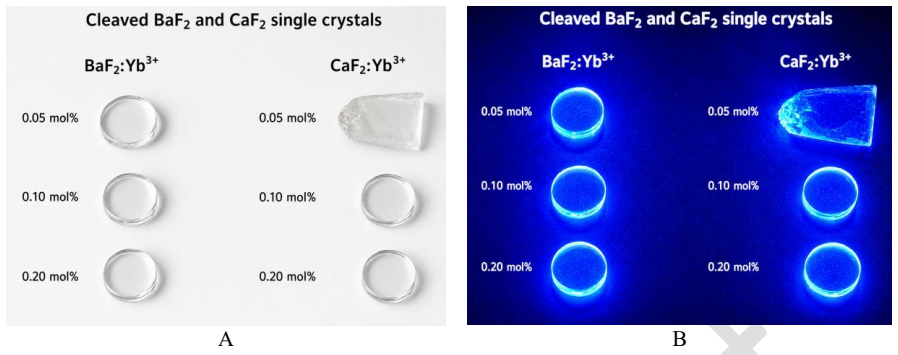
read the original abstract
Lanthanide-doped fluorides are promising materials for advanced photonic and quantum applications due to their wide bandgap, low phonon energy, and chemical stability. In this work, we present a systematic comparative study of ytterbium incorporation at low doping levels (0.05--0.2 mol\%) in BaF$_2$ and CaF$_2$ single crystals, focusing on the interplay between host lattice properties, charge-state stabilization, and defect formation mechanisms. Using a combination of X-ray diffraction (XRD), X-ray photoelectron spectroscopy (XPS), electron paramagnetic resonance (EPR), transmittance, and infrared photoluminescence (IR PL), we explore how host lattice properties affect the stabilization of Yb$^{3+}$ and Yb$^{2+}$ ions. XRD confirmed cubic phase purity and lattice parameter stability in both hosts, while XPS revealed surface chemical composition variations associated with charge-compensating defects and trace impurities. EPR spectra indicated that BaF$_2$ favored perturbed Yb$^{3+}$ environments with increasing dopant levels, while CaF$_2$ maintained predominantly unperturbed sites, suggesting a more favorable ionic match for Yb$^{2+}$. Photothermal deflection spectroscopy (PDS) and IR PL results showed host-specific optical responses, with CaF$_2$ exhibiting crystal-field splitting and broader local field effects. These results reveal a clear decoupling between long-range structural stability and local lattice perturbations, and demonstrate that host cation identity governs the balance between Yb$^{2+}$ and Yb$^{3+}$ stabilization as well as defect-driven optical behavior. This offers valuable insights for optimizing rare-earth-doped fluoride crystals in laser, scintillator, and quantum device applications.
Editorial analysis
A structured set of objections, weighed in public.
Referee Report
Summary. The manuscript reports a comparative experimental study of Yb incorporation at nominal doping levels of 0.05–0.2 mol% in BaF₂ and CaF₂ single crystals. Using XRD, XPS, EPR, transmittance, photothermal deflection spectroscopy, and IR photoluminescence, the authors observe cubic phase stability in both hosts but host-dependent differences in EPR spectra (perturbed Yb³⁺ sites increasing with dopant in BaF₂ vs. predominantly unperturbed in CaF₂), charge-state balance, and optical responses. They conclude that host cation identity governs Yb²⁺/Yb³⁺ stabilization and defect-driven optical behavior, demonstrating a decoupling between long-range structural order and local lattice perturbations.
Significance. If the attribution to host cation identity can be isolated from confounding factors, the work would offer practical guidance for selecting fluoride hosts to control rare-earth charge states in photonic, scintillator, and quantum applications. The multi-technique approach and focus on low doping levels are positive features, but the current lack of quantitative spectral details and controls limits the strength of the conclusions.
major comments (1)
- [Abstract] Abstract and experimental sections: The central claim that host cation identity governs the Yb²⁺/Yb³⁺ balance and defect behavior is not isolated from possible differences in actual incorporated dopant concentrations. Doping is reported only as the nominal range 0.05–0.2 mol% with no evidence of quantification (e.g., ICP-MS, calibrated XPS, or optical absorption) or confirmation that effective Yb levels and compensating defect densities are matched between BaF₂ and CaF₂. Solubility differences could reproduce the observed EPR trend (increasing perturbed sites with dopant in BaF₂) and optical variations without requiring cation identity as the primary cause.
minor comments (2)
- [Abstract] The abstract refers to 'crystal-field splitting and broader local field effects' in CaF₂ but provides no numerical values for splitting energies, linewidths, or direct spectral comparisons between hosts.
- No error bars, standard deviations, or statistical analysis are mentioned for the EPR intensity trends or PL spectra, making it difficult to assess the robustness of the reported differences.
Simulated Author's Rebuttal
We thank the referee for the constructive feedback on our manuscript. The concern about isolating host cation effects from possible differences in actual incorporated dopant levels is well taken. We address this point directly below and will make targeted revisions to clarify the use of nominal concentrations while preserving the core conclusions supported by the multi-technique data.
read point-by-point responses
-
Referee: [Abstract] Abstract and experimental sections: The central claim that host cation identity governs the Yb²⁺/Yb³⁺ balance and defect behavior is not isolated from possible differences in actual incorporated dopant concentrations. Doping is reported only as the nominal range 0.05–0.2 mol% with no evidence of quantification (e.g., ICP-MS, calibrated XPS, or optical absorption) or confirmation that effective Yb levels and compensating defect densities are matched between BaF₂ and CaF₂. Solubility differences could reproduce the observed EPR trend (increasing perturbed sites with dopant in BaF₂) and optical variations without requiring cation identity as the primary cause.
Authors: We agree that post-growth quantification of actual Yb incorporation would provide stronger isolation of host effects. Our work reports nominal doping levels (0.05–0.2 mol%), as is conventional for Czochralski-grown fluoride crystals where segregation coefficients can lead to minor deviations. All crystals were prepared under identical growth conditions with the same nominal YbF₃ addition. The EPR data reveal a host-specific trend—perturbed Yb³⁺ sites increase systematically with nominal dopant concentration in BaF₂ but remain predominantly unperturbed in CaF₂—consistent with the larger lattice mismatch and lower defect tolerance in the BaF₂ host (Ba²⁺ radius 1.35 Å vs. Ca²⁺ 1.00 Å). XRD confirms cubic phase stability and comparable lattice parameter shifts in both hosts, while the distinct IR PL and PDS responses further differentiate the local environments. Although we cannot exclude solubility variations without additional ICP-MS data, the observed decoupling between long-range order and local perturbations supports host cation identity as the dominant factor. We will revise the abstract and experimental sections to explicitly label concentrations as nominal, add a brief discussion of possible incorporation efficiency differences, and temper the central claim accordingly. revision: partial
- Quantitative post-growth measurement of actual incorporated Yb concentrations and compensating defect densities (e.g., via ICP-MS or calibrated optical absorption), which was not performed in the original study.
Circularity Check
No significant circularity: purely experimental observational study
full rationale
This paper presents an experimental comparative study of Yb incorporation in BaF2 and CaF2 hosts using XRD, XPS, EPR, transmittance, PDS, and IR PL measurements. No mathematical derivations, equations, model predictions, fitted parameters renamed as outputs, or self-citations of uniqueness theorems appear in the text. The central claims about host cation identity governing charge-state balance and defect behavior are drawn directly from the observed spectral differences and phase purity data without any reduction to inputs by construction. The logic chain is self-contained empirical interpretation, with no load-bearing steps that qualify under the enumerated circularity patterns.
Axiom & Free-Parameter Ledger
Reference graph
Works this paper leans on
-
[1]
L. Lei, Y. Wang, A. Kuzmin, Y. Hua, J. Zhao, S. Xu, P.N. Prasad, Next generation lanthanide doped nanoscintillators and photon converters, eLight 2 (2022) 17. https://doi.org/10.1186/s43593-022-00024-0
-
[2]
W. Xu, S. Zhang, A. Wei, D. Deng, S. Zhou, S. Xu, L. Lei, Advancing Multi‐Optical Performances in Lanthanide‐Doped Fluoride Core@Shell Nanoarchitectures by Minimizing Cation Intermixing, Adv Funct Materials 35 (2025) 2415815. https://doi.org/10.1002/adfm.202415815
-
[3]
L. Wang, Y. Li, Controlled Synthesis and Luminescence of Lanthanide Doped NaYF4 Nanocrystals, Chem. Mater. 19 (2007) 727-734. https://doi.org/10.1021/cm061887m
-
[4]
H. Yang, A. Zhang, H. Guo, D. Li, S. Xu, L. Lei, Enhancing upconversion via constructing local energy clusters in lanthanide-doped fluoride nanoparticles, J. Mater. Chem. C 11 (2023) 12915- 12921. https://doi.org/10.1039/D3TC02494F
-
[5]
Y.-J. Liang, F. Liu, Y.-F. Chen, X.-J. Wang, K.-N. Sun, Z. Pan, New function of the Yb3+ ion as an efficient emitter of persistent luminescence in the short-wave infrared, Light Sci Appl 5 (2016) e16124-e16124. https://doi.org/10.1038/lsa.2016.124
-
[6]
Y. Tai, H. Wang, H. Wang, J. Bai, Near-infrared down-conversion in Er3+ -Yb3+ co-doped transparent nanostructured glass ceramics for crystalline silicon solar cells, RSC Adv. 6 (2016) 4085-4089. https://doi.org/10.1039/C5RA25800F
-
[7]
C. Strohhöfer, A. Polman, Absorption and emission spectroscopy in Er3+-Yb3+ doped aluminum oxide waveguides, Optical Materials 21 (2003) 705-712. https://doi.org/10.1016/S0925-3467(02)00056-3
-
[8]
Y.-H. Kye, C.-J. Yu, U.-G. Jong, C.-N. Sin, W. Qin, Defect properties in Yb3+ -doped CaF2 from first-principles calculations: a route to defect engineering for up- and down-conversion photoluminescence, J. Mater. Chem. C 7 (2019) 15148-15152. https://doi.org/10.1039/C9TC04786G
-
[9]
H. Nalumaga, J.J. Schuyt, R.D. Breukers, G.V.M. Williams, Radiation-induced changes in the photoluminescence properties of NaMgF3:Yb nanoparticles: Yb3+ → Yb2+ valence conversion and oxygen-impurity charge transfer, Materials Research Bulletin 145 (2022) 111562. https://doi.org/10.1016/j.materresbull.2021.111562
-
[10]
S. Balabhadra, M.F. Reid, V. Golovko, J.-P.R. Wells, Absorption spectra, defect site distribution and upconversion excitation spectra of CaF2/SrF2/BaF2:Yb3+:Er3+ nanoparticles, Journal of Alloys and Compounds 834 (2020) 155165. https://doi.org/10.1016/j.jallcom.2020.155165
-
[11]
J. Shanker, S.C. Agrawal, Electronic polarizabilities and sizes of ions in alkaline earth halides and alkali chalcogenides, Journal of Physics and Chemistry of Solids 41 (1980) 209-213. https://doi.org/10.1016/0022-3697(80)90187-0
-
[12]
M. Stef, I. Nicoara, D. Vizman, Distribution of Yb3+ and Yb2+ Ions along YbF3 ‐Doped BaF2 Crystals, Crystal Research and Technology 53 (2018) 1800186. https://doi.org/10.1002/crat.201800186
-
[13]
S.M. Kaczmarek, T. Tsuboi, M. Ito, G. Boulon, G. Leniec, Optical study of Yb3+ /Yb2+ conversion in CaF2 crystals, J. Phys.: Condens. Matter 17 (2005) 3771-3786. https://doi.org/10.1088/0953-8984/17/25/005
-
[14]
Z. Barandiarán, L. Seijo, Intervalence charge transfer luminescence: Interplay between anomalous and 5 d − 4 f emissions in Yb-doped fluorite-type crystals, The Journal of Chemical Physics 141 (2014) 234704. https://doi.org/10.1063/1.4902759
-
[15]
F. d’Acapito, S. Pelli-Cresi, W. Blanc, M. Benabdesselam, F. Mady, P. Gredin, M. Mortier, The incorporation site of Er in nanosized CaF2, J. Phys.: Condens. Matter 28 (2016) 485301. https://doi.org/10.1088/0953-8984/28/48/485301
-
[16]
A.J. Nelson, T. Van Buuren, C. Bostedt, K.I. Schaffers, L.J. Terminello, M. Engelhard, D. Baer, Electronic structure of ytterbium-doped strontium fluoroapatite: Photoemission and photoabsorption investigation, Journal of Applied Physics 91 (2002) 5135-5140. https://doi.org/10.1063/1.1459601
-
[17]
W. Hayes, A.M. Stoneham, Defects and defect processes in nonmetallic solids, Dover edition, Dover Publications, Mineola, N.Y, 2004
work page 2004
-
[18]
B. Henderson, G.F. Imbusch, Optical spectroscopy of inorganic solids, Clarendon Press ; Oxford University Press, Oxford [Oxfordshire] : New York, 1989
work page 1989
-
[19]
N. Itoh, A.M. Stoneham, Materials modification by electronic excitation, Radiation Effects and Defects in Solids 155 (2001) 277-290. https://doi.org/10.1080/10420150108214126
-
[20]
G. Blasse, B.C. Grabmaier, Luminescent Materials, Springer Berlin Heidelberg, Berlin, Heidelberg, 1994. https://doi.org/10.1007/978-3-642-79017-1
-
[21]
V.V. Laguta, M. Buryi, M. Nikl, J. Rosa, S. Zazubovich, Hole capture in PbWO4:Mo,La(Y) scintillator crystals, Physical Review B - Condensed Matter and Materials Physics 83 (2011). https://doi.org/10.1103/PhysRevB.83.094123
-
[22]
C.S. Erickson, M.J. Crane, T.J. Milstein, D.R. Gamelin, Photoluminescence Saturation in Quantum-Cutting Yb3+ -Doped CsPb(Cl 1- x Br x )3 Perovskite Nanocrystals: Implications for Solar Downconversion, J. Phys. Chem. C 123 (2019) 12474-12484. https://doi.org/10.1021/acs.jpcc.9b01296
-
[23]
A. Ishii, T. Miyasaka, Sensitized Yb3+ Luminescence in CsPbCl3 Film for Highly Efficient Near‐ Infrared Light‐Emitting Diodes, Advanced Science 7 (2020) 1903142. https://doi.org/10.1002/advs.201903142
-
[24]
C. Zhang, A. Zhang, T. Liu, L. Zhou, J. Zheng, Y. Zuo, Y. He, J. Li, A facile method for preparing Yb3+ -doped perovskite nanocrystals with ultra-stable near-infrared light emission, RSC Adv. 10 (2020) 17635-17641. https://doi.org/10.1039/D0RA01897J
-
[25]
L. Procházková, V. Vaněček, V. Čuba, R. Pjatkan, R. Martinez-Turtos, I. Jakubec, M. Buryi, S. Omelkov, E. Auffray, P. Lecoq, E. Mihóková, M. Nikl, Core-shell ZnO:Ga-SiO2 nanocrystals: Limiting particle agglomeration and increasing luminescence: Via surface defect passivation, RSC Advances 9 (2019) 28946-28952. https://doi.org/10.1039/c9ra04421c
-
[26]
A. Pusdekar, N. Ugemuge, C. Gayner, R.A. Nafdey, S. Moharil, Energy transfer dynamics in Na5Y(WO4)4: Ln3+(Ln=Nd, Er, Yb) Phosphors, Materials Research Bulletin 199 (2026) 114065. https://doi.org/10.1016/j.materresbull.2026.114065
-
[27]
J.-C.G. Bünzli, S.V. Eliseeva, Lanthanide NIR luminescence for telecommunications, bioanalyses and solar energy conversion, Journal of Rare Earths 28 (2010) 824-842. https://doi.org/10.1016/S1002-0721(09)60208-8
-
[28]
V. Petit, P. Camy, J.-L. Doualan, X. Portier, R. Moncorgé, Spectroscopy of Yb 3 + : CaF 2 : From isolated centers to clusters, Phys. Rev. B 78 (2008) 085131. https://doi.org/10.1103/PhysRevB.78.085131
-
[29]
S. Zhang, Z. Song, F. Zhao, S. Liu, H. Cai, S. Wang, Q. Liu, Selecting nitride host for Yb3+ toward near-infrared emission with low-energy charge transfer band, Journal of Rare Earths 39 (2021) 1484-1491. https://doi.org/10.1016/j.jre.2021.05.012
-
[30]
J. Tan, N. Hu, X. Li, H. Zhou, Z. Li, P. Zhang, Z. Chen, Yb:YGG, crystal growth, concentration dependent, spectroscopy and the luminescence mechanisms, Infrared Physics & Technology 156 (2026) 106555. https://doi.org/10.1016/j.infrared.2026.106555
-
[31]
V. Babin, M. Buryi, V. Chlan, Y. Fomichov, K. Kamada, V.V. Laguta, M. Nikl, J. Pejchal, H. Štěpánková, A. Yoshikawa, Yu. Zagorodniy, S. Zazubovich, Influence of gallium content on Ga3+ position and photo- and thermally stimulated luminescence in Ce3+-doped multicomponent (Y,Lu)3GaxAl5-xO12 garnets, Journal of Luminescence 200 (2018) 141-150. https://doi.o...
-
[32]
Bünzli, Lanthanide Luminescence for Biomedical Analyses and Imaging, Chem
J.-C.G. Bünzli, Lanthanide Luminescence for Biomedical Analyses and Imaging, Chem. Rev. 110 (2010) 2729-2755. https://doi.org/10.1021/cr900362e
-
[33]
A.D. Sontakke, J. Ueda, J. Xu, K. Asami, M. Katayama, Y. Inada, S. Tanabe, A Comparison on Ce3+ Luminescence in Borate Glass and YAG Ceramic: Understanding the Role of Host’s Characteristics, J. Phys. Chem. C 120 (2016) 17683-17691. https://doi.org/10.1021/acs.jpcc.6b04159
-
[34]
K. Venkata Krishnaiah, C.K. Jayasankar, V. Venkatramu, S.F. Leόn-Luis, V. Lavín, S. Chaurasia, L.J. Dhareshwar, Optical properties of Yb3+ ions in fluorophosphate glasses for 1.0 μm solid-state infrared lasers, Appl. Phys. B 113 (2013) 527-535. https://doi.org/10.1007/s00340-013-5502-6
-
[35]
P. Barua, E.H. Sekiya, K. Saito, A.J. Ikushima, Influences of Yb3+ ion concentration on the spectroscopic properties of silica glass, Journal of Non-Crystalline Solids 354 (2008) 4760-4764. https://doi.org/10.1016/j.jnoncrysol.2008.04.020
-
[36]
M. Hongisto, A. Veber, N.G. Boetti, S. Danto, V. Jubera, L. Petit, Transparent Yb3+ doped phosphate glass-ceramics, Ceramics International 46 (2020) 26317-26325. https://doi.org/10.1016/j.ceramint.2020.01.121
-
[37]
C. Schornig, M. Stef, G. Buse, M. Poienar, P. Veber, D. Vizman, Spectroscopic Properties of TmF3-Doped CaF2 Crystals, Materials 17 (2024) 4965. https://doi.org/10.3390/ma17204965
-
[38]
M. Stef, C. Schornig, G. Buse, M. Poienar, P. Veber, D. Vizman, Spectroscopic analysis and Judd-Ofelt modelling of Tm3+ -doped BaF2 crystals, Optical Materials 169 (2026) 117689. https://doi.org/10.1016/j.optmat.2025.117689
-
[39]
Bottomonia in quark –antiquark confining potential,
Z. Remeš, Š. Remeš, N. Neykova, N. Jain, R.K. Sharma, J. Holovský, E. Ukraintsev, J. Kuliček, B. Rezek, H.S. Hsu, Optical, electrical and surface properties of bare and Al-doped nanocrystalline ZnO (AZO) thin films grown by pulsed laser deposition (PLD) on commercial interdigital electrodes (IDE), Phys. Scr. 100 (2025) 115910. https://doi.org/10.1088/1402...
-
[40]
S. Stoll, A. Schweiger, EasySpin, a comprehensive software package for spectral simulation and analysis in EPR, J. Magn. Reson. 178 (2006) 42-55. https://doi.org/10.1016/j.jmr.2005.08.013
-
[41]
M. 21. J.J.F.,. Stickle, W.F.,. Sobol, P.E.,. Bomben, K.D. (eds.)., Handbook of X-ray Photoelectron Spectroscopy, Physical Electronics, Inc., Minnesota, n.d
-
[42]
H. Qiu, P. Yang, J. Dong, P. Deng, J. Xu, W. Chen, The influence of Yb concentration on laser crystal Yb:YAG, Materials Letters 55 (2002) 1-7. https://doi.org/10.1016/S0167- 577X(01)00608-5
-
[43]
C. Wu, X. Yu, W. Zhu, K. Han, Z. Tian, Q. He, P. Zhao, Bi3+-enhanced upconversion luminescence and high-sensitivity optical thermometry in Er3+/Yb3+ co-doped Cs2NaYCl6 double perovskite crystals, Ceramics International 51 (2025) 36170-36181. https://doi.org/10.1016/j.ceramint.2025.05.338
-
[44]
C. Zhao, C. Wang, J. Song, H. Wang, Z. Yu, J. Wang, Z. Zhao, X. Li, J. Liu, K. Lin, Z. Wang, A. Neogi, Ultra‐Efficient, Broadband‐Excitable NIR Emission in Lead‐Free Cs2 NaYbCl6 via Cl → Yb Charge Transfer and Cr3+ Sensitization, Advanced Optical Materials 13 (2025) e01549. https://doi.org/10.1002/adom.202501549
-
[45]
M. Buryi, V. Babin, V. Laguta, Y. Yokota, H. Sato, A. Yoshikawa, J. Pejchal, M. Nikl, Undoped and Eu, Na co-doped LiCaAlF6 scintillation crystals: Paramagnetic centers, charge trapping and energy transfer properties, Journal of Alloys and Compounds 858 (2021) 158297. https://doi.org/10.1016/j.jallcom.2020.158297
-
[46]
R.D. Shannon, Revised effective ionic radii and systematic studies of interatomic distances in halides and chalcogenides, Acta Cryst A 32 (1976) 751-767. https://doi.org/10.1107/S0567739476001551
-
[47]
Fuller, Nuclear spins and moments, J
G.H. Fuller, Nuclear spins and moments, J. Phys. Chem. Ref. Data 1976 (n.d.) 835-1092
work page 1976
-
[48]
J.E. Wertz, J.R. Bolton, Electron spin resonance: elementary theory and practical applications, McGraw-Hill, New York, 1972
work page 1972
-
[49]
A. Abragam, B. Bleaney, Electron paramagnetic resonance of transition ions, Oxford University Press, Oxford, 2012
work page 2012
-
[50]
Cotton, Chemical applications of group theory, 3rd ed, Wiley, New York, 1990
F.A. Cotton, Chemical applications of group theory, 3rd ed, Wiley, New York, 1990
work page 1990
-
[51]
M.E. Thomas, W.J. Tropf, Barium Fluoride (BaF2), in: Handbook of Optical Constants of Solids, Elsevier, 1997: pp. 683-699. https://doi.org/10.1016/B978-012544415-6.50125-4
-
[52]
E. Morris, T. Groy, K. Leinenweber, Crystal structure and bonding in the high-pressure form of fluorite (CaF2), Journal of Physics and Chemistry of Solids 62 (2001) 1117-1122. https://doi.org/10.1016/S0022-3697(00)00291-2
-
[53]
I. Nicoara, L. Lighezan, M. Enculescu, I. Enculescu, Optical spectroscopy of Yb2+ ions in YbF3-doped CaF2 crystals, Journal of Crystal Growth 310 (2008) 2026-2032. https://doi.org/10.1016/j.jcrysgro.2007.11.183
-
[54]
Matzke, Fluorine self-diffusion in CaF2 and BaF2, J Mater Sci 5 (1970) 831-836
Hj. Matzke, Fluorine self-diffusion in CaF2 and BaF2, J Mater Sci 5 (1970) 831-836. https://doi.org/10.1007/BF00574851
-
[55]
I. Nicoara, M. Stef, Charge compensating defects study of YbF‐doped BaF crystals using dielectric loss, Physica Status Solidi (b) 253 (2016) 397-403. https://doi.org/10.1002/pssb.201552507
-
[56]
C.P. Poole, Electron spin resonance: a comprehensive treatise on experimental techniques, Dover Publications, Mineola, N.Y, 1996
work page 1996
-
[57]
S. Zhao, Z. Xu, L. Wang, S. Wageh, Influence of Yb3+ concentration on the upconversion luminescence of oxyfluoride material doped with Er3+, Sci. China Phys. Mech. Astron. 53 (2010) 310-314. https://doi.org/10.1007/s11433-010-0117-y
-
[58]
J. Zhang, J. Heo, 980 nm upconversion luminescence from oxy-fluoride glasses and glass- ceramics doped with Yb3+and Er3+ ions, Journal of Non-Crystalline Solids 383 (2014) 188-191. https://doi.org/10.1016/j.jnoncrysol.2013.04.026
discussion (0)
Sign in with ORCID, Apple, or X to comment. Anyone can read and Pith papers without signing in.