Recognition: 2 theorem links
· Lean TheoremReconstructing rare particle source by femtoscopic correlations
Pith reviewed 2026-05-12 03:15 UTC · model grok-4.3
The pith
A new statistical method reconstructs single-particle emission sources for rare particles directly from femtoscopic correlations.
A machine-rendered reading of the paper's core claim, the machinery that carries it, and where it could break.
Core claim
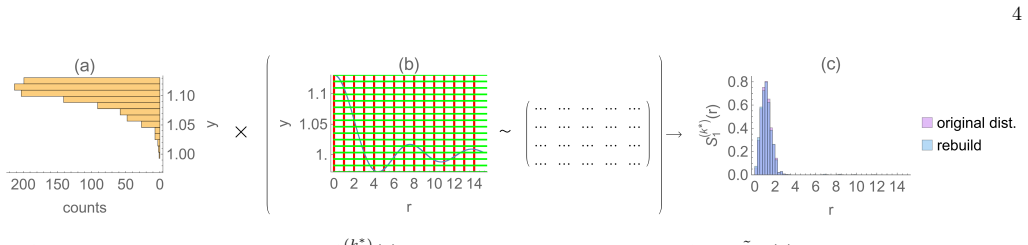
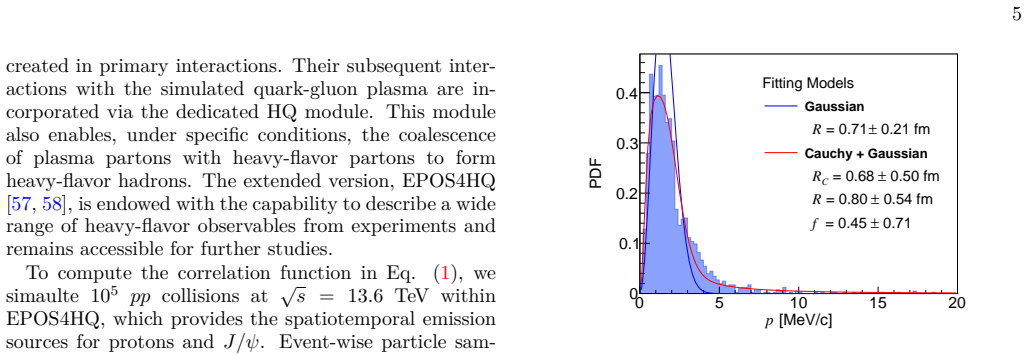
The correlation function is expressed as an ensemble average over the single-particle-conditioned correlation kernel distribution. For rare-yield particles this kernel distribution can be transformed into an event-by-event extraction and thus becomes experimentally accessible. This permits a direct statistical reconstruction of the single-particle emission source. When used to reconstruct the J/ψ source from p-J/ψ correlations with HAL QCD-derived potentials in EPOS4HQ simulations of 13.6 TeV pp collisions, the method reproduces key source characteristics and attains a systematic uncertainty of approximately 13 percent.
What carries the argument
The single-particle-conditioned correlation kernel, defined as the particle-by-particle contribution to the correlation function conditioned by the target particles, which allows the ensemble average to support source reconstruction without Gaussian assumptions.
If this is right
- Allows direct reconstruction of single-particle sources for rare particles instead of pair sources.
- The reconstructed J/ψ source in simulations reproduces key characteristics of the true source.
- The approach yields a systematic uncertainty of approximately 13% based on EPOS4 simulation.
- It uses a data-constrained reference source and external potentials for the reconstruction.
Where Pith is reading between the lines
- This technique might extend to reconstructing sources of other rare particles produced in collider experiments.
- If implemented in real data analysis, it could provide new constraints on particle production models in quantum chromodynamics.
- Comparisons with alternative source extraction methods could test the robustness of the 13% uncertainty figure.
- The method's reliance on simulations for validation suggests it could be tested in controlled settings with known sources.
Load-bearing premise
That the distribution of the particle-by-particle correlation contributions is accessible in experiment and can be used for reconstruction with little bias introduced by the reference source or the potentials employed.
What would settle it
Observing that the reconstructed source in real pp collision data at the LHC differs markedly from expectations based on other measurements, or that in simulations the uncertainty exceeds 13% substantially, would indicate the method does not perform as claimed.
Figures





read the original abstract
Measurement of particle emission source is a fundamental objective of femtoscopy in high-energy nuclear collisions. Conventional analyses rely on Gaussian parameterizations of pair emission sources, which makes the extraction of single-particle emission sources challenging, particularly for rare particles. Here, we introduce a novel Statistical Reconstruction method that allows extracting information of target single-particle sources relative to a data-constrained reference source instead of the Gaussian assumption. The correlation function is expressed as an ensemble average over single-particle-conditioned correlation kernel, defined as the particle-by-particle contribution to the correlation function conditioned by the target particles. For particles with rare yeilds, the particle-by-particle distribution of this kernel can be transformed into event-by-event extraction and becomes experimentally accessible, enabling a direct statistical reconstruction of the single-particle emission source, instead of inferring a pair source. We apply this method to reconstruct $J/\psi$ source via $p-J/\psi$ correlations, using HAL QCD-derived $NJ/\psi$ potentials in $\sqrt{s}=13.6$~TeV $pp$ collisions simulated with EPOS4HQ. The reconstructed source reproduces the key characteristics and this new approche achieves a systematic uncertainty of approximately $13\%$ based on EPOS4 simulation.
Editorial analysis
A structured set of objections, weighed in public.
Referee Report
Summary. The manuscript introduces a Statistical Reconstruction method for single-particle emission sources in femtoscopy, particularly for rare particles like J/ψ. It replaces the conventional Gaussian assumption for pair sources with an ensemble average over single-particle-conditioned correlation kernels. For rare yields, the particle-by-particle kernel distribution is transformed into event-by-event source extraction, claimed to be experimentally accessible. The method is demonstrated by reconstructing the J/ψ source from p-J/ψ correlations using HAL QCD potentials in EPOS4HQ simulations of √s = 13.6 TeV pp collisions, with the reconstructed source reproducing key characteristics at ~13% systematic uncertainty.
Significance. If the transformation proves robust, this would represent a useful advance in femtoscopy by enabling direct single-particle source reconstruction for rare particles without Gaussian pair-source assumptions. The grounding via data-constrained references and external HAL QCD potentials, together with the concrete EPOS4HQ simulation test, provides a clear proof-of-principle that could aid source imaging in high-energy collisions.
major comments (3)
- [Abstract] Abstract: The central claim that the particle-by-particle distribution of the single-particle-conditioned correlation kernel 'can be transformed into event-by-event extraction' lacks any explicit derivation, formula, or algorithm demonstrating that the mapping is exact and free of bias from the reference source or kernel definition. This transformation is load-bearing for the novelty assertion that the method reconstructs the single-particle source 'instead of inferring a pair source'.
- [Abstract] Abstract: The quoted systematic uncertainty of approximately 13% is obtained from the EPOS4HQ simulation, yet no procedure is given for its calculation, including propagation of uncertainties from the data-constrained reference source or variations in the HAL QCD potentials. Without this, it is impossible to judge whether the uncertainty fully supports the claim that key characteristics are reproduced.
- [Validation section] Validation section: The reconstruction is tested exclusively inside the EPOS4HQ model that also generates the input correlation data, creating a circularity risk. An independent cross-check with a different generator or varied dynamics is required to establish that the method reproduces source characteristics independently of the simulation assumptions.
minor comments (2)
- [Abstract] Abstract: Typographical errors: 'yeilds' should read 'yields' and 'approche' should read 'approach'.
- [Abstract] Abstract: The abstract supplies insufficient detail on the precise mathematical definition of the single-particle-conditioned correlation kernel and the conditioning procedure on target particles.
Simulated Author's Rebuttal
We thank the referee for the insightful comments on our manuscript. We address each major comment below and indicate the revisions made to strengthen the presentation of the Statistical Reconstruction method.
read point-by-point responses
-
Referee: [Abstract] Abstract: The central claim that the particle-by-particle distribution of the single-particle-conditioned correlation kernel 'can be transformed into event-by-event extraction' lacks any explicit derivation, formula, or algorithm demonstrating that the mapping is exact and free of bias from the reference source or kernel definition. This transformation is load-bearing for the novelty assertion that the method reconstructs the single-particle source 'instead of inferring a pair source'.
Authors: The derivation of this transformation is provided in Section II of the manuscript, where the correlation function is expressed as an ensemble average over the single-particle-conditioned kernels, and for rare yields, the particle-by-particle kernel distribution is shown to enable event-by-event source extraction through statistical averaging. The mapping is exact under the assumption of the reference source being data-constrained and independent of the pair source Gaussian assumption. To make this more explicit in the abstract as requested, we will revise the abstract to include a brief outline of the key formula and algorithm. This addresses the novelty by directly reconstructing the single-particle source. revision: partial
-
Referee: [Abstract] Abstract: The quoted systematic uncertainty of approximately 13% is obtained from the EPOS4HQ simulation, yet no procedure is given for its calculation, including propagation of uncertainties from the data-constrained reference source or variations in the HAL QCD potentials. Without this, it is impossible to judge whether the uncertainty fully supports the claim that key characteristics are reproduced.
Authors: We agree that the procedure for calculating the systematic uncertainty should be detailed. The 13% value is obtained by varying the parameters of the data-constrained reference source within their experimental uncertainties and using different parameter sets from the HAL QCD potentials, then comparing the reconstructed source to the input source in the simulation. We will add a dedicated paragraph in the Validation section describing this procedure, including how uncertainties are propagated. revision: yes
-
Referee: [Validation section] Validation section: The reconstruction is tested exclusively inside the EPOS4HQ model that also generates the input correlation data, creating a circularity risk. An independent cross-check with a different generator or varied dynamics is required to establish that the method reproduces source characteristics independently of the simulation assumptions.
Authors: We acknowledge the referee's concern regarding potential circularity. However, the method's core relies on the HAL QCD potentials, which are derived from lattice QCD and independent of the EPOS4HQ generator, and the reference source is constrained by experimental data rather than the simulation. The EPOS4HQ is used to generate realistic correlation functions for testing the reconstruction algorithm. To address this, we will expand the discussion in the Validation section to emphasize the independence of the potentials and reference, and note that future work will include cross-checks with other models such as PYTHIA. We believe the current validation provides a solid proof-of-principle. revision: partial
Circularity Check
No significant circularity; derivation uses external potentials and reports simulation-based validation
full rationale
The paper defines a statistical reconstruction via the single-particle-conditioned correlation kernel expressed as an ensemble average, then applies it to p-J/ψ correlations with HAL QCD potentials as an independent external input. Validation consists of applying the procedure to EPOS4HQ-generated events and checking that the output reproduces known input characteristics, which is a standard external test rather than a reduction by construction. No equation or step is shown to equate the reconstructed source to a fitted parameter or to a self-citation chain; the 13% systematic uncertainty is measured from the simulation comparison and does not force the central claim. The method therefore remains self-contained against the stated inputs.
Axiom & Free-Parameter Ledger
axioms (1)
- domain assumption The correlation function can be expressed as an ensemble average over single-particle-conditioned correlation kernels.
Lean theorems connected to this paper
-
IndisputableMonolith/Cost/FunctionalEquation.leanwashburn_uniqueness_aczel unclear?
unclearRelation between the paper passage and the cited Recognition theorem.
The correlation function is expressed as an ensemble average over single-particle-conditioned correlation kernel... enabling a direct statistical reconstruction of the single-particle emission source, instead of inferring a pair source.
-
IndisputableMonolith/Foundation/AlexanderDuality.leanalexander_duality_circle_linking unclear?
unclearRelation between the paper passage and the cited Recognition theorem.
We apply this method to reconstruct J/ψ source via p-J/ψ correlations, using HAL QCD-derived N J/ψ potentials in √s=13.6 TeV pp collisions simulated with EPOS4HQ.
What do these tags mean?
- matches
- The paper's claim is directly supported by a theorem in the formal canon.
- supports
- The theorem supports part of the paper's argument, but the paper may add assumptions or extra steps.
- extends
- The paper goes beyond the formal theorem; the theorem is a base layer rather than the whole result.
- uses
- The paper appears to rely on the theorem as machinery.
- contradicts
- The paper's claim conflicts with a theorem or certificate in the canon.
- unclear
- Pith found a possible connection, but the passage is too broad, indirect, or ambiguous to say the theorem truly supports the claim.
Reference graph
Works this paper leans on
- [1]
-
[2]
G. Goldhaber, S. Goldhaber, W. Lee, and A. Pais, Phys. Rev. 120, 300 (1960)
work page 1960
- [3]
-
[4]
W. A. Zajc, J. A. Bistirlich, R. R. Bossingham, et al. , Phys. Rev. C 29, 2173 (1984)
work page 1984
-
[5]
D. H. Boal, C. K. Gelbke, and B. K. Jennings, Rev. Mod. Phys. 62, 553 (1990)
work page 1990
- [6]
- [7]
-
[8]
Two-Particle Correlations in Relativistic Heavy-Ion Collisions
U. Heinz and B. V. Jacak, Annu. Rev. Nucl. Part. Sci. 49, 529 (1999) , arXiv:nucl-th/9902020
work page Pith review arXiv 1999
-
[9]
U. A. Wiedemann and U. Heinz, Phys. Rep. 319, 145 (1999)
work page 1999
-
[10]
J. H. Chen, X. Dong, H. Z. Huang, et al., Nucl. Sci. Tech. 35, 214 (2024)
work page 2024
-
[11]
Q. Y. Shou, Y. G. Ma, S. Zhang, et al. , Nucl. Sci. Tech. 35, 219 (2024)
work page 2024
-
[12]
P. Lu, R. Kavak, A. Dubla, S. Masciocchi, and I. Se- lyuzhenkov, Nucl. Sci. Tech. 36, 142 (2025)
work page 2025
-
[13]
R. Q. Wang, X. L. Hou, Y. H. Li, J. Song, and F. L. Shao, Nucl. Sci. Tech. 36, 185 (2025)
work page 2025
-
[14]
N. Yu, Z. M. Zhang, H. G. Xu, and M. X. Song, Nucl. Sci. Tech. 36, 65 (2025)
work page 2025
-
[15]
W. J. Dong, X. Z. Yu, S. Y. Ping, et al. , Nucl. Sci. Tech. 35, 120 (2024)
work page 2024
-
[16]
R. Lednicky and V. L. Lyuboshits, Yad. Fiz. (sov. J. Nucl. Phys.) 35, 1316 (770) (1981)
work page 1981
- [17]
- [18]
-
[19]
R. Lednický and V. L. Lyuboshitz, Acta Phys. Hung. New Ser. Heavy Ion Phys. 3, 93 (1996)
work page 1996
- [20]
-
[21]
Lednicky, in Multiparticle Dyn
R. Lednicky, in Multiparticle Dyn. (WORLD SCIEN- TIFIC, Alushta, Crimea, Ukraine, 2003) pp. 21–26, arXiv:nucl-th/0212089
-
[22]
Y. B. Wei, Y. G. Ma, W. Q. Shen, et al. , Phys. Lett. B 586, 225 (2004)
work page 2004
-
[23]
Y. G. Ma, G. H. Liu, X. Z. Cai, et al. , Phys. Rev. C 85, 024618 (2012)
work page 2012
-
[24]
Y. G. Ma, D. Q. Fang, X. Y. Sun, et al. , Phys. Lett. B 743, 306 (2015)
work page 2015
-
[25]
S. E. Koonin, Phys. Lett. B 70, 43 (1977)
work page 1977
- [26]
- [27]
- [28]
- [29]
-
[30]
Solving the Inverse Source Problem in Femtoscopy with a Toy Model
A.-S. Xiong, Q.-W. Yuan, M.-Z. Liu, F.-S. Yu, Z.-W. Liu, and L.-S. Geng, Solving the inverse source problem in femtoscopy with a toy model (2025), arXiv:2512.06904 [hep-ph]
work page internal anchor Pith review Pith/arXiv arXiv 2025
-
[31]
L. Wang and J. Zhao, Learning hadron emitting sources with deep neural networks (2025), arXiv:2411.16343 [nucl-th]
- [32]
- [33]
-
[34]
T.-T. Wang, Phys. Rev. C 107, 014911 (2023) , arXiv:2301.02846 [hep-ph]
-
[35]
F.-H. Qiao, X.-G. Deng, and Y.-G. Ma, Phys. Lett. B 850, 138535 (2024) , arXiv:2403.04341 [nucl-th]
- [36]
-
[37]
D.-F. Wang, M.-Y. Chen, Y.-G. Ma, Q.-Y. Shou, S. Zhang, and L. Zheng, Nucl. Sci. Tech. 36, 154 (2025) , arXiv:2501.15776 [nucl-th]
- [38]
- [39]
-
[40]
J. Haidenbauer, Nucl. Phys. A 981, 1 (2019) , arXiv:1808.05049 [hep-ph]
-
[41]
L. Fabbietti, V. M. Sarti, and O. V. Doce, Ann. Rev. Nucl. Part. Sci. 71, 377 (2021) , arXiv:2012.09806 [nucl- ex]
- [42]
- [43]
- [44]
- [45]
- [46]
- [47]
- [48]
- [49]
-
[50]
K. J. Sun, Nucl. Sci. Tech. 37, 64 (2026)
work page 2026
- [51]
-
[52]
J. H. Chen, F. K. Guo, J. J. Wu, B. S. Zou, Y. G. Ma, C. P. Shen, and Q. Y. Shou, Nucl. Sci. Tech. 36, 55 (2025)
work page 2025
- [53]
- [54]
- [55]
- [56]
-
[57]
J. Zhao, J. Aichelin, P. B. Gossiaux, and K. Werner, Phys. Rev. D 109, 054011 (2024)
work page 2024
-
[58]
J. Zhao, J. Aichelin, P. B. Gossiaux, V. Ozvenchuk, and K. Werner, Phys. Rev. C 110, 024909 (2024)
work page 2024
- [59]
- [60]
- [61]
- [62]
- [63]
-
[64]
S. Aoki and T. Doi, Front. in Phys. 8, 307 (2020) , arXiv:2003.10730 [hep-lat]
- [65]
discussion (0)
Sign in with ORCID, Apple, or X to comment. Anyone can read and Pith papers without signing in.