Recognition: 2 theorem links
· Lean TheoremLO-Free Receiver: Next-Gen Low-Power Joint Communication and Sensing
Pith reviewed 2026-05-12 03:15 UTC · model grok-4.3
The pith
SPMC encodes data and sensing information in inter-antenna phase differences recovered by an LO-free correlator receiver.
A machine-rendered reading of the paper's core claim, the machinery that carries it, and where it could break.
Core claim
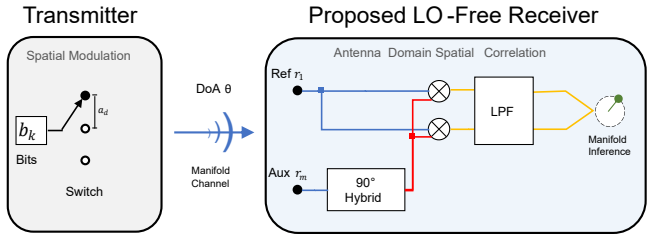
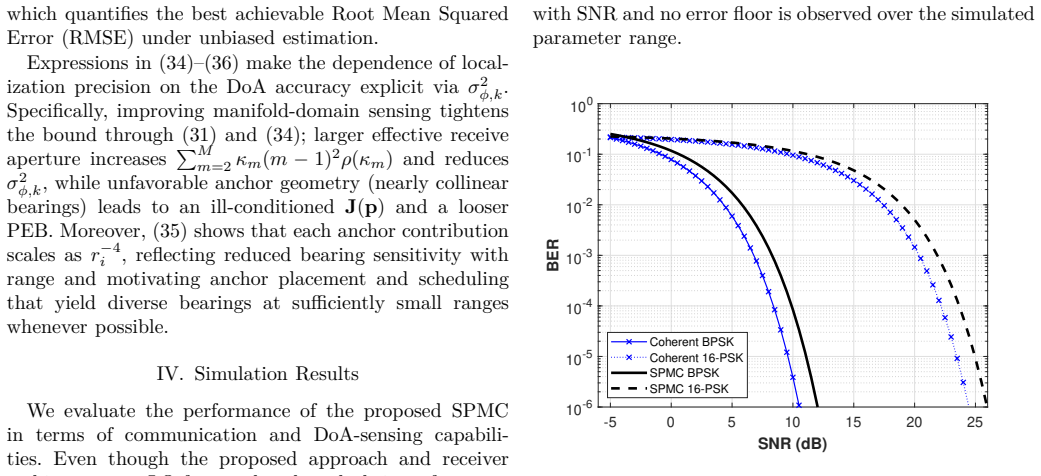
SPMC exploits antenna-domain correlation to form a baseband observable that is a function of inter-antenna phase differences. The formulation recasts communication and sensing as inference over the unit-circle manifold and thus naturally supports JCAS decomposition, i.e., data and spatial sensing are encoded and recovered through DoA signatures. The framework comprises a manifold-domain signal model with phase-alphabet design, an LO-free quadrature spatial-correlator receiver that resolves phase-sign ambiguity without requiring an LO, and analysis of error probability and sensing precision including robustness to phase noise.
What carries the argument
The LO-free quadrature spatial-correlator receiver that forms baseband observables solely from antenna-domain correlations tied to inter-antenna phase differences and DoA.
Load-bearing premise
The LO-free quadrature spatial-correlator receiver can reliably resolve phase-sign ambiguity and form the required baseband observable solely from antenna-domain correlation without any local oscillator or explicit channel estimation.
What would settle it
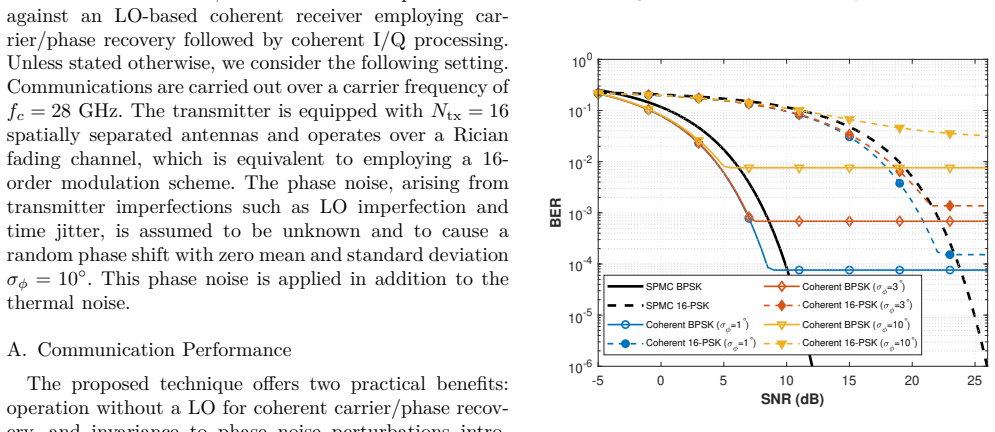
A measurement campaign or simulation showing that the quadrature spatial correlator cannot resolve phase-sign ambiguity or yields error rates that do not match the predicted manifold-based analysis in the presence of realistic phase noise would falsify the receiver architecture.
Figures

read the original abstract
This paper introduces and analyzes Spatial Phase Manifold Communications (SPMC), a paradigm that facilitates joint communication and sensing (JCAS) over Local Oscillator (LO) free receiver. Information is embedded in, and recovered from, the relative spatial phase between antennas. In contrast to conventional coherent receivers that rely on LOs and on channel estimation/equalization, SPMC exploits antenna-domain correlation to form a baseband observable that is a function of inter-antenna phase differences. Since these phase differences are fundamentally tied to Direction-of-Arrival (DoA) and vice-versa, the formulation recasts communication and sensing as inference over the unit-circle manifold and thus naturally supports JCAS decomposition, i.e., data and spatial sensing are encoded and recovered through DoA signatures. We develop a comprehensive framework comprising: (i) a manifold-domain signal model and corresponding phase-alphabet design; (ii) an LO-free quadrature spatial-correlator receiver architecture that resolves the phase-sign ambiguity without requiring an LO; and (iii) an analysis of error probability and sensing precision, including robustness to phase noise. The proposed paradigm is particularly suited to massive Internet-of-Things (IoT) deployments, for which hardware simplicity, LO distribution cost, power consumption, and seamless sensing integration are critical, especially at millimeter-wave and higher carrier frequencies.
Editorial analysis
A structured set of objections, weighed in public.
Referee Report
Summary. The manuscript introduces Spatial Phase Manifold Communications (SPMC), a framework for joint communication and sensing (JCAS) that operates with a local-oscillator-free receiver. Information is encoded in inter-antenna phase differences, which are recovered via antenna-domain correlation to form baseband observables on the unit-circle manifold. This allows simultaneous data recovery and direction-of-arrival (DoA) sensing without traditional channel estimation. The paper presents a manifold-domain signal model, a phase-alphabet design, an LO-free quadrature spatial-correlator receiver that resolves phase-sign ambiguity, and analyses of error probability and sensing precision, including robustness to phase noise. The approach is positioned for low-power massive IoT applications at millimeter-wave frequencies.
Significance. If the central claims hold, this work could meaningfully advance low-power JCAS by removing the LO and explicit channel estimation requirements, which are major bottlenecks in massive IoT and mmWave deployments. The manifold-inference formulation that unifies data and DoA sensing is conceptually clean and offers a fresh decomposition of the JCAS problem. The provision of an error-probability analysis together with phase-noise robustness gives the proposal a quantitative foundation that many conceptual JCAS papers lack.
major comments (2)
- [Receiver architecture and signal model] The resolution of phase-sign ambiguity is load-bearing for the entire baseband observable. The LO-free quadrature spatial-correlator is asserted to produce an odd function of the inter-antenna phase difference without any shared phase reference. Conventional correlators yield even functions (e.g., cos(ϕ)); the quadrature paths must therefore generate a sign-distinguishing statistic. The manuscript should supply the explicit derivation of this statistic (including the RF multiplication and baseband combination steps) and show that residual common-mode phase or path imbalance does not collapse the sign information back to an even function.
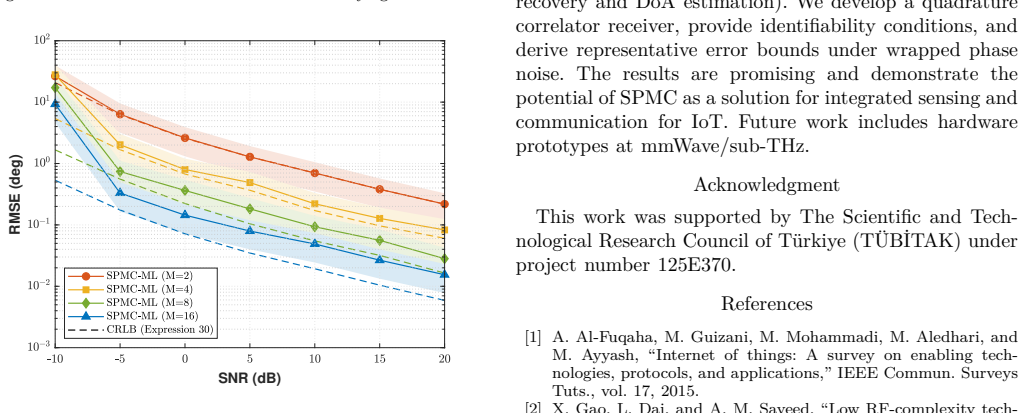
- [Performance analysis] The error-probability and sensing-precision analysis implicitly assumes that the phase-sign resolution step succeeds with probability 1. If the sign statistic is noisy or biased under realistic RF impairments, both the communication BER and the DoA estimation variance will be affected. The paper should either derive the joint error expression that includes the sign-resolution failure probability or provide Monte-Carlo results that isolate this impairment.
minor comments (2)
- [Signal model] The term 'phase-alphabet' is introduced without a compact mathematical definition or an example constellation diagram; adding one would clarify how symbols map to manifold points.
- [Numerical results] Several figures would benefit from explicit axis labels indicating whether the plotted quantity is the raw correlator output or the post-processed manifold coordinate.
Simulated Author's Rebuttal
We thank the referee for the constructive and insightful comments on our manuscript introducing SPMC for LO-free JCAS. The points raised highlight important aspects of the receiver architecture and performance analysis that merit clarification and expansion. We address each major comment below and indicate the revisions we will make.
read point-by-point responses
-
Referee: [Receiver architecture and signal model] The resolution of phase-sign ambiguity is load-bearing for the entire baseband observable. The LO-free quadrature spatial-correlator is asserted to produce an odd function of the inter-antenna phase difference without any shared phase reference. Conventional correlators yield even functions (e.g., cos(ϕ)); the quadrature paths must therefore generate a sign-distinguishing statistic. The manuscript should supply the explicit derivation of this statistic (including the RF multiplication and baseband combination steps) and show that residual common-mode phase or path imbalance does not collapse the sign information back to an even function.
Authors: We agree that the explicit derivation of the sign-resolving statistic is necessary to substantiate the central claim of the LO-free quadrature spatial-correlator. While Section III-B of the manuscript describes the architecture and states that it produces an odd function of the inter-antenna phase, the step-by-step derivation from the RF signal model through quadrature multiplications and baseband combining was not fully expanded. In the revised manuscript we will insert a complete derivation, including the mathematical expressions for the RF multiplication and baseband combination steps. We will also add an analysis showing that residual common-mode phase and path imbalance preserve the odd-function property and do not collapse the sign information to an even function. This material will be placed in a new subsection or appendix for clarity. revision: yes
-
Referee: [Performance analysis] The error-probability and sensing-precision analysis implicitly assumes that the phase-sign resolution step succeeds with probability 1. If the sign statistic is noisy or biased under realistic RF impairments, both the communication BER and the DoA estimation variance will be affected. The paper should either derive the joint error expression that includes the sign-resolution failure probability or provide Monte-Carlo results that isolate this impairment.
Authors: The referee is correct that the closed-form error-probability and sensing-precision expressions in Section IV are derived under the assumption of perfect sign resolution. This simplification was adopted to obtain tractable analytic results, but it leaves open the question of robustness to noisy sign statistics. We will revise the manuscript to include Monte-Carlo simulation results that isolate the effect of imperfect sign resolution under realistic RF impairments (phase noise, path imbalance, and additive noise). These simulations will report the resulting degradation in both communication BER and DoA estimation variance. If space allows, we will also outline the joint error expression that incorporates the sign-resolution failure probability. The new results will be presented in an updated Section IV or a dedicated subsection. revision: yes
Circularity Check
No significant circularity in SPMC derivation
full rationale
The paper defines a new signal model based on antenna-domain correlation producing a baseband observable from inter-antenna phase differences, then introduces an LO-free quadrature spatial-correlator architecture to resolve phase-sign ambiguity and recasts JCAS as inference on the unit-circle manifold. These elements are presented as original constructions rather than reductions of prior fitted parameters or self-citations. Error-probability and sensing-precision analyses are derived from the proposed model without evidence of self-definitional loops or load-bearing self-citations that force the central claims. The derivation chain remains self-contained against external benchmarks.
Axiom & Free-Parameter Ledger
axioms (2)
- domain assumption Antenna-domain correlation produces a baseband observable that depends only on inter-antenna phase differences and is independent of local oscillator phase.
- domain assumption Phase differences between antennas are deterministically tied to direction-of-arrival.
invented entities (3)
-
Spatial Phase Manifold Communications (SPMC)
no independent evidence
-
phase-alphabet
no independent evidence
-
LO-free quadrature spatial-correlator
no independent evidence
Lean theorems connected to this paper
-
IndisputableMonolith/Cost/FunctionalEquation.leanwashburn_uniqueness_aczel unclearVon Mises likelihood p(q|Δθ) ∝ exp(κ Re{q e^{-j(m-1)Δθ}})
Reference graph
Works this paper leans on
-
[1]
Internet of things: A survey on enabling tech- nologies, protocols, and applications,
A. Al-Fuqaha, M. Guizani, M. Mohammadi, M. Aledhari, and M. Ayyash, “Internet of things: A survey on enabling tech- nologies, protocols, and applications,” IEEE Commun. Surveys Tuts., vol. 17, 2015
work page 2015
-
[2]
X. Gao, L. Dai, and A. M. Sayeed, “Low RF-complexity tech- nologies to enable millimeter-wave MIMO with large antenna array for 5G wireless communications,” IEEE Commun. Mag., 2018
work page 2018
-
[3]
Hardware-constrained millimeter-wave systems for 5G: Chal- lenges, opportunities, and solutions,
X. Yang, M. Matthaiou, J. Yang, C.-K. Wen, F. Gao, and S. Jin, “Hardware-constrained millimeter-wave systems for 5G: Chal- lenges, opportunities, and solutions,” IEEE Commun. Mag., vol. 57, 2019
work page 2019
-
[4]
Integrating sensing and commu- nication for IoT systems: Task-oriented control perspective,
D. He, H. Hou, R. Jiang, X. Yu, Z. Zhao, Y. Mo, Y. Huang, W. Yu, and T. Q. S. Quek, “Integrating sensing and commu- nication for IoT systems: Task-oriented control perspective,” IEEE Internet Things Mag, vol. 7, 2024
work page 2024
-
[5]
Ultra-low power receivers for iot applications: A review,
D. D. Wentzloff, A. Alghaihab, and J. Im, “Ultra-low power receivers for iot applications: A review,” in Proc. IEEE CICC, 2020
work page 2020
-
[6]
Low-power RF wake- up receivers: Analysis, tradeoffs, and design,
P. P. Mercier, B. H. Calhoun, P.-H. P. Wang, A. Dissanayake, L. Zhang, D. A. Hall, and S. M. Bowers, “Low-power RF wake- up receivers: Analysis, tradeoffs, and design,” IEEE J. Solid- State Circuits, vol. 2, pp. 144–164, 2022
work page 2022
-
[7]
Wake-up receivers: A review of architectures analysis, design techniques, theories and fron- tiers,
S. Chen, X. Yu, and X. Huang, “Wake-up receivers: A review of architectures analysis, design techniques, theories and fron- tiers,” J. Low Power Electron. Appl., vol. 15, 2025
work page 2025
-
[8]
A 70-GHz 10.2-mW self-demodulator for OOK modulation in 65-nm CMOS technology,
X. Li, P. Baltus, P. van Zeijl, D. Milosevic, and A. van Roermund, “A 70-GHz 10.2-mW self-demodulator for OOK modulation in 65-nm CMOS technology,” in Proc. IEEE CICC, 2010
work page 2010
-
[9]
L. Godara, “Application of antenna arrays to mobile commu- nications. II. beam-forming and direction-of-arrival considera- tions,” Proc. IEEE, vol. 85, pp. 1195–1245, 1997
work page 1997
-
[10]
Enabling joint communication and radar sensing in mobile networks—a survey,
J. A. Zhang, M. L. Rahman, K. Wu, X. Huang, Y. J. Guo, S. Chen, and J. Yuan, “Enabling joint communication and radar sensing in mobile networks—a survey,” IEEE Commun. Surveys Tuts., vol. 24, pp. 306–345, 2022
work page 2022
-
[11]
M. Rajabi, N. Pan, S. Claessens, S. Pollin, and D. Schreurs, “Modulation techniques for simultaneous wireless information and power transfer with an integrated rectifier-receiver,” IEEE Trans. Microw. Theory Techn., vol. 66, pp. 2373–2385, 2018
work page 2018
-
[12]
Millimeter wave channel modeling and cellular capacity evaluation,
M. R. Akdeniz, Y. Liu, M. K. Samimi, S. Sun, S. Rangan, T. S. Rappaport, and E. Erkip, “Millimeter wave channel modeling and cellular capacity evaluation,” IEEE J. Sel. Areas Commun., vol. 32, 2014
work page 2014
-
[13]
N. I. Fisher, Statistical Analysis of Circular Data. Cambridge University Press, 1993
work page 1993
-
[14]
S. M. Kay, Fundamentals of Statistical Signal Processing, Volume I: Estimation Theory. Prentice Hall, 1993
work page 1993
-
[15]
H. L. V. Trees and K. L. Bell, Detection, Estimation, and Modulation Theory, Part I. Wiley, 2001
work page 2001
discussion (0)
Sign in with ORCID, Apple, or X to comment. Anyone can read and Pith papers without signing in.