Recognition: no theorem link
Breaking the Reward Barrier: Accelerating Tree-of-Thought Reasoning via Speculative Exploration
Pith reviewed 2026-05-12 03:48 UTC · model grok-4.3
The pith
Speculative path selection and early termination break the reward synchronization barrier to accelerate Tree-of-Thought reasoning 1.2 to 3 times.
A machine-rendered reading of the paper's core claim, the machinery that carries it, and where it could break.
Core claim
SPEX uses intra-query speculative path selection to expand high-potential branches, inter-query budget allocation to distribute resources, and adaptive early termination to cut unneeded depth, delivering 1.2 to 3 times speedup across ToT algorithms and up to 4.1 times when paired with token-level speculative decoding, all while preserving final answer quality.
What carries the argument
The SPEX speculative exploration mechanism, which predicts and expands high-potential reasoning branches before reward verification and applies dynamic allocation plus pruning to keep the search tree efficient.
If this is right
- ToT search can expand more branches in parallel without proportional increases in latency.
- Complex reasoning tasks become viable under tighter response-time limits.
- Existing ToT implementations gain immediate efficiency by adding the three SPEX techniques.
- Token-level speculative decoding and tree-level speculation multiply to produce cumulative gains up to 4.1 times.
- Reward model calls can occur less frequently while still guiding effective search.
Where Pith is reading between the lines
- The same prediction-and-prune pattern could apply to other tree or graph search methods used with language models.
- Serving systems might learn to adjust how aggressively they speculate based on observed task difficulty.
- Fewer reward evaluations per query could reduce total energy use in large-scale LLM deployments.
- The integration shown with SGLang indicates the methods can be added to production inference engines without major rewrites.
Load-bearing premise
That early predictions of promising branches and early termination of others will not miss correct solutions or lower final answer accuracy.
What would settle it
A controlled run on a standard math or code benchmark where SPEX at the reported speedups produces measurably lower accuracy than baseline ToT on the same model and task.
Figures





read the original abstract
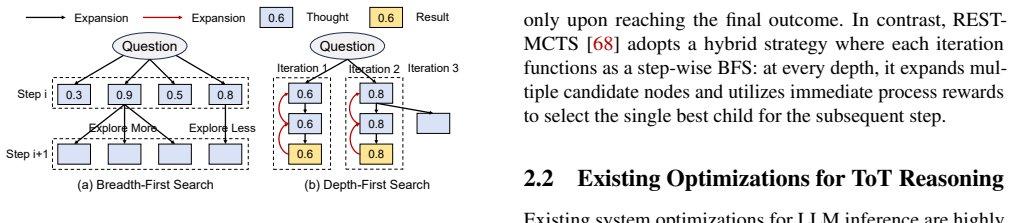
Tree-of-Thought (ToT) reasoning structures Large Language Model (LLM) inference as a tree-based search, demonstrating strong potential for solving complex mathematical and programming tasks. However, its efficiency is constrained by the reward dependency barrier -- a synchronization bottleneck caused by sequential reward-guided exploration that limits search parallelism and introduces substantial latency. Prior system optimizations, mainly designed for linear Chain-of-Thought (CoT) reasoning, cannot address these challenges, leaving the efficiency of ToT underexplored. To enhance ToT reasoning efficiency, we observe that the reasoning paths can be explored speculatively to break the reward synchronization barrier. Therefore, in this paper, we propose SPEX and introduce three key techniques: (i) intra-query speculative path selection to predict and expand high-potential branches of ToT, (ii) inter-query budget allocation to balance speculative resource allocation across queries dynamically, and (iii) adaptive early termination to prune deep and redundant branches for a skewed search tree. We implement SPEX on top of the SGLang framework and evaluate it across diverse ToT algorithms and LLMs. Extensive experiments show that SPEX achieves $1.2 \sim 3 \times$ speedup for different ToT reasoning algorithms. Moreover, SPEX synergizes with token-level speculative decoding, achieving cumulative speedups of up to $4.1\times$. Ablation studies further confirm the contributions of each technique. Overall, SPEX represents a significant step toward efficient and scalable ToT reasoning, unlocking the parallelism required for high-performance inference-time scaling for LLMs.
Editorial analysis
A structured set of objections, weighed in public.
Referee Report
Summary. The paper proposes SPEX to accelerate Tree-of-Thought (ToT) reasoning by breaking the reward synchronization barrier. It introduces three techniques: intra-query speculative path selection to expand high-potential branches, inter-query budget allocation for dynamic resource balancing across queries, and adaptive early termination to prune deep/redundant branches in skewed trees. Implemented on SGLang, experiments across ToT algorithms and LLMs report 1.2–3× speedups, up to 4.1× when combined with token-level speculative decoding, with ablations confirming each component's contribution.
Significance. If the reported speedups hold while preserving final answer correctness under the original ToT reward functions, this would represent a meaningful advance in inference-time scaling for complex reasoning tasks. The work directly targets the parallelism limitations of tree-based search that prior CoT-focused optimizations leave unaddressed, and the synergy with speculative decoding is a practical strength.
major comments (3)
- [§4] §4 (experimental evaluation): the 1.2–3× and 4.1× speedup claims are presented without per-task accuracy deltas, error bars, or worst-case path-loss statistics comparing SPEX outputs to baseline ToT under the original reward model. This is load-bearing because adaptive early termination and speculative selection could prune viable paths; the skeptic concern that quality equivalence is not demonstrated therefore remains unaddressed by the reported ablations.
- [§3.3] §3.3 (adaptive early termination): the technique is described as pruning 'deep and redundant branches' and 'high-potential branches' via prediction, yet no formal argument, invariant, or exhaustive enumeration is supplied showing that pruned branches never contain the optimal solution under the original ToT reward function. If the predictor has even modest error at deeper levels, the latency gains could be offset by hidden verification cost or accuracy loss.
- [§3.1–3.2] §3.1–3.2 (speculative path selection and budget allocation): the intra-query and inter-query mechanisms rely on predictors whose error rates and fallback costs are not quantified; without these measurements it is impossible to verify that the claimed cumulative speedups are net-positive once any required re-verification or re-expansion is included.
minor comments (2)
- [Abstract] The abstract and introduction would benefit from an explicit statement of the baseline ToT implementations and reward models used, to allow readers to assess the generality of the 1.2–3× range.
- [§3] Notation for the speculative predictor and early-termination threshold is introduced without a consolidated table of symbols or hyperparameters, making it harder to reproduce the exact conditions under which the speedups were measured.
Simulated Author's Rebuttal
We thank the referee for the constructive feedback and for recognizing the potential of SPEX to address parallelism limitations in Tree-of-Thought reasoning. We address each major comment below and describe the revisions we will make to provide stronger empirical validation and analysis.
read point-by-point responses
-
Referee: [§4] §4 (experimental evaluation): the 1.2–3× and 4.1× speedup claims are presented without per-task accuracy deltas, error bars, or worst-case path-loss statistics comparing SPEX outputs to baseline ToT under the original reward model. This is load-bearing because adaptive early termination and speculative selection could prune viable paths; the skeptic concern that quality equivalence is not demonstrated therefore remains unaddressed by the reported ablations.
Authors: We agree that explicit demonstration of quality equivalence is essential. While our internal evaluations confirmed that final answers match baseline ToT under the original reward model across tasks, the manuscript reports only aggregate speedups and component ablations without per-task accuracy deltas, error bars, or worst-case path statistics. In the revised version we will add tables reporting accuracy for each task and LLM, standard deviations from repeated runs, and analysis of path divergence cases to confirm that correctness is preserved. revision: yes
-
Referee: [§3.3] §3.3 (adaptive early termination): the technique is described as pruning 'deep and redundant branches' and 'high-potential branches' via prediction, yet no formal argument, invariant, or exhaustive enumeration is supplied showing that pruned branches never contain the optimal solution under the original ToT reward function. If the predictor has even modest error at deeper levels, the latency gains could be offset by hidden verification cost or accuracy loss.
Authors: The adaptive early termination employs a learned predictor to estimate whether further expansion of a branch is unlikely to improve the reward. A strict formal invariant guaranteeing that no optimal path is pruned is difficult to establish without restrictive assumptions on the reward function and LLM behavior. However, our experiments across diverse tasks show no accuracy degradation. We will expand §3.3 with additional details on predictor training, validation metrics, and a discussion of empirical safety conditions and fallback costs. revision: partial
-
Referee: [§3.1–3.2] §3.1–3.2 (speculative path selection and budget allocation): the intra-query and inter-query mechanisms rely on predictors whose error rates and fallback costs are not quantified; without these measurements it is impossible to verify that the claimed cumulative speedups are net-positive once any required re-verification or re-expansion is included.
Authors: We acknowledge that the error rates of the predictors and the overhead of any corrective re-expansions or re-verifications were not quantified in the initial submission. The manuscript focuses on end-to-end speedups and ablations, but additional breakdown is needed to confirm net gains. In the revision we will include new measurements of predictor accuracy, frequency of fallback events, and their latency contributions, allowing verification that the reported speedups remain positive after accounting for these costs. revision: yes
Circularity Check
No significant circularity in algorithmic proposal or empirical claims
full rationale
The paper proposes SPEX as a set of new algorithmic techniques (intra-query speculative path selection, inter-query budget allocation, adaptive early termination) implemented on SGLang and evaluated empirically on ToT algorithms and LLMs. Speedup claims (1.2-3x, up to 4.1x cumulative) rest on reported measurements and ablation studies rather than any equations, fitted parameters, or derivations. No self-citations are invoked as load-bearing premises, no uniqueness theorems are imported, and no ansatz or renaming of known results occurs. The central claims are self-contained experimental results without reduction to inputs by construction.
Axiom & Free-Parameter Ledger
Reference graph
Works this paper leans on
-
[1]
Llemma: An open language model for mathematics
Zhangir Azerbayev, Hailey Schoelkopf, Keiran Paster, Marco Dos Santos, Stephen McAleer, Albert Q Jiang, Jia Deng, Stella Biderman, and Sean Welleck. Llemma: An open language model for mathematics.arXiv preprint arXiv:2310.10631, 2023
-
[2]
Scal- ing test-time compute with open models
Edward Beeching, Lewis Tunstall, and Sasha Rush. Scal- ing test-time compute with open models. 2024. Hugging Face Technical Report
work page 2024
-
[3]
Large Language Monkeys: Scaling Inference Compute with Repeated Sampling
Bradley Brown, Jordan Juravsky, Ryan Ehrlich, Ronald Clark, Quoc V Le, Christopher Ré, and Azalia Mirho- seini. Large language monkeys: Scaling inference compute with repeated sampling.arXiv preprint arXiv:2407.21787, 2024
work page internal anchor Pith review arXiv 2024
-
[4]
brown university math olympiad 2025
BRUMO. brown university math olympiad 2025. https://www.brumo.org/, 2025
work page 2025
-
[5]
Monte-carlo tree search: A new frame- work for game ai
Guillaume Chaslot, Sander Bakkes, Istvan Szita, and Pieter Spronck. Monte-carlo tree search: A new frame- work for game ai. InProceedings of the AAAI Confer- ence on Artificial Intelligence and Interactive Digital Entertainment, volume 4, pages 216–217, 2008
work page 2008
-
[6]
Accelerating Large Language Model Decoding with Speculative Sampling
Charlie Chen, Sebastian Borgeaud, Geoffrey Irving, Jean-Baptiste Lespiau, Laurent Sifre, and John Jumper. Accelerating large language model decoding with specu- lative sampling.arXiv preprint arXiv:2302.01318, 2023
work page internal anchor Pith review Pith/arXiv arXiv 2023
-
[7]
Mcc-kd: Multi-cot consistent knowledge distillation.arXiv preprint arXiv:2310.14747, 2023
Hongzhan Chen, Siyue Wu, Xiaojun Quan, Rui Wang, Ming Yan, and Ji Zhang. Mcc-kd: Multi-cot consistent knowledge distillation.arXiv preprint arXiv:2310.14747, 2023
-
[8]
Lingjiao Chen, Jared Quincy Davis, Boris Hanin, Peter Bailis, Ion Stoica, Matei A Zaharia, and James Y Zou. Are more llm calls all you need? towards the scaling properties of compound ai systems.Advances in Neu- ral Information Processing Systems, 37:45767–45790, 2024
work page 2024
-
[9]
Xiao Chen, Sihang Zhou, Ke Liang, Xiaoyu Sun, and Xinwang Liu. Skip-thinking: Chunk-wise chain- of-thought distillation enable smaller language mod- els to reason better and faster.arXiv preprint arXiv:2505.18642, 2025
-
[10]
Do NOT Think That Much for 2+3=? On the Overthinking of o1-Like LLMs
Xingyu Chen, Jiahao Xu, Tian Liang, Zhiwei He, Jian- hui Pang, Dian Yu, Linfeng Song, Qiuzhi Liu, Mengfei Zhou, Zhuosheng Zhang, et al. Do not think that much for 2+ 3=? on the overthinking of o1-like llms.arXiv preprint arXiv:2412.21187, 2024
work page internal anchor Pith review arXiv 2024
-
[11]
Self-playing adversarial language game enhances llm reasoning
Pengyu Cheng, Yong Dai, Tianhao Hu, Han Xu, Zhisong Zhang, Lei Han, Nan Du, and Xiaolong Li. Self-playing adversarial language game enhances llm reasoning. Advances in Neural Information Processing Systems, 37:126515–126543, 2024
work page 2024
-
[12]
Speculative monte-carlo tree search
Scott Cheng, Mahmut Taylan Kandemir, and Ding-Yong Hong. Speculative monte-carlo tree search. InAdvances in Neural Information Processing Systems, pages 88664– 88683, 2024
work page 2024
-
[13]
Zheng Chu, Jingchang Chen, Qianglong Chen, Wei- jiang Yu, Tao He, Haotian Wang, Weihua Peng, Ming Liu, Bing Qin, and Ting Liu. Navigate through enig- matic labyrinth a survey of chain of thought reason- ing: Advances, frontiers and future.arXiv preprint arXiv:2309.15402, 2023
-
[14]
Training Verifiers to Solve Math Word Problems
Karl Cobbe, Vineet Kosaraju, Mohammad Bavarian, Mark Chen, Heewoo Jun, Lukasz Kaiser, Matthias Plap- pert, Jerry Tworek, Jacob Hilton, Reiichiro Nakano, et al. Training verifiers to solve math word problems.arXiv preprint arXiv:2110.14168, 2021
work page internal anchor Pith review Pith/arXiv arXiv 2021
-
[15]
Tri Dao, Dan Fu, Stefano Ermon, Atri Rudra, and Christopher Ré. Flashattention: Fast and memory- efficient exact attention with io-awareness.Advances in neural information processing systems, 35:16344– 16359, 2022
work page 2022
-
[16]
arXiv preprint arXiv:2309.17179 , year=
Xidong Feng, Ziyu Wan, Muning Wen, Stephen Mar- cus McAleer, Ying Wen, Weinan Zhang, and Jun Wang. Alphazero-like tree-search can guide large lan- guage model decoding and training.arXiv preprint arXiv:2309.17179, 2023
-
[17]
Efficiently serving llm reasoning programs with certaindex
Yichao Fu, Junda Chen, Siqi Zhu, Zheyu Fu, Zhong- dongming Dai, Yonghao Zhuang, Yian Ma, Aurick Qiao, Tajana Rosing, Ion Stoica, et al. Efficiently scal- ing llm reasoning with certaindex.arXiv preprint arXiv:2412.20993, 2024
-
[18]
Deep think with confidence, 2025
Yichao Fu, Xuewei Wang, Yuandong Tian, and Jiawei Zhao. Deep think with confidence, 2025
work page 2025
-
[19]
Interpretable contrastive monte carlo tree search reasoning
Zitian Gao, Boye Niu, Xuzheng He, Haotian Xu, Hongzhang Liu, Aiwei Liu, Xuming Hu, and Lijie Wen. Interpretable contrastive monte carlo tree search reason- ing.arXiv preprint arXiv:2410.01707, 2024
-
[20]
DeepSeek-R1: Incentivizing Reasoning Capability in LLMs via Reinforcement Learning
Daya Guo, Dejian Yang, Haowei Zhang, Junxiao Song, Ruoyu Zhang, Runxin Xu, Qihao Zhu, Shirong Ma, Peiyi Wang, Xiao Bi, et al. Deepseek-r1: Incentivizing reasoning capability in llms via reinforcement learning. arXiv preprint arXiv:2501.12948, 2025. 13
work page internal anchor Pith review Pith/arXiv arXiv 2025
-
[21]
Measuring Mathematical Problem Solving With the MATH Dataset
Dan Hendrycks, Collin Burns, Saurav Kadavath, Akul Arora, Steven Basart, Eric Tang, Dawn Song, and Jacob Steinhardt. Measuring mathematical problem solving with the math dataset.arXiv preprint arXiv:2103.03874, 2021
work page internal anchor Pith review Pith/arXiv arXiv 2021
-
[22]
Harvard-MIT Mathematics Tour- nament (HMMT) February 2025
HMMT Organization. Harvard-MIT Mathematics Tour- nament (HMMT) February 2025. https://www.hmmt. org, 2025
work page 2025
-
[23]
Ets: Efficient tree search for inference- time scaling.arXiv preprint arXiv:2502.13575, 2025
Coleman Hooper, Sehoon Kim, Suhong Moon, Kerem Dilmen, Monishwaran Maheswaran, Nicholas Lee, Michael W Mahoney, Sophia Shao, Kurt Keutzer, and Amir Gholami. Ets: Efficient tree search for inference- time scaling.arXiv preprint arXiv:2502.13575, 2025
-
[24]
arXiv preprint arXiv:2504.01296 , year=
Bairu Hou, Yang Zhang, Jiabao Ji, Yujian Liu, Kaizhi Qian, Jacob Andreas, and Shiyu Chang. Thinkprune: Pruning long chain-of-thought of llms via reinforcement learning.arXiv preprint arXiv:2504.01296, 2025
-
[25]
Juhwan Kim, Byeongmin Kang, and Hyungmin Cho. Specmcts: Accelerating monte carlo tree search us- ing speculative tree traversal.IEEE Access, 9:142195– 142205, 2021
work page 2021
-
[26]
Takeshi Kojima, Shixiang Shane Gu, Machel Reid, Yu- taka Matsuo, and Yusuke Iwasawa. Large language models are zero-shot reasoners.Advances in neural in- formation processing systems, 35:22199–22213, 2022
work page 2022
-
[27]
Efficient memory manage- ment for large language model serving with pagedatten- tion
Woosuk Kwon, Zhuohan Li, Siyuan Zhuang, Ying Sheng, Lianmin Zheng, Cody Hao Yu, Joseph Gonzalez, Hao Zhang, and Ion Stoica. Efficient memory manage- ment for large language model serving with pagedatten- tion. InProceedings of the 29th symposium on operating systems principles, pages 611–626, 2023
work page 2023
-
[28]
Fast inference from transformers via speculative decoding
Yaniv Leviathan, Matan Kalman, and Yossi Matias. Fast inference from transformers via speculative decoding. In International Conference on Machine Learning, pages 19274–19286. PMLR, 2023
work page 2023
-
[29]
Jinhao Li, Jiaming Xu, Shan Huang, Yonghua Chen, Wen Li, Jun Liu, Yaoxiu Lian, Jiayi Pan, Li Ding, Hao Zhou, et al. Large language model inference acceler- ation: A comprehensive hardware perspective.arXiv preprint arXiv:2410.04466, 2024
-
[30]
Sixu Li, Yuzhou Chen, Chaojian Li, Yonggan Fu, Zheng Wang, Zhongzhi Yu, Haoran You, Zhifan Ye, Wei Zhou, Yongan Zhang, and Yingyan (Celine) Lin. Orches: Or- chestrated test-time-compute-based llm reasoning on collaborative gpu-pim heterogeneous system. InPro- ceedings of the 58th IEEE/ACM International Sympo- sium on Microarchitecture, MICRO ’25, page 476...
work page 2025
-
[31]
Making language models better reasoners with step-aware verifier
Yifei Li, Zeqi Lin, Shizhuo Zhang, Qiang Fu, Bei Chen, Jian-Guang Lou, and Weizhu Chen. Making language models better reasoners with step-aware verifier. InPro- ceedings of the 61st Annual Meeting of the Association for Computational Linguistics (Volume 1: Long Papers), pages 5315–5333, 2023
work page 2023
-
[32]
Yiwei Li, Peiwen Yuan, Shaoxiong Feng, Boyuan Pan, Xinglin Wang, Bin Sun, Heda Wang, and Kan Li. Escape sky-high cost: Early-stopping self-consistency for multi- step reasoning.arXiv preprint arXiv:2401.10480, 2024
-
[33]
Reward-guided speculative decoding for efficient llm reasoning
Baohao Liao, Yuhui Xu, Hanze Dong, Junnan Li, Christof Monz, Silvio Savarese, Doyen Sahoo, and Caiming Xiong. Reward-guided speculative de- coding for efficient llm reasoning.arXiv preprint arXiv:2501.19324, 2025
-
[34]
Hunter Lightman, Vineet Kosaraju, Yuri Burda, Harrison Edwards, Bowen Baker, Teddy Lee, Jan Leike, John Schulman, Ilya Sutskever, and Karl Cobbe. Let’s verify step by step. InThe Twelfth International Conference on Learning Representations, 2023
work page 2023
-
[35]
Trimr: Verifier-based training-free thinking compression for efficient test-time scaling
Weizhe Lin, Xing Li, Zhiyuan Yang, Xiaojin Fu, Hui- Ling Zhen, Yaoyuan Wang, Xianzhi Yu, Wulong Liu, Xiaosong Li, and Mingxuan Yuan. Trimr: Verifier-based training-free thinking compression for efficient test-time scaling.arXiv preprint arXiv:2505.17155, 2025
-
[36]
Runze Liu, Junqi Gao, Jian Zhao, Kaiyan Zhang, Xiu Li, Biqing Qi, Wanli Ouyang, and Bowen Zhou. Can 1b llm surpass 405b llm? rethinking compute-optimal test-time scaling.arXiv preprint arXiv:2502.06703, 2025
-
[37]
Jinghui Lu, Haiyang Yu, Siliang Xu, Shiwei Ran, Guozhi Tang, Siqi Wang, Bin Shan, Teng Fu, Hao Feng, Jingqun Tang, et al. Prolonged reasoning is not all you need: Certainty-based adaptive routing for efficient llm/mllm reasoning.arXiv preprint arXiv:2505.15154, 2025
-
[38]
Autol2s: Auto long-short reasoning for efficient large language models
Feng Luo, Yu-Neng Chuang, Guanchu Wang, Hoang Anh Duy Le, Shaochen Zhong, Hongyi Liu, Jiayi Yuan, Yang Sui, Vladimir Braverman, Vipin Chaudhary, et al. Autol2s: Auto long-short reasoning for efficient large language models.arXiv preprint arXiv:2505.22662, 2025
-
[39]
American Invita- tional Mathematics Examination (AIME) 2024
Mathematical Association of America. American Invita- tional Mathematics Examination (AIME) 2024. https: //www.maa.org/math-competitions/aime, 2024
work page 2024
-
[40]
American Invita- tional Mathematics Examination (AIME) 2025
Mathematical Association of America. American Invita- tional Mathematics Examination (AIME) 2025. https: //www.maa.org/math-competitions/aime, 2025. 14
work page 2025
-
[41]
Jianmo Ni, Chen Qu, Jing Lu, Zhuyun Dai, Gus- tavo Hernández Ábrego, Ji Ma, Vincent Y
Xuefei Ning, Zinan Lin, Zixuan Zhou, Zifu Wang, Huazhong Yang, and Yu Wang. Skeleton-of-thought: Prompting llms for efficient parallel generation.arXiv preprint arXiv:2307.15337, 2023
-
[42]
OpenAI. Learning to reason with llms. Technical report, OpenAI, 2024. Technical Report
work page 2024
-
[43]
OpenAI. OpenAI O3-mini System Card. Technical report, OpenAI, January 2025. Technical Report
work page 2025
-
[44]
Specrea- son: Fast and accurate inference-time compute via speculative reasoning
Rui Pan, Yinwei Dai, Zhihao Zhang, Gabriele Oliaro, Zhihao Jia, and Ravi Netravali. Specreason: Fast and ac- curate inference-time compute via speculative reasoning. arXiv preprint arXiv:2504.07891, 2025
-
[45]
Optimizing anytime reasoning via budget relative policy optimization
Penghui Qi, Zichen Liu, Tianyu Pang, Chao Du, Wee Sun Lee, and Min Lin. Optimizing anytime rea- soning via budget relative policy optimization.arXiv preprint arXiv:2505.13438, 2025
-
[46]
Mutual reasoning makes smaller llms stronger problem-solvers,
Zhenting Qi, Mingyuan Ma, Jiahang Xu, Li Lyna Zhang, Fan Yang, and Mao Yang. Mutual reasoning makes smaller llms stronger problem-solvers.arXiv preprint arXiv:2408.06195, 2024
-
[47]
TreeBoN: Enhancing Inference-Time Alignment with Speculative Tree-Search and Best-of-N Sampling,
Jiahao Qiu, Yifu Lu, Yifan Zeng, Jiacheng Guo, Jiayi Geng, Huazheng Wang, Kaixuan Huang, Yue Wu, and Mengdi Wang. Treebon: Enhancing inference-time alignment with speculative tree-search and best-of-n sampling.arXiv preprint arXiv:2410.16033, 2024
-
[48]
Scalable fsm parallelization via path fusion and higher-order speculation
Junqiao Qiu, Xiaofan Sun, Amir Hossein Nodehi Sabet, and Zhijia Zhao. Scalable fsm parallelization via path fusion and higher-order speculation. InProceedings of the 26th ACM International Conference on Architectural Support for Programming Languages and Operating Systems, ASPLOS ’21, page 887–901, New York, NY , USA, 2021. Association for Computing Machinery
work page 2021
-
[49]
Speccot: Accelerating chain-of-thought reasoning through speculative exploration
Junhan Shi, Yijia Zhu, Zhenning Shi, Dan Zhao, Qing Li, and Yong Jiang. Speccot: Accelerating chain-of-thought reasoning through speculative exploration. InES-FoMo III: 3rd Workshop on Efficient Systems for Foundation Models
-
[50]
Scaling LLM Test-Time Compute Optimally can be More Effective than Scaling Model Parameters
Charlie Snell, Jaehoon Lee, Kelvin Xu, and Aviral Ku- mar. Scaling llm test-time compute optimally can be more effective than scaling model parameters.arXiv preprint arXiv:2408.03314, 2024
work page internal anchor Pith review Pith/arXiv arXiv 2024
-
[51]
Sky-t1: Train your own o1 preview model within $450, 2025
NovaSky Team. Sky-t1: Train your own o1 preview model within $450, 2025
work page 2025
-
[52]
Qwq: Reflect deeply on the boundaries of the unknown.Hugging Face, 2024
Qwen Team. Qwq: Reflect deeply on the boundaries of the unknown.Hugging Face, 2024
work page 2024
-
[53]
Xu Wan, Wei Wang, Wenyue Xu, Wotao Yin, Jie Song, and Mingyang Sun. Adapthink: Adaptive thinking pref- erences for reasoning language model.arXiv preprint arXiv:2506.18237, 2025
-
[54]
Q*: Improving multi-step reasoning for llms with deliberative planning,
Chaojie Wang, Yanchen Deng, Zhiyi Lyu, Liang Zeng, Jujie He, Shuicheng Yan, and Bo An. Q*: Improving multi-step reasoning for llms with deliberative planning. arXiv preprint arXiv:2406.14283, 2024
-
[55]
Jun Wang, Meng Fang, Ziyu Wan, Muning Wen, Jiachen Zhu, Anjie Liu, Ziqin Gong, Yan Song, Lei Chen, Li- onel M Ni, et al. Openr: An open source framework for advanced reasoning with large language models.arXiv preprint arXiv:2410.09671, 2024
-
[56]
R1-compress: Long chain-of-thought compression via chunk compression and search
Yibo Wang, Li Shen, Huanjin Yao, Tiansheng Huang, Rui Liu, Naiqiang Tan, Jiaxing Huang, Kai Zhang, and Dacheng Tao. R1-compress: Long chain-of-thought compression via chunk compression and search.arXiv preprint arXiv:2505.16838, 2025
-
[57]
Adaptive deep reasoning: Triggering deep thinking when needed.arXiv preprint arXiv:2505.20101, 2025
Yunhao Wang, Yuhao Zhang, Tinghao Yu, Can Xu, Feng Zhang, and Fengzong Lian. Adaptive deep reasoning: Triggering deep thinking when needed.arXiv preprint arXiv:2505.20101, 2025
-
[58]
Jason Wei, Xuezhi Wang, Dale Schuurmans, Maarten Bosma, Fei Xia, Ed Chi, Quoc V Le, Denny Zhou, et al. Chain-of-thought prompting elicits reasoning in large language models.Advances in neural information pro- cessing systems, 35:24824–24837, 2022
work page 2022
-
[59]
Inference scaling laws: An empirical analysis of compute-optimal inference for llm problem- solving
Yangzhen Wu, Zhiqing Sun, Shanda Li, Sean Welleck, and Yiming Yang. Inference scaling laws: An empirical analysis of compute-optimal inference for llm problem- solving. InThe Thirteenth International Conference on Learning Representations, 2025
work page 2025
-
[60]
Heming Xia, Yongqi Li, Jun Zhang, Cunxiao Du, and Wenjie Li
Heming Xia, Zhe Yang, Qingxiu Dong, Peiyi Wang, Yongqi Li, Tao Ge, Tianyu Liu, Wenjie Li, and Zhifang Sui. Unlocking efficiency in large language model infer- ence: A comprehensive survey of speculative decoding. arXiv preprint arXiv:2401.07851, 2024
-
[61]
Lillicrap, Kenji Kawaguchi, and Michael Shieh
Yuxi Xie, Anirudh Goyal, Wenyue Zheng, Min-Yen Kan, Timothy P Lillicrap, Kenji Kawaguchi, and Michael Shieh. Monte carlo tree search boosts reasoning via iterative preference learning.arXiv preprint arXiv:2405.00451, 2024
-
[62]
An Yang, Anfeng Li, Baosong Yang, Beichen Zhang, Binyuan Hui, Bo Zheng, Bowen Yu, Chang Gao, Chen- gen Huang, Chenxu Lv, Chujie Zheng, Dayiheng Liu, Fan Zhou, Fei Huang, Feng Hu, Hao Ge, Haoran Wei, Huan Lin, Jialong Tang, Jian Yang, Jianhong Tu, Jian- wei Zhang, Jianxin Yang, Jiaxi Yang, Jing Zhou, Jingren 15 Zhou, Junyang Lin, Kai Dang, Keqin Bao, Kexin...
work page 2025
-
[63]
Speculative thinking: En- hancing small-model reasoning with large model guidance at inference time
Wang Yang, Xiang Yue, Vipin Chaudhary, and Xiao- tian Han. Speculative thinking: Enhancing small-model reasoning with large model guidance at inference time. arXiv preprint arXiv:2504.12329, 2025
-
[64]
Shunyu Yao, Dian Yu, Jeffrey Zhao, Izhak Shafran, Tom Griffiths, Yuan Cao, and Karthik Narasimhan. Tree of thoughts: Deliberate problem solving with large lan- guage models.Advances in neural information process- ing systems, 36:11809–11822, 2023
work page 2023
-
[65]
Zihao Ye, Lequn Chen, Ruihang Lai, Wuwei Lin, Yineng Zhang, Stephanie Wang, Tianqi Chen, Baris Kasikci, Vinod Grover, Arvind Krishnamurthy, et al. Flashin- fer: Efficient and customizable attention engine for llm inference serving.arXiv preprint arXiv:2501.01005, 2025
-
[66]
Advancing llm reasoning generalists with preference trees
Lifan Yuan, Ganqu Cui, Hanbin Wang, Ning Ding, Xingyao Wang, Jia Deng, Boji Shan, Huimin Chen, Ruobing Xie, Yankai Lin, et al. Advancing llm rea- soning generalists with preference trees.arXiv preprint arXiv:2404.02078, 2024
-
[67]
Linan Yue, Yichao Du, Yizhi Wang, Weibo Gao, Fangzhou Yao, Li Wang, Ye Liu, Ziyu Xu, Qi Liu, Shimin Di, et al. Don’t overthink it: A survey of ef- ficient r1-style large reasoning models.arXiv preprint arXiv:2508.02120, 2025
-
[68]
Dan Zhang, Sining Zhoubian, Ziniu Hu, Yisong Yue, Yuxiao Dong, and Jie Tang. Rest-mcts*: Llm self- training via process reward guided tree search.Advances in Neural Information Processing Systems, 37:64735– 64772, 2024
work page 2024
-
[69]
More agents is all you need.Transactions on Machine Learning Research
Qin Zhang, Yangbin Yu, QIANG FU, Deheng Ye, et al. More agents is all you need.Transactions on Machine Learning Research
-
[70]
Can pruning improve reasoning? revisiting long-cot compression with capability in mind
Shangziqi Zhao, Jiahao Yuan, Guisong Yang, and Us- man Naseem. Can pruning improve reasoning? revisit- ing long-cot compression with capability in mind for bet- ter reasoning.arXiv preprint arXiv:2505.14582, 2025
-
[71]
Lianmin Zheng, Liangsheng Yin, Zhiqiang Xie, Chuyue Livia Sun, Jeff Huang, Cody Hao Yu, Shiyi Cao, Christos Kozyrakis, Ion Stoica, Joseph E Gonzalez, et al. Sglang: Efficient execution of structured language model programs.Advances in neural information pro- cessing systems, 37:62557–62583, 2024
work page 2024
-
[72]
Anni Zou, Zhuosheng Zhang, Hai Zhao, and Xiangru Tang. Generalizable chain-of-thought prompting in mixed-task scenarios with large language models.arXiv preprint arXiv:2310.06692, 2023. 16
discussion (0)
Sign in with ORCID, Apple, or X to comment. Anyone can read and Pith papers without signing in.