Recognition: 2 theorem links
· Lean TheoremControlled Penumbral Inflation from Monodromic Valleys
Pith reviewed 2026-05-12 03:26 UTC · model grok-4.3
The pith
Local branch data already determine if monodromic valleys support controlled inflation.
A machine-rendered reading of the paper's core claim, the machinery that carries it, and where it could break.
Core claim
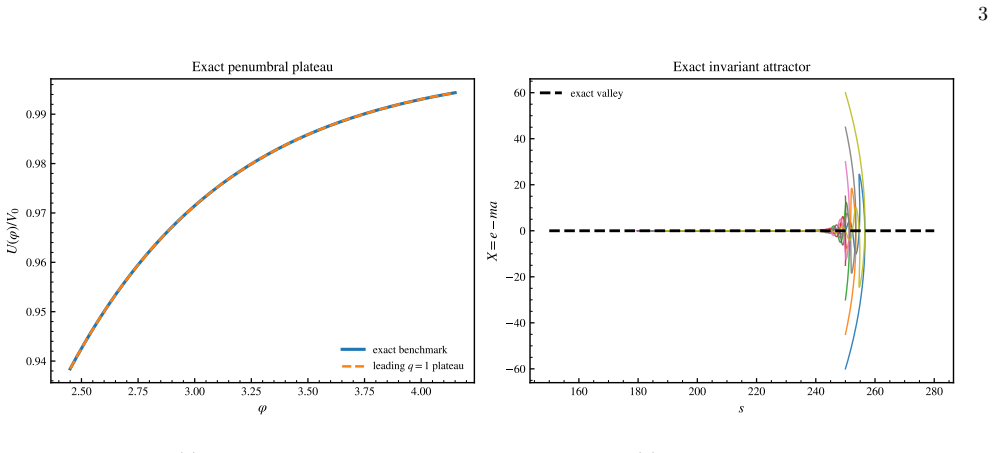
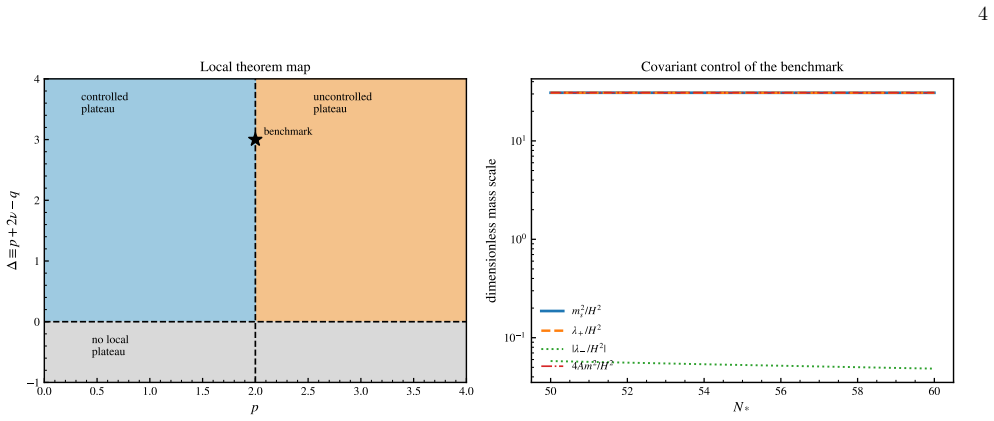
In the axion-saxion effective theory on these valleys, the branch-displacing odd term generates an inflationary plateau whenever Δ ≡ p + 2ν − q > 0. Covariant single-clock control holds for p < 2, or for p = 2 provided 12 A_pm² / V_0 ≫ 1 over the observational window. A minimal analytic family supplies a closed-form valley together with an invariant attractor equation that solves the complete two-field dynamics exactly and stays predictive at the subsequent penumbral order.
What carries the argument
The branch-displacing odd term in the axion-saxion effective theory on the monodromic valley, which creates the plateau under the Δ > 0 condition and supplies an invariant attractor equation for the two-field dynamics.
If this is right
- Penumbral valleys are partitioned into no-plateau, uncontrolled-plateau, and controlled-plateau classes using only local branch data.
- The minimal analytic family supplies the first exactly solvable penumbral inflationary model.
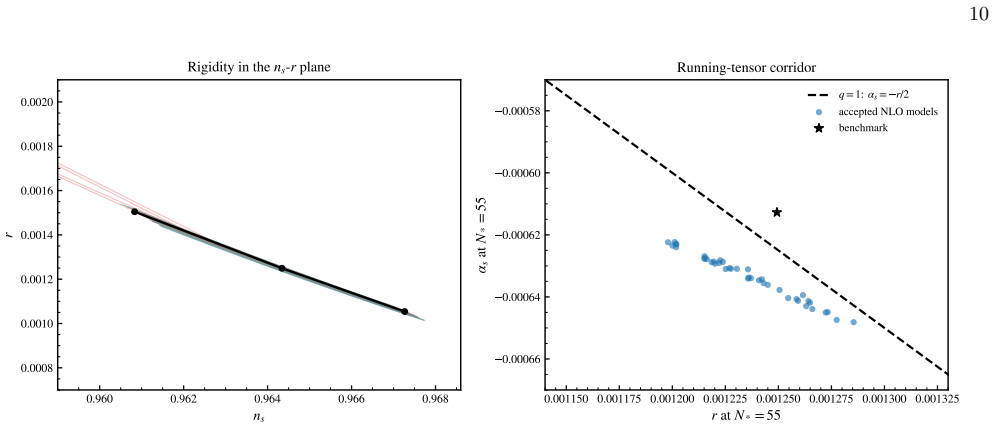
- Predictions from the controlled plateau remain stable when the next penumbral correction is restored.
- The penumbra is elevated from a geometric hint to a concrete, predictive search principle for inflationary models.
Where Pith is reading between the lines
- String compactifications realizing the required ranges of Δ and p could be searched for systematically.
- The same local-data criterion might be applied to other regions of moduli space to locate additional controlled inflationary windows.
- The attractor solution yields concrete predictions for the scalar spectral index and tensor-to-scalar ratio that can be compared with CMB data.
Load-bearing premise
The local effective theory remains valid and single-clock throughout the observable window, and higher-order penumbral corrections do not destroy the plateau or the attractor before inflation ends.
What would settle it
Explicit computation of the next penumbral-order corrections for the minimal analytic family, followed by a check that the attractor equation and the required number of e-folds survive over the field range needed for inflation.
Figures



read the original abstract
Long monodromic valleys arise in the penumbra of complex-structure moduli space. We show that their local branch data already determine whether they support controlled inflation, and thereby isolate the first controlled penumbral inflationary window. In the axion--saxion effective theory given in Eq.4, a branch-displacing odd term generates a plateau when $\Delta\equiv p+2\nu-q>0$, while covariant single-clock control further requires $p<2$, or $p=2$ with $12A_pm^2/V_0\gg1$ over the observational window. This splits penumbral valleys into no plateau, uncontrolled plateau, and controlled plateau before global completion is attempted. We identify a minimal analytic family with a closed-form valley and an invariant attractor equation for the full two-field dynamics, providing the first exactly solvable penumbral realization that remains predictive under the next penumbral order. The penumbra is thus promoted from a geometric suggestion to a predictive search principle.
Editorial analysis
A structured set of objections, weighed in public.
Referee Report
Summary. The paper argues that long monodromic valleys in the penumbra of complex-structure moduli space support controlled inflation, with local branch data sufficient to classify them. In the axion-saxion effective theory of Eq. 4, a branch-displacing odd term produces a plateau when Δ ≡ p + 2ν − q > 0, while covariant single-clock control requires p < 2 (or p = 2 with 12 A_pm² / V_0 ≫ 1 over the observational window). It identifies a minimal analytic family possessing a closed-form valley and an invariant attractor equation for the two-field dynamics, claiming this realization remains predictive under the next penumbral order and thereby promotes the penumbra to a predictive search principle.
Significance. If the central claims hold, the work would be significant for string cosmology: it isolates the first controlled penumbral inflationary window from local data alone, supplies an exactly solvable two-field model with an invariant attractor, and converts a geometric suggestion into a concrete classification (no-plateau, uncontrolled-plateau, controlled-plateau) without requiring global completion. The explicit parameter conditions and the assertion of robustness under higher-order corrections would provide a falsifiable search criterion for inflationary valleys in moduli space.
major comments (3)
- [analytic family / invariant attractor equation] The claim that the model 'remains predictive under the next penumbral order' (abstract and § on the analytic family) is load-bearing for the controlled-plateau classification, yet the manuscript does not exhibit an explicit computation of the next-order penumbral corrections to the potential or to the attractor equation. Without this, it is impossible to verify that the plateau condition Δ > 0 and the slow-roll parameters remain intact over the full observational window of ~50–60 e-folds.
- [Eq. 4 and parameter discussion] The covariant single-clock control criterion p < 2 (or the p = 2 case with 12 A_pm² / V_0 ≫ 1) is stated in terms of the effective-theory parameters introduced in Eq. 4, but the manuscript does not demonstrate that these parameters are fixed by the underlying string geometry rather than tuned to satisfy the bound. If they are free, the 'controlled' window is not isolated by local branch data alone.
- [two-field dynamics / attractor equation] The invariant attractor equation is presented as guaranteeing single-clock behavior, but no explicit check is given that the orthogonal (saxion) mode remains stabilized when the next penumbral terms are restored, nor is an error estimate supplied for the deviation from the attractor over the required number of e-folds.
minor comments (2)
- [Eq. 4] Notation for A_pm and V_0 is introduced in Eq. 4 without an immediate reminder of their origin in the monodromic expansion; a brief parenthetical or footnote would improve readability.
- [abstract] The abstract refers to 'the first controlled penumbral inflationary window' but does not cite prior penumbral or monodromic inflation literature for context; adding 1–2 references would clarify the novelty.
Simulated Author's Rebuttal
We thank the referee for the thorough review and valuable feedback on our manuscript. We address each of the major comments in detail below and outline the revisions we will make to strengthen the paper.
read point-by-point responses
-
Referee: The claim that the model 'remains predictive under the next penumbral order' (abstract and § on the analytic family) is load-bearing for the controlled-plateau classification, yet the manuscript does not exhibit an explicit computation of the next-order penumbral corrections to the potential or to the attractor equation. Without this, it is impossible to verify that the plateau condition Δ > 0 and the slow-roll parameters remain intact over the full observational window of ~50–60 e-folds.
Authors: We agree that an explicit verification of the next-order corrections would provide stronger support for the claim of predictivity. While the manuscript derives the leading-order attractor equation and argues for robustness based on the structure of the effective potential, we did not include the explicit next-order computation. We will add this calculation in a revised section on the analytic family, demonstrating that the conditions Δ > 0 and the slow-roll parameters are preserved over the observational window. revision: yes
-
Referee: The covariant single-clock control criterion p < 2 (or the p = 2 case with 12 A_pm² / V_0 ≫ 1) is stated in terms of the effective-theory parameters introduced in Eq. 4, but the manuscript does not demonstrate that these parameters are fixed by the underlying string geometry rather than tuned to satisfy the bound. If they are free, the 'controlled' window is not isolated by local branch data alone.
Authors: The parameters p, ν, q, and A_pm in Eq. 4 are not free but are determined by the local expansion coefficients of the monodromic valley in the complex-structure moduli space. The branch data fix these values, allowing the classification based on local data alone. We will revise the parameter discussion to include a clearer derivation or example showing how these coefficients arise from the geometric data, thereby confirming that the controlled window is isolated without tuning. revision: yes
-
Referee: The invariant attractor equation is presented as guaranteeing single-clock behavior, but no explicit check is given that the orthogonal (saxion) mode remains stabilized when the next penumbral terms are restored, nor is an error estimate supplied for the deviation from the attractor over the required number of e-folds.
Authors: We will include an explicit analysis of the saxion mode stability under the inclusion of next-order penumbral terms. This will involve perturbing around the attractor solution and providing an error estimate for the deviation over 50-60 e-folds, confirming that single-clock behavior is maintained within the controlled regime. revision: yes
Circularity Check
No circularity: derivation follows from given effective theory without self-referential reduction
full rationale
The abstract states that the axion-saxion effective theory is given in Eq. 4, from which the plateau condition Δ ≡ p + 2ν − q > 0 and the single-clock control requirements on p are derived. These conditions are presented as consequences of the local branch data in the theory, not as inputs redefined to match outputs. No quoted step shows a parameter fitted to data then renamed as a prediction, a self-definitional loop, or a load-bearing self-citation that reduces the central claim to an unverified prior result by the same authors. The minimal analytic family and invariant attractor equation are supplied as explicit constructions within the theory, keeping the derivation self-contained against the stated inputs.
Axiom & Free-Parameter Ledger
free parameters (5)
- p
- q
- ν
- A_pm
- V_0
axioms (2)
- domain assumption The axion-saxion effective theory of Eq. 4 accurately captures the local dynamics of the monodromic valley.
- domain assumption Higher-order penumbral corrections remain negligible over the observational window.
Lean theorems connected to this paper
-
IndisputableMonolith/Cost/FunctionalEquation.leanwashburn_uniqueness_aczel uncleara branch-displacing odd term generates a plateau when Δ≡p+2ν−q>0, while covariant single-clock control further requires p<2, or p=2 with 12A_pm²/V_0≫1
-
IndisputableMonolith/Foundation/AlexanderDuality.leanalexander_duality_circle_linking unclearhyperbolic metric L_kin = 1/(4s²)[(∂a)² + (∂s)²]
Reference graph
Works this paper leans on
-
[1]
E. Silverstein and A. Westphal, Monodromy in the CMB: Gravity waves and string inflation, Phys. Rev. D78, 106003 (2008), arXiv:0803.3085 [hep-th]
-
[2]
Gravity Waves and Linear Inflation from Axion Monodromy
L. McAllister, E. Silverstein, and A. Westphal, Gravity waves and linear inflation from axion monodromy, Phys. Rev. D82, 046003 (2010), arXiv:0808.0706 [hep-th]
work page Pith review arXiv 2010
-
[3]
A Natural Framework for Chaotic Inflation,
N. Kaloper and L. Sorbo, A natural framework for chaotic inflation, Phys. Rev. Lett.102, 121301 (2009), arXiv:0811.1989 [hep-th]
-
[4]
R. Flauger, L. McAllister, E. Pajer, A. Westphal, and G. Xu, Oscillations in the cmb from axion monodromy inflation, JCAP (06), 009, arXiv:0907.2916 [hep-th]
- [5]
-
[6]
F. Marchesano, G. Shiu, and A. M. Uranga, F-term axion monodromy inflation, JHEP (09), 184, arXiv:1404.3040 [hep-th]
-
[7]
R. Blumenhagen, D. Herschmann, and E. Plauschinn, The challenge of realizing F-term axion monodromy in- flation in string theory, JHEP (01), 007, arXiv:1409.7075 [hep-th]
-
[8]
A. Hebecker, P. Mangat, F. Rompineve, and L. T. Witkowski, Tuning and backreaction in F-term axion monodromy inflation, Nucl. Phys. B894, 456 (2015), arXiv:1411.2032 [hep-th]
-
[9]
A. Hebecker, P. Henkenjohann, and L. T. Witkowski, Flat monodromies and a moduli space size conjecture, JHEP (12), 033, arXiv:1708.06761 [hep-th]
-
[10]
F. Baume and E. Palti, Backreacted axion field ranges in string theory, JHEP (08), 043, arXiv:1602.06517 [hep- th]
-
[11]
I. Valenzuela, Backreaction issues in axion mon- odromy and minkowski 4-forms, JHEP (06), 098, arXiv:1611.00394 [hep-th]
-
[12]
A. Landete and G. Shiu, Mass hierarchies and dy- namical field range, Phys. Rev. D98, 066012 (2018), arXiv:1806.01874 [hep-th]
- [13]
- [14]
-
[15]
The EFT stringy viewpoint on large distances,
S. Lanza, F. Marchesano, L. Martucci, and I. Valenzuela, The EFT stringy viewpoint on large distances, JHEP (09), 197, arXiv:2104.05726 [hep-th]
-
[16]
The UV Sensitivity of Axion Monodromy Inflation
E. Pajer, D.-G. Wang, and B. Zhang, The UV sensitiv- ity of axion monodromy inflation, SciPost Phys.20, 097 (2026), arXiv:2412.05762 [hep-th]
work page internal anchor Pith review Pith/arXiv arXiv 2026
-
[17]
R. Kallosh, A. Linde, and D. Roest, Superconformal in- flationaryα-attractors, JHEP (11), 198, arXiv:1311.0472 [hep-th]
- [18]
-
[19]
M. Galante, R. Kallosh, A. Linde, and D. Roest, Unity of cosmological inflation attractors, Phys. Rev. Lett.114, 141302 (2015), arXiv:1412.3797 [hep-th]
-
[20]
D. Roest and M. Scalisi, Cosmological attractors from α-scale supergravity, Phys. Rev. D92, 043525 (2015), arXiv:1503.07909 [hep-th]
-
[21]
R. Kallosh and A. Linde, Escher in the sky, Comptes Rendus Physique16, 914 (2015), arXiv:1503.06785 [hep- th]
-
[22]
S. Lanza and A. Westphal, Uplifts in the penumbra: Features of the moduli potential away from infinite- distance boundaries, JHEP (05), 071, comparison with the present Letter: Ref. [22] identified penumbral complex-structure valleys with axion monodromy and backreaction-induced flattening, but its explicit valleys did not establish controlled slow-roll i...
-
[23]
Comment on the penumbra analysis, the penumbra anal- ysis identified long uplift-like penumbral valleys, but it did not claim controlled slow-roll inflation because the analyzed directions retained an excessively steep late de Sitter slope and global-sector instabilities remained un- resolved. The additional ingredient supplied here is the local displaced...
- [24]
- [25]
- [26]
-
[27]
Lanza, Machine learning the breakdown of tame effective theories, Eur
S. Lanza, Machine learning the breakdown of tame effective theories, Eur. Phys. J. C84, 631 (2024), arXiv:2311.03437 [hep-th]
-
[28]
Comment on local control, here “control” denotes co- variant adiabatic single-clock control inside the local complex-structure effective theory: the entropy mode is heavier than the Hubble scale, the turn rate is negligi- ble, and the reduced light trajectory is reliable over the observational window. It is not a claim that K¨ ahler sta- bilization, uplif...
-
[29]
Adiabatic and entropy perturbations from inflation
C. Gordon, D. Wands, B. A. Bassett, and R. Maartens, Adiabatic and entropy perturbations from inflation, Phys. Rev. D63, 023506 (2001), arXiv:astro-ph/0009131 [astro-ph]
work page Pith review arXiv 2001
-
[30]
L. Senatore and M. Zaldarriaga, The effective field theory of multifield inflation, JHEP (04), 024, arXiv:1009.2093 [hep-th]
-
[31]
A. Achucarro, J.-O. Gong, S. Hardeman, G. A. Palma, and S. P. Patil, Effective theories of single field in- flation when heavy fields matter, JHEP (05), 066, arXiv:1201.6342 [hep-th]
-
[32]
A. Achucarro, V. Atal, S. Cespedes, J.-O. Gong, G. A. Palma, and S. P. Patil, Heavy fields, reduced speeds of sound, and decoupling during inflation, Phys. Rev. D86, 121301 (2012), arXiv:1205.0710 [hep-th]
-
[33]
Geometrical Destabilization of Inflation
S. Renaux-Petel and K. Turzynski, Geometrical destabi- lization of inflation, Phys. Rev. Lett.117, 141301 (2016), arXiv:1510.01281 [astro-ph.CO]
work page Pith review arXiv 2016
-
[34]
Comment on benchmark normalization and flux discrete- ness, the benchmark ratios should be read as local ef- fective coefficients in a flux expansion: the dimension- less odd-to-even branch ratio is mild, while the overall scale is fixed by the observed scalar amplitude. In an ex- plicit compactification, flux quantization discretizes the allowed coeffici...
-
[35]
This is stronger than the existence of a single tuned benchmark
Comment on predictive stability, predictive stability means that, after the heavy-control filter is imposed, the complete next penumbral order changes only subleading exponential coefficients and leaves the leading running– tensor relation and the narrow observational corridor in- tact. This is stronger than the existence of a single tuned benchmark
-
[36]
On the Geometry of the String Landscape and the Swampland
H. Ooguri and C. Vafa, On the geometry of the string landscape and the swampland, Nucl. Phys. B766, 21 (2007), arXiv:hep-th/0605264 [hep-th]
work page Pith review arXiv 2007
- [37]
- [38]
- [39]
-
[40]
F-theory flux vacua at large complex structure
F. Marchesano, D. Prieto, and M. Wiesner, F-theory flux vacua at large complex structure, JHEP (08), 077, arXiv:2105.09326 [hep-th]
work page internal anchor Pith review Pith/arXiv arXiv
-
[41]
Planck 2018 results. X. Constraints on inflation
Y. Akramiet al.(Planck), Planck 2018 results. X. con- straints on inflation, Astron. Astrophys.641, A10 (2020), arXiv:1807.06211 [astro-ph.CO]
work page internal anchor Pith review Pith/arXiv arXiv 2018
-
[42]
M. Tristramet al.(BICEP/Keck and Planck), Im- proved limits on the tensor-to-scalar ratio using BICEP and Planck data, Phys. Rev. D105, 083524 (2022), arXiv:2112.07961 [astro-ph.CO]
-
[43]
T. Ghignaet al.(LiteBIRD), The LiteBIRD mission to explore cosmic inflation, arXiv e-prints (2024), arXiv:2406.02724 [astro-ph.IM]
- [44]
-
[45]
Supplemental material, sM denotes the Supplemental Material accompanying this Letter. It contains the local reduction, entropy-mass derivation, closed-form bench- mark details, complete next-order deformation scan, flux- expansion justification, and reproducibility diagnostics. 7 Supplementary Material This Supplemental Material gives the derivations and ...
discussion (0)
Sign in with ORCID, Apple, or X to comment. Anyone can read and Pith papers without signing in.