Recognition: no theorem link
One-dimensional relativistic hydrogen-like atom in Dirac materials: Energy spectra and supercritical states
Pith reviewed 2026-05-12 04:46 UTC · model grok-4.3
The pith
Confining a one-dimensional relativistic hydrogen atom in a graphene nanoribbon increases the critical nuclear charge for supercritical states.
A machine-rendered reading of the paper's core claim, the machinery that carries it, and where it could break.
Core claim
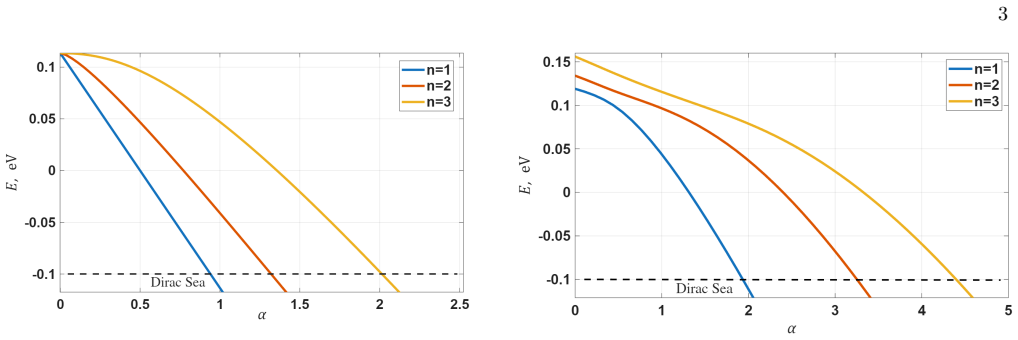
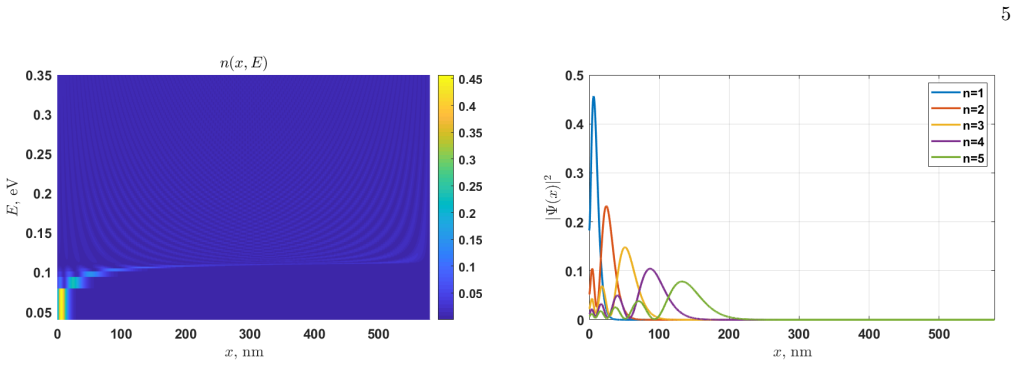
By solving the one-dimensional Dirac equation for a Coulomb potential with finite nucleus size, the eigenvalues and eigenfunctions reveal that the critical charge for the atom-in-box geometry exceeds the value found for the unconfined atom, while the probability density exhibits pronounced localization inside the box.
What carries the argument
The critical charge in the 1D Dirac-Coulomb problem, the nuclear charge at which the lowest bound state reaches the Dirac sea threshold.
If this is right
- The critical nuclear charge required to reach supercritical states is higher when the atom is confined inside a nanoribbon box than when it is free.
- The local density of states differs measurably between the confined and unconfined geometries.
- Electron probability density becomes strongly localized under box confinement.
- Energy spectra and eigenfunctions are obtained for both geometries with finite nuclear size included.
Where Pith is reading between the lines
- Confinement geometry could serve as a tunable parameter to delay or prevent supercritical instability in two-dimensional Dirac systems.
- The same 1D Dirac-plus-box model might describe impurity states in other confined Dirac materials such as carbon nanotubes or nanoribbon heterostructures.
- Scanning tunneling spectroscopy on gated nanoribbons could directly test the predicted shift in the critical charge.
Load-bearing premise
The electron motion in the graphene nanoribbon can be accurately described by the one-dimensional Dirac equation with a Coulomb potential that incorporates finite nucleus size and either unconfined or simple box boundary conditions.
What would settle it
Measuring the local density of states of an impurity in a narrow graphene nanoribbon and checking whether the onset of negative-energy states shifts to higher nuclear charge compared with the unconfined case.
Figures


read the original abstract
We consider a model of 1D relativistic hydrogen-like atom, formed by a Coulomb impurity in graphene nanoribbon. Describing the electron motion in terms of the one-dimensional Dirac equation for Coulomb potential taking into account the finite-size of the atomic nucleus, we compute the eigenvalues and eigenfunctions of the atomic electron. The cases of unconfined atom and atomin-box system are considered. Special focus is given calculation of supercritical energy levels and the critical charge. The latter is the value of the atomic nucleus charge, when the electronic state reaches the border of the Dirac sea. It is found that for confined atom the value of the critical charge is larger than that of free atom. Experimentally measurable characteristics, local density of states is also plotted for both cases. Existence of strong localization for atom-in-box system is shown.
Editorial analysis
A structured set of objections, weighed in public.
Referee Report
Summary. The manuscript develops a one-dimensional model of a relativistic hydrogen-like atom formed by a Coulomb impurity in a graphene nanoribbon. It solves the 1D Dirac equation with a finite-nucleus regularized Coulomb potential, computing eigenvalues, eigenfunctions, and local density of states for both the unconfined (free) atom and the atom-in-box (confined) system. The central results are that the critical charge Z_cr at which the ground state dives into the Dirac sea is larger for the confined case than for the free atom, and that the confined system exhibits strong localization.
Significance. If the 1D reduction and boundary conditions faithfully represent the nanoribbon physics, the work supplies concrete numerical predictions for how confinement modifies supercritical collapse and localization in Dirac materials. The explicit comparison of Z_cr values, the regularization procedure, and the LDOS plots constitute a clear, falsifiable set of results that could guide experiments on impurities in narrow graphene ribbons.
major comments (2)
- [Model section (atom-in-box system)] Model section (description of atom-in-box system): The hard-wall box boundary conditions are imposed without derivation from the underlying 2D Dirac equation on a finite-width nanoribbon or without testing alternative edge conditions (armchair vs. zigzag). Because the reported increase in Z_cr and the strong localization are obtained directly from this choice, the central claim that confinement raises the critical charge rests on an unverified modeling step.
- [Results section (supercritical states)] Results section (supercritical states and Z_cr): No systematic convergence study or error estimate is provided for the numerical eigenvalue solver near the critical point, nor is the sensitivity of Z_cr to the precise value of the finite-nucleus regularization radius quantified. This leaves the quantitative difference between free and confined Z_cr without a stated uncertainty.
minor comments (2)
- [Model section] The notation for the regularized potential (e.g., the cutoff radius) should be defined once in the text and used consistently in all figures and equations.
- [Figures] Figure captions for the LDOS plots should explicitly state the energy window and the distinction between free and confined cases to improve readability.
Simulated Author's Rebuttal
We thank the referee for the careful reading of our manuscript and the constructive comments. We address each major point below and have revised the manuscript to strengthen the presentation and numerical robustness of the results.
read point-by-point responses
-
Referee: Model section (description of atom-in-box system): The hard-wall box boundary conditions are imposed without derivation from the underlying 2D Dirac equation on a finite-width nanoribbon or without testing alternative edge conditions (armchair vs. zigzag). Because the reported increase in Z_cr and the strong localization are obtained directly from this choice, the central claim that confinement raises the critical charge rests on an unverified modeling step.
Authors: Our 1D model employs hard-wall boundary conditions as a standard effective description for narrow graphene nanoribbons in which transverse confinement quantizes the modes and the longitudinal dynamics are captured by the Dirac equation. This choice is consistent with prior effective 1D treatments in the literature. We agree that an explicit derivation from the 2D Dirac equation with specific edge terminations would provide further validation. In the revised manuscript we have expanded the Model section with additional justification, citing relevant works on 1D reductions of nanoribbon physics, and we explicitly note the limitations of not distinguishing armchair versus zigzag edges within the present 1D framework. The reported increase in Z_cr is presented as a result of this confined 1D model. revision: partial
-
Referee: Results section (supercritical states and Z_cr): No systematic convergence study or error estimate is provided for the numerical eigenvalue solver near the critical point, nor is the sensitivity of Z_cr to the precise value of the finite-nucleus regularization radius quantified. This leaves the quantitative difference between free and confined Z_cr without a stated uncertainty.
Authors: We thank the referee for highlighting this omission. In the revised manuscript we have added a systematic convergence analysis of the numerical eigenvalue solver, varying discretization parameters and basis size, and we report error estimates for the eigenvalues and Z_cr values near the critical point. We have also performed a sensitivity study of Z_cr with respect to the regularization radius R, computing results for a range of R values and showing that the qualitative difference between the free and confined cases remains robust; quantitative bounds on the uncertainty are now stated in the Results section together with supporting data. revision: yes
Circularity Check
No significant circularity; results follow from direct solution of the 1D Dirac eigenvalue problem
full rationale
The paper adopts the 1D Dirac equation with regularized Coulomb potential as a modeling choice for the nanoribbon and then computes eigenvalues, eigenfunctions, and the critical charge (defined as the Z value where the bound-state energy reaches the Dirac continuum) for both free and box-confined cases. These quantities are obtained by solving the boundary-value problem rather than being defined in terms of themselves or fitted to the outputs. No load-bearing self-citations, ansatz smuggling, or renaming of known results appear in the derivation chain; the modeling assumptions (1D reduction and boundary conditions) are stated independently of the numerical findings on Z_cr and localization.
Axiom & Free-Parameter Ledger
axioms (2)
- domain assumption Electron motion in the graphene nanoribbon is governed by the one-dimensional Dirac equation with Coulomb potential
- domain assumption Finite-size nucleus regularization prevents singularities and allows well-defined eigenvalues
Reference graph
Works this paper leans on
- [1]
-
[2]
W. Greiner, B. M¨ uller, and J. Rafelski, Quantum Electro- dynamics of Strong Fields (Springer Berlin, Heidelberg, 1985)
work page 1985
-
[3]
V. S. Popov, Phys. Atom. Nuclei64, 367 (2001)
work page 2001
- [4]
-
[5]
C. Kozhuharov, P. Kienle, E. Berdermann, H. Boke- meyer, J.S. Greenberg, Y. Nakayama, P.Vincent, H.Backe, L.Handschugand, E.Kankeleit, Phys. Rev. Lett. 42376 (1979)
work page 1979
-
[6]
T. St¨ ohlker,Y. A. Litvinov, and for the SPARC Collabo- ration, Phys.Scr., 014025 ( 2015)
work page 2015
- [7]
-
[8]
Hillenbrand, et.al., Phys.Scr., 4087 (2013)
P.M. Hillenbrand, et.al., Phys.Scr., 4087 (2013)
work page 2013
-
[9]
O.Kovalenko, Y. Litvinov and T. St¨ ohlker, J.Phys.Conf.Ser.875092013 (2017)
work page 2017
- [10]
-
[11]
R.V. Popov, V.M. Shabaev, D.A. Telnov, I I. Tupitsyn, I.A. Maltsev, Y.S. Kozhedub, A.I. Bondarev, N.V. Kozin, X. Ma, G. Plunien, T. St¨ ohlker, D.A. Tumakov, and V.A. Zaytsev, Phys. Rev. D102076005 (2020)
work page 2020
-
[12]
V. R. Khalilov, C.-L. Ho, Mod. Phys. Lett. A13, 615 (1998)
work page 1998
- [13]
-
[14]
D. S. Novikov Phys. Rev. B76, 245435 (2007)
work page 2007
-
[15]
A. V. Shytov, M. I. Katsnelson, and L. S. Levitov,Phys. Rev. Lett.99, 246802 (2007)
work page 2007
- [16]
-
[17]
V. M. Pereira, J. Nilsson, and A. H. Castro Neto, Phys. Rev. Lett.99, 166802 (2007)
work page 2007
-
[18]
V.M. Pereira, V.N. Kotov, and A. H. Castro Neto, Phys. Rev. B78, 085101 (2008)
work page 2008
-
[19]
O. V. Gamayun, E. V. Gorbar, and V. P. Gusynin, Phys. Rev. B80, 165429 (2009)
work page 2009
-
[20]
A. De Martino, D. Kl¨ opfer, D. Matrasulov, and R. Egger, Phys. Rev. Lett.112, 186603 (2014)
work page 2014
-
[21]
D. Kloepfer, A. De Martino, D.U. Matrasulov, R. Egger, Eur. Phys. J. B87, 187 (2014)
work page 2014
-
[22]
D. Babajanov, D.U. Matrasulov, R. Egger, Eur. Phys. J. B87, 258 (2014)
work page 2014
-
[23]
A. Luican-Mayer, M. Kharitonov, G. Li, C.-P. Lu, I. Skachko, A.-M. B. Gon¸ calves, K. Watanabe, T. Taniguchi, and E. Y. Andrei, Phys. Rev. Lett.112, 036804 (2014)
work page 2014
-
[24]
Y. Wang, V. W. Brar, A. V. Shytov, Q. Wu, W. Regan, H.-Z. Tsai, A. Zettl, L. S. Levitov, and M. F. Crommie, Nature Physics8, 653 (2012). 7
work page 2012
-
[25]
Y. Wang, D. Wong, A. V. Shytov, V. W. Brar, S. Choi, Q. Wu, H.-Z. Tsai, W. Regan, A. Zettl, R. K. Kawakami, et al., Science340, 734 (2013)
work page 2013
- [26]
-
[27]
S. Rakhmanov, R. Egger, D. Jumanazarov, and D. Ma- trasulov, EPL148, 55002 (2024)
work page 2024
-
[28]
V.M. Kuleshov, V.D. Mur and N.B. Narozhny, J. Phys.: Conf. Ser.788012044 (2017)
work page 2017
-
[29]
C. A. Downing, M. E. Portnoi, Phys. Rev. A90, 052116 (2014)
work page 2014
-
[30]
Yu. Voronina, A. Davydov, and K. Sveshnikov, Phys. Part. Nucl. Lett.14, 698 (2017)
work page 2017
-
[31]
N.J. Kylstra, A.M. Ermolaev, and C.J. Joachain, J. Phys. B: At. Mol. Opt. Phys.30L449 (1997)
work page 1997
- [32]
-
[33]
A. H. Castro Neto, F. Guinea, N. M. R. Peres, K. S. Novoselov, and A. K. Geim, Rev. Mod. Phys.81, 109 (2009)
work page 2009
-
[34]
Handbook of Mathematical Functions, edited by M. Abramowitz and I. A. Stegun (Dover, New York, 1965)
work page 1965
- [35]
- [36]
- [37]
-
[38]
A.R. Carvalho, J.H. Warnes, C.H. Lewenkopf, Phys. Rev. B,89, 245444 (2014)
work page 2014
- [39]
discussion (0)
Sign in with ORCID, Apple, or X to comment. Anyone can read and Pith papers without signing in.