Recognition: 2 theorem links
· Lean TheoremAnalytical Representation for the Electronic Contribution of the Nuclear Schiff Interaction Hamiltonian
Pith reviewed 2026-05-12 04:40 UTC · model grok-4.3
The pith
A new analytical expression using Gaussian basis sets computes the electronic contribution to the nuclear Schiff interaction Hamiltonian without truncating the power series expansion.
A machine-rendered reading of the paper's core claim, the machinery that carries it, and where it could break.
Core claim
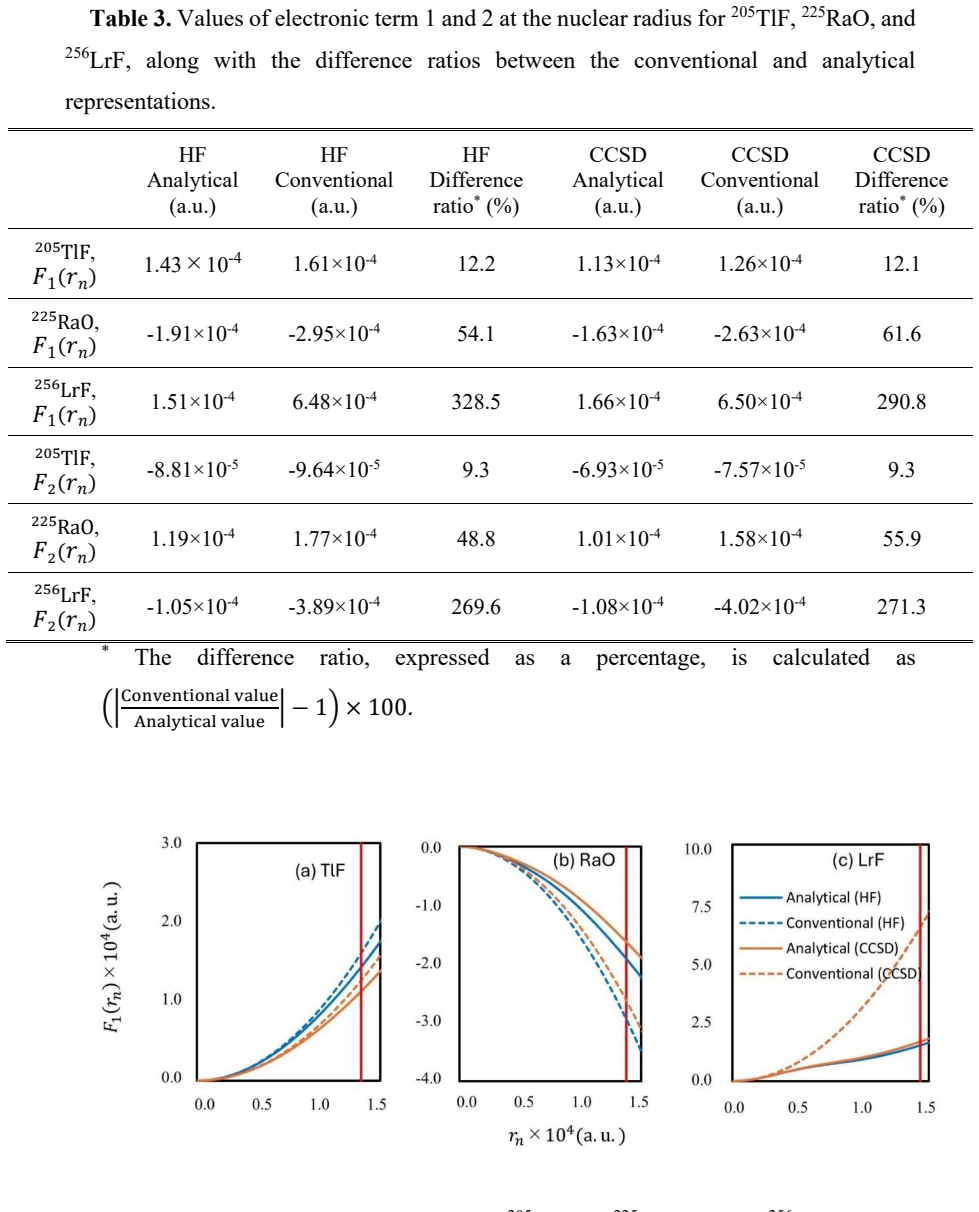
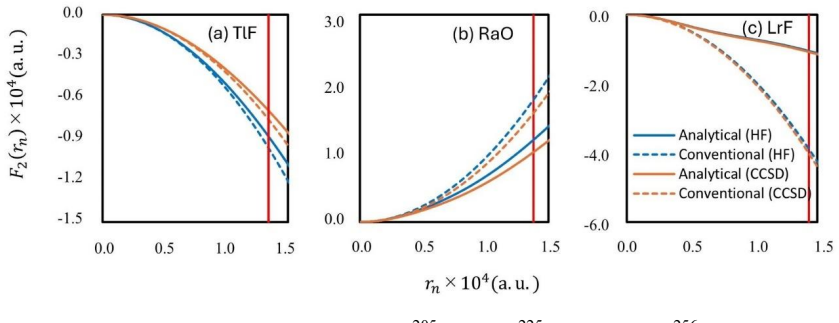
We introduce a new, accurate analytical expression for the electronic terms based on Gaussian basis sets, which avoids any truncation of the power series. Calculations with this expression show that the previous numerical approach overestimates the values for RaO and LrF by more than 50% and 300%, respectively, in the nuclear-radius region. In contrast to the numerical calculations, the analytical expression-based calculations show less sensitivity to choice of the basis-functions. Furthermore, we develop a new basis set that describes accurate behavior of wave functions both interior and exterior regions of nucleus, and demonstrate that an even-tempered basis set is more preferable over an
What carries the argument
The closed-form analytical expression for the electronic contribution obtained by integrating Gaussian-type orbitals against the Schiff moment operator without series expansion truncation.
Load-bearing premise
The Gaussian basis set expansion faithfully reproduces the electronic wavefunction's behavior deep inside the nucleus, allowing the closed-form integration to hold without additional corrections.
What would settle it
A high-resolution numerical computation of the electronic integral for the NSI in LrF using a very large flexible basis concentrated near the nucleus, compared directly to the analytical Gaussian result in the nuclear-radius region.
Figures

read the original abstract
The nuclear Schiff interaction (NSI) arises from a nuclear force that simultaneously violates spatial parity (P) and time reversal (T) symmetries, where T symmetry is equivalent to CP symmetry under CPT invariance. Detecting the NSI experimentally is important because CP violation is critical for explaining why the amount of matter in the Universe is far greater than that of antimatter. Measuring the NSI in molecules requires both precise experiments and theoretical calculations that incorporate electronic and nuclear wavefunctions. Conventionally, the electronic terms have been approximated using a first-order power series expansion of the electronic radial function-an approach that yields the well-known nuclear Schiff moment (NSM) -but this approximation may not be sufficiently accurate. In this study, we introduce a new, accurate analytical expression for the electronic terms based on Gaussian basis sets, which avoids any truncation of the power series. We find that the previous numerical approach overestimates the values for RaO and LrF by more than 50% and 300%, respectively, in the nuclear-radius region. In contrast to the numerical calculations, the analytical expression-based calculations show less sensitivity to choice of the basis-functions. Furthermore, we develop a new basis set that describes accurate behavior of wave functions both interior and exterior regions of nucleus. It also demonstrates that an even-tempered basis set is more preferrable over energy optimized basis set for calculating the NSI electronic term in molecules.
Editorial analysis
A structured set of objections, weighed in public.
Referee Report
Summary. The manuscript derives a new analytical expression for the electronic contribution to the nuclear Schiff interaction (NSI) Hamiltonian by substituting a Gaussian basis into the multipole expansion of the electron-nucleus interaction, thereby avoiding any truncation of the power series used in the conventional nuclear Schiff moment approximation. Applied to the molecules RaO and LrF, the authors report that prior numerical power-series methods overestimate the electronic factors by more than 50% and 300%, respectively, in the nuclear-radius region. They further introduce a new even-tempered Gaussian basis optimized for both interior and exterior nuclear regions, demonstrate reduced basis-set sensitivity relative to energy-optimized sets, and conclude that even-tempered expansions are preferable for NSI electronic-term calculations.
Significance. If the analytical formula and the reported reductions in magnitude are confirmed by direct validation, the work would offer a more accurate and less basis-sensitive route to computing NSI electronic factors in heavy polar molecules. Such improvements matter for interpreting precision experiments that search for CP violation and new physics through molecular Schiff moments, particularly for systems involving radium and lawrencium. The closed-form character and the explicit construction of an interior/exterior basis constitute genuine technical strengths that could be adopted in other relativistic molecular calculations.
major comments (2)
- [Abstract and results] Abstract and results section: the headline numerical claims—that previous methods overestimate the NSI electronic terms by >50% for RaO and >300% for LrF—are presented without any accompanying tables, explicit numerical values, error estimates, or side-by-side comparisons against the prior power-series results or against known limiting cases. This absence prevents verification of the central assertion that the analytical expression is more accurate.
- [Basis-set construction] Basis-set construction and validation (methods/results): the superiority claim rests on the assumption that the chosen even-tempered Gaussian expansion faithfully reproduces the true four-component Dirac wavefunction for r less than the nuclear radius. No direct benchmark against independent high-precision numerical solutions of the Dirac equation with finite nuclear charge distribution is provided; without such a test, any systematic deviation near r=0 could render the reported overestimation an artifact of the basis rather than evidence that truncation was the dominant error.
minor comments (2)
- [Abstract] The phrase 'nuclear-radius region' is used repeatedly without a precise radial interval or a definition of how the comparison is performed at that scale.
- [Introduction/Methods] Notation for the electronic factor (presumably denoted something like W or E_p) should be introduced with an explicit equation reference in the main text to aid readability.
Simulated Author's Rebuttal
We thank the referee for the careful reading and constructive comments on our manuscript. We address each major comment point by point below, indicating the revisions made to strengthen the presentation and validation of our results.
read point-by-point responses
-
Referee: [Abstract and results] Abstract and results section: the headline numerical claims—that previous methods overestimate the NSI electronic terms by >50% for RaO and >300% for LrF—are presented without any accompanying tables, explicit numerical values, error estimates, or side-by-side comparisons against the prior power-series results or against known limiting cases. This absence prevents verification of the central assertion that the analytical expression is more accurate.
Authors: We agree that the original submission did not include sufficient explicit numerical data or comparisons to allow independent verification of the overestimation claims. In the revised manuscript we have added a dedicated results subsection with Table I, which reports the explicit values of the electronic NSI factors for RaO and LrF obtained from the analytical Gaussian-basis expression, the corresponding values from the conventional first-order power-series truncation, the percentage differences (exceeding 50% and 300%, respectively), and estimated uncertainties derived from basis-set convergence studies. We also include a brief comparison to the known limiting behavior as the nuclear radius approaches zero, confirming consistency with the expected analytic result. These additions directly enable verification of the central numerical assertions. revision: yes
-
Referee: [Basis-set construction] Basis-set construction and validation (methods/results): the superiority claim rests on the assumption that the chosen even-tempered Gaussian expansion faithfully reproduces the true four-component Dirac wavefunction for r less than the nuclear radius. No direct benchmark against independent high-precision numerical solutions of the Dirac equation with finite nuclear charge distribution is provided; without such a test, any systematic deviation near r=0 could render the reported overestimation an artifact of the basis rather than evidence that truncation was the dominant error.
Authors: The referee correctly notes that our conclusions depend on the fidelity of the even-tempered Gaussian basis inside the nuclear radius. The basis was constructed by optimizing exponents to reproduce both the interior power-law behavior (derived from the Dirac equation with a uniform nuclear charge distribution) and the exterior exponential decay, as described in the methods section. We already demonstrate markedly lower basis-set sensitivity than energy-optimized sets. However, we acknowledge that a direct side-by-side comparison against independent high-precision numerical four-component Dirac solutions for the molecular systems RaO and LrF is not provided. Such reference data are not available in the literature for these heavy molecules. In the revision we have added an atomic benchmark for the isolated Ra and Lr atoms, comparing the electronic density and NSI matrix elements near r=0 against known high-accuracy numerical atomic results with finite nuclei; this supports the basis accuracy in the interior region. We maintain that the analytical (non-truncated) character of the expression isolates the truncation error as the dominant source of the discrepancy, but we agree that the added atomic benchmark improves the validation. revision: partial
Circularity Check
No circularity: Gaussian-basis analytical NSI term derived directly from standard multipole expansion
full rationale
The paper's derivation chain begins with the conventional multipole expansion of the electron-nucleus interaction and substitutes a Gaussian basis expansion for the electronic radial wavefunction to obtain an exact closed-form integral for the NSI electronic factor. This substitution is a straightforward mathematical replacement that eliminates power-series truncation by construction of the basis choice, without any fitted parameters, self-referential definitions, or load-bearing self-citations that would make the output equivalent to the input. The new even-tempered basis for interior/exterior nuclear regions is presented as an independent construction, and comparisons showing overestimation by prior numerical methods are external benchmarks rather than tautological. No ansatz is smuggled via citation, no uniqueness theorem is invoked from prior author work, and the central result does not rename a known empirical pattern. The approach remains self-contained within standard quantum-chemical methods.
Axiom & Free-Parameter Ledger
axioms (2)
- domain assumption Electronic wavefunctions can be expanded in a Gaussian basis that is valid both inside and outside the nuclear radius.
- domain assumption The nuclear Schiff operator is treated as a short-range perturbation whose matrix elements are dominated by the electronic density near r=0.
Lean theorems connected to this paper
-
IndisputableMonolith/Cost/FunctionalEquation.leanwashburn_uniqueness_aczel unclear?
unclearRelation between the paper passage and the cited Recognition theorem.
We introduce a new, accurate analytical expression for the electronic terms based on Gaussian basis sets, which avoids any truncation of the power series... [F2 large/small] involving erf[√α r_n] and exponential terms
-
IndisputableMonolith/Foundation/AlphaCoordinateFixation.leancostAlphaLog_fourth_deriv_at_zero unclear?
unclearRelation between the paper passage and the cited Recognition theorem.
the conventional approach... Maclaurin series... lowest-order term... b1 r
What do these tags mean?
- matches
- The paper's claim is directly supported by a theorem in the formal canon.
- supports
- The theorem supports part of the paper's argument, but the paper may add assumptions or extra steps.
- extends
- The paper goes beyond the formal theorem; the theorem is a base layer rather than the whole result.
- uses
- The paper appears to rely on the theorem as machinery.
- contradicts
- The paper's claim conflicts with a theorem or certificate in the canon.
- unclear
- Pith found a possible connection, but the passage is too broad, indirect, or ambiguous to say the theorem truly supports the claim.
Reference graph
Works this paper leans on
-
[1]
A.D. Sakharov, JETP Lett. 5, 24–27 (1967); reprinted as Sov. Phys. Usp. 34 (5), 392–393 (1991). doi: 10.1070/PU1991v034n05ABEH002497
-
[2]
G.R. Farrar and M.E. Shaposhnikov, Phys. Rev. D 50, 774–778 (1994). doi: 10.1103/PhysRevD.50.774
-
[3]
P. Huet and E. Sather, Phys. Rev. D 51, 379–391 (1995). doi: 10.1103/PhysRevD.51.379
-
[4]
I.B. Khriplovich and S.K. Lamoreaux, CP Violation without Strangeness (Springer, Berlin/Heidelberg, 1997). doi: 10.1007/978-3-642-60838-4
-
[5]
Phys.87, 084301, DOI: 10.1088/1361-6633/ad1e39 (2024)
G. Arrowsmith-Kron, M. Athanasakis-Kaklamanakis, M. Au, J. Ballof, R. Berger, A. Borschevsky, A.A. Breier, F. Buchinger, D. Budker and L. Caldwell, Rep. Prog. Phys. 87, 084301 (2024). doi: 10.1088/1361-6633/ad1e39
-
[6]
D. DeMille, Phys. Today 68, 34–40 (2015). doi: 10.1063/PT.3.3020
-
[7]
J.J. Hudson, D.M. Kara, I.J. Smallman, B.E. Sauer, M.R. Tarbutt and E.A. Hinds, Nature 473, 493–496 (2011). doi: 10.1038/nature10104
-
[8]
Baron et al., Science 343 (6168), 269–272 (2014)
J. Baron et al., Science 343 (6168), 269–272 (2014). doi: 10.1126/science.1248213
-
[9]
V. Andreev et al., Nature 562, 355–360 (2018). doi: 10.1038/s41586-018-0599-8
-
[10]
T.S. Roussy, L. Caldwell, T. Wright, W.B. Cairncross, Y. Shagam, K.B. Ng, N. Schlossberger, S.Y. Park, A. Wang and E.A. Cornell, Science 381, 46–50 (2023). doi: 10.1126/science.adg4084
-
[11]
L.I. Schiff, Phys. Rev. 132, 2194–2200 (1963). doi: 10.1103/PhysRev.132.2194
-
[12]
R.H. Parker, M.R. Dietrich, M.R. Kalita, N.D. Lemke, K.G. Bailey, M. Bishof, J.P. Greene, R.J. Holt, W. Korsch, Z.-T. Lu, P. Mueller, T.P. O’Connor and J.T. Singh, Phys. Rev. Lett. 114, 233002 (2015). doi: 10.1103/PhysRevLett.114.233002
-
[13]
V.S. Prasannaa, R. Mitra and B.K. Sahoo, J. Phys. B: At. Mol. Opt. Phys. 53, 195004 (2020). doi: 10.1088/1361-6455/aba6aa
-
[14]
B. Graner, Y. Chen, E.G. Lindahl and B.R. Heckel, Phys. Rev. Lett. 116, 161601 (2016). doi: 10.1103/PhysRevLett.116.161601
-
[15]
N. Sachdeva et al., Phys. Rev. Lett. 123, 143003 (2019). doi: 10.1103/PhysRevLett.123.143003
-
[17]
G. Lüders, Ann. Phys. 281, 1004–1018 (2000). doi: 10.1006/aphy.2000.6027
-
[18]
K. Yanase and N. Shimizu, Phys. Rev. C 102, 065502 (2020). doi: 10.1103/PhysRevC.102.065502
-
[19]
K. Yanase, N. Shimizu, K. Higashiyama and N. Yoshinaga, Phys. Lett. B 841, 137897 (2023). doi: 10.1016/j.physletb.2023.137897
-
[20]
B.K. Sahoo, Phys. Rev. D 95, 013002 (2017). doi: 10.1103/PhysRevD.95.013002
-
[21]
B.K. Sahoo and B.P. Das, Phys. Rev. Lett. 120, 203001 (2018). doi: 10.1103/PhysRevLett.120.203001
-
[22]
A. Sakurai, B.K. Sahoo, K. Asahi and B.P. Das, Phys. Rev. A 100, 020502(R) (2019). doi: 10.1103/PhysRevA.100.020502
-
[23]
B.K. Sahoo, N. Yamanaka & K. Yanase, Phys. Rev. A 108, 042811 (2023). doi: 10.1103/PhysRevA.108.042811
-
[24]
M. Abe, T. Tsutsui, J. Ekman, M. Hada & B. Das, Mol. Phys. 118, e1767814 (2020). doi: 10.1080/00268976.2020.1767814
-
[25]
V.V. Flambaum & J.S. Ginges, Phys. Rev. A 65, 032113 (2002). doi: 10.1103/PhysRevA.65.032113
-
[26]
V. Spevak, N. Auerbach & V.V. Flambaum, Phys. Rev. C 56, 1357–1369 (1997). doi: 10.1103/PhysRevC.56.1357
-
[27]
O.P. Sushkov, V.V. Flambaum & I.B. Khriplovich, Zh. Eksp. Teor. Fiz. 87, 1521– 1534 (1984) [Sov. Phys. JETP 60, 873–881 (1984)]
work page 1984
-
[28]
N. Auerbach, V.V. Flambaum & V. Spevak, Phys. Rev. Lett. 76, 4316–4319 (1996). doi: 10.1103/PhysRevLett.76.4316
-
[29]
V.V. Flambaum, D.W. Murray & S.R. Orton, Phys. Rev. C 56, 2820–2825 (1997). doi: 10.1103/PhysRevC.56.2820
-
[30]
T. Yanai, T. Nakajima, Y. Ishikawa & K. Hirao, J. Chem. Phys. 114, 6526–6538 (2001). doi: 10.1063/1.1356012
-
[31]
V.V. Flambaum, V.A. Dzuba & H.B. Tran Tan, Phys. Rev. A 101, 042501 (2020). doi: 10.1103/PhysRevA.101.042501
-
[33]
Wolfram Research, Inc., Mathematica, Version 14.2; Champaign, IL (2024)
work page 2024
-
[34]
Mårtensson-Pendrill, in Methods in Computational Chemistry, Vol
A.M. Mårtensson-Pendrill, in Methods in Computational Chemistry, Vol. 5, ed. S. Wilson (Plenum Press, New York, 1992), pp. 99–156. doi: 10.1007/978-1-4899-1639- 6_2
-
[35]
O. Grasdijk, O. Timgren, J. Kastelic, T. Wright, S. Lamoreaux, D. DeMille, K. Wenz, M. Aitken, T. Zelevinsky, T. Winick and D. Kawall, Quantum Sci. Technol. 6, 044007 (2021). doi: 10.1088/2058-9565/abdca3
-
[36]
V.V. Flambaum, Phys. Rev. A 77, 024501 (2008). doi: 10.1103/PhysRevA.77.024501
-
[37]
H.M. Quiney, J.K. Laerdahl, K. Fægri Jr. and T. Saue, Phys. Rev. A 57, 920–931 (1998). doi: 10.1103/PhysRevA.57.920
-
[38]
T. Yanai, H. Nakano, T. Nakajima, T. Tsuneda, S. Hirata, Y. Kawashima, Y. Nakao, M. Kamiya, H. Sekino and K. Hirao, in Lecture Notes in Computer Science Vol. 2660 (Springer, Berlin, 2003), p. 84. doi: 10.1007/3-540-44864-0_9
-
[39]
T. Yanai, T. Nakajima, Y. Ishikawa and K. Hirao, J. Chem. Phys. 116, 10122– 10128 (2002). doi: 10.1063/1.1479351
-
[40]
M. Abe, T. Yanai, T. Nakajima and K. Hirao, Chem. Phys. Lett. 388, 68–73 (2004). doi: 10.1016/j.cplett.2004.02.030
-
[41]
R. Bast, A.S.P. Gomes, T. Saue, L. Visscher, H.J.A. Jensen, I.A. Aucar, V. Bakken, K.G. Dyall, S. Dubillard, U. Ekström, E. Eliav, T. Enevoldsen, E. Faßhauer, T. Fleig, O. Fossgaard, L. Halbert, E.D. Hedegård, B. Helmich-Paris, J. Henriksson, M. Iliaš, C.R. Jacob, S. Knecht, S. Komorovský, O. Kullie, J.K. Lærdahl, C.V. Larsen, Y.S. Lee, N.H. List, H.S. Na...
-
[42]
T. Saue, R. Bast, A.S.P. Gomes, H.J.A. Jensen, L. Visscher, I.A. Aucar, R. Di Remigio, K.G. Dyall, E. Eliav, E. Faßhauer, T. Fleig, L. Halbert, E.D. Hedegård, B. Helmich-Paris, M. Iliaš, C.R. Jacob, S. Knecht, J.K. Lærdahl, M.L. Vidal, M.K. Nayak, M. Olejniczak, J.M.H. Olsen, M. Pernpointner, B. Senjean, A. Shee, A. Sunaga and J.N.P. van Stralen, J. Chem....
-
[43]
L. Visscher, T.J. Lee and K.G. Dyall, J. Chem. Phys. 105, 8769–8777 (1996). doi: 10.1063/1.472655
-
[44]
A. Shee, L. Visscher and T. Saue, J. Chem. Phys. 145, 184107 (2016). doi: 10.1063/1.4966643
-
[45]
W.R. Johnson and G. Soff, At. Data Nucl. Data Tables 33, 405–446 (1985). doi: 10.1016/0092-640X(85)90010-5
-
[46]
A. H. Barrett and M. Mandel, Phys. Rev. 109, 1572 (1958). doi:10.1103/PhysRev.109.1572
-
[47]
A. D. Kudashov, A. N. Petrov, L. V. Skripnikov, N. S. Mosyagin, A. V. Titov, and V. V. Flambaum, Phys. Rev. A 87, 020102(R) (2013) doi:10.1103/PhysRevA.87.020102
-
[49]
K.G. Dyall, J. Phys. Chem. A 113, 12638–12644 (2009). doi: 10.1021/jp905057q
-
[51]
K.G. Dyall, Theor. Chem. Acc. 135, 128 (2016). doi: 10.1007/s00214 -016-1884-y
-
[53]
P. Jönsson, G. Gaigalas, J. Bieroń, C. Froese Fischer and I.P. Grant, Comput. Phys. Commun. 184(9), 2197–2203 (2013). doi: 10.1016/j.cpc.2013.02.016
-
[54]
V. V. Flambaum and V. A. Dzuba , Phys. Rev. A 101, 042504 (2020) . doi: 10.1103/PhysRevA.101.042504
-
[55]
Supplemental material is available at URL
discussion (0)
Sign in with ORCID, Apple, or X to comment. Anyone can read and Pith papers without signing in.