Recognition: 2 theorem links
· Lean TheoremUnsupervised Online Channel Estimation for High-Mobility OFDM via Implicit Neural Representation
Pith reviewed 2026-05-12 04:19 UTC · model grok-4.3
The pith
An implicit neural representation can perform accurate unsupervised channel estimation for high-mobility OFDM by online fitting to received signals.
A machine-rendered reading of the paper's core claim, the machinery that carries it, and where it could break.
Core claim
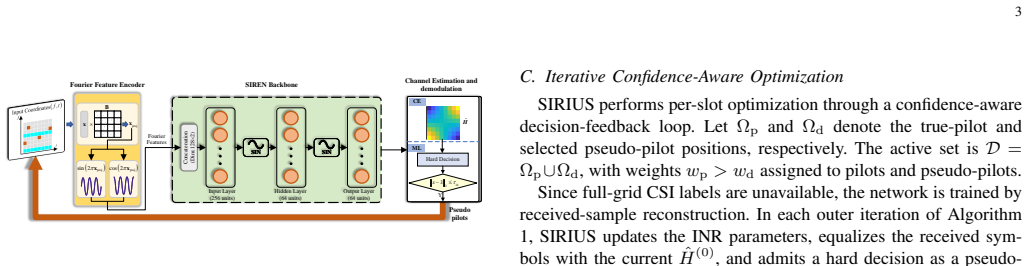
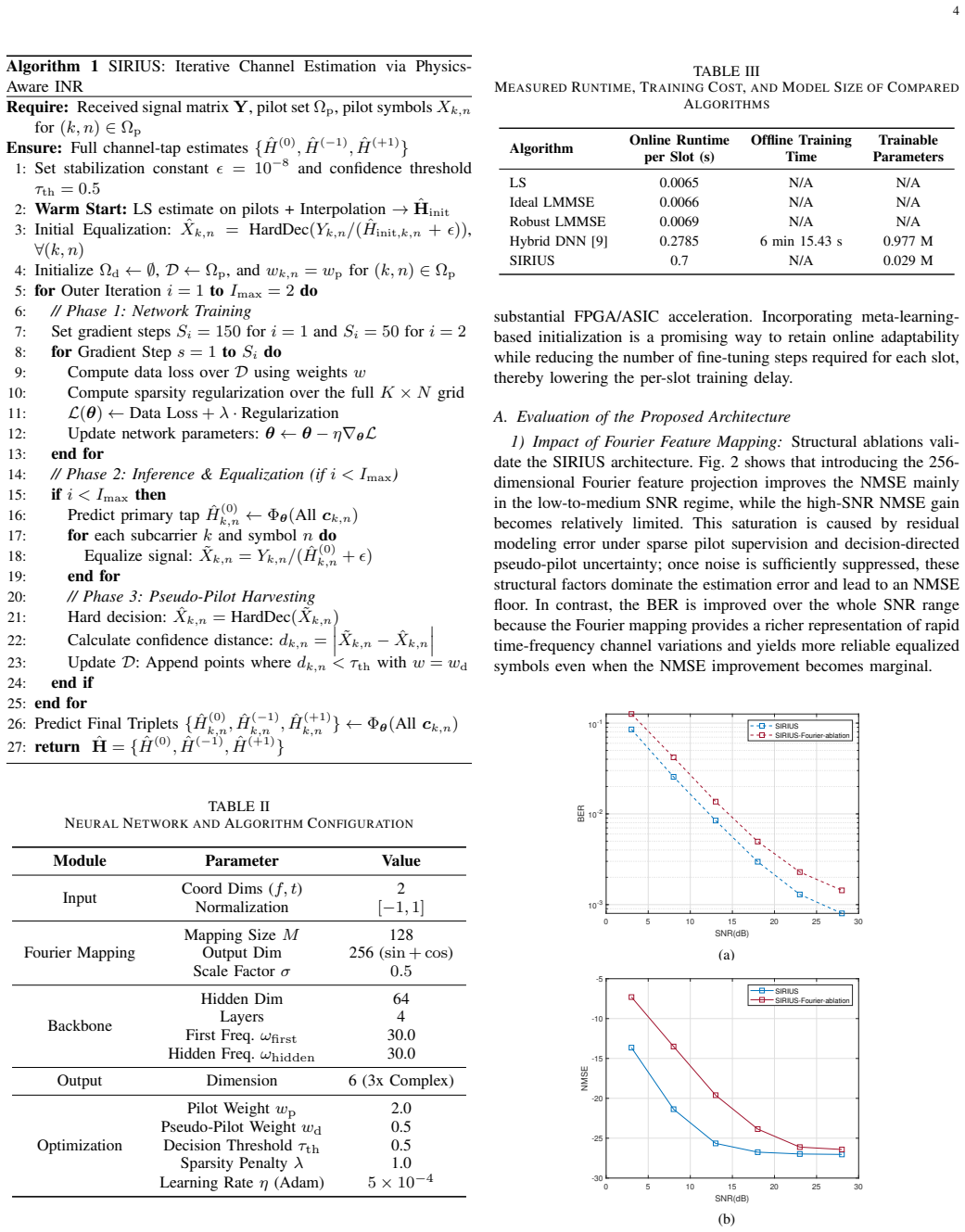
The proposed unsupervised online channel estimation framework models the channel as a continuous function of time-frequency coordinates using a Sinusoidal Representation Network (SIREN) with Gaussian Fourier feature mapping. For each received slot, network parameters are updated by minimizing a physics-aware ICI loss, supported by a confidence-aware decision-directed loop that harvests pseudo-pilots. This enables accurate estimation without labeled data or pre-training, leading to superior performance over LS and LMMSE in V2X simulations and better OOD robustness than supervised deep learning methods.
What carries the argument
Sinusoidal Representation Network (SIREN) as an implicit neural representation of the continuous time-frequency channel, optimized via per-slot online fitting with physics-aware ICI loss and confidence-aware decision-directed pseudo-pilot generation.
If this is right
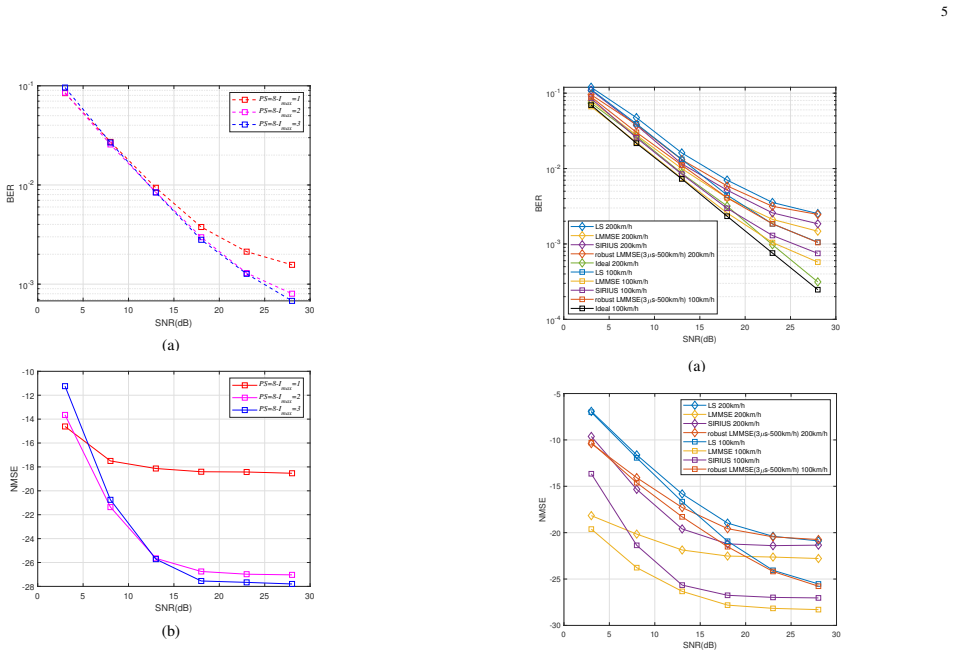
- Simulations in realistic V2X environments demonstrate near-optimal link-level reliability.
- Significantly outperforms Least Squares (LS) and robust Linear Minimum Mean Square Error (LMMSE) estimators.
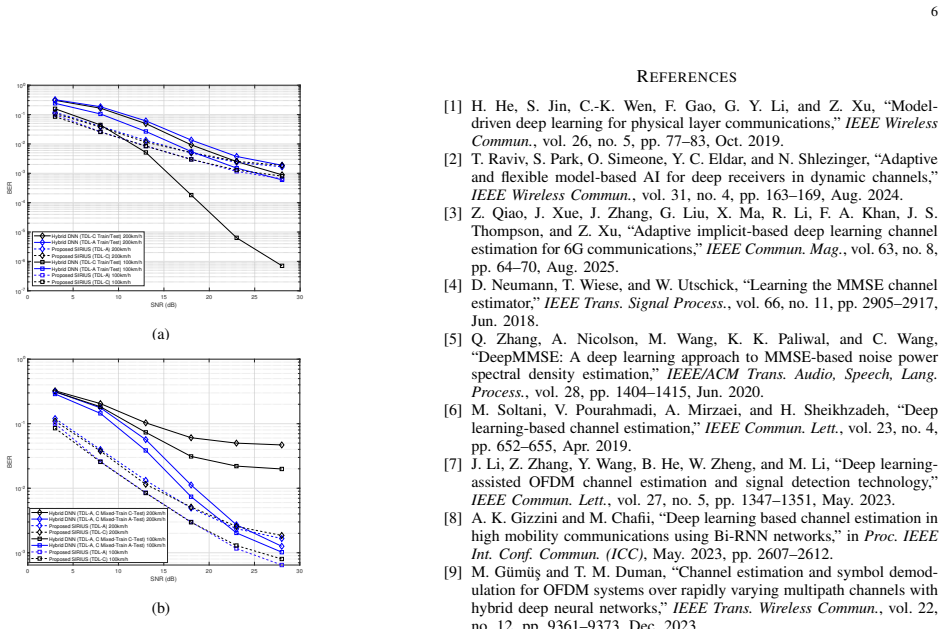
- Exhibits strong out-of-distribution robustness under environmental distribution shifts compared to supervised deep learning baselines.
- Establishes an adaptable data-efficient paradigm for physical-layer processing.
Where Pith is reading between the lines
- The continuous representation could allow flexible adaptation to different sampling rates or waveform parameters without retraining.
- Extending this approach to joint channel estimation and decoding might further reduce pilot overhead in high-mobility links.
- Testing in non-V2X high-mobility scenarios like high-speed trains could validate broader applicability.
Load-bearing premise
The per-slot online fitting of the SIREN network using the physics-aware ICI loss and confidence-aware decision-directed loop reliably estimates the channel without any labeled data or offline pre-training even under varying high-mobility conditions.
What would settle it
Running the method on real-world high-mobility OFDM measurements with known ground-truth channel responses and checking whether the bit error rate matches that of an ideal estimator using perfect channel knowledge.
Figures
read the original abstract
Accurate channel estimation remains challenging in high-mobility wireless systems because Doppler shifts induce severe inter-carrier interference (ICI) in Orthogonal Frequency Division Multiplexing (OFDM). We propose an unsupervised online channel estimation framework based on Implicit Neural Representation (INR). Unlike discrete-grid estimators, the proposed method decouples channel representation from the OFDM sampling resolution by modeling the time-varying frequency-selective channel as a continuous function of time-frequency coordinates. A Sinusoidal Representation Network (SIREN) with Gaussian Fourier feature mapping captures fine-grained channel variations and high-frequency details without offline pre-training or labeled data. For each received slot, the network parameters are updated by per-slot online fitting that minimizes a physics-aware ICI loss, while a confidence-aware decision-directed loop balances reliable pilots and dynamically harvested pseudo-pilots. Simulations in realistic Vehicle-to-Everything (V2X) environments show that the proposed method achieves near-optimal link-level reliability, significantly outperforming Least Squares (LS) and robust Linear Minimum Mean Square Error (LMMSE) estimators. Compared with supervised deep learning baselines, it also exhibits strong out-of-distribution (OOD) robustness under environmental distribution shifts, establishing an adaptable data-efficient physical-layer paradigm.
Editorial analysis
A structured set of objections, weighed in public.
Referee Report
Summary. The paper proposes an unsupervised online channel estimation framework for high-mobility OFDM systems that models the time-varying frequency-selective channel as a continuous function using a SIREN network with Gaussian Fourier feature mapping. For each received OFDM slot, network parameters are fitted by minimizing a physics-aware loss derived from the OFDM signal model (accounting for ICI) combined with a confidence-aware decision-directed loop that incorporates reliable pilots and harvested pseudo-pilots. No offline pre-training or labeled data is used. Simulations in realistic V2X environments are reported to demonstrate near-optimal link-level performance, outperforming LS and robust LMMSE estimators as well as supervised deep learning baselines, with strong OOD robustness under distribution shifts.
Significance. If the empirical results hold under rigorous verification, the approach would represent a meaningful step toward data-efficient, physics-informed neural methods for physical-layer tasks in dynamic wireless environments. The continuous INR representation decouples channel modeling from discrete grid resolution, and the per-slot unsupervised fitting could reduce pilot overhead and training data requirements in high-mobility scenarios such as V2X. The reported OOD robustness is particularly relevant for practical deployment where channel statistics vary.
major comments (2)
- [§III] §III (Method), the per-slot online fitting procedure: the central claim that gradient-based optimization of randomly initialized SIREN parameters on the physics-aware ICI loss plus confidence-weighted decision-directed pseudo-pilots reliably recovers a near-optimal channel estimate lacks any convergence analysis, iteration budget, regularization, or failure-mode characterization. Because the loss is non-convex in the continuous INR output and the bootstrap from initial pilots degrades with Doppler, this assumption is load-bearing for the unsupervised claim and the reported performance gains; without it, the superiority over LS/LMMSE cannot be attributed to the method.
- [§IV] §IV (Experiments), the V2X simulation results and OOD robustness claims: the manuscript reports superior link-level reliability and OOD performance but does not specify the exact Doppler spreads, SNR ranges, number of Monte Carlo runs, or statistical significance tests for the gains over LMMSE and supervised baselines. In addition, the construction of the environmental distribution shifts for OOD testing is not detailed, making it impossible to assess whether the robustness is genuine or an artifact of the chosen test conditions.
minor comments (2)
- [Abstract] The abstract and introduction use the term 'near-optimal' without defining the reference (e.g., perfect CSI or genie-aided estimator); a precise definition and corresponding curve in the figures would improve clarity.
- [§III] Notation for the SIREN architecture (layer widths, feature mapping dimension) and the exact form of the confidence weighting in the decision-directed loop should be consolidated into a single table or pseudocode block for reproducibility.
Simulated Author's Rebuttal
We thank the referee for the constructive and detailed comments. We address each major comment below and will revise the manuscript to strengthen the presentation of the method and experiments.
read point-by-point responses
-
Referee: [§III] §III (Method), the per-slot online fitting procedure: the central claim that gradient-based optimization of randomly initialized SIREN parameters on the physics-aware ICI loss plus confidence-weighted decision-directed pseudo-pilots reliably recovers a near-optimal channel estimate lacks any convergence analysis, iteration budget, regularization, or failure-mode characterization. Because the loss is non-convex in the continuous INR output and the bootstrap from initial pilots degrades with Doppler, this assumption is load-bearing for the unsupervised claim and the reported performance gains; without it, the superiority over LS/LMMSE cannot be attributed to the method.
Authors: We agree that additional characterization of the per-slot optimization is warranted to support the unsupervised claim. Section III describes the gradient-based fitting of the SIREN parameters using the physics-aware ICI loss and the confidence-aware decision-directed mechanism, but we did not include explicit convergence analysis or failure-mode discussion. In the revision we will add: (i) the iteration budget and optimizer settings (Adam with learning rate 1e-3, typically 500–2000 iterations per slot), (ii) regularization via weight decay and early stopping on the pilot loss, (iii) empirical convergence curves showing loss behavior across Doppler spreads, and (iv) a short discussion of observed failure modes at extreme Doppler where the initial pilot bootstrap is weak and how the confidence threshold on pseudo-pilots mitigates divergence. While a rigorous theoretical guarantee for the non-convex problem remains difficult, these additions will provide transparent empirical evidence that the fitting reliably produces estimates superior to LS/LMMSE. revision: yes
-
Referee: [§IV] §IV (Experiments), the V2X simulation results and OOD robustness claims: the manuscript reports superior link-level reliability and OOD performance but does not specify the exact Doppler spreads, SNR ranges, number of Monte Carlo runs, or statistical significance tests for the gains over LMMSE and supervised baselines. In addition, the construction of the environmental distribution shifts for OOD testing is not detailed, making it impossible to assess whether the robustness is genuine or an artifact of the chosen test conditions.
Authors: We acknowledge that the experimental section would benefit from greater specificity. The current manuscript reports aggregate performance in V2X channels but omits exact parameter values for brevity. We will revise Section IV to state: Doppler spreads of 100–1000 Hz, SNR range 0–30 dB, 1000 Monte Carlo realizations per configuration, and statistical significance via 95 % confidence intervals together with paired t-tests on the BER and NMSE gains versus LMMSE and supervised baselines. For the OOD evaluation we will explicitly describe the distribution-shift construction, including the precise changes in velocity distributions, multipath delay profiles, and environmental models (e.g., 3GPP urban to highway) used to generate the test channels, confirming that these statistics are disjoint from any data seen during per-slot fitting. These clarifications will allow readers to judge the robustness claims directly. revision: yes
Circularity Check
No significant circularity; framework uses independent physics-based loss
full rationale
The paper presents an unsupervised per-slot optimization of SIREN parameters to minimize a physics-aware ICI loss derived directly from the standard OFDM signal model plus confidence-weighted decision-directed pseudo-pilots. This objective is constructed from the received observations and known pilot structure rather than from the network output itself. No equations or claims reduce a prediction to a fitted input by construction, no load-bearing self-citations justify uniqueness, and no ansatz is smuggled via prior work. Performance results are obtained from external V2X simulations, keeping the derivation self-contained against the signal model.
Axiom & Free-Parameter Ledger
free parameters (1)
- SIREN hyperparameters such as layer sizes and feature mapping parameters
axioms (2)
- domain assumption The wireless channel in high-mobility OFDM can be accurately modeled as a continuous function of time and frequency coordinates
- domain assumption The physics-aware ICI loss provides sufficient information for unsupervised learning of the channel
Lean theorems connected to this paper
-
IndisputableMonolith/Cost/FunctionalEquation.leanwashburn_uniqueness_aczel unclearSIRIUS fits, for each received OFDM slot, a continuous time-frequency function whose outputs are the desired channel tap and dominant adjacent ICI taps. The function is optimized online by reconstructing received OFDM samples under the physical ICI model.
-
IndisputableMonolith/Foundation/AlphaCoordinateFixation.leanJ_uniquely_calibrated_via_higher_derivative unclearThe self-supervised objective is L(θ) = 1/ND ∑_{(k,n)∈D} w_{k,n} |Y_{k,n} − Ŷ_{k,n}|^2 + λ ∑ |Ĥ^{(±1)}_{k,n}|^2
Reference graph
Works this paper leans on
-
[1]
Model- driven deep learning for physical layer communications,
H. He, S. Jin, C.-K. Wen, F. Gao, G. Y . Li, and Z. Xu, “Model- driven deep learning for physical layer communications,”IEEE Wireless Commun., vol. 26, no. 5, pp. 77–83, Oct. 2019
work page 2019
-
[2]
Adaptive and flexible model-based AI for deep receivers in dynamic channels,
T. Raviv, S. Park, O. Simeone, Y . C. Eldar, and N. Shlezinger, “Adaptive and flexible model-based AI for deep receivers in dynamic channels,” IEEE Wireless Commun., vol. 31, no. 4, pp. 163–169, Aug. 2024
work page 2024
-
[3]
Adaptive implicit-based deep learning channel estimation for 6G communications,
Z. Qiao, J. Xue, J. Zhang, G. Liu, X. Ma, R. Li, F. A. Khan, J. S. Thompson, and Z. Xu, “Adaptive implicit-based deep learning channel estimation for 6G communications,”IEEE Commun. Mag., vol. 63, no. 8, pp. 64–70, Aug. 2025
work page 2025
-
[4]
Learning the MMSE channel estimator,
D. Neumann, T. Wiese, and W. Utschick, “Learning the MMSE channel estimator,”IEEE Trans. Signal Process., vol. 66, no. 11, pp. 2905–2917, Jun. 2018
work page 2018
-
[5]
DeepMMSE: A deep learning approach to MMSE-based noise power spectral density estimation,
Q. Zhang, A. Nicolson, M. Wang, K. K. Paliwal, and C. Wang, “DeepMMSE: A deep learning approach to MMSE-based noise power spectral density estimation,”IEEE/ACM Trans. Audio, Speech, Lang. Process., vol. 28, pp. 1404–1415, Jun. 2020
work page 2020
-
[6]
Deep learning-based channel estimation,
M. Soltani, V . Pourahmadi, A. Mirzaei, and H. Sheikhzadeh, “Deep learning-based channel estimation,”IEEE Commun. Lett., vol. 23, no. 4, pp. 652–655, Apr. 2019
work page 2019
-
[7]
Deep learning- assisted OFDM channel estimation and signal detection technology,
J. Li, Z. Zhang, Y . Wang, B. He, W. Zheng, and M. Li, “Deep learning- assisted OFDM channel estimation and signal detection technology,” IEEE Commun. Lett., vol. 27, no. 5, pp. 1347–1351, May. 2023
work page 2023
-
[8]
Deep learning based channel estimation in high mobility communications using Bi-RNN networks,
A. K. Gizzini and M. Chafii, “Deep learning based channel estimation in high mobility communications using Bi-RNN networks,” inProc. IEEE Int. Conf. Commun. (ICC), May. 2023, pp. 2607–2612
work page 2023
-
[9]
M. G ¨um¨us ¸ and T. M. Duman, “Channel estimation and symbol demod- ulation for OFDM systems over rapidly varying multipath channels with hybrid deep neural networks,”IEEE Trans. Wireless Commun., vol. 22, no. 12, pp. 9361–9373, Dec. 2023
work page 2023
-
[10]
S. Bai, J. Z. Kolter, and V . Koltun, “Deep equilibrium models,” inProc. Adv. Neural Inf. Process. Syst. (NeurIPS), vol. 32, 2019
work page 2019
-
[11]
GSURE-based unsupervised deep equilibrium model learning for large-scale channel estimation,
H. Tian and L. Lian, “GSURE-based unsupervised deep equilibrium model learning for large-scale channel estimation,” inProc. IEEE Global Commun. Conf., 2024, pp. 4938–4943
work page 2024
-
[12]
Leveraging variational autoencoders for parameterized MMSE estimation,
M. Baur, B. Fesl, and W. Utschick, “Leveraging variational autoencoders for parameterized MMSE estimation,”IEEE Trans. Signal Process., vol. 72, pp. 3731–3744, Aug. 2024
work page 2024
-
[13]
Channel estimation in underdetermined systems utilizing variational autoencoders,
M. Baur, N. Turan, B. Fesl, and W. Utschick, “Channel estimation in underdetermined systems utilizing variational autoencoders,” inProc. IEEE Int. Conf. Acoust., Speech Signal Process. (ICASSP), Apr. 2024, pp. 9031–9035
work page 2024
-
[14]
L. Zhang, C. She, K. Ying, Y . Li, and B. Vucetic, “Unsupervised learning for ultra-reliable and low-latency communications with practical channel estimation,”IEEE Trans. Wireless Commun., vol. 23, no. 4, pp. 3633– 3647, Apr. 2024
work page 2024
-
[15]
Z. Xiao, Z. Zhang, C. Huang, X. Chen, C. Zhong, and M. Debbah, “C-GRBFnet: A physics-inspired generative deep neural network for channel representation and prediction,”IEEE J. Sel. Areas Commun., vol. 40, no. 8, pp. 2282–2299, Aug. 2022
work page 2022
-
[16]
Model- based learning for multi-antenna multi-frequency location-to-channel mapping,
B. Chatelier, V . Corlay, M. Crussi `ere, and L. Le Magoarou, “Model- based learning for multi-antenna multi-frequency location-to-channel mapping,”IEEE J. Sel. Topics Signal Process., vol. 19, no. 3, pp. 520– 535, Apr. 2025
work page 2025
-
[17]
Physics-informed implicit neural representation for wireless imaging in RIS-aided ISAC system,
Y . Huang, J. Yang, C.-K. Wen, and S. Jin, “Physics-informed implicit neural representation for wireless imaging in RIS-aided ISAC system,” IEEE Trans. Wireless Commun., vol. 25, pp. 12 341–12 357, Feb. 2026
work page 2026
-
[18]
Robust channel estimation for OFDM systems with rapid dispersive fading channels,
Y . Li, L. J. Cimini, Jr., and N. R. Sollenberger, “Robust channel estimation for OFDM systems with rapid dispersive fading channels,” IEEE Trans. Commun., vol. 46, no. 7, pp. 902–915, Jul. 1998
work page 1998
-
[19]
Neural tangent kernel: Conver- gence and generalization in neural networks,
A. Jacot, F. Gabriel, and C. Hongler, “Neural tangent kernel: Conver- gence and generalization in neural networks,” inProc. Adv. Neural Inf. Process. Syst. (NeurIPS), vol. 31, 2018
work page 2018
-
[20]
Fourier features let networks learn high frequency functions in low dimensional domains,
M. Tancik, P. Srinivasan, B. Mildenhall, S. Fridovich-Keil, N. Raghavan, U. Singhal, R. Ramamoorthi, J. Barron, and R. Ng, “Fourier features let networks learn high frequency functions in low dimensional domains,” inProc. Adv. Neural Inf. Process. Syst. (NeurIPS), vol. 33, 2020, pp. 7537–7547
work page 2020
-
[21]
Study on channel model for frequencies from 0.5 to 100 GHz,
3GPP, “Study on channel model for frequencies from 0.5 to 100 GHz,” 3rd Generation Partnership Project (3GPP), TR 38.901 V19.1.0, Sep. 2025
work page 2025
discussion (0)
Sign in with ORCID, Apple, or X to comment. Anyone can read and Pith papers without signing in.