Recognition: no theorem link
TeV-scale neutrino cross-section measurement using upward through-going muons in Super-Kamiokande
Pith reviewed 2026-05-12 03:59 UTC · model grok-4.3
The pith
Super-Kamiokande extracts the muon neutrino charged-current cross section at TeV energies from atmospheric neutrinos.
A machine-rendered reading of the paper's core claim, the machinery that carries it, and where it could break.
Core claim
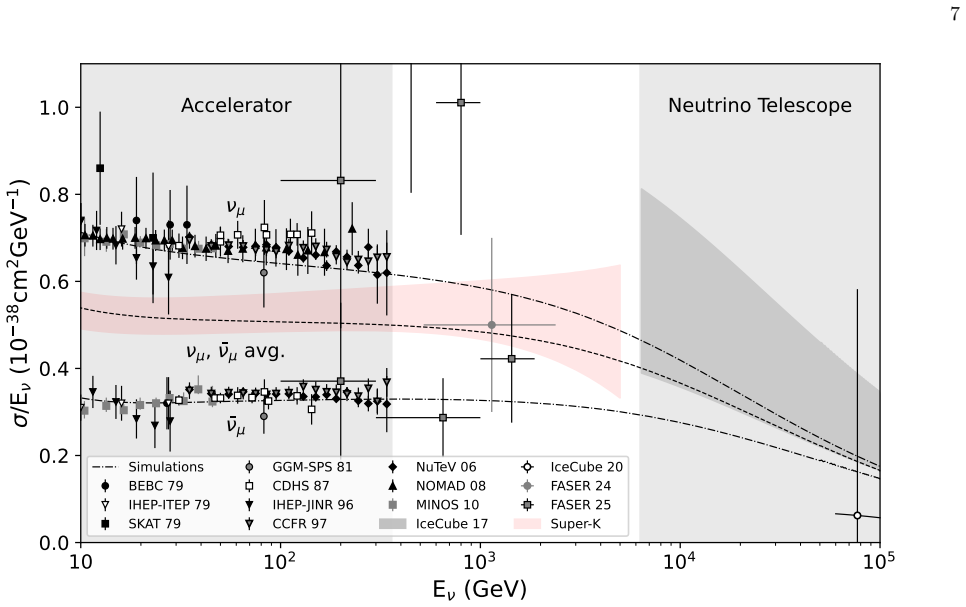
The analysis determines the flux-averaged charged-current total cross section in the 500-5000 GeV range to be σ/E_ν = (0.51 ± 0.11) × 10^{-38} cm² GeV^{-1}. The result is obtained from upward through-going muons produced by high-energy atmospheric neutrinos and is shown to be consistent with both accelerator data at lower energies and collider measurements at higher energies.
What carries the argument
Upward through-going muon events, treated as a clean sample of high-energy muon neutrino and antineutrino charged-current interactions and fitted Bayesianly to atmospheric flux models plus detector simulations.
If this is right
- The measured cross section fills the previously unmeasured interval between accelerator experiments below ~100 GeV and collider or telescope data above ~10 TeV.
- Large underground detectors can now be used for precision neutrino cross-section measurements without dedicated accelerator beams.
- The same data sample and method provide a new avenue for testing Standard Model predictions and searching for new physics at multi-TeV energies.
Where Pith is reading between the lines
- If the technique scales, future larger detectors could accumulate enough events to search for small deviations from Standard Model cross-section expectations.
- Atmospheric neutrinos could serve as a continuous, high-energy calibration beam for any sufficiently large neutrino detector.
- The measurement method could be adapted to study neutrino-nucleus interactions at energies inaccessible to man-made accelerators.
Load-bearing premise
The atmospheric neutrino flux model and the simulation of detector response and selection efficiencies contain no large unaccounted biases or correlations that would shift the extracted cross section.
What would settle it
An independent measurement of the muon neutrino charged-current cross section in the 500-5000 GeV range, obtained by a different experiment or technique, that lies well outside the interval 0.40–0.62 × 10^{-38} cm² GeV^{-1} would falsify the reported value.
Figures


read the original abstract
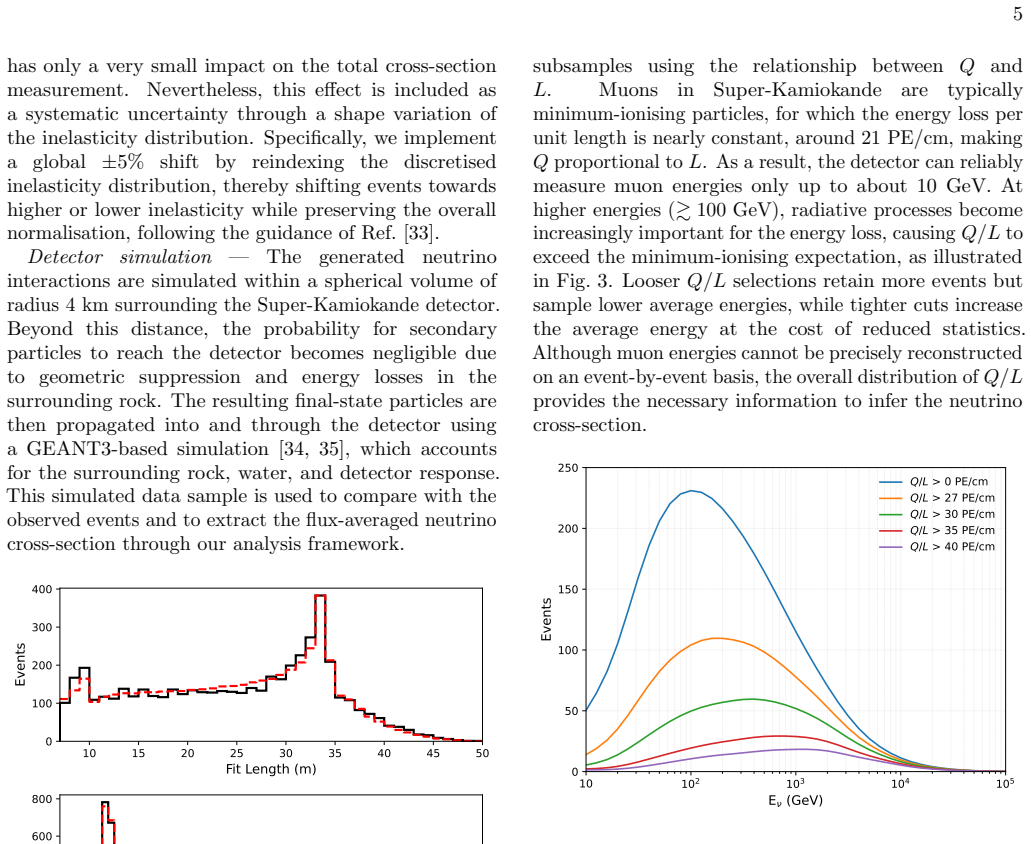
Neutrinos provide a unique probe of both particle physics and the high-energy universe, traversing astronomical distances with minimal interaction. Their charged-current scattering cross section encodes fundamental information about weak interactions and nucleon structure across a vast energy range, yet measurements at TeV energies remain sparse. Here we report the first determination of the flux-averaged muon neutrino and anti-neutrino charged-current total cross section using high-energy atmospheric neutrinos observed in Super-Kamiokande. Using 3989 upward through-going muon events collected over 4269 days, together with a Bayesian fit to atmospheric flux and detector simulations, we measure the flux-averaged charged-current cross section in the 500-5000 GeV range to be $\sigma/E_\nu=(0.51\pm 0.11)\times 10^{-38}$ cm$^2$GeV$^{-1}$, with the highest precision to date in the TeV regime. Our results are consistent with accelerator-based measurements at lower energies and collider-based measurements at higher energies, bridging a critical gap between accelerator experiments and neutrino telescopes. This work demonstrates the capability of large underground detectors to perform precision cross-section measurements with atmospheric neutrinos, opening a new window for probing Standard Model physics and potential new physics searches at multi-TeV energies.
Editorial analysis
A structured set of objections, weighed in public.
Referee Report
Summary. The manuscript reports the first measurement of the flux-averaged muon neutrino and antineutrino charged-current total cross section at TeV energies using atmospheric neutrinos. Analyzing 3989 upward through-going muon events collected over 4269 days in Super-Kamiokande, the authors perform a Bayesian fit incorporating atmospheric flux models and detector simulations to extract σ/E_ν = (0.51 ± 0.11) × 10^{-38} cm² GeV^{-1} in the 500-5000 GeV range, claiming consistency with accelerator and collider results while bridging the energy gap.
Significance. If robust, this provides the highest-precision TeV-scale neutrino cross-section datum from atmospheric neutrinos to date and demonstrates the viability of large underground water Cherenkov detectors for precision SM tests in a regime inaccessible to accelerators. The large event sample and Bayesian marginalization over nuisance parameters (flux normalization, spectral shape, detector efficiency) are strengths that allow a data-driven extraction without forcing agreement with input models by construction.
major comments (2)
- [§4.2] §4.2 (Bayesian fit procedure): The observed rate is proportional to flux × σ × efficiency. While the fit marginalizes over atmospheric flux normalization and spectral parameters, the manuscript does not show the posterior shift in σ/E_ν when the TeV-scale flux shape prior is varied within current hadronic-interaction uncertainties (e.g., from cosmic-ray spectrum or interaction models). This is load-bearing because any unaccounted bias in the flux model at 500-5000 GeV directly shifts the extracted central value by an amount comparable to the quoted ±0.11 uncertainty.
- [§5.1] §5.1 (Results and uncertainty breakdown): The total uncertainty is reported as ±0.11 without a quantitative decomposition into statistical, detector-response, and flux-model contributions. A table or plot showing the impact of each nuisance parameter on the final σ/E_ν posterior is required to confirm that the flux-model component does not dominate or correlate in a way that undermines the claimed precision.
minor comments (2)
- [Abstract] The abstract states 'highest precision to date' but lacks a direct numerical comparison to prior measurements; a small table in the results section would clarify this.
- [Introduction] Notation for the flux-averaged cross section (σ/E_ν) should be defined explicitly in the introduction with the exact energy weighting used in the average.
Simulated Author's Rebuttal
We thank the referee for the careful and constructive review. The comments highlight important aspects of the analysis presentation that we will address in the revision to strengthen the manuscript.
read point-by-point responses
-
Referee: [§4.2] §4.2 (Bayesian fit procedure): The observed rate is proportional to flux × σ × efficiency. While the fit marginalizes over atmospheric flux normalization and spectral parameters, the manuscript does not show the posterior shift in σ/E_ν when the TeV-scale flux shape prior is varied within current hadronic-interaction uncertainties (e.g., from cosmic-ray spectrum or interaction models). This is load-bearing because any unaccounted bias in the flux model at 500-5000 GeV directly shifts the extracted central value by an amount comparable to the quoted ±0.11 uncertainty.
Authors: We agree that explicitly demonstrating robustness against variations in the TeV-scale flux shape prior is valuable. Section 4.2 describes marginalization over flux normalization and spectral parameters with priors drawn from hadronic models. To address the specific request, the revised manuscript will include a new supplementary figure displaying the posterior for σ/E_ν under alternative flux shape priors (e.g., variations from different cosmic-ray spectra and interaction models such as EPOS-LHC and QGSJET). This will quantify any resulting shifts and confirm they lie within the reported uncertainty. revision: yes
-
Referee: [§5.1] §5.1 (Results and uncertainty breakdown): The total uncertainty is reported as ±0.11 without a quantitative decomposition into statistical, detector-response, and flux-model contributions. A table or plot showing the impact of each nuisance parameter on the final σ/E_ν posterior is required to confirm that the flux-model component does not dominate or correlate in a way that undermines the claimed precision.
Authors: We acknowledge that a quantitative uncertainty breakdown would improve transparency. The total ±0.11 uncertainty is obtained after full marginalization over all nuisance parameters, but the original manuscript does not decompose the contributions. In the revision we will add a new table listing the individual impacts (statistical, detector response, flux normalization, flux spectral shape) on the posterior mean and width of σ/E_ν, together with a plot showing the effect of fixing versus marginalizing each parameter. This will allow direct assessment of the flux-model contribution relative to other terms. revision: yes
Circularity Check
No circularity: data-driven measurement with independent external models
full rationale
The paper presents an experimental measurement of the flux-averaged neutrino cross section extracted from 3989 observed upward through-going muon events via a Bayesian fit that incorporates external atmospheric neutrino flux models and detector response simulations. The observed event count is an independent input, and the fit marginalizes over flux and detector parameters to solve for the cross section; the output is not equivalent to the inputs by construction, nor does any quoted step reduce to a self-definition, fitted parameter renamed as prediction, or self-citation load-bearing uniqueness theorem. The derivation chain is self-contained against external benchmarks (data and simulations) with no load-bearing reductions to the target result itself.
Axiom & Free-Parameter Ledger
free parameters (2)
- atmospheric neutrino flux normalization and spectral parameters
- detector efficiency and energy resolution parameters
axioms (2)
- domain assumption Atmospheric neutrinos are produced primarily from cosmic-ray induced pion and kaon decays in the atmosphere.
- domain assumption Upward through-going muons are dominantly from charged-current muon neutrino interactions.
Reference graph
Works this paper leans on
- [1]
-
[2]
Y. Fukuda et al. (Super-Kamiokande), Phys. Rev. Lett. 81, 1562 (1998), hep-ex/9807003
- [3]
- [4]
-
[5]
S. Abubakar et al. (T2K, NOvA), Nature646, 818 (2025), 2510.19888
- [6]
- [7]
-
[8]
R. M. Bionta et al., Phys. Rev. Lett.58, 1494 (1987)
work page 1987
-
[9]
E. N. Alekseev, L. N. Alekseeva, V. I. Volchenko, and I. V. Krivosheina, JETP Lett.45, 589 (1987)
work page 1987
- [10]
-
[11]
R. Abbasi et al. (IceCube), Science378, 538 (2022), 2211.09972
-
[12]
R. Abbasi et al. (IceCube), Science380, adc9818 (2023), 2307.04427
-
[13]
A. Schneider, B. Skrzypek, C. A. Arg¨ uelles, and J. M. Conrad, Phys. Rev. D104, 092015 (2021), 2106.01508
-
[14]
P. Di Bari, P. O. Ludl, and S. Palomares-Ruiz, JCAP11, 044 (2016), 1606.06238
-
[15]
M. Tzanov et al. (NuTeV), Phys. Rev. D74, 012008 (2006), hep-ex/0509010
- [16]
-
[17]
R. Abbasi et al. (IceCube), Phys. Rev. D104, 022001 (2021), 2011.03560
-
[18]
R. Abbasi et al. (IceCube), Phys. Rev. D111, 112001 (2025), 2502.13299
-
[19]
R. Mammen Abraham et al. (FASER), Phys. Rev. Lett. 133, 021802 (2024), 2403.12520
- [20]
-
[21]
Y. Fukuda et al. (Super-Kamiokande), Nucl. Instrum. Meth. A501, 418 (2003)
work page 2003
- [22]
-
[23]
T. Wester et al. (Super-Kamiokande), Phys. Rev. D109, 072014 (2024), 2311.05105
-
[24]
H. Nishino, K. Awai, Y. Hayato, S. Nakayama, K. Okumura, M. Shiozawa, A. Takeda, K. Ishikawa, A. Minegishi, and Y. Arai, Nucl. Instrum. Meth. A610, 710 (2009), 0911.0986
-
[25]
Atmospheric neutrino flux calculation using the NRLMSISE00 atmospheric model
M. Honda, M. Sajjad Athar, T. Kajita, K. Kasahara, and S. Midorikawa, Phys. Rev. D92, 023004 (2015), 1502.03916
work page Pith review arXiv 2015
-
[26]
L. V. Volkova, Sov. J. Nucl. Phys.31, 784 (1980)
work page 1980
- [27]
-
[28]
A. Bhattacharya, R. Enberg, M. H. Reno, I. Sarcevic, and A. Stasto, JHEP06, 110 (2015), 1502.01076
-
[29]
R. Abbasi et al. (IceCube), Phys. Rev. D110, 022001 (2024), 2402.18026
-
[30]
Y. Hayato and L. Pickering, Eur. Phys. J. ST230, 4469 (2021), 2106.15809
-
[31]
M. Gl¨ uck, E. Reya, and A. Vogt, Eur. Phys. J. C5, 461 (1998), hep-ph/9806404
-
[32]
A. Bodek and U. K. Yang, in2nd International Workshop on Neutrino-Nucleus Interactions in the Few GeV Region (2003), hep-ex/0308007
- [33]
-
[34]
R. Brun, F. Bruyant, M. Maire, A. C. McPherson, and P. Zanarini (1987)
work page 1987
-
[35]
S. Desai et al. (Super-Kamiokande), Astropart. Phys.29, 42 (2008), 0711.0053
-
[36]
M. D. Hoffman and A. Gelman, Journal of Machine Learning Research15, 1593 (2014)
work page 2014
-
[37]
P. Adamson et al. (MINOS), Phys. Rev. D81, 072002 (2010), 0910.2201
- [38]
-
[39]
D. C. Colley et al., Z. Phys. C2, 187 (1979)
work page 1979
-
[40]
J. P. Berge et al., Z. Phys. C35, 443 (1987)
work page 1987
-
[41]
W. G. Seligman, Ph.D. thesis, Nevis Labs, Columbia U. (1997)
work page 1997
-
[42]
J. G. Morfin et al. (Gargamelle SPS), Phys. Lett. B104, 235 (1981)
work page 1981
-
[43]
A. I. Mukhin, V. F. Perelygin, K. E. Shestermanov, A. A. Volkov, A. S. Vovenko, and V. P. Zhigunov, Sov. J. Nucl. Phys.30, 528 (1979)
work page 1979
-
[44]
V. B. Anikeev et al., Z. Phys. C70, 39 (1996)
work page 1996
-
[45]
D. S. Baranov et al., Phys. Lett. B81, 255 (1979)
work page 1979
-
[46]
K. Abe et al. (Hyper-Kamiokande) (2025), 2505.15019. Supplemental materials Number of events with differentQ/Lcuts Suppl.Tab. 1 summarises the data and MC event counts after each successive Q/L threshold cut. The pre-fit and post-fit values reflect the predicted rates before and after applying the fitted parameter values. The improvement in agreement illu...
discussion (0)
Sign in with ORCID, Apple, or X to comment. Anyone can read and Pith papers without signing in.