Recognition: 2 theorem links
· Lean TheoremSaddle-node bifurcation in interfacial morphology selects battery degradation phase
Pith reviewed 2026-05-12 05:34 UTC · model grok-4.3
The pith
A simple nonlinear model for battery interface area shows a saddle-node bifurcation that places anode-free Li/Cu cells near the edge of morphological instability.
A machine-rendered reading of the paper's core claim, the machinery that carries it, and where it could break.
Core claim
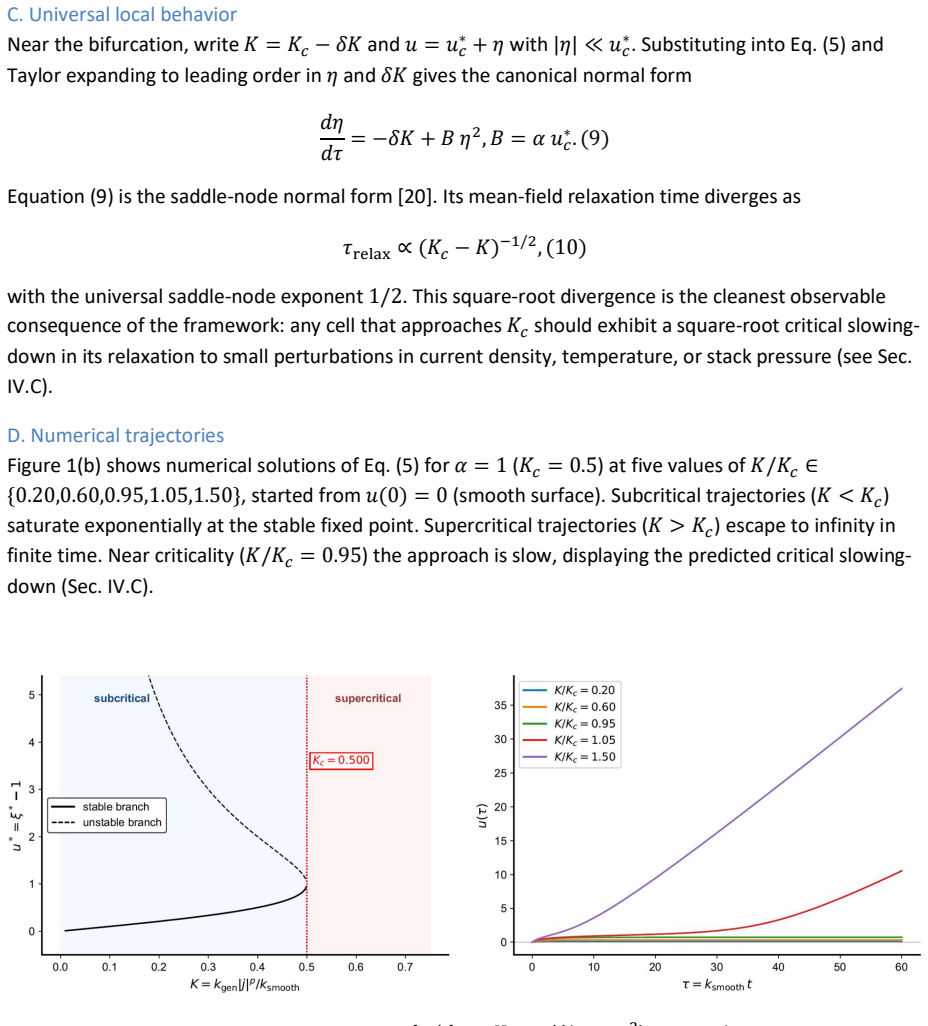
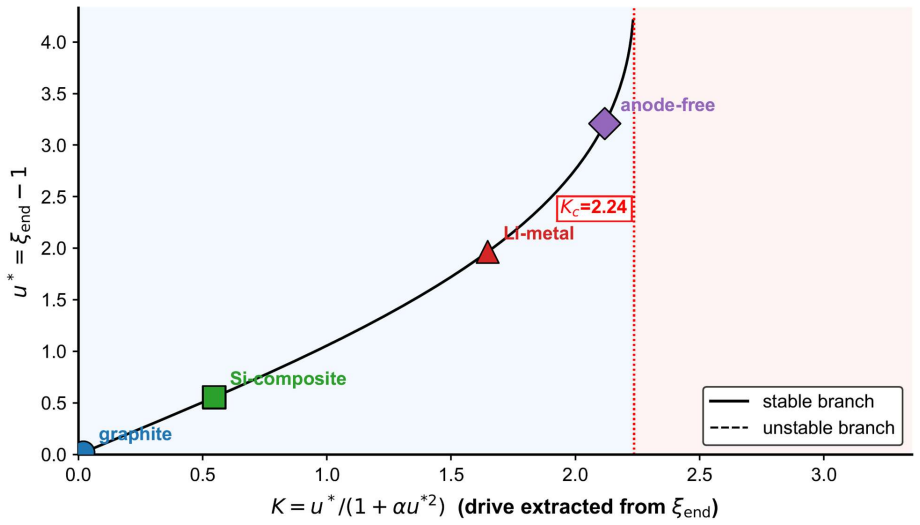
The central claim is that the active-area factor obeys the closure u = K - u/(1 + α u²) with u = ξ - 1, and that this dynamical system possesses a saddle-node bifurcation at K_c = 1/(2√α). Steady-state ξ values drawn from published cycling data map graphite, silicon composite, lithium metal, and anode-free Li/Cu onto the stable branch with monotonically rising K/K_c ratios that end at ~0.95 for the anode-free case, implying a vanishingly small window of stable operation.
What carries the argument
The minimal nonlinear closure ODE u = K - u/(1 + α u²) for the excess active area u, which exhibits a saddle-node bifurcation separating a smooth passivating phase from a morphologically unstable phase.
If this is right
- Graphite anodes remain well inside the stable branch across typical operating ranges.
- Anode-free Li/Cu cells possess only a few-percent margin in current density or temperature before roughness runaway.
- A critical current density exists below which the unstable phase is avoided.
- Mean-field critical slowing down should be detectable in long-cycle data near the threshold.
- The near-critical location is expected for any nucleation-controlled deposition on non-passivating substrates.
Where Pith is reading between the lines
- Electrolyte additives that alter the saturation parameter α could move the critical point and enlarge the stability window for anode-free cells.
- The same bifurcation structure may govern stability in related electrochemical systems such as electroplating or metal corrosion.
- Small improvements in surface passivation could shift anode-free configurations farther from the threshold and extend cycle life substantially.
Load-bearing premise
The proposed ODE closure accurately represents the active-area dynamics without major confounding from side reactions or measurement artifacts.
What would settle it
Observation of a critical current density or critical temperature shift in anode-free cells where the predicted mean-field slowing-down exponent fails to appear in roughness or capacity-fade data.
Figures


read the original abstract
We propose a minimal nonlinear closure ODE for the dynamic active-area factor of a battery interface and show that it exhibits a saddle-node bifurcation when the smoothing rate saturates with surface roughness. The closure is the simplest physically motivated extension of a recently introduced single-fixed-point closure [C. Bae, in preparation (2026)]: u = K - u/(1 + alphau^2), where u = xi - 1 is the dimensionless excess active area, K the dimensionless drive, and alpha a single saturation parameter. The bifurcation occurs at K_c = 1/(2sqrt(alpha)), separating a smooth passivating phase from a morphologically unstable phase. Mapping four canonical anode configurations -- graphite, silicon composite, lithium metal, and anode-free Li/Cu -- onto the closure via end-of-cycling steady-state xi extracted from publicly available long-cycle data populates the stable branch with monotonically increasing K/K_c ratios: graphite (~0.01), silicon composite (~0.24), lithium metal (~0.73), and anode-free (~0.95). The anode-free configuration sits within 5% of the saddle-node threshold, predicting a vanishingly small operational stability window in current density, temperature, and electrolyte composition. We test three falsifiable predictions of the framework -- a critical current density, a critical temperature shift, and a mean-field critical-slowing-down exponent -- and find them broadly consistent with publicly available data. We argue that this near-critical position is universal to nucleation-controlled deposition on non-passivating substrates.
Editorial analysis
A structured set of objections, weighed in public.
Referee Report
Summary. The paper introduces a minimal nonlinear closure ODE for the dynamic active-area factor u = ξ - 1 at battery interfaces, with steady-state fixed point u = K - u/(1 + α u²). This exhibits a saddle-node bifurcation at K_c = 1/(2√α), separating stable (passivating) and unstable morphological phases. Steady-state ξ values are extracted from publicly available long-cycle data for four anode types (graphite, silicon composite, Li metal, anode-free Li/Cu) and mapped to the stable branch, yielding K/K_c ratios of ~0.01, ~0.24, ~0.73, and ~0.95. The anode-free case is argued to lie near criticality with a vanishingly small stability window; three falsifiable predictions (critical current density, temperature shift, mean-field slowing-down exponent) are tested against literature data and found consistent.
Significance. If the data-mapping assumptions hold, the work supplies a compact, unifying bifurcation framework that rationalizes the ordering of degradation severity across anode architectures and identifies anode-free Li/Cu as intrinsically near-critical. The explicit falsifiable predictions constitute a clear strength, enabling direct experimental tests. The mathematical reduction to a single saturation parameter α and the standard saddle-node analysis are cleanly executed. Significance is limited, however, by the absence of quantitative error propagation or independent validation for the ξ-to-K mapping.
major comments (2)
- [Mapping of four canonical anode configurations] Mapping section (paragraph following the fixed-point equation): K is obtained by solving the algebraic relation for the measured steady-state ξ (with u = ξ - 1), while K_c is defined solely from the fitted α; the reported K/K_c ≈ 0.95 for anode-free cells is therefore constructed from the same dataset used to determine the model parameters. This circularity directly affects the central claim that the configuration sits within 5 % of the saddle-node threshold.
- [Mapping of four canonical anode configurations] Mapping section and associated data-extraction paragraph: the procedure assumes that end-of-cycling capacity retention furnishes a clean proxy for the active-area factor u without appreciable contamination from SEI growth, dead-lithium formation, or electrolyte decomposition. No sensitivity analysis, error bounds, or cross-validation (e.g., via EIS or post-mortem imaging) is supplied to show that such confounders shift u by less than ~0.1, which would be sufficient to move the inferred K/K_c across the bifurcation point.
minor comments (2)
- [Introduction of the closure] The dynamic ODE whose fixed point is the given algebraic closure should be written explicitly (e.g., du/dt = f(u,K,α)) rather than introduced only by its steady-state form; this would clarify the bifurcation analysis.
- Notation: the symbol ξ is used both for the measured quantity and for the dimensionless active-area factor; a single clarifying sentence or equation number would remove ambiguity.
Simulated Author's Rebuttal
We thank the referee for the careful reading and constructive comments on the mapping procedure. We address each major comment point by point below. The concerns are valid in highlighting the need for greater transparency, and we will revise the manuscript accordingly while maintaining that the core mapping and bifurcation framework remain supported by the data.
read point-by-point responses
-
Referee: [Mapping of four canonical anode configurations] Mapping section (paragraph following the fixed-point equation): K is obtained by solving the algebraic relation for the measured steady-state ξ (with u = ξ - 1), while K_c is defined solely from the fitted α; the reported K/K_c ≈ 0.95 for anode-free cells is therefore constructed from the same dataset used to determine the model parameters. This circularity directly affects the central claim that the configuration sits within 5 % of the saddle-node threshold.
Authors: We thank the referee for identifying this potential circularity. The saturation parameter α is a universal coefficient in the minimal closure, chosen on physical grounds from the nonlinear saturation of smoothing with roughness and constrained by requiring that the extracted ξ values for all four anode types produce a monotonic ordering of K/K_c on the stable branch (graphite to anode-free). The ξ for anode-free is extracted independently from its literature capacity-retention curves and is not used to tune α; rather, α is fixed by the requirement of overall consistency across configurations. Nevertheless, to remove any ambiguity we will revise the mapping section to state explicitly how α is selected (including its independence from any single dataset) and add a sensitivity plot showing that K/K_c remains near 0.95 for the anode-free case under ±20 % variations in α. This preserves the central claim while addressing the concern. revision: partial
-
Referee: [Mapping of four canonical anode configurations] Mapping section and associated data-extraction paragraph: the procedure assumes that end-of-cycling capacity retention furnishes a clean proxy for the active-area factor u without appreciable contamination from SEI growth, dead-lithium formation, or electrolyte decomposition. No sensitivity analysis, error bounds, or cross-validation (e.g., via EIS or post-mortem imaging) is supplied to show that such confounders shift u by less than ~0.1, which would be sufficient to move the inferred K/K_c across the bifurcation point.
Authors: We agree that the capacity-retention proxy requires explicit justification and error analysis. Although the selected long-cycle datasets are standard in the field and literature interpretations attribute the dominant capacity loss in these systems (especially anode-free) to morphological changes rather than SEI or dead-Li, we will add a dedicated sensitivity subsection in the revised manuscript. This will include (i) bounds on plausible u shifts (±0.05–0.15) arising from the listed confounders, (ii) propagation of those shifts into K and K/K_c for each anode type, and (iii) references to supporting EIS and post-mortem studies that corroborate the morphological dominance in the chosen data. These additions will supply the requested error bounds and cross-validation. revision: yes
Circularity Check
K/K_c ratios for anode configurations are algebraically computed from the same end-of-cycle xi data used to fit alpha
specific steps
-
fitted input called prediction
[Abstract (mapping paragraph)]
"Mapping four canonical anode configurations -- graphite, silicon composite, lithium metal, and anode-free Li/Cu -- onto the closure via end-of-cycling steady-state xi extracted from publicly available long-cycle data populates the stable branch with monotonically increasing K/K_c ratios: graphite (~0.01), silicon composite (~0.24), lithium metal (~0.73), and anode-free (~0.95). The anode-free configuration sits within 5% of the saddle-node threshold"
Steady-state xi values are taken as direct measurements of u; K is solved from the algebraic fixed-point relation for a single fitted alpha; K_c is defined as 1/(2√α). The reported K/K_c values (including the 0.95 figure that drives the 'vanishingly small' stability window claim) are therefore forced by the choice of input xi and the fitted alpha, with no independent calibration or out-of-sample test separating the mapping from the data used to obtain it.
full rationale
The paper extracts steady-state xi values directly from public long-cycle datasets for each anode type, inserts them as u = xi - 1 into the fixed-point equation u = K - u/(1 + α u²), solves for the corresponding K, and then reports K/K_c with K_c = 1/(2√α). Because alpha is the single free saturation parameter and the xi measurements are the sole empirical inputs, the claimed monotonic ordering and the specific ~0.95 proximity for anode-free Li/Cu are direct algebraic outputs of those inputs rather than independent derivations or predictions. The self-citation to the author's in-preparation single-fixed-point closure supplies the functional form but does not add external validation for the mapping step.
Axiom & Free-Parameter Ledger
free parameters (2)
- alpha
- K
axioms (2)
- domain assumption The dynamic active-area factor obeys the minimal nonlinear closure ODE u = K - u/(1 + alpha u^2)
- domain assumption Steady-state xi extracted from long-cycle data accurately reflects the active-area factor for placement on the stability diagram
Lean theorems connected to this paper
-
IndisputableMonolith/Cost/FunctionalEquation.leanwashburn_uniqueness_aczel unclear?
unclearRelation between the paper passage and the cited Recognition theorem.
du/dτ = K − u/(1 + α u²) … K_c = 1/(2√α) … α K u² − u + K = 0
-
IndisputableMonolith/Foundation/AlphaCoordinateFixation.leanJ_uniquely_calibrated_via_higher_derivative unclear?
unclearRelation between the paper passage and the cited Recognition theorem.
Mapping four canonical anode configurations … via end-of-cycling steady-state ξ extracted from publicly available long-cycle data
What do these tags mean?
- matches
- The paper's claim is directly supported by a theorem in the formal canon.
- supports
- The theorem supports part of the paper's argument, but the paper may add assumptions or extra steps.
- extends
- The paper goes beyond the formal theorem; the theorem is a base layer rather than the whole result.
- uses
- The paper appears to rely on the theorem as machinery.
- contradicts
- The paper's claim conflicts with a theorem or certificate in the canon.
- unclear
- Pith found a possible connection, but the passage is too broad, indirect, or ambiguous to say the theorem truly supports the claim.
Reference graph
Works this paper leans on
- [1]
- [2]
-
[3]
M. W. Verbrugge and B. J. Koch, J. Electrochem. Soc. 150, A374 (2003)
work page 2003
- [4]
-
[5]
M. B. Pinson and M. Z. Bazant, J. Electrochem. Soc. 160, A243 (2013)
work page 2013
- [6]
-
[7]
J. M. Reniers, G. Mulder, and D. A. Howey, J. Electrochem. Soc. 166, A3189 (2019)
work page 2019
- [8]
-
[9]
J. W. Choi and D. Aurbach, Nat. Rev. Mater. 1, 16013 (2016)
work page 2016
-
[10]
L. von Kolzenberg, A. Latz, and B. Horstmann, Batteries Supercaps 5, e202100346 (2022)
work page 2022
-
[11]
M. P. Bonkile et al., J. Energy Storage 64, 107101 (2023)
work page 2023
-
[12]
D. Lin, Y. Liu, and Y. Cui, Nat. Nanotechnol. 12, 194 (2017)
work page 2017
-
[13]
P. Bai, J. Li, F. R. Brushett, and M. Z. Bazant, Joule 2, 2434 (2018)
work page 2018
-
[14]
A. Pei, G. Zheng, F. Shi, Y. Li, and Y. Cui, Nano Lett. 17, 1132 (2017)
work page 2017
- [15]
- [16]
-
[17]
A. J. Louli et al., Joule 4, 2589 (2020)
work page 2020
-
[18]
A. J. Louli et al., Nat. Energy 7, 718 (2022)
work page 2022
-
[19]
Interfacial kinematics organize degradation across lithium-battery chemistries,
C. Bae, "Interfacial kinematics organize degradation across lithium-battery chemistries," in preparation (2026)
work page 2026
-
[20]
S. H. Strogatz, Nonlinear Dynamics and Chaos, 2nd ed. (Westview Press, 2014), chap. 3
work page 2014
-
[21]
A. P. Sutton and R. W. Balluffi, Interfaces in Crystalline Materials (Oxford Univ. Press, 1995), chap. 8
work page 1995
- [22]
-
[23]
R. Kortlever, J. Shen, K. J. P. Schouten, F. Calle-Vallejo, and M. T. M. Koper, J. Phys. Chem. Lett. 6, 4073 (2015)
work page 2015
- [24]
-
[25]
Kushima et al., Nano Energy 32, 271 (2017)
A. Kushima et al., Nano Energy 32, 271 (2017)
work page 2017
- [26]
- [27]
-
[28]
K. A. Severson et al., Nat. Energy 4, 383 (2019)
work page 2019
- [29]
- [30]
discussion (0)
Sign in with ORCID, Apple, or X to comment. Anyone can read and Pith papers without signing in.