Recognition: 2 theorem links
· Lean TheoremFloquet-tuned superfluid-checkerboard competition in dipolar bosons
Pith reviewed 2026-05-12 04:30 UTC · model grok-4.3
The pith
Periodic driving that suppresses transverse hopping stabilizes checkerboard order at weaker dipolar repulsion in hard-core bosons.
A machine-rendered reading of the paper's core claim, the machinery that carries it, and where it could break.
Core claim
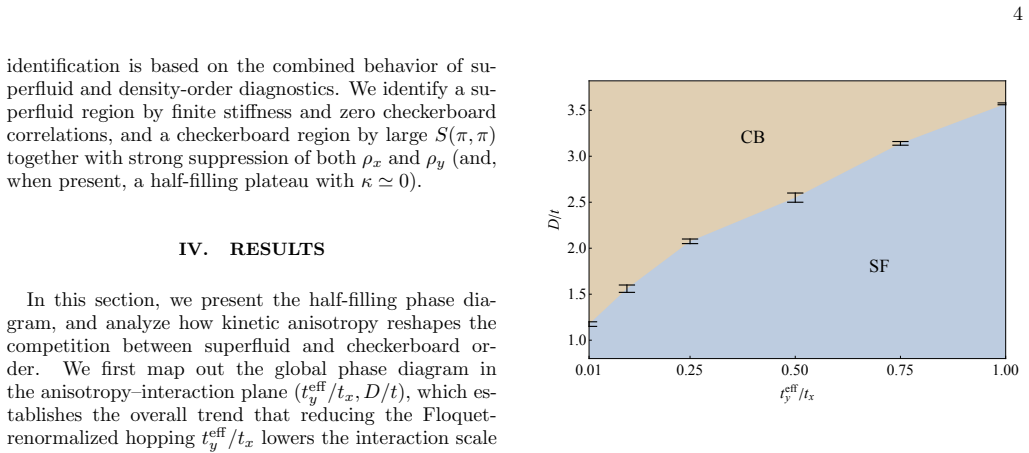
In the driven system, increasing kinetic anisotropy systematically lowers the interaction strength required to stabilize checkerboard order, demonstrating that Floquet-induced suppression of transverse motion enhances density ordering while the isotropic long-range interactions prevent reduction to decoupled chains.
What carries the argument
Unidirectional periodic drive that generates anisotropic hopping in the leading-order high-frequency effective Hamiltonian, combined with isotropic long-range dipolar repulsion and simulated via sign-problem-free worm-algorithm quantum Monte Carlo.
If this is right
- Checkerboard order appears at progressively smaller dipolar couplings as anisotropy increases.
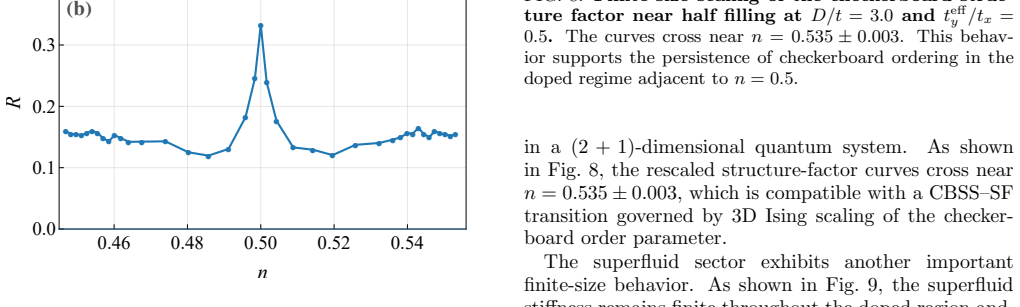
- Near the superfluid-checkerboard boundary the stiffness drops rapidly while checkerboard correlations rise sharply, with the feature sharpening at larger system sizes consistent with a weakly first-order transition.
- Away from half filling a narrow checkerboard-supersolid window exists where both checkerboard correlations and anisotropic superfluid stiffness are finite.
- The density pattern remains isotropic even though the superfluid stiffness is anisotropic.
Where Pith is reading between the lines
- Similar unidirectional drives could tune the balance between superfluid and density-wave phases in other long-range interacting lattice systems.
- The combination of anisotropic kinetics with isotropic interactions opens routes to directional transport within density-ordered phases.
- Varying drive frequency independently of amplitude would test the range of validity of the high-frequency approximation used for the phase diagram.
Load-bearing premise
The leading-order high-frequency Floquet effective Hamiltonian accurately describes the driven system without significant higher-order corrections or heating effects over the simulation timescales.
What would settle it
Observation of phase boundaries that deviate from the predicted anisotropy dependence, or measurable heating, when the drive frequency is lowered sufficiently for higher-order Floquet terms to matter would falsify the leading-order description.
Figures




read the original abstract
We study hard-core dipolar bosons on a square lattice subject to a unidirectional periodic drive that Floquet-engineers anisotropic hopping. Driving along one lattice direction provides a controlled way to suppress transverse tunneling, yielding a kinetically quasi-one-dimensional regime with strongly anisotropic transport within the leading-order high-frequency Floquet effective description. In this limit, the system does not reduce to decoupled chains, due to the long-range in-plane dipolar interaction remains isotropic and couples different chains. Focusing on dipoles polarized perpendicular to the plane, for which the interaction is purely repulsive and isotropic, we use sign-problem-free worm-algorithm quantum Monte Carlo simulations to map the half-filling phase diagram versus kinetic anisotropy and dipolar coupling. We find that increasing kinetic anisotropy systematically lowers the interaction strength required to stabilize checkerboard order, demonstrating that Floquet-induced suppression of transverse motion enhances density ordering. Near the superfluid--checkerboard boundary, finite-size results reveal a narrow transition region where the stiffness drops rapidly while checkerboard correlations rise sharply; Its pronounced sharpening with system size is consistent with a weakly first-order transition rounded by finite-size effects. Away from half filling, on the doped sides of the checkerboard plateau, we identify a narrow checkerboard-supersolid regime with simultaneously finite checkerboard correlations and superfluid stiffness, where the superfluid stiffness is anisotropic but the density pattern is isotropic.
Editorial analysis
A structured set of objections, weighed in public.
Referee Report
Summary. The paper claims that a unidirectional periodic drive applied to hard-core dipolar bosons on a square lattice Floquet-engineers anisotropic hopping in the leading-order high-frequency limit. Worm-algorithm QMC simulations of the resulting effective model (anisotropic t_x, t_y; isotropic dipolar V) at half filling show that increasing kinetic anisotropy lowers the critical dipolar strength for checkerboard order. The authors interpret this as Floquet-induced enhancement of density ordering, report finite-size sharpening consistent with a weakly first-order superfluid-checkerboard transition, and identify a narrow checkerboard-supersolid regime upon doping.
Significance. If the high-frequency approximation holds, the result is significant as it provides a controllable Floquet route to tune superfluid-density order competition in long-range interacting systems. The demonstration that kinetic anisotropy promotes checkerboard order despite isotropic interactions is a clear finding. The use of established sign-problem-free worm QMC is a strength, enabling direct access to stiffness and correlations without fitting parameters.
major comments (2)
- [§2] §2 (model and effective Hamiltonian): All reported phase boundaries and the central observation (anisotropy lowers critical V for checkerboard order) are obtained from QMC on the leading-order Magnus-expanded effective Hamiltonian. No quantitative bound on ω/t or ω/V is supplied, nor any estimate of O(1/ω) corrections to hopping or interactions, nor any comparison to time-dependent evolution. This assumption is load-bearing for attributing the anisotropy dependence to Floquet engineering rather than a static anisotropic model.
- [§4] §4 (finite-size analysis near the transition): The abstract and results describe pronounced sharpening of the stiffness drop and checkerboard rise with system size as consistent with a weakly first-order transition. However, no error bars are reported on the stiffness or structure-factor data, and no systematic table or figure quantifies convergence across multiple L values. This weakens the ability to assess the transition order claim.
minor comments (2)
- [Abstract] The abstract states that the superfluid stiffness is anisotropic while the density pattern is isotropic in the supersolid regime; a brief remark on how this is measured (e.g., via winding numbers in x and y) would aid clarity.
- [Figures] Figure captions could explicitly list the anisotropy ratios (t_y/t_x) and system sizes used for each data set.
Simulated Author's Rebuttal
We thank the referee for the positive assessment of our work and for the detailed, constructive comments. We address each major comment below, indicating where revisions have been made to the manuscript.
read point-by-point responses
-
Referee: [§2] §2 (model and effective Hamiltonian): All reported phase boundaries and the central observation (anisotropy lowers critical V for checkerboard order) are obtained from QMC on the leading-order Magnus-expanded effective Hamiltonian. No quantitative bound on ω/t or ω/V is supplied, nor any estimate of O(1/ω) corrections to hopping or interactions, nor any comparison to time-dependent evolution. This assumption is load-bearing for attributing the anisotropy dependence to Floquet engineering rather than a static anisotropic model.
Authors: We agree that the validity of the high-frequency approximation is central to interpreting the results as Floquet engineering. In the revised manuscript we have added a dedicated paragraph in §2 that supplies quantitative bounds on ω/t and ω/V for the driving parameters employed, together with an order-of-magnitude estimate of the leading O(1/ω) corrections to both hopping and interactions. These estimates confirm that the corrections remain perturbative in the regime studied. A direct comparison with time-dependent evolution is not provided, as the worm algorithm is formulated for the effective static Hamiltonian; performing unbiased Floquet time evolution for the system sizes required would demand an entirely different numerical approach and lies outside the scope of the present study. We maintain that the leading-order effective model is the appropriate and standard framework for isolating the Floquet-induced kinetic anisotropy that drives the reported physics. revision: partial
-
Referee: [§4] §4 (finite-size analysis near the transition): The abstract and results describe pronounced sharpening of the stiffness drop and checkerboard rise with system size as consistent with a weakly first-order transition. However, no error bars are reported on the stiffness or structure-factor data, and no systematic table or figure quantifies convergence across multiple L values. This weakens the ability to assess the transition order claim.
Authors: We thank the referee for highlighting this presentational shortcoming. In the revised manuscript we have added statistical error bars (obtained from the Monte Carlo sampling) to all plots of superfluid stiffness and checkerboard structure factor. We have also included a new supplementary figure that displays the same observables for a systematic sequence of system sizes (L = 8, 10, 12, 16, 20), making the finite-size sharpening of the transition region quantitatively visible. These additions directly address the concern and strengthen the evidence for our interpretation of a weakly first-order transition. revision: yes
Circularity Check
No significant circularity; results from direct QMC on derived effective Hamiltonian
full rationale
The paper constructs a leading-order high-frequency Floquet effective model with anisotropic hopping and isotropic dipolar interactions, then maps the phase diagram via independent worm-algorithm QMC simulations. The central observation (anisotropy lowers critical dipolar strength for checkerboard order) is an output of those simulations rather than a quantity defined in terms of fitted inputs or self-referential definitions. No self-citation chains, ansatz smuggling, or renaming of known results appear as load-bearing steps in the derivation.
Axiom & Free-Parameter Ledger
axioms (3)
- domain assumption Hard-core constraint on bosons (no double occupancy)
- domain assumption Validity of leading-order high-frequency Floquet effective Hamiltonian
- domain assumption Dipolar interaction remains purely repulsive and isotropic when dipoles are polarized perpendicular to the plane
Lean theorems connected to this paper
-
IndisputableMonolith/Cost/FunctionalEquation.leanwashburn_uniqueness_aczel unclear?
unclearRelation between the paper passage and the cited Recognition theorem.
In the high-frequency regime ... the effective Hamiltonian is obtained by averaging over a drive period ... teff_y = t_y J_0(K_y) ... Heff = −∑_<ij>_x t_x (b†_i b_j + H.c.) − ∑_<ij>_y t_eff_y (b†_i b_j + H.c.) − μ ∑_i n_i + ∑_i<j D/r_ij^3 n_i n_j
-
IndisputableMonolith/Foundation/RealityFromDistinction.leanreality_from_one_distinction unclear?
unclearRelation between the paper passage and the cited Recognition theorem.
We use sign-problem-free worm-algorithm quantum Monte Carlo simulations to map the half-filling phase diagram versus kinetic anisotropy and dipolar coupling.
What do these tags mean?
- matches
- The paper's claim is directly supported by a theorem in the formal canon.
- supports
- The theorem supports part of the paper's argument, but the paper may add assumptions or extra steps.
- extends
- The paper goes beyond the formal theorem; the theorem is a base layer rather than the whole result.
- uses
- The paper appears to rely on the theorem as machinery.
- contradicts
- The paper's claim conflicts with a theorem or certificate in the canon.
- unclear
- Pith found a possible connection, but the passage is too broad, indirect, or ambiguous to say the theorem truly supports the claim.
Reference graph
Works this paper leans on
-
[1]
A. Eckardt, C. Weiss, and M. Holthaus, Superfluid- insulator transition in a periodically driven optical lat- tice, Physical Review Letters95, 260404 (2005)
work page 2005
-
[2]
H. Lignier, C. Sias, D. Ciampini, Y. Singh, A. Zen- esini, O. Morsch, and E. Arimondo, Dynamical control of matter-wave tunneling in periodic potentials, Physical Review Letters99, 220403 (2007)
work page 2007
-
[3]
N. Goldman and J. Dalibard, Periodically driven quan- tum systems: Effective hamiltonians and engineered gauge fields, Physical Review X4, 031027 (2014)
work page 2014
-
[4]
A. Eckardt, Colloquium: Atomic quantum gases in pe- riodically driven optical lattices, Reviews of Modern Physics89, 011004 (2017)
work page 2017
- [5]
- [6]
-
[7]
K. G´ oral, L. Santos, and M. Lewenstein, Quantum phases of dipolar bosons in optical lattices, Physical Review Let- ters88, 170406 (2002)
work page 2002
-
[8]
S. A. Moses, J. P. Covey, M. T. Miecnikowski, D. S. Jin, and J. Ye, New frontiers for quantum gases of polar molecules, Nature Physics13, 13 (2017)
work page 2017
-
[9]
B. Yan, S. A. Moses, B. Gadway, J. P. Covey, K. R. A. Hazzard, A. M. Rey, D. S. Jin, and J. Ye, Observation of dipolar spin-exchange interactions with lattice-confined polar molecules, Nature501, 521 (2013)
work page 2013
- [10]
- [11]
-
[12]
M. Guo, F. B¨ ottcher, J. Hertkorn, J.-N. Schmidt, M. Wenzel, H. P. B¨ uchler, T. Langen, and T. Pfau, The low-energy goldstone mode in a trapped dipolar super- solid, Nature574, 386 (2019)
work page 2019
- [13]
- [14]
- [15]
-
[16]
S. Sinha and S. Sinha, Supersolid phases of bosons, Jour- nal of Physics: Condensed Matter37, 333001 (2025)
work page 2025
-
[17]
S. Wessel and M. Troyer, Supersolid phase of hard-core bosons on the triangular lattice, Phys. Rev. Lett.95, 127205 (2005)
work page 2005
-
[18]
S. Yi, T. Li, and C. P. Sun, Novel quantum phases of dipolar bose gases in optical lattices, Physical Review Letters98, 260405 (2007)
work page 2007
-
[19]
B. Capogrosso-Sansone, C. Trefzger, M. Lewenstein, P. Zoller, and G. Pupillo, Quantum phases of cold polar molecules in 2d optical lattices, Physical Review Letters 104, 125301 (2010)
work page 2010
-
[20]
C. Zhang and B. Capogrosso-Sansone, Quantum monte carlo study of the long-range site-diluted xxz model as re- alized by polar molecules, Physical Review A98, 013621 (2018)
work page 2018
- [21]
- [22]
- [23]
-
[24]
M. Boninsegni and N. Prokof’ev, Supersolid phase of hard-core bosons on a triangular lattice, Phys. Rev. Lett. 95, 237204 (2005)
work page 2005
- [25]
-
[26]
P. Sengupta, L. P. Pryadko, F. Alet, M. Troyer, and G. Schmid, Supersolids versus phase separation in two- dimensional lattice bosons, Physical Review Letters94, 207202 (2005)
work page 2005
- [27]
-
[28]
L. Cardarelli, S. Greschner, and L. Santos, Engineering interactions and anyon statistics by multicolor lattice- depth modulations, Phys. Rev. A94, 023615 (2016)
work page 2016
-
[29]
G. Pieplow, F. Sols, and C. E. Creffield, Generation of atypical hopping and interactions by kinetic driving, New Journal of Physics20, 073045 (2018)
work page 2018
- [30]
- [31]
-
[32]
J. Sch¨ onmeier-Kromer and L. Pollet, Ground-state phase diagram of the two-dimensional bose-hubbard model with anisotropic hopping, Physical Review A89, 023605 (2014)
work page 2014
discussion (0)
Sign in with ORCID, Apple, or X to comment. Anyone can read and Pith papers without signing in.