Recognition: 2 theorem links
· Lean TheoremComparing Qubit and Qudit Encodings for EV Charging and Trip Assignment Problems
Pith reviewed 2026-05-12 05:27 UTC · model grok-4.3
The pith
Qudit encoding for trip assignments in QAOA matches or beats qubit encoding on EV fleet problems while using far fewer quantum resources.
A machine-rendered reading of the paper's core claim, the machinery that carries it, and where it could break.
Core claim
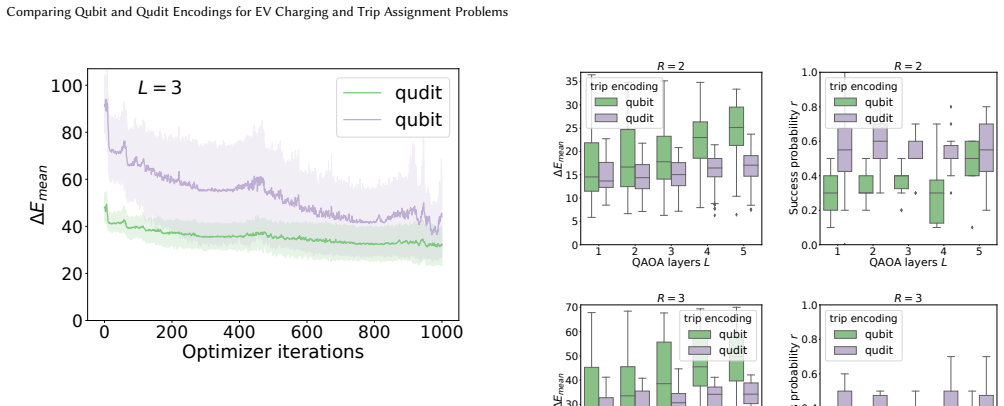
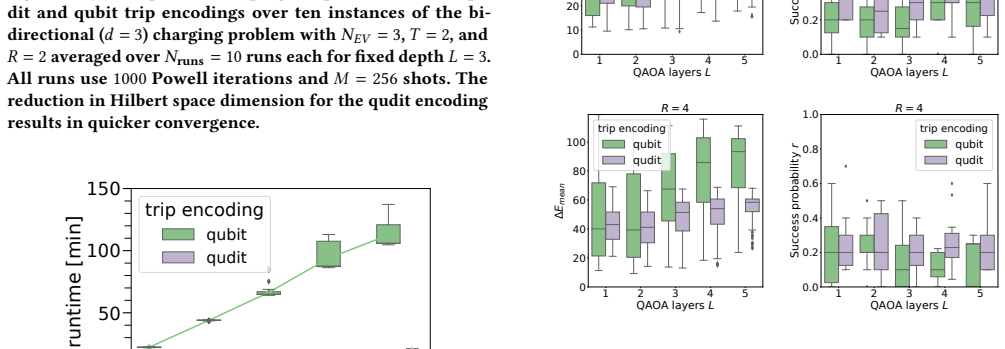
The qudit encoding of customer trips achieves similar or better optimization performance at much reduced resource requirements and shorter simulation runtime. Both encodings enforce the same feasible solution set, yet the integer representation reduces the Hilbert-space dimension exponentially compared with the conventional binary qubit map. The advantage is observed consistently when the resulting QAOA circuits are run on many randomly generated, highly constrained EV fleet instances.
What carries the argument
Qudit encoding of trip assignments, which maps each customer request directly to an integer level and thereby reduces the Hilbert-space dimension exponentially relative to binary qubit encoding while preserving the identical feasible set.
If this is right
- Integer and multi-valued scheduling problems become accessible to variational quantum optimization with lower qubit overhead.
- The same feasible set is retained while circuit depth and simulation cost fall, allowing larger problem sizes to be tested.
- Qudit-native encodings supply a direct route for problems whose variables naturally take more than two values.
- Resource savings compound when the number of trips or charging windows grows.
Where Pith is reading between the lines
- The same encoding principle could be applied to other logistics tasks such as job-shop scheduling or multi-resource allocation.
- Hardware platforms that natively support qudits would amplify the observed runtime and memory gains.
- Further scaling tests with growing fleet size would reveal whether the exponential dimension reduction continues to translate into practical speedups.
- The approach may combine with other variational algorithms beyond QAOA for broader combinatorial problems.
Load-bearing premise
The performance and resource advantages measured in classical simulation will continue to hold once the circuits run on actual noisy quantum hardware.
What would settle it
Implement the same qudit and qubit QAOA circuits for identical EV instances on real quantum processors and check whether the qudit version still reaches comparable or better solution quality with measurably lower gate count or shorter execution time.
Figures


read the original abstract
Variational quantum algorithms have attracted attention for their potential to solve combinatorial optimization problems. We study how the choice of encoding affects the resource requirements and optimization behavior of a variational quantum optimization algorithm. In order to quantify these effects, realistically inspired constrained electric vehicle (EV) fleet management problems were considered. These problems couple determining the optimal EV battery charging schedule with assigning EVs to trips requested by customers. We compare a conventional binary (qubit) trip encoding with an integer (qudit) encoding that represents assignments more directly. Both encodings guarantee the same feasible solution set, while the qudit encoding exponentially reduces the required Hilbert-space dimension. We solve many random instances of highly constrained uni- and bi-directional charging problems using qudit-based quantum approximate optimization algorithm (QAOA) and thoroughly evaluate the performance results. We find that the qudit encoding of customer trips achieves similar or better optimization performance at much reduced resource requirements and shorter simulation runtime. These results highlight qudit-native encodings as a practical route for integer and multi-valued scheduling problems in variational quantum optimization.
Editorial analysis
A structured set of objections, weighed in public.
Referee Report
Summary. The manuscript compares qubit and qudit encodings for constrained EV fleet management problems (charging schedules coupled with customer trip assignments) solved via QAOA. Both encodings enforce identical feasible sets, but the qudit encoding reduces the Hilbert-space dimension exponentially. On many randomly generated instances of uni- and bi-directional charging problems, the authors report that qudit QAOA achieves similar or better optimization performance with lower resource counts and shorter classical simulation runtimes.
Significance. If the empirical findings are robust, the work provides concrete evidence that qudit-native encodings can reduce resource overhead for integer-valued combinatorial problems in variational quantum optimization without sacrificing solution quality. This is a practical contribution for near-term quantum algorithms applied to scheduling tasks.
major comments (3)
- [Abstract] Abstract and results section: the central claim of 'similar or better optimization performance' is supported only by classical simulations whose quantitative metrics (approximation ratios, success probabilities, or objective values), number of QAOA layers p, and statistical error analysis are not detailed enough to allow independent verification or assessment of effect sizes.
- [Methods] Methods: the implementation of the qudit QAOA (mixer Hamiltonian, cost Hamiltonian construction for the trip-assignment constraints, and penalty terms) is described at a high level but lacks explicit equations or pseudocode that would confirm both encodings enforce exactly the same feasible set and permit direct comparison of circuit depth and gate counts.
- [Results] Results: while 'many random instances' are mentioned, the manuscript does not report the distribution of problem sizes (number of EVs, trips, time slots), the number of instances per size class, or any hypothesis testing that would substantiate the performance-parity claim across the uni- and bi-directional cases.
minor comments (2)
- [Introduction] Notation for the qudit states and the mapping from integer assignments to qudit basis states should be introduced with an explicit example for a small instance to improve readability.
- [Figures] Figure captions should include the number of QAOA layers p and the number of random instances averaged for each data point.
Simulated Author's Rebuttal
We thank the referee for the constructive and detailed report. The comments highlight areas where additional specificity will strengthen the manuscript. We have revised the paper accordingly to provide the requested quantitative details, explicit formulations, and statistical reporting while preserving the core findings on qudit versus qubit encodings for the EV problems.
read point-by-point responses
-
Referee: [Abstract] Abstract and results section: the central claim of 'similar or better optimization performance' is supported only by classical simulations whose quantitative metrics (approximation ratios, success probabilities, or objective values), number of QAOA layers p, and statistical error analysis are not detailed enough to allow independent verification or assessment of effect sizes.
Authors: We agree that the original presentation of performance metrics was insufficiently quantitative. In the revised manuscript we have expanded both the abstract and the results section to report explicit approximation ratios, success probabilities, and objective values for representative instances. We now specify the QAOA depth p (ranging from 1 to 3) used in all experiments and include error bars derived from 20 independent runs with distinct random seeds for each encoding. These additions permit direct assessment of effect sizes and confirm that the qudit encoding achieves comparable or superior performance on the tested uni- and bi-directional instances. revision: yes
-
Referee: [Methods] Methods: the implementation of the qudit QAOA (mixer Hamiltonian, cost Hamiltonian construction for the trip-assignment constraints, and penalty terms) is described at a high level but lacks explicit equations or pseudocode that would confirm both encodings enforce exactly the same feasible set and permit direct comparison of circuit depth and gate counts.
Authors: We accept that the methods description was too high-level for reproducibility. The revised version now contains the full explicit Hamiltonians: the cost Hamiltonian for both encodings (including the quadratic penalty terms that enforce the trip-assignment and charging constraints) and the corresponding mixer Hamiltonians. We have added pseudocode for circuit construction and a table comparing circuit depth and gate counts between the two encodings. These additions rigorously demonstrate that both encodings encode precisely the same feasible set while the qudit version requires an exponentially smaller Hilbert space. revision: yes
-
Referee: [Results] Results: while 'many random instances' are mentioned, the manuscript does not report the distribution of problem sizes (number of EVs, trips, time slots), the number of instances per size class, or any hypothesis testing that would substantiate the performance-parity claim across the uni- and bi-directional cases.
Authors: We have augmented the results section with a complete description of the instance generation procedure. Problem sizes are now reported as: number of EVs drawn uniformly from 5–20, trips from 10–50, and time slots fixed at 24 or 48; we generated 100 instances per size class for each of the uni- and bi-directional variants. We include mean and standard-deviation tables for all performance metrics together with two-sided t-test p-values comparing qubit and qudit encodings, confirming that the observed performance parity (or advantage for qudits) is statistically supported across the tested range. revision: yes
Circularity Check
No significant circularity detected
full rationale
The paper reports an empirical comparison of qubit versus qudit encodings for QAOA applied to randomly generated EV charging and trip assignment instances. Both encodings are stated to enforce identical feasible sets, and performance metrics (solution quality, resource counts, runtime) are obtained directly from classical simulations of the variational algorithm. No load-bearing step reduces by construction to a fitted parameter, self-definition, or self-citation chain; the central claim is a straightforward experimental outcome on independent test instances rather than an internal derivation that loops back to its inputs.
Axiom & Free-Parameter Ledger
Lean theorems connected to this paper
-
IndisputableMonolith/Foundation/RealityFromDistinction.leanreality_from_one_distinction unclear?
unclearRelation between the paper passage and the cited Recognition theorem.
We compare a conventional binary (qubit) trip encoding with an integer (qudit) encoding... Both encodings guarantee the same feasible solution set, while the qudit encoding exponentially reduces the required Hilbert-space dimension.
-
IndisputableMonolith/Cost/FunctionalEquation.leanwashburn_uniqueness_aczel unclear?
unclearRelation between the paper passage and the cited Recognition theorem.
We solve many random instances of highly constrained uni- and bi-directional charging problems using qudit-based quantum approximate optimization algorithm (QAOA)
What do these tags mean?
- matches
- The paper's claim is directly supported by a theorem in the formal canon.
- supports
- The theorem supports part of the paper's argument, but the paper may add assumptions or extra steps.
- extends
- The paper goes beyond the formal theorem; the theorem is a base layer rather than the whole result.
- uses
- The paper appears to rely on the theorem as machinery.
- contradicts
- The paper's claim conflicts with a theorem or certificate in the canon.
- unclear
- Pith found a possible connection, but the passage is too broad, indirect, or ambiguous to say the theorem truly supports the claim.
Reference graph
Works this paper leans on
-
[1]
Bharti, K., Cervera-Lierta, A., Kyaw, T.H., Haug, T., Alperin-Lea, S., Anand, A., Degroote, M., Heimonen, H., Kottmann, J.S., Menke, T., Mok, W.K., Sim, S., Kwek, L.C., Aspuru-Guzik, A.: Noisy intermediate-scale quantum algorithms. Rev. Mod. Phys.94, 015004 (Feb 2022). https://doi.org/10.1103/RevModPhys.94.015004, https://link.aps.org/doi/10.1103/RevModPh...
-
[2]
Physics Reports1068, 1–66 (2024)
Blekos, K., Brand, D., Ceschini, A., Chou, C.H., Li, R.H., Pandya, K., Summer, A.: A review on quantum approximate optimization algorithm and its variants. Physics Reports1068, 1–66 (2024). https://doi.org/https://doi.org/10.1016/j.physrep.2024.03.002, https: //www.sciencedirect.com/science/article/pii/S0370157324001078, a review on Quantum Approximate Op...
-
[3]
Bottarelli, A., Schmitt, S., Hauke, P.: Inequality constraints in variational quantum circuits with qudits. Phys. Rev. Res.7, 033202 (Aug 2025). https://doi.org/10.1103/3l96-41xf, https://link.aps.org/doi/10.1103/3l96-41xf 8 Comparing Qubit and Qudit Encodings for EV Charging and Trip Assignment Problems
-
[4]
Cerezo, M., Arrasmith, A., Babbush, R., Benjamin, S.C., Endo, S., Fujii, K., McClean, J.R., Mitarai, K., Yuan, X., Cincio, L., Coles, P.J.: Variational quantum algorithms. Nat. Rev. Phys.3(9), 625–644 (Sep 2021). https://doi.org/10.1038/s42254-021- 00348-9, https://www.nature.com/articles/s42254-021-00348-9
-
[5]
Chen, J., Stollenwerk, T., Chancellor, N.: Performance of domain-wall encoding for quantum annealing. arXiv:2102.12224 (2021)
-
[6]
Deller, Y., Schmitt, S., Lewenstein, M., Lenk, S., Federer, M., Jendrze- jewski, F., Hauke, P., Kasper, V.: Quantum approximate optimization algorithm for qudit systems. Phys. Rev. A107, 062410 (Jun 2023). https://doi.org/10.1103/PhysRevA.107.062410, https://link.aps.org/doi/10.1103/ PhysRevA.107.062410
-
[7]
Di Matteo, O., McCoy, A., Gysbers, P., Miyagi, T., Woloshyn, R.M., Navrátil, P.: Improving hamiltonian encodings with the gray code. Phys. Rev. A103, 042405 (Apr 2021). https://doi.org/10.1103/PhysRevA.103.042405, https://link.aps.org/ doi/10.1103/PhysRevA.103.042405
-
[8]
Advanced Quantum Technologies6, 2300104 (2023)
Djidjev, H.N.: Quantum annealing with inequality constraints: The set cover problem. Advanced Quantum Technologies6, 2300104 (2023). https://doi.org/10.1002/qute.202300104
-
[9]
Ekstrom, L., Wang, H., Schmitt, S.: Variational quantum mul- tiobjective optimization. Phys. Rev. Res.7, 023141 (May 2025). https://doi.org/10.1103/PhysRevResearch.7.023141, https://link.aps.org/ doi/10.1103/PhysRevResearch.7.023141
-
[10]
A Quantum Approximate Optimization Algorithm
Farhi, E., Goldstone, J., Gutmann, S.: A quantum approximate optimization algorithm. arXiv:1411.4028 (2014). https://doi.org/10.48550/arXiv.1411.4028
work page internal anchor Pith review Pith/arXiv arXiv doi:10.48550/arxiv.1411.4028 2014
- [11]
-
[12]
Quantum Inf Process18, 94 (2019)
Karimi, S., Ronagh, P.: Practical integer-to-binary mapping for quantum anneal- ers. Quantum Inf Process18, 94 (2019). https://doi.org/10.1007/s11128-019-2213-x, https://doi.org/10.1007/s11128-019-2213-x
-
[13]
Kuroiwa, K., Nakagawa, Y.O.: Penalty methods for a varia- tional quantum eigensolver. Phys. Rev. Res.3, 013197 (Feb 2021). https://doi.org/10.1103/PhysRevResearch.3.013197, https://link.aps.org/ doi/10.1103/PhysRevResearch.3.013197
-
[14]
arXiv (2026), https://arxiv.org/ abs/2603.04548
Li, C., Yeh, L.: Transversal and in quantum codes. arXiv (2026), https://arxiv.org/ abs/2603.04548
-
[15]
Limmer, S., Varga, J., Raidl, G.R.: Large neighborhood search for electric vehi- cle fleet scheduling. Energies16(12) (2023). https://doi.org/10.3390/en16124576, https://www.mdpi.com/1996-1073/16/12/4576
-
[16]
Mendek, I., Marentič, T., Anžur, K., Zajc, M.: A case study on electric vehicles as nationwide battery storage to meet slovenia’s final energy consumption with solar energy. Energies17(11), 2733 (2024)
work page 2024
-
[17]
Nature Physics21, 570–576 (03 2025)
Meth, M., Zhang, J., Haase, J., Edmunds, C., Postler, L., Jena, A., Steiner, A., Dellan- tonio, L., Blatt, R., Zoller, P., Monz, T., Schindler, P., Muschik, C., Ringbauer, M.: Simulating two-dimensional lattice gauge theories on a qudit quantum computer. Nature Physics21, 570–576 (03 2025). https://doi.org/10.1038/s41567-025-02797- w
-
[18]
Sawaya, N.P., Menke, T., Kyaw, T.H., Johri, S., Aspuru-Guzik, A., Guerreschi, G.G.: Resource-efficient digital quantum simulation of d-level systems for pho- tonic, vibrational, and spin-s hamiltonians. npj Quantum Inf6, 49 (2020). https://doi.org/10.1038/s41534-020-0278-0, https://doi.org/10.1038/s41534-020- 0278-0
-
[19]
Sawaya, N.P., Schmitz, A.T., Hadfield, S.: Encoding trade-offs and design toolkits in quantum algorithms for discrete optimization: coloring, routing, scheduling, and other problems. Quantum7, 1111 (Sep 2023). https://doi.org/10.22331/q-2023- 09-14-1111, https://doi.org/10.22331/q-2023-09-14-1111
-
[20]
Nature Communi- cations17(1), 1911 (Jan 2026)
Shi, X., Sinanan-Singh, J., Burke, T.J., Chiaverini, J., Chuang, I.L.: Efficient imple- mentation of a quantum algorithm with a trapped ion qudit. Nature Communi- cations17(1), 1911 (Jan 2026). https://doi.org/10.1038/s41467-026-68746-0
-
[21]
IEEE Access10, 115322–115337 (2022)
Singh, H.K., Ray, T., Rana, M.J., Limmer, S., Rodemann, T., Olhofer, M.: Investi- gating the use of linear programming and evolutionary algorithms for multi- objective electric vehicle charging problem. IEEE Access10, 115322–115337 (2022). https://doi.org/10.1109/ACCESS.2022.3218058
-
[22]
The variational quantum eigensolver: A review of methods and best practices,
Tilly, J., Chen, H., Cao, S., Picozzi, D., Setia, K., Li, Y., Grant, E., Wossnig, L., Rungger, I., Booth, G.H., Tennyson, J.: The variational quantum eigen- solver: A review of methods and best practices. Physics Reports986, 1–128 (2022). https://doi.org/https://doi.org/10.1016/j.physrep.2022.08.003, https://www. sciencedirect.com/science/article/pii/S037...
-
[23]
IEEE Access 10, 105786–105806 (2022)
Varga, J., Raidl, G.R., Limmer, S.: Computational methods for scheduling the charging and assignment of an on-site shared electric vehicle fleet. IEEE Access 10, 105786–105806 (2022). https://doi.org/10.1109/ACCESS.2022.3210168
-
[24]
Virtanen, P., Gommers, R., Oliphant, T.E., Haberland, M., Reddy, T., Cournapeau, D., Burovski, E., Peterson, P., Weckesser, W., Bright, J., van der Walt, S.J., Brett, M., Wilson, J., Millman, K.J., Mayorov, N., Nelson, A.R.J., Jones, E., Kern, R., Larson, E., Carey, C.J., Polat, İ., Feng, Y., Moore, E.W., VanderPlas, J., Laxalde, D., Perktold, J., Cimrman...
-
[25]
Frontiers in Physics8(nov 2020)
Wang, Y., Hu, Z., Sanders, B.C., Kais, S.: Qudits and High- Dimensional Quantum Computing. Frontiers in Physics8(nov 2020). https://doi.org/10.3389/fphy.2020.589504, https://www.frontiersin.org/articles/ 10.3389/fphy.2020.589504/full
-
[26]
Yarkoni, S., Raponi, E., Bäck, T., Schmitt, S.: Quantum Annealing for Industry Applications: Introduction and Review. Reports on Progress in Physics85(10), 104001 (2022), https://iopscience.iop.org/article/10.1088/1361-6633/ac8c54 9
discussion (0)
Sign in with ORCID, Apple, or X to comment. Anyone can read and Pith papers without signing in.