Recognition: no theorem link
Dripping-onto-droplet capillary breakup
Pith reviewed 2026-05-12 04:20 UTC · model grok-4.3
The pith
In the dripping-onto-droplet setup, filament breakup time plotted against Ohnesorge and Bond numbers identifies regimes and allows measurement of viscosity and surface tension.
A machine-rendered reading of the paper's core claim, the machinery that carries it, and where it could break.
Core claim
Dripping-onto-droplet capillary breakup produces a filament whose thinning and breakup time can be mapped on a diagram using the Ohnesorge number and Bond number to distinguish flow regimes and thereby quantify the liquid viscosity, surface tension for Newtonian cases, and extensional relaxation time for viscoelastic fluids.
What carries the argument
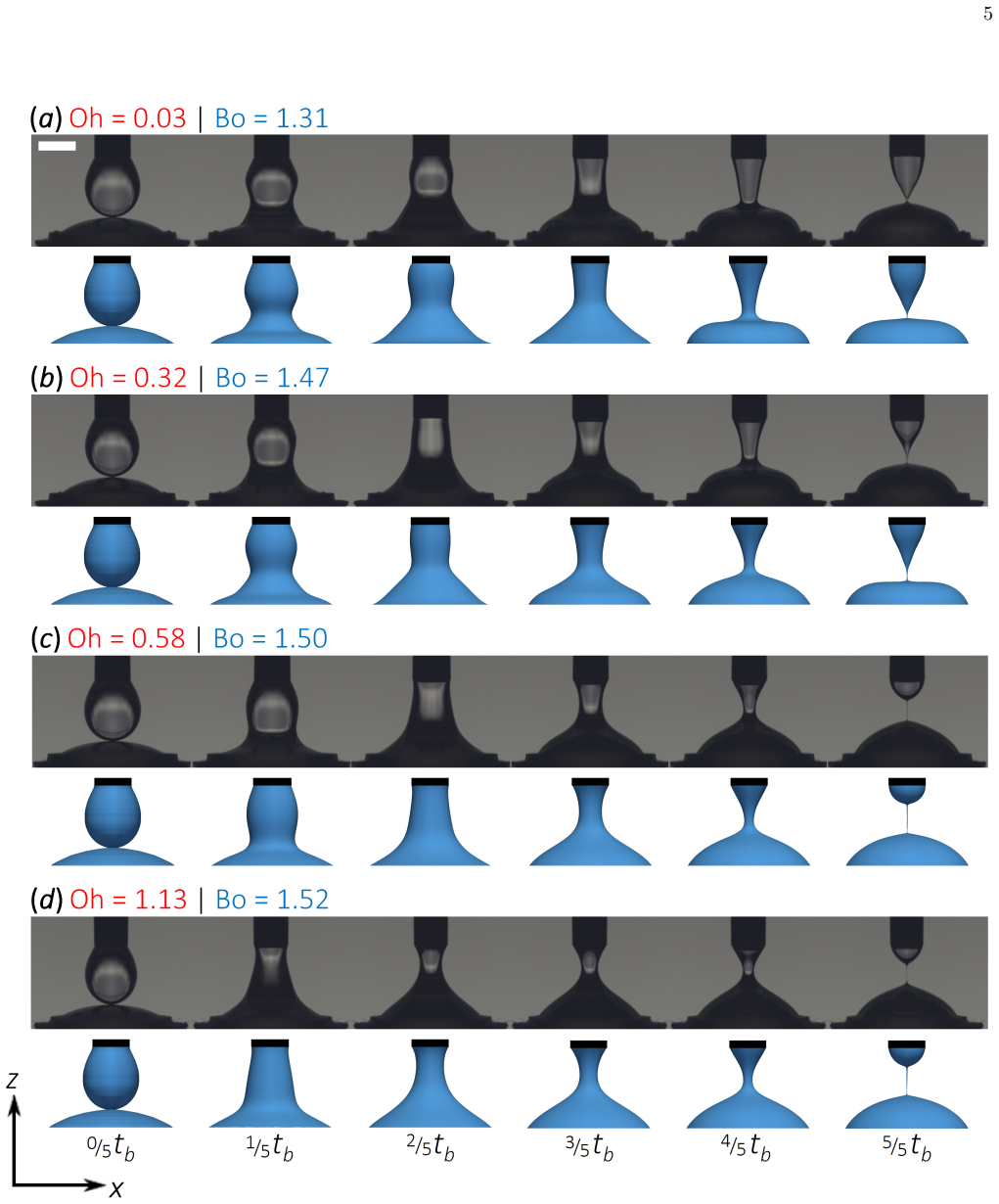
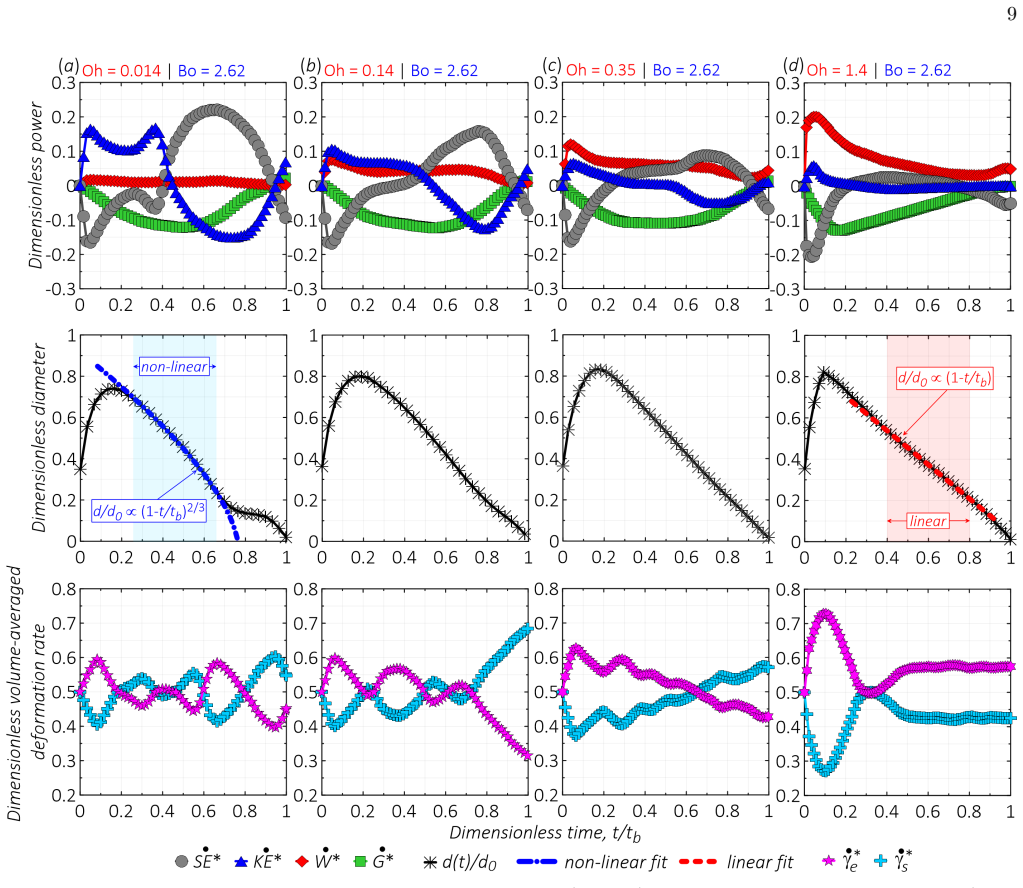
The two-dimensional diagram correlating filament breakup time to flow regimes via the Ohnesorge and Bond numbers.
If this is right
- The diagram quantifies both viscosity and surface tension for Newtonian fluids.
- DoD serves as a rheometric test for extensional relaxation time of polymer solutions.
- Three distinct flow regimes exist, all influenced by gravity.
- The analysis combines filament dynamics, energy transfers, and scaling laws from experiments and simulations.
Where Pith is reading between the lines
- This setup could provide a simple bench-top method for fluid characterization in labs without specialized equipment.
- The regime diagram might be extended to other coalescence configurations or different ambient fluids.
- Numerical validation of the diagram against more complex geometries would strengthen its applicability.
Load-bearing premise
The identified regimes and scaling laws hold without major interference from effects such as air drag, wall interactions, or nozzle geometry details, and the numerical simulations accurately capture the experimental breakup.
What would settle it
A systematic comparison showing that viscosities and surface tensions inferred from the breakup-time diagram deviate significantly from values obtained by independent standard methods would falsify the quantification claim.
Figures






read the original abstract
This experimental, numerical, and theoretical study investigates the capillary thinning and breakup of Newtonian filaments formed following the coalescence of a millimetric-nozzle-generated pendant drop with a lower droplet cap contained in a millimetric cylinder in ambient air, i.e., dripping-onto-droplet capillary breakup (DoD). Our mixed approach combines filament breakup experiments recorded with a high-speed camera and three-dimensional numerical simulations based on a variational multiscale framework for multiphase fluid flows. The results are analysed by considering the dynamics of fluid filament thinning, energy transfers, and scaling laws. Three flow regimes are highlighted: capillary-inertial, capillary-viscous, and mixed capillary-inertial-viscous. All regimes are affected by gravity. The findings are summarised in a two-dimensional diagram that correlates the filament breakup time with different flow regimes using the important dimensionless parameters of the problem, e.g., the Ohnesorge number (which relates the viscous stress to inertial and capillary stresses) and the Bond number (which balances the gravitational stress with the capillary one). This diagram can be used to quantify both the liquid viscosity and the liquid-gas surface tension (for Newtonian fluids). Lastly, we demonstrate that DoD can also be used as a rheometric test, giving access to the extensional relaxation time of polymer solutions (for viscoelastic fluids).
Editorial analysis
A structured set of objections, weighed in public.
Referee Report
Summary. The manuscript investigates capillary thinning and breakup of Newtonian and viscoelastic filaments formed by coalescence of a millimetric-nozzle-generated pendant drop with a lower droplet cap inside a millimetric cylinder (dripping-onto-droplet or DoD setup). Combining high-speed camera experiments, three-dimensional variational multiscale multiphase simulations, and scaling analysis of thinning dynamics and energy transfers, the authors identify three gravity-affected regimes (capillary-inertial, capillary-viscous, mixed) and summarize them in a two-dimensional diagram in the Ohnesorge-Bond plane that correlates filament breakup time with regime, enabling quantification of viscosity and surface tension for Newtonian fluids and extensional relaxation time for polymer solutions.
Significance. If the central claims hold, the work supplies a practical, low-cost rheometric tool for measuring Newtonian fluid properties and viscoelastic extensional relaxation times via a simple DoD configuration. The mixed experimental-numerical-theoretical approach, including explicit treatment of energy transfers, is a positive feature. The diagram's utility as a measurement device, however, hinges on whether breakup dynamics are fully captured by Oh and Bo alone.
major comments (3)
- [results section (regime diagram)] The regime diagram (results section): the claim that this diagram classifies all regimes and predicts breakup time using only Oh and Bo assumes that breakup dynamics are insensitive to additional geometric dimensionless groups arising from the millimetric cylinder, nozzle diameter, pendant-drop volume, and filament aspect ratio. No systematic variation of these parameters (e.g., nozzle-to-cylinder ratio or initial volume) is reported to confirm they are irrelevant, which is load-bearing for the assertion that the diagram can be used to quantify viscosity and surface tension in general.
- [numerical methods and validation] Numerical validation (methods and results): the abstract states that variational-multiscale simulations support the regimes and diagram, yet no quantitative metrics (breakup-time error between simulation and experiment, mesh-convergence data, or direct overlay of thinning curves) are provided. This directly affects the quantitative reliability of the diagram as a measurement tool.
- [viscoelastic fluids section] Viscoelastic rheometry claim (final section): the demonstration that DoD yields the extensional relaxation time lacks comparison against established techniques (e.g., CaBER) or reported uncertainty bounds on the extracted times, weakening the rheometric-test assertion.
minor comments (3)
- [abstract and introduction] The abstract and introduction should explicitly define the Ohnesorge and Bond numbers with their equations rather than describing them only in words.
- [figures] Figures presenting the regime diagram would benefit from error bars on experimental data points and a clear statement of how many independent runs underlie each regime boundary.
- [scaling analysis] Notation for filament radius evolution and breakup time should be introduced consistently in the scaling-analysis section to avoid ambiguity when comparing regimes.
Simulated Author's Rebuttal
We thank the referee for their careful and constructive review of our manuscript on dripping-onto-droplet capillary breakup. We address each of the major comments point by point below, indicating the changes made in the revised version.
read point-by-point responses
-
Referee: The regime diagram (results section): the claim that this diagram classifies all regimes and predicts breakup time using only Oh and Bo assumes that breakup dynamics are insensitive to additional geometric dimensionless groups arising from the millimetric cylinder, nozzle diameter, pendant-drop volume, and filament aspect ratio. No systematic variation of these parameters (e.g., nozzle-to-cylinder ratio or initial volume) is reported to confirm they are irrelevant, which is load-bearing for the assertion that the diagram can be used to quantify viscosity and surface tension in general.
Authors: We agree that demonstrating the insensitivity to geometric parameters is important for the general use of the diagram as a rheometric tool. Our original study was conducted with a fixed geometry corresponding to the experimental apparatus. The scaling laws and energy analysis focus on the filament thinning phase, where Oh and Bo are the governing parameters. In the revised manuscript, we have added a paragraph in the results section discussing the role of geometry and explaining why, based on our observations, the regime classification holds for the millimetric scales considered. We acknowledge that a broader parametric study would be beneficial and have noted this for future investigations. revision: yes
-
Referee: Numerical validation (methods and results): the abstract states that variational-multiscale simulations support the regimes and diagram, yet no quantitative metrics (breakup-time error between simulation and experiment, mesh-convergence data, or direct overlay of thinning curves) are provided. This directly affects the quantitative reliability of the diagram as a measurement tool.
Authors: We thank the referee for this observation. To improve the quantitative validation, we have revised the methods section to include mesh convergence studies for the breakup time and other key quantities. In the results section, we now provide overlaid plots of the filament radius versus time from experiments and simulations for representative cases in each regime, along with the computed relative errors in breakup times (which remain under 12% for all cases). These revisions directly address the reliability of the numerical support for the regime diagram. revision: yes
-
Referee: Viscoelastic rheometry claim (final section): the demonstration that DoD yields the extensional relaxation time lacks comparison against established techniques (e.g., CaBER) or reported uncertainty bounds on the extracted times, weakening the rheometric-test assertion.
Authors: We appreciate the referee's comment on strengthening the viscoelastic section. In the revised final section, we have added a comparison of the extensional relaxation times extracted via DoD with those from CaBER experiments reported in the literature for comparable polymer solutions, demonstrating consistency. We have also included uncertainty estimates for the DoD-derived relaxation times, based on variability across repeated trials and the sensitivity of the fitting to the thinning curve. These additions support the assertion that DoD can serve as a rheometric test. revision: yes
Circularity Check
No circularity in regime diagram or scaling laws
full rationale
The paper constructs its Ohnesorge-Bond regime diagram and identifies capillary-inertial, capillary-viscous, and mixed regimes directly from independent high-speed camera experiments and variational-multiscale numerical simulations of filament thinning and breakup times. Scaling laws and energy-transfer analysis are presented as summaries of these observations rather than reductions to fitted inputs or self-citation chains. The subsequent use of the diagram to quantify viscosity, surface tension, or extensional relaxation time is an application of the empirical correlation, not a tautological re-derivation. No load-bearing step reduces by construction to the paper's own inputs.
Axiom & Free-Parameter Ledger
Reference graph
Works this paper leans on
-
[1]
and consequently makes the use of equations 1 and 2 for rheological purposes difficult. Finally, since liquid jets rely on the growth of instabilities throughout an axially- perturbed filament [14, 48, 52], they are highly affected by axial tension [49], which leads to a diameter’s expo- nential decay different from that predicted by equation 2. To overco...
work page 2000
-
[2]
is a characteristic strain rate associated with the capillary-thinning process. In the present work, Oh air ≲10 −5,ρ air/ρ≲10 −3, and Weslot ≲10 −10 (U0 is much lower than the characteristic stretching velocity p σ/(ρd3 0)). Thus, the flow scenar- ios considered here vary with only two key dimensionless numbers: Oh = 3η p σ/(ρd3 0) σ/d0 (Ohnesorge number)...
-
[3]
is primarily converted into kinetic energy (∼ρu 2 cd3 0, whereu c is the characteristic filament thinning velocity approximated asu c ∼d 0/tb), leading to tci = r ρd3 0 σ (capillary-inertial time),(18) a well-known characteristic capillary-inertial time exten- sively discussed in previous works [20, 21, 30–34]. On the other hand, in the capillary-viscous ...
work page 1958
-
[4]
(e.g., the breakup time made dimensionless by the characteristic capillary-inertial time given by equation 18) as a function of Ohnesorge number for numerical results (open symbols) at three Bond numbers: Bo = 0 (grey circles), Bo = 0.8 (blue triangles), and Bo = 2.62 (red diamonds). The data collapse across a master curve divided into three regions highl...
work page 1958
-
[5]
U. Kuchner, A. Aragon-Salamanca, A. Rost, F. R. Pearce, M. E. Gray, W. Cui, A. Knebe, E. Rasia, and G. Yeoes, Cosmic filaments in galaxy cluster outskirts: quantifying finding filaments in redshift space, Monthly Notices of the Royal Astronomical Society503, 2065 (2021)
work page 2065
- [6]
-
[7]
J. Eggers and E. Villermaux, Physics of liquid jets, Re- ports on Progress in Physics71, 1 (2008)
work page 2008
-
[8]
M. Abkarian and H. A. Stone, Stretching and break-up of saliva filaments during speech: A route for pathogen aerosolization and its potential mitigation, Physical Re- view Fluids5, 102301 (2020)
work page 2020
-
[9]
S. J. Weinstein and K. J. Ruschak, Coating flows, The Annual Review of Fluid Mechanics36, 29 (2004)
work page 2004
-
[10]
A. Dewandre, J. Rivero Rodriguez, Y. Vitry, B. Sobac, and B. Scheid, Microfluidic droplet generation based on non-embedded co-flow-focusing using 3D printed nozzle, Scientific Reports10, 17 (2020)
work page 2020
-
[11]
B. He, S. Yang, Z. Qin, B. Wen, and C. Zhang, The roles of wettability and surface tension in droplet formation during inkjet printing, Scientific Reports7, 1 (2017)
work page 2017
- [12]
-
[13]
S. Yu, R. Castellani, A. Pereira, R. Valette, and T. Budtova, Additive-free 3D-printed nanostructured carboxymethyl cellulose aerogels, International Journal of Biological Macromolecules300, 1 (2025)
work page 2025
-
[14]
R. F. Liang and M. R. Mackley, Rheological characteri- zation of the time and strain dependence for polyisobuty- lene solutions, Journal of Non-Newtonian Fluid Mechan- ics52, 387 (1994)
work page 1994
-
[15]
V. M. Entov and E. J. Hinch, Effect of a spectrum of relaxation times on the capillary thinning of a filament of elastic liquid, Journal of Non-Newtonian Fluid Mechanics 72, 31 (1997). 12
work page 1997
-
[16]
G. H. McKinley and A. Tripathi, How to extract the new- tonian viscosity from capillary breakup measurements in a filament rheometer, Journal of Rheology44, 653 (2000)
work page 2000
-
[17]
T. R. Tuladhar and M. R. Mackley, Filament stretch- ing rheometry and break-up behaviour of low viscos- ity polymer solutions and inkjet fluids, Journal of Non- Newtonian Fluid Mechanics148, 97 (2008)
work page 2008
-
[18]
B. Keshavarz, V. Sharma, E. C. Houze, M. R. Koerner, J. R. Moore, P. M. Cotts, P. Threlfall Holmes, and G. H. McKinley, Studying the effects of elongational proper- ties on atomization of weakly viscoelastic solutions using Rayleigh Ohnesorge jetting extensional rheometry (RO- JER), Journal of Non-Newtonian Fluid Mechanics222, 171 (2015)
work page 2015
-
[19]
K. Zinelis, T. Abadie, G. H. McKinley, and O. K. Matar, The fluid dynamics of a viscoelastic fluid dripping onto a substrate, Soft Matter20, 198 (2024)
work page 2024
-
[20]
J. Plateau, Statique exp´ erimentale et th´ eorique des liquides soumis aux seules forces mol´ eculaires, Paris, Gauthier-Villars (1873)
-
[21]
Rayleigh, The theory of sound - volume 2, London: Macmillan and Co , 337–398 (1878)
L. Rayleigh, The theory of sound - volume 2, London: Macmillan and Co , 337–398 (1878)
-
[22]
L. Rayleigh, On the stability, or instability, of certain fluid motions, Proceedings of the London Mathematical Societys1-11, 57 (1880)
-
[23]
L. Rayleigh, On the instability of a cylinder of viscous liquid under capillary force, The London, Edinburgh, and Dublin Philosophical Magazine and Journal of Science 34, 145 (1892)
-
[24]
D. H. Peregrine, G. Shoker, and A. Symon, The bifurca- tion of liquid bridges, Journal of Fluid Mechanics212, 25 (1990)
work page 1990
-
[25]
J. Eggers, Universal pinching of 3D axisymmetric free- surface flow, Physical Review Letters71, 3458 (1993)
work page 1993
-
[26]
D. T. Papageorgiou, On the breakup of viscous liquid threads, Physics of Fluids7, 1529 (1995)
work page 1995
-
[27]
J. G. Oldroyd, On the formulation of rheological equa- tions of state, Proceedings of the Royal Society A200, 523 (1950)
work page 1950
-
[28]
R. B. Bird, R. C. Armstrong, and H. O., Dynamics of polymeric liquids, Wiley-Interscience, New York2nd edition, 172 (1987)
work page 1987
-
[29]
J. Hinch and O. Harlen, Oldroyd b, and not a?, Journal of Non-Newtonian Fluid Mechanics298, 1 (2021)
work page 2021
-
[30]
A. V. Bazilevskii, V. M. Entov, M. M. Lerner, and A. N. Rozhkov, Failure of polymer solution filaments, Polymer Science - Series A39, 316 (1997)
work page 1997
-
[32]
A. Pereira, R. M. Andrade, and E. J. Soares, Drag reduc- tion induced by flexible and rigid molecules in a turbulent flow into a rotating cylindrical double gap device: Com- parison between poly(ethylene oxide), polyacrylamide, and xanthan gum, Journal of Non-Newtonian Fluid Me- chanics202, 72 (2013)
work page 2013
-
[33]
J. Eggers, Nonlinear dynamics and breakup of free- surface flows, Reviews of Modern Physics69, 865 (1997)
work page 1997
-
[34]
J. Eggers, Drop formation - an overview, ZAMM - Jour- nal of Applied Mathematics and Mechanics6, 400–410 (2005)
work page 2005
- [35]
-
[36]
A. Deblais, M. A. Herrada, I. Hauner, K. P. Velikov, T. van Roon, H. Kellay, J. Eggers, and D. Bonn, Vis- cous effects on inertial drop formation, Physical Review Letters121, 254501 (2018)
work page 2018
-
[37]
J. Dinic and V. Sharma, Computational analysis of self- similar capillary-driven thinning and pinch-off dynam- ics during dripping using the volume-of-fluid method, Physics of Fluids31, 021211 (2019)
work page 2019
-
[38]
P. Bazazi and H. A. Stone, Pinch-off dynamics of emul- sion filaments before and after polymerization of the in- ternal phase, Soft Matter21, 1296 (2025)
work page 2025
- [39]
-
[40]
S. L. Anna and G. H. McKinley, Elasto-capillary thinning and breakup of model elastic liquids, Journal of Rheology 45, 115 (2001)
work page 2001
-
[41]
L. E. Rodd, T. P. Scott, J. J. Cooper-White, and G. H. McKinley, Capillary break-up rheometry of low-viscosity elastic fluids, Applied Rheology15, 12 (2005)
work page 2005
- [42]
- [43]
- [44]
-
[45]
M. Rosello, S. Sur, B. Barbet, and J. P. Rothstein, Dripping-onto-substrate capillary breakup extensional rheometry of low-viscosity printing inks, Journal of Non- Newtonian Fluid Mechanics266, 160 (2019)
work page 2019
-
[46]
R. Valette, E. Hachem, M. Khalloufi, A. Pereira, M. Mackley, and S. Butler, The effect of viscosity, yield stress, and surface tension on the deformation and breakup profiles of fluid filaments stretched at very high velocities, Journal of Non-Newtonian Fluid Mechanics 263, 130 (2019)
work page 2019
-
[47]
J. B. Joseph and J. P. Rothstein, Recovery dynamics and polymer scission in capillary breakup extensional rheom- etry, Journal of Non-Newtonian Fluid Mechanics337, 1 (2025)
work page 2025
-
[48]
P. K. Bhattacharjee, A. G. McDonnell, R. Prabhakar, L. Y. Yeo, and J. Friend, Extensional flow of low-viscosity fluids in capillary bridges formed by pulsed surface acous- tic wave jetting, New Journal of Physics13, 1 (2011)
work page 2011
-
[49]
A. G. McDonnell, T. C. Gopesh, J. Lo, M. O’Bryan, L. Yeo, J. R. Friend, and R. Prabhakar, Motility induced changes in viscosity of suspensions of swimming microbes in extensional flows, Soft Matter11, 4658 (2015)
work page 2015
-
[50]
D. B. Bogy, Drop formation in a circular liquid jet, An- nual Review in Fluid Mechanics11, 207 (1979)
work page 1979
-
[51]
P. Sch¨ ummer and K. H. Tebel, A new elongational rheometer for polymer solutions, Journal of Non- Newtonian Fluid Mechanics12, 331 (1983)
work page 1983
-
[52]
E. Greiciunas, J. Wong, I. Gorbatenko, J. Hall, M. C. T. Wilson, N. Kapur, O. G. Harlen, D. Vadillo, and P. Threlfall-Holmes, Design and operation of a Rayleigh Ohnesorge jetting extensional rheometer (ROJER) to study extensional properties of low viscosity polymer so- lutions, Journal of Rheology61, 467 (2017)
work page 2017
-
[53]
W. Mathues, S. Formenti, C. McIlroy, O. G. Harlen, and 13 C. Clasen, CaBER vs ROJER - different time scales for the thinning of a weakly elastic jet, Journal of Rheology 62, 1135 (2018)
work page 2018
- [54]
-
[55]
N. Hu, J. Hwang, T. Ruangkriengsin, and H. A. Stone, Revealing actual viscoelastic relaxation times in capillary breakup, Physical Review Lettes135, 048201 (2025)
work page 2025
-
[56]
B. Keshavarz and G. H. McKinley, Micro-scale exten- sional rheometry using hyperbolic converging/diverging channels and jet breakup, Biomicrofluidics10, 043502 (2016)
work page 2016
-
[57]
A. A. Castrej´ on-Pita, J. R. Castrej´ on-Pita, and I. Hutch- ings, The breakup of liquid filament, Physical Review Letters108, 1 (2012)
work page 2012
-
[58]
A. Pereira, A. Larcher, E. Hachem, and R. Valette, Cap- illary, viscous, and geometrical effects on the buckling of power-law fluid filaments under compression stresses, Computers & Fluids190, 514 (2019)
work page 2019
-
[59]
A. Pereira, E. Hachem, and R. Valette, Inertia-dominated coiling instabilities of power-law fluids, Journal of Non- Newtonian Fluid Mechanics282(2020)
work page 2020
-
[60]
R. Valette, A. Pereira, S. Riber, L. Sardo, A. Larcher, and E. Hachem, Viscoplastic dam-breaks, Journal of Non- Newtonian Fluid Mechanics287, 104447 (2021)
work page 2021
-
[61]
K. Isukwem, G. Godefroid, C. Monteux, D. Bouttes, R. Castellani, E. Hachem, R. Valette, and A. Pereira, The role of viscoplastic drop shape in impact, Journal of Fluid Mechanics978, A1 (2024)
work page 2024
-
[62]
K. Isukwem, R. Nemer, E. Hachem, and A. Pereira, Viscoplastic elliptical objects impacting a solid surface, Physics of Fluids36, 033125 (2024)
work page 2024
-
[63]
K. Isukwem, E. Hachem, and A. Pereira, Etude th´ eorique et num´ erique sur l’´ etalement d’objets viscoplastiques bidimensionnels impactant une surface solide, Rh´ eologie 45, 35 (2024)
work page 2024
-
[64]
K. Isukwem, C.-A. Charles, T. Phou, L. Ramos, C. Ligoure, E. Hachem, and A. Pereira, Inverse Leiden- frost impacting drops, Journal of Fluid Mechanics1002, A32 (2025)
work page 2025
-
[65]
K. Isukwem and A. Pereira, Dam break of viscoplastic elliptical objects, Journal of Non-Newtonian Fluid Me- chanics336, 1 (2025)
work page 2025
-
[66]
K. Isukwem, E. Hachem, and A. Pereira, Viscoplastic drops impacting a free-slip surface, International Journal of Multiphase Flow187, 1 (2025)
work page 2025
-
[67]
K. Isukwem, L. F` eve, R. Nemer, E. Peuvrel-Disdier, E. Hachem, and A. Pereira, Stretching and breakup of two-dimensional falling newtonian sheets, Physics of Flu- ids37, 063125 (2025)
work page 2025
-
[68]
J. Godefroid, D. Bouttes, A. Pereira, and C. Monteux, Gelation effects on the spreading of non-Newtonian drops impacting a reactive liquid, Soft Matter21, 9162 (2025)
work page 2025
discussion (0)
Sign in with ORCID, Apple, or X to comment. Anyone can read and Pith papers without signing in.