Recognition: no theorem link
Statistical mechanics of the N-queens problem
Pith reviewed 2026-05-13 07:27 UTC · model grok-4.3
The pith
The Simkin constant γ can be recovered from Monte Carlo simulations of the N-queens problem by integrating the specific heat down to zero temperature.
A machine-rendered reading of the paper's core claim, the machinery that carries it, and where it could break.
Core claim
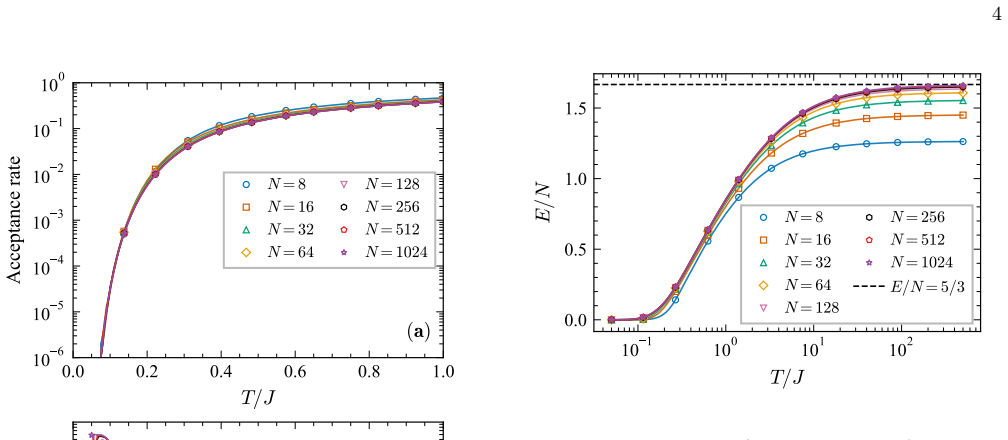
By mapping the N-queens problem to a lattice gas with repulsive interactions, the authors find that the specific heat per queen converges to a universal function of temperature. Thermodynamic integration of this function from infinite temperature, where the entropy is known exactly, to T=0 recovers the ground-state entropy per queen and hence the Simkin constant γ directly from the Monte Carlo data.
What carries the argument
Convergence of the specific heat per queen C_v/N to a universal, N-independent function of temperature, which permits thermodynamic integration of C_v/T from T=∞ to T=0.
If this is right
- The N-queens lattice gas has no thermodynamic phase transition in the large-N limit.
- The high-temperature energy per queen is exactly 5/3.
- Ground-state entropy can be obtained from simulation without enumerating solutions.
- The same integration route supplies an independent numerical check on the Simkin constant γ.
Where Pith is reading between the lines
- The same integration technique could be applied to other hard constraint problems whose ground-state entropy is difficult to count directly.
- Hybrid use of the transfer-matrix tensor network and Monte Carlo might give both exact small-N benchmarks and large-N estimates.
- Finite-size scaling of the specific-heat peak could be used to extrapolate γ to infinite N with controlled error.
Load-bearing premise
The specific heat per queen must approach a smooth universal function of temperature that can be integrated accurately to zero without missing non-analyticities or finite-size biases.
What would settle it
If larger-N simulations produced a divergent peak in C_v or an integrated entropy that deviates from the known combinatorial value of γ by more than the reported uncertainty.
Figures


read the original abstract
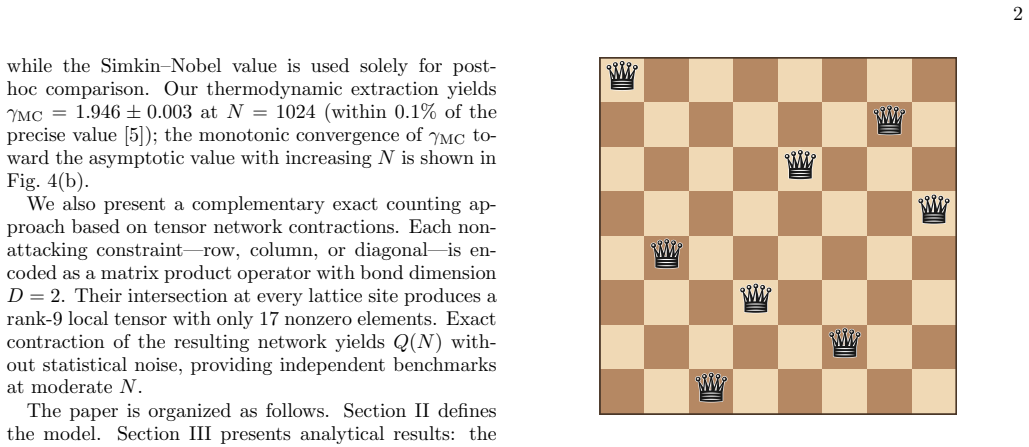
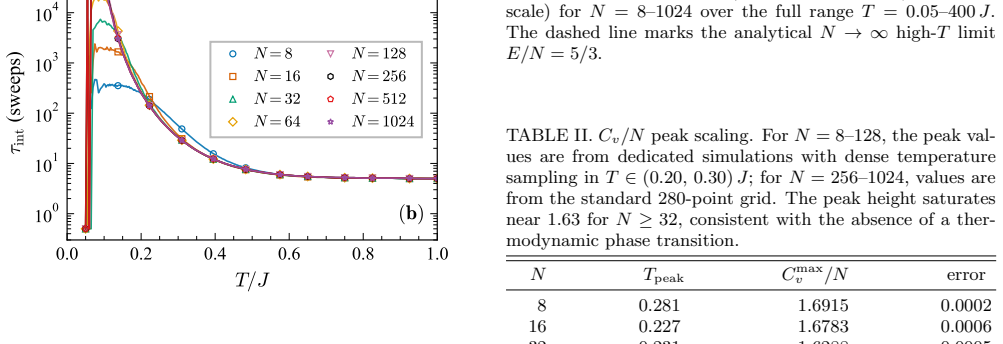
We investigate the $N$-queens problem as a lattice gas -- a model in which $N$ queens are placed on an $N \times N$ chessboard with pairwise repulsive interactions along shared rows, columns, and diagonals -- from the perspective of statistical mechanics. The ground states are exactly the $Q(N)$ solutions of the classical $N$-queens problem, with entropy per queen $s_0 \approx \ln N - \gamma$ ($\gamma \approx 1.944$). This entropy reflects a characteristic constraint hierarchy: each successive geometric constraint -- columns, then diagonals -- reduces the entropy from the free-placement value $\ln N$ by a definite constant. We derive the exact high-temperature energy $E/N \to 5/3$ as $N \to \infty$. Extensive Monte Carlo simulations with $10^8$ sweeps per temperature point for $N = 8$--$1024$ reveal that the specific heat per queen $C_v/N$ converges to a universal function of $T$ as $N \to \infty$. The converged curve features a non-divergent peak $C_v^{\max}/N \approx 1.63$ at $T^* \approx 0.235\,J$, establishing the absence of a thermodynamic phase transition. Combined with the trivially exact high-temperature entropy $S(\infty)/N = (1/N) \ln \binom{N^2}{N}$, the convergence of $C_v/N$ enables a thermodynamic integration of $C_v/T$ from $T = \infty$ to $T = 0$ that recovers the ground-state entropy -- and hence the Simkin constant $\gamma$ -- purely from Monte Carlo data. This provides an independent thermodynamic route to a fundamental combinatorial constant. Thermodynamic integration yields $\gamma_{\rm MC} = 1.946 \pm 0.003$ at $N = 1024$, within $0.1\%$ of the precise combinatorial value $\gamma = 1.94400(1)$. We further present a transfer-matrix-based tensor network formulation that encodes the non-attacking constraints into a rank-9 site tensor with 17 nonzero elements, providing a complementary exact-enumeration route.
Editorial analysis
A structured set of objections, weighed in public.
Referee Report
Summary. The manuscript models the N-queens problem as a lattice gas with repulsive interactions along rows, columns, and diagonals. It derives the exact high-temperature limit E/N → 5/3, performs Monte Carlo simulations (10^8 sweeps) for N = 8 to 1024 showing that Cv/N converges to a universal, N-independent curve with a non-divergent peak at T* ≈ 0.235J, establishes the absence of a thermodynamic phase transition, and uses thermodynamic integration of Cv/T from T = ∞ (with exact high-T entropy) to T = 0 to recover the ground-state entropy and thus the Simkin constant γ_MC = 1.946 ± 0.003, within 0.1% of the combinatorial value 1.94400(1). A rank-9 tensor-network formulation with 17 nonzero elements is also introduced.
Significance. If the reported convergence of Cv/N holds under finite-size extrapolation, the work supplies an independent thermodynamic route to the Simkin constant γ that relies only on Monte Carlo data and the exact high-T limit, rather than direct combinatorial enumeration. The large-scale simulations, exact high-T derivation, and close numerical agreement constitute clear strengths and demonstrate that the model has no thermodynamic transition. This approach may generalize to other constrained combinatorial problems.
major comments (2)
- [Thermodynamic integration] § on thermodynamic integration: the claim that finite-N corrections to the integrated entropy remain small at N = 1024 (yielding 0.1% accuracy on γ) rests on visual convergence of Cv/N; a quantitative extrapolation of the integral versus 1/N or 1/N^2, with error bands propagated from the Monte Carlo statistics, is needed to confirm that residual finite-size bias does not exceed the stated ±0.003 uncertainty.
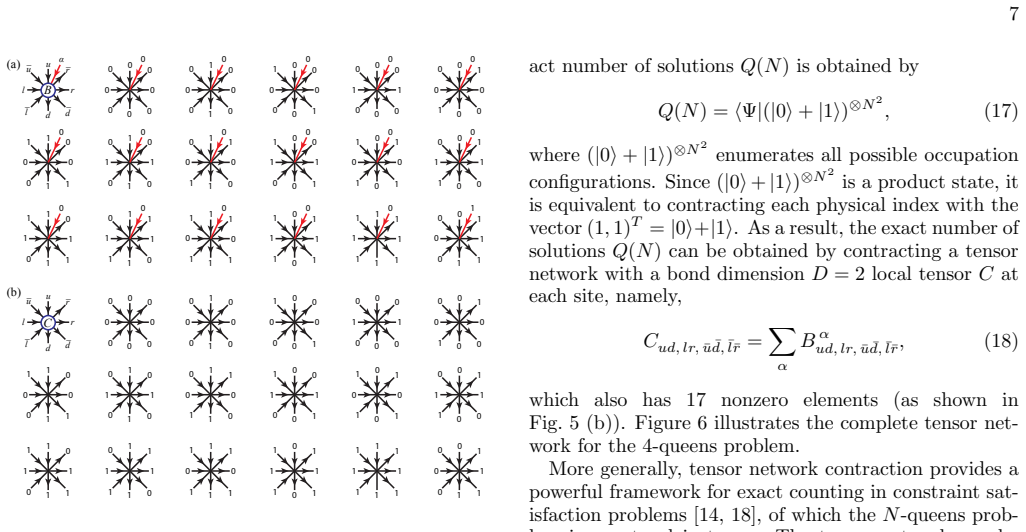
- [Tensor network formulation] Tensor-network section: the rank-9 site tensor with 17 nonzero elements is stated to encode the non-attacking constraints, but neither the explicit tensor entries nor the contraction/transfer-matrix algorithm used for enumeration are supplied, preventing independent verification of this complementary exact route.
minor comments (2)
- [Figures] Figure 2 (Cv/N curves): the legend should explicitly list the N values and state that T is in units of J; the peak location T* ≈ 0.235J should be marked on the plot.
- [High-temperature limit] The high-T entropy formula S(∞)/N = (1/N) ln binom(N^2, N) is used without derivation; a one-line justification that this is the exact non-interacting limit would aid clarity.
Simulated Author's Rebuttal
We thank the referee for the careful reading, positive assessment, and constructive suggestions. We address each major comment below and will revise the manuscript accordingly.
read point-by-point responses
-
Referee: the claim that finite-N corrections to the integrated entropy remain small at N = 1024 (yielding 0.1% accuracy on γ) rests on visual convergence of Cv/N; a quantitative extrapolation of the integral versus 1/N or 1/N^2, with error bands propagated from the Monte Carlo statistics, is needed to confirm that residual finite-size bias does not exceed the stated ±0.003 uncertainty.
Authors: We agree that a quantitative extrapolation would provide stronger confirmation of convergence. In the revised manuscript we will add a finite-size extrapolation of the integrated entropy (equivalently γ) versus 1/N, together with error bands obtained by propagating the Monte Carlo statistical uncertainties through the thermodynamic integration. This will explicitly verify that the residual bias at N=1024 lies within the quoted ±0.003 uncertainty. revision: yes
-
Referee: the rank-9 site tensor with 17 nonzero elements is stated to encode the non-attacking constraints, but neither the explicit tensor entries nor the contraction/transfer-matrix algorithm used for enumeration are supplied, preventing independent verification of this complementary exact route.
Authors: We acknowledge the omission. In the revised manuscript we will supply the explicit 17 nonzero entries of the rank-9 site tensor (in a compact notation) and a concise description of the transfer-matrix contraction procedure used to obtain the exact enumeration, thereby enabling independent verification. revision: yes
Circularity Check
No significant circularity: exact high-T limits plus independent MC integration
full rationale
The derivation begins with two exact inputs: the high-temperature energy limit E/N → 5/3 (derived from pairwise interaction counting) and the exact high-T entropy S(∞)/N = (1/N) ln binom(N²,N). Monte Carlo simulations for N up to 1024 independently sample the specific heat C_v(T) and demonstrate its convergence to an N-independent curve with a finite peak. Thermodynamic integration of C_v/T from ∞ to 0 then produces S(0)/N and the extracted γ_MC, which is compared post hoc to the known combinatorial value. No equation reduces to a fitted parameter renamed as a prediction, no self-citation supplies a load-bearing uniqueness theorem, and the tensor-network formulation is presented as an independent exact-enumeration route. The numerical agreement serves as validation rather than an input, leaving the central claim self-contained against external combinatorial benchmarks.
Axiom & Free-Parameter Ledger
axioms (2)
- standard math The high-temperature energy per queen approaches exactly 5/3 as N → ∞
- domain assumption The specific heat per queen converges to an N-independent function for large N
Reference graph
Works this paper leans on
-
[1]
Bezzel, Schachfreund, Berliner Schachzeitung3, 636 (1848)
M. Bezzel, Schachfreund, Berliner Schachzeitung3, 636 (1848)
-
[2]
Simkin, The number ofn-queens configurations, Adv
M. Simkin, The number ofn-queens configurations, Adv. Math.427, 109127 (2023)
work page 2023
-
[3]
C. Bowtell and P. Keevash, Then-queens problem, arXiv:2109.08083 (2021)
-
[4]
Z. Luria and M. Simkin, A lower bound for then-queens problem, arXiv:2105.11431 (2021)
- [5]
- [6]
-
[7]
D. E. Knuth,The Art of Computer Programming, Vol. 4B (Addison-Wesley, 2022), Sec. 7.2.2
work page 2022
-
[8]
C. Zhang and J. Ma, Counting solutions for theN-queens and Latin-square problems by efficient Monte Carlo sim- ulations, Phys. Rev. E79, 016703 (2009)
work page 2009
-
[9]
N. Polson and V. Sokolov, CountingNqueens, arXiv:2407.08830 (2024)
-
[10]
Kawasaki, Diffusion constants near the critical point for time-dependent Ising models
K. Kawasaki, Diffusion constants near the critical point for time-dependent Ising models. I, Phys. Rev.145, 224 (1966)
work page 1966
-
[11]
N. Metropolis, A. W. Rosenbluth, M. N. Rosenbluth, A. H. Teller, and E. Teller, Equation of state calcula- tions by fast computing machines, J. Chem. Phys.21, 1087 (1953)
work page 1953
-
[12]
Efron,The Jackknife, the Bootstrap, and Other Re- sampling Plans(SIAM, Philadelphia, 1982)
B. Efron,The Jackknife, the Bootstrap, and Other Re- sampling Plans(SIAM, Philadelphia, 1982)
work page 1982
-
[13]
K. Binder and D. W. Heermann,Monte Carlo Simulation in Statistical Physics(Springer, Berlin, 5th ed., 2010)
work page 2010
-
[14]
N. Kourtis, C. Chamon, E. R. Mucciolo, and A. E. Ruck- enstein, Fast counting with tensor networks, SciPost Phys.7, 060 (2019)
work page 2019
-
[15]
T. Xiang,Density Matrix and Tensor Network Renormal- ization(Cambridge University Press, Cambridge, 2024)
work page 2024
-
[16]
F. Fr¨ owis, V. Nebendahl, and W. D¨ ur, Tensor operators: Constructions and applications for long-range interaction systems, Phys. Rev. A81, 062337 (2010)
work page 2010
-
[17]
T. Nishino and K. Okunishi, Corner transfer matrix renormalization group method, J. Phys. Soc. Jpn.65, 891–894 (1996)
work page 1996
-
[18]
L. Vanderstraeten, B. Vanhecke, and F. Verstraete, Residual entropies for three-dimensional frustrated spin systems with tensor networks, Phys. Rev. E98, 042145 (2018)
work page 2018
-
[19]
Z.-Y. Liu, Simulation code and data for theN- queens lattice gas,https://github.com/LiuZY613/ nqueen-lattice-gas
discussion (0)
Sign in with ORCID, Apple, or X to comment. Anyone can read and Pith papers without signing in.