Recognition: 2 theorem links
· Lean TheoremConstraint-aware functional cloning for stable and transferable machine-learned density functional theory
Pith reviewed 2026-05-12 03:41 UTC · model grok-4.3
The pith
Constraint-aware neural networks clone known density functionals more accurately in self-consistent calculations and transfer from molecules to solids.
A machine-rendered reading of the paper's core claim, the machinery that carries it, and where it could break.
Core claim
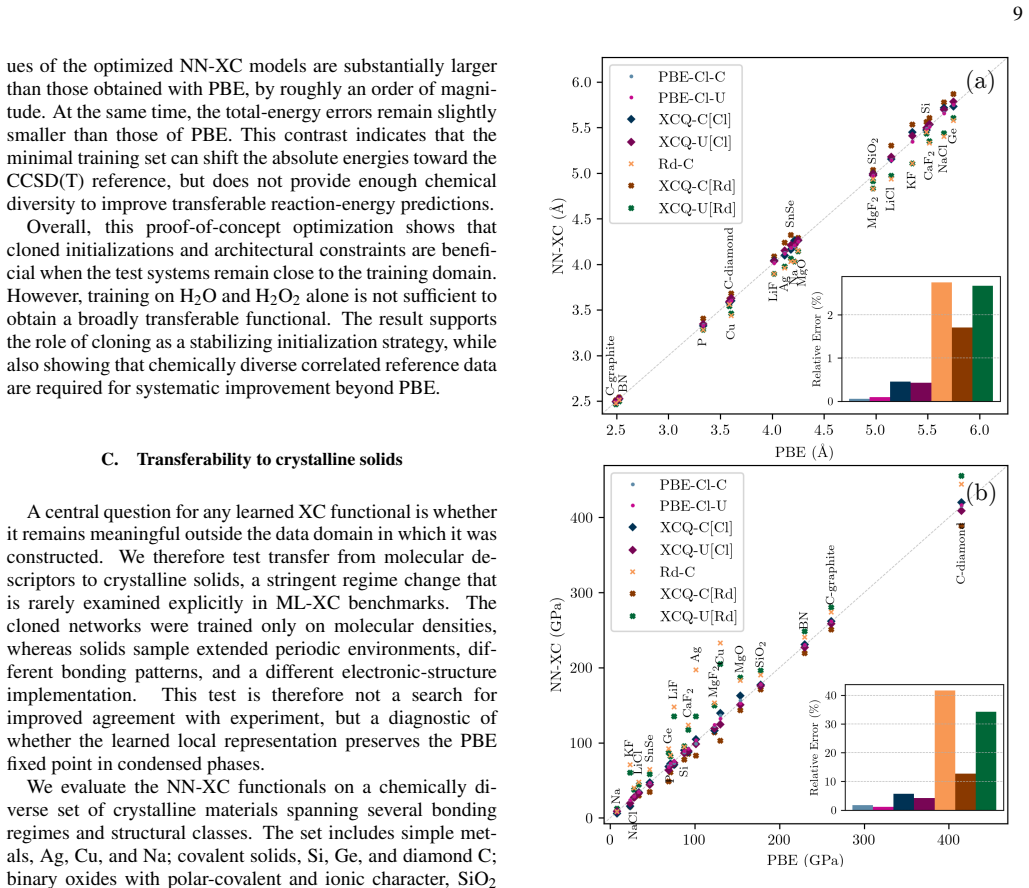
Functional cloning tests whether a neural model can reproduce a known semilocal exchange-correlation functional when it participates in generating the self-consistent density. Constrained models achieve higher accuracy than unconstrained ones in molecular self-consistent calculations and yield better starting points for optimization against correlated molecular energies. Models trained only on molecular densities transfer to solids, reproducing reference lattice constants and bulk moduli across metallic, covalent, ionic, oxide, and layered systems. Energy differences prove relatively robust across computational codes, while total energies depend on whether cloning descriptors derive from all
What carries the argument
The constraint-aware neural architecture for functional cloning, which trains models to reproduce a target functional while enforcing physical constraints to promote stable self-consistent behavior and cross-system transfer.
Load-bearing premise
That successful self-consistent reproduction of a semilocal functional reliably indicates the model will perform well when optimized against more accurate correlated energies and will retain transferability in that setting.
What would settle it
A result in which unconstrained models, after full optimization against correlated energies, match or surpass constrained clones on molecular energy errors or solid equations of state would falsify the claimed advantage of constraint-aware cloning.
Figures


read the original abstract
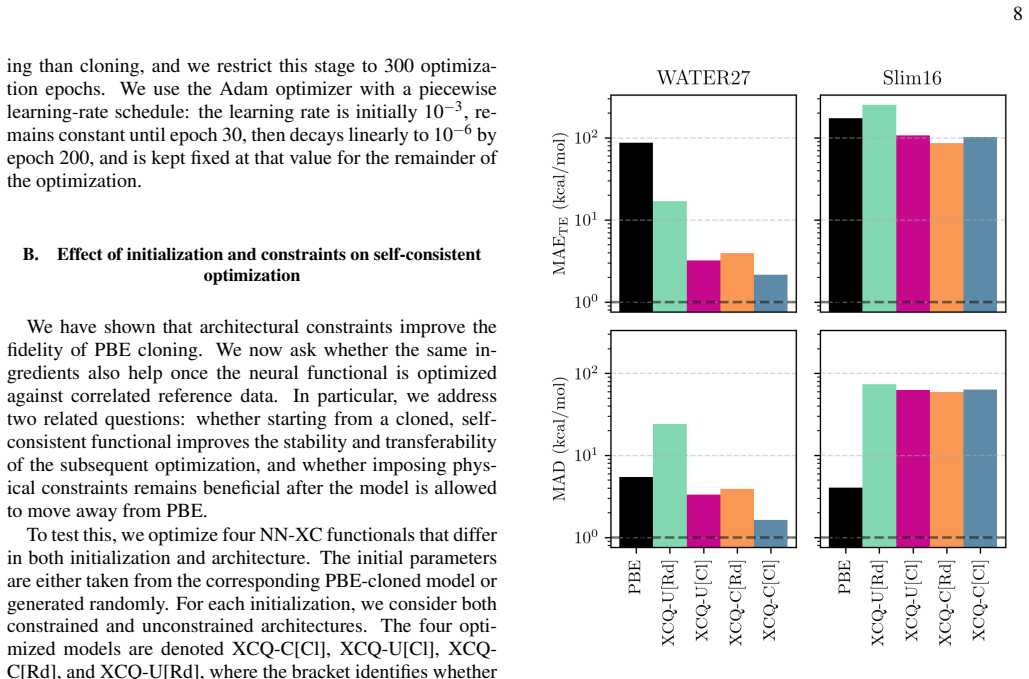
We study a simple but useful test for neural exchange-correlation (XC) functionals: can a neural model reproduce an established XC functional when it is used self-consistently? We call this test functional cloning. The model is trained at the GGA level to reproduce a known semilocal functional, using either a constrained or an unconstrained architecture. The motivation is that an XC functional is not used on a fixed input. In a Kohn-Sham self-consistent-field calculation it contributes to the potential, and the resulting density is part of the outcome of the same calculation. A good pointwise fit to sampled density descriptors is therefore not by itself enough. Because the target functional is known, the error can be measured directly. We compare the clones on sampled descriptors, molecular total energies, energy differences, transfer between PySCF and SIESTA, and equations of state for crystalline solids. The constrained models reproduce the reference functional more accurately in molecular self-consistent calculations. They also give better initial parameters for later optimization against correlated molecular energies. An additional observation is that the constrained architecture already gives a reasonable solid-state baseline before cloning, as seen from randomly initialized constrained models. Clones trained only on molecular densities transfer well to solids, reproducing reference lattice constants and bulk moduli across metallic, covalent, ionic, oxide, and layered systems. Cross-code tests show that energy differences are relatively robust, while total energies depend strongly on whether the cloning descriptors come from all-electron or pseudopotential densities. These results make functional cloning a useful diagnostic before full self-consistent training of neural XC functionals.
Editorial analysis
A structured set of objections, weighed in public.
Referee Report
Summary. The manuscript introduces functional cloning as a diagnostic test for neural exchange-correlation functionals: models are trained at the GGA level to reproduce a known semilocal functional self-consistently, using either constrained or unconstrained architectures. Performance is assessed on pointwise descriptor accuracy, self-consistent molecular total energies and differences, transfer between PySCF and SIESTA, and equations of state for solids (lattice constants and bulk moduli across metallic, covalent, ionic, oxide, and layered systems). The central findings are that constrained models achieve better self-consistent reproduction of the reference and supply improved initial parameters for subsequent optimization against correlated energies, while molecular-trained clones transfer reasonably to solids; cross-code tests indicate that energy differences are more robust than total energies.
Significance. If the results hold, functional cloning provides a practical, low-cost diagnostic for stability and transferability prior to full self-consistent training of neural XC functionals against correlated data. The demonstration of molecular-to-solid transfer and the observation that the constrained architecture yields a reasonable solid-state baseline even from random initialization are potentially useful for the field. The cross-code robustness findings also highlight practical issues in descriptor consistency.
major comments (2)
- Abstract and main text: the claim that constrained clones 'give better initial parameters for later optimization against correlated molecular energies' is not supported by any reported results; the manuscript does not present the outcomes of such optimization steps, final accuracies, or comparisons of optimized functionals, leaving the practical benefit unverified.
- Abstract and results sections on solids: while molecular-to-solid transfer is shown for the semilocal GGA reference (reproducing lattice constants and bulk moduli), the paper does not repeat the cloning-plus-optimization protocol with a target functional derived from correlated methods, so it remains unclear whether the observed descriptor overlap and transferability persist when the target has different form or statistics.
minor comments (3)
- The manuscript would benefit from explicit tables or figures reporting quantitative error metrics (e.g., MAE on energies, lattice constants) with error bars and details on data selection and sampling for the descriptor fits.
- Notation for the constrained vs. unconstrained architectures should be defined more clearly early in the text, including any specific constraints on the neural network outputs or inputs.
- A brief discussion of computational cost for the cloning procedure versus direct self-consistent training would help contextualize the diagnostic value.
Simulated Author's Rebuttal
We thank the referee for their careful reading of the manuscript and for the constructive comments. We address each of the major comments below.
read point-by-point responses
-
Referee: Abstract and main text: the claim that constrained clones 'give better initial parameters for later optimization against correlated molecular energies' is not supported by any reported results; the manuscript does not present the outcomes of such optimization steps, final accuracies, or comparisons of optimized functionals, leaving the practical benefit unverified.
Authors: We acknowledge that the manuscript does not report the results of subsequent optimization steps against correlated energies. The claim was based on the observation that constrained models achieve lower self-consistent errors when cloning the reference functional, which we hypothesized would translate to better starting points for optimization. However, since no such optimization results are presented, we agree that the statement is not fully supported. We will revise the abstract and main text to remove this specific claim, focusing instead on the demonstrated benefits in cloning accuracy and transferability. revision: yes
-
Referee: Abstract and results sections on solids: while molecular-to-solid transfer is shown for the semilocal GGA reference (reproducing lattice constants and bulk moduli), the paper does not repeat the cloning-plus-optimization protocol with a target functional derived from correlated methods, so it remains unclear whether the observed descriptor overlap and transferability persist when the target has different form or statistics.
Authors: The referee is correct that the cloning and transferability tests are conducted using a known GGA functional as the target. The purpose of the study is to use functional cloning as a controlled diagnostic where the reference is exact, allowing direct measurement of self-consistent errors. We do not claim that the transferability results directly apply to correlated targets, but rather that the constrained architecture shows promise in maintaining stability and transfer from molecules to solids even when trained on molecular data. We will add a paragraph in the discussion section to explicitly state this scope limitation and suggest that future work should test the approach with correlated reference data. revision: partial
Circularity Check
No circularity: empirical tests of cloning and transfer are independent of training inputs
full rationale
The paper trains neural XC models to reproduce a known semilocal functional on sampled density descriptors (pointwise fit). It then evaluates the clones via full self-consistent Kohn-Sham calculations on molecules, energy differences, cross-code transfer (PySCF/SIESTA), and equations of state on solids. These SCF and transfer tests are not equivalent to the training data by construction, as they involve iterative density-potential feedback and out-of-distribution systems. No equations reduce reported accuracies to fitted quantities, and no self-citation chain or uniqueness theorem is invoked to force the results. The derivation chain is self-contained against external reference functional and independent benchmarks.
Axiom & Free-Parameter Ledger
free parameters (1)
- neural network weights and biases
axioms (1)
- domain assumption A neural network with local density descriptors can approximate the XC functional sufficiently for cloning purposes.
Lean theorems connected to this paper
-
IndisputableMonolith/Cost/FunctionalEquation.leanwashburn_uniqueness_aczel unclearconstrained output mappings ... F_x(˜x2)=1+I_1.804[˜x2 F_x(˜x2;ω_x)] ... guarantees ... uniform-electron-gas limit ... Lieb–Oxford bound
-
IndisputableMonolith/Foundation/AlexanderDuality.leanalexander_duality_circle_linking unclearcloned NN-XC functionals reproduce PBE lattice constants and bulk moduli across metallic, covalent, ionic, oxide, and layered systems
Reference graph
Works this paper leans on
-
[1]
P. Hohenberg and W. Kohn. Inhomogeneous Electron Gas. Physical Review, 136(3B):B864–B871, November 1964. ISSN 0031-899X. doi:10.1103/PhysRev.136.B864. URLhttps: //link.aps.org/doi/10.1103/PhysRev.136.B864
-
[2]
W. Kohn and L. J. Sham. Self-Consistent Equations In- cluding Exchange and Correlation Effects.Physical Review, 140(4A):A1133–A1138, November 1965. ISSN 0031-899X. doi:10.1103/PhysRev.140.A1133. URLhttps://link.aps. org/doi/10.1103/PhysRev.140.A1133
-
[3]
Cohen, Paula Mori-Sánchez, and Weitao Yang
Aron J. Cohen, Paula Mori-Sánchez, and Weitao Yang. In- sights into Current Limitations of Density Functional The- ory.Science, 321(5890):792–794, August 2008. ISSN 0036- 8075, 1095-9203. doi:10.1126/science.1158722. URLhttps: //www.science.org/doi/10.1126/science.1158722
-
[4]
Physical Review Letters , author =
John P. Perdew, Kieron Burke, and Matthias Ernzerhof. Gener- alized Gradient Approximation Made Simple.Physical Review Letters, 77(18):3865–3868, October 1996. ISSN 0031-9007, 1079-7114. doi:10.1103/PhysRevLett.77.3865. URLhttps: //link.aps.org/doi/10.1103/PhysRevLett.77.3865
-
[5]
AIP Conference Proceedings577(1), 1–20 (2001) https://doi.org/10.1063/1.1390175
John P. Perdew and Karla Schmidt. Jacob’s ladder of den- sity functional approximations for the exchange-correlation en- ergy. InAIP Conference Proceedings, volume 577, pages 1– 20, Antwerp (Belgium), 2001. AIP. doi:10.1063/1.1390175. URLhttps://pubs.aip.org/aip/acp/article/577/1/ 1-20/573973
-
[6]
Aron J. Cohen, Paula Mori-Sánchez, and Weitao Yang. Chal- lenges for Density Functional Theory.Chemical Reviews, 112 (1):289–320, January 2012. ISSN 0009-2665, 1520-6890. doi: 10.1021/cr200107z. URLhttps://pubs.acs.org/doi/10. 1021/cr200107z
-
[7]
Axel D. Becke. Perspective: Fifty years of density- functional theory in chemical physics.The Journal of Chemical Physics, 140(18):18A301, May 2014. ISSN 0021- 9606, 1089-7690. doi:10.1063/1.4869598. URLhttps: //pubs.aip.org/jcp/article/140/18/18A301/149389/ Perspective-Fifty-years-of-density-functional
-
[8]
Pragya Verma and Donald G. Truhlar. Status and Chal- lenges of Density Functional Theory.Trends in Chem- istry, 2(4):302–318, April 2020. ISSN 25895974. doi: 10.1016/j.trechm.2020.02.005. URLhttps://linkinghub. elsevier.com/retrieve/pii/S2589597420300411
-
[9]
M. K. Horton, S. Dwaraknath, and K. A. Persson. Promises and perils of computational materials databases.Nature Computa- tional Science, 1(1):3–5, January 2021. ISSN 2662-8457. doi: 10.1038/s43588-020-00016-5. URLhttps://www.nature. com/articles/s43588-020-00016-5
-
[10]
Teale, Trygve Helgaker, Andreas Savin, Carlo Adamo, Bálint Aradi, Alexei V
Andrew M. Teale, Trygve Helgaker, Andreas Savin, Carlo Adamo, Bálint Aradi, Alexei V . Arbuznikov, Paul W. Ayers, Evert Jan Baerends, Vincenzo Barone, Patrizia Calaminici, Eric Cancès, Emily A. Carter, Pratim Kumar Chattaraj, Henry Chermette, Ilaria Ciofini, T. Daniel Crawford, Frank De Proft, John F. Dobson, Claudia Draxl, Thomas Frauenheim, Em- manuel F...
-
[11]
Nature Communications 2020 11:1 11(1), 1–10 (2020) https://doi.org/10.1038/s41467-020-17265-7
Sebastian Dick and Marivi Fernandez-Serra. Machine learning accurate exchange and correlation functionals of the electronic density.Nature Communications, 11(1):3509, July 2020. ISSN 2041-1723. doi:10.1038/s41467-020-17265-7. URLhttps: //www.nature.com/articles/s41467-020-17265-7
-
[12]
Nature Reviews Physics 2022 4:64(6), 357–358 (2022) https://doi.org/ 10.1038/s42254-022-00470-2
Ryan Pederson, Bhupalee Kalita, and Kieron Burke. Ma- chine learning and density functional theory.Nature Reviews Physics, 4(6):357–358, May 2022. ISSN 2522-5820. doi: 10.1038/s42254-022-00470-2. URLhttps://www.nature. com/articles/s42254-022-00470-2
-
[13]
Roadmap on Machine learn- ing in electronic structure.Electronic Structure, 4(2):023004, June 2022
H J Kulik, T Hammerschmidt, J Schmidt, S Botti, M A L Marques, M Boley, M Scheffler, M Todorovi ´c, P Rinke, C Oses, A Smolyanyuk, S Curtarolo, A Tkatchenko, A P Bartók, S Manzhos, M Ihara, T Carrington, J Behler, O Isayev, M Veit, A Grisafi, J Nigam, M Ceriotti, K T Schütt, J West- ermayr, M Gastegger, R J Maurer, B Kalita, K Burke, R Na- gai, R Akashi, ...
-
[14]
Kyle Bystrom and Boris Kozinsky. Nonlocal machine-learned exchange functional for molecules and solids.Physical Re- view B, 110(7):075130, August 2024. ISSN 2469-9950, 2469-
work page 2024
-
[15]
URLhttps:// link.aps.org/doi/10.1103/PhysRevB.110.075130
doi:10.1103/PhysRevB.110.075130. URLhttps:// link.aps.org/doi/10.1103/PhysRevB.110.075130. 12
-
[16]
Kyle Bystrom and Boris Kozinsky. CIDER: An Expressive, Nonlocal Feature Set for Machine Learning Density Func- tionals with Exact Constraints.Journal of Chemical Theory and Computation, 18(4):2180–2192, April 2022. ISSN 1549- 9618, 1549-9626. doi:10.1021/acs.jctc.1c00904. URLhttps: //pubs.acs.org/doi/10.1021/acs.jctc.1c00904
-
[17]
Accurate and scalable exchange-correlation with deep learning
Giulia Luise, Chin-Wei Huang, Thijs V ogels, Derk P. Kooi, Se- bastian Ehlert, Stephanie Lanius, Klaas J. H. Giesbertz, Amir Karton, Deniz Gunceler, Megan Stanley, Wessel P. Bruinsma, Lin Huang, Xinran Wei, José Garrido Torres, Abylay Katba- shev, Rodrigo Chavez Zavaleta, Bálint Máté, Sékou-Oumar Kaba, Roberto Sordillo, Yingrong Chen, David B. Williams- Y...
work page internal anchor Pith review Pith/arXiv arXiv 2025
-
[18]
Can ma- chines learn density functionals? Past, present, and future of ML in DFT, 2025
Ryosuke Akashi, Mihira Sogal, and Kieron Burke. Can ma- chines learn density functionals? Past, present, and future of ML in DFT, 2025. URLhttps://arxiv.org/abs/2503. 01709. Version Number: 1
work page 2025
-
[19]
Lars Goerigk, Andreas Hansen, Christoph Bauer, Stephan Ehrlich, Asim Najibi, and Stefan Grimme. A look at the density functional theory zoo with the advanced GMTKN55 database for general main group thermochemistry, kinetics and non- covalent interactions.Physical Chemistry Chemical Physics, 19(48):32184–32215, 2017. ISSN 1463-9076, 1463-9084. doi:10.1039/...
-
[20]
Tim Gould and Stefan Vuckovic. “Slim” Benchmark Sets for Faster Method Development.Journal of Chemical Theory and Computation, 21(13):6517–6527, July 2025. ISSN 1549- 9618, 1549-9626. doi:10.1021/acs.jctc.5c00512. URLhttps: //pubs.acs.org/doi/10.1021/acs.jctc.5c00512
-
[21]
Xing Zhang and Garnet Kin-Lic Chan. Differentiable quantum chemistry with <span style="font-variant:small- caps;">PySCF</span> for molecules and materials at the mean-field level and beyond.The Journal of Chemical Physics, 157(20):204801, November 2022. ISSN 0021- 9606, 1089-7690. doi:10.1063/5.0118200. URLhttps:// pubs.aip.org/jcp/article/157/20/204801/2...
-
[22]
Sebastian Dick and Marivi Fernandez-Serra. Highly accu- rate and constrained density functional obtained with dif- ferentiable programming.Physical Review B, 104(16): L161109, October 2021. ISSN 2469-9950, 2469-9969. doi: 10.1103/PhysRevB.104.L161109. URLhttps://link.aps. org/doi/10.1103/PhysRevB.104.L161109
-
[23]
Antonius V on Strachwitz, Karim K Alaa El-Din, Ana C C Dutra, and Sam M Vinko. Data-efficient learning of exchange-correlation functionals with differentiable DFT.Ma- chine Learning: Science and Technology, 7(2):025001, April
-
[24]
ISSN 2632-2153. doi:10.1088/2632-2153/ae3c5a. URLhttps://iopscience.iop.org/article/10.1088/ 2632-2153/ae3c5a
-
[25]
James Kirkpatrick, Brendan McMorrow, David H. P. Turban, Alexander L. Gaunt, James S. Spencer, Alexander G. D. G. Matthews, Annette Obika, Louis Thiry, Meire Fortunato, David Pfau, Lara Román Castellanos, Stig Petersen, Alexander W. R. Nelson, Pushmeet Kohli, Paula Mori-Sánchez, Demis Hassabis, and Aron J. Cohen. Pushing the frontiers of density functiona...
-
[26]
Ryan Pederson and Kieron Burke. The difference between molecules and materials: Reassessing the role of exact con- ditions in density functional theory.The Journal of Chemical Physics, 159(21):214113, December 2023. ISSN 0021- 9606, 1089-7690. doi:10.1063/5.0172058. URLhttps:// pubs.aip.org/jcp/article/159/21/214113/2926418/ The-difference-between-molecul...
-
[27]
John P. Perdew and Stefan Kurth. Density Functionals for Non-relativistic Coulomb Systems in the New Century. In R. Beig, B. G. Englert, U. Frisch, P. Hänggi, K. Hepp, W. Hille- brandt, D. Imboden, R. L. Jaffe, R. Lipowsky, H. V . Löhney- sen, I. Ojima, D. Sornette, S. Theisen, W. Weise, J. Wess, J. Zittartz, Carlos Fiolhais, Fernando Nogueira, and Miguel...
-
[28]
Jianwei Sun, Adrienn Ruzsinszky, and John P. Perdew. Strongly Constrained and Appropriately Normed Semilo- cal Density Functional.Physical Review Letters, 115(3): 036402, July 2015. ISSN 0031-9007, 1079-7114. doi: 10.1103/PhysRevLett.115.036402. URLhttps://link. aps.org/doi/10.1103/PhysRevLett.115.036402
-
[29]
Ryo Nagai, Ryosuke Akashi, and Osamu Sugino. Machine- learning-based exchange correlation functional with physi- cal asymptotic constraints.Physical Review Research, 4 (1):013106, February 2022. ISSN 2643-1564. doi: 10.1103/PhysRevResearch.4.013106. URLhttps://link. aps.org/doi/10.1103/PhysRevResearch.4.013106
-
[30]
Cubuk, Patrick Riley, and Kieron Burke
Li Li, Stephan Hoyer, Ryan Pederson, Ruoxi Sun, Ekin D. Cubuk, Patrick Riley, and Kieron Burke. Kohn-Sham Equations as Regularizer: Building Prior Knowledge into Machine-Learned Physics.Physical Review Letters, 126 (3):036401, January 2021. ISSN 0031-9007, 1079-7114. doi:10.1103/PhysRevLett.126.036401. URLhttps://link. aps.org/doi/10.1103/PhysRevLett.126.036401
-
[31]
SoftwareX7, 1–5 (2018) https://doi.org/10.1016/J.SOFTX.2017.11.002
Susi Lehtola, Conrad Steigemann, Micael J.T. Oliveira, and Miguel A.L. Marques. Recent developments in libxc — A comprehensive library of functionals for density functional the- ory.SoftwareX, 7:1–5, January 2018. ISSN 23527110. doi: 10.1016/j.softx.2017.11.002. URLhttps://linkinghub. elsevier.com/retrieve/pii/S2352711017300602
-
[32]
Soler, Alberto García, Micael J
José M. Soler, Alberto García, Micael J. T. Oliveira, Yan Pouil- lon, Nick R. Papior, and Luis C. Balbás. {libGridXC}: A library for the computation of exchange and correlation ener- gies and potentials in radial and {3D} grids. URLhttps: //gitlab.com/siesta-project/libraries/libgridxc
-
[33]
A novel single-crystal & single-pass source for polarisation- and colour-entangled photon pairs,
Alexander Ryabov, Iskander Akhatov, and Petr Zhilyaev. Ap- plication of two-component neural network for exchange- correlation functional interpolation.Scientific Reports, 12(1): 14133, August 2022. ISSN 2045-2322. doi:10.1038/s41598- 022-18083-1. URLhttps://www.nature.com/articles/ s41598-022-18083-1
-
[34]
Furness, Yi Yao, V olker Blum, Tom J
Kanun Pokharel, James W. Furness, Yi Yao, V olker Blum, Tom J. P. Irons, Andrew M. Teale, and Jianwei Sun. Ex- act constraints and appropriate norms in machine-learned exchange-correlation functionals.The Journal of Chemical Physics, 157(17):174106, November 2022. ISSN 0021- 9606, 1089-7690. doi:10.1063/5.0111183. URLhttps:// pubs.aip.org/jcp/article/157/...
-
[35]
Journal of Chemical Physics 136(15) (2012) https://doi.org/10.1063/1.4704546
Kieron Burke. Perspective on density functional theory.The 13 Journal of Chemical Physics, 136(15):150901, April 2012. ISSN 0021-9606, 1089-7690. doi:10.1063/1.4704546. URL https://pubs.aip.org/jcp/article/136/15/150901/ 941589/Perspective-on-density-functional-theory
-
[36]
Elliott H. Lieb and Stephen Oxford. Improved lower bound on the indirect Coulomb energy.International Journal of Quantum Chemistry, 19(3):427–439, March 1981. ISSN 0020-7608, 1097-461X. doi:10.1002/qua.560190306. URL https://onlinelibrary.wiley.com/doi/10.1002/qua. 560190306
-
[37]
Perdew, Adrienn Ruzsinszky, Jianwei Sun, and Kieron Burke
John P. Perdew, Adrienn Ruzsinszky, Jianwei Sun, and Kieron Burke. Gedanken densities and exact constraints in density functional theory.The Journal of Chemi- cal Physics, 140(18):18A533, May 2014. ISSN 0021- 9606, 1089-7690. doi:10.1063/1.4870763. URLhttps: //pubs.aip.org/jcp/article/140/18/18A533/149384/ Gedanken-densities-and-exact-constraints-in
-
[38]
Mathieu Lewin, Elliott H. Lieb, and Robert Seiringer. Im- proved Lieb–Oxford bound on the indirect and exchange en- ergies.Letters in Mathematical Physics, 112(5):92, October
-
[39]
doi:10.1007/s11005-022- 01584-5
ISSN 0377-9017, 1573-0530. doi:10.1007/s11005-022- 01584-5. URLhttps://link.springer.com/10.1007/ s11005-022-01584-5
-
[40]
Sara Navarro-Rodríguez and Alec Wills. xcquinox-clone. URL https://gitlab.com/saru1799/xcquinox-clone
-
[41]
Alec Wills. {xcquinox}: A machine learning package using the Equinox library for learning exchange–correlation func- tionals with JAX. URLhttps://github.com/alecpwills/ xcquinox/tree/b893ab8. GitHub repository, commit b893ab8, accessed 6 May 2026
work page 2026
-
[42]
Vyacheslav S. Bryantsev, Mamadou S. Diallo, Adri C. T. Van Duin, and William A. Goddard. Evaluation of B3LYP, X3LYP, and M06-Class Density Functionals for Predicting the Binding Energies of Neutral, Protonated, and Deprotonated Water Clusters.Journal of Chemical Theory and Computation, 5(4):1016–1026, April 2009. ISSN 1549-9618, 1549-9626. doi: 10.1021/ct...
-
[43]
Tony Anacker and Joachim Friedrich. New accurate bench- mark energies for large water clusters: DFT is better than expected.Journal of Computational Chemistry, 35(8):634– 643, March 2014. ISSN 0192-8651, 1096-987X. doi: 10.1002/jcc.23539. URLhttps://onlinelibrary.wiley. com/doi/10.1002/jcc.23539
-
[44]
Anubhav Jain, Shyue Ping Ong, Geoffroy Hautier, Wei Chen, William Davidson Richards, Stephen Dacek, Shreyas Cholia, Dan Gunter, David Skinner, Gerbrand Ceder, and Kristin A. Persson. Commentary: The Materials Project: A materials genome approach to accelerating materi- als innovation.APL Materials, 1(1):011002, July 2013. ISSN 2166-532X. doi:10.1063/1.481...
discussion (0)
Sign in with ORCID, Apple, or X to comment. Anyone can read and Pith papers without signing in.