Recognition: no theorem link
Non-equilibrium scaling across first-order transitions with relativistic scalar fields
Pith reviewed 2026-05-12 05:03 UTC · model grok-4.3
The pith
Rapid linear driving across first-order transitions in relativistic Z2 scalar fields produces finite-time scaling identical to mean-field theory, independent of temperature and dimension.
A machine-rendered reading of the paper's core claim, the machinery that carries it, and where it could break.
Core claim
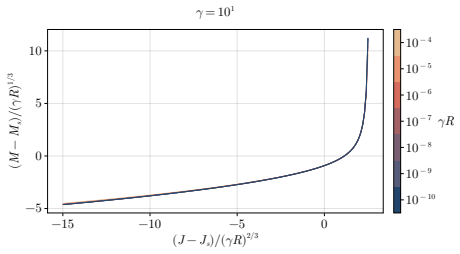
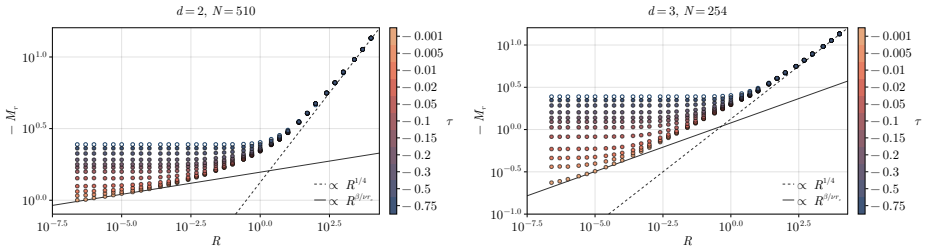
If the driving timescale is sufficiently fast, the system exhibits finite-time scaling behavior independent of temperature and dimensionality, identical to that observed in mean-field simulations. In slow quenches near Tc this mean-field behavior crosses over to critical Kibble-Zurek scaling behavior, while for temperatures T ≪ Tc nucleation and growth dominate the transition dynamics, resulting in corrections to scaling. Near the transition point where the order parameter changes sign, the crossover between mean-field and critical out-of-equilibrium dynamics is found to be well described by the leading algebraic correction to Kibble-Zurek scaling. Universal non-equilibrium scaling behavior
What carries the argument
Finite-time scaling of the order parameter under linear driving, with the crossover to Kibble-Zurek scaling captured by its leading algebraic correction.
If this is right
- Fast driving yields mean-field finite-time scaling for the order parameter regardless of temperature below Tc.
- Slow driving near Tc replaces the mean-field scaling with critical Kibble-Zurek scaling.
- At low temperatures, nucleation and growth produce corrections to the universal scaling.
- The crossover between these regimes near the sign change of the order parameter follows the leading algebraic correction to Kibble-Zurek scaling.
- Universal scaling functions for the order parameter can be extracted when driving is fast enough to suppress nucleation yet slow enough for correlations to develop.
Where Pith is reading between the lines
- The temperature independence suggests that the same finite-time scaling could appear in other models with first-order transitions under comparable linear driving protocols.
- The results indicate that quench rate can be used to select between mean-field-dominated and nucleation-dominated regimes in systems described by similar field theories.
Load-bearing premise
Classical-statistical lattice simulations with Langevin dynamics accurately capture the out-of-equilibrium dynamics of the relativistic Z2-symmetric scalar field theory across the range of driving timescales and temperatures studied.
What would settle it
A simulation or observation in which the order parameter evolution during a fast linear quench depends on temperature or changes when dimensionality is varied would falsify the claimed temperature- and dimension-independent finite-time scaling.
Figures






read the original abstract
We investigate the out-of-equilibrium dynamics of a relativistic $Z_2$-symmetric scalar field theory with Langevin dynamics in two and three spatial dimensions under linear driving across magnetic first-order phase transitions, close to and far below the critical temperature $T_c$. Using classical-statistical lattice simulations, we find that if the driving timescale is sufficiently fast, the system exhibits finite-time scaling behavior independent of temperature and dimensionality, identical to that observed in mean-field simulations. In slow quenches near $T_c$ this mean-field behavior crosses over to critical Kibble-Zurek scaling behavior, while for temperatures $T \ll T_c$ nucleation and growth dominate the transition dynamics, resulting in corrections to scaling. Near the transition point where the order parameter changes sign, the crossover between mean-field and critical out-of-equilibrium dynamics is found to be well described by the leading algebraic correction to Kibble-Zurek scaling. We find that universal non-equilibrium scaling behavior can be observed for $T \lesssim T_c$, provided the driving is fast enough to avoid nucleation but slow enough for correlations to form, and compute the associated universal scaling functions for the order parameter.
Editorial analysis
A structured set of objections, weighed in public.
Referee Report
Summary. The manuscript reports classical-statistical lattice simulations of a relativistic Z_2-symmetric scalar field with Langevin dynamics, driven linearly across first-order phase transitions in two and three spatial dimensions. It claims that fast driving produces finite-time scaling independent of temperature and dimensionality that matches mean-field simulations; slow quenches near T_c cross over to Kibble-Zurek scaling; far below T_c nucleation and growth dominate and produce corrections; and near the order-parameter sign-change point the mean-field to critical crossover is captured by the leading algebraic correction to Kibble-Zurek scaling. Universal scaling functions for the order parameter are extracted for T ≲ T_c when driving is fast enough to suppress nucleation but slow enough for correlations to develop.
Significance. If the numerical results hold, the work supplies concrete evidence for the coexistence of distinct non-equilibrium scaling regimes (mean-field finite-time, Kibble-Zurek, and nucleation-corrected) in driven first-order transitions of relativistic scalars. The direct extraction of universal scaling functions from simulations constitutes a strength, offering falsifiable predictions that can be tested in other models or dimensions. The findings are relevant to out-of-equilibrium dynamics in cosmology and heavy-ion physics.
major comments (2)
- [Numerical methods] Numerical methods section: the manuscript does not report lattice volumes, lattice spacings, number of independent realizations, or the precise procedures used for error estimation and data exclusion. These parameters are load-bearing for the central claims, as the reported crossovers and scaling functions rest entirely on the statistical reliability of the Langevin trajectories.
- [Results] Results on fast-quench regime: the claim that the finite-time scaling is identical to mean-field and independent of T and d requires explicit quantitative comparison (e.g., collapse quality or fitted exponents) between the lattice data and the mean-field reference simulations; without these, the independence statement remains qualitative.
minor comments (2)
- [Abstract] The abstract and introduction would benefit from a brief statement of the precise definition of the driving timescale and the observable used to locate the order-parameter sign-change point.
- [Figures] Figure captions should explicitly state the range of driving rates and temperatures shown, to allow readers to map the plotted data onto the three regimes discussed in the text.
Simulated Author's Rebuttal
We thank the referee for the careful reading of our manuscript and the constructive comments. We address each major point below and have revised the manuscript to incorporate the requested information and strengthen the quantitative support for our claims.
read point-by-point responses
-
Referee: [Numerical methods] Numerical methods section: the manuscript does not report lattice volumes, lattice spacings, number of independent realizations, or the precise procedures used for error estimation and data exclusion. These parameters are load-bearing for the central claims, as the reported crossovers and scaling functions rest entirely on the statistical reliability of the Langevin trajectories.
Authors: We agree that these details are necessary for assessing the statistical reliability of the results. In the revised manuscript we have expanded the Numerical Methods section to report the lattice volumes and spacings employed in both two and three dimensions, the number of independent realizations for each quench rate and temperature, and the precise error estimation procedure (including jackknife resampling and criteria for data exclusion based on trajectory convergence). revision: yes
-
Referee: [Results] Results on fast-quench regime: the claim that the finite-time scaling is identical to mean-field and independent of T and d requires explicit quantitative comparison (e.g., collapse quality or fitted exponents) between the lattice data and the mean-field reference simulations; without these, the independence statement remains qualitative.
Authors: We acknowledge that the original presentation of the fast-quench regime relied primarily on visual data collapse. In the revised manuscript we have added quantitative comparisons: we report the goodness-of-fit measures for the scaling collapse of the order parameter between the relativistic lattice data and the mean-field reference runs, together with the fitted effective exponents and their uncertainties, demonstrating consistency across the temperatures and dimensions considered. revision: yes
Circularity Check
No significant circularity
full rationale
The paper's central results are extracted from direct classical-statistical lattice simulations of Langevin dynamics for the relativistic Z2 scalar field. Scaling regimes (fast-quench finite-time scaling, crossover to Kibble-Zurek near Tc, nucleation corrections far below Tc) and associated universal functions are reported as numerical outputs, not as analytical derivations or predictions that presuppose the observed behavior. No self-definitional equations, fitted parameters renamed as predictions, or load-bearing self-citation chains appear in the methodology or claims.
Axiom & Free-Parameter Ledger
axioms (2)
- domain assumption The scalar field obeys relativistic dynamics with Z2 symmetry.
- domain assumption Langevin dynamics governs the out-of-equilibrium evolution on the lattice.
Reference graph
Works this paper leans on
-
[1]
T. W. B. Kibble, Topology of Cosmic Domains and Strings, J. Phys. A 9 (1976) 1387–1398. doi:10.1088/ 0305-4470/9/8/029
work page 1976
-
[2]
W. H. Zurek, Cosmological Experiments in Superfluid Helium?, Nature 317 (1985) 505–508. doi:10.1038/ 317505a0
work page 1985
-
[3]
W. H. Zurek, Cosmological experiments in condensed matter systems, Phys. Rept. 276 (1996) 177–221. arXiv:cond-mat/9607135,doi:10.1016/S0370-1573(96)00009-9
-
[4]
S. Gong, F. Zhong, X. Huang, S. Fan, Finite-time scaling via linear driving, New Journal of Physics 12 (4) (2010) 043036.doi:10.1088/1367-2630/12/4/043036
-
[5]
Zhong, Finite-time scaling and its applications to continuous phase transitions, in: S
F. Zhong, Finite-time scaling and its applications to continuous phase transitions, in: S. Mordechai (Ed.), Applications of Monte Carlo Method in Science and Engineering, IntechOpen, Rijeka, 2011, Ch. 18, pp. 469– 494.doi:10.5772/15284
-
[6]
Y . Huang, S. Yin, B. Feng, F. Zhong, Kibble-Zurek mechanism and finite-time scaling, Phys. Rev. B 90 (13) (2014) 134108.arXiv:1407.6612,doi:10.1103/PhysRevB.90.134108
-
[7]
Y . Huang, S. Yin, Q. Hu, F. Zhong, Kibble-zurek mechanism beyond adiabaticity: Finite-time scaling with critical initial slip, Phys. Rev. B 93 (2016) 024103.doi:10.1103/PhysRevB.93.024103
-
[8]
B. Feng, S. Yin, F. Zhong, Theory of driven nonequilibrium critical phenomena, Phys. Rev. B 94 (14) (2016) 144103.arXiv:1604.04345,doi:10.1103/PhysRevB.94.144103. 24
-
[9]
M. J. Bowick, L. Chandar, E. A. Schiff, A. M. Srivastava, The Cosmological Kibble mechanism in the laboratory: String formation in liquid crystals, Science 263 (1994) 943–945. arXiv:hep-ph/9208233, doi:10.1126/science.263.5149.943
-
[10]
P. Laguna, W. H. Zurek, Density of kinks after a quench: When symmetry breaks, how big are the pieces?, Phys. Rev. Lett. 78 (1997) 2519–2522.doi:10.1103/PhysRevLett.78.2519
-
[11]
P. Laguna, W. H. Zurek, Critical dynamics of symmetry breaking: Quenches, dissipation, and cosmology, Phys. Rev. D 58 (1998) 085021.doi:10.1103/PhysRevD.58.085021
-
[12]
A. Yates, W. H. Zurek, V ortex formation in two-dimensions: When symmetry breaks, how big are the pieces?, Phys. Rev. Lett. 80 (1998) 5477–5480.arXiv:hep-ph/9801223,doi:10.1103/PhysRevLett.80.5477
-
[13]
N. D. Antunes, L. M. A. Bettencourt, W. H. Zurek, V ortex string formation in a 3-D U(1) temperature quench, Phys. Rev. Lett. 82 (1999) 2824–2827.arXiv:hep-ph/9811426,doi:10.1103/PhysRevLett.82.2824
-
[14]
R. Monaco, J. Mygind, R. J. Rivers, Zurek-Kibble Domain Structures: The Dynamics of Spontaneous V ortex Formation in Annular Josephson Tunnel Junctions, Phys. Rev. Lett. 89 (2002) 080603. arXiv:cond-mat/ 0112321,doi:10.1103/PhysRevLett.89.080603
-
[15]
W. H. Zurek, U. Dorner, P. Zoller, Dynamics of a quantum phase transition, Phys. Rev. Lett. 95 (2005) 105701. arXiv:cond-mat/0503511,doi:10.1103/PhysRevLett.95.105701
-
[16]
Dziarmaga, Dynamics of a Quantum Phase Transition: Exact Solution of the Quantum Ising Model, Phys
J. Dziarmaga, Dynamics of a Quantum Phase Transition: Exact Solution of the Quantum Ising Model, Phys. Rev. Lett. 95 (24) (2005) 245701.doi:10.1103/PhysRevLett.95.245701
-
[17]
Polkovnikov, Universal adiabatic dynamics in the vicinity of a quantum critical point, Phys
A. Polkovnikov, Universal adiabatic dynamics in the vicinity of a quantum critical point, Phys. Rev. B 72 (16) (2005) 161201.doi:10.1103/PhysRevB.72.161201
-
[18]
A. Polkovnikov, V . Gritsev, Breakdown of the adiabatic limit in low dimensional gapless systems, Nature Phys. 4 (2008) 477.arXiv:0706.0212,doi:10.1038/nphys963
-
[19]
B. Damski, W. H. Zurek, Dynamics of a quantum phase transition in a ferromagnetic Bose-Einstein condensate, Phys. Rev. Lett. 99 (2007) 130402.arXiv:0704.0440,doi:10.1103/PhysRevLett.99.130402
-
[20]
J. Dziarmaga, Dynamics of a quantum phase transition and relaxation to a steady state, Advances In Physics 59 (12 2009).doi:10.1080/00018732.2010.514702
-
[21]
C. De Grandi, A. Polkovnikov, A. W. Sandvik, Universal nonequilibrium quantum dynamics in imaginary time, Phys. Rev. B 84 (2011) 224303.arXiv:1106.4078,doi:10.1103/PhysRevB.84.224303
-
[22]
M. Kolodrubetz, B. K. Clark, D. A. Huse, Nonequilibrium Dynamic Critical Scaling of the Quantum Ising Chain, Phys. Rev. Lett. 109 (1) (2012) 015701.doi:10.1103/PhysRevLett.109.015701
-
[23]
A. Chandran, A. Erez, S. S. Gubser, S. L. Sondhi, Kibble-Zurek problem: Universality and the scaling limit, Phys. Rev. B 86 (6) (2012) 064304.doi:10.1103/PhysRevB.86.064304
-
[24]
A. del Campo, W. H. Zurek, Universality of phase transition dynamics: Topological Defects from Sym- metry Breaking, Int. J. Mod. Phys. A 29 (8) (2014) 1430018. arXiv:1310.1600, doi:10.1142/ S0217751X1430018X
-
[25]
C.-W. Liu, A. Polkovnikov, A. W. Sandvik, Dynamic scaling at classical phase transitions approached through non-equilibrium quenching, Phys. Rev. B 89 (5) (2014) 054307. arXiv:1310.6327, doi: 10.1103/PhysRevB.89.054307
-
[26]
G. Lamporesi, S. Donadello, S. Serafini, F. Dalfovo, G. Ferrari, Spontaneous creation of kibble-zurek solitons in a bose-einstein condensate, Nature Physics 9 (06 2013).doi:10.1038/nphys2734. 25
-
[27]
N. Navon, A. L. Gaunt, R. P. Smith, Z. Hadzibabic, Critical dynamics of spontaneous symmetry breaking in a homogeneous Bose gas, Science 347 (6218) (2015) 167–170. arXiv:1410.8487, doi:10.1126/science. 1258676
-
[28]
S. Yin, P. Mai, F. Zhong, Nonequilibrium quantum criticality in open systems: The dissipation rate as an additional indispensable scaling variable, Phys. Rev. B 89 (2014) 094108. doi:10.1103/PhysRevB.89. 094108
-
[29]
S. Mukherjee, R. Venugopalan, Y . Yin, Universal off-equilibrium scaling of critical cumulants in the QCD phase diagram, Phys. Rev. Lett. 117 (22) (2016) 222301. arXiv:1605.09341, doi:10.1103/PhysRevLett.117. 222301
-
[30]
W. Weiss, M. Gerster, D. Jaschke, P. Silvi, S. Montangero, Kibble-Zurek scaling of the one-dimensional Bose-Hubbard model at finite temperatures, Phys. Rev. A 98 (2018) 063601. arXiv:1808.04649, doi: 10.1103/PhysRevA.98.063601
-
[31]
A. Keesling, et al., Quantum Kibble–Zurek mechanism and critical dynamics on a programmable Rydberg simulator, Nature 568 (7751) (2019) 207–211.arXiv:1809.05540,doi:10.1038/s41586-019-1070-1
-
[32]
Aaijet al.[LHCb Collaboration]
R. Puebla, A. Smirne, S. F. Huelga, M. B. Plenio, Universal anti-Kibble-Zurek scaling in fully-connected systems, Phys. Rev. Lett. 124 (23) (2020) 230602. arXiv:1911.06023, doi:10.1103/PhysRevLett.124. 230602
-
[33]
P. Weinberg, M. Tylutki, J. M. Rönkkö, J. Westerholm, J. A. Åström, P. Manninen, P. Törmä, A. W. Sandvik, Scaling and Diabatic Effects in Quantum Annealing with a D-Wave Device, Phys. Rev. Lett. 124 (9) (2020) 090502.arXiv:1909.13660,doi:10.1103/PhysRevLett.124.090502
-
[34]
W. Yuan, S. Yin, F. Zhong, Self-similarity breaking: Anomalous nonequilibrium finite-size scaling and finite- time scaling, Chinese Physics Letters 38 (2) (2021) 026401.doi:10.1088/0256-307X/38/2/026401
-
[35]
W. Yuan, F. Zhong, Phases fluctuations, self-similarity breaking and anomalous scalings in driven nonequi- librium critical phenomena, J. Phys. Condens. Matter 33 (38) (2021) 385401. arXiv:2103.02822, doi:10.1088/1361-648X/ac0f9d
-
[36]
W. Yuan, F. Zhong, Phases fluctuations and anomalous finite-time scaling in an externally applied field on finite-sized lattices, Journal of Physics: Condensed Matter 33 (37) (2021) 375401.doi:10.1088/1361-648X/ ac0ea8
-
[37]
A. D. King, et al., Quantum critical dynamics in a 5,000-qubit programmable spin glass, Nature 617 (7959) (2023) 61–66.arXiv:2207.13800,doi:10.1038/s41586-023-05867-2
-
[38]
B. Nienhuis, M. Nauenberg, First Order Phase Transitions in Renormalization Group Theory, Phys. Rev. Lett. 35 (1975) 477–479.doi:10.1103/PhysRevLett.35.477
-
[39]
M. E. Fisher, A. N. Berker, Scaling for first-order transitions in thermodynamic and finite systems, Phys. Rev. B 26 (1982) 2507–2513.doi:10.1103/PhysRevB.26.2507
-
[40]
Binder, Theory of first-order phase transitions, Reports on Progress in Physics 50 (7) (1987) 783
K. Binder, Theory of first-order phase transitions, Reports on Progress in Physics 50 (7) (1987) 783. doi: 10.1088/0034-4885/50/7/001
-
[41]
M. Rao, H. R. Krishnamurthy, R. Pandit, Magnetic hysteresis in two model spin systems, Phys. Rev. B 42 (1990) 856–884.doi:10.1103/PhysRevB.42.856
-
[42]
P. Jung, G. Gray, R. Roy, P. Mandel, Scaling law for dynamical hysteresis, Phys. Rev. Lett. 65 (1990) 1873–1876.doi:10.1103/PhysRevLett.65.1873
-
[43]
W. S. Lo, R. A. Pelcovits, Ising model in a time-dependent magnetic field, Phys. Rev. A 42 (1990) 7471–7474. doi:10.1103/PhysRevA.42.7471. 26
-
[44]
S. Sengupta, Y . Marathe, S. Puri, Cell-dynamical simulation of magnetic hysteresis in the two-dimensional ising system, Phys. Rev. B 45 (1992) 7828–7831.doi:10.1103/PhysRevB.45.7828
-
[45]
A. M. Somoza, R. C. Desai, Kinetics of systems with continuous symmetry under the effect of an external field, Phys. Rev. Lett. 70 (1993) 3279–3282.doi:10.1103/PhysRevLett.70.3279
-
[46]
P. B. Thomas, D. Dhar, Hysteresis in isotropic spin systems, Journal of Physics A: Mathematical and General 26 (16) (1993) 3973.doi:10.1088/0305-4470/26/16/014
-
[47]
C. N. Luse, A. Zangwill, Discontinuous scaling of hysteresis losses, Phys. Rev. E 50 (1994) 224–226. doi:10.1103/PhysRevE.50.224
-
[48]
P. A. Rikvold, H. Tomita, S. Miyashita, S. W. Sides, Metastable lifetimes in a kinetic ising model: Dependence on field and system size, Phys. Rev. E 49 (1994) 5080–5090.doi:10.1103/PhysRevE.49.5080
-
[49]
F. Zhong, J. X. Zhang, G. G. Siu, Dynamic scaling of hysteresis in a linearly driven system, Journal of Physics: Condensed Matter 6 (38) (1994) 7785.doi:10.1088/0953-8984/6/38/016
-
[50]
Z. Fan, Z. Jinxiu, L. Xiao, Scaling of hysteresis in the ising model and cell-dynamical systems in a linearly varying external field, Phys. Rev. E 52 (1995) 1399–1402.doi:10.1103/PhysRevE.52.1399
-
[51]
F. Zhong, J. Zhang, Renormalization group theory of hysteresis, Phys. Rev. Lett. 75 (1995) 2027–2030. doi:10.1103/PhysRevLett.75.2027
-
[52]
S. W. Sides, P. A. Rikvold, M. A. Novotny, Stochastic hysteresis and resonance in a kinetic ising system, Phys. Rev. E 57 (1998) 6512–6533.doi:10.1103/PhysRevE.57.6512
-
[53]
S. W. Sides, P. A. Rikvold, M. A. Novotny, Kinetic ising model in an oscillating field: Avrami theory for the hysteretic response and finite-size scaling for the dynamic phase transition, Phys. Rev. E 59 (1999) 2710–2729. doi:10.1103/PhysRevE.59.2710
-
[54]
B. K. Chakrabarti, M. Acharyya, Dynamic transitions and hysteresis, Rev. Mod. Phys. 71 (1999) 847–859. doi:10.1103/RevModPhys.71.847
-
[55]
F. Zhong, Monte carlo renormalization group study of the dynamic scaling of hysteresis in the two-dimensional ising model, Phys. Rev. B 66 (2002) 060401.doi:10.1103/PhysRevB.66.060401
-
[56]
F. Zhong, Q. Chen, Theory of the dynamics of first-order phase transitions: Unstable fixed points, exponents, and dynamical scaling, Phys. Rev. Lett. 95 (2005) 175701.doi:10.1103/PhysRevLett.95.175701
-
[57]
E. Loscar, E. Ferrero, T. Grigera, S. Cannas, Nonequilibrium characterization of spinodal points using short time dynamics, The Journal of chemical physics 131 (2009) 024120.doi:10.1063/1.3168404
-
[58]
M. H. S. Amin, V . Choi, First-order quantum phase transition in adiabatic quantum computation, Phys. Rev. A 80 (6) (2009) 062326.arXiv:0904.1387,doi:10.1103/PhysRevA.80.062326
-
[59]
T. Jörg, F. Krzakala, G. Semerjian, F. Zamponi, First-Order Transitions and the Performance of Quantum Algorithms in Random Optimization Problems, Phys. Rev. Lett. 104 (20) (2010) 207206. arXiv:0911.3438, doi:10.1103/PhysRevLett.104.207206
-
[60]
S. Fan, F. Zhong, Evidences of the instability fixed points of first-order phase transitions, Journal of Statistical Physics 143 (2011) 1136–1153.doi:10.1007/s10955-011-0225-8
-
[61]
F. Zhong, Renormalization-group theory of first-order phase transition dynamics in field-driven scalar model, Front. Phys. (Beijing) 12 (5) (2017) 126402.arXiv:1205.1400,doi:10.1007/s11467-016-0632-z
-
[62]
M. Ibáñez Berganza, P. Coletti, A. Petri, Anomalous metastability in a temperature-driven transition, EPL (Europhysics Letters) 106 (05 2014).doi:10.1209/0295-5075/106/56001. 27
-
[63]
H. Panagopoulos, E. Vicari, Off-equilibrium scaling behaviors across first-order transitions, Phys. Rev. E 92 (2015) 062107.arXiv:1508.02503,doi:10.1103/PhysRevE.92.062107
-
[64]
A. Pelissetto, E. Vicari, Off-equilibrium scaling behaviors driven by time-dependent external fields in three- dimensional O(n) vector models, Phys. Rev. E 93 (2016) 032141.doi:10.1103/PhysRevE.93.032141
-
[66]
N. Liang, F. Zhong, Renormalization-group theory for cooling first-order phase transitions in Potts models, Phys. Rev. E 95 (3) (2017) 032124.arXiv:1610.07861,doi:10.1103/PhysRevE.95.032124
-
[67]
A. Pelissetto, E. Vicari, Dynamic finite-size scaling at first-order transitions, Phys. Rev. E 96 (1) (2017) 012125. arXiv:1705.03198,doi:10.1103/PhysRevE.96.012125
-
[68]
H. Panagopoulos, A. Pelissetto, E. Vicari, Dynamic scaling behavior at thermal first-order transitions in systems with disordered boundary conditions, Phys. Rev. D 98 (7) (2018) 074507. arXiv:1805.04241, doi:10. 1103/PhysRevD.98.074507
-
[69]
F. Zhong, Universal scaling in first-order phase transitions mixed with nucleation and growth, Journal of Physics: Condensed Matter 30 (44) (2018) 445401.doi:10.1088/1361-648X/aae3cc
-
[71]
S. Scopa, S. Wald, Dynamical off-equilibrium scaling across magnetic first-order phase transitions, Journal of Statistical Mechanics: Theory and Experiment 2018 (11) (2018) 113205. doi:10.1088/1742-5468/aaeb46
-
[72]
A. Pelissetto, D. Rossini, E. Vicari, Dynamic finite-size scaling after a quench at quantum transitions, Phys. Rev. E 97 (5) (2018) 052148.arXiv:1804.03102,doi:10.1103/PhysRevE.97.052148
-
[73]
A. Pelissetto, D. Rossini, E. Vicari, Out-of-equilibrium dynamics driven by localized time-dependent perturba- tions at quantum phase transitions, Phys. Rev. B 97 (2018) 094414.doi:10.1103/PhysRevB.97.094414
-
[74]
S. Iino, S. Morita, N. Kawashima, A. W. Sandvik, Detecting Signals of Weakly First-order Phase Transitions in Two-dimensional Potts Models, J. Phys. Soc. Jap. 88 (3) (2019) 034006. arXiv:1801.02786, doi: 10.7566/JPSJ.88.034006
-
[75]
Fontana, Scaling behavior of Ising systems at first-order transitions, J
P. Fontana, Scaling behavior of Ising systems at first-order transitions, J. Stat. Mech. 1906 (6) (2019) 063206. arXiv:1903.01513,doi:10.1088/1742-5468/ab16c7
-
[76]
L. Qiu, H.-Y . Liang, Y .-B. Yang, H. Yang, T. Tian, Y . Xu, L.-M. Duan, Observation of generalized kibble-zurek mechanism across a first-order quantum phase transition in a spinor condensate, Science Advances 6 (2020) eaba7292.doi:10.1126/sciadv.aba7292
-
[78]
Coherent and dissipative dynamics at quantum phase transitions
D. Rossini, E. Vicari, Coherent and dissipative dynamics at quantum phase transitions, Phys. Rept. 936 (2021) 1–110.arXiv:2103.02626,doi:10.1016/j.physrep.2021.08.003
work page internal anchor Pith review Pith/arXiv arXiv doi:10.1016/j.physrep.2021.08.003 2021
- [79]
-
[80]
F. Tarantelli, S. Scopa, Out-of-equilibrium scaling behavior arising during round-trip protocols across a quantum first-order transition, Phys. Rev. B 108 (10) (2023) 104316. arXiv:2305.12993, doi:10.1103/PhysRevB. 108.104316
-
[81]
A. Pelissetto, E. Vicari, Scaling Behaviors at Quantum and Classical First-Order Transitions, World Scientific, 2024, Ch. Chapter 27, pp. 437–476.doi:10.1142/9789811282386_0027
-
[82]
Zhong, Complete Universal Scaling in First-Order Phase Transitions, Chin
F. Zhong, Complete Universal Scaling in First-Order Phase Transitions, Chin. Phys. Lett. 41 (10) (2024) 100502.arXiv:2404.00219,doi:10.1088/0256-307X/41/10/100502
-
[83]
Y . Zhang, F. Zhong, Nucleation and growth manifest universal scaling, surely, Journal of the Physical Society of Japan 94 (4) (2025) 043001.doi:10.7566/JPSJ.94.043001
discussion (0)
Sign in with ORCID, Apple, or X to comment. Anyone can read and Pith papers without signing in.