Recognition: 2 theorem links
· Lean TheoremLearning to Rank for Selected Configuration Interaction
Pith reviewed 2026-05-12 05:21 UTC · model grok-4.3
The pith
Reframing determinant selection as a pairwise ranking task lets a Transformer model reach chemical accuracy in selected configuration interaction with substantially fewer terms than classification or regression baselines.
A machine-rendered reading of the paper's core claim, the machinery that carries it, and where it could break.
Core claim
Ranking configuration interaction reframes determinant selection as a pairwise ranking problem and trains a Transformer-based model to optimize the partial ordering of determinants according to their contribution to electron correlation. Benchmarks across plane-wave and Gaussian basis sets show that this alignment of training objective with the intrinsic ranking nature of SCI produces faster convergence and more compact wavefunctions than classification or regression alternatives.
What carries the argument
The pairwise ranking loss inside a Transformer encoder that processes orbital information to score relative importance between pairs of determinants.
Load-bearing premise
That a model trained to rank determinants by pairwise comparisons on small molecules will correctly identify the highest-contributing determinants when applied to new systems or larger active spaces.
What would settle it
A test on an additional molecule or active space where the ranking model requires more determinants than a simple energy-threshold selection to reach the same target accuracy.
Figures




read the original abstract
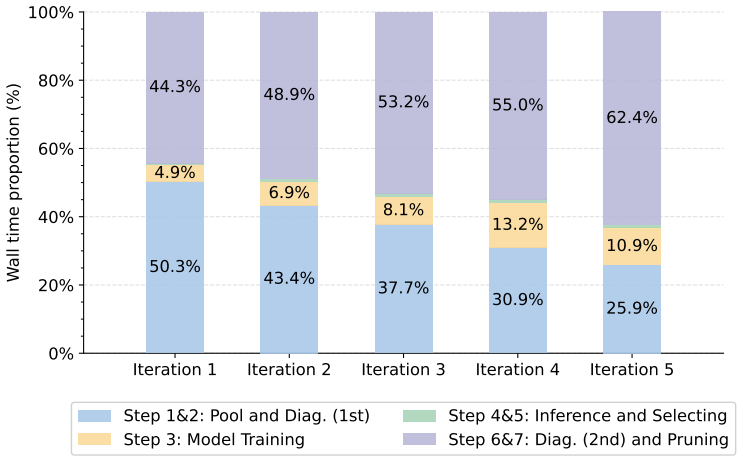
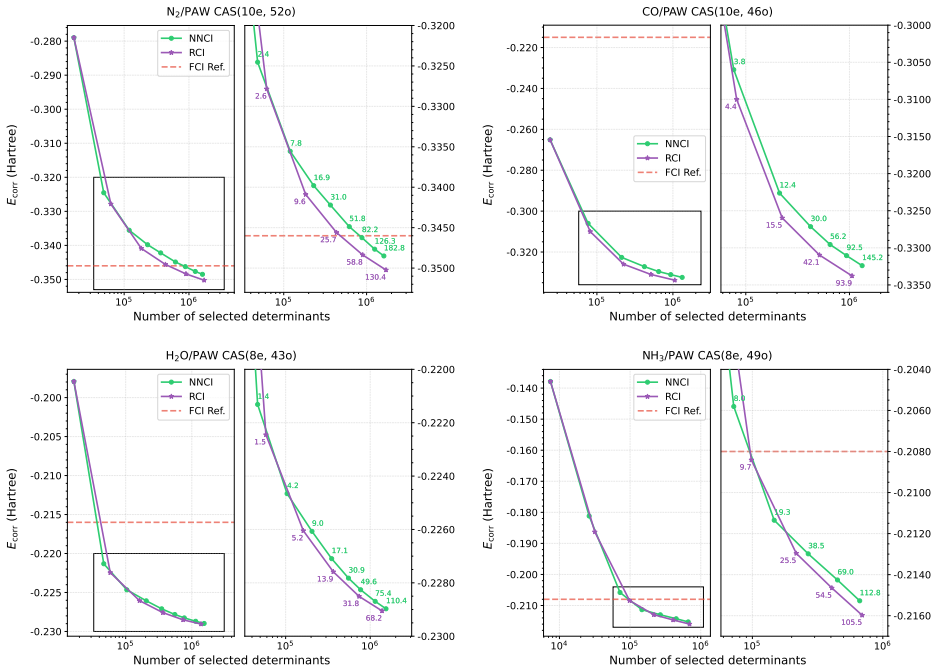
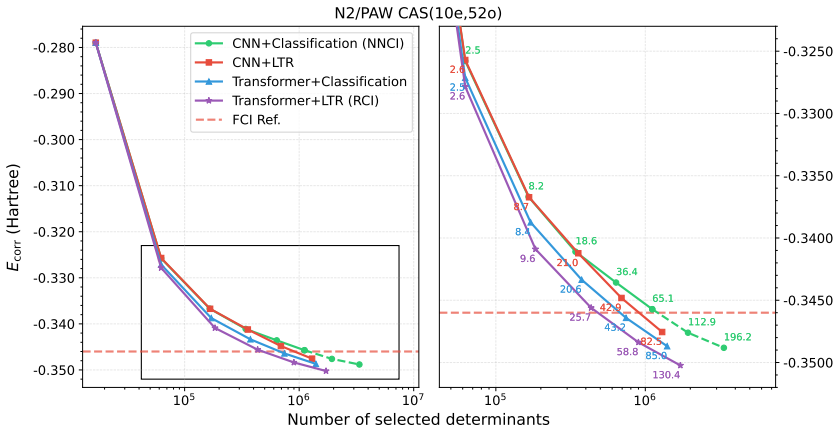
The accurate description of electron correlation is a central challenge in computational chemistry, with selected configuration interaction (SCI) emerging as a powerful tool to approach the full CI limit. While recent machine learning (ML) integrations have accelerated determinant selection, existing regression and classification approaches suffer from a fundamental objective-loss mismatch: they evaluate the importance of determinants in isolation without explicitly accounting for their relative importance ranking. Here, we introduce ranking configuration interaction (RCI), a novel ML-supported SCI framework that reframes determinant selection as a pairwise ranking problem. Building upon a Transformer-based architecture to capture complex, non-local orbital dependencies, RCI progressively optimizes the partial ordering of determinants. By doing so, RCI aligns the training objective more closely with the intrinsic ranking nature of SCI. Extensive benchmarks across both plane-wave and Gaussian basis sets, including the molecules N$_2$, CO, H$_2$O, NH$_3$, and C$_2$, demonstrate the substantial efficiency of RCI. Compared to previously reported classification baselines, RCI consistently accelerates convergence-reducing overall computational time by 23% to over 50% depending on the system, and requiring only 55% of the determinant count in representative cases such as N$_2$ and CO. Furthermore, RCI exhibits robust performance and reaches chemical accuracy on the highly challenging iron-sulfur using only 12% of the full CI space. Notably, RCI outperforms recent regression-based SCI methods by delivering either further 15% improvement in accuracy at comparable determinant counts, or 15% gain in compactness at similar accuracy. This pairwise learning-to-rank model provides a lightweight and modular plugin that can be seamlessly incorporated into other supervised-learning frameworks.
Editorial analysis
A structured set of objections, weighed in public.
Referee Report
Summary. The paper introduces Ranking Configuration Interaction (RCI), a machine-learning framework for selected configuration interaction (SCI) that reframes determinant selection as a pairwise ranking task solved by a Transformer model capturing non-local orbital dependencies. It claims this yields faster convergence than prior classification or regression ML-SCI approaches, with 23-50% reductions in computational time, 55% fewer determinants for N2 and CO, chemical accuracy for iron-sulfur clusters using only 12% of the full CI space, and a 15% edge in accuracy or compactness over recent regression baselines.
Significance. If the central claim holds after verification, RCI would supply a training objective more intrinsically matched to the ranking character of determinant importance in SCI, potentially enabling more compact and rapidly converging wavefunctions for strongly correlated systems. The modular plugin design and benchmarks across plane-wave and Gaussian bases on multiple molecules would make it a practical addition to existing supervised SCI pipelines.
major comments (3)
- [Abstract and Methods] Abstract and Methods: The pairwise ranking loss and the procedure for generating training pair labels (i.e., how 'true' relative importance is derived from reference SCI runs) are not specified. Without these definitions it is impossible to determine whether the reported 15% gains over regression baselines arise from the ranking objective itself or from differences in data selection, architecture, or post-hoc tuning.
- [Results] Results section: No ablation is presented that isolates the ranking formulation from the Transformer architecture or from the choice of training data splits. Consequently the claim that 'RCI aligns the training objective more closely with the intrinsic ranking nature of SCI' cannot be separated from possible confounding factors such as overfitting to the benchmark molecules or selection bias in the determinant pool.
- [Benchmarks] Benchmarks: The reported time reductions (23-50%) and determinant-count savings (55% for N2/CO, 12% for iron-sulfur) are given without error bars, number of independent runs, or statistical tests against the classification and regression baselines. This leaves open the possibility that the efficiency gains are not robust or are driven by implementation details rather than the ranking approach.
minor comments (1)
- [Abstract] The abstract states that RCI 'progressively optimizes the partial ordering'; the precise schedule (e.g., how many ranking iterations per SCI step) should be clarified for reproducibility.
Simulated Author's Rebuttal
We thank the referee for the constructive and detailed feedback. We address each major comment point by point below. Where clarifications or additions are needed, we will revise the manuscript accordingly to improve reproducibility and strengthen the claims.
read point-by-point responses
-
Referee: [Abstract and Methods] Abstract and Methods: The pairwise ranking loss and the procedure for generating training pair labels (i.e., how 'true' relative importance is derived from reference SCI runs) are not specified. Without these definitions it is impossible to determine whether the reported 15% gains over regression baselines arise from the ranking objective itself or from differences in data selection, architecture, or post-hoc tuning.
Authors: We agree that explicit definitions of the pairwise ranking loss and label generation procedure are essential for reproducibility and for isolating the source of the reported gains. In the revised manuscript we will add a dedicated subsection in Methods that (i) specifies the exact pairwise loss (e.g., logistic or hinge loss on ordered pairs), (ii) describes how reference SCI runs are used to assign ground-truth labels (by comparing each determinant’s contribution to the total energy or to the squared norm of the wavefunction), and (iii) states the sampling strategy used to form training pairs. These additions will allow readers to verify that performance differences arise from the ranking objective rather than ancillary implementation choices. revision: yes
-
Referee: [Results] Results section: No ablation is presented that isolates the ranking formulation from the Transformer architecture or from the choice of training data splits. Consequently the claim that 'RCI aligns the training objective more closely with the intrinsic ranking nature of SCI' cannot be separated from possible confounding factors such as overfitting to the benchmark molecules or selection bias in the determinant pool.
Authors: We acknowledge the value of controlled ablations. The revised manuscript will include a new ablation table that fixes the Transformer architecture and training-data splits while varying only the training objective (ranking loss versus classification and regression losses). We will also report performance on held-out molecules and on alternative determinant-pool splits to address potential overfitting or selection bias. These experiments will provide direct evidence that the ranking formulation, rather than architecture or data choices, drives the observed improvements. revision: yes
-
Referee: [Benchmarks] Benchmarks: The reported time reductions (23-50%) and determinant-count savings (55% for N2/CO, 12% for iron-sulfur) are given without error bars, number of independent runs, or statistical tests against the classification and regression baselines. This leaves open the possibility that the efficiency gains are not robust or are driven by implementation details rather than the ranking approach.
Authors: We agree that statistical characterization is necessary to substantiate robustness. In the revised manuscript we will (i) report means and standard deviations over a stated number of independent runs (with different random seeds for both training and determinant selection), (ii) include error bars on all timing and determinant-count figures, and (iii) apply paired statistical tests (e.g., t-tests) against the classification and regression baselines. These additions will demonstrate that the efficiency gains are statistically significant and not attributable to implementation variability. revision: yes
Circularity Check
No circularity: empirical ML ranking framework validated on external benchmarks
full rationale
The paper introduces RCI as an empirical supervised learning method that trains a Transformer on pairwise ranking labels derived from SCI determinant contributions. Reported gains (23-50% time reduction, 55% fewer determinants for N2/CO, 12% CI space for iron-sulfur, 15% edge over regression baselines) are obtained from direct numerical benchmarks on held-out molecular systems rather than from any fitted parameter, self-referential definition, or self-citation chain that reduces the claimed result to its own inputs by construction. No equations, uniqueness theorems, or ansatzes are presented that loop back; the derivation chain consists of standard ML training plus SCI energy evaluation, which remains externally falsifiable.
Axiom & Free-Parameter Ledger
Lean theorems connected to this paper
-
IndisputableMonolith/Cost/FunctionalEquation.leanwashburn_uniqueness_aczel unclearreframes determinant selection as a pairwise ranking problem... Pairwise Logistic Loss... L = 1/|P| Σ log(1 + exp(-(s_i - s_j)))
-
IndisputableMonolith/Foundation/AlexanderDuality.leanalexander_duality_circle_linking unclearTransformer-based architecture to capture complex, non-local orbital dependencies
Reference graph
Works this paper leans on
-
[1]
Learning to rank for information retrieval , ISBN =
Liu, Tie-Yan , year =. Learning to rank for information retrieval , ISBN =. doi:10.1007/978-3-642-14267-3 , publisher =
-
[2]
Journal of Chemical Theory and Computation , volume=
Neural-network-based selective configuration interaction approach to molecular electronic structure , author=. Journal of Chemical Theory and Computation , volume=. 2025 , publisher=
work page 2025
-
[3]
SciPost Physics Codebases , pages=
SOLAX: A Python solver for fermionic quantum systems with neural network support , author=. SciPost Physics Codebases , pages=
-
[4]
Advances in Neural Information Processing Systems , volume=
Pytorch: An imperative style, high-performance deep learning library , author=. Advances in Neural Information Processing Systems , volume=
-
[5]
Proceedings of the 22nd International Conference on Machine Learning , pages=
Learning to rank using gradient descent , author=. Proceedings of the 22nd International Conference on Machine Learning , pages=
-
[6]
Advances in Neural Information Processing Systems , volume=
Mcrank: Learning to rank using multiple classification and gradient boosting , author=. Advances in Neural Information Processing Systems , volume=
-
[7]
Proceedings of the 24th International Conference on Machine Learning , pages=
Learning to rank: from pairwise approach to listwise approach , author=. Proceedings of the 24th International Conference on Machine Learning , pages=
-
[8]
Advances in Neural Information Processing Systems , volume=
Attention is all you need , author=. Advances in Neural Information Processing Systems , volume=
-
[9]
Advances in Neural Information Processing Systems , volume=
Learning to rank with nonsmooth cost functions , author=. Advances in Neural Information Processing Systems , volume=
-
[10]
Structured learning for non-smooth ranking losses , author=. Proceedings of the 14th ACM SIGKDD International Conference on Knowledge Discovery and Data Mining , pages=
-
[11]
Chemical Physics Letters , volume=
A full-configuration benchmark for the N2 molecule , author=. Chemical Physics Letters , volume=. 1999 , publisher=
work page 1999
-
[12]
Journal of Chemical Theory and Computation , volume=
Distributed implementation of full configuration interaction for one trillion determinants , author=. Journal of Chemical Theory and Computation , volume=. 2024 , publisher=
work page 2024
-
[13]
Journal of Chemical Theory and Computation , volume=
Solving the Schr\"odinger equation in the configuration space with generative machine learning , author=. Journal of Chemical Theory and Computation , volume=. 2023 , publisher=
work page 2023
-
[14]
Journal of Chemical Theory and Computation , volume=
Accelerating many-body quantum chemistry via generative Transformer-enhanced configuration interaction , author=. Journal of Chemical Theory and Computation , volume=. 2025 , publisher=
work page 2025
-
[15]
The Journal of Chemical Physics , volume=
An accurate analytic potential function for ground-state N2 from a direct-potential-fit analysis of spectroscopic data , author=. The Journal of Chemical Physics , volume=. 2006 , publisher=
work page 2006
-
[16]
The Journal of Chemical Physics , volume=
Iterative perturbation calculations of ground and excited state energies from multiconfigurational zeroth-order wavefunctions , author=. The Journal of Chemical Physics , volume=. 1973 , publisher=
work page 1973
-
[17]
The Journal of Chemical Physics , volume=
A deterministic alternative to the full configuration interaction quantum Monte Carlo method , author=. The Journal of Chemical Physics , volume=. 2016 , publisher=
work page 2016
-
[18]
Journal of Chemical Theory and Computation , volume=
Modern approaches to exact diagonalization and selected configuration interaction with the adaptive sampling CI method , author=. Journal of Chemical Theory and Computation , volume=. 2020 , publisher=
work page 2020
-
[19]
Journal of Chemical Theory and Computation , volume=
Efficient heat-bath sampling in Fock space , author=. Journal of Chemical Theory and Computation , volume=. 2016 , publisher=
work page 2016
-
[20]
Journal of Chemical Theory and Computation , volume=
Heat-bath configuration interaction: An efficient selected configuration interaction algorithm inspired by heat-bath sampling , author=. Journal of Chemical Theory and Computation , volume=. 2016 , publisher=
work page 2016
-
[21]
Journal of Chemical Theory and Computation , volume=
Semistochastic heat-bath configuration interaction method: Selected configuration interaction with semistochastic perturbation theory , author=. Journal of Chemical Theory and Computation , volume=. 2017 , publisher=
work page 2017
-
[22]
International Journal of Quantum Chemistry , volume=
An application of perturbation theory ideas in configuration interaction calculations , author=. International Journal of Quantum Chemistry , volume=. 1968 , publisher=
work page 1968
-
[23]
Chemical Physics Letters , volume=
Direct selected configuration interaction using a hole-particle formalism , author=. Chemical Physics Letters , volume=. 1992 , publisher=
work page 1992
-
[24]
The Journal of Chemical Physics , volume=
Adaptive multiconfigurational wave functions , author=. The Journal of Chemical Physics , volume=. 2014 , publisher=
work page 2014
-
[25]
The Journal of Physical Chemistry Letters , volume=
Downfolded configuration interaction for chemically accurate electron correlation , author=. The Journal of Physical Chemistry Letters , volume=. 2022 , publisher=
work page 2022
-
[26]
Journal of Chemical Theory and Computation , volume=
Machine learning configuration interaction , author=. Journal of Chemical Theory and Computation , volume=. 2018 , publisher=
work page 2018
-
[27]
Journal of Chemical Theory and Computation , volume=
Machine learning configuration interaction for ab initio potential energy curves , author=. Journal of Chemical Theory and Computation , volume=. 2019 , publisher=
work page 2019
-
[28]
Machine learning approach to pattern recognition in nuclear dynamics from the ab initio symmetry-adapted no-core shell model , author=. Physical Review C , volume=. 2022 , publisher=
work page 2022
-
[29]
Journal of Chemical Theory and Computation , volume=
Hamiltonian-guided autoregressive selected-configuration interaction achieves chemical accuracy in strongly correlated systems , author=. Journal of Chemical Theory and Computation , volume=. 2025 , publisher=
work page 2025
-
[30]
Journal of Chemical Theory and Computation , volume=
Chembot: A machine learning approach to selective configuration interaction , author=. Journal of Chemical Theory and Computation , volume=. 2021 , publisher=
work page 2021
-
[31]
Journal of Chemical Theory and Computation , volume=
Active learning configuration interaction for excited-state calculations of polycyclic aromatic hydrocarbons , author=. Journal of Chemical Theory and Computation , volume=. 2021 , publisher=
work page 2021
-
[32]
Physical Review Letters , volume=
Deep-learning approach for the atomic configuration interaction problem on large basis sets , author=. Physical Review Letters , volume=. 2023 , publisher=
work page 2023
-
[33]
Neural-network approach to running high-precision atomic computations , author=. Physical Review A , volume=. 2024 , publisher=
work page 2024
-
[34]
Neural-network-supported basis optimizer for the configuration interaction problem in quantum many-body clusters: Feasibility study and numerical proof , author=. Physical Review B , volume=. 2025 , publisher=
work page 2025
-
[35]
arXiv preprint arXiv:2510.27665 , year=
Natural-orbital-based neural network configuration interaction , author=. arXiv preprint arXiv:2510.27665 , year=
-
[36]
Casier, Bastien and El Hamdi, Maissa and Herzog, Basile , year =. Machine Learning Assisted Selective Configuration Interaction for Accurate Ground and Excited State Calculations , volume =. Journal of Chemical Theory and Computation , publisher =. doi:10.1021/acs.jctc.5c01652 , number =
-
[37]
Journal of Chemical Theory and Computation , volume=
Reinforcement learning configuration interaction , author=. Journal of Chemical Theory and Computation , volume=. 2021 , publisher=
work page 2021
-
[38]
Synthetic analogs of the active sites of iron-sulfur proteins. XI. Synthesis and properties of complexes containing the iron sulfide (Fe2S2) core and the structures of bis [o-xylyl-. alpha.,. alpha.'-dithiolato-. mu.-sulfido-ferrate (III)] and bis [p-tolylthiolato-. mu.-sulfido-ferrate (III)] dianions , author=. Journal of the American Chemical Society , ...
work page 1975
-
[39]
Low-energy spectrum of iron--sulfur clusters directly from many-particle quantum mechanics , author=. Nature Chemistry , volume=. 2014 , publisher=
work page 2014
-
[40]
The Journal of Chemical Physics , volume=
Communication: A flexible multi-reference perturbation theory by minimizing the Hylleraas functional with matrix product states , author=. The Journal of Chemical Physics , volume=. 2014 , publisher=
work page 2014
-
[41]
Journal of Chemical Theory and Computation , volume=
Spin-projected matrix product states: Versatile tool for strongly correlated systems , author=. Journal of Chemical Theory and Computation , volume=. 2017 , publisher=
work page 2017
-
[42]
Wiley Interdisciplinary Reviews: Computational Molecular Science , volume=
PySCF: the Python-based simulations of chemistry framework , author=. Wiley Interdisciplinary Reviews: Computational Molecular Science , volume=. 2018 , publisher=
work page 2018
-
[43]
The Journal of Chemical Physics , volume=
Recent developments in the PySCF program package , author=. The Journal of Chemical Physics , volume=. 2020 , publisher=
work page 2020
-
[44]
Proceedings of the IEEE/CVF Conference on Computer Vision and Pattern Recognition , pages=
Pads: Policy-adapted sampling for visual similarity learning , author=. Proceedings of the IEEE/CVF Conference on Computer Vision and Pattern Recognition , pages=
-
[45]
The Journal of Chemical Physics , volume=
Fast semistochastic heat-bath configuration interaction , author=. The Journal of Chemical Physics , volume=. 2018 , publisher=
work page 2018
-
[46]
Advances in Neural Information Processing Systems , volume=
PSL: Rethinking and improving softmax loss from pairwise perspective for recommendation , author=. Advances in Neural Information Processing Systems , volume=
-
[47]
IR evaluation methods for retrieving highly relevant documents , author=. ACM SIGIR Forum , volume=. 2017 , organization=
work page 2017
-
[48]
Projector augmented-wave method , author=. Physical Review B , volume=. 1994 , publisher=
work page 1994
-
[49]
Bulletin of Materials Science , volume=
Projector augmented wave method: ab initio molecular dynamics with full wave functions , author=. Bulletin of Materials Science , volume=. 2003 , publisher=
work page 2003
discussion (0)
Sign in with ORCID, Apple, or X to comment. Anyone can read and Pith papers without signing in.