Recognition: 2 theorem links
· Lean TheoremSignal-Dependent Shot Noise Modeling of Rydberg Atomic Quantum Receivers: A Design Perspective
Pith reviewed 2026-05-12 05:16 UTC · model grok-4.3
The pith
A baseband model for Rydberg atomic quantum receivers includes signal-dependent shot noise to reveal when RAQ-MIMO outperforms RF-MIMO.
A machine-rendered reading of the paper's core claim, the machinery that carries it, and where it could break.
Core claim
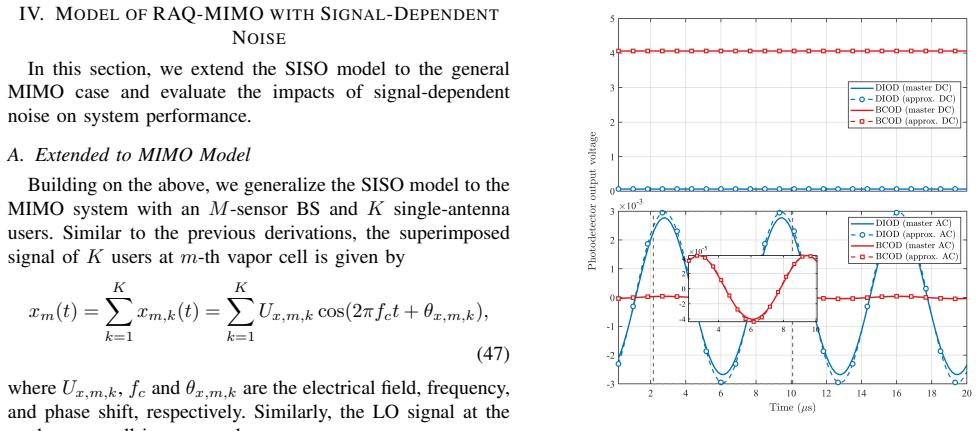
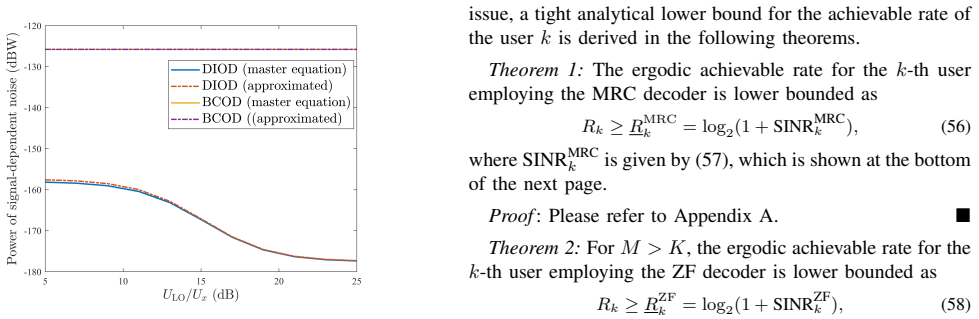
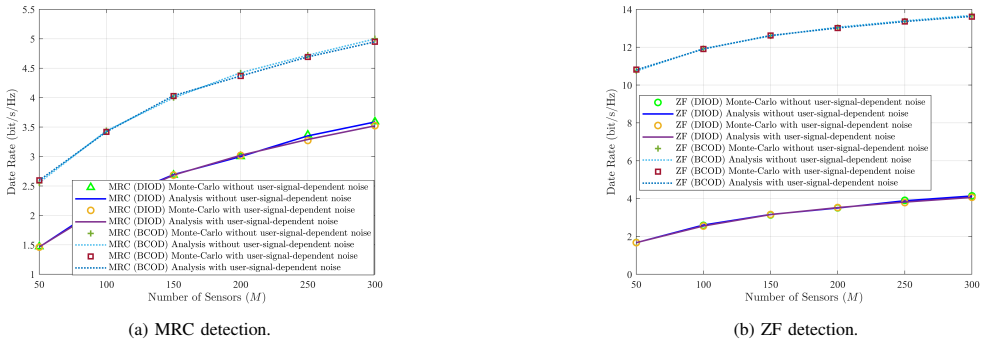
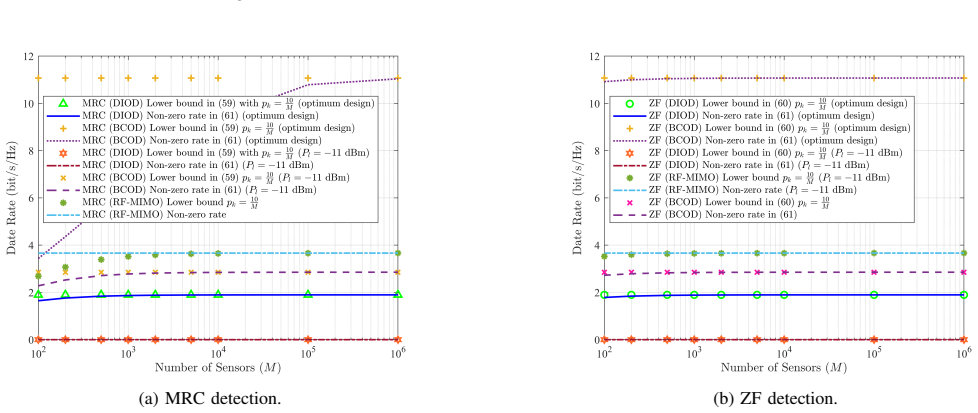
Under a strong local oscillator in the superheterodyne architecture, the complex baseband model represents both the received signal and the signal-dependent shot noise for direct incoherent and balanced coherent optical detection. The optical operating point simultaneously fixes the normalized effective receive gain and the equivalent noise background, establishing a traceable gain-noise tradeoff. Neglecting the shot noise leads to suboptimal design. For the MIMO extension, the derived lower bound on achievable rate is non-zero and superior to RF-MIMO precisely when the RAQ receive chain's normalized noise floor is lower than that of RF-MIMO.
What carries the argument
Complex baseband equivalent model that incorporates photodetection-induced signal-dependent shot noise and its coupling to the optical operating point under superheterodyne detection with strong local oscillator.
If this is right
- The optical operating point must be chosen jointly for gain and noise, rather than for gain alone.
- Operating-point design that ignores signal-dependent shot noise produces suboptimal RAQR performance.
- RAQ-MIMO possesses a non-zero asymptotic achievable rate once the model is applied.
- RAQ-MIMO exceeds conventional RF-MIMO rates only when the RAQ normalized noise floor falls below the RF floor.
- Simulations of the model supply closed-form guidelines for RAQR front-end parameters.
Where Pith is reading between the lines
- The gain-noise tradeoff may favor balanced coherent detection over direct detection in practice.
- Stronger local oscillators could be used to push the RAQ noise floor further below RF levels.
- The model could be tested by comparing predicted rates against hardware measurements at varying optical powers.
- Similar noise modeling may apply to other atomic or quantum receivers operating in the optical domain.
Load-bearing premise
The derived complex baseband model correctly captures the photodetection-induced signal-dependent shot noise and its coupling with the optical operating point under the superheterodyne architecture with strong local oscillator.
What would settle it
Measure the normalized noise floor of an RAQ receive chain in a laboratory setup and compare it against the RF-MIMO floor; the model is falsified if RAQ-MIMO rates remain positive and exceed RF rates even when the RAQ floor is not lower.
Figures





read the original abstract
In this paper, we develop a communication-oriented complex baseband equivalent model for superheterodyne Rydberg atomic quantum receivers (RAQRs). The model explicitly captures photodetection-induced signal-dependent shot noise and its coupling with the optical operating point. By leveraging an atomic superheterodyne architecture and a strong local oscillator, we construct a complex baseband representation for both the received signal and the signal-dependent shot noise under both direct incoherent optical detection and balanced coherent optical detection. The derived model reveals that the optical operating point jointly determines the normalized effective receive gain and the equivalent noise background, thereby establishing a traceable gain-noise tradeoff governed by system design. More importantly, the proposed model shows that neglecting signal-dependent shot noise may lead to inaccurate operating-point design. Finally, by extending to the multiple-input-multiple-output (MIMO) case, we derive a lower bound on the achievable rate while considering the signal-dependent shot noise. Our analysis \textcolor{black}{reveals} that the non-zero asymptotic rate of RAQ-MIMO and its superiority over conventional RF-MIMO hinge on the normalized noise floor of the RAQ receive chain falling below that of RF MIMO. Simulation results validate our analysis and yield practical, closed-form design guidelines for RAQR front ends, revealing parameter regimes in which RAQ-MIMO outperforms conventional MIMO systems.
Editorial analysis
A structured set of objections, weighed in public.
Referee Report
Summary. The paper develops a communication-oriented complex baseband equivalent model for superheterodyne Rydberg atomic quantum receivers (RAQRs) that explicitly incorporates photodetection-induced signal-dependent shot noise and its dependence on the optical operating point. The model is constructed for both direct incoherent and balanced coherent detection under a strong local oscillator; it is then extended to the MIMO setting to derive a lower bound on achievable rate. The central result is that RAQ-MIMO admits a non-zero asymptotic rate and can outperform conventional RF-MIMO provided the normalized noise floor of the RAQ receive chain lies below that of RF MIMO; simulations are used to validate the model and extract closed-form design guidelines.
Significance. If the baseband model is shown to be faithful to the underlying optical statistics, the work supplies a traceable gain-noise tradeoff that directly informs front-end design for Rydberg receivers. The explicit treatment of signal-dependent shot noise, the MIMO rate bound, and the identification of operating regimes where RAQ-MIMO is superior constitute concrete, falsifiable contributions that could guide experimental implementations.
major comments (2)
- [Complex baseband model derivation (Sections 3–4)] The headline comparison between RAQ-MIMO and RF-MIMO rests on the normalized noise floor obtained from the complex baseband shot-noise model. The derivation that maps the optical operating point to both effective gain and signal-dependent variance must be shown not to reduce the noise-floor ratio by construction; any omitted cross-term in the photodetection statistics or inexact strong-LO approximation would shift this ratio and could eliminate the claimed rate advantage.
- [MIMO rate analysis and asymptotic behavior] The lower bound on the RAQ-MIMO achievable rate is conditioned on the RAQ noise floor being strictly lower than the RF floor. The manuscript should supply an explicit parameter set (including LO strength, atomic density, and photodetector quantum efficiency) together with the resulting numerical noise-floor values to demonstrate that the superiority region is non-empty and robust to small perturbations in the strong-LO assumption.
minor comments (2)
- [Simulation results] The abstract states that simulations 'validate our analysis and yield practical, closed-form design guidelines'; the main text should tabulate the specific parameter regimes (e.g., optical power, detuning) in which RAQ-MIMO outperforms RF-MIMO so that the guidelines are immediately usable.
- [Notation and definitions] Notation for the normalized effective receive gain and equivalent noise background should be introduced once with a clear mapping to the optical operating point; subsequent sections can then refer to these quantities without re-deriving the coupling each time.
Simulated Author's Rebuttal
We thank the referee for the constructive comments, which help clarify the model derivation and strengthen the supporting evidence for the MIMO analysis. We address each major comment below and have revised the manuscript to incorporate additional derivation details and explicit parameter examples.
read point-by-point responses
-
Referee: [Complex baseband model derivation (Sections 3–4)] The headline comparison between RAQ-MIMO and RF-MIMO rests on the normalized noise floor obtained from the complex baseband shot-noise model. The derivation that maps the optical operating point to both effective gain and signal-dependent variance must be shown not to reduce the noise-floor ratio by construction; any omitted cross-term in the photodetection statistics or inexact strong-LO approximation would shift this ratio and could eliminate the claimed rate advantage.
Authors: The derivation follows the standard semiclassical photodetection model, in which the photocurrent equals the optical intensity and the shot-noise variance equals the mean photocurrent (scaled by the electron charge and bandwidth). Under a strong local oscillator the dominant noise term is the LO-induced shot noise; the signal-signal beat term is negligible compared with the LO-LO term, and the signal-LO cross term produces the desired baseband signal. We have verified that the intensity autocorrelation contains no additional cross-terms that would alter the baseband noise variance. The strong-LO approximation is the conventional operating regime for superheterodyne optical receivers and is justified when LO power exceeds signal power by several orders of magnitude, as is typical for Rydberg atomic receivers. To make the mapping explicit, we have added Appendix A containing the full step-by-step derivation from the optical field to the complex baseband model, together with a short sensitivity study showing that ±10 % deviations from the strong-LO assumption leave the normalized noise-floor ratio below unity for the parameter ranges of interest. revision: yes
-
Referee: [MIMO rate analysis and asymptotic behavior] The lower bound on the RAQ-MIMO achievable rate is conditioned on the RAQ noise floor being strictly lower than the RF floor. The manuscript should supply an explicit parameter set (including LO strength, atomic density, and photodetector quantum efficiency) together with the resulting numerical noise-floor values to demonstrate that the superiority region is non-empty and robust to small perturbations in the strong-LO assumption.
Authors: We agree that concrete numerical values are needed to confirm the superiority region is attainable. In the revised manuscript we have inserted a new subsection (Section 5.3) that lists a representative parameter set: LO optical power 10 mW, atomic vapor density 10^{12} atoms/cm^{3}, photodetector quantum efficiency 0.8, and standard values for the remaining Rydberg-system constants. With these parameters the normalized RAQ noise floor evaluates to approximately 0.68 times the normalized RF-MIMO thermal-noise floor. We further include a robustness table (Table II) that perturbs the LO strength by ±20 % and shows that the noise-floor ratio remains strictly below 1, preserving both the non-zero asymptotic rate and the rate advantage over RF-MIMO. revision: yes
Circularity Check
No circularity: first-principles derivation of baseband model and rate bound
full rationale
The paper constructs the complex baseband equivalent model by inserting atomic superheterodyne field expressions into photodetection statistics for direct and balanced coherent detection under strong LO. The normalized effective gain, signal-dependent shot-noise variance, and resulting noise-floor comparison are direct outputs of this construction rather than inputs. The MIMO rate lower bound is then obtained by standard information-theoretic bounding applied to the derived model; the non-zero asymptotic rate condition follows as a consequence of the noise-floor inequality and is not presupposed. No parameter is fitted to the target rate or noise comparison, no self-citation supplies a uniqueness theorem or ansatz, and no renaming of known results occurs. Simulations serve only for validation, not for defining the analytic claims. The derivation chain is therefore self-contained against external physical assumptions.
Axiom & Free-Parameter Ledger
Lean theorems connected to this paper
-
IndisputableMonolith/Cost/FunctionalEquation.leanwashburn_uniqueness_aczel unclearWe develop a communication-oriented complex baseband equivalent model for superheterodyne Rydberg atomic quantum receivers (RAQRs). The model explicitly captures photodetection-induced signal-dependent shot noise and its coupling with the optical operating point.
-
IndisputableMonolith/Foundation/RealityFromDistinction.leanreality_from_one_distinction unclearthe non-zero asymptotic rate of RAQ-MIMO and its superiority over conventional RF-MIMO hinge on the normalized noise floor of the RAQ receive chain falling below that of RF MIMO.
Reference graph
Works this paper leans on
-
[1]
A. Artusio-Glimpse, M. T. Simons, N. Prajapati, and C. L. Holloway, “Modern RF measurements with hot atoms: A technology review of rydberg atom-based radio frequency field sensors,”IEEE Microw. Mag., vol. 23, no. 5, pp. 44–56, 2022
work page 2022
-
[2]
Microwave dressing of Rydberg dark states,
M. Tanasittikosol, J. Pritchard, D. Maxwell, A. Gauguet, K. Weatherill, R. Potvliege, and C. Adams, “Microwave dressing of Rydberg dark states,”J. Phys. B: At. Mol. Opt. Phys., vol. 44, no. 18, p. 184020, 2011
work page 2011
-
[3]
Enhanced ground–satellite direct access via onboard Rydberg atomic quantum receivers,
Q. Peng, T. Gong, Z. Song, Q. Luo, Z. Lin, P. Xiao, and C. Yuen, “Enhanced ground–satellite direct access via onboard Rydberg atomic quantum receivers,”IEEE Wireless Commun., pp. 1–8, 2026
work page 2026
-
[4]
New paradigm for integrated sensing and communication with Rydberg atomic receiver,
M. Chen, T. Mao, Y . Zhao, W. Xiao, D. Zheng, Z. Wang, J. Zhang, and S. Chen, “New paradigm for integrated sensing and communication with Rydberg atomic receiver,”IEEE Commun. Mag., vol. 63, no. 12, pp. 104–111, 2025
work page 2025
-
[5]
A. K. Mohapatra, T. R. Jackson, and C. S. Adams, “Coherent optical detection of highly excited Rydberg states using electromagnetically induced transparency,”Phys. Rev. Lett., vol. 98, p. 113003, Mar 2007
work page 2007
-
[6]
Microwave electrometry with Rydberg atoms in a vapour cell using bright atomic resonances,
J. A. Sedlacek, A. Schwettmann, H. K ¨ubler, R. L ¨ow, T. Pfau, and J. P. Shaffer, “Microwave electrometry with Rydberg atoms in a vapour cell using bright atomic resonances,”Nat. Phys., vol. 8, no. 11, pp. 819–824, 2012
work page 2012
-
[7]
Atom based RF electric field sensing,
H. Fan, S. Kumar, J. Sedlacek, H. K ¨ubler, S. Karimkashi, and J. P. Shaffer, “Atom based RF electric field sensing,”J. Phys. B: At. Mol. Opt. Phys., vol. 48, no. 20, p. 202001, 2015
work page 2015
-
[8]
H. Fan, S. Kumar, J. Sheng, J. P. Shaffer, C. L. Holloway, and J. A. Gordon, “Effect of vapor-cell geometry on Rydberg-atom-based mea- surements of radio-frequency electric fields,”Phys. Rev. Appl., vol. 4, no. 4, p. 044015, 2015
work page 2015
-
[9]
Digital com- munication with rydberg atoms and amplitude-modulated microwave fields,
D. H. Meyer, K. C. Cox, F. K. Fatemi, and P. D. Kunz, “Digital com- munication with rydberg atoms and amplitude-modulated microwave fields,”Appl. Phys. Lett., vol. 112, no. 21, 2018
work page 2018
-
[10]
Rydberg atom-based AM receiver with a weak continuous frequency carrier,
H. Li, J. Hu, J. Bai, M. Shi, Y . Jiao, J. Zhao, and S. Jia, “Rydberg atom-based AM receiver with a weak continuous frequency carrier,” Opt. Express, vol. 30, no. 8, pp. 13 522–13 529, 2022
work page 2022
-
[11]
Rydberg-atom-based digital communication using a continuously tun- able radio-frequency carrier,
Z. Song, H. Liu, X. Liu, W. Zhang, H. Zou, J. Zhang, and J. Qu, “Rydberg-atom-based digital communication using a continuously tun- able radio-frequency carrier,”Opt. Express, vol. 27, no. 6, pp. 8848– 8857, 2019
work page 2019
-
[12]
A multiple-band rydberg atom-based receiver: AM/FM stereo reception,
C. Holloway, M. Simons, A. H. Haddab, J. A. Gordon, D. A. Anderson, G. Raithel, and S. V oran, “A multiple-band rydberg atom-based receiver: AM/FM stereo reception,”IEEE Antennas Propag. Mag., vol. 63, no. 3, pp. 63–76, 2020
work page 2020
-
[13]
Detecting and receiving phase-modulated signals with a Rydberg atom-based receiver,
C. L. Holloway, M. T. Simons, J. A. Gordon, and D. Novotny, “Detecting and receiving phase-modulated signals with a Rydberg atom-based receiver,”IEEE Antennas Wireless Propag. Lett., vol. 18, no. 9, pp. 1853–1857, 2019
work page 2019
-
[14]
Y . Cai, S. Shi, Y . Zhou, Y . Li, J. Yu, W. Li, and L. Li, “High-sensitivity Rydberg-atom-based phase-modulation receiver for frequency-division- multiplexing communication,”Phys. Rev. Appl., vol. 19, no. 4, p. 044079, 2023
work page 2023
-
[15]
Rydberg atom electric field sensors for communications and sensing,
C. T. Fancher, D. R. Scherer, M. C. S. John, and B. L. S. Marlow, “Rydberg atom electric field sensors for communications and sensing,” IEEE Trans. Quantum Eng., vol. 2, pp. 1–13, 2021
work page 2021
-
[16]
Highly sensitive measurement of a megahertz rf electric field with a rydberg-atom sensor,
B. Liu, L.-H. Zhang, Z.-K. Liu, Z.-Y . Zhang, Z.-H. Zhu, W. Gao, G.- C. Guo, D.-S. Ding, and B.-S. Shi, “Highly sensitive measurement of a megahertz rf electric field with a rydberg-atom sensor,”Phys. Rev. Appl., vol. 18, no. 1, p. 014045, 2022
work page 2022
-
[17]
Electric field measurement and application based on rydberg atoms,
B. Liu, L. Zhang, Z. Liu, Z. Deng, D. Ding, B. Shi, and G. Guo, “Electric field measurement and application based on rydberg atoms,” Electromagnetic Science, vol. 1, no. 2, pp. 1–16, 2023
work page 2023
-
[18]
A Rydberg atom-based mixer: Measuring the phase of a radio frequency wave,
M. T. Simons, A. H. Haddab, J. A. Gordon, and C. L. Holloway, “A Rydberg atom-based mixer: Measuring the phase of a radio frequency wave,”Appl. Phys. Lett., vol. 114, no. 11, 2019
work page 2019
-
[19]
Atomic superheterodyne receiver based on microwave-dressed rydberg spectroscopy,
M. Jing, Y . Hu, J. Ma, H. Zhang, L. Zhang, L. Xiao, and S. Jia, “Atomic superheterodyne receiver based on microwave-dressed rydberg spectroscopy,”Nat. Phys., vol. 16, no. 9, pp. 911–915, 2020
work page 2020
-
[20]
Towards atomic MIMO receivers,
M. Cui, Q. Zeng, and K. Huang, “Towards atomic MIMO receivers,” IEEE J. Sel. Areas Commun., vol. 43, no. 3, pp. 659–673, 2025
work page 2025
-
[21]
Electromagnetic modeling and capacity analysis of Rydberg atom-based MIMO system,
S. S. A. Yuan, X. Y . I. Xu, J. Yuan, G. Xie, C. Huang, X. Chen, Z. Huang, and W. E. I. Sha, “Electromagnetic modeling and capacity analysis of Rydberg atom-based MIMO system,”IEEE Antennas Wire- less Propag. Lett., vol. 24, no. 7, pp. 1839–1843, 2025
work page 2025
-
[22]
RIS-assisted atomic MIMO receiver,
Q. Peng, J. Liu, Q. Luo, Y . Ma, P. Xiao, M. Elkashlan, and G. K. Karagiannidis, “RIS-assisted atomic MIMO receiver,” 2025. [Online]. Available: https://arxiv.org/abs/2510.15763
-
[23]
T. Gong, J. Sun, C. Yuen, G. Hu, Y . Zhao, Y . L. Guan, C. M. S. See, M. Debbah, and L. Hanzo, “Rydberg atomic quantum receivers for classical wireless communications and sensing: Their models and performance,”IEEE Transactions on Communications, pp. 1–1, 2026
work page 2026
-
[24]
Rydberg atomic quantum MIMO receivers for the multi-user uplink,
T. Gong, C. Yuen, C. M. S. See, M. Debbah, and L. Hanzo, “Rydberg atomic quantum MIMO receivers for the multi-user uplink,” 2025. [Online]. Available: https://arxiv.org/abs/2506.01355
-
[25]
General signal model and capacity limit for rydberg quantum information system,
J. Zhu and L. Dai, “General signal model and capacity limit for rydberg quantum information system,”IEEE Trans. Wireless Commun., vol. 25, pp. 8292–8307, 2026
work page 2026
-
[26]
Quantum-MUSIC: Multiple signal classification for quantum wireless sensing,
H. Kim, H. Park, and S. Kim, “Quantum-MUSIC: Multiple signal classification for quantum wireless sensing,”IEEE Wireless Commun. Lett., 2025
work page 2025
-
[27]
Channel estimation for Rydberg atomic receivers,
B. Xu, J. Zhang, Z. Chen, B. Cheng, Z. Liu, Y .-C. Wu, and B. Ai, “Channel estimation for Rydberg atomic receivers,”IEEE Wireless Commun. Lett., 2025
work page 2025
-
[28]
Rydberg atomic quantum receivers for multi-target DOA estimation,
T. Gong, C. Yuen, C. M. S. See, M. Debbah, and L. Hanzo, “Rydberg atomic quantum receivers for multi-target DOA estimation,”IEEE Trans. Veh. Technol., 2025
work page 2025
-
[29]
Instantaneous LEO localization using a single satellite with a single Rydberg atomic receiver,
M. Guo, X. Guo, Y . Guo, Y . Wang, Z. Han, and P. Zhang, “Instantaneous LEO localization using a single satellite with a single Rydberg atomic receiver,”IEEE Internet Things J., vol. 13, no. 7, pp. 13 690–13 708, 2026
work page 2026
-
[30]
Ultra-high precision LEO doppler localization facilitated by Rydberg atomic receivers,
M. Guo, Y . Guo, X. Guo, C. Guo, and Y . Wang, “Ultra-high precision LEO doppler localization facilitated by Rydberg atomic receivers,”IEEE IEEE Trans. Veh. Technol., vol. 75, no. 3, pp. 5161–5166, 2026
work page 2026
-
[31]
Noise analysis of the atomic superheterodyne receiver based on flat-top laser beams,
Z. Wang, M. Jing, P. Zhang, S. Yuan, H. Zhang, L. Zhang, L. Xiao, and S. Jia, “Noise analysis of the atomic superheterodyne receiver based on flat-top laser beams,”Opt. Express, vol. 31, no. 12, pp. 19 909–19 917, 2023
work page 2023
-
[32]
Noise performance of a Rydberg atomic receiver,
Y . Tang, H. Zhou, C. Yang, S. Ren, S. Wang, and C. Lu, “Noise performance of a Rydberg atomic receiver,”Phys. Rev. A, vol. 112, no. 4, p. 043106, 2025
work page 2025
-
[33]
Tight capacity bounds for indoor visible light communications with signal-dependent noise,
J.-Y . Wang, X.-T. Fu, R.-R. Lu, J.-B. Wang, M. Lin, and J. Cheng, “Tight capacity bounds for indoor visible light communications with signal-dependent noise,”IEEE Trans. Wireless Commun., vol. 20, no. 3, pp. 1700–1713, 2020
work page 2020
-
[34]
Modulation designs for visible light communications with signal-dependent noise,
Q. Gao, S. Hu, C. Gong, and Z. Xu, “Modulation designs for visible light communications with signal-dependent noise,”J. Lightwave Technol., vol. 34, no. 23, pp. 5516–5525, 2016
work page 2016
-
[35]
Capacity results of an optical intensity channel with input- dependent gaussian noise,
S. M. Moser, “Capacity results of an optical intensity channel with input- dependent gaussian noise,”IEEE Trans. Inf. Theory, vol. 58, no. 1, pp. 207–223, 2012
work page 2012
-
[36]
T. L. Marzetta, E. G. Larsson, H. Yang, and H. Q. Ngo,Fundamentals of massive MIMO. Cambridge University Press, 2016
work page 2016
discussion (0)
Sign in with ORCID, Apple, or X to comment. Anyone can read and Pith papers without signing in.