Recognition: no theorem link
Quantifying System Level KPI Deviations of Sionna RT: Material and Near-Field Error Analysis Using a 5G OAI Testbed
Pith reviewed 2026-05-12 05:10 UTC · model grok-4.3
The pith
Sionna ray tracing produces KPI deviations in 5G systems mainly from near-field antenna effects and material mismatches.
A machine-rendered reading of the paper's core claim, the machinery that carries it, and where it could break.
Core claim
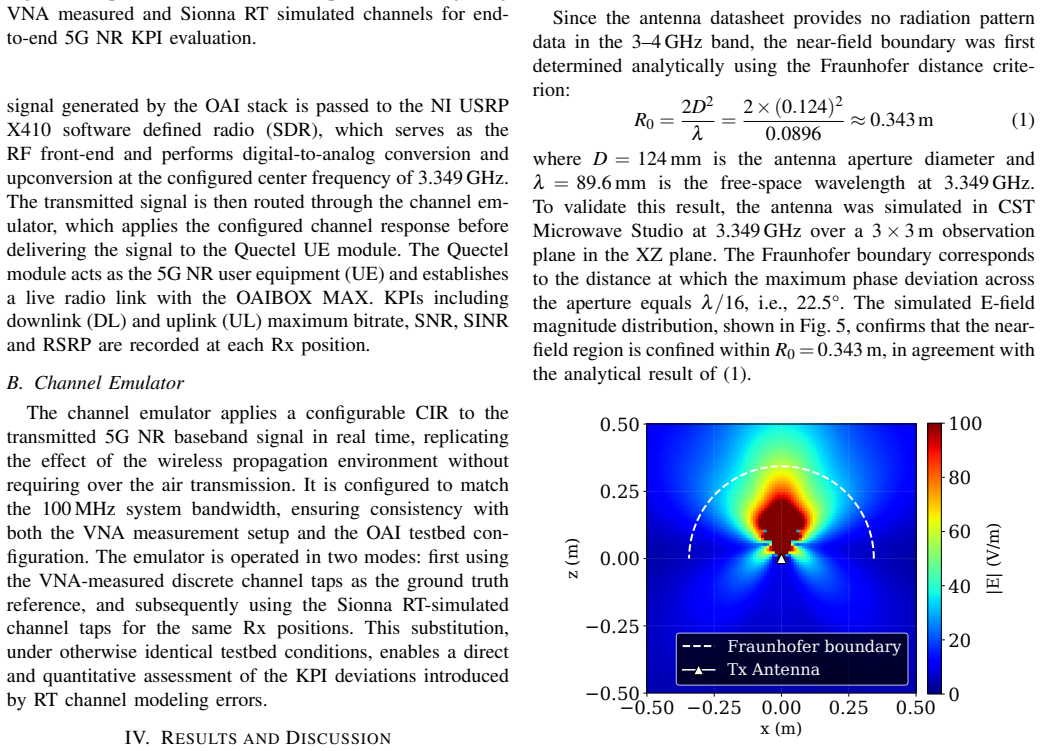
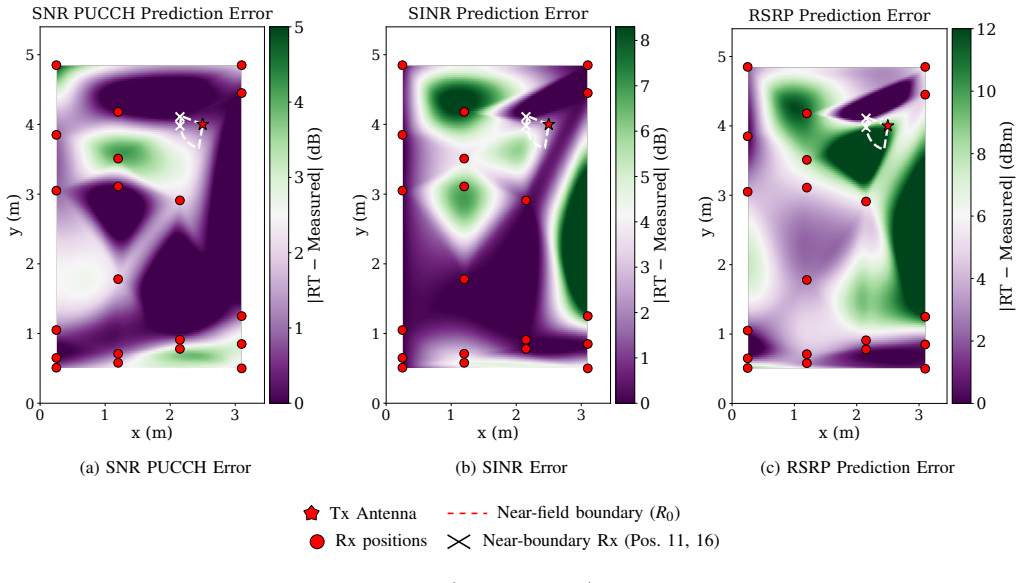
By contrasting ray-tracing channels from Sionna with measured channels from a VNA and evaluating them on an OpenAirInterface 5G NR testbed with a channel emulator, the authors find that antenna near-field transition effects act as a critical position-dependent error source alongside material property mismatch, leading to deviations in system level KPIs.
What carries the argument
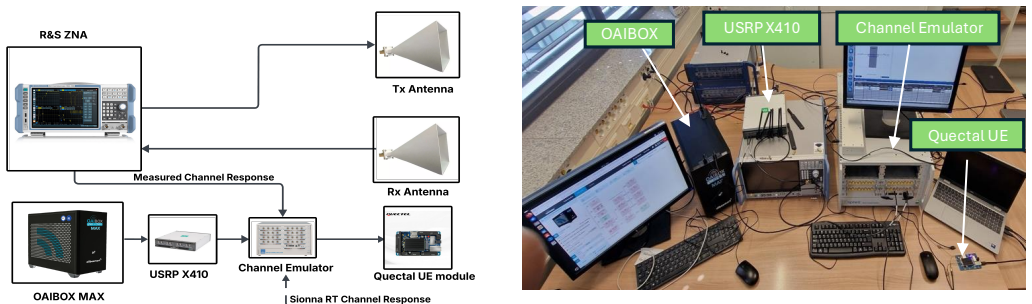
The hardware-in-the-loop channel emulator that interfaces the OAIBOX MAX base station and Quectel UE, allowing direct comparison of RT-simulated and VNA-measured channels on real 5G hardware.
If this is right
- Material property databases in ray tracing tools require higher fidelity to reduce KPI prediction errors in digital twins.
- Position-dependent near-field corrections should be integrated into RT models for indoor 5G scenarios.
- Quantitative benchmarks like these can guide validation of other RT simulators for beyond-5G network planning.
- System-level KPI evaluation reveals error propagation not visible in channel-level comparisons alone.
Where Pith is reading between the lines
- Applying similar tests in larger or outdoor environments could reveal whether near-field effects remain dominant or if other factors like diffraction take precedence.
- Digital twin frameworks might benefit from adaptive modeling that switches between RT and empirical corrections based on distance to antennas.
- This analysis could extend to other frequencies or 6G scenarios where near-field regions are larger due to massive MIMO arrays.
Load-bearing premise
The specific indoor laboratory environment and the 20 chosen positions, combined with the testbed setup, isolate the RT modeling inaccuracies without significant interference from hardware imperfections or atypical propagation conditions.
What would settle it
Conducting the same comparison in an anechoic chamber or with accurately measured material properties and finding no significant KPI deviation would falsify the identification of these as primary error sources.
Figures


read the original abstract
Ray tracing (RT) has recently gained renewed interest in wireless communications, driven by its integration into digital twin (DT) frameworks for site specific channel modeling. Several previous studies have validated RT at the channel level, yet how these errors propagate into real 5G system level key performance indicators (KPIs) on actual hardware remains unquantified. This paper addresses this gap by comparing Sionna RT simulated channels against vector network analyzer (VNA) measured channels using an OpenAirInterface (OAI) 5G NR testbed. Channel measurements are conducted at 20 receiver positions in an indoor laboratory, with both channel types injected into a hardware in the loop channel emulator interfacing an OAIBOX MAX base station and a Quectel UE. RSRP, PUCCH SNR, and SINR are evaluated under both conditions. The results identify antenna near-field transition effects as a critical position-dependent error source, alongside material property mismatch, providing a quantitative benchmark for digital twin-based 5G and beyond network planning.
Editorial analysis
A structured set of objections, weighed in public.
Referee Report
Summary. The paper compares Sionna RT simulated channels against VNA-measured channels at 20 indoor laboratory positions using an OpenAirInterface 5G NR testbed. Both channel realizations are injected via a hardware-in-the-loop emulator into an OAIBOX MAX base station and Quectel UE; the resulting RSRP, PUCCH SNR, and SINR values are contrasted to quantify deviations attributable to RT modeling inaccuracies, specifically antenna near-field transition effects and material permittivity mismatches.
Significance. If the error attribution holds after isolating testbed contributions, the work supplies a rare quantitative bridge from ray-tracing channel errors to real 5G hardware KPIs. Its direct use of VNA measurements, OAI hardware, and emulator injection (rather than end-to-end simulation) constitutes a concrete strength for validating digital-twin channel models in site-specific deployments.
major comments (1)
- [Experimental setup and KPI evaluation (methods and results sections describing the emulator injection)] The central claim that KPI differences (RSRP, PUCCH SNR, SINR) are caused by Sionna RT near-field and material errors requires that the hardware-in-the-loop emulator adds no position-dependent or channel-type-dependent artifacts. The manuscript reports no calibration loop (direct cable versus emulator, or known synthetic-channel injection) that quantifies any such added distortion; without it, emulator effects cannot be cleanly partitioned from RT modeling errors in the 20-position comparison.
minor comments (2)
- [Measurement campaign description] The selection criteria and spatial distribution of the 20 receiver positions (near-field versus far-field) should be stated explicitly so readers can judge how representative the near-field error observations are.
- [Ray-tracing configuration] The carrier frequency, bandwidth, and exact material permittivity values assigned in Sionna RT should be tabulated for reproducibility.
Simulated Author's Rebuttal
We thank the referee for the constructive review and for recognizing the value of bridging ray-tracing errors to hardware-measured 5G KPIs. We address the single major comment below and will revise the manuscript to strengthen the experimental validation.
read point-by-point responses
-
Referee: [Experimental setup and KPI evaluation (methods and results sections describing the emulator injection)] The central claim that KPI differences (RSRP, PUCCH SNR, SINR) are caused by Sionna RT near-field and material errors requires that the hardware-in-the-loop emulator adds no position-dependent or channel-type-dependent artifacts. The manuscript reports no calibration loop (direct cable versus emulator, or known synthetic-channel injection) that quantifies any such added distortion; without it, emulator effects cannot be cleanly partitioned from RT modeling errors in the 20-position comparison.
Authors: We agree that an explicit calibration is required to rigorously isolate emulator contributions from RT modeling errors. The original manuscript did not report a dedicated calibration loop, instead relying on the use of an identical emulation chain for both VNA-measured and Sionna RT channels at each of the 20 positions. While this differential approach minimizes common-mode effects, it does not fully exclude potential channel-type-dependent artifacts arising from differences in delay spread or power delay profile. In the revised manuscript we will add a new methods subsection describing emulator calibration measurements: (i) direct cable bypass versus emulated injection of the same VNA traces, and (ii) injection of known synthetic channels (e.g., single-tap and exponential PDP) at representative positions. These data will quantify any residual position-dependent or channel-dependent distortion and confirm that it remains below the observed KPI deviations. We will also report the emulator's measured linearity and frequency response over the 3.5 GHz band used in the experiments. revision: yes
Circularity Check
No circularity: direct empirical comparison of RT simulation vs. measurement
full rationale
The manuscript conducts an experimental benchmark by capturing real channels with a VNA at 20 indoor positions, simulating the same geometry with Sionna RT, and injecting both channel realizations into an OAI hardware-in-the-loop emulator to obtain system-level KPIs (RSRP, PUCCH SNR, SINR). No derivation, prediction, or uniqueness claim is advanced; the central result is simply the observed difference between the two arms. No equations reduce a fitted parameter to a renamed output, no self-citation supplies a load-bearing premise, and no ansatz is smuggled in. The work is therefore self-contained against external benchmarks and receives the default non-circularity finding.
Axiom & Free-Parameter Ledger
axioms (1)
- domain assumption The channel emulator and hardware setup introduce negligible additional distortions when injecting simulated versus measured channels.
Reference graph
Works this paper leans on
-
[1]
Ray tracing for radio propagation modeling: Principles and applications,
Z. Yun and M. F. Iskander, “Ray tracing for radio propagation modeling: Principles and applications,”IEEE Access, vol. 3, pp. 1089–1100, 2015
work page 2015
-
[2]
Sionna rt: Differentiable ray tracing for radio propagation modeling,
J. Hoydis, F. Aït Aoudia, S. Cammerer, M. Nimier-David, N. Binder, G. Marcus, and A. Keller, “Sionna rt: Differentiable ray tracing for radio propagation modeling,” in2023 IEEE Globecom Workshops (GC Wkshps). IEEE, 2023, pp. 317–321
work page 2023
-
[3]
Comparison of ray tracing simulations and channel measurements at mmwave bands for indoor scenarios,
A. Karstensen, W. Fan, I. Carton, and G. F. Pedersen, “Comparison of ray tracing simulations and channel measurements at mmwave bands for indoor scenarios,” in2016 10th European Conference on Antennas and Propagation (EuCAP). IEEE, 2016, pp. 1–5
work page 2016
-
[4]
Validation of ray- tracing simulated channels for massive mimo systems at millimeter- wave bands,
J. Di, Z. Yuan, Y . Lyu, F. Zhang, and W. Fan, “Validation of ray- tracing simulated channels for massive mimo systems at millimeter- wave bands,” in2024 18th European Conference on Antennas and Propagation (EuCAP). IEEE, 2024, pp. 1–5
work page 2024
-
[5]
Ray tracing simulation and experimental validation for millimeter-wave massive mimo systems,
J. Di, Z. Yuan, Y . Lyv, R. Tan, and W. Fan, “Ray tracing simulation and experimental validation for millimeter-wave massive mimo systems,” International Journal of Microwave and Wireless Technologies, vol. 17, no. 5, pp. 794–803, 2025
work page 2025
-
[6]
D. Dupleich, D. Sitdikov, A. Ebert, and M. Boban, “Measurement- based validation of ray-tracing model at sub-thz for isac applications of blockage in industrial scenario,” in2024 4th URSI Atlantic Radio Science Meeting (AT-RASC). IEEE, 2024, pp. 1–4
work page 2024
-
[7]
Digital twin empowered in-vehicular channel modeling and wireless planning in the terahertz band,
M. Zhu, Y . Lyu, and C. Han, “Digital twin empowered in-vehicular channel modeling and wireless planning in the terahertz band,”arXiv preprint arXiv:2511.07789, 2025
-
[8]
On the limitations of ray-tracing for learning-based rf tasks in urban environments,
A. Manukyan, H. Khachatrian, E. Ghukasyan, and T. P. Raptis, “On the limitations of ray-tracing for learning-based rf tasks in urban environments,”arXiv preprint arXiv:2507.19653, 2025
-
[9]
Calibrating wireless ray tracing for digital twinning using local phase error esti- mates,
C. Ruah, O. Simeone, J. Hoydis, and B. Al-Hashimi, “Calibrating wireless ray tracing for digital twinning using local phase error esti- mates,”IEEE Transactions on Machine Learning in Communications and Networking, vol. 2, pp. 1193–1215, 2024
work page 2024
-
[10]
Wireless Digital Twin Calibration: Refining DFT-Domain Channel Information
H. Luo, S. R. Khosravirad, and A. Alkhateeb, “Wireless digital twin calibration: Refining DFT-domain channel information,”arXiv preprint arXiv:2603.16126, 2026
work page internal anchor Pith review Pith/arXiv arXiv 2026
-
[11]
Learnable wireless digital twins: Reconstructing electromagnetic field with neural representations,
S. Jiang, Q. Qu, X. Pan, A. K. Agrawal, R. Newcombe, and A. Alkha- teeb, “Learnable wireless digital twins: Reconstructing electromagnetic field with neural representations,”IEEE Open Journal of the Communi- cations Society, vol. 6, pp. 1568–1590, 2025
work page 2025
-
[12]
Z. Kang, Y . Lim, Z. Gu, S.-W. Ko, T. Q. Quek, and J. Park, “Vision-language-model-guided differentiable ray tracing for fast and accurate multi-material rf parameter estimation,”arXiv preprint arXiv:2601.18242, 2026
-
[13]
Open wireless digital twin: End- to-end 5g mobility emulation in o-ran framework,
T. Iye, M. Sakamoto, S. Takaya, E. Sato, Y . Susukida, Y . Na- gaoka, K. Maruta, and J. Nakazato, “Open wireless digital twin: End- to-end 5g mobility emulation in o-ran framework,”arXiv preprint arXiv:2503.12177, 2025
-
[14]
Study on channel model for frequencies from 0.5 to 100 ghz,
3GPP, “Study on channel model for frequencies from 0.5 to 100 ghz,” 3rd Generation Partnership Project, Tech. Rep. TR 38.901 V18.0.0, 2024, accessed: May 2025. [Online]. Available: https://www.etsi.org/deliver/etsi_tr/138900_138999/138901/ 18.00.00_60/tr_138901v180000p.pdf
work page 2024
-
[15]
R&S ZNA Vector Network Analyzer,
Rohde & Schwarz, “R&S ZNA Vector Network Analyzer,” https://www.rohde-schwarz.com/de/produkte/messtechnik/ vektornetzwerkanalysatoren/rs-zna-vektornetzwerkanalysatoren_ 63493-551810.html, accessed: May 2025
work page 2025
-
[16]
BBHA 9120 L Double Ridged Broadband Horn Antenna,
Schwarzbeck Mess-Elektronik, “BBHA 9120 L Double Ridged Broadband Horn Antenna,” https://www.schwarzbeck.com/antennas/ broadband-horn-antennas/double-ridged-horn-antennas/bbha-9120-l/, accessed: May 2025
work page 2025
discussion (0)
Sign in with ORCID, Apple, or X to comment. Anyone can read and Pith papers without signing in.