Recognition: no theorem link
Weibel-mediated filamentary structures observed in the ICF context
Pith reviewed 2026-05-12 02:52 UTC · model grok-4.3
The pith
Electron pressure anisotropy from quasi-spherical plasma expansion drives Weibel-mediated magnetic filaments that match ICF experiment data.
A machine-rendered reading of the paper's core claim, the machinery that carries it, and where it could break.
Core claim
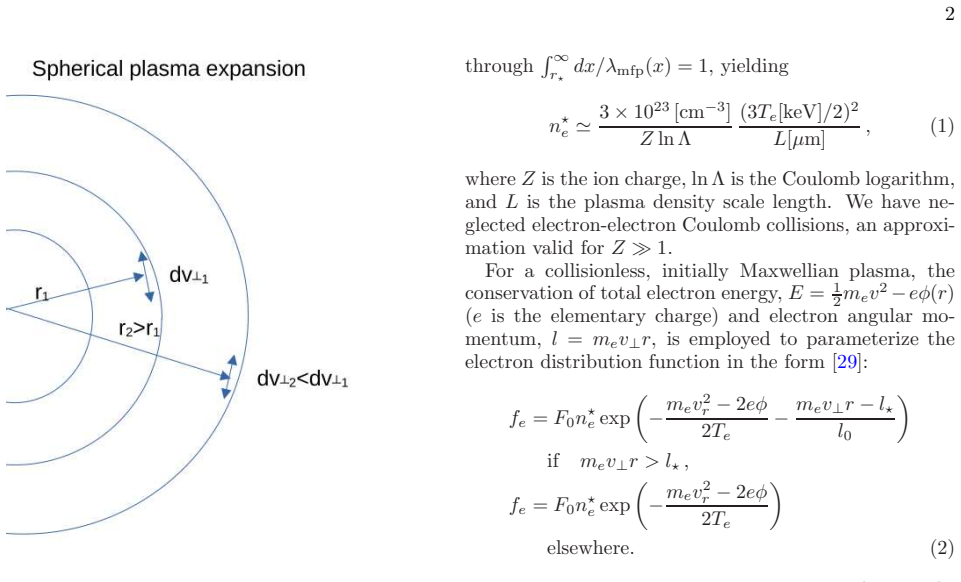
The transverse ballistic cooling that occurs during the quasi-spherical plasma expansion naturally drives an electron pressure anisotropy, resulting in the growth of electron current filaments via the Weibel instability. This effect competes with electron-ion Coulomb collisions. Theoretical and particle-in-cell modeling provides estimates of the dominant wavelength and amplitude of the self-generated magnetic fluctuations, which explain experimental data obtained at the OMEGA and Laser Megajoule facilities.
What carries the argument
The Weibel instability triggered by electron pressure anisotropy that is induced by transverse ballistic cooling during quasi-spherical expansion of laser plasma.
If this is right
- Dominant wavelength and amplitude of the magnetic fluctuations can be calculated from theory and particle-in-cell simulations.
- These fluctuations account for the filamentary structures recorded at the OMEGA and Laser Megajoule facilities.
- Filament growth can outpace the isotropizing action of electron-ion collisions under the modeled conditions.
- The same mechanism produces current filaments throughout the plasma plume of a laser-irradiated foil.
Where Pith is reading between the lines
- The same anisotropy mechanism may operate in other expanding plasma flows where spherical geometry and rapid cooling occur.
- Varying target curvature or expansion speed in experiments could test the predicted dependence of filament wavelength on cooling rate.
- The resulting magnetic fields may alter electron transport and energy deposition in inertial confinement fusion targets.
Load-bearing premise
The transverse ballistic cooling during quasi-spherical plasma expansion naturally drives an electron pressure anisotropy that grows Weibel filaments faster than electron-ion Coulomb collisions can isotropize the distribution.
What would settle it
High-resolution magnetic field measurements or imaging in a laser-foil experiment that showed no filamentary structures at the predicted wavelengths despite conditions for ballistic cooling would disprove the explanation.
Figures


read the original abstract
In light of novel and past experimental results, we demonstrate how Weibel-mediated filamentary structures can develop in the expanding plasma plume of a laser-irradiated foil. The transverse ballistic cooling that occurs during the quasi-spherical plasma expansion naturally drives an electron pressure anisotropy, resulting in the growth of electron current filaments. This effect competes with electron-ion Coulomb collisions which tend to isotropize the electron distribution function. Based on theoretical and particle-in-cell modeling, we provide estimates of the dominant wavelength and amplitude of the self-generated magnetic fluctuations, which are found to explain experimental data obtained at the OMEGA and Laser Megajoule facilities.
Editorial analysis
A structured set of objections, weighed in public.
Referee Report
Summary. The manuscript argues that transverse ballistic cooling during quasi-spherical expansion of laser-irradiated foil plasmas naturally generates electron pressure anisotropy, driving Weibel instability and filamentary magnetic structures. Theoretical estimates combined with particle-in-cell modeling are used to predict the dominant wavelength and amplitude of the resulting magnetic fluctuations, which the authors state explain filamentary structures observed in OMEGA and Laser Megajoule experiments.
Significance. If the central mechanism is validated, the work would offer a concrete explanation for self-generated magnetic fields in expanding ICF-relevant plasmas, with potential consequences for electron transport and implosion symmetry. The integration of analytical theory with PIC simulations to produce specific estimates is a constructive approach that could be strengthened by quantitative experimental anchoring.
major comments (3)
- [Abstract and results section] Abstract and results section on experimental comparison: the claim that the modeled dominant wavelength and amplitude 'explain experimental data' from OMEGA and LMJ lacks supporting quantitative evidence. No error bars on the estimates, no goodness-of-fit metrics, no direct overlay plots, and no discussion of post-hoc parameter adjustments are provided, leaving the explanatory power of the central claim difficult to assess.
- [Theoretical modeling section] Theoretical modeling section: the competition between Weibel growth driven by anisotropy and electron-ion Coulomb isotropization is asserted to favor filament formation, but no explicit timescale comparison (growth rate versus collision frequency) is performed using the reported experimental density-temperature-expansion parameters. This comparison is load-bearing for the weakest assumption identified in the work.
- [PIC simulations section] PIC simulations section: it is unclear whether the simulations incorporate electron-ion collisions, employ realistic mass ratios, or generate the pressure anisotropy self-consistently via the expansion dynamics rather than by initialization. Without these details, the reported wavelengths and amplitudes cannot be taken as direct evidence that the mechanism operates in the experimental regime.
minor comments (2)
- [Figures] Figure captions and axis labels would benefit from explicit statement of the plasma parameters (density, temperature, expansion velocity) used in each panel to facilitate direct comparison with the experimental conditions.
- [Abstract] The abstract could include the numerical values obtained for the dominant wavelength and magnetic fluctuation amplitude to make the comparison claim more concrete.
Simulated Author's Rebuttal
We thank the referee for their careful reading and constructive comments, which have helped us identify areas where the manuscript can be strengthened. We address each major comment below and have revised the manuscript to incorporate additional quantitative details, explicit comparisons, and clarifications as appropriate.
read point-by-point responses
-
Referee: [Abstract and results section] Abstract and results section on experimental comparison: the claim that the modeled dominant wavelength and amplitude 'explain experimental data' from OMEGA and LMJ lacks supporting quantitative evidence. No error bars on the estimates, no goodness-of-fit metrics, no direct overlay plots, and no discussion of post-hoc parameter adjustments are provided, leaving the explanatory power of the central claim difficult to assess.
Authors: We agree that the comparison with experimental data would benefit from more rigorous quantitative support. In the revised manuscript, we will add error bars to the estimated dominant wavelength and magnetic fluctuation amplitude, include direct overlay plots of our theoretical and PIC predictions against the OMEGA and LMJ observations, and provide a discussion of goodness-of-fit along with sensitivity to key parameters. These additions will allow a clearer assessment of how well the model accounts for the data. revision: yes
-
Referee: [Theoretical modeling section] Theoretical modeling section: the competition between Weibel growth driven by anisotropy and electron-ion Coulomb isotropization is asserted to favor filament formation, but no explicit timescale comparison (growth rate versus collision frequency) is performed using the reported experimental density-temperature-expansion parameters. This comparison is load-bearing for the weakest assumption identified in the work.
Authors: We acknowledge that an explicit timescale comparison is necessary to substantiate the claim. Using the experimental density, temperature, and expansion parameters already reported in the manuscript, we have performed the comparison between the Weibel growth rate and the electron-ion collision frequency. The revised theoretical modeling section will present this calculation, showing that the instability growth outpaces isotropization under the relevant conditions and thereby supports filament formation. revision: yes
-
Referee: [PIC simulations section] PIC simulations section: it is unclear whether the simulations incorporate electron-ion collisions, employ realistic mass ratios, or generate the pressure anisotropy self-consistently via the expansion dynamics rather than by initialization. Without these details, the reported wavelengths and amplitudes cannot be taken as direct evidence that the mechanism operates in the experimental regime.
Authors: We thank the referee for highlighting the need for these methodological details. The simulations incorporate electron-ion collisions through a Monte Carlo module, use a realistic electron-to-ion mass ratio, and generate the pressure anisotropy self-consistently from the quasi-spherical expansion dynamics rather than by direct initialization. The revised PIC simulations section will explicitly document these choices and the associated parameters to confirm applicability to the experimental regime. revision: yes
Circularity Check
No significant circularity detected in derivation chain
full rationale
The paper derives estimates of Weibel filament wavelength and amplitude from theoretical analysis of expansion-driven electron pressure anisotropy and supporting PIC simulations, then compares those estimates to OMEGA and LMJ observations. No quoted equations or steps reduce a claimed prediction to a fitted input by construction, nor does any load-bearing premise collapse to a self-citation or self-defined ansatz. The competition between ballistic cooling and Coulomb isotropization is presented as an independent physical process whose outcome is tested against external data rather than presupposed. The modeling therefore supplies independent content rather than tautological renaming or forced agreement.
Axiom & Free-Parameter Ledger
free parameters (2)
- dominant wavelength of filaments
- amplitude of magnetic fluctuations
axioms (2)
- domain assumption Transverse ballistic cooling in quasi-spherical expansion produces electron pressure anisotropy
- standard math Weibel instability grows from electron pressure anisotropy in collisionless or weakly collisional plasma
Reference graph
Works this paper leans on
-
[1]
determines the transition from the region where the electron distribu- tion function remains isotropic to the region where the Coulomb collisions are weak enough to allow a finite pres- sure anisotropy. It is evaluated in Ref. [ 29] from the Fokker-Planck equation, but a simpler derivation can be obtained from the variance of the electron-ion Coulomb colli...
work page 2000
-
[2]
We first numerically extract φ(r > r ⋆ ) from Eq
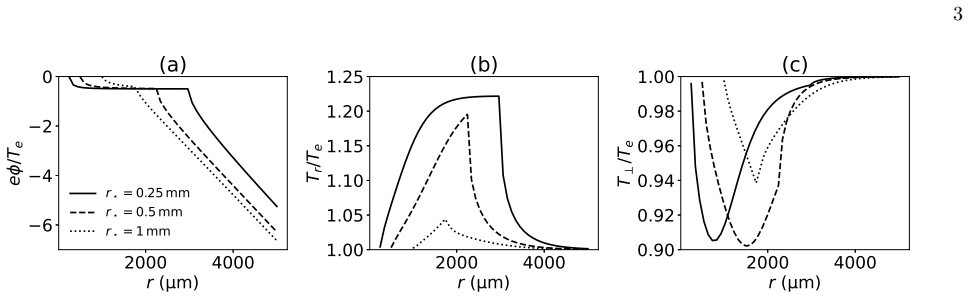
for ln Λ = 10. We first numerically extract φ(r > r ⋆ ) from Eq. ( 7) as shown in Fig. 2(a) for three values of r⋆ = 0. 4 mm (solid lines),
-
[3]
We then proceed to evaluate Tr and T⊥ using Eqs
5 mm (dashed lines) and 1 mm (dotted lines). We then proceed to evaluate Tr and T⊥ using Eqs. ( 2), ( 7), ( 9) and ( 10). One can see that the radial [Fig. 2(b)] and transverse [Fig. 2(c)] temperatures exhibit opposite behaviors: heat- ing for Tr and cooling for T⊥ . Both effects are modest (≲ 5 %), intensify as the collisional radius r⋆ decreases, and occ...
-
[4]
2 mm, centered at z = 2 . 4 mm (where ne(z) = n⋆ e). At sufficient distances from the foil plane, the overlap of the isocontours and these circles confirms the tran- sition toward spherical expansion. This suggests that the spherical expansion model is applicable near the axis for r ≳ 0. 3–0. 5 mm and z ≳ 3 mm (or equivalently ne ≲ 7 × 10− 3nc). Notably, the...
-
[5]
8 mm. Although the model in Ref. [ 29] strictly requires Z ≫ 1, which is only marginally satisfied here, its predic- tions do not change significantly when electron-electron Coulomb collisions are included in the mean-free-path calculation [Eq. ( 6)], pointing to a sub-dominant effect of self-collisions. Although the predicted filament wavelengths [ λ W ≡ 2π/...
-
[6]
006 T mm), albeit a factor of two below the experimental values
5 ≤ z ≤ 3 mm, leading to a path-integrated B-field on both target sides at measurable levels ( ∼ 0. 006 T mm), albeit a factor of two below the experimental values. Our prediction should therefore be considered a lower bound. Overall, the interplay between spherical ex- pansion and Coulomb collisions yields a weak yet non- negligible anisotropy, capable of...
-
[7]
1 T mm and a typical wavelength of λ ∼ 200 µ m. High-quality Thomson measurements give a good idea of the plasma parameters during the foil expansion. They suggest that an electron temperature of ∼ 0. 5− 0. 7 keV is reached after 1 . 5 ns. In the corona, these measurements indicate a plasma scale length of ∼ 750 µ m, comparable with the laser spot diamete...
-
[8]
and (12). We therefore expect the dominant wavelength to range between λ W ≃ 120 and 250 µ m (dashed line) with a magnetic field amplitude reaching Bsat ≃ 0. 02 T (dot- ted line). This corresponds to a line-of-sight-integrated field of ∼ 0. 015 T mm, consistent in order of magnitude (though somewhat lower) with observations. The spher- 1 2 3 4 r (mm) 0.00 0...
-
[9]
Experimental setup and results The last experiment analyzed was conducted at the LMJ-PETAL facility (see setup in Fig. 7). The target was irradiated by four LMJ quads focused at different 8 Figure 8. Proton radiographs (for 29 MeV protons) at four different times. The top and bottom rows show the results for the Ti and Au foils, respectively. Rectangles ind...
-
[10]
Theoretical analysis We performed hydro-rad troll simulations of the ex- periment for the two target materials. These simula- tions predict an exponentially decreasing plasma den- sity with a scale length of L ≃ 400 µ m for Ti and L ≃ 290 µ m for Au, and an electron temperature of ∼ 1 keV in both cases. From these values, we estimate n⋆ e ≃ 3. 3 × 1019 cm...
-
[11]
This smoothing effect complicates precise quantitative analy- sis
The predicted wavelength varies by a factor of ∼ 4 within the measurement region, and the radiographs are expected to be smoothed by proton scat- tering within the Ti target over a ∼ 80 µ m scale. This smoothing effect complicates precise quantitative analy- sis. To address the impact of Coulomb collisions on the Weibel instability, we ran several 1D PIC s...
-
[12]
1 T mm and ne/n c ≲ 10− 3), the Faraday rotation an- gle is estimated to be φ rot ≲ 10− 4 rad (assuming a laser wavelength of 0 . 35 µ m). This negligible rotation sug- gests that Weibel-generated fields are unlikely to affect polarization-dependent instabilities such as cross-beam energy transfer [ 54]. The predicted field strengths and wavelengths also imp...
-
[13]
to numerically determine φ as a function of the radial position r. ACKNOWLEDGEMENTS This work has been done under the auspices of CEA- DAM and the simulations were performed using HPC resources at TGCC/CCRT and CEA-DAM/TERA. We acknowledge M. Manuel for valuable input and exchange, and D. B´ enisti for insightful comments. DATA A V AILABILITY The data tha...
-
[14]
E. S. Weibel, Spontaneously Growing Transverse Waves in a Plasma Due to an Anisotropic Velocity Distribution, Phys. Rev. Lett. 2, 83 (1959)
work page 1959
-
[15]
B. D. Fried, Mechanism for Instability of Transverse Plasma Waves, Phys. Fluids 2, 337 (1959)
work page 1959
-
[16]
S. S. Moiseev and R. Z. Sagdeev, Collisionless shock waves in a plasma in a weak magnetic field, J. Nucl. Energy 5, 43 (1963)
work page 1963
-
[17]
R. C. Davidson, D. A. Hammer, I. Haber, and C. E. Wag- ner, Nonlinear Development of Electromagnetic Instabili- ties in Anisotropic Plasmas, Phys. Fluids 15, 317 (1972)
work page 1972
- [18]
-
[19]
F. Califano, F. Pegoraro, S. V. Bulanov, and A. Man- geney, Kinetic saturation of the Weibel instability in a collisionless plasma, Phys. Rev. E 57, 7048 (1998)
work page 1998
-
[20]
T. N. Kato, Saturation mechanism of the Weibel instability in weakly magnetized plasmas, Phys. Plasmas 12, 080705 (2005)
work page 2005
-
[21]
A. Achterberg, J. Wiersma, and C. A. Norman, The Weibel instability in relativistic plasmas. II. Nonlinear theory and stabilization mechanism, 12 Astron. Astrophys. 475, 19 (2007) ; The Weibel instabil- ity in relativistic plasmas. II. Nonlinear theory and stabi - lization mechanism, Astron. Astrophys. 475, 19 (2007)
work page 2007
-
[22]
H. H. Kaang, C.-M. Ryu, and P. H. Yoon, Nonlinear satu- ration of relativistic Weibel instability driven by therma l anisotropy, Phys. Plasmas 16, 082103 (2009)
work page 2009
-
[23]
A. Bret, L. Gremillet, and M. E. Dieckmann, Multidi- mensional electron beam-plasma instabilities in the rela- tivistic regime, Phys. Plasmas 17, 120501 (2010)
work page 2010
-
[24]
Y. N. Istomin, Nonlinear Weibel waves, Plasma Phys. Control. Fusion 53, 015006 (2011)
work page 2011
-
[25]
O. A. Pokhotelov and O. A. Amariutei, Quasi-linear dynamics of Weibel instability, Annales Geophysicae 29, 1997 (2011)
work page 1997
- [26]
-
[27]
M. V. Medvedev and A. Loeb, Generation of Magnetic Fields in the Relativistic Shock of Gamma-Ray Burst Sources, Astrophys. J. 526, 697 (1999)
work page 1999
-
[28]
R. P. Drake and G. Gregori, Design Considerations for Unmagnetized Collisionless-shock Measurements in Ho- mologous Flows, Astrophys. J. 749, 171 (2012)
work page 2012
-
[29]
F. Fiuza, G. F. Swadling, A. Grassi, H. G. Rinderknecht, D. P. Higginson, D. D. Ryutov, C. Bruulsema, R. P. Drake, S. Funk, S. Glenzer, G. Gregori, C. K. Li, B. B. Pollock, B. A. Remington, J. S. Ross, W. Rozmus, Y. Sakawa, A. Spitkovsky, S. Wilks, and H.-S. Park, Electron acceleration in laboratory-produced turbulent collisionless shocks, Nat. Phys. 16, ...
work page 2020
-
[30]
A. Grassi and F. Fiuza, Efficient generation of turbulent collisionless shocks in laser-ablated counter-streaming plasmas, Phys. Rev. Res. 3, 023124 (2021)
work page 2021
- [31]
-
[32]
J. Fuchs, T. E. Cowan, P. Audebert, H. Ruhl, L. Gremil- let, A. Kemp, M. Allen, A. Blazevic, J.-C. Gau- thier, M. Geissel, M. Hegelich, S. Karsch, P. Parks, M. Roth, Y. Sentoku, R. Stephens, and E. M. Camp- bell, Spatial uniformity of laser-accelerated ultrahigh- current MeV electron propagation in metals and insu- lators, Phys. Rev. Lett. 91, 255002 (2003)
work page 2003
-
[33]
H. Chen, S. C. Wilks, J. D. Bonlie, E. P. Liang, J. My- att, D. F. Price, D. D. Meyerhofer, and P. Beiersdorfer, Relativistic Positron Creation Using Ultraintense Short Pulse Lasers, Phys. Rev. Lett. 102, 105001 (2009)
work page 2009
-
[34]
M. Roth, D. Jung, K. Falk, N. Guler, O. Dep- pert, M. Devlin, A. Favalli, J. Fernandez, D. Gau- tier, M. Geissel, R. Haight, C. E. Hamilton, B. M. Hegelich, R. P. Johnson, F. Merrill, G. Schaumann, K. Schoenberg, M. Schollmeier, T. Shimada, T. Tad- deucci, J. L. Tybo, F. Wagner, S. A. Wender, C. H. Wilde, and G. A. Wurden, Bright laser-driven neutron sour...
work page 2013
-
[35]
G. G. Scott, C. M. Brenner, V. Bagnoud, R. J. Clarke, B. Gonzalez-Izquierdo, J. S. Green, R. I. Heathcote, H. W. Powell, D. R. Rusby, B. Zielbauer, P. McKenna, and D. Neely, Diagnosis of Weibel in- stability evolution in the rear surface density scale lengths of laser solid interactions via proton acceleratio n, New J. Phys. 19, 043010 (2017)
work page 2017
-
[36]
Y. Sentoku, K. Mima, P. Kaw, and K. Nishikawa, Anomalous Resistivity Resulting from MeV- Electron Transport in Overdense Plasma, Phys. Rev. Lett. 90, 155001 (2003)
work page 2003
-
[37]
L. Gremillet, G. Bonnaud, and F. Amiranoff, Filamented transport of laser-generated relativistic electrons pene - trating a solid target, Phys. Plasmas 9, 941 (2002)
work page 2002
-
[38]
K. Quinn, L. Romagnani, B. Ramakrishna, G. Sarri, M. E. Dieckmann, P. A. Wilson, J. Fuchs, L. Lancia, A. Pipahl, T. Toncian, O. Willi, R. J. Clarke, M. Notley, A. Macchi, and M. Borghesi, Weibel-induced filamenta- tion during an ultrafast laser-driven plasma expansion, Phys. Rev. Lett. 108, 135001 (2012)
work page 2012
-
[39]
C. Ruyer, S. Bola˜ nos, B. Albertazzi, S. N. Chen, P. An- tici, J. B¨ oker, V. Dervieux, L. Lancia, M. Nakatsutsumi, L. Romagnani, R. Shepherd, M. Swantusch, M. Borghesi, O. Willi, H. P´ epin, M. Starodubtsev, M. Grech, C. Ri- conda, L. Gremillet, and J. Fuchs, Growth of concomi- tant laser-driven collisionless and resistive electron fil a- mentation insta...
work page 2020
-
[40]
Z. Zhao, S. He, H. An, Z. Lei, Y. Xie, W. Yuan, J. Jiao, K. Zhou, Y. Zhang, J. Ye, Z. Xie, J. Xiong, Z. Fang, X. He, W. Wang, W. Zhou, B. Zhang, S. Zhu, and B. Qiao, Laboratory evidence of weibel magnetogenesis driven by temperature gra- dient using three-dimensional synchronous proton radiography, Science Advances 10, eadk5229 (2024) , https://www.scienc...
- [41]
-
[42]
M. A. True, Weibel instability in the spherical corona of a laser fusion target, Phys. Fluids 28, 2597 (1985)
work page 1985
-
[43]
E. Lefebvre, N. Cochet, S. Frizler, V. Malka, M.- M. Al´ eonard, J.-F. Chemin, S. Darbon, L. Dis- dier, J. Faure, A. Fedotoff, O. Landoas, G. Malka, V. M´ eot, P. Morel, M. Rabec Le Goahec, A. Rouyer, C. Rubbelynck, V. Tikhonchuk, R. Wrobel, P. Au- debert, and C. Rousseaux, Electron and photon production from relativistic laser-plasma interactions, Nucl. F...
work page 2003
-
[44]
J. D. Jackson, Classical electrodynamics (Wiley, New York, NY, 1975) Chap. 13
work page 1975
-
[45]
Y. Sentoku and A. Kemp, Numerical methods for parti- cle simulations at extreme densities and temperatures: Weighted particles, relativistic collisions and reduced currents, J. Comp. Phys. 227, 6846 (2008)
work page 2008
-
[46]
J. R. Rygg, F. H. S´ eguin, C. K. Li, J. A. Frenje, M. J.-E. Manuel, R. D. Petrasso, R. Betti, J. A. Delettrez, O. V. Gotchev, J. P. Knauer, D. D. Meyerhofer, F. J. Marshall, C. Stoeckl, and W. Theobald, Proton radiography of in- ertial fusion implosions, Science 319, 1223 (2008)
work page 2008
-
[47]
F. H. S´ eguin, C. K. Li, M. J.-E. Manuel, H. G. Rinderknecht, N. Sinenian, J. A. Frenje, J. R. Rygg, D. G. Hicks, R. D. Petrasso, J. Delettrez, R. Betti, F. J. Marshall, and V. A. Smalyuk, Time evolution of filamentation and self-generated fields in the coronae of directly driven inertial-confinement fusion capsules, Phys. Plasmas 19, 012701 (2012)
work page 2012
-
[48]
M. J.-E. Manuel, C. K. Li, F. H. S´ eguin, N. Sinenian, J. A. Frenje, D. T. Casey, R. D. Petrasso, J. D. Hager, 13 R. Betti, S. X. Hu, J. Delettrez, and D. D. Meyerhofer, Instability-driven electromagnetic fields in coronal plas - masa), Physics of Plasmas 20, 056301 (2013)
work page 2013
-
[49]
D. A. Tidman and R. A. Shanny, Field-generating thermal instability in laser-heated plasmas, Phys. Fluids 17, 1207 (1974)
work page 1974
-
[50]
A. J. Mackinnon, P. K. Patel, R. P. Town, M. J. Ed- wards, T. Phillips, S. C. Lerner, D. W. Price, D. Hicks, M. H. Key, S. Hatchett, S. C. Wilks, M. Borghesi, L. Ro- magnani, S. Kar, T. Toncian, G. Pretzler, O. Willi, M. Koenig, E. Martinolli, S. Lepape, A. Benuzzi- Mounaix, P. Audebert, J. C. Gauthier, J. King, R. Snavely, R. R. Freeman, and T. Boehlly, ...
work page 2004
-
[51]
N. L. Kugland, D. D. Ryutov, C. Plechaty, J. S. Ross, and H.-S. Park, Relation between electric and mag- netic field structures and their proton-beam images, Rev. Sci. Instrum. 83, 101301-101301-26 (2012)
work page 2012
-
[52]
N. A. Krall and A. W. Trivelpiece, Principles of plasma physics (McGraw-Hill Book Company, New York, 1973) Chap. 11, p. 490
work page 1973
-
[53]
S. G¨ ode, C. R¨ odel, K. Zeil, R. Mishra, M. Gauthier, F.-E. Brack, T. Kluge, M. J. MacDonald, J. Metzkes, L. Obst, M. Rehwald, C. Ruyer, H.-P. Schlenvoigt, W. Schumaker, P. Sommer, T. E. Cowan, U. Schramm, S. Glenzer, and F. Fiuza, Relativistic electron streaming instabili- ties modulate proton beams accelerated in laser-plasma interactions, Phys. Rev. ...
work page 2017
-
[54]
G. F. Swadling, C. Bruulsema, F. Fiuza, D. P. Higginson, C. M. Huntington, H.-S. Park, B. B. Pollock, W. Rozmus, H. G. Rinderknecht, J. Katz, A. Birkel, and J. S. Ross, Measurement of kinetic-scale current filamentation dy- namics and associated magnetic fields in interpenetrating plasmas, Phys. Rev. Lett. 124, 215001 (2020)
work page 2020
-
[55]
P.-E. Masson-Laborde, S. Laffite, C. K. Li, S. C. Wilks, R. Riquier, R. D. Petrasso, G. Kluth, and V. Tassin, Interpretation of proton radiography exper- iments of hohlraums with three-dimensional simulations, Phys. Rev. E 99, 053207 (2019)
work page 2019
-
[56]
A. F. A. Bott, C. Graziani, P. Tzeferacos, T. G. White, D. Q. Lamb, G. Gregori, and A. A. Schekochi- hin, Proton imaging of stochastic magnetic fields, J. Plasma Phys. 83, 905830614 (2017)
work page 2017
-
[57]
E. Lefebvre, S. Bernard, C. Esnault, P. Gauthier, A. Grisollet, P. Hoch, L. Jacquet, G. Kluth, S. Laf- fite, S. Liberatore, I. Marmajou, P.-E. Masson-Laborde, O. Morice, and J.-L. Willien, Development and valida- tion of the TROLL radiation-hydrodynamics code for 3d hohlraum calculations, Nucl. Fusion 59, 032010 (2018)
work page 2018
-
[58]
C. K. Li, F. H. S´ eguin, J. A. Frenje, J. R. Rygg, R. D. Petrasso, R. P. J. Town, P. A. Amendt, S. P. Hatchett, O. L. Landen, A. J. Mackinnon, P. K. Patel, V. A. Sma- lyuk, T. C. Sangster, and J. P. Knauer, Measuring e and b fields in laser-produced plasmas with monoenergetic pro- ton radiography, Phys. Rev. Lett. 97, 135003 (2006)
work page 2006
-
[59]
G. D. Sutcliffe, J. A. Pearcy, T. M. Johnson, P. J. Adrian, N. V. Kabadi, B. Pollock, J. D. Moody, R. D. Petrasso, and C. K. Li, Experiments on the dynamics and scaling of spontaneous-magnetic-field saturation in laser-produced plasmas, Phys. Rev. E 105, L063202 (2022)
work page 2022
- [60]
-
[61]
W. Cayzac, G. Boutoux, S. Brygoo, A. Denoeud, S. De- pierreux, V. Tassin, F. Albert, E. Alozy, C. Baccou, D. Batani, N. Blanchot, M. Bonneau, M. Bonnefille, R. Botrel, C. Bowen, P. Bradford, M. Brochier, T. Cail- laud, A. Chaleil, S. Chardavoine, C. Chollet, C. Courtois, S. Darbon, X. Davoine, S. Debesset, V. Denis, R. Diaz, A. Dizi` ere, R. Du Jeu, W. Duc...
work page 2024
-
[62]
A. F. A. Bott, L. Chen, G. Boutoux, T. Caillaud, A. Du- val, M. Koenig, B. Khiar, I. Lantu´ ejoul, L. Le-Deroff, B. Reville, R. Rosch, D. Ryu, C. Spindloe, B. Vauzour, B. Villette, A. A. Schekochihin, D. Q. Lamb, P. Tzefer- acos, G. Gregori, and A. Casner, Inefficient magnetic- field amplification in supersonic laser-plasma turbulence, Phys. Rev. Lett. 127, 17...
work page 2021
-
[63]
J. M. Wallace, J. U. Brackbill, C. W. Cranfill, D. W. Forslund, and R. J. Mason, Collisional effects on the Weibel instability, Phys. Fluids 30, 1085 (1987)
work page 1987
-
[64]
K. M. Schoeffler, N. F. Loureiro, R. A. Fonseca, and L. O. Silva, Magnetic-field generation and amplification in an expanding plasma, Phys. Rev. Lett. 112, 175001 (2014)
work page 2014
-
[65]
A. R. Bell and M. Sherlock, The fast VFP code for solution of the Vlasov-Fokker-Planck equation, Plasma Phys. Control. Fusion 66, 035014 (2024)
work page 2024
-
[66]
K. V. Lezhnin, S. R. Totorica, J. Griff-McMahon, M. V. Medvedev, H. Landsberger, A. Diallo, and W. Fox, Expansion-driven self-magnetization of high-energy- density plasmas, Phys. Rev. Lett. 136, 115101 (2026)
work page 2026
-
[67]
P. Michel, L. Divol, E. A. Williams, S. Weber, C. A. Thomas, D. A. Callahan, S. W. Haan, J. D. Salmonson, S. Dixit, D. E. Hinkel, M. J. Edwards, B. J. MacGowan, J. D. Lindl, S. H. Glenzer, and L. J. Suter, Tuning the implosion symmetry of icf targets via controlled crossed-beam energy transfer, Phys. Rev. Lett. 102, 025004 (2009)
work page 2009
- [68]
- [69]
discussion (0)
Sign in with ORCID, Apple, or X to comment. Anyone can read and Pith papers without signing in.