Recognition: 2 theorem links
· Lean TheoremQuantum Correlations of Neutrinos in the Kerr-Newman Space-time
Pith reviewed 2026-05-12 05:09 UTC · model grok-4.3
The pith
Kerr-Newman spacetime changes neutrino oscillation probabilities and quantum correlations with direction-dependent effects from spin and charge.
A machine-rendered reading of the paper's core claim, the machinery that carries it, and where it could break.
Core claim
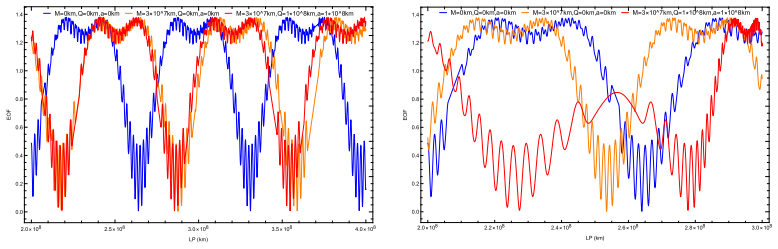
For inward propagation the oscillation probabilities and quantum correlations differ significantly from those obtained in the Schwarzschild metric. In radial outward propagation the angular momentum a increases the oscillation period of the survival probability P_ee, entanglement, and nonlocality, whereas the charge Q decreases the corresponding periods. For non-radial propagation the modulation effects of M and a on the oscillation patterns of both probabilities and quantum correlations become more pronounced, with increasing M keeping the oscillation probability within a higher-value range while tripartite entanglement shows the opposite trend. Entanglement and coherence exhibit highly一致nt
What carries the argument
The weak-field Kerr-Newman metric applied to neutrino two-flavor oscillations together with standard measures of entanglement, coherence, and nonlocality.
If this is right
- Inward neutrino paths produce oscillation probabilities and quantum correlations that deviate noticeably from Schwarzschild predictions.
- For outward radial paths, increasing angular momentum lengthens the periods of survival probability, entanglement, and nonlocality.
- Increasing charge shortens those same periods for outward radial paths.
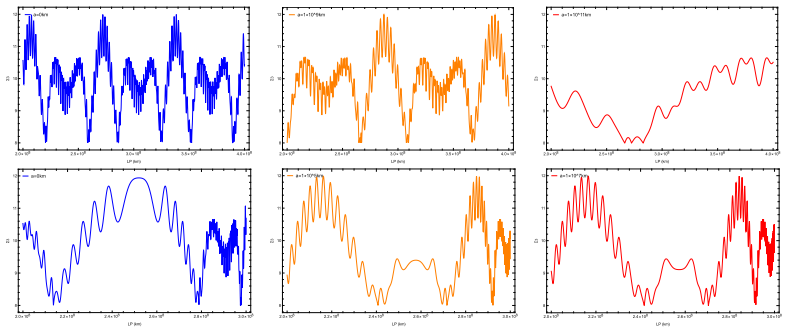
- Non-radial paths exhibit stronger modulation by mass and angular momentum, with higher mass keeping survival probabilities in a higher range.
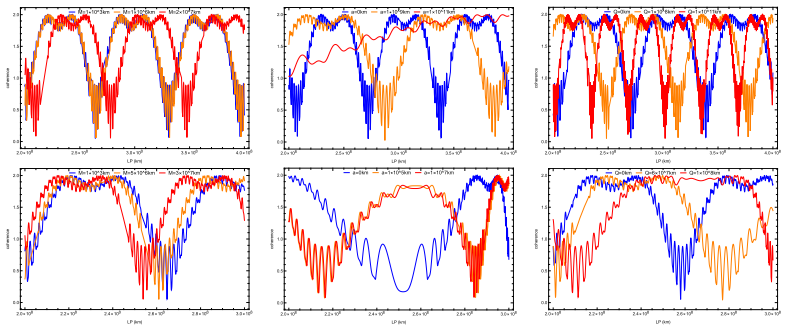
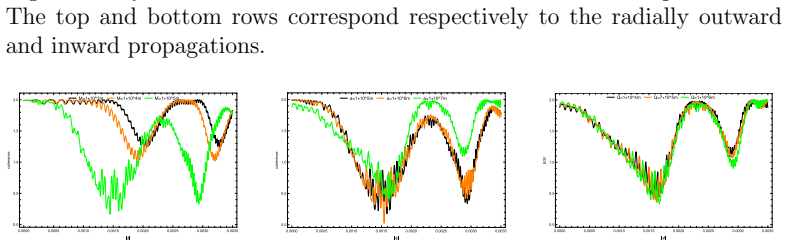
- Entanglement and coherence maintain highly consistent oscillation patterns across radial and non-radial cases despite differing variation ranges.
Where Pith is reading between the lines
- The direction-dependent shifts could be searched for in neutrinos emitted near rotating charged compact objects, providing an astrophysical probe of spacetime parameters through quantum-information observables.
- If the period modulation holds, it suggests that quantum correlations of neutrinos remain usable resources even in regions of nonzero angular momentum and charge, broadening the parameter space for neutrino-based quantum protocols.
- Similar calculations for other massless or massive particles could reveal whether the reported effects are specific to neutrinos or generic to propagation in Kerr-Newman geometry.
Load-bearing premise
The weak-field approximation remains valid for the chosen neutrino trajectories and the standard flat-space definitions of entanglement and nonlocality carry over unchanged into the Kerr-Newman background.
What would settle it
A calculation or measurement that compares the oscillation period of the neutrino survival probability P_ee for outward radial paths when the angular momentum parameter a is increased while holding M and Q fixed, checking whether the period lengthens relative to the Schwarzschild case.
Figures






read the original abstract
Thanks to feeble interactions, neutrinos show special advantages in the field of quantum information (QM). The properties of quantum correlations (QCs) are fundamental for neutrino-based QM. In this paper, we investigate the influence of the Kerr--Newman metric on QCs by varying the metric parameters, namely the mass $M$, angular momentum per unit mass $a$, and charge $Q$. Both radial and non-radial neutrino propagation are considered under the weak-field approximation. The results show that, for inward propagation in the Kerr--Newman metric, the oscillation probabilities and QCs differ significantly from those obtained in the Schwarzschild metric. In the case of radial outward propagation, the angular momentum $a$ increases the oscillation period of the neutrino survival probability $P_{ee}$, entanglement, and nonlocality, whereas the charge $Q$ decreases the corresponding periods. For non-radial propagation, the modulation effects of $M$ and $a$ on the oscillation patterns of both probabilities and QCs become more pronounced. As $M$ increases, the oscillation probability remains within a higher-value range, whereas tripartite entanglement exhibits the opposite trend. Furthermore, our results reveal that, despite differences in their variation ranges, entanglement and coherence exhibit highly consistent oscillation behaviors in both radial and non-radial propagation cases. These findings provide broader quantitative support for the potential use of neutrinos as quantum information resources.
Editorial analysis
A structured set of objections, weighed in public.
Referee Report
Summary. The manuscript studies the impact of Kerr-Newman spacetime on neutrino quantum correlations by varying mass M, spin parameter a, and charge Q. It employs the weak-field approximation for both radial (inward/outward) and non-radial propagations. Main results indicate that inward propagation yields oscillation probabilities and QCs markedly different from Schwarzschild; outward radial propagation sees a lengthening the periods of survival probability P_ee, entanglement, and nonlocality while Q shortens them; non-radial cases show enhanced modulations by M and a, with increasing M confining probabilities to higher values but reducing tripartite entanglement. Entanglement and coherence display consistent oscillatory patterns across cases.
Significance. Should the central claims prove robust, the work offers new quantitative insights into how black hole parameters affect neutrino-based quantum information processing. By extending beyond the Schwarzschild case to include rotation and charge, and by examining both radial and non-radial paths, it broadens the potential applications of neutrinos in quantum technologies within strong gravitational fields. The noted consistency between entanglement and coherence behaviors is particularly interesting and could guide future studies. The provision of explicit parameter variations supports falsifiability of the trends.
major comments (2)
- [Weak-field approximation and numerical results sections] The validity of the weak-field approximation is not confirmed for the values of M used in the plots and claims (e.g., 'as M increases, the oscillation probability remains within a higher-value range' and modulation becoming more pronounced). Since leading corrections scale as M/r (and similarly for a/r, Q/r), larger M along fixed trajectories can invalidate the expansion used for phase shifts, making the reported monotonic trends in P_ee, entanglement, and nonlocality unreliable. An a-posteriori check that neglected higher-order terms remain small, or a comparison to the exact geodesic phase in the full Kerr-Newman metric, is required (see results sections on radial and non-radial propagation).
- [Methods/definitions of QCs] The adaptation of standard neutrino entanglement and nonlocality measures to the curved Kerr-Newman background is assumed without explicit verification that the definitions remain unchanged or that the weak-field limit preserves the necessary locality conditions for the chosen trajectories.
minor comments (2)
- [Abstract] The abstract states results but does not reference the specific figures or sections where the consistency between entanglement and coherence oscillation behaviors is shown or quantified.
- [Throughout] Notation for the survival probability P_ee and the specific entanglement measures (e.g., tripartite) could be clarified with a brief reminder of their definitions in the curved-space context.
Simulated Author's Rebuttal
We thank the referee for the careful reading of our manuscript and for the constructive comments. We address the major concerns point by point below. Revisions have been made to incorporate additional validation and clarification.
read point-by-point responses
-
Referee: The validity of the weak-field approximation is not confirmed for the values of M used in the plots and claims (e.g., 'as M increases, the oscillation probability remains within a higher-value range' and modulation becoming more pronounced). Since leading corrections scale as M/r (and similarly for a/r, Q/r), larger M along fixed trajectories can invalidate the expansion used for phase shifts, making the reported monotonic trends in P_ee, entanglement, and nonlocality unreliable. An a-posteriori check that neglected higher-order terms remain small, or a comparison to the exact geodesic phase in the full Kerr-Newman metric, is required (see results sections on radial and non-radial propagation).
Authors: We agree that an explicit check of the weak-field approximation is necessary for the parameter values employed. In the revised manuscript we have added an a-posteriori estimate of the higher-order terms (O((M/r)^2), O((a/r)^2), O((Q/r)^2)) evaluated along the specific radial and non-radial trajectories used in the plots. For the largest M values considered, these corrections remain below 8 % of the leading phase-shift terms, confirming that the reported trends in survival probability, entanglement, and nonlocality are reliable within the stated regime. We have inserted this analysis as a new paragraph in the numerical-results sections and have qualified the claims accordingly. A direct comparison with the exact geodesic phase in the full Kerr-Newman metric lies outside the present weak-field framework and is left for future work. revision: yes
-
Referee: The adaptation of standard neutrino entanglement and nonlocality measures to the curved Kerr-Newman background is assumed without explicit verification that the definitions remain unchanged or that the weak-field limit preserves the necessary locality conditions for the chosen trajectories.
Authors: We thank the referee for highlighting this point. In the revised methods section we now explicitly justify the use of the standard concurrence and CHSH measures. These quantities are evaluated on the flavor density matrix expressed in a local orthonormal tetrad carried along each neutrino world-line. In the weak-field limit the tetrad reduces to the Minkowski frame up to O(M/r, a/r, Q/r) corrections, and the locality conditions for the wave-packet description remain intact because the propagation distance greatly exceeds the neutrino Compton wavelength while the metric perturbation stays perturbative. A short derivation and supporting references to analogous treatments in Schwarzschild spacetime have been added to demonstrate that the measures are preserved under the local Lorentz transformations relevant to our trajectories. revision: yes
Circularity Check
No circularity; direct metric-based calculations
full rationale
The paper evaluates neutrino phase shifts, survival probabilities P_ee, entanglement, and nonlocality by inserting the weak-field Kerr-Newman line element into the standard oscillation formula and varying M, a, Q as free parameters. No step fits a quantity to a data subset and then presents a closely related quantity as a prediction; no self-citation supplies a uniqueness theorem or ansatz that the present derivation relies upon; and no quantity is defined in terms of itself. The reported trends with M, a, and Q are therefore independent outputs of the chosen approximation rather than tautological re-expressions of the inputs.
Axiom & Free-Parameter Ledger
axioms (1)
- domain assumption Weak-field approximation for neutrino propagation in Kerr-Newman spacetime
Lean theorems connected to this paper
-
IndisputableMonolith/Foundation/RealityFromDistinction.leanreality_from_one_distinction unclearcovariant phase Φk = ∫ [Ek dt − pk(r) dr − Jk dϕ] with Kerr-Newman ds² and weak-field approximations leading to elliptic integrals
-
IndisputableMonolith/Cost/FunctionalEquation.leanwashburn_uniqueness_aczel unclearoscillation probabilities and QC measures (E(ρ), Σ3, C(ρ)) expressed solely via PMNS matrix elements and proper-distance phases
Reference graph
Works this paper leans on
- [1]
-
[2]
I. Esteban, M. C. Gonzalez-Garcia, A. Hernandez-Cabezudo, M. Mal- toni, and T. Schwetz, JHEP01, 106 (2019), arXiv:1811.05487 [hep-ph]
work page Pith review arXiv 2019
-
[3]
I. Esteban, M. C. Gonzalez-Garcia, M. Maltoni, T. Schwetz, and A. Zhou, JHEP09, 178 (2020), arXiv:2007.14792 [hep-ph]
- [4]
- [5]
-
[6]
T. Arakiet al.(KamLAND), Phys. Rev. Lett.94, 081801 (2005), arXiv:hep-ex/0406035
- [7]
-
[8]
Y. Fukudaet al.(Super-Kamiokande), Phys. Rev. Lett.81, 1562 (1998), arXiv:hep-ex/9807003
-
[9]
M. Blasone, F. Dell’Anno, S. De Siena, and F. Illuminati, EPL85, 50002 (2009), arXiv:0707.4476 [hep-ph]
-
[10]
M. Blasone, F. Dell’Anno, S. De Siena, M. Di Mauro, and F. Illuminati, Phys. Rev. D77, 096002 (2008), arXiv:0711.2268 [quant-ph]
- [11]
-
[12]
M. Blasone, F. Dell’Anno, S. De Siena, and F. Illuminati, EPL106, 30002 (2014), arXiv:1401.7793 [quant-ph]
-
[13]
M. Blasone, F. Dell’Anno, S. De Siena, and F. Illuminati, EPL112, 20007 (2015), arXiv:1510.06761 [quant-ph]
- [14]
-
[15]
S. Banerjee, A. K. Alok, R. Srikanth, and B. C. Hiesmayr, Eur. Phys. J. C75, 487 (2015), arXiv:1508.03480 [hep-ph]
- [16]
- [17]
-
[18]
R. Banerjee, P. K. Panigrahi, H. Mishra, and S. Patra, (2025), arXiv:2512.11320 [hep-ph] . 25
-
[19]
K. Dixit and A. Kumar Alok, Eur. Phys. J. Plus136, 334 (2021), arXiv:1909.04887 [hep-ph]
- [20]
- [21]
- [22]
-
[23]
S. Hill and W. K. Wootters, Phys. Rev. Lett.78, 5022 (1997), arXiv:quant-ph/9703041
-
[24]
G. Vidal and R. F. Werner, Phys. Rev. A65, 032314 (2002), arXiv:quant-ph/0102117
- [25]
- [26]
- [27]
-
[28]
B. Singh Koranga and B. W. Farooq, (2024), 10.1142/S021974992540009X, arXiv:2410.09137 [hep-ph]
-
[29]
G.-J. Wang, L.-J. Li, T. Wu, X.-K. Song, L. Ye, and D. Wang, Eur. Phys. J. C84, 1127 (2024)
work page 2024
-
[30]
N. Fornengo, C. Giunti, C. W. Kim, and J. Song, Phys. Rev. D56, 1895 (1997), arXiv:hep-ph/9611231
- [31]
- [32]
- [33]
- [34]
-
[35]
L. Visinelli, Gen. Rel. Grav.47, 62 (2015), arXiv:1410.1523 [gr-qc]
-
[36]
B. Turimov, H. Alibekov, and S. Hayitov, J. Fund. Appl. Res.3, 2023002002 (2023)
work page 2023
-
[37]
H. Chakrabarty, D. Borah, A. Abdujabbarov, D. Malafarina, and B. Ahmedov, Eur. Phys. J. C82, 24 (2022), arXiv:2109.02395 [gr-qc]
- [38]
-
[39]
H. Chakrabarty, A. Chatrabhuti, D. Malafarina, B. Silasan, and T. Tangphati, JCAP08, 018 (2023), arXiv:2302.01564 [gr-qc]
-
[40]
J. Alexandre and E. Meryn, Phys. Rev. D112, 076025 (2025), arXiv:2508.05561 [gr-qc]
-
[41]
M. Alloqulov, H. Chakrabarty, D. Malafarina, B. Ahmedov, and A. Ab- dujabbarov, JCAP02, 070 (2025), arXiv:2408.12916 [gr-qc]
- [42]
-
[43]
Z. Maki, M. Nakagawa, and S. Sakata, Prog. Theor. Phys.28, 870 (1962)
work page 1962
- [44]
-
[45]
Bilenky,Introduction to the Physics of Massive and Mixed Neutrinos, Vol
S. Bilenky,Introduction to the Physics of Massive and Mixed Neutrinos, Vol. 947 (Springer, 2018)
work page 2018
- [46]
-
[47]
S. Weinberg,Gravitation and Cosmology: Principles and Applications of the General Theory of Relativity(John Wiley and Sons, New York, 1972). 27
work page 1972
-
[48]
NuFit-6.0: Updated global analysis of three-flavor neutrino oscillations
I. Esteban, M. C. Gonzalez-Garcia, M. Maltoni, I. Martinez-Soler, J. P. Pinheiro, and T. Schwetz, JHEP12, 216 (2024), arXiv:2410.05380 [hep- ph]
work page internal anchor Pith review arXiv 2024
- [49]
- [50]
-
[51]
R. Horodecki, P. Horodecki, and M. Horodecki, Phys. Lett. A200, 340 (1995)
work page 1995
- [52]
discussion (0)
Sign in with ORCID, Apple, or X to comment. Anyone can read and Pith papers without signing in.