Recognition: 2 theorem links
· Lean TheoremRG-Consistent (P)NJL Model: Impact of Thermal Cutoff Modifications on Thermodynamics and Net-Baryon Number Fluctuations
Pith reviewed 2026-05-12 04:44 UTC · model grok-4.3
The pith
RG-consistent PNJL model with growing thermal cutoff improves agreement with lattice data on net-baryon number fluctuations at zero chemical potential.
A machine-rendered reading of the paper's core claim, the machinery that carries it, and where it could break.
Core claim
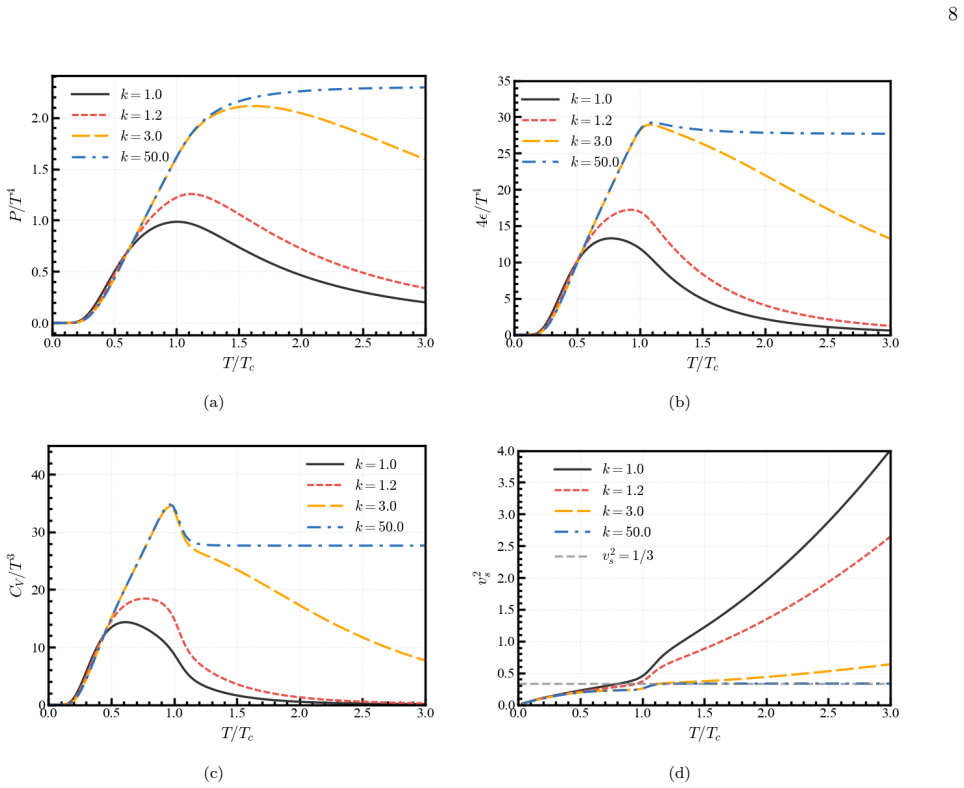
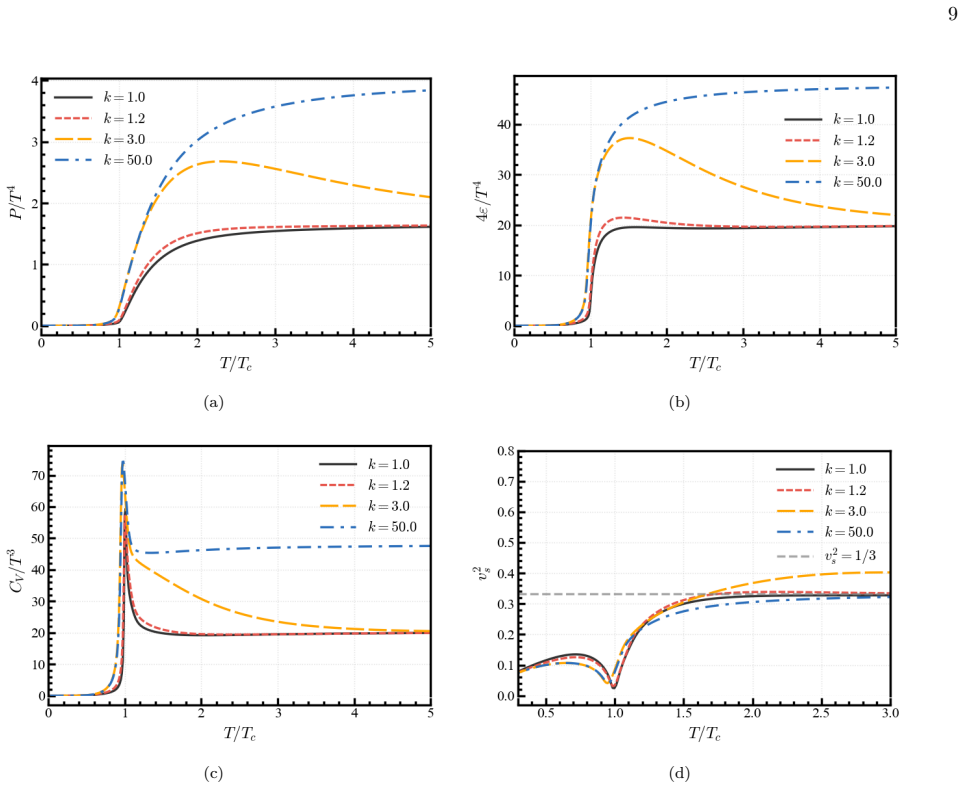
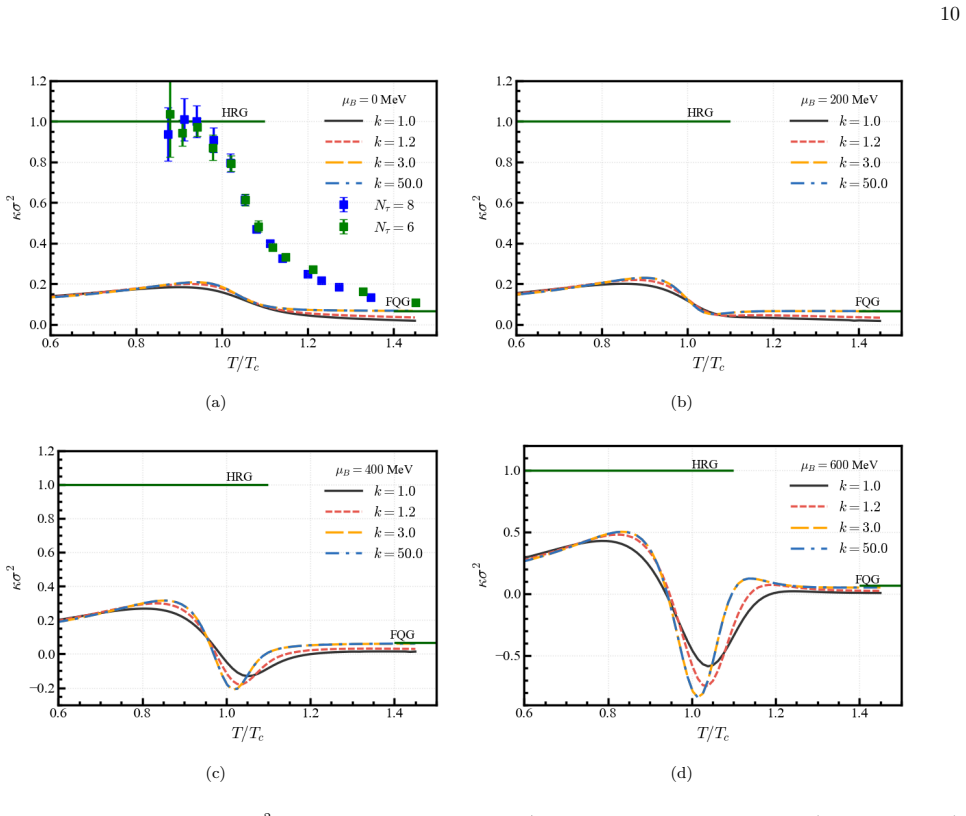
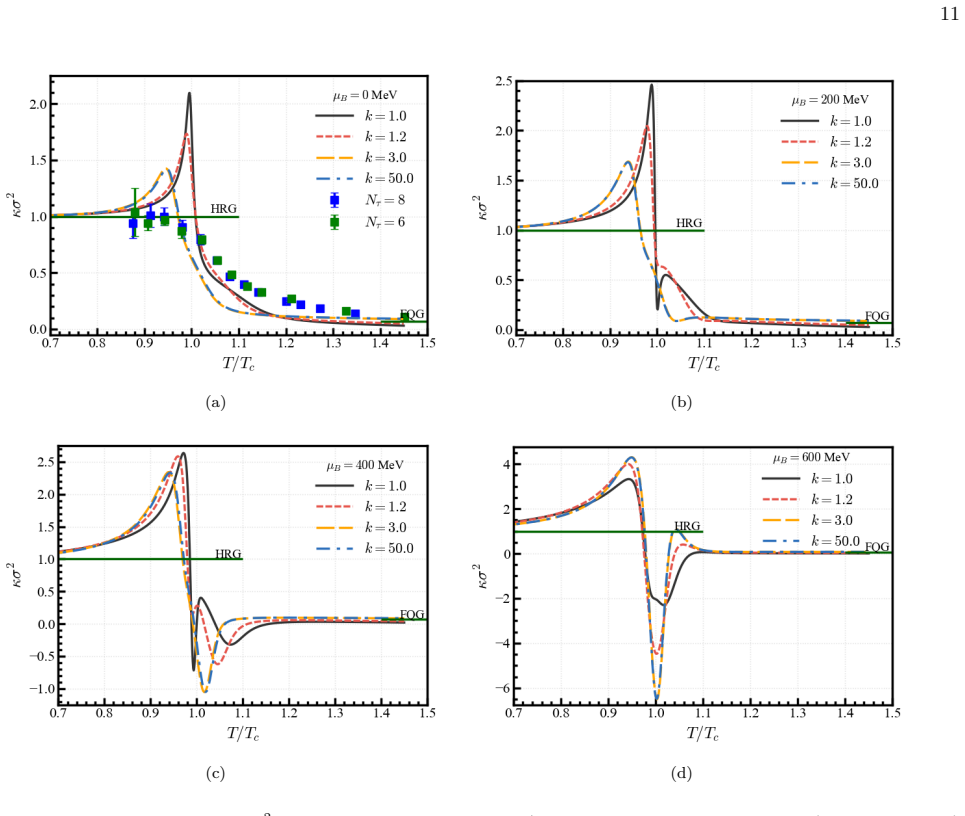
Implementing the RG-consistency condition via the cutoff Λ_T = k Λ_0 allows the RGNJL model to bind the speed of sound to the conformal limit and makes the RGPNJL model reproduce lattice QCD net-baryon fluctuations (κσ²) more accurately at μ_B = 0, while the same cutoff produces non-monotonic k-dependence and stronger fluctuations at finite baryon density.
What carries the argument
The temperature-dependent thermal cutoff Λ_T = k Λ_0 together with the RG-consistency limit k → ∞, which rescales the momentum integrals in the thermodynamic potential so that ultraviolet behavior matches renormalization-group expectations.
If this is right
- Causality violations disappear in the RGNJL sector once k approaches infinity.
- The RGPNJL model exhibits non-monotonic dependence on the cutoff parameter k.
- Net-baryon fluctuations at vanishing density move closer to lattice values.
- Fluctuations intensify rapidly at high baryon density, tightening constraints on the remaining parameters.
Where Pith is reading between the lines
- A different functional form for the cutoff could reduce the density sensitivity while keeping the high-temperature improvement.
- The same RG-consistent cutoff prescription might be portable to other effective models used for the dense QCD phase diagram.
- Future lattice runs at small but nonzero μ_B could directly test whether the intensified fluctuations persist or are an artifact.
Load-bearing premise
That the chosen linear temperature dependence of the cutoff together with the infinite-k limit faithfully encodes QCD dynamics without adding artifacts once baryon density is nonzero.
What would settle it
Lattice QCD results for κσ² at moderate nonzero chemical potential that lie well outside the band of predictions obtained by varying k in the RGPNJL model.
Figures


read the original abstract
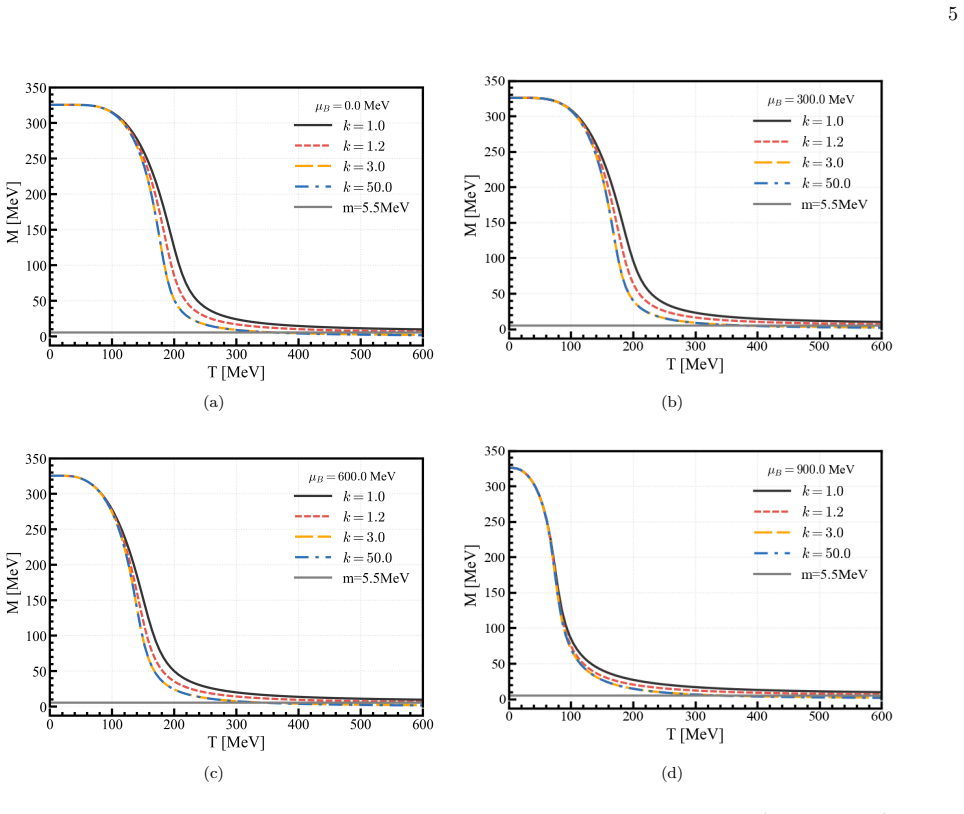
In this paper, we investigate the impact of renormalization group (RG) consistency on the chiral phase transition and thermodynamic properties of QCD matter using the RGNJL and RGPNJL models. By implementing a temperature-dependent thermal cutoff $\Lambda_T = k\Lambda_0$, we ensure that thermodynamic quantities converge toward the Stefan-Boltzmann limit at high temperatures, effectively extending the applicability of these effective theories. Our analysis shows that while the RG-consistency condition ($k \rightarrow \infty$) resolves causality violations in the RGNJL model by binding the speed of sound to the conformal limit, the RGPNJL model exhibits a more complex, non-monotonic sensitivity to the parameter $k$. Furthermore, we demonstrate that the RG-improved PNJL framework significantly enhances the description of net-baryon number fluctuations ($\kappa\sigma^2$) relative to lattice QCD data at vanishing chemical potential, though the intensification of these fluctuations at high baryon density highlights a critical sensitivity to the model's parametric constraints. This study provides a rigorous evaluation of the RG-consistency framework's predictive power in mapping the QCD phase diagram and interpreting experimental observables.
Editorial analysis
A structured set of objections, weighed in public.
Referee Report
Summary. The paper investigates renormalization group (RG) consistency in the RGNJL and RGPNJL models by introducing a temperature-dependent thermal cutoff of the form Λ_T = k Λ_0. It claims that the k → ∞ limit resolves causality violations in RGNJL by binding the speed of sound to the conformal limit, ensures convergence of thermodynamic quantities to the Stefan-Boltzmann limit at high T, and yields a significant improvement in the description of net-baryon number fluctuations (κσ²) relative to lattice QCD data at μ = 0 in the RGPNJL case, while the intensification of fluctuations at high baryon density signals sensitivity to the model's parametric constraints.
Significance. If substantiated, the work strengthens the use of RG-consistent effective models for mapping the QCD phase diagram and interpreting fluctuation observables from heavy-ion collisions. Explicit resolution of causality issues and the Stefan-Boltzmann restoration represent concrete technical advances over standard (P)NJL implementations.
major comments (1)
- [Abstract and the section presenting net-baryon fluctuation results] The central claim of enhanced κσ² agreement with lattice data at vanishing chemical potential (abstract) rests on the specific cutoff form Λ_T = k Λ_0 and the k → ∞ extrapolation; however, the manuscript provides no explicit derivation details, fitting procedure, or quantitative error assessment for how parameters are fixed when comparing to lattice results, leaving open whether the reported improvement is independent of post-hoc tuning.
minor comments (2)
- [Model definition and numerical methods] Clarify the numerical implementation of the k → ∞ limit in the RGPNJL model, including any convergence tests or regularization of the non-monotonic k-dependence mentioned in the abstract.
- [Results on thermodynamics and fluctuations] Add explicit tables or figures quantifying the non-monotonic sensitivity to k and the high-density intensification of fluctuations, with direct overlays against lattice data points.
Simulated Author's Rebuttal
We thank the referee for their careful reading of the manuscript and for the positive assessment of its potential significance. We address the single major comment below and will incorporate the requested clarifications in a revised version.
read point-by-point responses
-
Referee: [Abstract and the section presenting net-baryon fluctuation results] The central claim of enhanced κσ² agreement with lattice data at vanishing chemical potential (abstract) rests on the specific cutoff form Λ_T = k Λ_0 and the k → ∞ extrapolation; however, the manuscript provides no explicit derivation details, fitting procedure, or quantitative error assessment for how parameters are fixed when comparing to lattice results, leaving open whether the reported improvement is independent of post-hoc tuning.
Authors: We agree that additional explicit details on parameter fixing and quantitative comparison metrics would strengthen the presentation. The vacuum parameters (G, K for PNJL, and Λ_0) are fixed in the standard manner by reproducing the pion mass, decay constant, and constituent quark mass at T = μ = 0; the temperature-dependent cutoff form Λ_T = k Λ_0 is introduced solely to enforce RG consistency and is not adjusted to finite-temperature lattice data. The k → ∞ limit follows directly from the RG-invariance requirement rather than from fitting to fluctuation observables. In the revised manuscript we will add a dedicated paragraph (or subsection) that (i) derives the cutoff prescription from the RG-consistency condition, (ii) lists the numerical values and references for the vacuum fit, and (iii) supplies quantitative measures of agreement with lattice κσ² (e.g., mean absolute deviation over the temperature range shown). These additions will make clear that the reported improvement is a consequence of the RG-consistent framework and not the result of post-hoc tuning. revision: yes
Circularity Check
No significant circularity in derivation chain
full rationale
The provided abstract and context introduce a temperature-dependent cutoff Λ_T = kΛ_0 explicitly to enforce the Stefan-Boltzmann limit at high T, with the k→∞ limit applied to restore causality in RGNJL while noting non-monotonic behavior in RGPNJL. The claimed enhancement of κσ² agreement with lattice QCD at μ=0 is presented as an outcome of this framework, with high-density sensitivity to parameters explicitly flagged. No self-definitional reductions, fitted inputs relabeled as predictions, or load-bearing self-citations that collapse the central claims to inputs by construction appear in the text. The derivation remains self-contained against external lattice benchmarks without reducing to tautology.
Axiom & Free-Parameter Ledger
free parameters (1)
- k
axioms (2)
- domain assumption The NJL/PNJL Lagrangian approximates low-energy QCD via local four-fermion interactions and a Polyakov loop for confinement.
- domain assumption RG consistency is achieved by sending the thermal cutoff parameter k to infinity.
Lean theorems connected to this paper
-
IndisputableMonolith/Cost/FunctionalEquation.leanwashburn_uniqueness_aczel unclear?
unclearRelation between the paper passage and the cited Recognition theorem.
By implementing a temperature-dependent thermal cutoff Λ_T = k Λ_0, we ensure that thermodynamic quantities converge toward the Stefan-Boltzmann limit... the RG-consistency condition (k → ∞) resolves causality violations
-
IndisputableMonolith/Foundation/RealityFromDistinction.leanreality_from_one_distinction unclear?
unclearRelation between the paper passage and the cited Recognition theorem.
the RG-improved PNJL framework significantly enhances the description of net-baryon number fluctuations (κσ²) relative to lattice QCD data
What do these tags mean?
- matches
- The paper's claim is directly supported by a theorem in the formal canon.
- supports
- The theorem supports part of the paper's argument, but the paper may add assumptions or extra steps.
- extends
- The paper goes beyond the formal theorem; the theorem is a base layer rather than the whole result.
- uses
- The paper appears to rely on the theorem as machinery.
- contradicts
- The paper's claim conflicts with a theorem or certificate in the canon.
- unclear
- Pith found a possible connection, but the passage is too broad, indirect, or ambiguous to say the theorem truly supports the claim.
Reference graph
Works this paper leans on
-
[1]
The phase diagram of dense QCD.Rept
Kenji Fukushima and Tetsuo Hatsuda. The phase diagram of dense QCD.Rept. Prog. Phys., 74:014001, 2011
work page 2011
- [2]
-
[3]
A. Bazavov et al. The chiral and deconfinement aspects of the QCD transition.Phys. Rev. D, 85:054503, 2012
work page 2012
-
[4]
Misha A. Stephanov, K. Rajagopal, and Edward V. Shuryak. Signatures of the tricritical point in QCD.Phys. Rev. Lett., 81:4816–4819, 1998
work page 1998
-
[5]
Z. Fodor and S. D. Katz. Critical point of QCD at finite T and mu, lattice results for physical quark masses.JHEP, 04:050, 2004
work page 2004
-
[6]
Misha A. Stephanov, K. Rajagopal, and Edward V. Shuryak. Event-by-event fluctuations in heavy ion collisions and the QCD critical point.Phys. Rev. D, 60:114028, 1999
work page 1999
- [7]
-
[8]
L. Adamczyk et al. Energy Dependence of Moments of Net-proton Multiplicity Distributions at RHIC.Phys. Rev. Lett., 112:032302, 2014
work page 2014
-
[9]
M. M. Aggarwal et al. An Experimental Exploration of the QCD Phase Diagram: The Search for the Critical Point and the Onset of De-confinement. 7 2010
work page 2010
-
[10]
J. Adam et al. Nonmonotonic Energy Dependence of Net-Proton Number Fluctuations.Phys. Rev. Lett., 126(9):092301,
- [11]
-
[12]
B. E. Aboona et al. Precision Measurement of Net-Proton-Number Fluctuations in Au+Au Collisions at RHIC.Phys. Rev. Lett., 135(14):142301, 2025
work page 2025
-
[13]
Yoichiro Nambu and G. Jona-Lasinio. Dynamical Model of Elementary Particles Based on an Analogy with Superconduc- tivity. 1.Phys. Rev., 122:345–358, 1961
work page 1961
-
[14]
Yoichiro Nambu and G. Jona-Lasinio. Dynamical model of elementary particles based on an analogy with superconductivity. II.Phys. Rev., 124:246–254, 1961
work page 1961
-
[15]
S. P. Klevansky. The Nambu-Jona-Lasinio model of quantum chromodynamics.Rev. Mod. Phys., 64:649–708, 1992
work page 1992
-
[16]
NJL model analysis of quark matter at large density.Phys
Michael Buballa. NJL model analysis of quark matter at large density.Phys. Rept., 407:205–376, 2005
work page 2005
-
[17]
Shijun Mao. Reduction of pseudocritical temperatures of chiral restoration and deconfinement phase transitions in a magnetized PNJL model.Phys. Rev. D, 110(5):054002, 2024
work page 2024
-
[18]
Magnetic catalysis and diamagnetism from pion fluctuations
Jie Mei, Rui Wen, Shijun Mao, Mei Huang, and Kun Xu. Magnetic catalysis and diamagnetism from pion fluctuations. Phys. Rev. D, 110(3):034024, 2024
work page 2024
-
[19]
QCD Matter and Phase Transitions under Extreme Conditions.Symmetry, 15(2):541, 2023
Mei Huang and Pengfei Zhuang. QCD Matter and Phase Transitions under Extreme Conditions.Symmetry, 15(2):541, 2023
work page 2023
-
[20]
Chiral effective model with the Polyakov loop.Phys
Kenji Fukushima. Chiral effective model with the Polyakov loop.Phys. Lett. B, 591:277–284, 2004
work page 2004
-
[21]
Phase diagrams in the three-flavor Nambu-Jona-Lasinio model with the Polyakov loop.Phys
Kenji Fukushima. Phase diagrams in the three-flavor Nambu-Jona-Lasinio model with the Polyakov loop.Phys. Rev. D, 77:114028, 2008. [Erratum: Phys.Rev.D 78, 039902 (2008)]
work page 2008
-
[22]
Claudia Ratti, Michael A. Thaler, and Wolfram Weise. Phase diagram and thermodynamics of the PNJL model. 4 2006
work page 2006
-
[23]
Lang Yu, Hao Liu, and Mei Huang. Effect of the chiral chemical potential on the chiral phase transition in the NJL model with different regularization schemes.Phys. Rev. D, 94(1):014026, 2016
work page 2016
-
[24]
Do we need to use regularization for the thermal part in the NJL model? *
Kai Xue, Xiaozhu Yu, and Xinyang Wang. Do we need to use regularization for the thermal part in the NJL model? *. Chin. Phys. C, 46(5):013103, 2022
work page 2022
-
[25]
Sidney S. Avancini, Ricardo L. S. Farias, Norberto N. Scoccola, and William R. Tavares. NJL-type models in the presence of intense magnetic fields: the role of the regularization prescription.Phys. Rev. D, 99(11):116002, 2019
work page 2019
-
[26]
Sidney S. Avancini, Ricardo L. S. Farias, and William R. Tavares. Neutral meson properties in hot and magnetized quark matter: a new magnetic field independent regularization scheme applied to NJL-type model.Phys. Rev. D, 99(5):056009, 2019
work page 2019
-
[27]
Exact evolution equation for the effective potential.Phys
Christof Wetterich. Exact evolution equation for the effective potential.Phys. Lett. B, 301:90–94, 1993. 13
work page 1993
- [28]
-
[29]
Renormalization-group consistent treatment of color supercon- ductivity in the NJL model.Phys
Hosein Gholami, Marco Hofmann, and Michael Buballa. Renormalization-group consistent treatment of color supercon- ductivity in the NJL model.Phys. Rev. D, 111(1):014006, 2025
work page 2025
-
[30]
Hosein Gholami, Ishfaq Ahmad Rather, Marco Hofmann, Michael Buballa, and J¨ urgen Schaffner-Bielich. Astrophysi- cal constraints on color-superconducting phases in compact stars within the RG-consistent NJL model.Phys. Rev. D, 111(10):103034, 2025
work page 2025
-
[31]
Fan Lin, Kun Xu, and Mei Huang. Magnetism of QCD matter and the pion mass from tensor-type spin polarization and the anomalous magnetic moment of quarks.Phys. Rev. D, 106(1):016005, 2022
work page 2022
-
[32]
The Effective Potential for the Order Parameter of Gauge Theories at Finite Temperature.Phys
Nathan Weiss. The Effective Potential for the Order Parameter of Gauge Theories at Finite Temperature.Phys. Rev. D, 24:475, 1981
work page 1981
-
[33]
The Wilson Line in Finite Temperature Gauge Theories.Phys
Nathan Weiss. The Wilson Line in Finite Temperature Gauge Theories.Phys. Rev. D, 25:2667, 1982
work page 1982
-
[34]
Stability of the perturbative vacuum against spatial variations of the Polyakov loop
Kenji Fukushima and Koichi Ohta. Stability of the perturbative vacuum against spatial variations of the Polyakov loop. J. Phys. G, 26:1397–1415, 2000
work page 2000
-
[35]
C. Ratti, Simon Roessner, M. A. Thaler, and W. Weise. Thermodynamics of the PNJL model.Eur. Phys. J. C, 49:213–217, 2007
work page 2007
-
[36]
Baryon number fluctuations and the phase structure in the PNJL model.Eur
Guo-yun Shao, Zhan-duo Tang, Xue-yan Gao, and Wei-bo He. Baryon number fluctuations and the phase structure in the PNJL model.Eur. Phys. J. C, 78(2):138, 2018
work page 2018
-
[37]
Thermodynamics of two-colour QCD and the Nambu Jona-Lasinio model.Phys
Claudia Ratti and Wolfram Weise. Thermodynamics of two-colour QCD and the Nambu Jona-Lasinio model.Phys. Rev. D, 70:054013, 2004
work page 2004
-
[38]
Discussion of thermodynamic features within the PNJL model.Chin
Jin-Li Zhang, Cheng-Ming Li, and Hong-Shi Zong. Discussion of thermodynamic features within the PNJL model.Chin. Phys. C, 42(12):123105, 2018
work page 2018
-
[39]
Sanjay K. Ghosh, Tamal K. Mukherjee, Munshi G. Mustafa, and Rajarshi Ray. Susceptibilities and speed of sound from PNJL model.Phys. Rev. D, 73:114007, 2006
work page 2006
-
[40]
A. Bazavov et al. The QCD Equation of State toO(µ 6 B) from Lattice QCD.Phys. Rev. D, 95(5):054504, 2017
work page 2017
-
[41]
Pawlowski, Fabian Rennecke, Rui Wen, and Shi Yin
Wei-jie Fu, Xiaofeng Luo, Jan M. Pawlowski, Fabian Rennecke, Rui Wen, and Shi Yin. Hyper-order baryon number fluctuations at finite temperature and density.Phys. Rev. D, 104(9):094047, 2021
work page 2021
-
[42]
Pawlowski, Fabian Rennecke, Rui Wen, and Shi Yin
Wei-jie Fu, Xiaofeng Luo, Jan M. Pawlowski, Fabian Rennecke, Rui Wen, and Shi Yin. High-order baryon number fluctuations within the fRG approach.PoS, CPOD2021:009, 2022
work page 2022
-
[43]
Revealing the signal of QCD phase transition in heavy-ion collisions.Sci
Yi Lu, Fei Gao, Xiaofeng Luo, Lei Chang, and Yuxin Liu. Revealing the signal of QCD phase transition in heavy-ion collisions.Sci. China Phys. Mech. Astron., 68(5):251012, 2025
work page 2025
discussion (0)
Sign in with ORCID, Apple, or X to comment. Anyone can read and Pith papers without signing in.