Recognition: 2 theorem links
· Lean TheoremRenormalization of Quantum Operations: Parity-Time Transition and Chaotic Flows
Pith reviewed 2026-05-12 04:29 UTC · model grok-4.3
The pith
Real-time coarse-graining of quantum operations produces chaotic renormalization flows when coherent dynamics dominate.
A machine-rendered reading of the paper's core claim, the machinery that carries it, and where it could break.
Core claim
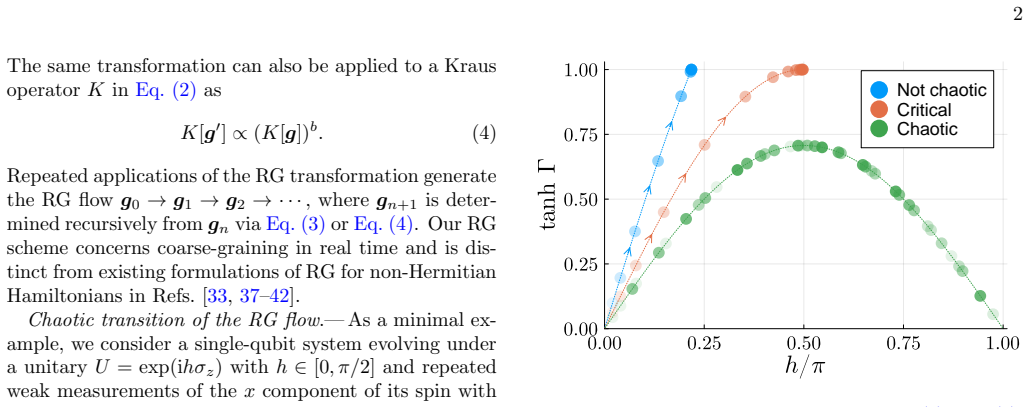
By performing coarse-graining in real time, the renormalization group applied to quantum operations shows that the competition between decoherence and coherent dynamics governs the flow. Chaotic behavior without fixed points emerges when coherent dynamics is dominant, and the measurement-induced parity-time transition belongs to the universality class of the one-dimensional Yang-Lee edge singularity.
What carries the argument
Real-time coarse-graining of quantum operations, which tracks how the competition between decoherence and coherent evolution shapes the renormalization flow.
If this is right
- When coherent dynamics dominate, the renormalization flow of quantum operations becomes chaotic and lacks fixed points.
- The measurement-induced parity-time transition falls into the universality class of the one-dimensional Yang-Lee edge singularity.
- This classification offers a practical guide for realizing effective imaginary fields in lattice spin systems through quantum operations.
Where Pith is reading between the lines
- The same real-time coarse-graining procedure could be applied to other families of dissipative quantum maps to search for additional chaotic regimes.
- Mapping the parity-time transition onto the Yang-Lee edge singularity opens the possibility of borrowing classical statistical mechanics techniques to compute properties of certain quantum measurement protocols.
- Quantum simulators could test the predicted universality by varying the relative strength of coherent and measurement terms and extracting scaling exponents near the transition.
Load-bearing premise
Real-time coarse-graining of quantum operations faithfully captures the long-time universal behavior without artifacts from time discretization choices or neglected higher-order correlations.
What would settle it
A numerical or experimental determination of the critical exponents at the measurement-induced parity-time transition in a lattice spin model, checked against the known exponents of the one-dimensional Yang-Lee edge singularity, would confirm or refute the claimed universality class.
Figures
read the original abstract
The renormalization group (RG) in statistical physics focuses on ground-state properties of equilibrium systems. However, it is unclear how it should be generalized to nonunitary quantum dynamics caused by dissipation and measurement backaction, in which the notion of conserved energy is absent. Here, we extend the RG to cover nonunitary quantum dynamics governed by quantum operations. By performing coarse-graining in real time, we find that the competition between decoherence and coherent dynamics plays a decisive role in the behavior of the RG flow. In particular, we find that chaotic behavior without fixed points emerges in the RG flow when coherent dynamics is dominant, with the parity-time transition serving as a prototypical example. The measurement-induced parity-time transition belongs to the universality class of the one-dimensional Yang-Lee edge singularity, which serves as a guide for experimentally realizing imaginary fields in lattice spin systems with a quantum system.
Editorial analysis
A structured set of objections, weighed in public.
Referee Report
Summary. The paper extends the renormalization group (RG) to nonunitary quantum dynamics by performing real-time coarse-graining of quantum operations. It finds that the competition between decoherence and coherent dynamics governs the RG flow, leading to chaotic behavior without fixed points when coherent dynamics dominate, with the parity-time (PT) transition as a prototypical example. The measurement-induced PT transition is claimed to belong to the universality class of the one-dimensional Yang-Lee edge singularity, providing guidance for experimentally realizing imaginary fields in lattice spin systems.
Significance. If the real-time RG procedure is shown to be robust, this work would offer a valuable new framework for applying renormalization ideas to open quantum systems lacking a conserved energy, highlighting how decoherence-coherence competition can produce chaotic flows and linking measurement-induced transitions to classical critical phenomena such as the Yang-Lee edge singularity. This could stimulate both theoretical developments in non-equilibrium statistical mechanics and experimental protocols in quantum many-body systems.
major comments (1)
- [Analysis of the parity-time transition] The central claim that the measurement-induced PT transition belongs to the 1D Yang-Lee edge singularity universality class (abstract) is load-bearing for the paper's main conclusions and experimental implications. This identification requires that the real-time coarse-graining of quantum operations reproduces the correct fixed-point structure and scaling without artifacts. The manuscript provides no explicit checks demonstrating that the RG flow is insensitive to the choice of time-discretization step size or to the truncation of higher-order correlations in the nonunitary evolution; if such sensitivity exists, the universality class assignment would not hold.
minor comments (2)
- [Abstract] The abstract clearly states the main results but would benefit from a brief specification of the concrete quantum operations or model Hamiltonian used to illustrate the PT transition, aiding quick comprehension of the setup.
- [Methods or formalism section] Notation for the quantum operations and the coarse-graining procedure could be introduced with a short table or explicit definitions early in the text to improve readability for readers unfamiliar with the formalism.
Simulated Author's Rebuttal
We thank the referee for their careful reading of our manuscript and for highlighting the importance of verifying the robustness of the real-time RG procedure. We address the major comment below and will incorporate additional checks in the revised version to strengthen the universality class assignment.
read point-by-point responses
-
Referee: [Analysis of the parity-time transition] The central claim that the measurement-induced PT transition belongs to the 1D Yang-Lee edge singularity universality class (abstract) is load-bearing for the paper's main conclusions and experimental implications. This identification requires that the real-time coarse-graining of quantum operations reproduces the correct fixed-point structure and scaling without artifacts. The manuscript provides no explicit checks demonstrating that the RG flow is insensitive to the choice of time-discretization step size or to the truncation of higher-order correlations in the nonunitary evolution; if such sensitivity exists, the universality class assignment would not hold.
Authors: We agree that explicit verification of robustness to discretization and truncation is essential to support the universality class identification. The original manuscript derives the RG equations from the quantum operation formalism and demonstrates the emergence of chaotic flows and the PT transition, with the Yang-Lee mapping following from the fixed-point structure in the coherent-dominant regime. However, we did not include systematic numerical scans over time-step size or correlation truncation order. In the revised manuscript, we will add an appendix with convergence tests: (i) RG flows for successively smaller time steps showing that the chaotic attractor and the PT critical point remain stable in the continuous-time limit, and (ii) comparisons of flows truncated at different orders of the nonunitary generator, confirming that the relevant scaling exponents converge to those of the 1D Yang-Lee edge singularity. These additions will directly address the concern that the class assignment could be an artifact. revision: yes
Circularity Check
No circularity: new real-time RG procedure derives the universality class independently.
full rationale
The paper introduces a real-time coarse-graining RG for nonunitary quantum operations as a novel extension, then applies the resulting flow equations to the PT-symmetric transition and extracts the Yang-Lee edge singularity class from the fixed-point structure. No step reduces by construction to a fitted parameter, self-defined quantity, or load-bearing self-citation; the identification follows from the explicit RG beta-functions and scaling analysis rather than tautology or renaming of prior results. External benchmarks (Yang-Lee literature) are cited only for comparison after the flow is computed.
Axiom & Free-Parameter Ledger
axioms (1)
- domain assumption Renormalization-group coarse-graining can be meaningfully defined for sequences of quantum operations in real time
Lean theorems connected to this paper
-
IndisputableMonolith/Cost/FunctionalEquation.leanwashburn_uniqueness_aczel unclearBy blocking b discrete-time steps, we find a set of renormalized coupling constants g′ from Φ[g′] ∝ (Φ[g])b. ... the RG equation in Eq. (8) becomes a chaotic map with no fixed points.
-
IndisputableMonolith/Foundation/AlexanderDuality.leanalexander_duality_circle_linking unclearthe measurement model can be mapped to the imaginary-time evolution of the classical one-dimensional Ising chain subject to a pure imaginary magnetic field ... Yang-Lee universality class
Reference graph
Works this paper leans on
-
[1]
H.-P. Breuer and F. Petruccione,The Theory of Open Quantum Systems(Oxford University Press, 2007)
work page 2007
-
[2]
A. J. Daley, Quantum trajectories and open many-body quantum systems, Adv. Phys.63, 77 (2014)
work page 2014
-
[3]
H. M. Wiseman and G. J. Milburn,Quantum measure- ment and control(Cambridge University Press, 2009)
work page 2009
-
[4]
T. D. Lee and C. N. Yang, Statistical theory of equations of state and phase transitions. II. Lattice gas and Ising model, Phys. Rev.87, 410 (1952)
work page 1952
-
[5]
E. J. Bergholtz, J. C. Budich, and F. K. Kunst, Ex- ceptional topology of non-hermitian systems, Rev. Mod. Phys.93, 015005 (2021)
work page 2021
- [6]
-
[7]
C. M. Bender and D. W. Hook,PT-symmetric quantum mechanics, Rev. Mod. Phys.96, 045002 (2024)
work page 2024
-
[8]
B. Skinner, J. Ruhman, and A. Nahum, Measurement- induced phase transitions in the dynamics of entangle- ment, Phys. Rev. X9, 031009 (2019)
work page 2019
-
[9]
Y. Li, X. Chen, and M. P. A. Fisher, Quantum Zeno effect and the many-body entanglement transition, Phys. Rev. B98, 205136 (2018)
work page 2018
-
[10]
A. Chan, R. M. Nandkishore, M. Pretko, and G. Smith, Unitary-projective entanglement dynamics, Phys. Rev. B 99, 224307 (2019)
work page 2019
-
[11]
M. J. Gullans and D. A. Huse, Dynamical purifica- tion phase transition induced by quantum measurements, Phys. Rev. X10, 041020 (2020)
work page 2020
-
[12]
M. P. Fisher, V. Khemani, A. Nahum, and S. Vijay, Ran- dom quantum circuits, Annu. Rev. Cond. Matt. Phys.14, 335–379 (2023)
work page 2023
-
[13]
E. M. Kessler, G. Giedke, A. Imamoglu, S. F. Yelin, M. D. Lukin, and J. I. Cirac, Dissipative phase transition in a central spin system, Phys. Rev. A86, 012116 (2012)
work page 2012
-
[14]
F. Minganti, A. Biella, N. Bartolo, and C. Ciuti, Spectral theory of Liouvillians for dissipative phase transitions, Phys. Rev. A98, 042118 (2018)
work page 2018
-
[15]
T. Haga, M. Nakagawa, R. Hamazaki, and M. Ueda, Quasiparticles of decoherence processes in open quantum many-body systems: Incoherentons, Phys. Rev. Res.5, 043225 (2023)
work page 2023
-
[16]
L. P. Kadanoff, Scaling laws for Ising models nearT c, Phys. Phys. Fiz.2, 263 (1966)
work page 1966
-
[17]
K. G. Wilson, Renormalization group and critical phe- nomena. I. Renormalization group and the Kadanoff scal- ing picture, Phys. Rev. B4, 3174 (1971)
work page 1971
-
[18]
K. G. Wilson, Renormalization group and critical phe- nomena. II. Phase-space cell analysis of critical behavior, Phys. Rev. B4, 3184 (1971)
work page 1971
-
[19]
K. G. Wilson and J. Kogut, The renormalization group and theϵexpansion, Phys. Rep.12, 75 (1974)
work page 1974
-
[20]
K. G. Wilson, The renormalization group: Critical phe- nomena and the Kondo problem, Rev. Mod. Phys.47, 773 (1975)
work page 1975
-
[21]
L. M. Sieberer, M. Buchhold, and S. Diehl, Keldysh field theory for driven open quantum systems, Rep. Prog. Phys.79, 096001 (2016)
work page 2016
-
[22]
Kamenev,Field Theory of Non-Equilibrium Systems (Cambridge University Press, 2023)
A. Kamenev,Field Theory of Non-Equilibrium Systems (Cambridge University Press, 2023)
work page 2023
-
[23]
S. Sang, Y. Zou, and T. H. Hsieh, Mixed-state quantum phases: Renormalization and quantum error correction, Phys. Rev. X14, 031044 (2024)
work page 2024
-
[24]
C. M. Bender and S. Boettcher, Real spectra in non- Hermitian hamiltonians havingPTsymmetry, Phys. Rev. Lett.80, 5243 (1998)
work page 1998
-
[25]
Y. Nakanishi and T. Sasamoto, Lindbladian PT phase transitions (2025), arXiv:2512.24981 [quant-ph]
-
[26]
I. Bena, M. Droz, and A. Lipowski, Statistical mechan- ics of equilibrium and nonequilibrium phase transitions: the Yang–Lee formalism, Int. J. Mod. Phys. B19, 4269 (2005)
work page 2005
-
[27]
M. E. Fisher, Yang-Lee edge singularity andϕ 3 field the- ory, Phys. Rev. Lett.40, 1610 (1978)
work page 1978
-
[28]
D. A. Kurtze and M. E. Fisher, Yang-Lee edge singulari- ties at high temperatures, Phys. Rev. B20, 2785 (1979)
work page 1979
-
[29]
M. E. Fisher, Yang-Lee edge behavior in one-dimensional systems, Prog. Theor. Phys. Suppl.69, 14 (1980)
work page 1980
-
[30]
J. L. Cardy, Conformal invariance and the Yang-Lee edge singularity in two dimensions, Phys. Rev. Lett.54, 1354 (1985)
work page 1985
-
[31]
J. Cardy, The Yang–Lee edge singularity and related problems, in50 Years of the Renormalization Group: Dedicated to the Memory of Michael E Fisher(World Scientific, 2024) pp. 281–302, arXiv:2305.13288 [cond- mat.stat-mech]
-
[32]
Li, Yang-Lee zeros in quantum phase transitions: An entanglement perspective, Phys
H. Li, Yang-Lee zeros in quantum phase transitions: An entanglement perspective, Phys. Rev. B111, 045139 (2025)
work page 2025
- [33]
-
[34]
F. Verstraete, J. I. Cirac, J. I. Latorre, E. Rico, and M. M. Wolf, Renormalization-group transformations on quan- tum states, Phys. Rev. Lett.94, 140601 (2005)
work page 2005
- [35]
-
[36]
M. A. Nielsen and I. L. Chuang,Quantum Computation and Quantum Information(Cambridge University Press, 2010)
work page 2010
- [37]
-
[38]
M. Nakagawa, N. Kawakami, and M. Ueda, Non- Hermitian Kondo effect in ultracold alkaline-earth atoms, Phys. Rev. Lett.121, 203001 (2018)
work page 2018
-
[39]
P. C. Burke and A. K. Mitchell, Non-Hermitian numeri- cal renormalization group: Solution of the non-Hermitian Kondo model, Phys. Rev. Lett.135, 206502 (2025)
work page 2025
-
[40]
C. Yang and T. Scaffidi, Asymptotic freedom, lost: Complex conformal field theory in the two-dimensional O(N >2) nonlinear sigma model and its realization in Heisenberg spin chains (2026), arXiv:2601.02459 [cond- mat.stat-mech]
-
[41]
K. Yamamoto and K. Kawabata, Complex nonlinear sigma model (2026), arXiv:2601.20166 [cond-mat.stat- mech]
- [42]
-
[43]
B. P. Dolan, Chaotic behavior of renormalization flow in a complex magnetic field, Phys. Rev. E52, 4512 (1995)
work page 1995
-
[44]
See Supplemental Material
-
[45]
B. Derrida, J.-P. Eckmann, and A. Erzan, Renormalisa- tion groups with periodic and aperiodic orbits, J. Phys. A: Math. Gen.16, 893 (1983)
work page 1983
-
[46]
P. H. Damgaard and G. Thorleifsson, Chaotic renormalization-group trajectories, Phys. Rev. A 44, 2738 (1991)
work page 1991
-
[47]
P. H. Damgaard, Stability and instability of renormaliza- tion group flows, Int. J. Mod. Phys. A7, 6933 (1992)
work page 1992
-
[48]
K. G. Wilson, Renormalization group and strong inter- actions, Phys. Rev. D3, 1818 (1971)
work page 1971
-
[49]
S. R. McKay, A. N. Berker, and S. Kirkpatrick, Spin- glass behavior in frustrated Ising models with chaotic renormalization-group trajectories, Phys. Rev. Lett.48, 767 (1982)
work page 1982
-
[50]
N. M. Svrakic, J. Kertesz, and W. Selke, Hierarchical lat- tice with competing interactions: an example of a non- linear map, J. Phys. A: Math. Gen.15, L427 (1982)
work page 1982
-
[51]
A. N. Berker and S. R. McKay, Hierarchical models and chaotic spin glasses, J. Stat. Phys.36, 787 (1984)
work page 1984
-
[52]
J. R. Banavar and A. J. Bray, Chaos in spin glasses: A renormalization-group study, Phys. Rev. B35, 8888 (1987)
work page 1987
-
[53]
B. P. Dolan and D. A. Johnston, One-dimensional Potts model, Lee-Yang edges, and chaos, Phys. Rev. E65, 057103 (2002)
work page 2002
-
[54]
S. D. G lazek and K. G. Wilson, Limit cycles in quantum theories, Phys. Rev. Lett.89, 230401 (2002)
work page 2002
-
[55]
A. Morozov and A. J. Niemi, Can renormalization group flow end in a big mess?, Nucl. Phys. B666, 311 (2003)
work page 2003
-
[56]
T. L. Curtright, X. Jin, and C. K. Zachos, Renormal- ization group flows, cycles, andc-theorem folklore, Phys. Rev. Lett.108, 131601 (2012)
work page 2012
-
[57]
Ilderton, Renormalization group flow of the Jaynes- Cummings model, Phys
A. Ilderton, Renormalization group flow of the Jaynes- Cummings model, Phys. Rev. Lett.125, 130402 (2020)
work page 2020
- [58]
-
[59]
M. M. Bosschaert, C. B. Jepsen, and F. K. Popov, Chaotic RG flow in tensor models, Phys. Rev. D105, 065021 (2022)
work page 2022
-
[60]
J. Calero-Sanz, B. Luque, and L. Lacasa, Chaotic renor- malization group flow and entropy gradients over Haros graphs, Phys. Rev. E107, 044217 (2023)
work page 2023
-
[61]
C. M. Bender, Making sense of non-Hermitian hamilto- nians, Rep. Prog. Phys.70, 947 (2007)
work page 2007
-
[62]
S. H. Strogatz,Nonlinear dynamics and chaos(Chapman and Hall/CRC, 2024)
work page 2024
-
[63]
N. Matsumoto, M. Nakagawa, and M. Ueda, Embedding the Yang-Lee quantum criticality in open quantum sys- tems, Phys. Rev. Res.4, 033250 (2022)
work page 2022
-
[64]
P. N. Meisinger and M. C. Ogilvie, PT symmetry in clas- sical and quantum statistical mechanics, Phil. Trans. R. Soc. A.371, 20120058 (2013)
work page 2013
-
[65]
D. Perez-Garcia, F. Verstraete, M. M. Wolf, and J. I. Cirac, Matrix product state representations, Quant. Inf. Comput.7, 401–430 (2007)
work page 2007
- [66]
-
[67]
X. Chen, Z.-C. Gu, and X.-G. Wen, Classification of gapped symmetric phases in one-dimensional spin sys- tems, Phys. Rev. B83, 035107 (2011)
work page 2011
-
[68]
C. Sch¨ on, E. Solano, F. Verstraete, J. I. Cirac, and M. M. Wolf, Sequential generation of entangled multi- qubit states, Phys. Rev. Lett.95, 110503 (2005)
work page 2005
-
[69]
C. Sch¨ on, K. Hammerer, M. M. Wolf, J. I. Cirac, and E. Solano, Sequential generation of matrix-product states in cavity QED, Phys. Rev. A75, 032311 (2007)
work page 2007
-
[70]
M. C. Ba˜ nuls, D. P´ erez-Garc´ ıa, M. M. Wolf, F. Ver- straete, and J. I. Cirac, Sequentially generated states for the study of two-dimensional systems, Phys. Rev. A77, 052306 (2008)
work page 2008
-
[71]
Z.-Y. Wei, D. Malz, and J. I. Cirac, Sequential generation of projected entangled-pair states, Phys. Rev. Lett.128, 010607 (2022)
work page 2022
-
[72]
M. M. Wolf, Quantum Channels and Operations — Guided Tour (2012)
work page 2012
- [73]
-
[74]
A. B. Zamolodchikov, Irreversibility of the flux of the renormalization group in a 2D field theory, JETP Lett. 43, 730 (1986)
work page 1986
-
[75]
G. M. Palma, K.-A. Suominen, and A. Ekert, Quantum computers and dissipation, Proc. Roy. Soc. Lond. A452, 567 (1996)
work page 1996
-
[76]
P. Zanardi and M. Rasetti, Noiseless quantum codes, Phys. Rev. Lett.79, 3306 (1997)
work page 1997
-
[77]
L.-M. Duan and G.-C. Guo, Preserving coherence in quantum computation by pairing quantum bits, Phys. Rev. Lett.79, 1953 (1997)
work page 1953
-
[78]
D. A. Lidar, I. L. Chuang, and K. B. Whaley, Decoherence-free subspaces for quantum computation, Phys. Rev. Lett.81, 2594 (1998)
work page 1998
-
[79]
D. A. Lidar, D. Bacon, and K. B. Whaley, Concatenating decoherence-free subspaces with quantum error correct- ing codes, Phys. Rev. Lett.82, 4556 (1999)
work page 1999
-
[80]
Z. Gong, R. Hamazaki, and M. Ueda, Discrete Time- Crystalline Order in Cavity and Circuit QED Systems, Phys. Rev. Lett.120, 040404 (2018)
work page 2018
discussion (0)
Sign in with ORCID, Apple, or X to comment. Anyone can read and Pith papers without signing in.