Recognition: no theorem link
EEXICC: An event generator for doubly heavy baryon production at e^+e^- colliders
Pith reviewed 2026-05-12 04:38 UTC · model grok-4.3
The pith
EEXICC is a Monte Carlo event generator that efficiently simulates doubly heavy baryon production in electron-positron collisions via an improved trace technique.
A machine-rendered reading of the paper's core claim, the machinery that carries it, and where it could break.
Core claim
The paper establishes EEXICC as a dedicated event generator that calculates doubly heavy baryon production amplitudes using nonrelativistic QCD and an improved trace technique at the amplitude level, delivering substantially higher numerical efficiency than conventional squared-amplitude approaches while remaining compatible with the PYTHIA framework for full event generation.
What carries the argument
The improved trace technique at the amplitude level, which directly evaluates the production process e+ e- → ΞQQ' + anti-Q' + anti-Q within nonrelativistic QCD to avoid computationally heavy squared amplitudes.
If this is right
- The generator supports both weighted and unweighted event samples for flexible use in collider studies.
- Full compatibility with PYTHIA allows seamless inclusion in complete event simulation chains.
- Numerical results match existing theoretical predictions, confirming reliability for the included processes.
- The tool is positioned for use at future facilities such as CEPC and FCC-ee to study baryon properties.
Where Pith is reading between the lines
- Large-scale production of realistic event samples for rare baryons becomes feasible with reduced computing time.
- The modular Fortran design may support later addition of radiative corrections or other production channels.
- Event distributions generated this way could guide detector design and analysis strategies at next-generation colliders.
Load-bearing premise
Nonrelativistic QCD together with the improved trace technique accurately models the full production dynamics without significant missing higher-order effects or implementation errors.
What would settle it
A mismatch between the generator's computed cross sections or kinematic distributions for specific baryon channels and independent theoretical calculations or measured data from e+ e- colliders would show the implementation or framework is incomplete.
Figures


read the original abstract
We present EEXICC, a Monte Carlo event generator designed to simulate the production of doubly heavy baryons ($\Xi_{cc}$, $\Xi_{bc}$, and $\Xi_{bb}$) via $e^+e^-$ annihilation. Based on nonrelativistic QCD effective theory, the generator calculates the process $e^{+}+e^{-}\rightarrow \Xi_{QQ'}+\bar{Q}'+\bar{Q}$ using an improved trace technique at the amplitude level, which greatly improves numerical efficiency compared with traditional squared-amplitude methods. EEXICC is developed in Fortran with a modular structure and is fully compatible with the PYTHIA framework, enabling convenient integration into complete event simulation workflows. The program supports both weighted and unweighted event generation, and its numerical reliability has been verified against existing theoretical results. EEXICC provides a flexible and robust tool for studying the properties of doubly heavy baryons at future high-luminosity and high-energy $e^+e^-$ colliders such as the CEPC and FCC-ee.
Editorial analysis
A structured set of objections, weighed in public.
Referee Report
Summary. The manuscript presents EEXICC, a Fortran-based Monte Carlo event generator for simulating production of doubly heavy baryons (Ξcc, Ξbc, Ξbb) in e⁺e⁻ annihilation. It implements the process e⁺e⁻ → ΞQQ′ + Q¯′ + Q¯ within the NRQCD framework using an improved trace technique at the amplitude level for claimed efficiency gains over squared-amplitude methods, with modular structure, PYTHIA compatibility, support for weighted/unweighted events, and numerical verification against existing results for application at future colliders such as CEPC and FCC-ee.
Significance. If the implementation and verification are sound, EEXICC would supply a useful, efficient simulation tool for rare doubly heavy baryon processes at high-luminosity e⁺e⁻ colliders. The modular Fortran design and PYTHIA integration are practical strengths that enable integration into full event workflows, potentially aiding experimental searches and phenomenological studies where dedicated generators for these channels have been limited.
major comments (2)
- [Abstract and results section] Abstract and results section: the central reliability claim rests on 'numerical reliability has been verified against existing theoretical results,' yet no quantitative comparisons (e.g., cross-section values, relative differences, or error estimates) or tables are provided. This is load-bearing for the assertion of a robust tool.
- [Implementation description] Implementation description: the assertion that the improved trace technique 'greatly improves numerical efficiency' lacks specific benchmarks such as timing ratios or scaling tests versus traditional methods, which is needed to substantiate the efficiency advantage for the generator's intended use.
minor comments (2)
- [Methods section] The modular structure and PYTHIA interface are well-motivated; a brief flowchart or pseudocode in the methods section would further clarify the event-generation workflow for users.
- [Introduction] Notation for the baryon states (e.g., ΞQQ′) is introduced clearly in the abstract but could be expanded with explicit quark-content definitions in the introduction for broader accessibility.
Simulated Author's Rebuttal
We thank the referee for the careful reading of our manuscript and the constructive comments. We address each major comment below and will revise the manuscript to incorporate the requested quantitative details.
read point-by-point responses
-
Referee: [Abstract and results section] Abstract and results section: the central reliability claim rests on 'numerical reliability has been verified against existing theoretical results,' yet no quantitative comparisons (e.g., cross-section values, relative differences, or error estimates) or tables are provided. This is load-bearing for the assertion of a robust tool.
Authors: We agree that the absence of explicit quantitative comparisons weakens the presentation of the reliability claim. Although the manuscript states that verification was performed, no tables or numerical values (cross sections, relative differences) appear in the results section. In the revised version we will add a dedicated table in the results section comparing EEXICC cross sections for representative channels (e.g., Ξcc, Ξbc, Ξbb production) with existing NRQCD calculations, including relative differences and any error estimates from the Monte Carlo integration. revision: yes
-
Referee: [Implementation description] Implementation description: the assertion that the improved trace technique 'greatly improves numerical efficiency' lacks specific benchmarks such as timing ratios or scaling tests versus traditional methods, which is needed to substantiate the efficiency advantage for the generator's intended use.
Authors: We acknowledge that the efficiency statement is made without accompanying numerical benchmarks. The improved trace technique is implemented at the amplitude level, but no timing data or scaling tests versus squared-amplitude methods are reported. In the revised manuscript we will insert a short subsection (or paragraph) in the implementation description providing CPU timing ratios and scaling behavior for benchmark processes, obtained from direct comparisons performed during code development. revision: yes
Circularity Check
No significant circularity detected
full rationale
The paper is a software implementation of an existing NRQCD framework for generating events in e+e- → ΞQQ' + Q'bar + Qbar, using an improved trace technique at the amplitude level. No new physical quantities are derived, no parameters are fitted to data and then presented as predictions, and no load-bearing steps reduce to self-citations or self-definitions. The central claim is the numerical reliability of the Fortran code (modular structure, PYTHIA compatibility, weighted/unweighted generation) verified against prior independent results. All load-bearing elements are external to the paper's own inputs, making the derivation chain self-contained with no circular reductions.
Axiom & Free-Parameter Ledger
axioms (1)
- domain assumption Nonrelativistic QCD effective theory provides an accurate description of doubly heavy baryon production in e+e- annihilation
Reference graph
Works this paper leans on
-
[1]
For the Q = Q′ case, there are eight Z-boson-exchange Feyn- man diagrams and eight photon-exchange Feynman di- agrams. Besides the two Z-boson/photon-exchange di- agrams shown in Fig. 1, the other six diagrams can be obtained by interchanging the positions of the two iden- tical quarks or the two identical antiquarks in Fig. 1. Since the production proces...
-
[2]
However, doubly heavy baryons with dif- ferent light quarks are experimentally distinguishable
gives the total cross sections for the produc- tion of doubly heavy baryons containing a ( QQ′) pair, summed over all possible light constituent quark flavors (u, d, and s). However, doubly heavy baryons with dif- ferent light quarks are experimentally distinguishable. Therefore, providing predictions for these specific states is of great phenomenological i...
-
[3]
For example, for doubly charmed baryons, we obtain σ (Ξ ++ cc ) ≈ σ (Ξ + cc) ≈ 43
by the corresponding frag- mentation fractions. For example, for doubly charmed baryons, we obtain σ (Ξ ++ cc ) ≈ σ (Ξ + cc) ≈ 43. 5% σ (Ξ cc) and σ (Ω + cc) ≈ 13. 0% σ (Ξ cc). To compute the total and differential cross sections for the relevant processes, we first use the RAMBOS subrou- tine [ 41] to generate the phase-space points. This subrou- tine tran...
-
[4]
grid” files store importance-sampling functions, “.cs
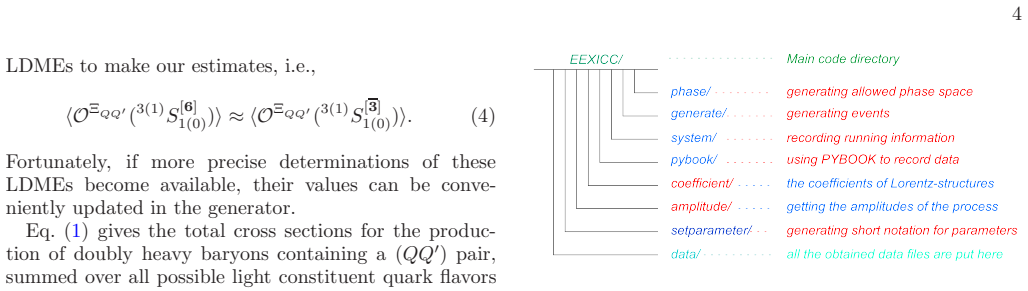
The package contains a total of eight subdirectories within the main directory. The generator is divided into seven modules according to their func- tions, and each module includes the essential files to com- plete the designated tasks for event generation. Addition- ally, the main directory EEXICC contains three Fortran source files: parameter.F, run.F, an...
-
[5]
• PMC: charm-quark mass (in GeV); default value
10 GeV. • PMC: charm-quark mass (in GeV); default value
-
[6]
• PMZ: Z-boson mass (in GeV); default value
80 GeV. • PMZ: Z-boson mass (in GeV); default value
-
[7]
1876 GeV. • PME: electron mass (in GeV); default value 0 . 51 × 10− 3 GeV. • ECM: center-of-mass energy of the initial e+e− sys- tem (in GeV); default value 91 . 1876 GeV. • SINTHETA2: sin 2 θW ; default value 0 . 23119. • MSTU(111): specifies the perturbative order of α s used in PYALPS. Setting MSTU(111)=0 keeps α s fixed at the value defined by PARU(111),...
-
[8]
R. Aaij et al. [LHCb], Observation of the doubly charmed baryon Ξ ++ cc , Phys. Rev. Lett. 119, 112001 (2017)
work page 2017
-
[9]
R. Aaij et al. [LHCb], First Observation of the Doubly Charmed Baryon Decay Ξ ++ cc → Ξ + c π +, Phys. Rev. Lett. 121, 162002 (2018)
work page 2018
-
[10]
R. Aaij et al. [LHCb], Observation of the doubly charmed baryon decay Ξ ++ cc → Ξ ′+ c π +, JHEP 05, 038 (2022)
work page 2022
-
[11]
R. Aaij et al. [LHCb], Observation of the doubly- charmed-baryon decay Ξ ++ cc → Ξ 0 cπ +π +, JHEP 10, 136 (2025)
work page 2025
-
[12]
R. Aaij et al. [LHCb], Observation of the doubly charmed baryon Ξ + cc with the LHCb Run 3 detector, [arXiv:2603.28456 [hep-ex]]
-
[13]
H. Y. Bi, R. Y. Zhang, X. G. Wu, W. G. Ma, X. Z. Li and S. Owusu, Photoproduction of doubly heavy baryon at the LHeC, Phys. Rev. D 95, 074020 (2017)
work page 2017
- [14]
-
[15]
G. Chen, X. G. Wu and S. Xu, Impacts of the intrinsic charm content of the proton on the Ξ cc hadroproduction at a fixed target experiment at the LHC, Phys. Rev. D 100, 054022 (2019)
work page 2019
-
[16]
G. Chen, C. H. Chang and X. G. Wu, Hadronic pro- duction of the doubly charmed baryon via the pro- ton–nucleus and the nucleus–nucleus collisions at the RHIC and LHC, Eur. Phys. J. C 78, 801 (2018)
work page 2018
-
[17]
S. Koshkarev, Production of the Doubly Heavy Baryons, Bc Meson and the All-charm Tetraquark at AF- TER@LHC with Double Intrinsic Heavy Mechanism, Acta Phys. Polon. B 48, 163 (2017)
work page 2017
-
[18]
S. Koshkarev and V. Anikeev, Production of the doubly charmed baryons at the SELEX experiment – The double intrinsic charm approach, Phys. Lett. B 765, 171-174 (2017)
work page 2017
-
[19]
S. Groote and S. Koshkarev, Production of doubly charmed baryons nearly at rest, Eur. Phys. J. C 77, 509 (2017)
work page 2017
-
[20]
A. V. Berezhnoy, A. K. Likhoded and A. V. Luchinsky, Doubly heavy baryons at the LHC, Phys. Rev. D 98, 113004 (2018)
work page 2018
-
[21]
A. V. Berezhnoy, I. N. Belov and A. K. Likhoded, Pro- duction of doubly charmed baryons with the excited heavy diquark at LHC, Int. J. Mod. Phys. A 34, 1950038 (2019)
work page 2019
-
[22]
J. J. Niu, L. Guo, H. H. Ma, X. G. Wu and X. C. Zheng, Production of semi-inclusive doubly heavy baryons via top-quark decays, Phys. Rev. D 98, 094021 (2018)
work page 2018
-
[23]
J. J. Niu, L. Guo, H. H. Ma and X. G. Wu, Production of doubly heavy baryons via Higgs boson decays, Eur. Phys. J. C 79, 339 (2019)
work page 2019
-
[24]
P. H. Zhang, L. Guo, X. C. Zheng and Q. W. Ke, Excited doubly heavy baryon production via W + boson decays, Phys. Rev. D 105, 034016 (2022)
work page 2022
- [25]
-
[26]
X. Luo, H. B. Fu and H. J. Tian, Investigation of Z-boson decay into and baryons within the NRQCD factorization approach, Chin. Phys. C 47, 053102 (2023)
work page 2023
-
[27]
S. Y. Li, Z. Y. Li, Z. G. Si, Z. J. Yang and X. Zhang, Doubly heavy baryon Ξ cc production in Υ(1 S) decay, Phys. Rev. D 104, 114003 (2021)
work page 2021
-
[28]
H. H. Ma, J. J. Niu and X. C. Zheng, Excited doubly heavy baryons production via top-quark decays, Phys. Rev. D 107, 014006 (2023)
work page 2023
-
[29]
H. H. Ma and J. J. Niu, Excited doubly heavy baryons production via Higgs decays, Eur. Phys. J. C 83, 5 (2023)
work page 2023
-
[30]
J. J. Niu, J. B. Li, H. Y. Bi and H. H. Ma, Production of excited doubly heavy baryons at the super-Z factory, Eur. Phys. J. C 83, 822 (2023)
work page 2023
-
[31]
H. H. Ma, J. J. Niu and L. Guo, Further study on excited Ξ QQ′ via photoproduction at CEPC and FCC-ee, JHEP 05, 197 (2025)
work page 2025
-
[32]
C. H. Chang, J. X. Wang and X. G. Wu, GENXICC: A Generator for hadronic production of the double heavy baryons Xi(cc), Xi(bc) and Xi(bb), Comput. Phys. Com- mun. 177, 467-478 (2007)
work page 2007
-
[33]
C. H. Chang, J. X. Wang and X. G. Wu, GENXICC2.0: An Upgraded Version of the Generator for Hadronic Pro- duction of Double Heavy Baryons Xi(cc), Xi(bc) and Xi(bb), Comput. Phys. Commun. 181, 1144-1149 (2010)
work page 2010
-
[34]
C. H. Chang, X. Y. Wang and X. G. Wu, BCVEGPY2.2: A newly upgraded version for hadronic production of the meson Bc and its excited states, Comput. Phys. Com- mun. 197, 335-338 (2015)
work page 2015
-
[35]
T. Sjostrand, S. Mrenna and P. Z. Skands, PYTHIA 6.4 Physics and Manual, JHEP 05, 026 (2006)
work page 2006
-
[36]
W. Abdallah et al. [CEPC Study Group], CEPC Tech- nical Design Report: Accelerator, Radiat. Detect. Tech- nol. Methods 8, 1-1105 (2024). [erratum: Radiat. Detect. Technol. Methods 9, 184-192 (2025)]
work page 2024
-
[37]
A. Abada et al. [FCC], FCC-ee: The Lepton Collider: Future Circular Collider Conceptual Design Report Vol- ume 2, Eur. Phys. J. ST 228, 261-623 (2019)
work page 2019
-
[38]
A. Aryshev et al. [ILC International Development Team], The International Linear Collider: Report to Snowmass 2021, [arXiv:2203.07622 [physics.acc-ph]]
-
[39]
J. P. Ma and Z. X. Zhang, (the super Z-factory group), Preface, Sci. China: Phys. Mech. Astron. 53, 1947(2010)
work page 1947
- [40]
- [41]
-
[42]
G. T. Bodwin, E. Braaten and G. P. Lepage, Rigorous QCD analysis of inclusive annihilation and production of heavy quarkonium, Phys. Rev. D 51, 1125-1171 (1995)
work page 1995
-
[43]
C. H. Chang and Y. Q. Chen, The Production of B(c) or anti-B(c) meson associated with two heavy quark jets in Z0 boson decay, Phys. Rev. D 46, 3845 (1992), [erratum: Phys. Rev. D 50, 6013 (1994)]
work page 1992
-
[44]
C. H. Chang, J. X. Wang and X. G. Wu, Production of Bc or ¯Bc meson and its excited states via ¯t quark or t quark decays, Phys. Rev. D 77, 014022 (2008)
work page 2008
-
[45]
L. C. Deng, X. G. Wu, Z. Yang, Z. Y. Fang and Q. L. Liao, Z0 Boson Decays to B(∗ ) c Meson and Its Un- certainties, Eur. Phys. J. C 70, 113-124 (2010)
work page 2010
-
[46]
Z. Yang, X. G. Wu, L. C. Deng, J. W. Zhang and G. Chen, Production of the P -Wave Excited Bc-States through the Z0 Boson Decays, Eur. Phys. J. C 71, 1563 (2011)
work page 2011
-
[47]
Z. Yang, X. G. Wu, G. Chen, Q. L. Liao and J. W. Zhang, Bc Meson Production around the Z0 Peak at a High Lu- minosity e+e− Collider, Phys. Rev. D 85, 094015 (2012)
work page 2012
- [48]
-
[49]
G. P. Lepage, A New Algorithm for Adaptive Multidi- mensional Integration, J. Comput. Phys. 27, 192 (1978)
work page 1978
-
[50]
X. C. Zheng, C. H. Chang and Z. Pan, Production of doubly heavy-flavored hadrons at e+e− colliders, Phys. Rev. D 93, 034019 (2016)
work page 2016
-
[51]
J. P. Ma and Z. G. Si, Factorization approach for inclu- sive production of doubly heavy baryon, Phys. Lett. B 568, 135-145 (2003)
work page 2003
-
[52]
C. H. Chang, C. F. Qiao, J. X. Wang and X. G. Wu, Es- timate of the hadronic production of the doubly charmed baryon Xi(cc) under GM-VFN scheme, Phys. Rev. D 73, 094022 (2006)
work page 2006
-
[53]
S. P. Baranov, On the production of doubly flavored baryons in p p, e p and gamma gamma collisions, Phys. Rev. D 54, 3228-3236 (1996)
work page 1996
discussion (0)
Sign in with ORCID, Apple, or X to comment. Anyone can read and Pith papers without signing in.