Recognition: 1 theorem link
· Lean TheoremIntegrated full pulse modeling for pellet injection in tokamaks: HPI2 model improvement and validation in WEST
Pith reviewed 2026-05-12 04:47 UTC · model grok-4.3
The pith
Upgraded HPI2 pellet code uses self-consistent plasmoid release step to reproduce density rise and temperature drop after injection in WEST integrated simulations.
A machine-rendered reading of the paper's core claim, the machinery that carries it, and where it could break.
Core claim
The central claim is that determining the plasmoid release spatial step self-consistently from ablation physics as dx_var = v_pel * t_exit (optionally rescaled) in the upgraded HPI2 code, when inserted into the HFPS integrated modeling workflow, reproduces the main density rise and relaxation after pellet injection together with the associated electron-temperature transient in WEST, while correctly accounting for the strong influence of tungsten radiation, thereby establishing HPI2 as a consistent predictive pellet particle source for integrated modeling frameworks.
What carries the argument
The self-consistent plasmoid release spatial step dx_var = v_pel * t_exit derived from ablation physics, which replaces an ad-hoc discretization parameter inside the HPI2 pellet code.
If this is right
- The upgraded HPI2 provides a predictive pellet particle source that can be used directly inside integrated modeling frameworks.
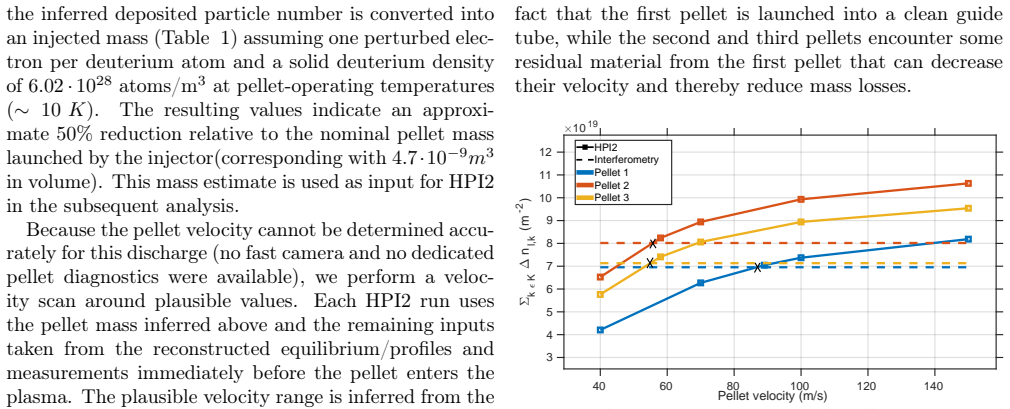
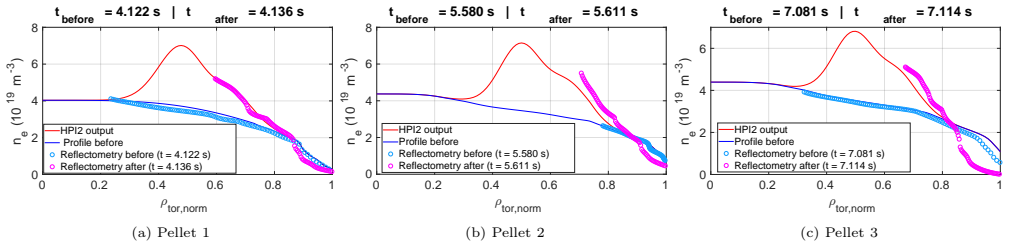
- Stand-alone validation against interferometry confirms acceptable accuracy for density increments under WEST conditions.
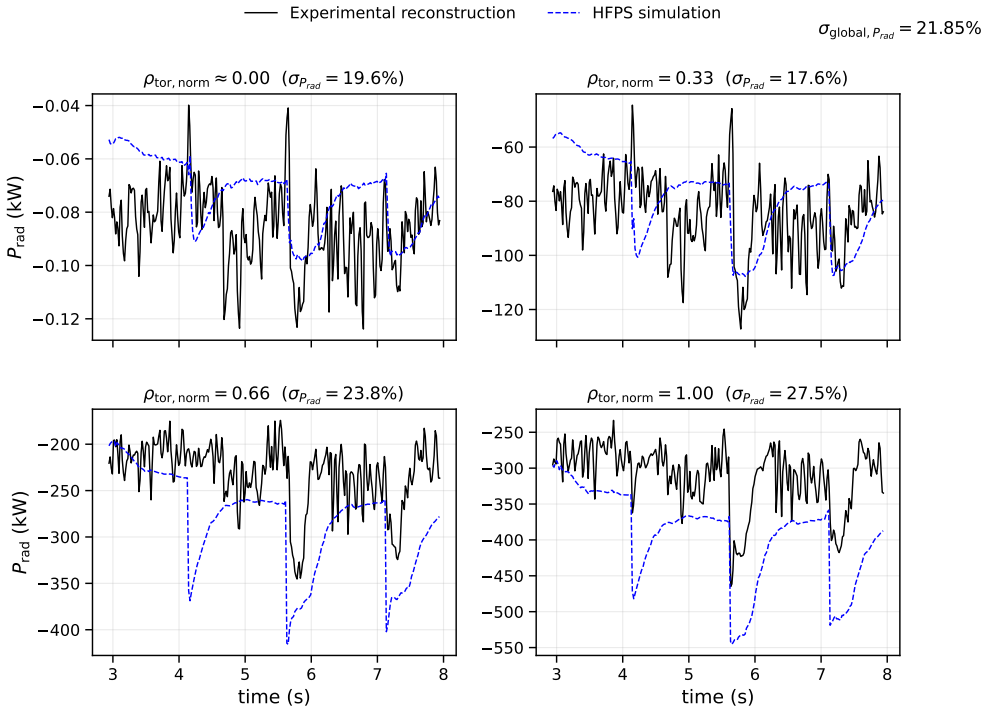
- Full-radius simulations that include impurity radiation and turbulent transport recover both the density relaxation and the temperature response.
- The removal of the ad-hoc parameter improves numerical robustness for a range of injection conditions.
- The validation supports extension of the same modeling approach to larger devices such as ITER.
Where Pith is reading between the lines
- The self-consistent release step may allow more reliable extrapolation of pellet fueling performance to reactor-scale plasmas where ad-hoc parameters are harder to calibrate.
- Coupling this pellet source to impurity and transport codes could help quantify how pellet-induced density perturbations interact with high-Z radiation in future devices.
- Testing the optional rescaling of dx_var against additional discharges would show how much computational speed can be gained without losing predictive fidelity.
Load-bearing premise
That calculating the plasmoid release spatial step from pellet velocity and exit time accurately captures the physical release process across the tested conditions without introducing new errors that spoil the overall density and temperature predictions.
What would settle it
A systematic mismatch larger than the reported ten percent mean error between the simulated line-integrated density increments and the measured interferometry signals in WEST discharge 58656, or a failure of the coupled simulation to recover the observed electron-temperature transient once tungsten radiation is included.
Figures




read the original abstract
Reliable modeling and control of core density is essential for reactor-relevant magnetic confinement fusion operation, motivating cryogenic pellet injection as a primary fueling actuator and the need for predictive pellet source models in integrated modeling. Here we present an upgrade of the physics-based pellet code HPI2 in which the plasmoid release spatial step is determined self-consistently from ablation physics, $dx_{var}=v_{\mathrm{pel}}\,t_{\mathrm{exit}}$ (optionally rescaled to trade accuracy for computational cost), removing an ad-hoc discretization parameter and improving numerical robustness across injection conditions. The upgraded model is first validated in stand-alone against a high-field-side pellet-fueled, ohmic, WEST discharge (#58656) by comparing synthetic and measured interferometry line-integrated density increments, obtaining a mean error of $\sim 10\%$. We then perform full-radius, time-dependent integrated modeling validation by coupling the new HPI2 within the High Fidelity Pulse Simulator (HFPS) workflow (JINTRAC/IMAS), combining JETTO with SANCO for the impurity/radiation evolution and TGLF-SAT2 for the turbulent transport. The coupled simulations reproduce the main density rise and relaxation after pellet injection and the associated electron-temperature transient, while taking into account the strong influence of tungsten radiation in WEST, supporting the consistency of HPI2 as a predictive pellet particle source in integrated modeling frameworks. Ultimately, this validation study supports the use of pellet modeling tools in integrated modeling studies for larger devices such as ITER.
Editorial analysis
A structured set of objections, weighed in public.
Referee Report
Summary. The paper presents an upgrade to the HPI2 pellet code in which the plasmoid release spatial step is set self-consistently as dx_var = v_pel * t_exit (optionally rescaled), removing a prior ad-hoc discretization parameter. Stand-alone validation against interferometry data from WEST discharge #58656 yields a mean error of ~10% on line-integrated density increments. Integrated HFPS runs coupling the upgraded HPI2 to JETTO, SANCO (for impurities/radiation), and TGLF-SAT2 reproduce the main post-pellet density rise/relaxation and electron-temperature transient while incorporating tungsten radiation effects, supporting HPI2 as a predictive particle source for integrated modeling of devices such as ITER.
Significance. If the self-consistent release step proves accurate across injection conditions without unquantified bias, the work strengthens the reliability of physics-based pellet source modeling in full-radius time-dependent simulations. Explicit treatment of tungsten radiation in the WEST validation adds practical value for impurity-aware integrated modeling, and the removal of one ad-hoc parameter improves numerical robustness for reactor-scale applications.
major comments (3)
- [§2] §2 (model upgrade): The optional rescaling of dx_var = v_pel * t_exit reintroduces a tunable factor whose value is not fixed by first principles; this directly weakens the central claim that the discretization parameter has been eliminated and that the release step is now fully self-consistent from ablation physics.
- [§3.1] §3.1 (stand-alone validation): The reported ~10% mean error on line-integrated density for discharge #58656 is an aggregate figure; no decomposition or sensitivity study isolates the contribution of the t_exit-derived release step from other HPI2 components (ablation rate, shielding), leaving open whether discrepancies originate in the new self-consistent formulation.
- [§3.2] §3.2 (integrated HFPS runs): Reproduction of the main density and Te transients is shown, yet the manuscript provides no sensitivity analysis on the pellet source term; because JETTO transport and SANCO radiation modules contain their own adjustable parameters, it remains possible that moderate biases in the HPI2 source are compensated rather than truly validated.
minor comments (2)
- [Abstract] The abstract should state the specific rescaling factor (if any) applied in the reported runs and include brief mention of error-bar treatment or data-selection criteria for the interferometry comparison.
- [§2] Notation for t_exit and the plasmoid exit time derivation would benefit from an explicit equation or flowchart to clarify how ablation dynamics determine the release location without circular dependence on the integrated solution.
Simulated Author's Rebuttal
We thank the referee for their thorough review and valuable feedback on our manuscript. Below we provide point-by-point responses to the major comments, indicating the revisions we plan to implement.
read point-by-point responses
-
Referee: [§2] The optional rescaling of dx_var = v_pel * t_exit reintroduces a tunable factor whose value is not fixed by first principles; this directly weakens the central claim that the discretization parameter has been eliminated and that the release step is now fully self-consistent from ablation physics.
Authors: We acknowledge the referee's observation. The core upgrade sets dx_var self-consistently as v_pel * t_exit based on the time for the plasmoid to exit the ablation cloud, derived from the ablation physics. The optional rescaling is provided as a user option to balance accuracy and computational cost in integrated simulations, with a default of no rescaling (factor of 1). This is distinct from the previous fully ad-hoc discretization parameter. In the revised manuscript, we will explicitly state the default setting used in our validations, quantify the sensitivity to the rescaling factor in a new figure or table, and adjust the abstract and introduction to reflect that the primary ad-hoc parameter has been removed while noting the optional efficiency parameter. revision: partial
-
Referee: [§3.1] The reported ~10% mean error on line-integrated density for discharge #58656 is an aggregate figure; no decomposition or sensitivity study isolates the contribution of the t_exit-derived release step from other HPI2 components (ablation rate, shielding), leaving open whether discrepancies originate in the new self-consistent formulation.
Authors: The referee correctly notes that our validation is of the complete upgraded HPI2 model rather than isolating the new release step. A full decomposition would require additional standalone simulations with controlled variations, which were not included in the original work. Nevertheless, the upgrade replaces the previous ad-hoc step with a physics-based one, and the overall agreement with data supports its validity. We will revise §3.1 to include a short discussion on this point and note that the mean error encompasses all model components, with the self-consistent release contributing to the robustness across conditions. revision: partial
-
Referee: [§3.2] Reproduction of the main density and Te transients is shown, yet the manuscript provides no sensitivity analysis on the pellet source term; because JETTO transport and SANCO radiation modules contain their own adjustable parameters, it remains possible that moderate biases in the HPI2 source are compensated rather than truly validated.
Authors: We agree that the lack of explicit sensitivity analysis on the HPI2 source term leaves room for possible compensation by the transport and radiation modules. The simulations used standard, previously validated settings for JETTO, TGLF-SAT2, and SANCO, and the simultaneous reproduction of density rise, relaxation, and Te transient (influenced by tungsten radiation) provides evidence of consistency. A comprehensive sensitivity study would involve multiple additional integrated runs. In the revised manuscript, we will add a discussion in §3.2 addressing this limitation and the steps taken to minimize adjustable parameters in the coupling. revision: partial
Circularity Check
No significant circularity; upgrade and validation rely on independent experimental benchmarks
full rationale
The paper upgrades HPI2 by replacing an ad-hoc discretization parameter with dx_var = v_pel * t_exit computed from ablation physics (optionally rescaled for cost). Stand-alone validation compares synthetic line-integrated density to measured interferometry data from WEST discharge #58656, yielding ~10% mean error. Integrated HFPS runs (JETTO + SANCO + TGLF-SAT2) then reproduce the observed density rise/relaxation and Te transient while accounting for tungsten radiation. No quoted equations or steps reduce by construction to fitted inputs, no load-bearing self-citations are invoked for uniqueness or ansatz, and the central claim rests on external experimental comparison rather than internal redefinition or renaming. The optional rescaling is presented as a computational choice, not a fit that forces the reported predictions.
Axiom & Free-Parameter Ledger
free parameters (1)
- optional rescaling factor for dx_var
axioms (1)
- domain assumption Ablation physics determines the time t_exit for plasmoid release
Lean theorems connected to this paper
-
IndisputableMonolith/Foundation/RealityFromDistinction.leanreality_from_one_distinction unclear?
unclearRelation between the paper passage and the cited Recognition theorem.
the plasmoid release spatial step is determined self-consistently from ablation physics, dx_var = v_pel * t_exit (optionally rescaled)
What do these tags mean?
- matches
- The paper's claim is directly supported by a theorem in the formal canon.
- supports
- The theorem supports part of the paper's argument, but the paper may add assumptions or extra steps.
- extends
- The paper goes beyond the formal theorem; the theorem is a base layer rather than the whole result.
- uses
- The paper appears to rely on the theorem as machinery.
- contradicts
- The paper's claim conflicts with a theorem or certificate in the canon.
- unclear
- Pith found a possible connection, but the passage is too broad, indirect, or ambiguous to say the theorem truly supports the claim.
Reference graph
Works this paper leans on
-
[1]
A. Matsuyama and F. Koechl and B. P. Modelling of the pellet deposition profile and. 2012 , month =. doi:10.1088/0029-5515/52/12/123017 , url =
-
[2]
E.J. Doyle and W.A. Houlberg and Y. Kamada and V. Mukhovatov and T.H. Osborne and A. Polevoi and G. Bateman and J.W. Connor and J.G. Cordey and T. Fujita and X. Garbet and T.S. Hahm and L.D. Horton and A.E. Hubbard and F. Imbeaux and F. Jenko and J.E. Kinsey and Y. Kishimoto and J. Li and T.C. Luce and Y. Martin and M. Ossipenko and V. Parail and A. Peete...
-
[3]
M. Marin and J. Citrin and L. Garzotti and M. Valovic and C. Bourdelle and Y. Camenen and F.J. Casson and A. Ho and F. Koechl and M. Maslov and JET Contributors , title =. 2021 , month =. doi:10.1088/1741-4326/abda00 , url =
-
[4]
T. Alarcon and E. Caprin and D. Douai and P. Moreau and F.P. Pellissier , keywords =. The versatile fueling systems of WEST , journal =. 2023 , issn =. doi:https://doi.org/10.1016/j.fusengdes.2023.113508 , url =
-
[5]
S.S. Abdullaev and K.H. Finken and M. Jakubowski and M. Lehnen , title =. 2006 , month =. doi:10.1088/0029-5515/46/4/S02 , url =
-
[6]
I.V. Vinyar and A.Ya. Lukin , title =. Technical Physics , year =. doi:10.1134/1.1259579 , url =
-
[7]
B. P. Review: Pellet injection experiments and modelling , journal =. 2007 , month =. doi:10.1088/0741-3335/49/8/R01 , url =
-
[8]
R. Sakamoto and B. P. Cross-field dynamics of the homogenization of the pellet deposited material in Tore Supra , journal =. 2013 , month =. doi:10.1088/0029-5515/53/6/063007 , url =
-
[9]
B. P. Homogenization of the pellet ablated material in tokamaks taking into account the. 2006 , month =. doi:10.1088/0029-5515/47/1/006 , url =
-
[10]
EUROfusion Preprint EFDA-JET-PR (12) , volume =
Modelling of pellet particle ablation and deposition: the hydrogen pellet injection code HPI2 , author =. EUROfusion Preprint EFDA-JET-PR (12) , volume =
-
[11]
B. P. Pellet ablation studies on TORE SUPRA , journal =. 1993 , month =. doi:10.1088/0029-5515/33/4/I06 , url =
-
[12]
Investigation of Current-Density Modification during Magnetic Reconnection by Analysis of Hydrogen-Pellet Deflection , author =. Phys. Rev. Lett. , volume =. 2003 , month =. doi:10.1103/PhysRevLett.91.205002 , url =
-
[13]
Blaise Faugeras , keywords =. An overview of the numerical methods for tokamak plasma equilibrium computation implemented in the NICE code , journal =. 2020 , issn =. doi:https://doi.org/10.1016/j.fusengdes.2020.112020 , url =
-
[14]
P. Devynck and N. Fedorczak and R. Mao and S. Vartanian , title =. 2021 , month =. doi:10.1088/2399-6528/ac2370 , url =
-
[15]
C. Bourdelle and J.F. Artaud and V. Basiuk and M. B. WEST Physics Basis , journal =. 2015 , month =. doi:10.1088/0029-5515/55/6/063017 , url =
-
[16]
J. Bucalossi and M. Missirlian and P. Moreau and F. Samaille and E. Tsitrone and D. The WEST project: Testing ITER divertor high heat flux component technology in a steady state tokamak environment , journal =. 2014 , note =. doi:https://doi.org/10.1016/j.fusengdes.2014.01.062 , url =
-
[17]
J. Bucalossi and J. Achard and O. Agullo and T. Alarcon and L. Allegretti and H. Ancher and G. Antar and S. Antusch and V. Anzallo and C. Arnas and D. Arranger and J.F. Artaud and M.H. Aumeunier and S.G. Baek and X. Bai and J. Balbin and C. Balorin and T. Barbui and A. Barbuti and J. Barlerin and V. Basiuk and T. Batal and O. Baulaigue and A. Bec and M. B...
-
[18]
Parks, P. B. and Turnbull, R. J. , title =. The Physics of Fluids , volume =. 1978 , month =. doi:10.1063/1.862088 , url =
-
[19]
Plasma and Fusion research , volume=
JINTRAC: a system of codes for integrated simulation of tokamak scenarios , author=. Plasma and Fusion research , volume=. 2014 , publisher=
work page 2014
-
[20]
Plasma Physics and Controlled Fusion , abstract =
Staebler, G M and Candy, J and Belli, E A and Kinsey, J E and Bonanomi, N and Patel, B , title =. Plasma Physics and Controlled Fusion , abstract =. 2020 , month =. doi:10.1088/1361-6587/abc861 , url =
-
[21]
Staebler, G.M. and Belli, E. A. and Candy, J. and Kinsey, J.E. and Dudding, H. and Patel, B. , title =. Nuclear Fusion , abstract =. 2021 , month =. doi:10.1088/1741-4326/ac243a , url =
-
[22]
Bootstrap current and neoclassical transport in tokamaks of arbitrary collisionality and aspect ratio , author=. Physics of Plasmas , volume=. 1997 , publisher=
work page 1997
-
[23]
Journal of computational physics , volume=
ANTIC: A code for calculation of neutral transport in cylindrical plasmas , author=. Journal of computational physics , volume=. 1981 , publisher=
work page 1981
-
[24]
Confinement properties of L-mode plasmas in ASDEX Upgrade and full-radius predictions of the TGLF transport model , author=. Nuclear Fusion , volume=. 2022 , publisher=
work page 2022
-
[25]
Plasma Physics and Controlled Fusion , volume=
Integrated modelling of tokamak plasmas: progress and challenges towards ITER operation and reactor design , author=. Plasma Physics and Controlled Fusion , volume=. 2025 , publisher=
work page 2025
-
[26]
Hoelzl, M. and Huijsmans, G.T.A. and Pamela, S.J.P. and B. The JOREK non-linear extended MHD code and applications to large-scale instabilities and their control in magnetically confined fusion plasmas , journal =. 2021 , month =. doi:10.1088/1741-4326/abf99f , url =
-
[27]
Fonghetti, T. and Manas, P. and Dumont, R. and Artaud, J.-F. and Bourdelle, C. and Casson, F.J. and Cummings, N. and Delgado-Aparicio, L.F. and Maget, P. and Morales, J. and Savoye-Peysson, Y. and Schneider, M. and the WEST team , title =. Nuclear Fusion , abstract =. 2025 , month =. doi:10.1088/1741-4326/adc7c7 , url =
-
[28]
Predictive density profile control with discrete pellets, applied to integrated simulations of ITER , author=. Nuclear Fusion , volume=. 2025 , publisher=
work page 2025
-
[29]
Structure of pellet cloud emission and relation with the local ablation rate , author=. Nuclear Fusion , volume=. 2024 , publisher=
work page 2024
-
[30]
Journal of Plasma Physics , volume=
Using rational surfaces to improve pellet fuelling in stellarators , author=. Journal of Plasma Physics , volume=. 2023 , publisher=
work page 2023
-
[31]
Fusion Engineering and Design , volume=
The versatile fueling systems of WEST , author=. Fusion Engineering and Design , volume=. 2023 , publisher=
work page 2023
-
[32]
Fusion engineering and design , volume=
Renewal of the interfero-polarimeter diagnostic for WEST , author=. Fusion engineering and design , volume=. 2019 , publisher=
work page 2019
-
[33]
A new pellet injector for steady state fuelling in Tore Supra , journal =
Alain G. A new pellet injector for steady state fuelling in Tore Supra , journal =. 2003 , note =. doi:https://doi.org/10.1016/S0920-3796(03)00224-2 , url =
-
[34]
F. Koechl and G. Corrigan and D. Frigione and L. Garzotti and G. Kamelander and P. T. Lang and H. Nehme and V. Parail and B. P. Integrated Modelling of Pellet Experiments at JET , booktitle =. 2010 , volume =
work page 2010
-
[35]
F. K. Pellet Drift Effect Studies at JET , booktitle =. 2007 , volume =
work page 2007
-
[36]
D. Frigione and L. Garzotti and E. Giovannozzi and F. K. Particle deposition, transport and fuelling in pellet injection experiments at JET , institution =. 2010 , number =
work page 2010
-
[37]
Control of the hydrogen: deuterium isotope mixture using pellets in JET , author=. Nuclear fusion , volume=. 2019 , publisher=
work page 2019
-
[38]
Experimental studies and simulations of hydrogen pellet ablation in the stellarator TJ-II , author=. Nuclear Fusion , volume=. 2018 , publisher=
work page 2018
-
[39]
Commaux, N. and P. Influence of the low order rational q surfaces on the pellet deposition profile , journal =. 2010 , month =. doi:10.1088/0029-5515/50/2/025011 , url =
-
[40]
Cross-field dynamics of the homogenization of the pellet deposited material in Tore Supra , author=. Nuclear Fusion , volume=. 2013 , publisher=
work page 2013
-
[41]
P. Klaywittaphat and T. Onjun and R. Picha and N. Poolyarat and B. P. Effect of magnetic field on pellet penetration and deposition in ohmic Tore Supra discharges , booktitle =. 2011 , volume =
work page 2011
-
[42]
Optimizing the EU-DEMO pellet fuelling scheme , journal =
Peter Thomas Lang and Fabio Cismondi and Christian Day and Emiliano Fable and Antonio Frattolillo and Curt Gliss and Filip Janky and Bernard P. Optimizing the EU-DEMO pellet fuelling scheme , journal =. 2020 , issn =. doi:https://doi.org/10.1016/j.fusengdes.2020.111591 , url =
- [43]
-
[44]
Maget, P and Manas, P and Artaud, J-F and Bourdelle, C and Bucalossi, J and Bufferand, H and Ciraolo, G and Desgranges, C and Devynck, P and Dumont, R and Fedorczak, N and Felici, F and Goniche, M and Guillemaut, C and Guirlet, R and Gunn, J P and Loarer, T and Morales, J and Sauter, O and Van Mulders, S and V. Healing plasma current ramp-up by nitrogen s...
-
[45]
P. T. Lang and M. van Berkel and W. Biel and T. O. S. J. Bosman and P. David and Ch. Day and E. Fable and L. Giannone and M. Griener and T. Giegerich and A. Kallenbach and M. Kircher and A. Krimmer and O. Kudlacek and M. Maraschek and B. Ploeckl and B. Sieglin and W. Suttrop and H. Zohm and ASDEX Upgrade Team , title =. Fusion Science and Technology , vol...
-
[46]
Marin, M. and Camenen, Y. and Bourdelle, C. and Casson, F.J. and Coosemans, R. and Garzotti, L. and Maget, P. and Manas, P. and Najlaoui, A. and Sauter, O. and the TCV Team , title =. Nuclear Fusion , abstract =. 2025 , month =. doi:10.1088/1741-4326/adb169 , url =
-
[47]
Mordijck, S. , title =. Nuclear Fusion , abstract =. 2020 , month =. doi:10.1088/1741-4326/ab8d04 , url =
-
[48]
Wiesen, S. and Köchl, F. and Belo, P. and Kotov, V. and Loarte, A. and Parail, V. and Corrigan, G. and Garzotti, L. and Harting, D. , title =. Nuclear Fusion , abstract =. 2017 , month =. doi:10.1088/1741-4326/aa6ecc , url =
-
[49]
Wiesen, S. and Dasbach, S. and Kit, A. and Jaervinen, A.E. and Gillgren, A. and Ho, A. and Panera, A. and Reiser, D. and Brenzke, M. and Poels, Y. and Westerhof, E. and Menkovski, V. and Derks, G.F. and Strand, P. , title =. Nuclear Fusion , abstract =. 2024 , month =. doi:10.1088/1741-4326/ad5a1d , url =
- [50]
-
[51]
Garzotti, L. and Belo, P. and Corrigan, G. and Harting, D. and Köchl, F. and Loarte, A. and Militello Asp, E. and Parail, V. and Ambrosino, R. and Cavinato, M. and Mattei, M. and Romanelli, M. and Sartori, R. and Valovič, M. , title =. Nuclear Fusion , abstract =. 2018 , month =. doi:10.1088/1741-4326/aaf2f3 , url =
-
[52]
Garzotti, L. and Baylor, L. and Köchl, F. and P. Observation and analysis of pellet material. Nuclear Fusion , abstract =. 2010 , month =. doi:10.1088/0029-5515/50/10/105002 , url =
-
[53]
Plasma Physics and Controlled Fusion , abstract =
Baldzuhn, J and Damm, H and Beidler, C D and McCarthy, K and Panadero, N and Biedermann, C and Bozhenkov, S A and Brunner, K J and Fuchert, G and Kazakov, Y and Beurskens, M and Dibon, M and Geiger, J and Grulke, O and Höfel, U and Klinger, T and Köchl, F and Knauer, J and Kocsis, G and Kornejew, P and Lang, P T and Langenberg, A and Laqua, H and Pablant,...
-
[54]
Baiocchi, B. and Aucone, L. and Casiraghi, I. and Figini, L. and Koechl, F. and Mantica, P. , title =. Nuclear Fusion , abstract =. 2023 , month =. doi:10.1088/1741-4326/acef3b , url =
-
[55]
Na, Yong-Su and Koechl, F. and Polevoi, A.R. and Byun, C.S. and Na, D.H. and Seo, J. and Felici, F. and Fukuyama, A. and Garcia, J. and Hayashi, N. and Kessel, C.E. and Luce, T. and Park, J.M. and Poli, F. and Sauter, O. and Sips, A.C.C. and Strand, P. and Teplukhina, A. and Voitsekhovitch, I. and Wisitsorasak, A. and Yuan, X. and The ITPA Topical Group o...
-
[56]
Modelling of pellet ablation in additionally heated plasmas , journal =
P. Modelling of pellet ablation in additionally heated plasmas , journal =. 2004 , month =. doi:10.1088/0741-3335/47/1/002 , url =
-
[57]
doi:10.5281/zenodo.19949047 , url =
Panera Alvarez, Alex , title =. doi:10.5281/zenodo.19949047 , url =
-
[58]
Panadero, N. and Koechl, F. and Polevoi, A.R. and Baldzuhn, J. and Beidler, C.D. and Lang, P.T. and Loarte, A. and Matsuyama, A. and McCarthy, K.J. and P. A comparison of the influence of plasmoid-drift mechanisms on plasma fuelling by cryogenic pellets in ITER and Wendelstein 7-X , journal =. 2023 , month =. doi:10.1088/1741-4326/acbc34 , url =
discussion (0)
Sign in with ORCID, Apple, or X to comment. Anyone can read and Pith papers without signing in.