Recognition: 3 theorem links
· Lean TheoremBreaking Free from the Swampland of Impossible Universes through the DESI Portal
Pith reviewed 2026-05-12 04:18 UTC · model grok-4.3
The pith
Recent DESI measurements favoring evolving dark energy may allow string theory to escape the de Sitter swampland.
A machine-rendered reading of the paper's core claim, the machinery that carries it, and where it could break.
Core claim
The central claim is that the apparent preference in recent DESI data for a time-evolving dark energy density, rather than a constant Lambda, opens a pathway for string theory to describe our universe without violating the de Sitter swampland conjectures that forbid stable de Sitter spaces.
What carries the argument
The de Sitter swampland conjecture, which states that effective field theories admitting stable de Sitter vacua cannot arise from consistent string theory compactifications.
If this is right
- Constant dark energy models such as Lambda CDM become harder to reconcile with string theory.
- Dynamical dark energy scenarios gain support as more likely to be consistent with quantum gravity.
- String theory models incorporating quintessence-like fields can now be confronted directly with cosmological data.
- The observed reduction in dark energy density over the last several billion years supplies a concrete target for string constructions.
Where Pith is reading between the lines
- If the DESI trend holds, next-generation surveys such as Euclid or the Rubin Observatory could further test whether the evolution matches specific string-theory predictions for the dark energy equation of state.
- Any alternative Lambda CDM explanation for the DESI results would have to be exhaustively excluded before the string-theory compatibility argument can be considered robust.
- Explicit model-building efforts could now focus on string compactifications that naturally produce a slowly rolling scalar field whose energy density drops by about ten percent in the recent past.
Load-bearing premise
The preference for evolving dark energy reported by DESI reflects the true expansion history rather than unaccounted systematics or alternative explanations still allowed inside Lambda CDM.
What would settle it
Future surveys returning a clear confirmation of constant dark energy density, or an explicit construction of a stable de Sitter vacuum within string theory, would remove the proposed resolution.
Figures

read the original abstract
The persistent challenge of creating stable de Sitter vacua within string theory undermines the observational validity of the $\Lambda$ cold dark matter (CDM) model. This difficulty suggests that the concordance model of cosmology, characterized by a constant dark energy $\Lambda$, may reside in the swampland of inconsistent quantum gravity theories rather than the string landscape of consistent ones. Recent observational data, particularly from the Dark Energy Spectroscopic Instrument (DESI), have significantly challenged $\Lambda$CDM cosmology. Specifically, the combination of DESI baryon acoustic oscillation measurements with cosmological surveys seem to indicate a preference for a dynamic, time-evolving dark energy rather than a constant, with roughly 10\% reduction in density over the last several billion years. This review summarizes significant advancements made over the past two years in linking DESI findings to string-inspired scenarios.
Editorial analysis
A structured set of objections, weighed in public.
Referee Report
Summary. The manuscript is a review summarizing the string-theory de Sitter swampland problem for constant-Lambda cosmologies and recent DESI BAO measurements (combined with other surveys) that appear to favor time-evolving dark energy with an approximately 10% density reduction over the last several billion years. It compiles advancements from the past two years that connect these observations to string-inspired models with dynamic dark energy, thereby offering a potential route out of the swampland.
Significance. If the cited DESI preference for evolving dark energy is robust, the review usefully consolidates literature at the interface of observational cosmology and string theory. Its value lies in synthesizing external results rather than deriving new ones; credit is due for focusing on falsifiable observational inputs (DESI BAO) and for avoiding internal derivations that could introduce circularity.
minor comments (1)
- Abstract: the quantitative claim of a 'roughly 10% reduction in density' should be tied explicitly to a cited DESI analysis or table in the main text so readers can trace the origin of the number without ambiguity.
Simulated Author's Rebuttal
We thank the referee for their positive assessment of the manuscript as a timely review synthesizing DESI observations with string-theory swampland considerations, and for recommending minor revision. We agree that the value lies in consolidating external results rather than new derivations, and we have prepared minor updates to improve clarity and completeness.
Circularity Check
No significant circularity: review of external data and literature
full rationale
The paper is explicitly a review that summarizes existing DESI BAO results from external surveys and prior string-theory constructions for time-varying dark energy. No new derivations, parameter fits, predictions, or model-building equations are introduced whose validity depends on quantities defined inside the manuscript. All central claims rest on cited external analyses rather than self-referential definitions or internal reductions, satisfying the default expectation of no circularity.
Axiom & Free-Parameter Ledger
axioms (2)
- domain assumption Stable de Sitter vacua are difficult or impossible to construct in string theory (swampland conjecture).
- domain assumption DESI BAO measurements combined with other surveys genuinely favor evolving dark energy.
Lean theorems connected to this paper
-
IndisputableMonolith/Cost/FunctionalEquation.leanwashburn_uniqueness_aczel unclear?
unclearRelation between the paper passage and the cited Recognition theorem.
dS conjecture... Mp |∇V|/V ≡ c′ ≳ O(1) or −Mp² min(∇i∇jV)/V ≡ c″ ≳ O(1)
-
IndisputableMonolith/Foundation/AlphaCoordinateFixation.leancostAlphaLog_fourth_deriv_at_zero unclear?
unclearRelation between the paper passage and the cited Recognition theorem.
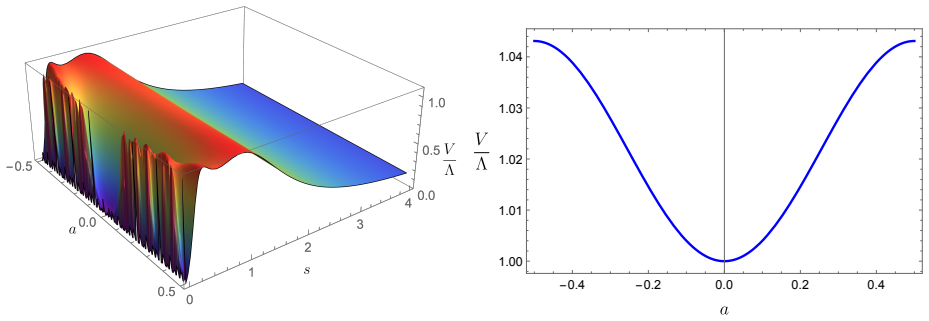
V(ϕ) = Λ sech(κ ϕ/Mp) ... V(s) = 2Λ/(s + 1/s)
What do these tags mean?
- matches
- The paper's claim is directly supported by a theorem in the formal canon.
- supports
- The theorem supports part of the paper's argument, but the paper may add assumptions or extra steps.
- extends
- The paper goes beyond the formal theorem; the theorem is a base layer rather than the whole result.
- uses
- The paper appears to rely on the theorem as machinery.
- contradicts
- The paper's claim conflicts with a theorem or certificate in the canon.
- unclear
- Pith found a possible connection, but the passage is too broad, indirect, or ambiguous to say the theorem truly supports the claim.
Reference graph
Works this paper leans on
-
[1]
A. G. Riesset al.[Supernova Search Team], Observational evidence from supernovae for an accelerating universe and a cosmological constant, Astron. J.116, 1009-1038 (1998) doi:10.1086/300499 [arXiv:astro-ph/9805201 [astro-ph]]
work page internal anchor Pith review Pith/arXiv arXiv doi:10.1086/300499 1998
-
[2]
Measurements of Omega and Lambda from 42 High-Redshift Supernovae
S. Perlmutteret al.[Supernova Cosmology Project], Measurements of Ω and Λ from 42 High Redshift Supernovae, Astrophys. J.517, 565-586 (1999) doi:10.1086/307221 [arXiv:astro- ph/9812133 [astro-ph]]
work page internal anchor Pith review doi:10.1086/307221 1999
-
[3]
G. Efstathiou, W. J. Sutherland and S. J. Maddox, The cosmological constant and cold dark matter, Nature348, 705-707 (1990) doi:10.1038/348705a0
-
[4]
Nine-Year Wilkinson Microwave Anisotropy Probe (WMAP) Observations: Cosmological Parameter Results
G. Hinshawet al.[WMAP], Nine-Year Wilkinson Microwave Anisotropy Probe (WMAP) Observations: Cosmological Parameter Results, Astrophys. J. Suppl.208, 19 (2013) doi:10.1088/0067-0049/208/2/19 [arXiv:1212.5226 [astro-ph.CO]]
-
[5]
Planck 2018 results. VI. Cosmological parameters
N. Aghanimet al.[Planck], Planck 2018 results VI: Cosmological parameters, Astron. As- trophys.641, A6 (2020) [erratum: Astron. Astrophys.652, C4 (2021)] doi:10.1051/0004- 6361/201833910 [arXiv:1807.06209 [astro-ph.CO]]
work page internal anchor Pith review Pith/arXiv arXiv doi:10.1051/0004- 2018
-
[6]
DESI DR2 Results II: Measurements of Baryon Acoustic Oscillations and Cosmological Constraints
M. Abdul Karimet al.[DESI], DESI DR2 results II: Measurements of baryon acoustic oscilla- tions and cosmological constraints, Phys. Rev. D112, no.8, 083515 (2025) doi:10.1103/tr6y- kpc6 [arXiv:2503.14738 [astro-ph.CO]]. 41
work page internal anchor Pith review Pith/arXiv arXiv doi:10.1103/tr6y- 2025
-
[7]
M. A. Sabogal and R. C. Nunes, Robust evidence for dynamical dark energy from DESI galaxy-CMB lensing cross-correlation and geometric probes, JCAP09, 084 (2025) doi:10.1088/1475-7516/2025/09/084 [arXiv:2505.24465 [astro-ph.CO]]
-
[8]
M. Ishak and L. Medina-Varela, Persistent and serious challenge to the ΛCDM throne: Ev- idence for dynamical dark energy rising from combinations of different types of datasets, [arXiv:2507.22856 [astro-ph.CO]]
-
[9]
P. J. E. Peebles and B. Ratra, Cosmology with a Time Variable Cosmological Constant, Astrophys. J. Lett.325, L17 (1988) doi:10.1086/185100
-
[10]
B. Ratra and P. J. E. Peebles, Cosmological Consequences of a Rolling Homogeneous Scalar Field, Phys. Rev. D37, 3406 (1988) doi:10.1103/PhysRevD.37.3406
-
[11]
The cosmon model for an asymptotically vanishing time-dependent cosmological ``constant''
C. Wetterich, The Cosmon model for an asymptotically vanishing time dependent cosmolog- ical ’constant’, Astron. Astrophys.301, 321-328 (1995) [arXiv:hep-th/9408025 [hep-th]]
work page Pith review arXiv 1995
-
[12]
R. R. Caldwell, R. Dave and P. J. Steinhardt, Cosmological imprint of an energy component with general equation of state, Phys. Rev. Lett.80, 1582-1585 (1998) doi:10.1103/PhysRevLett.80.1582 [arXiv:astro-ph/9708069 [astro-ph]]
-
[13]
The String Landscape and the Swampland
C. Vafa, The string landscape and the swampland, [arXiv:hep-th/0509212 [hep-th]]
-
[14]
Palti, The swampland: introduction and review, Fortsch
E. Palti, The swampland: introduction and review, Fortsch. Phys.67, no.6, 1900037 (2019) doi:10.1002/prop.201900037 [arXiv:1903.06239 [hep-th]]
-
[15]
M. van Beest, J. Calder´ on-Infante, D. Mirfendereski and I. Valenzuela, Lectures on the Swampland Program in string compactifications, Phys. Rept.989, 1-50 (2022) doi:10.1016/j.physrep.2022.09.002 [arXiv:2102.01111 [hep-th]]
-
[16]
M. Gra˜ na and A. Herr´ aez, The Swampland Conjectures: A Bridge from Quantum Gravity to Particle Physics, Universe7, no.8, 273 (2021) doi:10.3390/universe7080273 [arXiv:2107.00087 [hep-th]]
- [17]
-
[18]
L. A. Anchordoqui, I. Antoniadis and D. L¨ ust, Landscape, Swampland, and Extra Dimen- sions, PoSCORFU2023, 215 (2024) doi:10.22323/1.463.0215 [arXiv:2405.04427 [hep-th]]
-
[19]
E. J. Copeland, M. Sami and S. Tsujikawa, Dynamics of dark energy, Int. J. Mod. Phys. D 15, 1753-1936 (2006) doi:10.1142/S021827180600942X [arXiv:hep-th/0603057 [hep-th]]
-
[20]
Dark energy from string theory: an introductory review
D. Andriot, Dark energy from string theory: an introductory review, [arXiv:2603.25797 [hep- 42 th]]
work page internal anchor Pith review Pith/arXiv arXiv
-
[21]
Annalen der Physik , year = 1916, volume = 354, pages =
A. Einstein, The foundation of the general theory of relativity, Annalen Phys.49, no.7, 769-822 (1916) doi:10.1002/andp.19163540702
-
[22]
Einstein, Cosmological Considerations in the General Theory of Relativity, Sitzungsber
A. Einstein, Cosmological Considerations in the General Theory of Relativity, Sitzungsber. Preuss. Akad. Wiss. Berlin (Math. Phys. )1917, 142-152 (1917)
work page 1917
-
[23]
Friedmann, On the Curvature of space, Z
A. Friedmann, On the Curvature of space, Z. Phys.10, 377-386 (1922) doi:10.1007/BF01332580
-
[24]
Friedmann, On the Possibility of a world with constant negative curvature of space, Z
A. Friedmann, On the Possibility of a world with constant negative curvature of space, Z. Phys.21, 326-332 (1924) doi:10.1007/BF01328280
-
[25]
G. Lemaitre, A Homogeneous Universe of Constant Mass and Growing Radius Accounting for the Radial Velocity of Extragalactic Nebulae, Annales Soc. Sci. Bruxelles A47, 49-59 (1927) doi:10.1007/s10714-013-1548-3
-
[26]
H. P. Robertson, Kinematics and World-Structure, Astrophys. J.82, 284-301 (1935) doi:10.1086/143681
-
[27]
A. G. Walker, On Milne’s Theory of World-Structure, Proc. Lond. Math. Soc. s2-42, no.1, 90-127 (1937) doi:10.1112/plms/s2-42.1.90
-
[28]
Proceedings of the National Academy of Science , year = 1929, month = mar, volume =
E. Hubble, A relation between distance and radial velocity among extra-galactic nebulae. Proc. Nat. Acad. Sci. USA1929,15, 168–173. doi:10.1073/pnas.15.3.168
-
[29]
Navaset al.[Particle Data Group], Review of particle physics, Phys
S. Navaset al.[Particle Data Group], Review of particle physics, Phys. Rev. D110, no.3, 030001 (2024) doi:10.1103/PhysRevD.110.03 0001
-
[30]
Accelerating universes with scaling dark matter
M. Chevallier and D. Polarski, Accelerating universes with scaling dark matter, Int. J. Mod. Phys. D10, 213-224 (2001) doi:10.1142/S0218271801000822 [arXiv:gr-qc/0009008 [gr-qc]]
-
[31]
E. V. Linder, Exploring the expansion history of the universe, Phys. Rev. Lett.90, 091301 (2003) doi:10.1103/PhysRevLett.90.091301 [arXiv:astro-ph/0208512 [astro-ph]]
-
[32]
D. H. Weinberg, M. J. Mortonson, D. J. Eisenstein, C. Hirata, A. G. Riess and E. Rozo, Observational Probes of Cosmic Acceleration, Phys. Rept.530, 87-255 (2013) doi:10.1016/j.physrep.2013.05.001 [arXiv:1201.2434 [astro-ph.CO]]
-
[33]
S. Brieden, H. Gil-Mar´ ın and L. Verde, A tale of two (or more)h’s, JCAP04, 023 (2023) doi:10.1088/1475-7516/2023/04/023 [arXiv:2212.04522 [astro-ph.CO]]
-
[34]
A. G. Adameet al.[DESI], DESI 2024 III: baryon acoustic oscillations from galaxies and quasars, JCAP04, 012 (2025) doi:10.1088/1475-7516/2025/04/012 [arXiv:2404.03000 [astro- 43 ph.CO]]
-
[35]
A. G. Adameet al.[DESI], DESI 2024 II: sample definitions, characteristics, and two-point clustering statistics, JCAP07, 017 (2025) doi:10.1088/1475-7516/2025/07/017 [arXiv:2411.12020 [astro-ph.CO]]
-
[36]
D. W. Hogg, Distance measures in cosmology, [arXiv:astro-ph/9905116 [astro-ph]]
work page internal anchor Pith review arXiv
-
[37]
A. Lewis, A. Challinor and A. Lasenby, Efficient computation of CMB anisotropies in closed FRW models, Astrophys. J.538, 473-476 (2000) doi:10.1086/309179 [arXiv:astro-ph/9911177 [astro-ph]]
-
[38]
J. Torrado and A. Lewis, Cobaya: Code for Bayesian Analysis of hierarchical physical models, JCAP05, 057 (2021) doi:10.1088/1475-7516/2021/05/057 [arXiv:2005.05290 [astro-ph.IM]]
-
[39]
A. J. Rosset al.[eBOSS], The Completed SDSS-IV extended Baryon Oscillation Spectro- scopic Survey: Large-scale structure catalogues for cosmological analysis, Mon. Not. Roy. Astron. Soc.498, no.2, 2354-2371 (2020) doi:10.1093/mnras/staa2416 [arXiv:2007.09000 [astro-ph.CO]]
-
[40]
A. G. Adameet al.[DESI], DESI 2024 VI: cosmological constraints from the measurements of baryon acoustic oscillations, JCAP02, 021 (2025) doi:10.1088/1475-7516/2025/02/021 [arXiv:2404.03002 [astro-ph.CO]]
work page internal anchor Pith review Pith/arXiv arXiv doi:10.1088/1475-7516/2025/02/021 2024
-
[41]
Aghanimet al.[Planck], Planck 2018 results V: CMB power spectra and likelihoods, As- tron
N. Aghanimet al.[Planck], Planck 2018 results V: CMB power spectra and likelihoods, As- tron. Astrophys.641, A5 (2020) doi:10.1051/0004-6361/201936386 [arXiv:1907.12875 [astro- ph.CO]]
-
[42]
F. J. Quet al.[ACT], The Atacama Cosmology Telescope: A Measurement of the DR6 CMB Lensing Power Spectrum and Its Implications for Structure Growth, Astrophys. J.962, no.2, 112 (2024) doi:10.3847/1538-4357/acfe06 [arXiv:2304.05202 [astro-ph.CO]]
-
[43]
N. MacCrannet al.[ACT], The Atacama Cosmology Telescope: Mitigating the Impact of Extragalactic Foregrounds for the DR6 Cosmic Microwave Background Lensing Analysis, Astrophys. J.966, no.1, 138 (2024) doi:10.3847/1538-4357/ad2610 [arXiv:2304.05196 [astro- ph.CO]]
-
[44]
M. S. Madhavacherilet al.[ACT], The Atacama Cosmology Telescope: DR6 Gravita- tional Lensing Map and Cosmological Parameters, Astrophys. J.962, no.2, 113 (2024) doi:10.3847/1538-4357/acff5f [arXiv:2304.05203 [astro-ph.CO]]
-
[45]
J. Carron, M. Mirmelstein and A. Lewis, CMB lensing from Planck PR4 maps, JCAP09, 44 039 (2022) doi:10.1088/1475-7516/2022/09/039 [arXiv:2206.07773 [astro-ph.CO]]
-
[46]
Scolnicet al., The Pantheon+ Analysis: The Full Data Set and Light-curve Release, Astrophys
D. Scolnicet al., The Pantheon+ Analysis: The Full Data Set and Light-curve Release, Astrophys. J.938, no.2, 113 (2022) doi:10.3847/1538-4357/ac8b7a [arXiv:2112.03863 [astro- ph.CO]]
-
[47]
The Pantheon+ Analysis: Cosmological Constraints
D. Broutet al., The Pantheon+ Analysis: Cosmological Constraints, Astrophys. J.938, no.2, 110 (2022) doi:10.3847/1538-4357/ac8e04 [arXiv:2202.04077 [astro-ph.CO]]
work page internal anchor Pith review Pith/arXiv arXiv doi:10.3847/1538-4357/ac8e04 2022
-
[48]
D. Rubinet al., Union Through UNITY: Cosmology with 2,000 SNe Using a Unified Bayesian Framework, Astrophys. J.986, no.2, 231 (2025) doi:10.3847/1538-4357/adc0a5 [arXiv:2311.12098 [astro-ph.CO]]
-
[49]
T. M. C. Abbottet al.[DES], The Dark Energy Survey: Cosmology Results with∼1500 New High-redshift Type Ia Supernovae Using the Full 5 yr Data Set, Astrophys. J. Lett. 973, no.1, L14 (2024) doi:10.3847/2041-8213/ad6f9f [arXiv:2401.02929 [astro-ph.CO]]
-
[50]
B. Popovicet al.[DES], The Dark Energy Survey Supernova Program: A Reanalysis Of Cosmology Results And Evidence For Evolving Dark Energy With An Updated Type Ia Supernova Calibration, [arXiv:2511.07517 [astro-ph.CO]]
work page internal anchor Pith review Pith/arXiv arXiv
- [51]
- [52]
-
[53]
W. Giar` e, M. Najafi, S. Pan, E. Di Valentino and J. T. Firouzjaee, Robust preference for Dynamical Dark Energy in DESI BAO and SN measurements, JCAP10, 035 (2024) doi:10.1088/1475-7516/2024/10/035 [arXiv:2407.16689 [astro-ph.CO]]
-
[54]
M. Cortˆ es and A. R. Liddle, On DESI’s DR2 exclusion of ΛCDM, Mon. Not. Roy. Astron. Soc.544, L121-L125 (2025) doi:10.1093/mnrasl/slaf108 [arXiv:2504.15336 [astro-ph.CO]]
-
[55]
D. Shlivko, P. J. Steinhardt and C. L. Steinhardt, Optimal parameterizations for observational constraints on thawing dark energy, doi:10.1088/1475-7516/2025/06/054 [arXiv:2504.02028 [astro-ph.CO]]
-
[56]
D. Shlivko and P. J. Steinhardt, Assessing observational constraints on dark energy, Phys. Lett. B855, 138826 (2024) doi:10.1016/j.physletb.2024.138826 [arXiv:2405.03933 [astro- 45 ph.CO]]
-
[57]
M. L. Abreu and M. S. Turner, DESI Dark Secrets, [arXiv:2502.08876 [astro-ph.CO]]
work page internal anchor Pith review Pith/arXiv arXiv
-
[58]
A. J. Shajib and J. A. Frieman, Scalar-field dark energy models: Current and forecast con- straints, Phys. Rev. D112, no.6, 063508 (2025) doi:10.1103/kjpb-r698 [arXiv:2502.06929 [astro-ph.CO]]
-
[59]
I. Esteban, M. C. Gonzalez-Garcia, M. Maltoni, I. Martinez-Soler, J. P. Pinheiro and T. Schwetz, NuFit-6.0: updated global analysis of three-flavor neutrino oscillations, JHEP 12, 216 (2024) doi:10.1007/JHEP12(2024)216 [arXiv:2410.05380 [hep-ph]]
-
[60]
N. Craig, D. Green, J. Meyers and S. Rajendran, Noνs is Good News, JHEP09, 097 (2024) doi:10.1007/JHEP09(2024)097 [arXiv:2405.00836 [astro-ph.CO]]
-
[61]
Cosmological preference for a negative neutrino mass
D. Green and J. Meyers, Cosmological preference for a negative neutrino mass, Phys. Rev. D111, no.8, 083507 (2025) doi:10.1103/PhysRevD.111.083507 [arXiv:2407.07878 [astro- ph.CO]]
-
[62]
W. Elbers, C. S. Frenk, A. Jenkins, B. Li and S. Pascoli, Negative neutrino masses as a mirage of dark energy, Phys. Rev. D111, no.6, 063534 (2025) doi:10.1103/PhysRevD.111.063534 [arXiv:2407.10965 [astro-ph.CO]]
-
[63]
J. Q. Jiang, W. Giar` e, S. Gariazzo, M. G. Dainotti, E. Di Valentino, O. Mena, D. Pedrotti, S. S. da Costa and S. Vagnozzi, Neutrino cosmology after DESI: tightest mass upper limits, preference for the normal ordering, and tension with terrestrial observations, JCAP01, 153 (2025) doi:10.1088/1475-7516/2025/01/153 [arXiv:2407.18047 [astro-ph.CO]]
-
[64]
L. A. Anchordoqui, D. Marfatia and J. F. Soriano, Massive neutrinos and interacting dark matter look alike through the lens of lensing, Phys. Rev. D (in press) doi:10.1103/r89c-jtp2 [arXiv:2511.01048 [astro-ph.CO]]
work page internal anchor Pith review Pith/arXiv arXiv doi:10.1103/r89c-jtp2
-
[65]
W. Elbers, A. Aviles, H. E. Noriega, D. Chebat, A. Menegas, C. S. Frenk, C. Garcia-Quintero, D. Gonzalez, M. Ishak and O. Lahav,et al.Constraints on neutrino physics from DESI DR2 BAO and DR1 full shape, Phys. Rev. D112, no.8, 083513 (2025) doi:10.1103/w9pk-xsk7 [arXiv:2503.14744 [astro-ph.CO]]
-
[66]
S. P. Ahlenet al.[DESI], Positive Neutrino Masses with DESI DR2 via Matter Conver- sion to Dark Energy, Phys. Rev. Lett.135, no.8, 081003 (2025) doi:10.1103/yb2k-kn7h [arXiv:2504.20338 [astro-ph.CO]]
- [67]
- [68]
- [69]
-
[70]
Efstathiou, Evolving dark energy or supernovae systematics?, Mon
G. Efstathiou, Evolving dark energy or supernovae systematics?, Mon. Not. Roy. Astron. Soc.538, no.2, 875-882 (2025) doi:10.1093/mnras/staf301 [arXiv:2408.07175 [astro-ph.CO]]
-
[71]
E. ´O. Colg´ ain and M. M. Sheikh-Jabbari, DESI and SNe: Dynamical Dark Energy, Ωm Tension or Systematics?, Mon. Not. Roy. Astron. Soc.542, no.1, L24-L30 (2025) doi:10.1093/mnrasl/slaf042 [arXiv:2412.12905 [astro-ph.CO]]
-
[72]
E. ´O. Colg´ ain, S. Pourojaghi, M. M. Sheikh-Jabbari and L. Yin, How much has DESI dark en- ergy evolved since DR1?, Phys. Dark Univ.52, 102268 (2026) doi:10.1016/j.dark.2026.102268 [arXiv:2504.04417 [astro-ph.CO]]
-
[73]
D. Wang and D. Mota, Did DESI DR2 truly reveal dynamical dark energy?, Eur. Phys. J. C85, no.11, 1356 (2025) doi:10.1140/epjc/s10052-025-15076-y [arXiv:2504.15222 [astro- ph.CO]]
-
[74]
Efstathiou, Baryon acoustic oscillations from a different angle, Mon
G. Efstathiou, Baryon acoustic oscillations from a different angle, Mon. Not. Roy. Astron. Soc. 540, no.3, 2844-2852 (2025) doi:10.1093/mnras/staf906 [arXiv:2505.02658 [astro-ph.CO]]
-
[75]
D. D. Y. Ong, D. Yallup and W. Handley, A Bayesian Perspective on Evidence for Evolving Dark Energy, [arXiv:2511.10631 [astro-ph.CO]]
work page internal anchor Pith review arXiv
- [76]
-
[77]
E. Abdalla, G. Franco Abell´ an, A. Aboubrahim, A. Agnello, O. Akarsu, Y. Akrami, G. Alestas, D. Aloni, L. Amendola and L. A. Anchordoqui,et al.Cosmology intertwined: A review of the particle physics, astrophysics, and cosmology associated with the cosmo- logical tensions and anomalies, JHEAp34, 49-211 (2022) doi:10.1016/j.jheap.2022.04.002 [arXiv:2203.06...
work page internal anchor Pith review doi:10.1016/j.jheap.2022.04.002 2022
-
[78]
S. Casertanoet al.[H0DN], The Local Distance Network: a community consensus report on the measurement of the Hubble constant at 1% precision, Astron. Astrophys.708, A166 47 (2026) doi:10.1051/0004-6361/202557993 [arXiv:2510.23823 [astro-ph.CO]]
work page internal anchor Pith review Pith/arXiv arXiv doi:10.1051/0004-6361/202557993 2026
-
[79]
Physics of the Dark Universe , keywords =
E. Di Valentinoet al.[CosmoVerse Network], The CosmoVerse White Paper: Addressing observational tensions in cosmology with systematics and fundamental physics, Phys. Dark Univ.49, 101965 (2025) doi:10.1016/j.dark.2025.101965 [arXiv:2504.01669 [astro-ph.CO]]
-
[80]
Y. H. Pang, X. Zhang and Q. G. Huang, The impact of the Hubble tension on the evi- dence for dynamical dark energy, Sci. China Phys. Mech. Astron.68, no.8, 280410 (2025) doi:10.1007/s11433-025-2713-8 [arXiv:2503.21600 [astro-ph.CO]]
discussion (0)
Sign in with ORCID, Apple, or X to comment. Anyone can read and Pith papers without signing in.